Wednesday, November 02, 2011

Noam Chomsky, Occupy = A Decent Future

Noam Chomsky delivered this year's Howard Zinn Memorial Lecture to Occupy Boston.  He stressed that the Occupy movement may be our last, best hope for a decent future and that it's vital the movement grow within the United States and around the world.   He contrasted America today with the situation in the Great Depression.


"...although the situation was objectively much harsher than it is today, the spirit was quite different. There was a sense that we're going to get out of it, even among unemployed people. It'll get better. There was a militant labor movement organizing, CIO was organizing. It was getting to the point of sit-down strikes, which are very frightening to the business world.

...It’s quite different now. Now there’s kind of a pervasive sense of hopeless, or, I think, despair. I think it’s quite new in American history and it has an objective basis. In the 1930s unemployed “working people” could anticipate realistically that the jobs are going to come back. If you’re a worker in manufacturing today -- and the unemployment level in manufacturing today is approximately like the Depression -- if current tendencies persist, then those jobs aren’t going to come back.

America radically transformed beginning in the 70's.  "We turned to a process of deindustrialization and de-development. Of course, manufacturing production continued, but overseas (it’s very profitable, but no good for the workforce). Along with that came a significant shift of the economy from productive enterprise, producing things people need, to financial manipulation.

 The 1970s set off a kind of a vicious cycle that led to a concentration of wealth increasingly in the hands of the financial sector, which doesn’t benefit the economy. Concentration of wealth yields concentration of political power, which, in turn, arrives to legislation that increases and accelerates the cycle. The physical policies such as tax changes, rules of corporate governance, deregulation were essentially bipartisan. Alongside of this began a very sharp rise in the costs of elections, which drives the political parties even deeper than before into the pockets of the corporate sector.

A couple years later started a different process. The parties dissolved, essentially. [Does that sound familiar?] It used to be if you were a person in Congress and hoped for a position of committee chair or a position of responsibility, you got it mainly through seniority and service. Within a couple of years, you started to have to put money into the party coffers in order to get ahead. That just drove the whole system even deeper into the pockets of the corporate sector and increasingly the financial sector--a tremendous concentration of wealth, mainly in the literally top 1/10th of 1 percent of the population.

Meanwhile, for the general population it began an open period of pretty much stagnation, or decline for the majority. People got by through pretty artificial means -- like borrowing, so a lot of debt. Longer working hours for many. There was a period of stagnation and a higher concentration of wealth. The political system began to dissolve. There’s always been a gap between public policy and the public will, but it just grew kind of astronomically. You can see it right now, in fact.
Take a look at what’s happening right now. The big topic in Washington that everyone concentrates on is the deficit. For the public, correctly, the deficit is not much of an issue. The issue is joblessness, not a deficit. Now there’s a deficit commission but no joblessness commission.

...For the general population -- the 99 percent in the imagery of the Occupy movement --it’s really harsh and it could get worse. This could be a period of irreversible decline. For the 1 percent, or furthermore 1/10th of 1 percent, it’s just fine. They’re at the top, richer and more powerful than ever in controlling the political system and disregarding the public, and if it can continue, then sure why not?

...A couple of years ago [Citibank] came out with a brochure for investors. They urged investors to put their money in what they call the “plutonomy index.” The world is dividing into a plutonomy, the rich and so on. That’s where the action is. They said their plutonomy index is way outperforming the stock market, so put your money into it. And as for the rest? We set them adrift. We don’t really care about them and we don’t need them. They have to be around to provide a powerful state to protect us and bail us out when we get into trouble, but they essentially have no function. It’s sometimes called these days the “precariat,” people who live a precarious existence at the periphery of society. It’s not the periphery anymore...

...when Alan Greenspan was still “St. Alan,” hailed by the economics profession as one of the greatest economists of all time (this is before the crash for which he is substantially responsible for), he was testifying to Congress in the Clinton years explaining the wonders of the great economy. He said much of this economy was based on what he called “growing worker insecurity.” If working people are insecure, if they’re “precariat” and living precarious existences, then they’re not going to make demands, they won’t make wages, they won’t get benefits and we can kick them out if we don’t like them, and that’s good for the health of the economy.

...Well, now the world is indeed splitting into a plutonomy and a precariat, again in the imagery of the Occupy movement, the 1 percent and the 99 percent. The plutonomy is where the action is. It could continue like this, and if it does, then this historic reversal that began in the 1970s could become irreversible. That’s where we’re heading. The Occupy movements are the first major popular reaction which could avert this. It’s going to be necessary to face the fact that it’s a long hard struggle. You don’t win victories tomorrow. You have to go on and form structures that will be sustained through hard times and can win major victories.

...There are very dangerous developments in the international arena, including two of them which are kind of a shadow that hangs over almost everything we discuss. There are, for the first time to human history, real threats to peace and survival of the species. One has been hanging around since 1945 and it’s kind of a miracle we’ve escaped it and that’s the threat of nuclear weapons. That’s a threat that’s being escalated by the administration and its allies. Something has to be done about that or we’re in real trouble. The other, of course, is environmental catastrophe. Every country in the world is taking at least halting steps toward trying to do something about it. The US is also taking steps, namely to accelerate the threat. The US is now the only country that’s not only not doing something constructive…it’s not climbing on the train. It’s pulling it backwards.

Congress is right now reversing legislation instituted by the Nixon administration. (Nixon was really the last liberal president of the United States, and literally, this shows you what’s been going on!) They’re dismantling the limited measures the Nixon administration took to try to do something about
what’s a growing and emerging catastrophe. This is connected with a huge propaganda system, perfectly openly declared by the business world, that it’s all just a liberal hoax. Why pay attention to these scientists? We’re really regressing back to the Medieval period. It’s not a joke. If that’s happening to the most powerful and richest country in history then this crisis is not going to be averted and all of this we’re talking about won’t matter in a generation or two. All of that’s going on right now and something has to be done about it very soon and in a dedicated and sustained way. It’s not going to be easy to succeed. There are going to be barriers, hardships and failures along the way. Unless the process that’s taking place here and around the world, unless that continues to grow and kind of becomes a major social force in the world, the chances for a decent future are not very high. 

Chomsky makes a convincing argument for the expansion of the Occupy Movement everywhere, including Canada.  It's easy to watch a couple of very selective clips on a corporate news station and dismiss it as so much street theatre staged by whiny kids looking for handouts.  That's exactly what the rich and powerful, who now pretty much have a complete lock on the mass media, want you to think.

Sure, some of these young protesters may come from relatively affluent homes but that's irrelevant.  What matters is what lies ahead for them in the future, a promise that's rapidly collapsing.  At least they're turning out to demand an end to inequality - of wealth, incomes and opportunity.

Chomsky said  it, twice, politics is dissolving.  That process extends to Canada.  Ignatieff steered the Liberals to the right, transforming the party into a Conservative-Lite travesty.  Parliament itself has devolved into a gaggle of petro-pols on both sides of the aisle quite happy to see Canada turned into a hapless, corrupt petro-state.  Here's a hint - they can't work for you and be indentured servants of Big Oil.  The gap between public policy and public will is widening rapidly under Harper.  This has to be stopped and the Liberals and any other party can go to Hell if they won't stand up for Canada.

Tuesday, November 01, 2011

He Said What?

Poor Hamid Karzai.  The old bugger has to run the assassins' gauntlet until 2014 when he can step down and di di mau his sorry ass and his loot the hell out of Afghanistan.   In the meantime he'll need plenty of protection, as much as he can get, and US forces are vital to Hamid's continued well being.  So why does Karzai keep saying really stupid things?

The latest gaffe was a remark Karzai made during an interview when he said that, if there was ever a war between Pakistan and the US, Afghanistan would side with Pakistan.

"If conflict breaks out between Pakistan and the US, we will be beside with Pakistan."

Afghan government officials quickly backtracked, arguing the remark was taken out of context.

Making Global Warming Official

There has been a lot of reluctance to link global warming to the spate of severe weather events our world has experienced in recent years.   Nobody wants to tie specific weather events to climate change because, well because they're weather events, not climate events.   That may be about to change.

The UN's IPCC, Intergovernmental Panel for Climate Change, is working its way through a "phonebook size" draft of its next report that is said to conclude "that man-made climate change has boosted the frequency or intensity of heat waves, wildfires, floods and cyclones and that such disasters are likely to increase in the future.

"The document being discussed by the world's Nobel-winning panel of climate scientists says the severity of the impacts vary, and some regions are more vulnerable than others
.

"...AFP obtained a copy of the draft report's 20-page Summary for Policymakers, which is subject to revision by governments before release on November 18.

"Its publication coincides with a series of natural catastrophes around the world that have boosted the need to determine whether such events are freaks of the weather or part of a long-term shift in climate.

"In 2010, record temperatures fuelled devastating forest fires across Siberia, while parts of Pakistan and India reeled from unprecedented flooding.

"This year, the United States has suffered from a record number of billion-dollar disasters ranging from flooding in the Mississippi and Missouri Rivers to Hurricane Irene to the ongoing Texas drought.

Large swathes of China are suffering from intense drought as well, even as central America and Thailand count their dead from recent diluvian rains.

"Most of these events match predicted impacts of manmade global warming, which has raised temperatures, increased the amount of water in the atmosphere and warmed ocean surface temperatures -- all drivers of extreme weather.

"But teasing apart the role of natural fluctuations in the weather and rising levels of greenhouse gases in the atmosphere has proven devilishly difficult for scientists."

The report breaks down its findings according to degree of scientific certainty.  For example, the finding that temperature extremes will continue to increase through this century is given a 99-100% "virtual certainty."   The prediction of ongoing heat events of increasing duration, intensity and frequency is rated a 90-100% "very likely" conclusion.

The IPCC research confirms that, for at least the balance of this century, mankind faces what The Guardian terms "global weirding."  Some regions will be extraordinarily dry and hot.  Other regions face extraordinary flooding.   Most of the planet will get hotter but some parts will see colder conditions.

It promises to be fascinating watching what efforts will be made to derail this report.  It's sure to get a rough ride from denialist governments including Canada's.

Sunday, October 30, 2011

Arms Race Update - A World Going Mad for Nukes

German built, Israeli Nuclear Missile Sub
This is a big reason why our world needs the Occupy and similar movements.  A new report from BASIC, the British American Security Information Council, reveals that a multinational nuclear arms race is breaking out.

The American government that pleads poverty when it comes to its social security obligations, is planning to spend more than three-quarters of a trillion dollars over the next ten years on its nuclear weapons industry.   And the US is far from alone.  In fact, it seems that most of today's nuclear players, including all the insidious ones, are also going for their thermonuclear guns.

"...Russia will spend at least $70bn on delivery systems alone. Other countries including China, India, Israel, France and Pakistan are expected to devote formidable sums on tactical and strategic missile systems.

"For several countries, including Russia, Pakistan, Israel and France, nuclear weapons are being assigned roles that go well beyond deterrence, says the report. In Russia and Pakistan, it warns, nuclear weapons are assigned "war-fighting roles in military planning".

"...Pakistan and India, it warns, appear to be seeking smaller, lighter nuclear warheads so they have a greater range or can be deployed over shorter distances for tactical or "non-strategic" roles. "In the case of Israel, the size of its nuclear-tipped cruise missile enabled submarine fleet is being increased and the country seems to be on course, on the back of its satellite launch rocket programme, for future development of an inter-continental ballistic missile (ICBM)," the report notes.

This is a truly terrible time for a rebirth of nuclear weapons technology.  The world is in a power transition, something that inevitably gives rise to power vacuums, suspicion and hostility.   Many parts of the world are already destabilized, a situation that climate change impacts are forecast to worsen through the 21st century.   Three worrisome nuclear powers - Pakistan, India and China - face water stresses dependent on their disputed access to Himalayan headwaters.   Pakistan and India going for "quick draw" tactical nukes suitable for border conflicts.  Israel with a larger fleet of nuclear missile subs and ICBMs?  Even India is developing and deploying its own fleet of nuclear missile subs.  Think that's going to help settle their neighbourhoods?

This sounds like a formula for global nuclear paranoia.   How many new players will this nuclear rearmament force into the club?   Around the world, the people in charge who are steering this course are of a time gone past.  They have no vision, they have no solutions.  They must be replaced.

Charlie Blow Explodes the American Dream

New York Times columnist Charles Blow has put a match to the powder keg that has, for decades, propped up the American Dream Myth.

"We sold ourselves a pipe dream that everyone could get rich and no one would get hurt — a pipe dream that exploded like a pipe bomb when the already-rich grabbed for all the gold; when they used their fortunes to influence government and gain favors and protection; when everyone else was left to scrounge around their ankles in hopes that a few coins would fall.

"We have not taken care of the least among us. We have allowed a revolting level of income inequality to develop. We have watched as millions of our fellow countrymen have fallen into poverty. And we have done a poor job of educating our children and now threaten to leave them a country that is a shell of its former self. We should be ashamed."

Blow provides a data assessment of social justice in the OECD countries showing the US stuck in the bottom quintile followed only by Greece, Chile, Mexico and Turkey.   The top quintile is reserved exclusively for the Nordic countries.    Canada falls into the second quintile behind the Netherlands, Switzerland and Luxembourg.  It sounds like Stevie Harper has a lot of work ahead of him to drag us into line with his American Idol.


Wilkinson, along with co-author Kate Pickett (both epidemiologists), wrote an excellent book, The Spirit Level.   Read it.   Buy it if you can.

Saturday, October 29, 2011

Occupy This!

I'm a bit surprised that there are still some progressives who don't "get" what the Occupy movement is truly about.  Some think it's just so much street theatre, a bunch of unambitious but greedy kids eager for attention.

Bollocks!

Quite predictably Rolling Stone's Matt Taibbi gets it - loud and clear.  I'm not sure you can find a better take on Occupy.

Egyptians Protest in Support of Occupy Oakland

First they got rid of Mubarak.   Now Egyptians have returned to Tahrir Square to march on the US Embassy in support of Occupy Oakland.   Here are a few photos.


Meanwhile, Turning to F-35 News


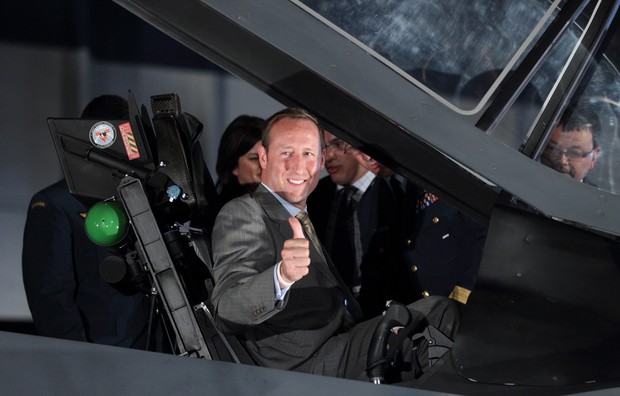
Here's the week in news for the poor F-35 Joint Strike Fighter, Harper-MacKay's  pride and joy, and what a week it's been.

---

Nat Po's Michael Den Tandt has a telling assessment suggesting that the F-35 project is unravelling.

“It just seems like it’s slowly unravelling,” said an industry insider who specializes in aircraft procurement. “It’s a mess.”

 Peter MacKay has doggedly championed the Royal Canadian Air Force plan to purchase 65 “fifth-generation” Lockheed Martin Lightning stealth fighters to replace Canada’s aging fleet of CF-18s. Last week MacKay sought, with only limited success, to deflect reports that the first batch of planes built by Lockheed will be incapable of communicating in Canada’s far North.

...As other members of the international F-35 consortium — including Turkey, the Netherlands, Norway, Israel and Australia have either delayed or curtailed expectations of the number of planes they will buy, price estimates have skyrocketed. But even the latest figures are just educated guesses.

---

Meanwhile the F-35's prime customer, the Pentagon, is launching a pricing war with Lockheed that, if the military prevails, could leave the manufacturer facing a loss on the airplane.

The Defense Department's push to change the terms of its next production contract for the F-35, or Joint Strike Fighter, could expose Lockheed to possible losses in coming years, said consultant Loren Thompson, who has close ties to the company.

"The government wants to radically change its approach to sharing risk on new weapons programs so that all of the exposure is shifted to industry," Thompson said.

Shay Assad, the Pentagon's director of defense pricing, told Reuters in a recent interview that he was braced for resistance from industry to some reforms. "We're going to be breaking some glass here," he said.


---

Australian government officials, concerned that their F-35s won't be available in time, have sent a team to Lockheed to audit the whole F-35 programme.   The audit may lead Australia to defer its order.

---

And even more happy tidings.    


...the Pentagon's weapons testing office is warning that pilot training in the new jets should be delayed for safety reasons.
 
Director of Operational Testing Michael Gilmore, Bloomberg News reports in its subscriber only BGOV news service (not available online at this point), warns that Air Force plans to begin pilot training in November risk a "serious mishap" due to unresolved safety issues.

Gilmore, in an Oct. 21 memo, said there are “serious concerns” with commencing initial training for F-35 pilots as early as November at Eglin Air Force Base.

Gilmore recommended a delay of as much as 10 months to fly the Lockheed Martin Corp. plane 1,500 more hours on top 1,000 already flown at Edwards Air Force Base,  by experienced test pilots.

The F-35 “has not yet met the prerequisites previously set for reducing” air-mission abort rates and “resolving other safety-related issues before initiating training,” Gilmore said in a four-page memo to the department’s top weapons buyer, Frank Kendall.

---

Which may explain why the US Naval Air Station Pensacola, which was to have 29 F-35s by now, has received just four of the aircraft.   The F-35 development programme has the appearance of a dog and pony show, minus the pony.  It's what can happen, and usually does, when you give up the common sense approach of "fly before you buy."

...the F-35 program is five to six years behind schedule. The estimated cost to taxpayers has nearly doubled.

The military will not have combat-ready F-35s to replace 30-year-old warplanes until 2016, if then.
There are numerous reasons for the F-35 debacle, say longtime defense observers, and most of them were predictable: Pentagon officials and military officers cobble together unrealistic goals, timetables and budgets, and defense contractors sign on knowing that once a big program is launched, it's seldom canceled and the money keeps flowing.

"What's happened here is what happens with 90 percent of defense programs," said Tom Christie, retired Pentagon director of operational testing and a battle-scarred veteran of 40-plus years of internal Defense Department weapons-buying conflicts.

...Lockheed has found F-35 development "more challenging and complicated" than predicted, concedes Tom Burbage, executive vice president and general manager.

 ...It wasn't as if the Pentagon, the military and Lockheed couldn't have foreseen big problems.
In October 2001, just days before Pentagon officials were to announce the winner of the F-35 development contract, the watchdog General Accounting Office warned against proceeding with the program, then valued at $200 billion.

Much of the technology needed, the report said, had not yet been developed to the point that the program could be launched without a high risk of major problems, production delays and runaway cost increases.

The GAO and other government agencies had issued similar warnings at least two years earlier. Each time the Pentagon replied that it had the situation under control.

The Pentagon, as it has done historically, has responded to the problems by cutting orders for planes to save money to pay for fixes. That in turn is driving up the future cost per plane for the U.S. and its allies.

As the estimated price of the F-35 has risen, some of the U.S.' partner nations have scaled back their buying plans or are considering doing so. At this point, no partner nation has actually placed an order for production aircraft, although Canada and Australia have said they expect to within a year or two.
Britain, which was once expected to buy 150 F-35Bs, the costly and more complicated version being developed for the Marines, now plans to buy many fewer F-35Cs, the U.S. Navy version. That will drive up the cost of the Marines' version, if it ever gets built.

---

The F-35 is a truly hi-tech fighter but one thing that high-tech always comes with is a serious shelf-life problem.  Hi-tech weaponry is inevitably expensive which usually means sacrificing quantity for quality.  You wind up with fewer of them in the expectation they'll actually be so much more effective that you'll come out ahead compared with the cheaper option.  The term used is "force multiplier."  But it's a big gamble that will turn into a loser eventually.

The history of man is full of high-tech weaponry.   When prehistoric man first figured out how to lash a sharp pointy stone to a sapling, turning a knife into a spear, that was pretty high-tech for its time.  Boiling leather to form it into armour was high-tech for its time.  Gunpowder, muskets, cannon, rifles, machine guns, artillery, heavier than air flight, tanks, rockets, jet engines, nuclear bombs - all were high-tech by turns.   Each was a huge force-multiplier but only for a while, only until rivals figured out how to counter them or copy them.

The F-35 is a mediocre fighter made invisible, sort of invisible.   Once it becomes detectable, however, you're left with a mediocre fighter and, because of its enormous costs, very few of them.  It should still work well enough against backward enemies lacking modern air defence systems but there are far more capable, far less expensive aircraft that can do that job even better.   The F-35 is designed to fight countries that can afford to deploy their own high-tech weaponry, countries that are already developing their own stealth aircraft and the sort of radar that does work quite well against the F-35.   And these potential adversaries know they've got at least five years, probably ten, before they would have to worry about defeating a force of F-35 fighters.

Worse yet, the F-35 is "high-tech brittle" unlike its big stealth brother, the F-22 Raptor.  If the Raptor's stealth advantage is negated it remains an incredibly effective fighter.  It's fast, agile, long-range, survivable and carries a substantial weapons load.   If you negate the F-35's stealth advantage it's far from fast, unmaneuverable,  short range and carries a very modest weapons load.  In air combat against any of the old Russian Sukhoi 30 series fighters, the F-35 would be dead meat.

So what assurance do we have, what manufacturer's warranty will we get, that the F-35's stealth technology will remain effective for ten, twenty or thirty years, the service life we expect from this aircraft?   Shouldn't we get some promise that the F-35 won't be old-tech target practice for at least a decade, maybe even two?

This thing is wrong at so many levels that one wonders what backroom deals keep driving it forward.

Friday, October 28, 2011

Move Along Now - Preparing for Climate Migrants

It's already happening.   Our world is being divided into countries from which people are fleeing and countries to which they're fleeing.   These people doing the fleeing are climate migrants, people forced out of their homelands by impacts such as water shortages, agriculture collapse or sea level rise.

The world's governments and relief agencies need to plan now to resettle millions of people expected to be displaced by climate change, an international panel of experts said on Thursday.

Resettlement related to large infrastructure development projects has been occurring for decades, with some estimates of up to 10 million people a year, said the report's lead author, Alex de Sherbinin.

Planning for millions of refugees will be challenging, but it is vastly better than the alternative, de Sherbinin said by telephone from The Earth Institute at Columbia University in New York.

"Are we just going to respond to the next 911 (emergency) call that comes out, or are we going to actually anticipate some of these things and in so doing hopefully avert the 911 call to some extent and maybe save some money in the process?" he said.

Some countries, such as the United States, face a potential double-whammy of coping with internally displaced Americans needing relocation from drought or inundation areas while simultaneously dealing with massive illegal migration from Central Americans forced out of their homelands.

Der Spiegel Says the "O" Word

Spiegel Online has come right out and asked whether America has been transformed into a true oligarchy?

It's an perfectly legitimate question and the answer is plainly "yes."

"Inequality in America is greater than it has been in almost a century. Those fortunate enough to belong to the 1 percent, made up of the super-rich, stand on one side of the divide; the remaining 99 percent on the other. Even for a country that has always accepted opposite extremes as part of its identity, the chasm has simply grown too vast.

Those who succeed in the US are congratulated rather than berated. Resenting other people's wealth is viewed as supporting class struggle, which is something very frowned upon.

Still, statistics indicate that the growing disparity is genuinely overwhelming. In fact, the 400 wealthiest Americans now own more than the "lower" 150 million Americans put together.

Nearly two-thirds of net private assets are concentrated in the hands of 5 percent of Americans. In comparison, the upper 5 percent of Germany hold less than half of net assets. In 2009 alone, at the same time as the US was being convulsed by mass layoffs, the number of millionaires in the country skyrocketed.

Indeed, if you look at the reports it compiles on every country in the world, even the CIA has concluded that wealth disparity is greater in the US than in Tunisia or Egypt.

...The major economic expansion under President Ronald Reagan benefited only a few, and the problem only grew worse under George W. Bush.

At least since the beginning of the millennium, it has no longer been a simple matter of two societal extremes drifting further apart. Instead, the development is also accelerating. In the years of economic g.rowth between 2002 and 2007, 65 percent of the income gains went to the top 1 percent of taxpayers. Likewise, although the productivity of the US economy has increased considerably since the beginning of the millennium, most Americans haven't benefited from it, with average annual incomes falling by more than 10 percent, to $49,909 (€35,184).

...Indeed, as [political scientists Jacob] Hacker and [Paul] Pierson see it, the United States has developed into a "winner-take-all economy."

The political scientists analyzed statistics and studies concerning income development and other economic data from the last decades. They conclude that: "A generation ago, the United States was a recognizable, if somewhat more unequal, member of the cluster of affluent democracies known as mixed economies, where fast growth was widely shared. No more. Since around 1980, we have drifted away from that mixed-economy cluster, and traveled a considerable distance toward another: the capitalist oligarchies, like Brazil, Mexico, and Russia, with their much greater concentration of economic bounty."

...Larry Bartels, one of America's leading political scientists, also believes America has entered a new Gilded Age. Bartels' 2008 book on the subject, "Unequal Democracy: The Political Economy of the New Gilded Age," has drawn a great deal of attention and even been quoted by President Barack Obama.


"The really dramatic economic gains over the past 30 years have been concentrated among the extremely rich," Bartels writes, "largely bypassing even the vast majority of ordinary rich people in the top 5 percent of income distribution." He doesn't see this fundamental shift in the distribution of wealth as having resulted from market forces or drastic events, such as the financial crisis. Instead, he believes they are "the result of policy choices." 

...recent research indicates that the economies of countries experiencing periods of pronounced inequality often show considerably less growth and more instability. On the other hand, it also finds that economies grow faster when income is more evenly distributed.

In a study published in September, the International Monetary Fund (IMF) also concluded that: "The recent global economic crisis, with its roots in US financial markets, may have resulted, in part at least, from the increase in inequality" in the country.

...Differences between rich and poor are tolerated as long as the rags-to-riches story of the dishwasher-turned-millionaire remains theoretically possible. But studies show that increasing inequality and political control concentrated in the hands of the wealthy elite have drastically reduced economic mobility and that the US has long since fallen far behind Europe on this issue. Indeed, only 4 percent of less-well-off Americans ever successfully make the leap into the upper-middle class.

It is disgraceful - disgraceful and telling - that the Liberal Party has avoided tackling Canada's income inequality head on.   Between the inequality problem and the LPC's rank ambivalence to tackling climate change the party and its leadership just keep showing how far it has fallen since it was last fit to govern Canada.

Criminalizing Pot Only Breeds Criminals

Well, Duh!  A new report entitled "Breaking the Silence" says that the current criminalization of marijuana only supports organized crime.   In other words, Steve Harper supports organized crime.


Stop the Violence B.C., which comprises dozens of police officials, doctors, university professors, legal experts and more, released a report today titled Breaking the Silence, which aims to show that marijuana prohibition, while well intentioned, has been ineffective — and, in fact, has adverse effects.

“There’s a huge problem that nobody, particularly political and other leaders in B.C., is talking about, and that is the link between cannabis prohibition and organized crime,” said Dr. Evan Wood, a coalition member and director of urban health research initiative at the BC Centre for Excellence in HIV/AIDS.

“The gang warfare that’s playing out on our streets is a natural consequence of cannabis prohibition.”
 
...The report also cites a 2009 Health Canada survey which estimated there to be “well over 430,000 cannabis users” in B.C., while the number of heroin and cocaine users is only a fraction of the size. This accounts for the high profit margins for marijuana in B.C. and explains why prohibition “has made such a key financial contribution to the growth of organized crime in this province,” the report notes.

Steve's answer, of course, is to build more prisons so that pot growers can be housed at taxpayer expense, making room thereby for successors to take over their lucrative trade.  What an ideological idiot.

7 Billion Reasons to Wake Up

7-billion but who's counting?   Apparently a lot of people are counting including the environmental desk of The Guardian a.k.a. Monbiot & Co.   They've taken the occasion of humanity passing the 7-billion threshold to publish a bevy of articles on the state of the planet going onward to 9-billion, possibly more.

Monbiot argues that population is really just the sideshow.  It's not so much how many mouths we have to feed as the massive amounts a lot of those mouths are consuming.

"...In 2009 for example, a group of US billionaires met to decide which threat to the planet most urgently required their attention. Who'd have guessed? These men, who probably each consume as many of the world's resources in half an hour as the average African consumes in a lifetime, decided that it was population.  

Population is the issue you blame if you can't admit to your own impacts: it's not us consuming, it's those brown people reproducing. It seems to be a reliable rule of environmental politics that the richer you are, the more likely you are to place population growth close to the top of the list of crimes against the planet.

The new report, inflated though its figures seem to be, will gravely disappoint the population obsessives. It cites Paul Murtaugh of Oregon State University, whose research shows that:
"An extra child born today in the United States, would, down the generations, produce an eventual carbon footprint seven times that of an extra child in China, 55 times that of an Indian child or 86 times that of a Nigerian child."

And, if you were born after 1952, The Guardian has a neat calculator that figures out the size of the global population when you were born.

Of course you can't discuss population without considering the youth who'll have to live with what's coming.    A recent United Nations study shows that tough sledding lies ahead for this 1.8-billion whose potential will be lost to a lack of infrastructure, education and jobs.

Contributor Andrew Simms offers insights into Occupy London:

"Oddly, the era of modern, triumphal, deregulated finance was much shorter than the lifespan of its apparent antithesis, the old Soviet Union. Here were two systems, very different, yet equally centralising of power and privilege, and arrogantly certain of their own mission. Both, also, left an awful mess behind.

Twenty five years on from the "big bang" in the City of London we can survey how the period of great deference to finance reshaped our landscape. Consequences are everywhere in the results of an economic scorched earth policy, still unfolding in business failures, instability, unemployment, loss of public services and recession.

But as well as the way in which untethered finance fuelled expansion and divergence in the global economy, it equally re-engineered society and the environment. Alongside the financial explosion have been others in debt-driven over-consumption, greenhouse gas emissions and inequality. New Scientist magazine last week reported that "our current emissions trajectory is close to the worst case scenario of the intergovernmental panel on climate change".

...Just as finance loosed its moorings from the real economy, the economy has loosed its moorings from the real world. The other great destabilisation over the last quarter of a century has been the growth of inequality. In the large majority of OECD countries inequality rose from the 1980s. Inequality matters, pushing up a wide range of social costs, weakening the social fabric and producing less convivial places to live. While things have been bad in English-speaking countries such as the United Kingdom and United States, the negative trend has caught up with traditionally more equal countries such as Denmark, Germany and Sweden.

...As nature abhors a vacuum so, it seems, does culture and politics. The Occupy movement has, almost by accident, taken on the role of self- and public education about the financial system. Here are unpaid amateurs attempting a necessary critique of finance that paid professionals woefully failed to provide. And, of course, they are being damned for doing so.


...It's fashionable to say that the protesters' demands are too broad and vague. Yet, what they are achieving is to reclaim a public realm for debate and engagement, one that the privileges given to finance have done so much to destroy. If nothing else, practising a different kind of politics and calling for finance to be made subservient to useful social, economic and environmental purposes, to make things better rather than worse, is enough for one demonstration."

Thursday, October 20, 2011

Muammar Ain't No Mar

Former, as in "dead", Libyan dictator Muammar Gaddafi is no more.   Libyan authorities report the man who ruled their country for 42-years was shot and killed today.

How he died isn't clear.   Some reports claim he was making a breakout in a convoy that was attacked by NATO strike fighters.   By other accounts Gaddafi was taken alive and was later shot, sort of like Mussolini I suppose.

Tuesday, October 18, 2011

Putting a Price on Environmental Vulnerabilities

If a nation's economy is heavily dependent on imported resources that are in increasingly short supply, should this be factored into that country's credit rating?   It seems to follow that the more dependent an economy on limited resources the more vulnerable that economy would be to disruptions or reductions in supply or price instability.

Could an abundance of natural wealth be a factor in positively influencing a country's credit rating and the quality of its bonds? Could a resource-guzzling economy be cause for a downgrade?


The UN Environment Programme Finance Initiative (UNEP FI) in collaboration with Global Footprint Network and leading financial institutions will endeavor to shine a light on these questions with a groundbreaking project to explore the role of natural resource accounting in strengthening risk models for government bonds. The project seeks to incorporate how much natural wealth countries have and how much they spend into assessments of long-term credit risk.

 "The global financial crisis has taught us more than anything that some of the core risks that affect the value of debt securities and derivatives can simply run ahead of our ability to understand them," said Paul Clements-Hunt, Head of UNEP FI. This is why we must deepen our understanding of the risks posed by climate change, water scarcity and the overuse of natural resources for securities. We should not be caught off-guard again. This project is one of the first that tries to quantitatively and systematically consider the linkages between the use of natural resources and its impact on a country's core economic indicators that in turn influence the quality of its bonds.

The study raises important and overlooked questions that go to the environmental stability of many leading countries including the United States and the emerging economic superpowers of China, India, Russia and Brazil.  We're only beginning to grasp the havoc their economies will face from already unpreventable climate change, from their precarious and unsustainable water resources and from the rising global demand for other scarce resources, including food.

Hey Liberals - Lick Your Finger, Stick It Up In the Air, Way Up

There was a time you didn't have to tell a Liberal how to read the winds of change.   Of course that was before they (were) moved from Sussex Drive to Stornoway to Motel 6.

Change, however, is very much in the air whether it's in the Middle East, Europe or even the United States.

The Right is losing its grip.  An entire generation, more even, is saying "enough" and demanding their own New Deal.   They've seen what the Right pulled on their parents and grandparents ever since that half-wit president and his handlers took over three decades back.   They've witnessed the massive, unearned transfer of wealth, security and dignity from the working classes to the new aristocracy and their corporate masters.   The usurpers stole their wealth, stripped their political power, pilfered their jobs and pensions - but did they also have to make off with their dignity to boot?

To those who foresaw the Occupy Wall Street movement the surprise isn't that it happened but that it took so long to show up.   This was "Casting Bones and Reading Entrails 101, a beginner's introduction to making sense of the obvious."   Hell, the signs were all there, everywhere.   Environmental calamity, concentration of wealth, class suffocation and the dismembering of opportunity, the unfettered rise of corporatism and the financialization of economies.  You had to hold your nose to avoid the putrid stench of decaying society.

And what were the Libs doing all this time?  Why they were giddily traipsing behind their own Pied Piper, Iggy the Impossible, as he led them out into the deserts of the Right in pursuit of Stinky Steve Harper.   They Z-Igged when they should have zagged only to discover that the Canadian voting public wasn't willing to follow them, wasn't interested in a Conservative-Lite option.   Ignatieff and his Ontario cabal of handlers sucked what fragile life remained straight out of the Liberal Party.

And now?  Who knows?  Even under the leadership of Rae the party languishes, drifting along dispirited and irrelevant, waiting and hoping for a new Messiah to replace the last failed Messiah.  Rubbish.  What would any truly first-rate leader want with this atrophied, impotent relic of a political party?  What remains worth salvaging?

Oh, but what about the namesake, the Liberal Party's own Gandhi?  Please.  Of the great Pierre's three sons, the one who alone might possibly have emulated his father rests at the bottom of a very deep and cold mountain lake.  No, look elsewhere if you want the voting public to somehow again take your party seriously.

But, perhaps, the Liberal Party needs a fresh coat of paint if it is to attract the leadership it so sorely needs.  A fresh coat of paint in the form of a rededication, fresh and bold principles and policies that speak to these urgent times.   Dedicate the party to environmental remediation and adaptation.  Commit to social equality and fairness.   Restore media diversity and freedom.  Restate the limits of corporate influence and power and harness them to the service of the nation and people.  Reclaim Canada for Canadians.

A time of struggle and change is upon us.   Great challenges lie ahead.   The Liberal Party risks being overtaken and buried beneath these events.   Tomorrow is no longer an option.  It's sink or swim.

Monday, October 17, 2011

Around the World, People Losing Trust in Their Leaders

See, we're not alone.   Sure we don't trust Steve Harper but people in many other countries are coming to distrust their leaders too.  It's this loss of faith and overwhelming discontent that's fueling everything from food price protests to austerity riots to the OWS movement.

UN Sec-Gen Ban Ki-Moon was blunt in addressing the opening session of the Inter-Parliamentary Union.  "It's a deficit of trust.  People are losing trust in governments and institutions to do the right things.”

Ban added that “the time for haggling over incremental steps is over” within the Group of 20 rich and developing nations, which he said now “must shoulder their full share of responsibility” — for the crisis.

Echoing that sentiment was IPU President Theo-Ben Gurirab of Namibia, who said “everywhere we look we see people suffering from a crisis and mismanagement which is not of their making.”

In a warning that should be taken to heart by the likes of 'Spuds' O'Flaherty and 'Stinky' Harper, Ban alluded to the seismic shift in political power already underway from obsolete, 20th century leaders to a new generation of young people.

“It is no exaggeration to say they have changed the world today. We used to say that we are the leaders of today and they are the leaders of tomorrow. But now it has changed. They have become the leaders of today, already.  Let us listen to them.”

Saturday, October 15, 2011

Will the Anchor Hold?


With each passing day the Occupy Wall Street movement, in New York and elsewhere, grows more resilient.  It shows itself to be more than a mere protest, the standard venting over one egregious malady or another, but rather a rejection of an entire rotten deal that Western governments have wrought for their young people and those to follow.

We shouldn't be surprised that the OWS movement has sprung up.  We should be surprised that it's taken this long, that the deal had to get this rotten before it sparked a truly broadbased dissent.

Throughout much of the world, national governments are broken, defective, dysfunctional.   It's as blatant as a plague pustule in Washington.  It's somewhat less obvious in Ottawa but it's there.

What is the prime directive of any democratic national government but to protect the welfare of its people and the country?   Isn't that implicit in universal suffrage?  How, then, did our governments veer so far into corporatism to the detriment of our democracy?

Corporatist government is inherently undemocratic as it places corporate interests, capital, above the interests of the public often using the most astonishing fabrications to blur the distinction, to supposedly merge the irreconcilable.   Corporatism in a democratic state is wilful dereliction of duty and a wanton abuse of power.   It strikes me that the essence of Occupy Wall Street is to dismember the fabrications that prop up corporatism in the guise of democracy so that it can be exposed for what it is, denounced and expelled.

A telltale sign that a democratic government has turned corporatist is in the emergence of leadership vacuums.   These arise when our leaders, choosing instead to be our rulers, determine not to exercise the authority, powers and resources we vest in them to protect the interests of the people and the country.  When this occurs it's invariably related to a conflict between the interests of the people and country and competing interests such as those of an oligarchy or corporatist movement.

And just what leadership vacuums exist in Ottawa?  Where to begin?  Two obvious examples are climate change and wealth inequality.   More and more wealth is concentrating in the hands of an ever richer elite who, conveniently, are almost uniformly opposed to any effective government action on climate change.  The link exists and it's as powerful as it is obvious.

I became The Disaffected Lib when I watched as the Liberal Party leadership played Quisling to Harper's drive to shift Canada's political centre far to the right.   My disaffection turned to anger as I saw the party of Laurier, St. Laurent, Pearson and Trudeau go utterly flaccid on the dangers of the day - climate change and inequality.  "Funding for the arts" and "daycare"?  Go f__k yourselves!

One lesson I have drawn from watching Occupy Wall Street is that we're saddled with a political class that's obsolete.  If the OWS people tell us anything it just might be that we're witnessing what could turn into a mass extinction of our conventional politicos.

These, our supposed leaders, are of a different time and they're incapable of evolving to survive the rapidly changing events that are overtaking them - and us.   They have no answers for us, no guidance, no vision.  The engines are still churning but we're rudderless in a sea of shoals.

How can one tell they're obsolete?   That's actually quite easy.   All you need to do is look at the future leaders.  They're people not already invested in the existing, sputtering machine.  They can see politics for what it is and they don't hesitate to point out what needs fixing.   They're not radical.  Compared to the existing bunch with their heads buried in the sands of convenience and narrow self-interest, these future leaders are infinitely rational.  Unlike the existing leadership, the future leaders want to fix what's broken, to salvage what can still be reclaimed.  They want to do these things because they know how much hangs in the balance for their generation and those to follow if they fail.   They are not of us.  We have seen to that.

I've seen their faces, some of them at least.   They're part of a movement that toppled Mubarak, revolted in the streets of Athens and Madrid and now occupies Wall Street.  The future leader our country, our world, needs will be cut from that cloth.

Why do I think the OWS will prevail where so many others have failed?  Because this movement is so well anchored by the dual scourges of inequality and climate change.   These are two malignancies that the movement's adversaries create and nurture and have absolutely no interest in treating.  They're not going away, either of them.   All the movement need do to win is persevere until its adversaries inevitably have to own the diseases of their own making.

Skepticism on our part is natural.  It is only when you get really close into this movement that you can appreciate that it is inevitable and really unstoppable.  It is the only vehicle that even attempts to respond to what vexes our youth and what threatens to make their future unlivable.   This is not to say that the immediate effort will overturn the world order.  That will take some time and follow a path that is not by any means predictable.  

The OWS movement is probably just a early step in a process as essential to life as breathing.  It is a process rooted in a struggle to break the mantle on which a mountain of inequality has been built even at the cost of the health of the environment itself and the mutilated future of millions, probably billions of people around the world.  It is a struggle not of their own making but from which neither is there any safe withdrawal.   This can't be turned off and it won't.

Monday, October 10, 2011

Harper's War on Universal Human Rights Continues

It's Air Canada again.  This time it's the 6,800 flight attendants who have voted down an offer from the airline and will be in a legal strike position on Thursday.

It wasn't long after the flight attendants' Sunday vote that a spokesperson for LabourMin Lisa Raitt began sending out e-mails warning the Harper government won't tolerate a lengthy work stoppage.

"We will be clear that a work stoppage is unacceptable in this time of fragile economy," said Ashley Kelehear in the email.


About 65 per cent of employees who cast a ballot voted against the contract.

Raitt made it clear during the negotiation process that she was ready and willing to introduce back-to-work legislation if the two sides were unable to make a deal by the deadline.

She even had the legislation prepared ahead of time, though it was never used because the negotiators managed to settle on an agreement just hours before the deadline was reached.

Now that members have rejected that deal, Raitt will likely bring back the legislation if employees walk off the job.

That is Harper's notion of collective bargaining.   Before negotiations even conclude the government loads a "back to work" round in the chamber.  And it's all done on the flimsy claim that a strike by flight attendants would cripple the fragile Canadian economy.   Couldn't they at least have said the cabin crews were concealing WMDs?  But that's what happens when you have authoritarian rule.  They don't even try to lie convincingly.
And there's a clear pattern here.  Harper will not abide strike action in sectors falling under federal jurisdiction.  And by repeatedly and consistently siding on behalf of employers against labour, Harper is flagrantly violating the Universal Declaration of Human Rights under which Canada, as a signatory, guarantees the right to collective bargaining.   Apparently being a human rights violator doesn't cut much ice with lardass Steve.

Sunday, October 09, 2011

It's the Sound of Cracking Ice


Growing up in Ontario back when it used to have winters, young boys gravitated to frozen ponds, streams and lakes.  We'd skate or play hockey or sometimes just marvel at walking across expanses of frozen water.   One sound that instantly commanded everyone's attention was the sharp crack that signified shifting, perhaps even breaking ice.

I think I'm hearing that sharp cracking sound again.  The truth is I've been expecting it, wondering "when" not "if."   This time it's not ice that's cracking but complacency and submission and acquiescence.   What is breaking is the mantle on which a mountain of inequality has been built even at the cost of the health of the environment itself and the mutilated future of millions, probably billions of people around the world.

I knew the moment would come, it had to.  It is absolutely inevitable.   It is the hellspawn that emerges from the incestuous coupling of the unstoppable and the unsustainable.   This is the candle fiercely ablaze from both ends.

What has been puzzling has been our refusal to see this coming.   We seemingly sought security where none was to be found by compelling ourselves to look the other way.   We opted for a false sense of security rather than reach for the real thing.

This sound we're hearing even comes with its own awkward name, "Occupy Wall Street."  OWS, as pointed out by Naomi Klein and others, isn't really a protest but something far greater - it's a movement that seeks not merely to object but to demand change, a new order, new values and rules to serve mankind in the 21st century, not to defy the 21st century.

This may sound like a mighty bold prediction, a real longshot, but it's not.   What is beginning is a process as essential to life as breathing.  If we as a civilization are to keep breathing we have no choice but to abandon 18th century economics, 19th century industrialism and 20th century geopolitics, the very models that have propelled us to the edge of this abyss.

We need new models crafted to adapt to reality.   The first of these, the governing reality is that we live on a finite planet within a very finite biosphere.   The second reality is that whatever economic, political and social models we devise must operate sustainably within the scope of the governing reality.   This is not revolutionary, merely rational.

We can no longer rev our economic engine past the red line.   That engine is about to blow.   We need to replace the component we removed to go faster - posterity.   We need posterity - regard for the future, for generations yet unborn - we need it badly and we need to give it priority in our policy decision making.   Posterity is the governor that keeps the engine from destructively over-revving.  If your priority is to provide for the future as well as the present, you ratchet back the throttle.

To abuse a line from Mackenzie King, revolution if necessary but not necessarily revolution.  Indeed, as we're already seeing in the Arab world and elsewhere, the 21st is already emerging as the Century of Revolution.   Canada is not Tunisia or Syria or even the United States.  If we are wise, if we make the right decisions, if we act in time, this troubling century will go far easier on us than just about any other place on earth.  If we turn our back on change, if we yield the initiative and dig in our heels, this century could be much harder on us and those who will follow.

Saturday, October 08, 2011

For Sale - Army Surplus

For sale.   Infantry helmet.  Only four previous owners, one surviving.  Fair condition.   Some wear & tear.  Original paint.   Custom ventilation.

The Sun Will Rise and Set in Afghanistan

Of course it will and, as surely as Afghanistan will see another rising and setting sun, so too will it see the resumption of its long-running and unresolved civil war when Western babysitters head home in 2014.

The Guardian reports that a British military assessment soon to be released warns that civil war or an outright Taliban takeover could follow NATO's 2014 withdrawal. 

With three years to go until Afghan security forces are supposed to fight the insurgency without the help of foreign combat troops, the Afghanistan review will portray a country in turmoil. Last year's 30,000-strong US troop surge and new counterinsurgency tactics have pushed the Taliban out of much of the territory it controlled a year ago, but with the widespread use of improvised mines and roadside bombs, as well as a campaign of assassinations, the insurgents have sought to paralyse the Kabul government and hinder western-backed development.

President Hamid Karzai's administration remains weak and corrupt, reliant on a loose coalition of warlords. The country's biggest bank has been crippled by rampant embezzlement, and there have been a string of assassinations of high-profile Karzai allies

 "Anyone who is following the situation in Afghanistan is worried. A civil war is a real possibility," said Martine van Bijlert of the Kabul-based Afghanistan Analysts Network.

"There is a real feeling of instability, that the future is unsure. People don't know who are their friends and enemies. So they try to make themselves ready for any eventuality, positioning themselves politically and worrying about how strong they are. People are falling back on old networks and old loyalties."

Perhaps Afghanistan has finally outgrown its skin.  Its ethnic groups - Pashtun, Baloch, Tajik, Uzbek, Hazara, Turkmen and others - may be irreconcilable except when absorbed into temporary alliances against other Afghan groups.   And, within those ethnic groups, exists a web of warlords themselves often in conflict over tribal control.

No Muslim country has ever survived as a modern nation-state without overcoming warlordism and tribalism both of which are powerfully entrenched in today's Afghanistan.  In this reality it's only natural, inevitable, that "people don't know who are their friends and enemies."   Afghan warlords have a long and rich history of treachery.  It's claimed that, at one time or another, each warlord has been an ally and a foe of every other.   How is one supposed to know his friends from his enemies when they're interchangeable.

The British analysis posits another path, one that's rarely mentioned and potentially far more explosive - a Taliban takeover of the Pashtun homeland that spans both Afghanistan and Pakistan.   This would result in a great loss of Pakistani territory and would probably instigate a similar gambit by the already rebellious Balochs.  It could leave both Afghanistan and Pakistan mortally destabilized.   This map reveals the dimensions of an independent Pashtunistan and Balochistan.


The red line is the Durand Line, the prescribed border between Afghanistan and Pakistan.  The territory shown in green is the Pashtun homeland while that in pink is the Baloch territory.  As can be seen, the Pashtun and Baloch territories constitute about half of Pakistan.   Worse still, the Baloch region of southern Pakistan contains most of that country's mineral wealth.

It is only when you see the potential for upheaval confronting Islamabad that you can begin to grasp Pakistan's duplicity in the country's dealings with Washington and NATO.   Our interests and theirs are anything but coterminous.  For us to prevail in Afghanistan would require a seamless geo-political entity combining Afghanistan and Pakistan.  That doesn't exist and it's safe to assume it never will.  Just as Afghanistan accommodates both tribalism and warlordism, these same realities constantly threaten to undermine Pakistan, something that's well understood by Pakistan's rival, India.

Wheels spinning within wheels.

Friday, October 07, 2011

Do Stock Brokerages Have the Right to Kill?

Why do big investment houses have the right to speculate in ways that can lead to death?  Speculation in food, in water.   While there are fortunes to be had in creating bottlenecks that restrict access to the very things people cannot survive without do nations and leaders have a moral right or duty to suppress this sort of perfidy?

A study released last week by Cornell University reveals that the relatively recent scourge of food insecurity manifested in substantial food price hikes is mainly the result of investor speculation and ethanol conversion.

"...The two sharp peaks in 2007/2008 and 2010/2011 are specifically due to investor speculation, while an underlying upward trend is due to increasing demand from ethanol conversion. The model includes investor trend following as well as shifting between commodities, equities and bonds to take advantage of increased expected returns. Claims that speculators cannot influence grain prices are shown to be invalid by direct analysis of price setting practices of granaries. Both causes of price increase, speculative investment and ethanol conversion, are promoted by recent regulatory changes---deregulation of the commodity markets, and policies promoting the conversion of corn to ethanol. Rapid action is needed to reduce the impacts of the price increases on global hunger."

If nothing else, it's high time we were honest with ourselves.  Our 21st century concept of deregulated market capitalism is entirely accommodating of practices that inflict suffering, even death on the most vulnerable for the sake of nothing more than maximizing investor profits.  And let's be honest enough to understand that these greed-driven practices will eventually spark retribution on us.

We Need to Talk Turkey in the Muslim World

There was a time we expected Turkey to grovel for a place at the table with the Big Boys.   We were willing to consider allowing our only Muslim NATO ally into the European Union but only once it showed itself a deserving supplicant.   That was then.   This is now.   Behold what may be the rebirth of the Ottomans.

Amid revolt and revolution, the Prime Minister, Recep Tayyip Erdogan, and his country are lionised across the region as Islamic and democratic role models in post-dictator Libya, Egypt and Tunisia; and, perhaps, even in Syria.

The essential ingredients in all of this are Erdogan's propensity to speak his mind and Turkey's modern success - a secular democracy in which a modern, moderate Islamist party presides over a surging economy, which is the world's 17th biggest.

'You can't imagine the popularity, after decades of seeing Turkey as atheist, anti-Islamic, anti-Arab, the friend of Israel that abolished the caliphate,'' a senior Egyptian official told the International Crisis Group. ''Suddenly we see a new Turkey - the Arab street is not only fascinated by Erdogan, but by the phenomenon of Turkey.''

Turkey quickly [took advantage] advantage of what [foreign minister Ahmet] Davutoglu describes as Turkey's ''psychological affinity'' with much of the Arab world, to offer itself as the right model for Islamic countries in transition to democracy and, at the same time, seeking sufficient economic horsepower to generate the jobs of the future.

The magical mix of Davutoglu's strategic logic and what one Turkish commentator describes as Erdogan's ''animal-like political intuition'' were on display during a tour of Egypt, Tunisia and Libya last month by Erdogan, Davutoglu and 280 Turkish businessmen, who, on a single day in Cairo, reportedly signed deals worth $1 billion.

Feted like a rock star, the Turkish prime minister offered himself as a proud Muslim and democrat who was firmly on the side of the region's revolutions and that of the Palestinians in their struggle with Israel.

As American hegemony in the Muslim world wanes and the influence of other outsiders, notably China, increases, the West may need to reboot its relationship with Turkey and sooner rather than later.  Courting Turkey now may come at a price we would never have considered paying before, including some rationalization of our obsessive support of Israel, but in the long run it may be a small price to pay.

For Europeans - Poverty and Climate Change Greatest Threats to Mankind

Europeans are awash in economic disaster yet they see the greatest threats their world faces as poverty and climate change.

The Eurobarometer poll (pdf) found that the majority of the public in the European Union consider global warming to be one of the world's most serious problems, with one-fifth saying it is the single most serious problem.

Overall, respondents said climate change was the second most serious issue facing the world, after poverty.

Connie Hedegaard, European climate commissioner, said: "This is encouraging news. The survey shows that the citizens of Europe can see that economic challenges are not the only ones we face. A clear majority of Europeans expect their politicians and business leaders to address the serious climate challenge now."

She said it was "striking" that the public were even more concerned about climate change than in the run-up to the landmark Copenhagen summit on climate change in late 2009.

Yet here in the emerging petro-state formerly known as Canada, politicians of all stripes have managed to lull our population into what now is a virtual climate change coma.   Public awareness of climate change is crucial to any meaningful action - and they know it, the lot of them.   No matter what it means to today's Canadian young people and the generations that will follow them, it's not good politics to stand on the issue and so they don't.   Liberal, NDP are hardly better than the Tories.   They may have lost their legislative powers but even Harper can't rob them of their voices yet they're mute.

The West's "Frighteningly Simplistic" Afghan Adventure

It's a solemn 10th anniversary for Western gunplay in Afghanistan.   I'll call it gunplay instead of "war" because wars are normally fought to win and we've never been fighting to win in Afghanistan, instead we've passed the time mostly banging away on the same old drum.   Hint - that's why we've gotten nowhere (or worse).

On the 10th anniversary controversial former general Stan McChrystal, the American Thor who was supposed to mop the floor with the Talibs, said the US began the war with a "frighteningly simplistic" grasp of what it was getting itself in to.

"We didn't know enough and we still don't know enough. Most of us, me included, had a very superficial understanding of the situation and history, and we had a frighteningly simplistic view of recent history, the last 50 years."

Wait a minute.  Stan the Man admitting even he had a "very superficial understanding of the situation"? And he was supposed to be the guy who was clued in, the Pentagon's own warlock.   And if Stan couldn't find his counterinsurgency ass with both hands, what about his boss Petraeus?   And if those two were so astonishingly inept, what about Canada's own self-made Patton, now safely-retired Rick "Big Cod" Hillier?   Remember when he assured us that Canada's Kandahar Caper was a trice, a matter of merely killing "a few dozen ...scumbags"?  Remember?

No, the Afghan War, as it stands on its 10th anniversary, represents the culmination of a decade of inept political and military leadership.  It is the adventure for which the term FUBAR was conceived.

Like the drowning man desperately clutching the briefcase full of gold bars, America can't let go of the prospective riches of the Caspian Basin oil and gas reserves that control of Afghanistan promises.  It can't let go.  It can't.  And so it continues to fight a war that can only be won, if it can be won at all, in a different and hostile country where it cannot dare fight beyond periodic drone attacks.   And, as America flails about and begins heading to the bottom, the spectators line up along the beach to watch and wait - Afghani, Pakistani, Talib, Chinese, Russian, Iranian, Indian, Saudi and more.

And, in case you think this assessment ill-informed or unreliable, why not listen to the take on the Afghan frolic of top German general Herald Kujat who is declaring the mission a failure.

"The mission fulfilled the political aim of showing solidarity with the United States," Kujat told the German daily Mitteldeutsche Zeitung. "But if you measure progress against the goal of stabilizing a country and a region, then the mission has failed."
Kujat, however, thinks the West might have prevailed if only it treated the mission as a "military battle" rather than a stabilization mission.   That might have been accurate for the German effort in the north but, in the south, the US and ISAF very much waged a military war just as the Soviets waged a military war before them and with about the same results.

Kujat is right for the wrong reasons.   He's right in admitting that "the mission has failed."   He's wrong, dead wrong, about why.   The mission failed because we fought a military war against an insurgency that always wages political war, not military war.   Insurgents don't have tanks, artillery, helicopters and jet fighters.   They can't engage in military war without accepting swift extermination.  Instead they wage a type of war that Kujat, Hillier, McChrystal can't seem to grasp.

In July of last year, the Pentagon's own think tank, the RAND Corporation issued an analysis of our Afghan war and why it was conclusively doomed to fail.   Not surprisingly, the RAND assessment is an indictment of our incompetence and the flawed thinking of our military and political leadership.

Meanwhile Afghan prez Hamid Karzai has "vowed" he'll step down in 2014.  By sheer coincidence Hamid has picked the very same year most of the West's forces will be leaving town.  Wow, what a fluke.

Wednesday, October 05, 2011

Steve, You've Got Mail. Stop Being Such a G__damned Socialist!

Dear Exalted Ruler, you have mail from the OECD and the IEA.   They want you and other world leaders to cut out the billions of dollars you waste each year on fossil fuel subsidies.  Yes, your Grace, that means the Tar Sands too.

The Organization for Economic Cooperation and Development and the International Energy Agency Tuesday urged governments world-wide to cut billions of dollars in fossil-fuel subsidies, arguing the rollbacks would bolster sagging government budgets while cutting wasteful energy use and carbon emissions.
 
A group of 24 industrialized countries now spends $45 billion to $75 billion annually on more than 250 support measures to producers and consumers, according to a report released Tuesday by the OECD.The estimated price tag is even bigger for emerging countries: A group of 37 mostly developing countries studied by the IEA spent $409 billion in 2010 on fossil-fuel-consumption subsidies, according to IEA data.

And by subsidies, your Magesty, we must include all the free freshwater we let Big Oil take.   As you may know, Canada is one of the few places around the world that continues to treat this sort of water as free.   Put a realistic fair market value on that natural treasure and send Big Oil an invoice.

It's high time to stomp out this sort of socialist gladhanding, don't you think Steve?

Tuesday, October 04, 2011

The Older I Get, The Less I Like Old People


"Most men die at 27, we just bury them at 72"
- Mark Twain

It's interesting living in the human equivalent of the fabled "elephant graveyard."  My town is a place where the climate is, by any Canadian standard, idyllic.  It's as though there was a by-law prohibiting extreme weather, cold or hot.   Places like mine are magnets for the geriatric set and not just my fellow British Columbians either.  Geezers from Saskatchewan, geezers from Ontario and the dreaded Alberta geezers descend on us in swarms like locusts.  Unfortunately they bring their half-assed ways and attitudes with them.  Stephen Harper thanks them for that.

The trouble with old people is their insatiable urge to remake the very world they're so soon to depart.  Can there be a greater conceit in human nature than for those nearing the close of life to demand that it be restored as it was when they found it?

Recently our community paper printed letters advocating the reinstatement of our schools of the Lord's Prayer and the daily singing of both "Oh Canada" and "God Save the Queen."   They wanted public education reset to what they recalled as the good old days.

The Lord's Prayer, really?   Surely the religious youth is not so lacking in opportunity to recite that mantra that they need another chance, this time out loud at school.   But these crotchety old farts aren't worried about the religious youth.   Rather they're after the kids who don't recite their prayer enough or at all for whatever reason.

Societies change, civilizations evolve.   We should still be living in sod huts with hard packed dirt floors if every generation of old fogies was allowed to reset society to the backward state in which, in their own youth, they had found it.

Screw old people.

Sunday, October 02, 2011

The Wisdom of the Great - Abraham Lincoln

If I were two-faced, would I be wearing this one?

Labor is prior to, and independent of, capital. Capital is only the fruit of labor, and could never have existed if labor had not first existed. Labor is the superior of capital, and deserves much the higher consideration.  


Allow the president to invade a neighboring nation, whenever he shall deem it necessary to repel an invasion, and you allow him to do so whenever he may choose to say he deems it necessary for such a purpose - and you allow him to make war at pleasure.

The probability that we may fail in the struggle ought not to deter us from the support of a cause we believe to be just.
 
Be sure you put your feet in the right place, then stand firm.  


Am I not destroying my enemies when I make friends of them?

I am a firm believer in the people. If given the truth, they can be depended upon to meet any national crisis. The great point is to bring them the real facts.
 
Every one desires to live long, but no one would be old.  


America will never be destroyed from the outside. If we falter and lose our freedoms, it will be because we destroyed ourselves.

Important principles may, and must, be inflexible.
 
Give me six hours to chop down a tree and I will spend the first four sharpening the axe. 

How many legs does a dog have if you call the tail a leg? Four. Calling a tail a leg doesn't make it a leg. 

These capitalists generally act harmoniously and in concert, to fleece the people.
 
I care not much for a man's religion whose dog and cat are not the better for it.

Nearly all men can stand adversity, but if you want to test a man's character, give him power. 

You cannot escape the responsibility of tomorrow by evading it today.  


Republicans are for both the man and the dollar, but in case of conflict the man before the dollar. 

The dogmas of the quiet past are inadequate to the stormy present. The occasion is piled high with difficulty, and we must rise with the occasion. As our case is new, so we must think anew and act anew.

Whenever I hear anyone arguing for slavery, I feel a strong impulse to see it tried on him personally.