Friday, November 24, 2006

We Forgot to Liberate Half of Aghanistan's People

The liberated one? She'd be the one in blue.

Our leaders can't help themselves. Every time they want to jumpstart enthusiasm for the go-nowhere mission to Afghanistan, they trot out the liberation of the Afghan people. We got rid of the Taliban. We got Karzai installed in their place. The people are now free.

What a load of rubbish. Power has changed hands, yes. That power, however, hasn't gone where we intended it to go. Karzai's power is minimal, his remit not extending much past Kabul. Warlords rule the north. The Taliban are gaining control of more territory in the south. Yet none of this matters much to one segment of Afghan society - its women.

Our leaders trotted out their ladies' auxillery, Laura Bush and Cherie Blair, to trumpet the liberation of Afghan women in the wake of the ouster of the Taliban. Half the population, free from the yoke of gender intolerance. Yeah, right.

About the only freedom Afghan women are exercising these days is the freedom to take their own lives. The rate of suicide among Afghan's newly liberated women folk has seen such an alarming rise that they just held a conference on the problem in Kabul a few days ago.

But surely Afghan's new crop of female legislators can deal with it, right? No, wrong. According to The Independent, they're kind of busy right now just trying to stay alive:

"Those who should be in the best position to help, women MPs, another supposed sign of the brave new Afghanistan, are themselves facing violence and intimidation. Malalai Joya, at 28 one of Afghanistan's youngest MPs, regularly changes addresses because of death threats. "When I speak in parliament male MPs throw water bottles at me. Some of them shout 'take and rape her'.

"'Many of the men in power have the same attitude as the Taliban. Women have not been liberated. You want to know how women feel in this country? Look at the rate of suicide,' she said.

"Nasima Niazi, who represents Helmand, the centre of British operations, is frightened to go back to her constituency. 'During Eid I went to visit relations and friends. I had to constantly change my burqa because I was so worried that I was being followed. Obviously it is not possible for me to represent my constituents, women or men, under these circumstances.'"

This reality beggars the notion of Afghan democracy pitched so readily by Harper and O'Conner and Hillier and Fraser and, from the wings, Lewis MacKenzie. This war isn't about democracy or the liberation of Afghan women or bringing freedom to Afghan peasants beset by corrupt police. If it was, we'd be pointing our guns in both directions.

Stirring Up the Pot


Russia seems to be getting in everybody's face these days. Yesterday came the release of classified documents showing that the US and Britain aquiesced to Russia's invasion of the Baltics a year before Hitler invaded the Soviet Union. The disclosure days before the NATO summit in Riga was pure coincidence, according to Moscow.

Today Russia confirmed the first deliveries of its Tor - M1, anti-aircraft missile systems to Iran. They'll likely be deployed just in time to be launched against any US or Israeli warplanes that may pay a visit to Iranian nuclear sites.

Russia is definitely stirring the pot. These provocations can't be sitting too well with Washington. From Iraq to Iran, North Korea, Syria, Russia and China there are signs of a growing indifference to American foreign policy. Washington badly needs to restore its credibility. There is simply too much at stake to let this continue.

Two Hours

Recently the US adjusted its troop deployment in Iraq to bring more forces in to quell violence in Baghdad. We were told that Baghdad was the key to preventing full-scale civil war. It probably is.

Yesterday's numbers speak for themselves. Carnage on a record scale, at least until tomorrow or next week. There was one incident in yesterday's violence, though, that was telling of just how bad this civil war has become.

For two hours yesterday, a gang of about 30-Sunni militiamen, armed with assault rifles, machine guns and rocket propelled grenades, brought the Shia-controlled, Iraqi Health Ministry offices under fire. This, is in Baghdad. This went on for two hours. Only after two hours of assault did Iraqi security forces and American helicopter gunships show up to drive the gunmen away.

Two hours to respond to an attack inside what is now a heavily-armed fortress. Two hours - those are people who just don't want to go out in the rain.

The response to the attack on the health ministry doesn't bode well for the Iraqi government's prospects of quelling this civil war. It appears that both the Iraqi government and the American forces are reluctant to get drawn into the middle of this madness.

The Iraqi government tried to put Baghdad under a lockdown today but to no avail. Shia militia are reported to be storming Sunni mosques today, the Muslim holdy day, in retaliation for yesterday's carnage.

At last count, seven mosques were reported to have been attacked, three completely destroyed. Government forces were unable, or unwilling to stop them. A group of Shia legislators meeting at Sadr's headquarters fix the blame for the violence on the presence of American forces and demand a withdrawal of US troops.

Welcome to Anarchy Central.

Thursday, November 23, 2006

Did London and Washington Sell Out the Baltics to Stalin?


Moscow has decided to stir things up before next week's NATO summit in Riga. Russia has released declassified documents showing that the US and Britain secretly approved a Soviet occupation of the Baltics a full year before the Nazis invaded Russia.

Apparently the rationale was that the Baltics were necessary to form a buffer for Soviet defence against a German invasion.

The Guardian says the NDVK dossier contains documents likely provided by such British traitors as Kim Philby and Donald MacLean.

Moscow denies the timing of the release of these documents was intended to cause a rift at the NATO summit. No, not likely.

Nuance is Everything

As recently as a year ago, American politicians and military types liked to say of Iraq that it was "still winnable." It's now obvious that still winnable has a greater meaning - it means "we're struggling" or even losing. Still winnable means there is an immediate need to turn things around or else.

America's ambassador to Kabul, Ronald Neumann, seemed to give that message today when he urged the Karzai government to take advantage of the expected winter lull in fighting to clean up its act:

“Next year is likely to be just as bloody as this year, but the fight is still winnable,” he said.

“We have a window of opportunity to improve governance before the Taliban regroup for their spring offensive.”

Overreaching? Big Expansion for NATO


According to a report in the Financial Times, arms will be twisted - hard - at next week's NATO summit in Riga to get the 16-member states to agree to a substantial beefing up of the troubled alliance.

NATO is already having a frustrating time getting more member support for the mission in Afghanistan as nations other than the US, Britain, Canada and Holland are unwilling to permit their forces to be deployed on combat operations in the south.

Washington clearly wants a more robust NATO, one that is capable of tackling two major operations at once. Given that the alliance is already under considerable strain from the relatively limited Afghanistan campaign it is difficult to imagine many of the member states embracing this 'two war' concept.

One sign that the summit probably won't be as productive as hoped in Washington and London is that the agenda has now been whittled down to two working sessions totalling only 24 hours. It also appears that the American initiative for an expanded NATO partnership with Australia, South Korea and Japan may be a non-starter. Australia has already indicated it's not interested.

Ortega Turns Nicaragua's Face South

Nicaraguan president-elect Daniel Ortega says he wants to work for a unified Central America. In a speech given in Guatemala City, Ortega says Nicaragua needs new trading partners beyond its neighbouring countries and the United States. He referred to the Mercosur bloc of Brazil,
Argentina, Paraguay, Uruguay and Venezuela along with the more leftist Bolivarian pact of Cuba, Bolivia and Venezuela.

Needless to say, Ortega's comments won't be welcome in Washington. Reports this week indicate the US may be ready to build a new, permanent airbase in the Mosquitia region of Honduras. It was from this same region that American-sponsored Contra rebels launched attacks on Nicaragua widely believed to have caused the deaths of 30,000 Nicaraguan peasants.

It will be interesting to see how America's military presence in Honduras evolves if Ortega comes to present a real threat to Washington's presence in Central America.

Did the CIA Whack Bobby Kennedy?

I know how that sounds, but that's the story coming from the venerable BBC.

http://news.bbc.co.uk/2/hi/programmes/newsnight/6169006.stm

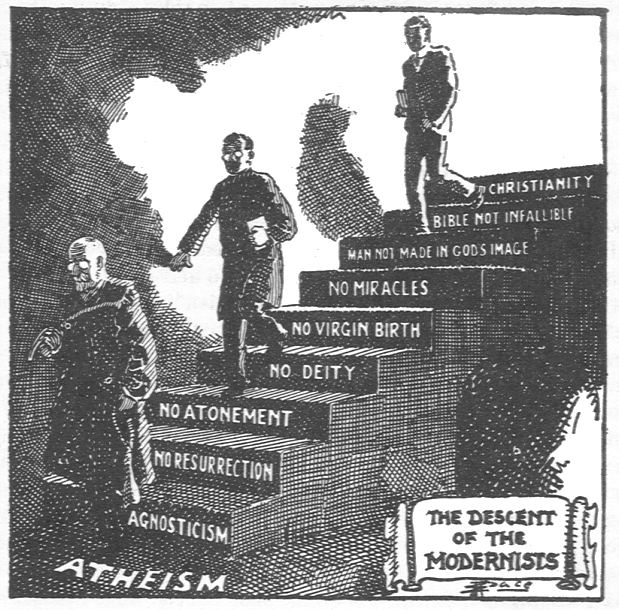
The Fundy Papers

This is how fundamentalists saw liberals a century ago. Nice to know that some things just don't change.


See, They're Not So Different

A. What do America's religious right, the Christian fundamentalists, and their Islamic fundamentalist counterparts have in common? B. What value do the United States and Turkey have in common?

Answer A. Both support Creationism and both utterly loathe Charles Darwin's theory of evolution. A 768-page, lavishly illustrated book entitled "Atlas of Creation" is being delivered to schools and libraries throughout Turkey. The tract argues that Darwinism is the actual root of terrorism.

Answer B. In a survey of public acceptance of evolution, Turkey came in dead last among the 34 nations studied, forcing the United States to settle for second place in the 33rd slot.

Amen, Brother


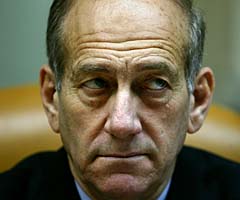
Okay, so invading Iraq hasn't been all that great an idea for the U.S. On the other hand, it was a pretty good deal for al-Qaeda (see next post "Played For a Fool") but it doesn't stop there. Israeli Prime Minister Ehud Olmert is also tickled with how it worked out for his country.

In a speech to visiting American Jews, Olmert says the invasion of Iraq was just dandy from Israel's perspective:

"I stand with the president because I know that Iraq without Saddam Hussein is so much better for the security and safety of Israel, and all of the neighbors of Israel without any significance to us," added Olmert, who was speaking in English.

"Thank God for the power and the determination and leadership manifested by President Bush."
Of course, after the way the Lebanon fiasco turned out, it can't take much to please Olmert.

See, Bush has made everybody happy - except maybe for the Iraqis, and the Brits and, I suppose, the American people, and....

Oh gosh, I almost left out Iran and Syria. They're both pretty happy with the changes President Bush has brought to Iraq. Let's see, the winners are: Israel (supposedly), al-Qaeda (obviously), Syria (vicariously) and the Grand Prize Winner - Iran.

Amen, Brother.

Played For a Fool, Part Deux

Last Friday I posted a story about an al-Qaeda double agent who spied for the British and the French governments. This fellow, in an interview with BBC, told how a prominent al-Qaeda leader captured by the Americans fed deliberately false information to Washington to lure the White House into doing al-Qaeda's bidding.

Here's Gwynne Dyer's take on this foolishness:

"Why Bush himself went along with it is an enduring mystery, and Maureen Dowd's hypothesis that it's really driven by Oedipal conflict ("Dad didn't take Baghdad, but I will") is as good as any. But the invasion would have happened without Libi's lies. It would even have happened without 9/11, if the neo-cons had got their way.

"The point is that al-Qaeda wanted to attack Saddam itself, but was happy to have the U.S. invade Iraq and overthrow him instead because it knew that in the long run it would benefit from the ensuing war of resistance against foreign occupation. I have been saying this all along, because I know a little about how Salafists think, and quite a lot about how terrorist strategies work. However, Nasiri's revelations are the first circumstantial evidence that al-Qaeda leaders actively tried to encourage the U.S. invasion.

"Every day that U.S. troops have been in Iraq since March 2003 has been a day when they served the purposes of al-Qaeda. Every day that they remain, they will continue to serve its purposes."

It's more than sad, it's pathetic.

Dan McTeague Sets the Record Straight

There was less than met the eye to Stephen Harper's bravado with Chinese President Hu over the Celil case, a lot less. Dad McTeague sets the record straight in the latest edition of the online newspaper, Embassy:

www.embassymag.ca/html/index.php?display=story&full_path=/2006/november/22/celil

As usual, there's a lot more show than substance to Stephen Harper.

And Some Days the Bear Eats You


President Bush hasn't had a good time of it lately but, after the last two days, he must be wondering what's next?

First his daughter Barbara gets her purse lifted from beneath her table at an Argentine restaurant while under the watchful eyes of the Secret Service.

Then, during a stopover in Hawaii, the White House acting travel director, Greg Pitts, gets rolled coming out of a Waikiki nightclub at 2 a.m. Another wallet gone.

After that, three motorcycle cops crashed while escorting the president on his way to an air base for his trip home. Two of the officers were seriously injured during the mishap on rain-drenched roads.

The fourth incident, actually the earliest, came in Vietnam when Air Force One crapped out, forcing the president to hop a lowly 757 for his trip to Indonesia.

Sometimes things just don't work out.

The Appeal of Authoritarianism

For months I've argued that democracy has no natural home in either Afghanistan or Iraq; that we can't simply impose something we ourselves took centuries to evolve into. Here's another take on that same point by Ian Bremmer writing in Slate:

"Beginning in 2000, newly elevated President Vladimir Putin restored Russian stability by concentrating political power in the Kremlin, curbing free expression in the country's media, and consolidating economic power in the hands of the state. (The tripling of oil prices over the last four years has made his work much easier.) This forceful reimposition of order has earned Putin a 70-plus-percent approval rating. Broadly speaking, Russians have chosen the order that flows from authoritarianism over the chaos they believe was generated by ill-considered attempts to impose Western-style democracy.

"The people of Afghanistan may already be headed toward the same conclusion. Afghans have nothing like the collective sense of national identity that Iraqis have developed over the last several decades or Russians over the last several centuries—and the elections that made Hamid Karzai president of Afghanistan are even less likely to generate lasting democracy.

"Building democracy in a state with no democratic history is the work of decades—and it can't be done on the cheap. Investing considerable human, political, and financial capital in support of the construction of democracy in two such states simultaneously, acting as if national elections and good police work will create an inexpensive and self-sustaining momentum toward stable political pluralism, is foolhardy.

"Democracy and the open society needed to nourish it requires more than peaceful elections. It demands the steady long-term development of governing institutions that are independent of one another, trump the power of the country's dominant political personalities, and earn the faith of its citizens.

"The United States can continue to try to safeguard Iraq's security until that nation's political leaders forge the compromises needed to begin the long-term process of democratization. But American and British troops will not remain in Iraq indefinitely, because American and British taxpayers won't allow it.

"Iraqis may be pleased with that option as well. When people face the daily uncertainties of life in a dangerously unstable country, they value stability above all else. Freedom from fear trumps the freedom to vote. Until Iraq's Shiites, Sunnis, and Kurds are finally free from fear of sectarian attack and economic exclusion, they will demand stability—just as Russians demand a strong president instead of a strong presidency. Many Iraqis will pledge allegiance to those who can protect them from other Iraqis.

"The process of democratization creates instability in Iraq, Russia, Afghanistan, and any other state in which democracy remains an import. Democratization releases repressed demand for change, and previously disenfranchised players scramble for the first time for a share of the country's political and economic spoils.

"Authoritarians are much better than democrats at quickly bringing order in such a frightening environment. This is mainly because it is easier and more efficient to impose martial law than to build political consensus. The volatility of democratic transitions creates demand for authoritarianism. If a country has more experience with dictators than with democrats, this demand may be second nature.

"In the end, this option might not be as unsavory as it sounds. Before Iraq can become a democracy, it must become a country safe enough for open political debate. As so many have argued, the violence in Iraq requires a political, not a military, solution. And as Bismarck once said, politics is the art of the possible."

Bremmer's right. We don't have a snowball's chance of installing democracy in Afghanistan. We have to stop using that notion as a justification for the "sacrifice" of our soldiers' lives. Maybe we need to re-open the debate Harper so undemocratically shut down. But we won't. We'll stick silly little plastic magnets on the back of our cars and that way ignore the reality of what we're doing to the Afghans and our own soldiers.

Whoops, Lost Sight of That One

Remember back to what seems so very long ago. Go all the way back to September, 2001. Remember when THIS is what we all wanted?

Don't Forget the Parting Gifts

The Harper government is big on law and order, real big. It regularly tells us about how we need to reinforce the deterrence factor of our criminal laws - get tough on crime, stop coddling the villains even those as young as ten.

With this upstanding morality you might be forgiven for thinking that, when we nabbed a foreign spy working in our midst, we would throw the book at him if only "pour encouragez les autres." Guess again.

According to our Public Safety Minister, Stockwell Day, we'd like it if he'd just leave and we're guessing the mystery man would like that too. Here's how Stockwell put it; "I think he would be happiest if he did that."

Let's see - when we catch a foreign agent committing espionage in Canada, we don't want him to become 'unhappy'? That should strike fear in the hearts of Russia's SVR, foreign intelligence agency. Now I don't know much about spying, mainly what I picked up from Le Carre and those spy scandals of the 50's and 60's, but, when we get one of these guys aren't we supposed to bleed him for information?

Maybe not, but at least let's not forget the parting gifts.

Tactics But Where Is The Strategy?

Stephen Harper can periodically show tactical brilliance. Seizing the moment to promote acknowledgement of Quebec nationhood was one example. The brilliance wasn't in the acknowledgement itself but in the way it was manipulated to create something of a fait accompli.

Tactics, however, are no substitute for strategy. Tactics win battles but, unless they're formulated to support a winning strategy, they can actually lose wars and this is Harper's shortcoming.

When I was a kid the corner store sold "grab bags." For five cents (yes, it was that long ago) you got your pick from a tray of small, paper bags. You had to pick first and then find out what was inside that paper bag. Stephen Harper is taking a grab bag approach to the Quebec nation debate. Actually, he's more like the shopkeeper and he's making us pick the grab bag.

Steve's a bully. He likes to push people, forcing them to make decisions without giving them enough time to consider their choices. A brilliant tactic because it keeps your opposition off balance and induces them to do your bidding. I think that's what he's doing this time too.

It's a standard approach in the US Congress. Pass something into law first and then argue about what it means. If the minority don't go along with it, they can be cast as unpatriotic or cowardly. Only after they're in the trap does the majority decide what the legislation they all voted to support will actually mean. That's the essence of right-wing democracy.

Harper, of course, doesn't have a majority but he doesn't need one this time. I doubt that he really cares much whether his motion succeeds in parliament. Either way he gets the political gravy that he's counting on to generate a majority government. It's all form over substance. He's hoping he can make Quebec nationalists believe they've finally met an Anglo PM sympathetic to their aspirations and thereby take Quebec votes away from both the Libs and the Bloc.

Here's my take on what Harper is up to. I have long believed that Stevie's real interests aren't in Canada but in Alberta. I think he understands that his far-right agenda has a short wick on the national stage, that the clock is ticking. He realizes that the Canadian people are much too centrist to be swayed to his policy preferences although they can be nudged that way in the short term. This puts him in a "seize the day" mentality. Get what you can before you get the boot. He's got the helm so he might as well steer the ship his way until the mutiny.

I may sound paranoid but I think the Quebec initiative is a way to achieve Harper's real goal of a fundamental devolution of federal powers to the provinces. Give it to Quebec and how can you refuse to do the same for, say, Alberta or every other province? Stripping Ottawa of its jurisdictions, and associated spending powers, is the ultimate gift to a cash-rich province, soon to be a nation. A profoundly weakened Ottawa would be a blessing to the Oil Patch, especially the tar sands boys.

Harper saw what happened to Meech Lake and the Charlatan Accord. He knows they set a precedent of submitting major constitutional changes to the referendum process. The Quebec gambit may circumvent the referendum process or simply render it irrelevant. That would then clear the way for rapacious provinces to devour the federal roast until they're sated.

There is no Clyde Wells today to put the brakes on this risky business, to demand that we first define what "nation" is going to mean in the context of Quebec. There is no one today in a position to force an open debate on devolution of federal powers. Stephen Harper intends to use his tactics to effectively gag anyone who might be willing to stand up for federalism and the federalist cause.

I doubt very much that Stephen Harper has a national strategy behind this maneuvre. If he has any strategy at all, it's limited to the future of Alberta.

Hey Vlad, Heard From Stevie?

Little Stevie could hardly wait to puff up his chest and let us in on how he gave Chinese President Hu a piece of his mind, a tongue-lashing that rocked Hu back on his heels. Wow, now there's a man of action, a Fearless Leader (if you get the drift).

Has anybody heard Steve mention how he tore a strip off Vlad Putin for running spies in Canada? I would have thought someone as courageous as our Tom Terrific PM would have wasted no time in reprimanding Putin and reminding him he'd better be careful because he's messing with a future energy superpower.

I know. Let's get Putin and Harper in the ring for a little martial arts, one-on-one, a chance for Stevie to really put the smackdown on the scheming Russkie.

Wednesday, November 22, 2006

Rona's Empty Admission

Rona Ambrose was a national humiliation in her performance before the world in Nairobi. Here's an interesting take on Rona from the online publication, "Embassy, Canada's Foreign Policy Newsweekly":

"When it comes to climate change, Canada is a big player because, as the PM likes to say, "Canada is an emerging energy superpower." This country's wealth of oil, gas and hydropower makes its Kyoto voice morally and practically influential.

"Lambasted by her critics, Minister Ambrose is still praised by her friends for telling it like it is in Nairobi. Canada, she said, in an unusually partisan note for an international conference, had failed to live up its Kyoto commitments. "Truth and honesty in government" said her supporters. "Just what we all wanted."

"Well, yes...and no. Truth in admitting a failing in international relations has to be like truth in the confessional. It's only of value if the admission of the sin includes a plan for its correction–or at least a vow to stop doing the harmful thing over and over again.

"The minister's mea culpa has merit only if she is prepared to put forward a plan to meet Kyoto. As most everyone back in Calgary knows, climate change and Canada's energy superpower status are intrinsically bound up with each other.

"Canada will go on to meet and even exceed Kyoto standards for greenhouse gas emissions only when it publicly makes an accounting of the present and future activities of its energy and transportation industries.

"If there is an epicentre for this process, it is probably in the heart of the Alberta tar sands.

"A great place for mea culpas, sure. But a better place to first publicly catalog how it fits into meeting Kyoto requirements. And then to take federally enforced steps to limit the global harm."