Thursday, January 25, 2007

Not Ready for Prime Time


The idea behind the Baghdad "surge" is for American troops to back up Iraqi forces in cleaning out neighbourhoods infested with Sunni and Shiite militias. It sounds good in theory but the theory assumes the Iraqi army forces are up to the job. Two reporters from the Herald Tribune accompanied a US force in Baghdad today and learned that things aren't what they are assumed to be:

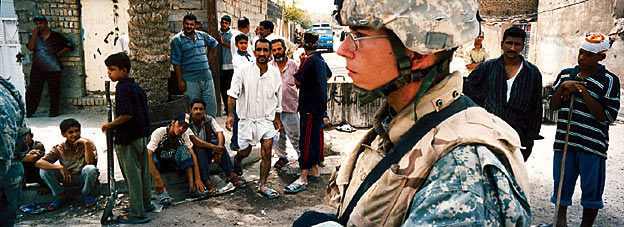
"In a miniature version of the troop increase that the United States hopes will secure the city, American soldiers and armored vehicles raced onto Haifa Street before dawn to dislodge Sunni insurgents and Shiite militias who have been battling for a stretch of ragged slums and mostly abandoned high rises. But as the sun rose, many of the Iraqi Army units who were supposed to do the actual searches of the buildings did not arrive on time, forcing the Americans to start the job on their own.

"When the Iraqi units finally did show up, it was with the air of a class outing, cheering and laughing as the Americans blew locks off doors with shotguns. As the morning wore on and the troops came under fire from all directions, another apparent flaw in this strategy became clear as empty apartments became lairs for gunmen who flitted from window to window and killed at least one American soldier, with a shot to the head.

"Whether the gunfire was coming from Sunni or Shiite insurgents or militia fighters or some of the Iraqi soldiers who had disappeared into the Gotham-like cityscape, no one could say.

The commander of the operation, Lt. Col. Avanulas Smiley of the Third Stryker Brigade Combat Team, Second Infantry Division, said, "This was an Iraqi-led effort and with that come challenges and risks. It can be organized chaos."

"Many of the Iraqi units that showed up late never seemed to take the task seriously, searching haphazardly, breaking dishes and rifling through personal CD collections in the apartments. Eventually the Americans realized that the Iraqis were searching no more than half of the apartments; at one point the Iraqis completely disappeared, leaving the American unit working with them flabbergasted."

The mission resulted in one American killed and two Iraqi wounded but the targets, the militiamen and insurgents, simply melted away.

The Cavalry - Just In Time


Or let's hope it'll be just in time. Word that the Afghan mission is in for some badly needed reinforcements - at least one more NATO brigade and more US forces as well.

The NATO brigade is to be made up of troops mainly from the various nations already active in Afghanistan. The Americans are (wisely) extending the tour of their mountain brigade by another four months and possibly sending fresh troops in also.

It's not clear whether the NATO reinforcement troops will be combat-ready and whether their committment will be subject to any of the caveats that have kept some, such as the Germans, from being deployed into the south where the fighting is most intense.

Let's hope the extra troops are enough to bolster NATO forces to meet the anticipated Taliban spring offensive. The trouble is that it's all guesswork as to what is coming. Will it be the Taliban and al-Qaeda or will they, too, show up with reinforcements. There have been rumours that the Taliban have been joined by the northern warlords, various drug lords, mujahadeen and disaffected nationalists, temporarily operating together under an agreement to set aside their differences until the Westerners are driven out and Karzai toppled. That is definitely a worst-case scenario but no one knows what's coming or, if they do, they're not speaking openly about it.

Looking Into the Crystal Ball


Imagine it's 1957 and you're suddenly presented with clear proof of where the world would be in half a century.

Let's say, for example, that we all realized that the Cold War would consume massive wealth and resources to end in the fall of communism. Would both sides agree that they could use their treasure more wisely for the actual benefit of their people?

What if our environmental decline was mapped out fifty years in advance? Would we have started looking for better, safer alternatives in time to avoid at least the worst of the problems that face us today?

The truth is that a lot of what is coming down the pike can be accurately predicted but it is our human condition not to respond until we must, perhaps not even until it's too late.

What strategies is Canada now mapping out to leave us ideally positioned for the world of 2057? You and I both know the answer. We're doing nothing or next to nothing.

If the world in 2050 is going to be markedly different than the world we've known for centuries, shouldn't we at least be discussing what lies ahead and our options for coping with it?

A couple of things we'll probably have to deal with are securing and distributing our freshwater resources. Some areas, particularly southern Alberta and Saskatchewan, may fall into protracted drought while B.C. receives heavy rainfall. Wouldn't it make sense to see if and how that surplus water could be used in places that may need it most?

We also need to consider growth. The areas expected to be hardest hit by global warming are the regions that are already the hottest on the planet. It won't take much change to render a lot of the earth's surface uninhabitable. That will leave the occupants two choices - migrate to more temperate areas or die. What do you think they'll choose? The Pentagon and the British Ministry of Defence have already studied this and they came to the same conclusion.

It would be wonderful if we could just make room for all the newcomers but we can't. We may, however, be compelled to accept a lot more than we want or are prepared to assimilate.

We have enough experience with immigration to be able to identify the opportunities and problems this will present. Surely the time to work on these questions is now, not when we are beset by migrants.

Should we give priority to Americans? How do we retain control of our own country? How do we safeguard our resources for our needs and benefit?

This whole exercise is very time-consuming. We need time to formulate the questions we need to address. We need time to come up with reliable scenarios that are essential for planning. We need time to debate and discuss our options and make choices. We need time to put our choices, our policies into effect before we wind up playing catch-up.

What we have at the moment is a government that claims it is minty green, almost overnight, and will do everything except anything that might impact on the economy. That timid approach consigns us to window dressing solutions. It does not welcome questions and debates and making choices. It actually seeks to forestall those things.

We may have a chance right now to take steps that will pay huge benefits in the future. One thing that is apparent, the longer we loiter with our heads in the sand claiming to be green, the fewer options we'll have when we're forced to make decisions.

Everyone Finds Their Reasons

Anti-Americanism is sweeping the globe. According to the controversial right-winger, Dinesh D'Souza writing in the Christian Science Monitor, it's because the US offers so many things to condemn, there's something for everyone.

"Anti-Americanism comes in different varieties. The European kind emphasizes the "evils" of "red" America: a shoot-first, ask-questions-later cowboy in the White House, and Bible- toting fundamentalists walking around the corridors of power.

"The Muslim variety is very different. Many Muslims point to the "horrors" of "blue" America: homosexual marriage, family breakdown, and a popular culture that is trivial, materialistic, vulgar, and, in many cases, morally repulsive.

"This latter view is dangerously – and justifiably – common in many traditional cultures across the globe. Because it feeds their perception that American values are inimical to their way of life, this attitude can blossom into the kind of anti- American pathology that partly fueled the 9/11 attacks. Any serious effort to shore up American's security must include steps to edify American culture.

"The most powerful of all the American offenses recited in the lands of Islam, argues preeminent Middle East expert Bernard Lewis, "is the "degeneracy and debauchery of the American way of life."

"A major reason why some Muslims focus their anger on the United States is because it is American culture – not Swedish culture or French culture – that is finding its way into every nook and cranny of Islamic society.

"There is a cultural blowback against America that is coming from all the traditional cultures of Africa, South America, the Middle East, and Asia. This resistance is summed up in a slogan used by Singapore's former prime minister, Lee Kuan Yew: "Modernization without Westernization." What this means is that traditional cultures want prosperity and technology, but they don't want the values of American culture."

"Even the term "Great Satan," so commonly used to denounce America in the Muslim world, is better understood when we recall that in the traditional understanding, shared by Judaism, Christianity, and Islam, Satan is not a conqueror; he is a tempter. In one of its best-known verses, the Koran describes Satan as "the insidious tempter who whispers into the hearts of men."

Dinesh may have identified a genuine problem that needs to be addressed, but how? He wants a culture war at home and, by his implication, a war on liberalism. Dinesh, naturally, equates liberalism with depravity. He also urges the US to do more to show the world the "other America" that they don't see, the conservative and religious America.

Of course Dinesh doesn't want to consider just how much good old, religious conservatism the US has been showing the Middle East in recent years. Does this guy think liberals caused the quagmire in Iraq? Does he think the insurgencies in Iraq and Afghanistan and Islamism globally is being fueled by rap music or American military and political interventions in the Middle East?

The Islamists believe there is a crusade now underway driven by Christian fundamentalists who wish to subjugate the Muslim world. Sadly, that doesn't fit into Dinesh's equation, his view of the root of all of America's troubles. Dinesh is another radical flogging another book, a phenomenon that has led to a bizarre game of one-upsmanship. His tome is dedicated to the proposition that liberalism caused the attacks of 9/11. Idiot.

A refreshing, alternate viewpoint comes from Henryk Broder writing in Spiegel who warns that adjusting our cultures so as to not affend the Muslim world is rank capituation:

"Those who react to kidnappings and beheadings, to massacres of people of other faiths, and to eruptions of collective hysteria with a call for "cultural dialogue" don't deserve any better.

"'The West should desist from engaging in all provocations that produce feelings of debasement and humiliation,' says psychoanalyst Horst-Eberhard Richter. 'We should show greater respect for the cultural identity of Muslim countries. ... For Muslims, it is important to be recognized and respected as equals.' In Richter's view, what the Muslims need is "a partnership of equals."

"But Richter neglects to describe what this partnership might look like. Does achieving such equality mean that we should set up separate sections for women on buses, as is the custom in Saudi Arabia? Should the marrying age for girls be reduced to 12, as is the case in Iran? And should death by stoning be our punishment for adultery, as Shariah law demands? What else could the West do to show its respect for the cultural identity of Islamic countries? Would it be sufficient to allow Horst-Eberhard Richter to decide whether, for example, a wet T-shirt contest in a German city rises to a level of criminal provocation that could cause the Muslim faithful in Hyderabad to feel debased and humiliated?

"Should devout Jews be entitled to demand that non-Jews give up pork? And should they have the power to impose sanctions if their demands are not met? Can a Hindu in India run amok because the Dutch do not view cows as sacred beings? Those who believe Muslims have the right to be outraged by the Danes failing to abide by an Islamic prohibition -- especially when it's not even clear that such a prohibition even exists -- must answer such questions clearly in the affirmative. Even illiterates must then be allowed to ransack bookstores; in a world in which anyone is entitled to feel offended and humiliated, anyone can also choose which provocations he is unwilling to accept."

MacKay Wants NATO to Guard Border


Foreign Affairs minister Peter MacKay wants our NATO allies to send help to guard Afghanistan's border with Pakistan.

Even if he gets a few thousand extra hands, they probably won't arrive in time to make any difference to the insurgent's spring offensive. In any event, NATO forces in Afghanistan are too few to tackle the Herculean job of guarding the border with Pakistan.

The rugged border region is all but impossible to control. The Soviets tried it when they had a force of more than 100,000 soldiers in Afghanistan. Infiltrators had to dodge infrequent air strikes and other minor irritants but the border remained open for business.

The only nation with enough troops to make a serious effort at this is Pakistan and they're not about to go beyond some fencing and minefields.

MacKay's instincts are good, he sees the real problem, but his chances of coming up with an effective response are almost nil.

Putting the Cart Before the Horse


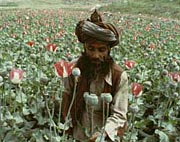
It's poppy eradication time again in Afghanistan, the time right after Afghan winter when Kabul, the UN, Washington and NATO toss around ideas for wiping out Afghan poppy fields.

There's no question that getting rid of poppies and the opium produced from them is a good thing - if you're not going to buy the stuff to answer the demand for legitimate, opiate medicines. If we don't buy it, our addicts will buy it on our streets.

US Drug Czar, John Walters, thought he had a deal with president Karzai to permit spraying. Kabul now says no. The Afghan goverment wants the West to provide tractors so it can simply plough the poppy fields under. Nobody's quite sure what to do or even what will be done.

Despite all the babble, what never seems to cross their lips is how to put an alternative economy in place to allow the locals to support their families without growing poppies. Why is that not the first priority? It seems like a no-brainer, doesn't it?

The alternative economy idea doesn't work because it cannot be a first priority. Before you can even hope to establish an alternative economy, you have to give the farmers genuine security - from the Taliban, from the drug lords, even from the police and their own government. That's the first objective, the alternative economy is second, getting rid of the poppies is third.

Campaigning against the poppies as we have done is an admission of failure in the first two objectives, the prerequisites. We can't give them security so we can't create an alternative economy so we'll complete the vise we've left them in by trying to wipe out their livelihood.

The drug czars of the US and UN have repeatedly shown that they couldn't care less about the repercussions of eradicating Afghan's poppy fields. They consider the consequences to be someone else's problems.

When There's Just Not Enough Time for Waterboarding


Hey, if you haven't got time to waste making a guy feel like he's drowning, why not make him feel like he's on fire? Ah, the modern age.

The US military has unveiled its "heat gun" the latest, non-lethal weapon it has developed for "crowd control." The weapon fires a beam of radiation that terrifies those it hits by making them feel they're about to burst into flames. Pretty neat, huh?

"There should be no collateral damage to this," said Senior Airman Adam Navin, 22, of Green Bay, Wis., who has served several tours in Iraq. That was the same view taken when the US military exposed hundreds of its own soldiers to early nuclear weapons tests. Hmm, how did that turn out, by the way? Oh, that's right, a lot of them died of cancers. Ooops!

I expect there are a number of practical problems to the use of this system in the field for crowd control but I can think of one application where it would be just dandy - interrogation. It'll sure save on the water bill.

We're Presumptuous?


The US Ambassador to Canada, David Wilkins, has called Stockwell Day "a little presumptuous" for seeking to have Maher Arar removed from America's no-fly list' "It's a little presumptuous for him [Day] to say who the United States can and cannot allow into our country."

Odd that it's not presumptuous for the United States to tell Canada who we should or should not allow into Canada nor, apparently, is it presumptuous for the US to seize Canadian citizens and send them abroad to be tortured.

Now the ambassador explained that his country has its own reasons for continuing to see Arar as some sort of danger but, whatever those concerns may be, they're not prepared to share them with us, their partner in Washington's Global War Without End on Terror. I'm sorry but, if Maher Arar is some sort of villain, America had damned well better start coming clean with us about it.

If, however, this is all about spite because Arar is suing the US because the little ninny can't even take a year of torture like a man, well then, that's another matter entirely.

Wednesday, January 24, 2007

Thrown To The Wolves


He bombed. By all accounts, George Bush's State of the Union Address last night was a dud. Usually a president can expect a bump in support after these things but Bush got no bump after his Iraq initiative speech a couple of weeks back and, by all accounts, he didn't seem to move anyone with his speech last night either.

Bush needed to win support last night - from his own, congressional Republicans. Many of them will be reading the winds of public opinion to decide whether to remain neutral or to join other Repubs in a revolt against the White House. The signs aren't good for George Bush.

The Democrats today begin the long-overdue investigations into the Iraq war. They'll have what George Bush can no longer command, a receptive audience from the American people. There are a lot of questions that the executive, sheltered by a Republican congress, was able to dodge. That cover is now gone and, with his support in tatters, this president is more vulnerable than at any time over the past five years.

Arrogance and naivete. In a president they make a lethal cocktail of bad judgment. George Bush didn't understand that, while you can deceive your people into a war, once you've launched that war you have to deliver the promised results. You have to win because you simply can't lie your way back out again.

What makes Bush's failure so remarkable is that the bar was set so low. In reality, he didn't have to uncover WMDs or show that Iraq was capable of attacking the US or even that Saddam was in league with al-Qaeda. The American people would have tolerated all of those inconvenient realities - if Bush had won his war as he'd promised.

The American people showed themselves willing to accept an "end justifies the means" war so long as the US won it fairly quickly. After all, isn't their country the world's only superpower? Who can stand up to that? Some nation that's been hobbled by a decade of sanctions? Never.

Everything else was window dressing. All George Bush had to do was to conquer Iraq but that he couldn't achieve. He didn't defeat the Iraqi military in the field - they vanished to return as an insurgency. He didn't achieve a surrender of the Hussein government - they too evaporated. Even without a defeat or a surrender it might have been enough if he'd been able to secure the occupied country but he didn't take nearly enough troops for that. He never intended to be in that position.

Bush has served up a fiasco that carries with it a national humiliation. For that he won't be forgiven.

Now the Frat Boy has to await his fate as a hostile congress pokes and prods and deconstructs his actions and decisions, one by one. The most secretive presidency in living history will now be dragged out into the light for public scrutiny and that is what George Bush must fear most. George Bush has been thrown to the wolves.

Tuesday, January 23, 2007

Can America Reclaim its Integrity?

It's all about reverse polling, planting seeds of doubt, smear jobs. It's becoming a defining part of American society.

Remember John McCain and the whispering campaign claiming that he had an illegitimate, black baby in his past? You can't forget John Kerry and the Swift Boat brigade.

A low and vile element has crept into American politics that works to confuse voters and play on their worst instincts, an element that is robbing America of its integrity.

Who can forget the Kim Campbell campaign in which the Tories ran an ad mocking Jean Chretien's face? I clearly recall people in my neighbourhood going out and tearing PC campaign signs from their front lawns. There was a torrent of outrage that swept across party lines. It was an affirmation that our integrity would stand above partisan politics and that we would punish those who dared to do these things.

Now this same ugliness is surfacing again in the United States in a campaign to smear Barak Obama. The con job tries to spread the word that Obama is from a radical Muslim family and was educated in a fundamentalist madrassa or Islamist school. It's false but that doesn't matter to a society that has grown indifferent, perhaps even tolerant about these things. The vision is of a closet, radical Muslim with a name one letter off that of America's arch-enemy, taking hold of the White House and subverting the United States to the will of Allah.

Why do people resort to these smear jobs? Because they work. They work well enough to let a completely unqualified Frat Boy with an unaccomplished and chequered background to squeak into the White House to wreak havoc on his nation.

When will this end? Not until the American people repudiate these tactics and punish the perpetrators at the ballot box.

We should all keep an eye on this because there are some in this country who want to take us down this same path. There are those who watch carefully what works in the states, who even consult practitioners of these dark arts, and who would not hesitate to take our integrity from us.

Drawing the Line

Imagine, Bill Clinton back in the White House. Hillary sitting behind the Commander in Chief's desk in the same oval room where her husband had certain dalliances back in the 90's.

Walking the halls and coming upon a portrait of a former president who is still revered today as something akin to a rock star. Knowing that whenever you speak, a lot of people will be judging your words by what that other president might have said.

Realizing that you're presiding over a nation in troubled economic straits while everyone remembers how good everything seemed when that other president ran the economy.

Will Hillary Clinton be measured by the America she inherits or by the other Clinton who ran the place up to end of the millenium?

Bill exuded a serene confidence, he put people at ease. Hillary doesn't have that gift. She comes across as cold and ambitious, the sort who lets no one get in her way. Bill was blessed by the gift of extemporaneous speech. He could speak, convincingly, at length, without notes and he did it in a way that reached people. Hillary hasn't shown that same spontaneity.

Bill was also incredibly lucky. During his administration America experienced the "Dot Com" boom. Of course it was aberrent, an empty bubble, but it was a blessing for the presidency. Notional wealth was being created on an astonishing scale. With that, a tsunami of tax revenues flooded the treasury. Americans felt prosperous and the government was awash in sufficient revenue that it was able to balance the budget. Sure it was an illusion but it had concerete benefits for Bill Clinton.

America was respected globally. Bill Clinton made friends and allies easily. Around the world he was liked, even admired, and that spilled over into a fondness for America and its people.

All that has changed, for the worse. Bush has squandered America's goodwill. It is now widely seen as a pariah, a rogue state. George Bush has stupidly revealed how fragile America's military might can be. Nasty little states are flaunting their nasty little ways, confident that America is so tied down in Iraq that its options against them are limited.

At home, George Bush has created an American oligarchy where the divide between the rich few and the poor or marginal working class is wider than ever, where social mobility has been strangled, where the wealthy make their fortunes offshore while their working class countrymen work harder for less reward, if they're lucky, or search for jobs if they're not.

He has transformed the United States into a fiscally weak state that has accrued massive debts, that runs enormous deficits and that even funds its foreign wars on foreign loans. George Bush has "defunded" the American government, crippling its strength for years, if not decades, to come and mortgaging the future of its working class by borrowing to fund its excesses. George Bush has waged and perhaps even won America's first class war.

Should she become president, Hillary Clinton will face a towering wall of challenges that Bill never had to confront. Lucky as his administration was, the next one will be just the opposite. The Frat Boy who now occupies the White House is like the deadbeat tenant who can't make the rent and steals away into the night leaving behind a filthy and damaged apartment and a landlord with no money.

The next president is going to have to make some tough and potentially unpopular decisions. He or she will have to call upon the American people to make the sacrifices that George Bush was too gutless to ask of them in order to fund his war of whim. The next president is going to have to behave like a grown up - and that, too, will come as a shock to the American people. If it is Hillary, her government will bear no resemblance to Bill's and there are bound to be people who will be angry about that.

As president, Hillary Clinton will have to redefine Bill or exile him to pursue "good works" far from Washington. The problem isn't her and it really isn't him either. It's the American people and the expectations that having Bill there might heap onto Hillary's shoulders. Such a presidency may be the one to draw a clear line between president and presidential spouse, a line that was increasingly blurred by the likes of Nancy Reagan and - why Hillary herself.

The Alamo, Baghdad


It's what the Bush "surge" is all about, a cluster of fortified houses that will become one of about 22-outposts that US forces are planning to establish throughout trouble spots in Baghdad.

The New York Times reports that the outpost has already drawn fire from insurgents:

The "...outpost here, a cluster of fortified houses officially designated a joint security station and unofficially called the Alamo by some of the soldiers, is a test case for President Bush’s new Baghdad security plan. The strategy envisions at least 20 more facilities like it in other troubled neighborhoods, all jointly staffed by Iraqi and American forces.

"Even after the stations are set up, American commanders say, it will be many months, at best, before they can even hope to prevent bombings like the one that killed at least 88 people in a central Baghdad market area on Monday.

"In the week since the Americans arrived, however, the troops have seen the truth of what their commanders warned in announcing the plan: it leaves Americans more exposed than ever, stationary targets for warring militias.

“'I’m a juicy target they are just trying to figure out,' said Capt. Erik Peterson, 29, the commander at the outpost.

"During the week, the soldiers also received their first glimpse of the green Iraqi forces who will share the mission and eventually, they hoped, take it over. The soldiers talked about them with a mixture of bemusement, disdain and mistrust.

“'You could talk about partnership, but you would be lying,' said one soldier who asked that his name not be used, for fear of punishment by his superiors."

The compound was barely in operation before it was attacked with small arms and rocket grenade fire. The first patrol from the fortress into the local neighbourhood drew three sniper attacks. The US troops were fortunate to come through unscathed. They know that their every move is being watched. Neighbours have warned that the Mahdi Army and al-Qaeda have spies watching the compound to see who is giving information to the Americans.

The local, Sunni population leaves no doubt who it wants the Americans to deal with, even painting the message on nearby walls:

“Hey Americans, we want you to destroy the J.A.M.” It was a reference to the largest Shiite militia, the Mahdi Army. In smaller letters, someone had written an equally clear message: “Bush is appalling and dreadful.”

Once the US troops had the Alamo up and running their Iraqi military counterparts showed up. Not surprisingly it was a Shiite contingent and it was gunning for Sunni targets.

"Maj. Chasib Kattab, a boisterous Shiite who commands the Iraqi unit of two companies, about 200 men, started to provide information. But, in a likely hint of things to come, all his tips involved Sunni fighters. He had nothing to say about the Shiite militias."

The fortress campaign seems destined to either become a mediocre success or a complete disaster. It presents the militias, insurgents and terrorists with very enticing, high-value targets. If, or perhaps when, they can identify the vulnerabilities in the structures and the operations of the troops inside, there will be attempts to destroy at least some of these compounds. With the American people already solidly against this war, wiping out one of these fortresses would present a huge psychological victory for the bad guys - whether Sunni, Shiite, al-Qaeda, Iraqi, Iranian, you name it.

Monday, January 22, 2007

Freedom House 2007 Survey - Much Work to be Done


Freedom House has released its 2007 survey. The study shows that, overall, freedom around the world has largely stagnated over the past decade and, in some regions, is in decline:

"Regionally, major findings include a setback for freedom in a number of countries in the Asia-Pacific region, a more modest decline in Africa, and a solidification of authoritarian rule in the majority of countries of the former Soviet Union. Three countries experienced positive status changes: Guyana moved from Partly Free to Free, and Haiti and Nepal moved from Not Free to Partly Free. Two countries experienced negative status changes: both Thailand and Congo (Brazzaville) moved from Partly Free to Not Free.

"...the trends reflected the growing pushback against democracy driven by authoritarian regimes, including Russia, Venezuela, China, Iran, and Zimbabwe, threatening to further erode the gains made in the last thirty years. The pushback is targeted at organizations, movements, and media that advocate for the expansion of democratic freedoms.

"...the number of countries judged by Freedom in the World as Free in 2006 stood at 90, representing 47 percent of the global population. Fifty-eight countries qualified as Partly Free, with 30 percent of the world’s population. The survey finds that 45 countries are Not Free, representing 23 percent of the world’s inhabitants. About one-half of those living in Not Free conditions inhabit one country: China.

"Several of the countries that showed declines during the year were already ranked among the world’s most repressive states: Burma, Zimbabwe, Somalia, Eritrea and Iran. Yet declines were also noted in a number of countries rated Free or Partly Free, but whose democratic institutions remain unformed or fragile, as well as in societies that had previously demonstrated a strong measure of democratic stability: South Africa, Kenya, Taiwan, Philippines, Mexico, Argentina, Brazil and Hungary."

Sea Shepherd versus Japanese Whalers - the Battle Turns Ugly


The Sea Shepherd Conservation Society is resolutely determined to disrupt whaling around the world. Under the direction of Paul Watson, the group's ships are said to have sunk at least 10-whalers.

Sea Shepherd recently acquired a surplus US Coast Guard vessel, now renamed the MV Robert Hunter which, together with the society's other ship, the Farley Mowat, has now been sent to the Antarctic to intercept a Japanese whaling mission heading there.

Japan is certainly fighting back and with some success. It seems that the Japanese were able to induce Ottawa to "deflag" the Farley Mowat which means it no longer sails as a Canadian-registered vessel. That coup has allowed the Japanese to claim that the Mowat is a pirate ship:

"Japan Whaling Association President Keiichi Nakajima said, "Sea Shepherd is officially running a pirate vessel."

"International law says any non-flagged vessel can be boarded for inspection, and in case of any violation or piracy, has to be detained with its crew arrested. If Paul Watson continues with his violent campaign using this vessel, then he'll be risking everything," said Mr Nakajima, who called on the Government of Japan to ensure everything possible was done to secure the safety of Japanese researchers and crew by boarding the Farley Mowat on the high seas and seizing the ship and arresting the crew as pirates.

"Captain Paul Watson, Sea Shepherd's founder and president, dismissed Nakajima's threats saying that the crew of the Farley Mowat is quite prepared to defend the ship against Japanese violence. As for risking everything he said, "We are quite prepared to risk our lives and this ship for the whales."

Selfish or Altruistic - It's All In The Brain


Posterior superior temporal sulcus. That's the name for the part of the human brain that determines whether you'll be selfish or altruistic - willing to help out others with no expectation of reward.

A Duke University Medical Center study published in Nature Neuroscience assessed 45 volunteers. The test subjects were asked to disclose how often they engaged in different helping behaviours, such as doing charity work, and were also asked to play a computer game designed to measure altruism.

The researchers are now exploring ways to study the development of this brain region in early life and believe such information may help determine how altruistic tendencies are established. In particular they want to know if early childhood influences could affect development in the altruism centre.

The Infidels' Dwindling Shelf Life


Whether it be Afghanistan or Iraq, one factor that's rarely talked about is our forces' very limited shelf life.

Let's face it - we are aliens in these places. We don't share their language, their culture, their religion, their ethnicity, their poverty and health problems, their vision and aspirations.

We're mainly white, we're relatively affluent and we have the biggest and best guns. That's bound to rankle after a while. It's the sort of thing that can inject an element of fervor into latent nationalistic sentiment.

When you're this different, you don't get to play around indefinitely. You really can outstay your welcome. People get tired of looking at you, tired of strangers telling them what to do, tired of the fighting, tired of the mistakes.

No, when you get stuck into these situations, time is a limited asset and you have none to squander. In these two countries we have been profligate in our waste of time.

Now, Asia Times reports on a growing, grassroots resistance developing in southern Iraq:

"Attacks against occupation forces appear to stem more from a growing nationalism. 'This is not about vengeance,' a former Iraqi Army officer from Kut, 200 kilometers south of Baghdad, said in the capital. 'People have lost hope in the US-led occupation's promises, and they are thinking of saving the country from Iranian influence, which has been supported, or at least allowed, by the multinational forces.'

"While members of the Mehdi Army certainly carry out attacks against occupation forces in southern Iraq, other home-grown resistance seems to have taken root, fed also by earlier memories.

"'People here have always hated the US and British occupation of Iraq, and remembered their grandfathers who fought the British troops with the simplest weapons,' said Jassim al-Assadi, a school principal from Kut. Assadi was referring to the Shi'ite resistance that eventually played a key role in expelling British forces from Iraq during the 1920s and 1930s.

"Armed resistance against the occupation in the south was slow to begin with because religious clerics instructed their followers to give the occupation time to fulfill promises made by the US and British administrations, Assadi said. 'But now they do not believe any cleric's promises anymore. They have started fighting, and that is that.'"

The Afghans likewise have a rich and proud history of resisting and throwing out the infidels. If the locals do lose faith in us and their president, Hamid Karzai, they can be expected to swell the ranks of the insurgency.

War on Terror Trumps War on Drugs


It's no secret that America's military services are stretched thin, some almost to the breaking point, due mainly to the quagmire that is Iraq. Some soldiers are now being sent back for their third, even their fourth tours of duty.

A lesser known victim of the Global War Without End on Terror has been America's War on Drugs. Once the lead service in defending America's borders against drug smugglers, the military has sharply reduced its role on drug interdiction.

According to a report in the LA Times, the cuts have been substantial and have left significant gaps in America's interdiction efforts:

"Internal records show that in the last four years the Pentagon has reduced by more than 62% its surveillance flight-hours over Caribbean and Pacific Ocean routes that are used to smuggle cocaine, marijuana and, increasingly, Colombian-produced heroin. At the same time, the Navy is deploying one-third fewer patrol boats in search of smugglers.

"The Defense Department also plans to withdraw as many as 10 Black Hawk helicopters that have been used by a multi-agency task force to move quickly to make drug seizures and arrests in the Caribbean, a major hub for drugs heading to the United States.

"And the military has deactivated many of the high-tech surveillance "aerostats," or radar balloons, that once guarded the entire southern border, saying it lacks the funds to restore and maintain them."

A Dubious "First" for Canada


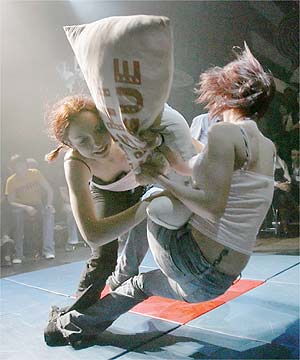
It's the PFL and it's taken New York by storm. PFL stands for Pillow Fight League, an idea hatched in Toronto.

It's a big enough sensation to make the major US papers. Here is how the Washington Post sees it:

"Will people pay to watch Canadian women clobber each other with pillows?

"The answer: Duh. Demand for the $20 tickets was so high that a second night at Galapagos was added and quickly sold out. But anyone who comes for a giggly face-off between two chicks in undies -- the age-old slumber party fantasy -- is in for an unhappy shock. "Real women. Real fights" is the league's motto, and this is no joke. When the fight starts, nearly anything goes -- leg drops, arm bars, chokeholds and punching -- as long as a pillow is the point of contact. Just don't gouge, scratch or pull hair, and no fair hiding bricks or any foreign objects in the pillowcase.

"You win by pinning an opponent's shoulders, as in a standard wrestling match, or pummeling her so hard she quits, or if the referee stops the action. If there's no winner at the end of the one-round, five-minute fight, three judges choose a victor, based on style, stamina and aggressiveness."

"Nothing is fake or scripted, though in the tradition of professional wrestling, each fighter takes a nom de guerre and a persona. Lady Die enters the ring dressed in elegant equestrian gear, though she undercuts the aura of English hauteur by flipping the bird with both hands as she struts to her corner. Eiffel Power is dressed in a shirt with those horizontal stripes that will forever connote Frenchness. Lynn Somnia enters screaming, ostensibly driven insane from a lack of sleep and wearing a white hospital gown."

"Fight like a girl!" howls the ref -- the phrase that launches every bout -- and it begins.

"Forget technique. None of the fighters seems to have any, aside from the basic windup and swing and the occasional leg sweep to dump an opponent on the mat. The action is frantic and grueling. The fighters seem exhausted after a minute. Wild swings outnumber square hits. Much of the action happens on the ground, where the fighters pitch and roll, occasionally using their pillows to try to choke each other, which doesn't really work. There's nothing sexy about it, and with a 20-ish, mostly male crowd calling out such bons mots as "Hit her low!" the event often has the atmosphere of a "Jerry Springer" melee."

The Post reports that the Pillow Fight League was the brainchild of Stacey P. Case who just stumbled onto the idea while driving through Austria in 2004 with his band, Tijuana Bibles.

The American People More Anti-Bush Than Ever


On Iraq and just about every other issue, the American people would rather have
American policy set by congressional Democrats than president George Bush. That's the message of the latest Washington Post-ABC News poll.

"Iraq dominates the national agenda, with 48 percent of Americans calling the war the single most important issue they want Bush and the Congress to deal with this year. No other issue rises out of single digits. The poll also found that the public trusts congressional Democrats over Bush to deal with the conflict by a margin of 60 percent to 33 percent."

The poll results come just one day before Bush gives his State of the Union Address, his last,best shot at winning support for his "surge" initiative.

"The Post-ABC poll shows that 65 percent of Americans oppose sending more troops to Iraq; it was 61 percent immediately after the president unveiled the plan on Jan. 10 in a nationally televised address."

"More broadly, Bush will be speaking on Tuesday night to a nation that is deeply pessimistic, with just 26 percent of Americans saying the country is heading in the right direction and 71 percent saying the country is seriously off track. That is the worst these ratings have been in more than a decade."

"Just 42 percent say he can be trusted in a crisis, with 56 percent saying he cannot -- the first time a majority has given him a negative rating on a crucial element of presidential leadership. Only 45 percent call him a strong leader, which is also the lowest mark of his presidency. His previous low, 47 percent, came two months after Katrina ravaged New Orleans and the Gulf Coast."

Iran Moves Up the List

USS John C. Stennis

Foreign papers suggest that the United States, possibly in conjunction with Israel, may be preparing to strike Iran.

A second US aircraft carrier, the Stennis, is expected to arrive on station in the Persian Gulf by the end of the month to join the USS Eisenhower that arrived in December. Spiegel Online noted this ominous fact:

"A buildup of US aircraft carriers in the Gulf has happened five times in the last 15 years: at the beginning of the 1991 Gulf war; leading up to the "Operation Desert Strike" in 1996; prior to "Operation Desert Fox" in 1998; in the spring of 2003; and today. In only one of these cases was a buildup on this scale not followed by a military strike: in early May 1998, when the Iraqi regime temporarily accepted the conditions imposed by the United Nations Security Council.within days."
Today it was reported that Iran has refused entry to 38 IAEA inspectors, apparently in response to sanctions recently imposed on the country by the Security Council.
Meanwhile The Independent reports on the rise of war rhetoric in Israel. The paper reports on hawk Benjamin Netanyahu, leader of the Likud Party, who warned, "No one will come defend the Jews if they do not defend themselves. This is the lesson of history."
Netanyahu told reporters that he doubted the "genocidal regime" of prime minister Ahmadinejad was "deterrable."
Meanwhile Ahmadinejad is digging in his heels in rejecting the UN resolution: "The resolution was born dead and even if they issue 10 more it will not affect Iran's economy and policies."