Tuesday, February 25, 2014

ExxonMobile CEO Fights Fracking - in His Neighbourhood


Rex Tillerson has joined the fight against fracking in Denton, Texas.   That's a little upscale spot where Tillerson happens to live.

The story broke on February 20 in the Wall Street Journal in an article entitled: "Exxon CEO Joins Suit Citing Fracking Concerns: Residents of Dallas Suburb Fight Construction of Tower That Would Provide Water for Drilling." As noted in a piece posted on Truthout in December of 2013, Denton is a hotbed of fracking activity.  This has resulted in a citizen revolt against all the threats that fracking poses: toxic chemical use, acceleration of global warming, air pollution, water pollution, earth tremor risks, noise, airborne debris, bright night lights and more -- much more.

You can be sure that the CEO of ExxonMobil is a promoter of fracking, just not in his backyard in his estate just outside of Denton (but within Denton County). As a local ABC affiliate reported:

Rex Tillerson has joined a lawsuit to stop construction of a water tower near his $1.3 million estate on Dove Creek Road. That water would be used in fracking, a process to drill oil and gas.

Tillerson even appeared at a Bartonville Town Council meeting to speak against it.

Tillerson, of course, has a reputation for being a straight shooter, speaking his mind.


Don't let reality get you down, Rex.  You have money, lots of it, and money talks.

Christian Fundamentalists Score Another Win. Uganda Implements Anti-Gay Law.


What do Arizona governor Jan Brewer and Uganda prez Yowari Musevini have in common?  They both preside over homophobic governments oppressive to gays.

Brewer is widely expected to sign into law a bill that allows discrimination against pretty much anybody who strays too far from the dictates of Christian fundamentalists.   Her Ugandan counterpart, Musevini, has approved a law imposing tougher penalties on gays.  Musevini has stopped short of approving a bill that would introduce the death penalty for homosexuality but that may become irrelevant.

Uganda, whipped up by the exhortations of American Christian fundamentalists, has turned rabidly anti-gay.  And now the local newspaper, Red Pepper, has published a list of names of 200-prominent gay Ugandans.  I wonder what that's all about?

Homosexual acts were already illegal in Uganda, but the new law bans the promotion of homosexuality and covers lesbians for the first time.

In 2011, Ugandan gay activist David Kato was killed in what rights activists said was a homophobic attack.

His name had appeared on a list published by the now-defunct Ugandan Rolling Stone magazine, calling for the execution of gay people.


U.S. state secretary, John Kerry, says his government will review its foreign aid to Uganda that currently totals $400-million annually.  Sweden, the Netherlands, Norway and Denmark are cutting off their aid to the Musevini government.


I wonder how long we'll have to wait to hear from Sideshow Steve Harper.

Religious fundamentalism is a dangerous disease whether it's Christian or Muslim, Jewish, Hindu or whatever. 


Monday, February 24, 2014

The Deep State


If you're like most, you've probably wondered what to make of America's dysfunctional, gridlocked government.  Mike Lofgren offers a disturbing explanation of the apparent madness in a terrific essay entitled, "Anatomy of the Deep State."  What he maintains is that what we're witnessing is simply a concluding step in the transfer of power to a parallel state, a plutocracy that now both runs the country and controls the destiny of the American people.

Lofgren is not some conspiracy theorist.  With the facts and conclusions he presents, there's really no need for theories.  The Deep State is shadow government, operating independently of the ballot box in a world where political and corporate power merge seamlessly.

The Deep State is the big story of our time. It is the red thread that runs through the war on terrorism, the financialization and deindustrialization of the American economy, the rise of a plutocratic social structure and political dysfunction. Washington is the headquarters of the Deep State, and its time in the sun as a rival to Rome, Constantinople or London may be term-limited by its overweening sense of self-importance and its habit, as Winwood Reade said of Rome, to “live upon its principal till ruin stared it in the face.” “Living upon its principal,” in this case, means that the Deep State has been extracting value from the American people in vampire-like fashion.

We are faced with two disagreeable implications. First, that the Deep State is so heavily entrenched, so well protected by surveillance, firepower, money and its ability to co-opt resistance that it is almost impervious to change. Second, that just as in so many previous empires, the Deep State is populated with those whose instinctive reaction to the failure of their policies is to double down on those very policies in the future.

To the extent that America directs influences so much of what occurs in Canada, it is vital that we understand what is going on in the Deep State that floats freely above Pennsylvania Avenue.

Trudeau Shows His True Colours. And They're Not That Far Off Harper's.

Justin Trudeau doesn't even try to hide that he's just another greasy Ottawa petrol-head.  He says he opposes the Enbridge Northern Gateway pipeline for obscure reasons that perhaps only he understands.  Enbridge, he says, needs to go back to the drawing board and come back with something more palatable.  That's a pretty soft 'no' on the Northern Gateway.

Trudeau doesn't like the idea of a pipeline running through the Great Bear Rainforest and gives Enbridge a failing grade on getting First Nations' and affected communities' approval.   He's even got a lovely little quip for it:  "Ultimately governments grant permits, but only communities grant permission.”  Really, junior, that's it?

JT also opposes the Northern Gateway because of the potential ramifications of a tanker accident.  He points out there are thousands of British Columbians who make their living on the sea and could see their livelihoods ruined.

Trudeau's hypocrisy, however, comes through with his gushing support for TransCanada's Kinder Morgan pipeline expansion.  On that southern pipeline, Trudeau ditches all the objections he raises in opposing the Northern Gateway.

Every community in the Lower Mainland, representing about 2-million Canadians, is fiercely opposed to the Kinder-Morgan expansion.  A tanker sinking anywhere from Indian Arm to the open Pacific would wreak far greater damage even than the same spill on the north coast.  Does Trudeau not realize that Vancouver's inner harbour is Canada's gateway to the Pacific?  What does he think a tanker mishap could do to downtown Vancouver, Burnaby and the North Shore municipalities?  Has he not heard how our National Energy Board gave America's Environmental Protection Agency the slip on the Kinder Morgan hearings?

Trudeau the Lesser doesn't even want to deal with the Tar Sands, groundwater contamination and the spread of carcinogens much less  the environmental consequences of pushing the world's highest-cost, highest-carbon on world markets.  That pretty much shows where Trudeau would be environmentally - not far from Harper.

We've mocked Harper for transforming Canada into an international pariah, five time winner of the Fossil of the Year award, but the policies Trudeau is taking would commit his government to defend the same interests, build the same barricades to action, that have left our country so tarnished already.

And, lest any of you think the NDP is one bit better, a touch of Murray Dobbin will disperse your delusions.

Harold Ramis, 69

Terrific SCTV founding cast member, Harold Ramis, dead at 69.


Is the U.S. Working to Sabotage Its Nuke Deal with Iran?

According to Asia Times, the U.S. is adopting an Israeli policy platform that could scuttle the prospects of a nuke deal with Iran.

The Barack Obama administration's insistence that Iran discuss its ballistic missile program in the negotiations for a comprehensive nuclear agreement brings its position into line with that of Israel and senators who introduced legislation drafted by the pro-Israel lobby group AIPAC aimed at torpedoing the negotiations.

White House spokesman Jay Carney highlighted the new US demand in a statement Wednesday that the Iranians "have to deal with matters related to their ballistic missile program".

Carney cited United Nations Security Council resolution 1929, approved in 2010, which prohibited any activity related to ballistic missiles capable of delivering nuclear weapons, including missile launches. "So that's completely agreed by Iran in the Joint Plan of Action," he added.

Iranian Foreign Minister Mohammad Javad Zarif not only explicitly contradicted Carney's claim that Iran had agreed to discuss ballistic missiles but warned that a US demand for discussion of its missile program would violate a red line for Iran.

"Nothing except Iran's nuclear activities will be discussed in the talks with the [six powers known as the P5+1], and we have agreed on it," he said, according to Iran's IRNA.

The pushback by Zarif implies that the US position would seriously risk the breakdown of the negotiations if the Obama administration were to persist in making the demand.

Who Wants to Be the Piers Morgan of Mars?


Inventor/entrepreneur Elon Musk says he wants to travel to Mars.  He's young enough that he might manage to do that unless he comes to his senses and thinks better of it.  Still there are thousands lining up for a chance to make the one-way trip.

Some say it is possible (or within a decade or two will be) to land a small human expedition on Mars.  We could pre-deploy all the life support stuff - food, water, building materials, fuel, oxygen, etc.

There will be plenty of challenges - exposure to radiation, the Martian environment, just landing safely.  Scientists seem optimistic of their abilities to work around those.

Yet there's one Achilles' Heel that science can't engineer out - human attention span.  Oh it'd be great to watch them land and we'd be enthusiastic little voyeurs glued to the screen to see  them get organized and sheltered.  But then what?  What do they do for a second act?   There is no second act.  After act one is completed, it's essentially a very, very long death watch. 

We might place bets on who would go first and what would get them but even then we'd grow impatient.  It would be like one of those reality shows where you're waiting, month after month, for fate to vote somebody off the island.

It's more than possible that we could get frustrated with, even resentful of these new Martians.  They won't have much to offer us but we'll still have to shell out billions of dollars to keep these extra-terrestrials in toilet paper and shampoo until death do them part.   At some point, some bright light is going to run the numbers and tell us that we could be saving thousands of kids' lives for what we're forking out on a pair of space wastrels who, in any case, knew they were going to Mars to die.  Why should innocent children die so those distant loafers, who aren't coming back anyway, can drag out their own demise?

It's a safe bet that our Martian voyagers would one day receive a message that their regular supply ships won't be all that regular any longer and that they should really focus on stretching out what they've got on hand - well, forever.

Piers Morgan lasted three years on CNN.  Could our Martian envoys expect to do much better?

With Numbers Like This, We're So Screwed


Now I remember why I so rarely lift the carpet to take a peek underneath.   Just had a look at the world's largest corporations.  Eight out of the top twelve are oil companies.  Royal Dutch Shell (2),  Exxon (3), BP (4), Sinopec(5), China National Petroleum (6), Chevron (10), Total (11) and Conoco Phillips (12).

What do you think are our chances of getting those companies to write off the book value of a substantial chunk of their assets, their energy reserves?  Which government do you think has the clout to pull that off?

It looks like we're in for a whole lotta "burn baby, burn."

The Fall of Victor Yanukovych

With Ukraine teetering on the edge of bankruptcy, the country's deposed ex-president, Victor Yanukovych is finished.  The fugitive former prez is being charged with the murders of protestors as he sought to quell the uprising that led to his ouster.

To seal his fate, ordinary Ukrainians were allowed in to Yanukovych's opulent country estate.  Let's put it this way.  It's not what somebody like Yanukovych would want hungry people to see.  Follow the link to view the photos.

Jimmy Carter's secretary of state, Zbigniew Brezinski claims that a peaceful resolution of the struggle between Moscow and the west over Ukraine lies in a "Finland Option."
 Viktor Yanukovich has shown himself to be a mendacious schemer, a coward and a thief. His palatial personal residence in an impoverished country speaks for itself. Russia’s President Vladimir Putin would be making a fatal mistake by backing him.

But Russia can still plunge Ukraine into a destructive and internationally dangerous civil war. It can prompt and then support the secession of Crimea and some of the industrial eastern portions of the country.
 
Brezinski contends Washington needs to approach Moscow with a 'carrot and stick' proposition.

The US could and should convey clearly to Mr Putin that it is prepared to use its influence to make certain a truly independent and territorially undivided Ukraine will pursue policies towards Russia similar to those so effectively practised by Finland: mutually respectful neighbours with wide-ranging economic relations with Russia and the EU; no participation in any military alliance viewed by Moscow as directed at itself but expanding its European connectivity.

In brief, the Finnish model is ideal for Ukraine, the EU and Russia in any larger east-west strategic accommodation.

But to be credible to the Kremlin, the US needs also to spell out privately that attempts to destabilise the emerging democracy in Kiev or detach parts of Ukraine – not to mention even overt or covert Russian participation in its neighbour’s domestic conflicts – would compel Washington to use its influence internationally to prompt steps that would be economically costly to Moscow.

Clearly, for Russia, Ukraine is not another Finland but, instead, part of the Slavic world.  Putin might also have other reasons for testing America's resolve.

What Befalls Putin's Potemkin Village?

Now that the Olympics are over and the athletes and tourists - and their wallets - have packed up and left what does the future hold for host city Sochi, Vlad Putin's Potemkin Village?

The facilities will probably wind up in predictable hands.  Many already have.  Putin, meanwhile, seems to remain strong enough to fend off any enquiry into where that $50-billion actually went.

Was it all for show?  CBC News offers this example of a café created, literally overnight, as a photo op for Putin.

A week into the Olympics, a buoyant Vladimir Putin took a stroll on the freshly constructed boardwalk, settling in at an outdoor café with a view of the Black Sea to chat with Olympic officials.

Like many photo opportunities, everything about the Russian president’s latest appearance seemed
staged: the “customers” who filled every table, the untouched glasses of beer growing tepid in front of them, the colourful macaroons — all of it appeared designed to look spontaneous when it was anything but.

Even the café itself was a prop. A day earlier, it didn’t even exist. It was just a patchwork of unpainted and unremarkable wooden beams tended to by purposeful labourers seemingly unmoved by the unseasonably warm temperatures.

Overnight, it had been painted, outfitted with a bar and furniture, staffed with waiters, and by midday, it was ready to welcome the president.

It should be interesting to see what Sochi looks like in two or three years.  Salon's Lindsay Abrams interviewed Jon Pack and Gary Hustwit who have checked out other Olympic venues from games long past.

Gary Hustwit: Everything in Athens is probably a good example. Any time when there really isn’t a need for these facilities in these cities, but they get built anyway for the games, everybody has kind of wishful thinking about what the afterlife of these spaces is going to be. If there is not demand for it before the Olympics, there’s probably not going to be demand for it afterwards. So unless it’s a government like China or Russia that can just pump money into these places to keep them going, when there isn’t really a need for them you end up with something like Athens, where there are 20 of these beautiful, amazing venues that were built that just have chain-link fences around them and are covered in graffiti and haven’t been used in 10 years.

And when people do find different uses for the city it can end up being almost ironic. I’m torn between Lake Placid (where the Olympic Village was converted into a prison) and what happened in Sarajevo as being the most unexpected use of space that you captured. The same spot where the 1984 Winter Games were held, for example, would later become the site of over 10,000 deaths during the Siege of Sarajevo less than a decade later.

Jon Pack: The other unusual thing is that for the last few Olympics, people have really seen Athens in their rear view. They’ve really been nervous about having a mess like Athens on their hands. They’re very careful to build temporary venues. In London they were talking a lot about that; they built six or seven temporary venues that were broken down and sold off. And they’re doing that a again in Rio, being very careful. But in Sochi, I didn’t hear anything about that.


America Downsizing

The American people's security blankie is about to shrink.  Defense Secretary Chuck Hagel is proposing to reduce the U.S. Army from 570,000 to about 440,000.   With America's wars in Iraq and Afghanistan now consigned to the Dead Letter box, the extra troops once needed for those misguided adventures are no longer needed.


The Army won't be the only service getting a haircut.  While few specifics have yet been announced, one force to go will be the USAF's venerable A-10 Warthog.   One of the ugliest yet most effective warplanes of its era, the A-10 has never been popular with Air Force brass who prefer sleek and fast.

Hagel's move is bound to elicit plenty of pushback in Congress where legislators tend to go ballistic at the suggestion of base closings in their districts.

Reader, Steve, left a comment that got me thinking about what awaits America's private army spawned by Bush-Cheney.  Outfits like Blackwater/Xe; Kellogg Brown and Root; Halliburton and dozens of smaller companies that provided 'contractor' services in Iraq and Afghanistan.  In the latter years of the Afghan war there were more contractors fighting working in Afghanistan  than there were American military personnel. 

Andrew J. Bacevich in his book, The New American Militarism, (here, here and here), chronicled how, under Bush-Cheney, America became saddled with a hydra that he described as a "military/industrial/neo-conservative/Christian fundamentalist/commercial warfighting complex."

Roman senators used to like to keep their legions deployed in distant lands, fearful of having their city swarmed with unemployed soldiers.  Where will today's Legion of contractors go, what will they do?

Sunday, February 23, 2014

When Government Turns Irrational, Mad as Hatters

Why are governments becoming increasingly detached from reality?

Especially when it comes to climate change impacts, governments seem incapable of acting rationally.   Case in point, Britain.

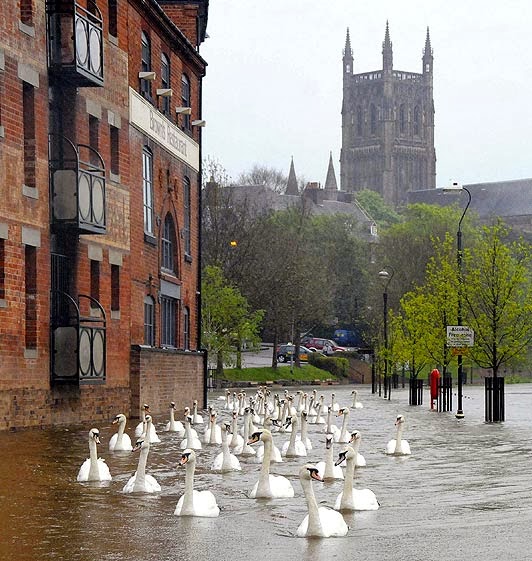
In recent years the news has been full of stories about heavy and sustained flooding in Britain.  We've all seen the pictures of historic villages inundated, entire residential neighbourhoods flooded out.  You would imagine that sort of devastation would send a government racing into action, especially a Conservative administration like Cameron's.  Well, as this report from the Telegraph demonstrates, that's not the case.

It would be “absurd, given the knowledge we now have,” said the Environment Secretary, Owen Paterson, last month, “to build houses or anything else on a flood plain.” Scientists and insurers have said the same, but the hard truth is that developers probably won’t take much notice.
 
According to the latest land use data, 7 per cent of all new dwellings in 2011 were built on flood plains. Over the past decade, about 40,000 properties went up on wholly or largely undefended land at “significant risk” of flooding, said the Government’s Committee on Climate Change (CCC).
 
Development on flood plains grew faster than development in the rest of the country. Surely now that will change? But political memories are short, and the problem is that southern England, seeing enormous population growth, probably cannot find room for all the new homes it needs without building on flood plains. Even where it could, some government policies push in the opposite direction.
 
The “National Policy Planning Framework” requires local authorities to “significantly boost” land available for housing. Across the country, including in currently flooded areas, councils are planning to allow tens of thousands of new flood plain properties as they struggle to meet this target. Flood plain or Green Belt is most of the development land that some councils have. Faced with that choice, any local politician would choose flood plain.
 
In the end, the only answer may be to accept development, but make it flood-proof: houses on legs, for instance, with garages or car parking at ground level. Developments in catchment areas need to be given tanks and pools to mop up water that plants used to absorb.
 
In the long term, flood plain homes not built like this will probably be uninsurable anyway, unmortgageable, and thus unsellable. The market will probably do more to stop bad development than the Government ever can.

Canada's Mythical Middle Class and the Quislings of Parliament Hill


The government likes to say it's all about the middle class.  So, too, the opposition parties.  On Parliament Hill it seems Canada's middle class is virtually surrounded by a sea of friends, each clamouring to outdo the other to lend a hand, give a leg up.  With friends like that in high places, those of the middle class can surely look forward to a bright and prosperous future.

Except that it's a load of crap.

An internal report prepared for the Harper government by Employment and Social Development Canada and pried out of the cold dead Tory hands by Canadian Press via a freedom of information demand, paints a much different, far less rosy picture of the state of Canada's middle class and the future that awaits them.

"The wages of middle income workers have stagnated," it says, referring to the period from 1993 to 2007. "Middle-income families are increasingly vulnerable to financial shocks."

The document, drawing on three years of "internal research," was prepared for the department's deputy minister, Ian Shugart, shortly before the resumption of Parliament last fall.

"In Canada, political parties are making the middle class a central piece of their agendas," notes the presentation.

"The market does not reward middle-income families so well," says the report. "As a result, they get an increasingly smaller share of the earning's pie" compared with higher-income families.

The Cheney-inspired, neo-conservative government of Harper, Flaherty, Oliver et al, seem happy enough to watch the middle class devolve into an American-style 'precariat' while the spoils of their labour increasingly accrue to the wealthy.  Mulcair and Trudeau, with their pledge not to increase taxes, appear to be walking in lockstep with Harper.

"Over the medium term, middle-income Canadians are unlikely to move to higher income brackets, i.e., the 'Canadian dream' is a myth more than a reality."

When judging the culpability of our parliamentarians for this deplorable condition, remember this.  Most inequality today and most of the stagnation of the middle class isn't market-driven or merit-based.  It is legislated, the creature of statutes written and passed on Parliament Hill.  Harper knows it.  Mulcair knows it.  Trudeau, unless he's an idiot, knows it.  It's about time we got some straight talk from these characters - not from Harper of course but at least from our own.


Just Sayin'

When you've just tossed your president and appoint an interim president to govern in his place pending elections, don't choose somebody who shows up for work dressed like this:


That, kids, is the standard uniform of an old-school, KGB thug - the dark, crew-neck sweater and the unmistakable black leather coat. Putin's got dozens in his closet from the good old, USSR days.    In that part of the world that costume is a symbol, it has meaning, and the meaning ain't good.
 
Congratulations, interim president Oleksandr Turchynov.  Try to go easy on the dissidents before the March elections. 


The Relief of California

Desperately needed rain may be enroute to northern California.  With any luck some agricultural production may be saved.  There's hope that an El Nino believed to be building in the Pacific will indulge California with a good drenching next winter.

For Once It Sucks to Live on the West Coast

Getting up at 4 a.m. to watch a hockey game.  Well more than just a hockey game.  It was worth it.  And now a message to the flat-packers who earned silver:

Saturday, February 22, 2014

Do We Really Need the Moon?

Without it, life on Earth probably never would have occurred.  It has defended life on Earth from many meteor and asteroid strikes.  It energizes life on Earth today.  It may even save us from ourselves with its gift of massive amounts of free energy, ours for the taking.  "It" is our moon.

This BBC documentary, Do We Really Need the Moon, is brilliant, almost mesmerizing.   It's almost an hour in length but it only takes a few minutes' watching before you'll be hooked.


Are We Poisoning Our Babies?

The growing onset of neurodevelopment disorders in babies such as autism and ADHD may be rooted in toxic chemicals to which infants are exposed.  That's the opinion of Philippe Grandjean, adjunct professor of environmental health at Harvard School of Public Health (HSPH) and Philip Landrigan, Dean for Global Health at Mount Sinai.   Their study was published today in The Lancet.

"The greatest concern is the large numbers of children who are affected by toxic damage to brain development in the absence of a formal diagnosis. They suffer reduced attention span, delayed development and poor school performance. Industrial chemicals are now emerging as likely causes," said Grandjean.

The new study follows similar research by the authors published in 2006 in which they reviewed clinical and epidemiological studies and identified five industrial chemicals as developmental neurotoxicants: lead, methylmercury, polychlorinated biphenyls, arsenic and toluene.

Grandjean and Landrigan's current review updates that list and adds six newly recognized developmental neurotoxicants: manganese, fluoride, chlorpyrifos and DDT (pesticides), tetrachloroethylene (a solvent), and the polybrominated diphenyl ethers (often used as flame retardants).

The effects of neurotoxicity can be society-wide, the authors note, as loss of IQ points may bring down earnings thereby affecting GDP. They can be costly as well; for example, the annual cost of lead poisoning in the U.S. is $50 billion, while behavioral problems associated with neurotoxicant exposure could also require special educational services and may even lead to incarceration, the authors write.

"The presumption that new chemicals and technologies are safe until proven otherwise is a fundamental problem," the authors write, adding, "Voluntary controls seem to be of little value."

Grandjean and Landrigan are advocates for the introduction of the "precautionary principle" which Wiki summarizes thusly:

"The precautionary principle or precautionary approach states if an action or policy has a suspected risk of causing harm to the public or to the environment, in the absence of scientific consensus that the action or policy is harmful, the burden of proof that it is not harmful falls on those taking the action. 
"This principle allows policy makers to make discretionary decisions in situations where there is the possibility of harm from taking a particular course or making a certain decision when extensive scientific knowledge on the matter is lacking. The principle implies that there is a social responsibility to protect the public from exposure to harm, when scientific investigation has found a plausible risk. These protections can be relaxed only if further scientific findings emerge that provide sound evidence that no harm will result."

This sort of rationale appealed to Adam Smith who wrote the 18th century masterpiece, the Koran of Free Enterprise Capitalism, The Wealth of Nations.  It was this same Adam Smith who warned of the "order of men" like Joe Oliver and Stephen Harper.

"The proposal of any new law or regulation of commerce which comes from [the business community] ought always to be listened to with great precaution, and ought never to be adopted till after having been long and carefully examined, not only with the most scrupulous, but with the most suspicious attention.  It comes from an order of men, whose interest is never exactly the same with that of the public, who have generally an interest to deceive and even to oppress the public, and who accordingly have, upon many occasions, both deceived and oppressed it."
We have left the barn door wide open an awfully long time but it's never too late to start acting sensibly by embracing the precautionary principle in our governmental and regulatory decision-making. 

Time we stopped poisoning our babies and corrupting our water and wreaking havoc on our atmosphere. 


Rex Murphy's Best Friend and Staunchest Defender - Why That'd be Rex Murphy


Wherein Rex assures us all, soiled linens aside, he has not been sleeping with Big Oil and, indeed, always says what's on his mind, unfettered though that may be by facts.

Rex, what's that line about "thou doth protest too much, methinks"? 

Hungary '56, Czechoslovakia '68, Ukraine '14?


Ukraine's pro-Russian president, Viktor Yanukovych, has been sent packing.  The parliament has turned on him and proclaimed him constitutionally unable to carry out his duties.  It is being reported that jailed opposition leader and former president, Yulia Tymoshenko, has been sprung from prison and reunited with the anti-government faction. 

Yanukovych has gone into hiding but not without first making a television appearance in which he condemned his ouster as a coup d'état. 

Hovering in the wings is the Kremlin which views a pro-Russia Ukraine as almost indispensable.  Rumblings out of Moscow, while restrained, sound just a bit ominous and harken back to the Hungarian revolution of 1956 and the Czech revolution of 1968, both of which were crushed beneath the treads of Soviet tanks.

Russian Foreign Minister Sergei Lavrov on Saturday expressed his "most serious concern" over what he said was the failure of the Ukrainian opposition to deliver on its February 21 deal with President Viktor Yanukovich.

Yanukovich agreed to sweeping concessions under the peace deal - clinched with the mediation efforts of the foreign ministers of France, Germany and Poland - that include early elections as well as a reduction of presidential powers.

Lavrov spoke on the phone with the European Union trio on Saturday, according to a statement released by the Russian Foreign Ministry, and expressed to them his "most serious concern" about the latest developments in Ukraine.

"The opposition not only has failed to fulfill a single one of its obligations but is already presenting new demands all the time, following the lead of armed extremists and pogromists whose actions pose a direct threat to Ukraine's sovereignty and constitutional order," he told his counterparts.

Could Putin intervene in the Ukraine as the Kremlin did in Hungary in 1956 and Czechoslovakia in 1968?  It seems unthinkable today but Russia did invade Georgia in 2008 to force then president Saakashvili to drop Georgia's claims to South Ossetia.  Back then Putin claimed his forces were 'peacekeepers.'