Wednesday, January 21, 2015

It's Nearly "Duffy Time" Again

We're just over two months away from the start of the trial of senator Mike Duffy.  It's scheduled to open April 7 and continue to May 12, when it will adjourn to be completed from June 1 to 19.  That's 41 court days in all.

With trial prep, motions and 41 days in court, that adds up to one huge legal bill for a guy who, rumour has it, is somewhat impecunious.

I'm guessing those will be the longest 41 days in the political career of Stephen Joseph Harper.  It could turn into an ordeal for a lot of the players including the PMO types and the Tory Senate leadership.

The known facts raise far more questions than they answer.  People are going to be examined and cross-examined on a number of those issues, some of which go uncomfortably close to the prime minister himself.

I'm surprised this has gone on as long as it has and I'll be even more surprised if the trial proceeds in April.   I thought this might be settled with a quiet plea bargain deal - no time/conditional sentence/various charges withdrawn - over the Christmas break.  Anything, just make it go away soon to put as much distance as possible between Duffy and the next election.

That hasn't happened and I'll spend some time over the next couple of weeks to see if I can find out why.

The Winter That Wasn't


I put a stand of firewood in my garage this year figuring it would spare me having to go out to the woodshed in back on cold winter nights.  I figured it would hold enough firewood to get through maybe six weeks of winter heating. As things are looking now, the modest cache in the garage won't even need refilling this winter.

Crocuses and daffs are coming up.  Trees are budding.  The herbs are re-awakening.  Before long it'll be time to fire up the lawnmower.

I never did get to dig out my snow shovel from the dark recesses of the garden shed.  We had a sprinkling of snow, maybe half an inch, one morning but it was gone as fast as it had arrived.

My daughter has noticed it too.  She figures we've entered a "sweater" climate. Her fireplace now turns her home into an oven so it's easier and more pleasant for all concerned just to throw on a sweater.

It's something of an annual rite of passage out here to needle our Eastern kin with accounts of early spring sprouting while they're still digging out from the latest blizzard.  It used to be good fun.  It's not funny any more.

What does this warming mean?  For urban dwellers it brings some obvious benefits in even lower heating costs and driveways that go from one year to the next without need of clearing.  But we share this big, sparsely populated, island with a great variety of wildlife for which this change may hold ominous consequences.

Warm winters mean reduced mountain snowpack.  That snowpack plays a vital role, especially during our summer "drought" months.  It's essential for salmon to spawn.  Not enough fresh water to dilute the seawater at the mouths of spawning rivers and the salmon will simply not head upstream.  If they do go up and spawn it takes a steady flow of cooling meltwater to keep their eggs from overheating and dying.  And, of course, the salmon spawn is critical for the survival of bears, wolves, eagles and scavengers of all sorts.

Those of us who live along the coasts - Pacific, Arctic and Atlantic - tend to see the changing climate perhaps a little more clearly than the inland population. From early-onset sea level rise to marine species migration there is a range of changes showing up at our doorsteps.  And just noticing it makes you wonder, okay, what's coming next?


Tuesday, January 20, 2015

Jesse Ventura's Two Million Dollar Judgment Against the "American Sniper"


American sniper, Chris Kyle, may be dead but he still owes Jesse Ventura nearly two million greenbacks in damages for defamation.  Even for me, that's a lot of money.

Kyle’s legal difficulties emerged from a subchapter of American Sniper titled “Punching Out Scruff Face.” In it, Kyle describes beating up a former Navy SEAL (“Scruff Face”) after the SEAL claims American soldiers deserved to die in Iraq. Early drafts of the book identified the SEAL as Jesse Ventura, former governor of Minnesota and famed professional wrestler, but Kyle’s publishers removed the name for fear of a lawsuit. Nonetheless, in a radio interview following the book’s release, Kyle admitted that “Scruff Face” was Ventura, and he repeated the claim soon after on The O’Reilly Factor.American Sniper shot to the top of Amazon’s best-seller list, becoming a smash hit for its publisher, HarperCollins, selling more than 1.5 million copies by July of 2014.

There was, however, a problem: The Ventura story wasn’t true, and Ventura meant to prove it. So he took Kyle to trial, suing him—and, after he died, his estate—for defamation and unjust enrichment. In the United States, defamation cases are extremely difficult to win, thanks to the First Amendment. When allegedly defamatory statements pertain to a public figure, the plaintiff mustn’t just prove those statements were false. He has to prove the defendant made those statements with “actual malice”—that is, knowledge that they were false—or with “reckless disregard” for their falsity. Very few defamation plaintiffs can make it over the high bar of actual malice.

Ventura made it. On July 29, 2014, a federal jury returned from six days of deliberations to award Ventura $1.845 million in damages—specifically, $500,000 for defamation and about $1.345 million for unjust enrichment. (In other words, Kyle unjustly profited from defaming Ventura, and so his estate must give Ventura some of that money.) Kyle’s widow, Taya Kyle, promptly filed for “judgment as a matter of law,” asking the trial judge to reverse’s the jury’s verdict because the jury clearly got it wrong. Failing that, she asked for an entirely new trial. The judge denied both requests, defending the jury’s verdict as legally and factually justifiable. Kyle’s widow is currently appealing the decision; her odds of winning appear quite low.

Now Ventura has launched another suit, this time against Kyle's publisher, Harper Collins.  Good luck with that, governor.

It's Not al Qaeda or ISIS That Endangers My Family. What Truly Imperils My Grandkids Is My Government.

The greatest threat to my grandchildren and their future is not Islamic radicalism. It's the Harper government and its obscene fetish with energy superpowerdom. It's helpful to remember what Harper & Co. are really about and it's a hell of a lot more than simply dragging their heels on climate change.

They're not only doing nothing to curb greenhouse gas emissions in Canada, they're obsessed with maximizing the extraction, production, transportation and consumption of the highest-cost/highest-carbon petroleum and, in the pursuit of their fossil fetish, they actively seek to undermine international consensus and derail any prospect of effective action.  That's going from bad to pernicious to diabolical.

It's not al Qaeda you have to fear.  If you're worried about the world in which your kids and grandkids will live out their lives, the enemy stalking you and yours currently lurks on Parliament Hill and in certain provincial legislatures across our land.

Do you think your grandkids will give a sh_t about you squandering billions (on their tab of course) fighting to save the world from al Qaeda while throwing the environment into chaos and ruin?  They'll be wondering, rather angrily I expect, at why you let it all happen knowing full well what it would mean for them fifty years down the road. They will despise us and with good cause.

A Sea Change for Davos?

The World Economic Forum spent its first four decades focused on economics, trade, and globalization.  Welcome World Economic Forum, Mk. 2.  From New Scientist.

"The risks of the last 10 years were all about economy. Those in the next 10 will be about societal and environmental issues," said Axel P. Lehmann of Zurich Insurance, at the launch last week of a WEF report that polled the opinions of 900 experts, including researchers, politicians and business leaders.
The demand for fresh water is so large and unsustainable that wide-scale shortages are expected. The report ranked this impending water crisis as the most dangerous risk facing our civilisation, followed by fast-spreading pandemics.

Failure to adapt to climate change came fifth on the WEF report's list of risks ranked by their potential impact on humankind.

As well as assessing impact, the report also estimates the likelihood of these risks becoming a reality. It ranks extreme weather events as second only to international conflicts, with natural catastrophes, not acting on climate change and water crises all featuring in the top 10.

Environmental risks to civilisation have risen in the forum's assessment this year, said Margareta Drzeniek-Hanouz of the WEF at the launch. And thanks to a rise in conflicts and distrust among states, the international community will be less able to deal with global health and environment issues, as it expends more energy on squabbling, said Espen Barth Eide, also of the WEF.

The World Economic Forum also seems to be adopting the "precautionary principle" in its approach to emerging technologies and the unknown risks they may hold.

New technologies, such as synthetic biology, nanotechnology and artificial intelligence, carry largely unknown – but potentially huge – risks, according to the report. Synthetic biology commands tremendous and rising interest from both academia and industry, said John Drzik of Marsh, a risk advice company, but could be risky due to "error and terror". The field is likely to grow dramatically but lacks oversight, he said.

According to Drzik, we face similar hazards from nanotech too. "Risks are not fully understood, yet already we have 180 products on the shelves," Drzik said. Emerging technologies carry a higher risk because the pace of innovation is faster, and governments have not caught up with that, he added. "Bodies that exist haven't done sufficient amount to regulate these risks."

For those interested in learning more about the inherent risks in these emerging technologies and from the manner in which scientific research is being undertaken in this new neo-liberal era, you should get your hands on a copy of "Our Final Hour, A Scientist's Warning: How Terror, Error, and Environmental Disaster Threaten Humankind's Future in This Century" by Royal Society professor and Britain's Astronomer Royal, Lord Martin Rees.  It's a well-reasoned, impeccably researched and compellingly argued warning to us all.

We've Already Entered the Counter-Stealth Technology Era


It'll be years before the over-priced, overdue and underperforming F-35, stealth light-attack bomber, ever shows up in Canadian air force hangars but already the supposed magic of stealth is losing its lustre to the evolution of counter-stealth technology.

Ask yourself just what did we expect the countries obviously intended as the targets of our stealth supremacy to do except to work out ways of both copying it and defeating it.  We've been waving this "first strike" sword over their heads - Russia's and China's - for about 15-years now.  The Americans even war-gamed a dress rehearsal of a stealth sneak attack on China.

The Russians were pretty quick off the mark but, then again, it was a Russian mathematician who unlocked the magical ratios and angles necessary to bring stealth to fruition.  The Americans simply translated his paper.  It took the Americans to show the Russians what they had overlooked.

The Chinese were no slouches either.  They hacked reams of data, including millions of lines of stealth computer code, from the computers of defence contractors (American and British) and the US government.  Then they pounced on the Lockheed RQ-170 stealth drone the Iranians brought down to help unlock secrets of design, radar-cloaking materials and electronics.  Tehran, it seems, allowed Chinese engineers to pretty much help themselves.

So today we have one Russian and two Chinese stealth warplanes flying and in late-stage development that will be coming into service about the same time as the F-35 and one can only guess what they're working on that's still under wraps.

In parallel with developing their own stealth warplanes, the designated "enemies" have also been making strides in counter-stealth technologies.  This room, housing models of America's top stealth warplanes and missiles, is at a Russian laboratory.


As far back as 2001 Aviation Week was publishing accounts of Russia's counter-stealth programme.  Back then the Russians were working to unlock America's stealth secrets using the wreckage of an F-117 stealth bomber brought down by the Serbs during the Kosovo air campaign.

Aviation Week's stealth guy is Bill Sweetman.  He writes that, in 2015, the F-35 debate will be mainly about cost and the emergence of new counter-stealth technologies.

Programmatic risk has become a reality that users must accept. The Netherlands is buying 37 aircraft rather than the planned 85; the money that would have acquired 60 F-15s for South Korea pays for 40 F-35As. The U.S. Air Force has put its badly needed F-16 upgrades on ice and is suffering readiness issues: The F-35 fleet, with a deficient diagnostic and logistics system, has a big appetite for experienced support people.

Cost will drive more JSF stories this year. The program has 700-plus international sales on its books, and relies on them to achieve planned production rates before 2020, but fewer than 5% are covered by signed contracts. Getting firm orders is an increasingly urgent matter. Denmark’s decision is due this year, as is a U.K. defense review that may indicate whether and when Britain plans to acquire most of its on-paper 138-aircraft fleet.

F-35 customers looking at budgets and schedules will want to know what the Block 4A/4B upgrade package will contain. Block 4A development starts next year and 4B becomes operational in 2024, making it the best capability before 2026. The wish list includes nuclear capability, Norwegian and Turkish cruise missiles, Brimstone and Meteor for the U.K., AIM-9X Block 3 for the U.S. Navy, “5th to 4th” communications and close-air-support systems for the Marines. Nobody is perfect, so 4A/4B will also fix discoveries from operational testing. Customers had better be ready to compromise.

The second class of risk, as the programmatic issue closes, is operational. Counter-stealth technology went from theory to big green pieces of hardware in 2013 with the appearance of Russia's 55Zh6ME radar complex, comprising a VHF active, electronically scanned array (AESA) networked with higher-frequency radars. Last year saw claims of stealth detection by the infrared-search-and-track community and radar developers, and the appearance of China’s analog to the 55Zh6ME. Nobody argues that stealth is dead, but has the operational advantage of the F-35 been eroded?

Expect more of the same in 2015: China is building its new, bigger Type 055 destroyer—it will not be surprising to see a low-band AESA on its aft deckhouse. Everyone and his aunt is selling digitized versions of the veteran Russian P-18 radar—counter-stealth on the cheap. In response to concern over low-band threats, Congress has extended the F/A-18/EA-18G production line and, with it, the debate over the future makeup of the carrier air wing.

What this suggests is that the F-35 will no longer be an independent operator but will require jamming from the EA-18G Growler.  Two steps forward, one step back.

Growler

The Marines will continue to mitigate operational risk by developing ways to use the short-takeoff, vertical-landing F-35B. The latest concept of operations seeks to place ships and main bases outside the range of mobile missiles while keeping refueling and rearming points close to the targets. Survival depends on moving those forward strips faster than the adversary can target them.

In other words the Marines operating the F-35B will be on the wrong side of the "whack-a-mole" board.

You Can't Defeat Radicalism with F-18s

Picture this.  You've got the crew in the bilges bailing furiously except for a couple of guys who are keeping busy boring new holes.   That's not likely to turn out well, is it?

Yet that's similar to the scenario outlined by the International Crisis Group on the radicalization spreading across Central Asia and churning out recruits for movements like ISIS.

The ICG reports that somewhere between 2,000 and 4,000 radicals have left Central Asia to join fighters in Iraq and Syria and, eventually, they'll return to bring the insurgency to their homelands.

The five – Kazakhstan, Kyrgyzstan, Tajikistan, Turkmenistan and Uzbekistan – crippled by corruption, poor governance and policing, have done little to address a threat as intricate as radical Islam. Instead, they are fuelling further radicalisation by curtailing civil liberties and initiating security crackdowns.

“It is easier for IS to gain recruits in Central Asia than in nearby Afghanistan and Pakistan”, says Deirdre Tynan, Central Asia Project Director. “Its appeal in the region is rooted in an unfulfilled desire for political and social change. Rich or poor, educated or not, young or mature, male or female – there is no single profile of an Islamic State supporter”.

Unfortunately the leaders of the five "Stans" have shown little inclination to accept the social, political and economic reforms needed to curb the ongoing and growing radicalism of their populations.  We in the West have done little beyond turning our heads to their excesses.  These tyrants are, after all, notionally on "our side."  

Monday, January 19, 2015

Is British Columbia Ready for a Green Party Breakthrough?


Legendary pundit Rafe Mair looks around his affluent West Vancouver riding and sees change in the air.

In years past, many people whom I know throughout the constituency would rather have been found in a house of ill fame than part of a meeting supporting environmentalists. But this has dramatically changed, and people I once knew as staunch Socreds are now leaders against LNG development, pipelines and tankers, and now openly Green in their politics. Is this happening elsewhere, I wonder?

The Green Party has another plus. More and more Canadians are coming to realize that government MPs are no more than highly paid lickspittles doing precisely what they're told. They pretend to be busy little bees on their constituents' behalf, but the most cursory examination shows this to be rubbish. My own MP, in nearly eight years, has never uttered a single word of criticism of any statement or action by the Tory government.

...The federal Liberal leader doesn't have the magic name in B.C. that he evidently has in Ontario. Nevertheless, B.C. is essentially a small "l" liberal province, driven away from the Liberal party by policy rather than philosophy. Will dislike of Harper translate into votes for the son of the hated Pierre, who probably isn't as hated in death as he was alive?

The NDP has its base and has been strongest of the major parties on the environment. But Thomas Mulcair looks and sounds so... eastern!

While it's early days, I'll venture this prognostication. The Greens will do substantially better than last time, and that doesn't have to be terrific to be effective. In fact, I'll go so far as to predict that they'll hold the balance of power after next November.

If I'm right, at least there'll finally be something happening in Ottawa of interest to British Columbians.

In Kentucky, the Cops Shoot Themselves

In Glasgow, Kentucky, a cop goes into a sporting goods store to check out a pistol.  The clerk hands him (inadvertently I'm sure) a loaded automatic.  The cop plays with it for a minute before proceeding to blow off his own finger.


We should never entrust firearms to cops like this.  He breaks every rule in the book.  First rule, you assume the weapon is loaded.  That's your responsibility as soon as you pick up the gun.  Second rule, you SAFE the firearm, ensuring that it's not loaded.  Third rule, you never, ever, ever point a firearm at others, such as the two employees and two customers further down the counter.

Je Suis L'Oeuf

There's nothing quite like watching a senior capo in the Harper mob on the run.

We Don' Need No Steenking Pipelines

Fourth Time Lucky?

All is not well up Alberta's Athabasca poop chute.  The Tyee's Mitchell Anderson writes that the Wild Rose hangover is just setting in.


So what does Alberta have to show for some 24 billion barrels of conventional crude and bitumen that have so far come out of the ground? The province is currently over $12 billion in debt and is projected to run a budget deficit of $500 million this year, the seventh consecutive year in the red for a province that prides itself on having a sharp fiscal pencil.

Resource prices often go through boom and bust cycles, and this is certainly not the first in Alberta, as evidenced by a certain iconic bumper sticker. Yet to fully grasp Canada's colossal lost opportunity, we need to look toward our Norwegian neighbours.


Norway, like Canada, was scaling up its petroleum industry in the early 1970s. It endured the same cyclical rides in resource pricing, and negotiated terms with many of the same foreign companies.

Yet Norway now has over $1 trillion socked away in its sovereign wealth fund, a dedicated repository of all petroleum revenues. Even if oil was worth nothing tomorrow, the country would still have no public debt, fully funded social programs that we can only dream of, and a very large nest egg to transition to a new economy.

So where is our nest egg? The Alberta Heritage Fund was started almost 15 years before the Norwegian oil fund, yet the province has not contributed a dime of resource revenues since 1987. This moribund fund has only two per cent of the value of Norway's pile of cash, which is now the largest sovereign wealth fund in the world.


The difference is what Alberta had that Norway didn't have.  The Norwegians didn't have Ralph Klein.  They didn't have Ed "Special Ed" Stelmach.  They didn't have Alison Redford and they sure as hell didn't have Sideshow Steve Harper or Joe Oliver.  They also were spared the sophomoric and ultimately self-destructive ideology these morons inflict on all and sundry in their rush to maximize bitumen extraction at any cost.


The laissez-faire approach to resource management in Alberta has been a fiscal disaster compared to what might have been. In 2012, the province collected a mere $4.04 in royalties per barrel of oil equivalent. That same year, the Norwegian taxpayer raked in $46.29 on their petroleum production -- more than 10 times as much. How did they achieve such vastly better results? By embracing a profitable public involvement and oversight in their resource economy that would be abhorrent to the Fraser Institute worldview that has taken root in Alberta.

While it is true that Norway's Brent crude is worth much more than the low-grade bitumen currently wrung out of the oilsands, Alberta has also produced enormous amounts of conventional crude since oil was discovered in the Turner Valley southwest of Calgary 100 years ago.

Ignoring the oilsands altogether, Alberta has produced 18 per cent more conventional crude and natural gas than has Norway, and the province didn't have to venture hundreds of kilometres into the North Sea to get it
.


Anderson sees a glimmer of hope in the recent election of Jim Prentice to become the province's premier.  He thinks Prentice might just be the first sane Alberta politician to come along since Peter Lougheed.  Maybe, we'll see.

Remember, these are the same people who are telling the people of British Columbia to stand aside and let them run hazmat pipelines across our province so that armadas of supertankers can ply our pristine but treacherous coast.  I don't think so.

All I Want from Davos This Year

I feel like a kid writing his wish list for Santa Claus.  In this case Santa would be the World Economic Forum meeting, a gaggle of billionaires and top politicos, gathering this week in the beautiful mountain resort of Davos, Switzerland.

We know they're going to receive a couple of "this is it, really, the world is ending, last call" reports on the terminal state of our global environment.  That should get them through the first three courses and then, for dessert, they'll mull over a report on inequality from Oxfam showing that, by next year, 1% of mankind will own more than half of everything.  If you're with me and still safely within that 99% that means we get to share the other half.  Here's your share.  Sorry.

The charity’s research, published on Monday, shows that the share of the world’s wealth owned by the best-off 1% has increased from 44% in 2009 to 48% in 2014, while the least well-off 80% currently own just 5.5%.

“The message is that rising inequality is dangerous. It’s bad for growth and it’s bad for governance. We see a concentration of wealth capturing power and leaving ordinary people voiceless and their interests uncared for.”

Oxfam made headlines at Davos last year with a study showing that the 85 richest people on the planet have the same wealth as the poorest 50% (3.5 billion people). The charity said this year that the comparison was now even more stark, with just 80 people owning the same amount of wealth as more than 3.5 billion people, down from 388 in 2010.


Oxfam said it was calling on governments to adopt a seven point plan:

• Clamp down on tax dodging by corporations and rich individuals.

• Invest in universal, free public services such as health and education.

• Share the tax burden fairly, shifting taxation from labour and consumption towards capital and wealth.

• Introduce minimum wages and move towards a living wage for all workers.

• Introduce equal pay legislation and promote economic policies to give women a fair deal.

• Ensure adequate safety-nets for the poorest, including a minimum-income guarantee.

• Agree a global goal to tackle inequality.

Speaking to the Guardian, Byanyima added: “Extreme inequality is not just an accident or a natural rule of economics. It is the result of policies and with different policies it can be reduced. I am optimistic that there will be change.


This echoes the warning from Nobel laureate economist, Joe Stiglitz, in his 2012 book, "The Price of Inequality" that was heralded by The New York Times as "the single most comprehensive counterargument to Democratic neo-liberalism and Republican laissez-faire theories."  In his book, Stiglitz dissects inequality and then demonstrates how classic merit- and market-based inequality has been utterly eclipsed by the rampant inequality crafted by our legislatures.  It stands as an indictment of our political classes for their abject betrayal of the publics they are supposed to serve.  

What began as a means to shift the tax burden from capital to labour and benefits from labour to capital has, today, predictably resulted in the transfer of political power and influence from the electorate to capital in a process now called "political capture."  It's a form of political corruption by which the political apparatus is put to the service of privileged interests at the cost and to the detriment of the public interest. Nowhere is this as blatant as in Washington but there's plenty of it in the Great White North as well.  Fossil fuel subsidies are a classic example. Harper's income splitting initiative that will benefit the top 15% of households is another.  Every corporate tax exemption and deferral, almost every subsidy, grant and waiver (especially ecological) come under this umbrella of legislated inequality.  

The bitter irony is that this political capture so boldly on display in our politically engineered inequality is the unmovable mountain that will continue to thwart any possible chance we have at saving this planet, our environment, for future generations.  We haven't got a chance, not a snowball's chance in hell, of salvaging what remains of our environment until we begin to see those forces that suppress action that only they are empowered (and duty bound) to initiate for what they are.  That goes for the lot of them.

So, what do I want from Davos Claus this year?  Truth, that's all.  Just complete, unvarnished truth about the threats facing mankind, who is behind those threats and what we have to do, now, to fight back.  What's that?  There is no Santa? Well, shit!

I'm Sorry He's Not Going to Live But It's a Dangerous Job


One of the two RCMP officers shot in a casino in St. Albert, Alberta, is not expected to live.  Constable David Wynn was shot in the head and doctors do not believe he will recover from his wound. It reminds us that policing in Canada can be a dangerous job. I suspect that's why we give them body armour, pistols, shotguns, tasers, pepper spray and such.

This being the Year of Our Harper, 2015, the usual suspects have wasted no time jumping on the idling hearse to demand "more protection" for Canada's police officers.  RCMP Commish, Bob "I always get my Duffy" Paulson, questioned how the shooter, Shawn Rhen, was able to get his hands on a gun given his lifetime ban against owning one.  Who knows?  Maybe if we had a gun registry that might be a good place to start looking for answers.  Of course the shooter probably just went into some seedy bar and bought the gun under the table.

More worrisome were the remarks from Captain Former, Kash Heed, the former chief of the West Vancouver police before he moved on to become British Columbia's former solicitor general, who said, “We need to outfit our police officers, give them the tactics, give them the training … to ensure they go home each and every day.”

They're pretty good at couching their remarks but what it seems they're after is something that might wind up looking like the Ferguson, Missouri goon squads. Do we want our cops strolling around with assault rifles?  Will that make them safer? Will it make you safer? 

Maybe if this government did a better job at gun control, putting some serious money into intelligence to locate, identify and recover guns circulating through the criminal ranks that would be a good start.  We seem to be doing a good job at generously funding an intelligence operation to keep track of dissidents opposed to pipelines.  Maybe we should take the considerable experience we have amassed on that project and put it to work in a crackdown on illegal firearms.

In the meantime, let's keep this in perspective. Cops die. It's an unfortunate reality in their job.   

Sunday, January 18, 2015

Jumpin' Jehovah


"Gott Mit Uns", the motto that was stamped on the belt buckle of every soldier in the Nazi Wehrmacht in WWII as they did their decidedly ungodly work.  Now it seems the US military's turn to invoke the god link and it's causing quite a stir.


It's hard to imagine exactly what has been achieved for god by the US military over the past 15-years or ever.  Somehow I don't think any god, as we're given to understand the deity, would see American soldiers as on some divine mission.

Yet, as former US army commander turned professor, Andrew J. Bacevich, notes in "The New American Militarism", fundamentalist Christianity has become deeply embedded within the US military.  Harper's magazine also dealt with this in a 2009 article, "Jesus Killed Mohammed."

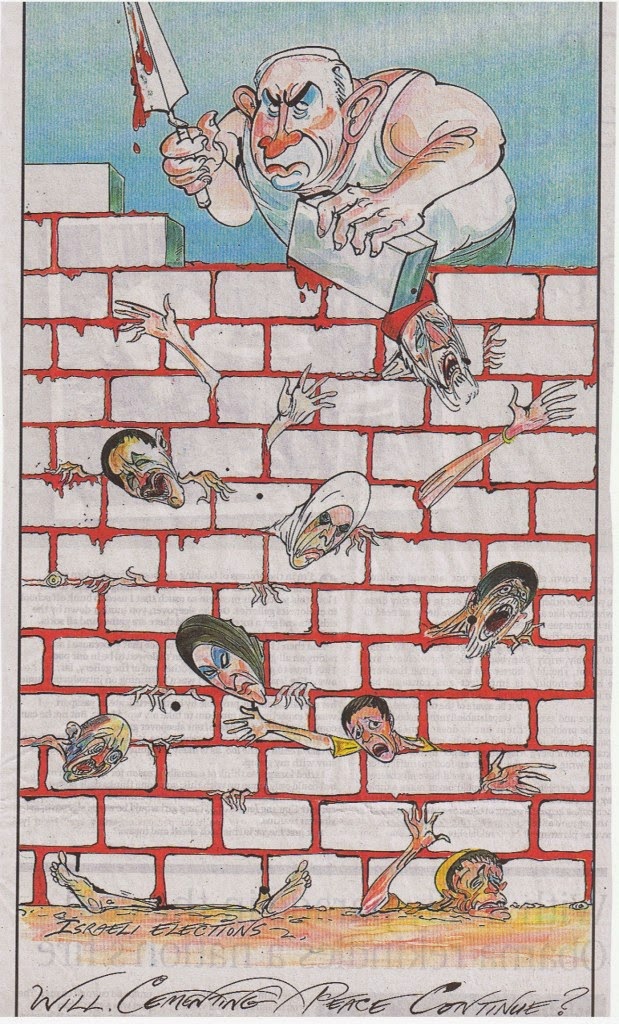
Meanwhile, in other wingnuttery news, Reptilian Rupert Murdoch has groveled to apologize to Israel and prime minister Benjy Netanyahu for a cartoon published in the Sunday Times depicting an obviously bloody Netanyahu building a wall using Palestinian bodies.


According to the Times of Israel, the cartoon has so outraged Israelis that the country's ambassador to Britain has demanded an apology.

In a meeting Monday with Prime Minister Benjamin Netanyahu, Tony Blair, the representative of the Middle East quartet who’s also a former British premier, deplored the caricature, noting the timing of its publication on International Holocaust Remembrance Day, according to a press release from the Prime Minister’s Office.


Good to see Tony hasn't lost any of his brown nosing, butt sniffing skills.  


Saturday, January 17, 2015

This Changes Everything? I Doubt It.

I finally got around to finishing Naomi Klein's "This Changes Everything." While it's insightful it didn't break much ground and was disappointing in discussing just how we'll ever "change everything."  Klein gets it.  There's more than climate change at work threatening mankind.  She has a handle on over-population and over-consumption, resource shortages and such but she seems to pin her hopes on some sort of uprising in the miasma emanating from our excesses.  I'm unconvinced.

When I look at the world today, I think that, barring some planet-wide epiphany, some massive revolutionary change, we're hooped.  

I try to stay current with developments in environmental science, the latest reports and such.  Many of these studies are behind paywalls but you can usually find the executive summary and a few informative reviews to put the pieces together.

The past six months have seen new science that has certainly dimmed my outlook.  There was the World Bank study that found we have already locked in 1.5C warming for our grandkids even if we stopped carbon emissions today. What that means is that all of our ongoing and steadily increasing carbon emissions are adding to that 1.5C.  It seems to confirm projections that we're heading for 4 to 5C of warming by the end of this century and nobody contends that's survivable.

In September we received the Living Planet Report 2014 of the WWF, the Global Footprint Network and the Zoological Society of London that found we have lost half of the wild life on our planet since the early 70s.  Half of it is gone.  We're now working our way on the remaining half.  How can that be?  It's easy.  Mankind is now consuming renewable resources at more than 1.5 times their replenishment rate.  When we're taking that much, what's left for all other life forms?  Certainly not enough to sustain them.  We won't do without so they have to until they can't.  We get politely concerned when lakes dry up or rivers no longer reach the sea but we're talking about habitats that other animals and plants cannot live without. Sometimes, as in the collapse of global fisheries, we go at them directly for our own consumption.  Sometimes it's our pollution, especially nitrogen and phosphorous discharge, that kills them off.  If you're a non-human life form today you have to contend with climate change impacts, loss of resources and habitat, human predation and the steadily accumulating pollutants and contaminants of many varieties.

Then there were the reports released this week, apparently for the World Economic Forum, Davos.  The WEF released its "Global Risks 2015" report. The future it foresees is increasingly challenging, an "increasingly complex risk environment for which the world is "insufficiently prepared."  Inter-state wars, resource wars which are wars for survival, are the predominant threat to global security in the coming decade.  Water wars are the prime culprit.

Most troubling for me was the report on the 5-year study of the nine key factors that "ensure a livable planet for humans."  We're already in serious trouble on four of the nine and the trend is not encouraging on the others.

The report reinforces a conclusion I reached some time ago that climate change/global warming is not a stand-alone problem but one symptom of a much greater disorder that confronts and threatens the continuation of mankind.  The comments of the lead author, published in The Guardian, speak for themselves about the mess we're in.

Since 1950 urban populations have increased seven-fold, primary energy use has soared by a factor of five, while the amount of fertiliser used is now eight times higher. The amount of nitrogen entering the oceans has quadrupled.

All of these changes are shifting Earth into a “new state” that is becoming less hospitable to human life, researchers said.

“These indicators have shot up since 1950 and there are no signs they are slowing down,” said Prof Will Steffen of the Australian National University and the Stockholm Resilience Centre. Steffen is the lead author on both of the studies.

“When economic systems went into overdrive, there was a massive increase in resource use and pollution. It used to be confined to local and regional areas but we’re now seeing this occurring on a global scale. These changes are down to human activity, not natural variability.”

“We are clearing land, we are degrading land, we introduce feral animals and take the top predators out, we change the marine ecosystem by overfishing – it’s a death by a thousand cuts,” he said. “That direct impact upon the land is the most important factor right now, even more than climate change.”

“If the Earth is going to move to a warmer state, 5-6C warmer, with no ice caps, it will do so and that won’t be good for large mammals like us. People say the world is robust and that’s true, there will be life on Earth, but the Earth won’t be robust for us.

“Some people say we can adapt due to technology, but that’s a belief system, it’s not based on fact. There is no convincing evidence that a large mammal, with a core body temperature of 37C, will be able to evolve that quickly. Insects can, but humans can’t and that’s a problem.”

Steffen said the research showed the economic system was “fundamentally flawed” as it ignored critically important life support systems.

“It’s clear the economic system is driving us towards an unsustainable future and people of my daughter’s generation will find it increasingly hard to survive,” he said. “History has shown that civilisations have risen, stuck to their core values and then collapsed because they didn’t change. That’s where we are today.”

The two studies, published in Science and Anthropocene Review, featured the work of scientists from countries including the US, Sweden, Germany and India. The findings will be presented in seven seminars at the World Economic Forum in Davos, which takes place between 21 and 25 January.

All of these studies that are coming in point to one conclusion.   We, mankind, have painted ourselves into a very dangerous corner and there may no longer be a way out.  We cling to forms of organization - economic, industrial, social and political - that outlived their utility as far back as the 70s when we began expanding past the limits of our environment.  Whether we even have the ability to solve our challenges isn't the issue.  What's holding us back is a complete lack of will, especially among those we empower and rely upon to safeguard our nation and our children.  

International Criminal Court Launches Probe. Israel Seethes and Squirms.


A prosecutor from the International Criminal Court has opened a probe into possible war crimes in the Palestinian territories.  Israel wasted no time lashing out, threatening to dismantle the ICC.

Potential cases [prosecutor Fatou] Bensouda could take on include allegations of war crimes by Israel during last summer's Gaza war where the Palestinians suffered heavy civilian casualties. Israel's settlement construction on occupied Palestinian lands could also be examined.

The cases could also include alleged war crimes by Hamas, which controls Gaza, including the firing of thousands of rockets at Israeli residential areas from crowded neighborhoods.

[Israeli prime minister, Benjamin] Netanyahu also said that, "unfortunately, the move turns the court into part of the problem, rather than part of the solution," Netanyahu concluded. "It's a scandalous that only days after terrorists slaughtered Jews in Paris ... the ICC opens an inquiry against the Jewish state, and only because it defends its citizens against Hamas, a terrorist organization that is partnered with the Palestinian Authority."

Describing the court's statement as hypocritical and supportive of terror, Foreign Minister Avigdor Lieberman the decision was "scandalous," stemmed political and anti-Israel motives and was an attempt to "harm Israel's right to defend itself against terror." He added that Israel would take international action to have the ICC dismantled.


Lieberman said that it was impossible to compare the Israel Defense Forces, which "does everything possible to avoid harming innocents," with "terror organizations which fire from areas populated by civilians against areas populated by other civilians." 

Lieberman, true to form, is talking out of his ass.  The assault on Gaza last summer was a textbook case of the Israeli tactic, Dahiyeh, the deliberate and massive targeting of civilians and the essential infrastructure upon which civilians depend.  It begins with airstrikes to take out sewer and water plants, indispensible to urban living.  Next up are hospitals and schools.  Finally residential areas are targeted and attacked.  Dahiyeh  takes its name from the Lebanese suburb of Beirut where Israel introduced the atrocity.  That this is a deliberate. calculated policy authorized by the highest Israeli authority was revealed by documents released by Wikileaks.

Thursday, January 15, 2015

Russell Brand Skewers FOX News

The idiots at FOX really have only themselves to blame for this.


The Nine Really Deadly Sins. Another One Falls.


Five years ago a team of 30-scientists formulated a list of nine ecological tipping points mankind must not cross.  Consider them the planetary nine deadly sins. A report in Scientific American warns that we have just crossed our fourth tipping point.

To its peril, the world had already crossed three of those safe limits: too much carbon dioxide in the atmosphere, too rapid a rate of species loss and too much pouring of nitrogen into rivers and oceans—primarily in the form of fertilizer runoff.

Now we have succeeded in transgressing a fourth limit: the amount of forestland being bulldozed or burned out of existence. Less and less forest reduces the planet’s ability to absorb some of that carbon dioxide and to produce water vapor, crucial to plant life. And the ongoing loss alters how much of the sun’s energy is absorbed or reflected across wide regions, which itself can modify climate.

Details about the fourth transgression, and updates on how well the planet is faring on all nine boundaries, are being published today online in Science. Another international team, with some of the same members from the original group, decided to reassess the boundaries given five more years of data, and they plan to keep doing so into the future. “Science moves on,” says the paper’s lead author, Will Steffen, a professor at the Australian National University and at the Stockholm Resilience Center at Stockholm University. “And so do the best ways to formulate the boundaries and apply them to policy.”


It's all too much for the political classes to grasp.

 Indeed, the group chose two “core boundaries,” each of which could “drive the earth system into a new state” if they are persistently surpassed. Of course the insinuation is that a “new” state is not a state we want to be in. The two core boundaries are “climate change”—primarily the amount of CO2 in the atmosphere—and “biosphere integrity,” which is how much we are killing off species and tearing up natural habitat. “Looking back into geologic history, we see that climate change and mass extinctions have occurred when major changes took place on earth,” Steffen says. Too much CO2 will simply cook the planet, and too much disruption of ecosystems will destroy natural resources (think food) on which people depend.

The designation of two core boundaries may in part be a response to frustration from policymakers when the nine boundaries were first revealed. They were simply too much for legislators and political leaders to take on. Steffen hopes that a focus on the core boundaries will guide the finalization of U.N. Sustainable Development Goals, happening this year, which are meant to guide nations in crafting policies that help sustain the planet into the future.
The realization that it is time to talk tough comes from a second new paper appearing today online in Anthropocene Review, also led by Steffen. It updates a striking set of 24 graphs that show that almost all the damage to earth by humans has occurred since 1950, in lock step with rapid economic growth worldwide. This “great acceleration” of social, economic and environmental drivers basically says that although growing population adds stress to the earth’s systems, greater consumption through rising living standards is responsible for even more of the burden.

The fact is that we're out of time.  Applying the brakes, slowing down, is not going to do it for us any more.  We have to find "reverse".  We have to claw our way back out of this or accept what could be a terminal outcome for not just mankind but almost all life on our planet.

We have to stop looking the other way.  Watching this clip would be a good start.

Feeding Europe's Islamophobia (And Our Own?)

Europe's Islamophobes know a good thing when they see it and, according to Der Spiegel, they're making the most of the Charlie Hebdo massacre.

This week's events in France could ultimately pour fuel on the flames of widespread French anxiety about an Islam that many believe is threatening the fabric of the country's very identity along with fears that other radical Islamists might conduct similar attacks.

Of course, that applies not only to France, but to the entire Western World, including Germany, which has so far been spared attacks comparable in scale. Nevertheless, Germans too harbor a diffuse fear of Islam, which has been manifesting itself of late on the streets of Dresden in the form of protests held by the loose-knit group calling itself Patriotic Europeans Against the Islamization of the West (Pegida). All over the place, it seems, people incapable of differentiating between Muslims and murderous assassins feel affirmed in their views.

...The debate is raging particularly intensely in France, where Marine Le Pen's Front National has been winning big with voters for years with its Islamophobic messages. Still fresh on the minds of the French is the March 2012 killing spree waged by 23-year-old Mohamed Merah, who hunted down soldiers, Jewish children and their teacher in Toulouse with a handgun and a scooter, killing seven.

...One of Queen Elizabeth II's crowning moments came after the London bombings in 2005. In a remarkable speech, the Queen directed some of her remarks right at terrorists: "Those who perpetrate these brutal acts against innocent people should know that they will not change our way of life."
...There's also a chance France could fall prey to right-wing populists. In a tweet on Thursday, Le Pen reiterated her demand that the country hold a referendum on the death penalty, which is banned in France, a prohibition enshrined in the Charter of Fundamental Rights of the European Union. Le Pen's standing was soaring in public opinion polls even prior to Wednesday's attack. Whether support for her will now rise or fall hinges on how the French public ultimately reacts to the murders.

...The radicalization of French youth is hardly a recent phenomenon. For 15 years, the anthropologist Dounia Bouzar has been studying the issue. She has observed that a growing number of young French have found refuge in religion because, as Bouzar says, "reality no longer offers them a future."

They used to be primarily young men and women from the suburbs who grow up in broken families or orphanages, like the gunman Merah, for example. But the profile has changed. Now, even children from the middle classes are attracted to an absurdly radical form of Islam.

Those who are now doing the killing, Bouzar is convinced, are the little brothers of those who tried hard to succeed, but who were unable to. They used to believe in the Republic and its values and thought that, if only they did well enough in school, they would find a job. But unfortunately things didn't turn out that way: Because they had the wrong names and lived in the wrong part of town. "That engenders hate," says Bouzar.


"Man Has Gone Too Far." Pope Francis Comes Out Swinging.


What better place to speak out against climate change than the severe storm ravaged Philippines?

Wading into the climate change debate on board the papal plane, the Pope told journalists he hoped negotiators at the next round of climate change talks in Paris in November would take a courageous stand to protect the environment.

"I don't know if it is all (man's fault) but the majority is, for the most part, it is man who continuously slaps down nature," he said.

"We have in a sense taken over nature. I think we have exploited nature too much."

The comments were Pope Francis' clearest on the environment since he pledged to make the issue a priority on the day of his installation as Pope in 2013.

"We have, in a sense, lorded it over nature, over Sister Earth, over Mother Earth," said the leader of 1.2 billion Catholics, who has in the past spoken about the need to protect the environment.