Thursday, January 18, 2007

Why Not Follow Britain & America on This One?


Around the world the arrival of Spring means many things. In Afghanistan it means open season for the Taliban insurgency.

The Americans and the British have no doubt that this Spring will bring a renewed Taliban offensive that is expected to be more violent than in the past. That's why both countries are talking about sending reinforcements to meet the growing Taliban challenge.

Makes sense, doesn't it? If the bad guys increase their force, if their threat to your own soldiers increases, you increase the size of your own force to meet the growing threat.

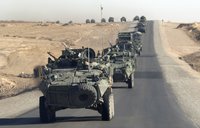
So, how are we doing in Kandahar? I suppose the Canadian contingent could use another 1,000 to 1,500 combat soldiers right about now to supplement the meagre battle group of 1,000 rifles we use to control Kandahar province.

What are we doing to back up our fighting troops? Is "nothing" too harsh a word?

According to a statement made by General Rick Hillier a month ago, we're tapped. We don't have any more troops to send. Now Hillier has shown he has a bit of the politician in him. He may actually be able to stretch his forces a little further. He could copy Bush's "surge" trick - extend tours of soldiers who were to leave Iraq and speed up the arrival of their replacements - to create greater numbers. He could scour the non-combat types at Kandahar airfield and get some of them on the line. I think he should do just that and Parliament should make sure he does.

One rifle for every 20 square miles pretty much limits your options, especially when the other guy is on the offensive and he's working in his own backyard, among his own people. If the Americans and the Brits realize they need to urgently reinforce their contingents, it's a good bet we do too. And, when it comes to reinforcement, timing is everything. They're only good if they're there in time.

Maliki Bites Bush


Lord knows he's taken enough criticism from Washington, now Iraqi PM al-Maliki isn't passing up any chances to get a few in himself.

Today he announced that his government has apprehended some 400-Shiite militia fighters including about 100-senior Mahdi army officials. Then, just when it began to sound like Maliki was finally dancing to Washington's tune, the mood changed. According to The Guardian, it was Maliki who now had plenty of criticism:

"Maliki underscored his differences with the U.S., suggesting that American miscalculations had worsened the bloodshed in Iraq, and warning that his patience for political negotiation with warring factions was wearing thin."

"Maliki said if Iraqi security forces were given sufficient training and equipment, they could stabilize the country enough to allow the withdrawal of U.S. troops starting in three to six months — a period in which President Bush's proposed troop buildup would still be underway.

"He said if better U.S. training and supplies had come earlier, lives could have been saved."I think that within three to six months our need for the American troops will dramatically go down," Maliki said. "That's on the condition that there are real strong efforts to support our military forces."

"When asked whether the Bush administration needed him now more than he needed the administration, Maliki laughed uproariously, calling it an "evil question.

"Throughout, Maliki appeared confident and seemed to relish the chance to respond to statements by Bush and U.S. officials, including allegations that his government had botched the hanging of deposed leader Saddam Hussein and had not done enough to stop the sectarian violence.

"Commenting on a recent statement by Secretary of State Condoleezza Rice, he said, "Rice is expressing her own point of view if she thinks that the [Iraqi] government is on borrowed time," humorously suggesting that it might be the Bush administration that is on borrowed time.

"I understand and realize that inside the American administration there is some kind of a crisis situation, especially after the results of the last election," he said.

"Maliki said suggestions by Bush officials that the U.S. did not fully support his government played into the hands of insurgents.

"'I believe such statements give a morale boost to the terrorists and push them toward making an extra effort, making them believe they have defeated the American administration,' Maliki said. 'But I can tell you, they haven't defeated the Iraqi government.'"

The Iraqi government may have arrested 400-Sadr loyalists but it remains to be seen what will be done with them. If the arrests were simply for appearances to keep Washington happy, those apprehended may be quietly released in short order. That has happened before.

War Words

Criticism of James Polk's war on Mexico:

"As to the mode of terminating the war and securing peace, the president is equally wandering and indefinite.

"First, it is to be done by a more vigorous prosecution of the war in the vital parts of the enemy's country; and, after apparently talking himself tired on this point, the president drops down into a half despairing tone, and tells us that 'with a people distracted and divided by contending factions, and a government subject to constant changes, by successive revolutions, the continued success of our arms may fail to secure a satisfactory peace'.

"Then he suggests the propriety of wheedling the Mexican people to desert the counsels of their own leaders and, trusting in our protection, to set up a government from which we can secure a satisfactory peace, telling us, that 'this may become the only mode of obtaining such a peace'.

"But soon he falls into doubt of this too, and then drops back on to the already half abandoned ground of 'more vigorous prosecution'. All this shows that the president is, in no ways, satisfied with his own positions.

"First he takes up one and, in attempting to argue us into it, he argues himself out of it; then seizes another, and goes through the same process, and then, confused at being able to think of nothing new, he snatches up the old one again, which he has some time before cast off. His mind, tasked beyond its power, is running hither and thither, like some tortured creature on a burning surface, finding no position on which it can settle down and be at ease."

- Abraham Lincoln

Art Buchwald - Dead at 81

Wednesday, January 17, 2007

The Insufferable Prig


I wonder how much Stephen Harper admires Alberto Gonzales. George Bush's off-the-wall Attorney-General must appeal to Stevie's idea of top-down, iron claw control.

In his latest tirade, Gonzales says federal judges are unqualified to make rulings affecting national security policy - stuff like indefinite detention without charge, illegal searches, that sort of thing.

Gonzales, in a speech prepared (naturally) for the ultra-right American Enterprise Institute, discussed the Bush administration's criteria for selecting lapdog judges. "We want to determine whether he understands the inherent limits that make an unelected judiciary inferior to Congress or the president in making policy judgments. That, for example, a judge will never be in the best position to know what is in the national security interests of our country."

Gonzales who, in his opinion on torture, defined the practise as something that began just short of flaying someone alive, obviously wants toadie judges and, until now, he's had his way. With the Dems in control of Congress, George Bush has withdrawn four of his nominations for judicial appointments.

Does Anyone Have a Better Idea?


That's the cheesy mantra of the Bush Brigade, chanted far and wide as their sole response to the growing mass of their critics.

Isn't it odd how they want better ideas, now that they've screwed up the Global War Without End on Terrorism? Too bad they weren't open to the ideas that were offered back when they could have made a difference.

How about the ideas, or at least the opinion of Hans Blix, well before the conquest, to the effect that there was no sign Saddam had any WMDs or that he posed a threat to anyone? That was certainly worth noting, that is if you had any genuine concerns about WMDs other than their utility to scare the hell out of the folks back home.

How about the idea from many sources suggesting you finish the job in Afghanistan before dropping that to embark on an adventure in Iraq?

How about the ideas of General Shinseki that you go into Iraq with several hundreds of thousands of soldiers so you could properly secure the place? Or the ideas put forward by your own State Department to help you prepare for the challenges of a lengthy occupation?

Sorry George, sorry Dick, sorry Mr. Snow - your problem hasn't been a shortage of ideas better than your own, it's been your arrogant stupidity in refusing to consider them. You've already got this hopelessly screwed up, there are no more good ideas, only bad ideas and you're quite capable of making those all by yourself.

This Will Add a Few Bucks to Your Ticket


Imagine - a jetliner that smells you and watches your face and listens to detect any strange words or sounds you make, that monitors you in your seat and in the toilet. Kinda freaky, eh? Yeah, well get ready because this plane is under development right now in Europe. Here's how the Sydney Morning Herald describes it:

"At the door, a device reputedly 30 times more sensitive than a dog scans passengers for dangerous chemicals and vapours.

"After take-off, computers monitor conversations for suspicious words and fingernail-size video cameras detect any nervous facial tics. Buzzers or flashing lights on a computer screen warn the crew and pilot of potential trouble.

"The SAFEE project - Security of Aircraft in the Future European Environment - is the first co-ordinated international effort to create an aircraft capable of thwarting hijackings and terrorist attacks.

"Testing of most of the technologies in simulators will begin this year and continue into next year, he said. The systems are unlikely to be available on commercial aircraft for 10 years because most would need to be built into the frames of planes during construction."

Here's a tip. If you're going flying, lay off the bean salad.

Too Bad None of Them Thought This One Through


Yes, the consequences of American failure in Iraq will be devastating - to Iraq, to the Gulf region and perhaps even to the West. Okay, so what?

Late last year, Vanity Fair ran an article on the Iraq debacle featuring all the leading neo-cons. To a man they insisted their ideas were good, it was the execution of them that was bad. What a load of hooey.

Just how good were their ideas? For starters, their grand scheme simply ignored the reality of Iraq and its smoldering sectarian tensions. The neo-con wizards had the same opportunity the rest of us had to watch the disintegration of another hobbled-together country held intact only by strongman rule - Yugoslavia. It was obvious that it was the strongman who served as the cork that kept the genie of sectarian mayhem safely inside the bottle of the state. Why would Iraq without Saddam be any better?

They thought that a government of exiles could be tossed into place to rule Iraq in serene democracy. How could they be so stupid as to think that? For starters, the Kurdish north was already in a de facto state of autonomy and, in the Arab south, Iraq would have to go through a transition from Sunni rule to governance by the Iran-leaning, Shia majority. These were seismic-level changes.

They thought that the Bush/Cheney administration had the "right stuff" to pull this one off. Just what in Bush's extensive background of mediocrity and failure convinced them that he had the wisdom and vision to finesse this extraordinarily challenging and delicate task? What did they see in Cheney's rich history of cynical manipulation that warranted their confidence?

What made them believe that American-style democracy could be imposed on a distant and troubled state that shared no common history, language, religion or culture with the US, a people that had never known democracy?

Bush surely deserves a swill bucketful of blame but the neo-cons who put him up to this were flat out idiots, willingly blinded by their radical ideology. Yes, American failure in Iraq will have disastrous consequences for the region and the world for many years to come but both the inevitable failure of their grand scheme and the consequences that would flow from it were all too obvious before this adventure even began.

I Don't Understand


I wish I knew what to make of this. An American general recently told the Associated Press that the 200 insurgents intercepted and attacked while crossing from Pakistan last week were ill-equipped fighters, some wearing plastic bags on their feet.

"Maj. Gen. Benjamin Freakley, said the insurgent leader, Jalaluddin Haqqani, recruited and sent unemployed and untrained men to fight in Afghanistan."

It's still winter in Afghanistan. How does the Taliban get 200 recruits, some with only plastic bags on their feet, to march into Afghanistan? Where do they go? Somewhere along the line they have to be properly equipped and armed and trained.

Our soldiers and the Brits and US forces all say that the insurgents they encounter fight well and fight hard, showing good discipline and sophisticated tactics. That takes some doing. If they're not being trained in Pakistan that means that the Taliban must be operating a large and advanced training establishment within Afghanistan itself. That in turn would require the Taliban to have secure control over a fair bit of Afghan territory.

Taking out 200-unarmed, unequipped, raw recruits is a lot less satisfying that defeating the same number of insurgents after the Taliban had expended its resources to train and arm them. It also suggests that the Taliban has a sufficient supply of recruits that it can risk losing them in droves by sending them so ill-prepared to cross the border region.

This isn't good.

It's Hard to Get Ahead When You're Always Backpedalling


Poor old Stephen Harper. He's got such a bad case of "hoof in mouth" disease that it's a miracle he has any teeth left. It's the result of harbouring a burning, radical ideology in a country that has no time for it.

Like all reactionaries, Stevie tends to shoot his mouth off and regret it later. The guy went from Tar Sands sludge brown to Eco-Green in a year. Now there's a vivid example of core values for you. Of course even the National Post dismisses Harper's epiphany as cynical opportunism.

Another glaring example is the China incident. Harper wanted to look and sound tough in front of a few reporters so he told them that he would never sacrifice human rights concerns for the sake of the "almighty dollar." No sir, this was a man of high principle, tough enough to get right in the face of the Chinese.

So Mr. Bigmouth had his photo-op, his John Wayne moment, and we've paid for it ever since. Of course Harper isn't going to be the one to eat crow. No, he's sending a man of even lower principles, David Emerson, to suck up to the Chinese.

According to some China watchers, it'll take a lot more than Emerson to undo the damage Harper caused as shown in this report from the Globe & Mail:

Wenran Jiang, director of the University of Alberta's China Institute, said the notion that two nations can have "cold" political relations but "hot" economic relations will not fly in Beijing.

"That is not going to work with Canada and China," he said. "We have cold politics and lukewarm economics." He said the Chinese can take criticism but not "grandstanding statements" such as the ones Mr. Harper made last year.

"...Mr. Emerson said Canada is losing ground to its rivals in the Chinese market. Canadian exports to China grew only 2.3 per cent in 2005, while the United States recorded a 9.14-per-cent increase and Australia reaped a 40-per-cent jump. "For Canada, I suspect 2006 was even worse," he said."

It may take Stephen Harper to undo the damage caused by Stephen Harper, but that would mean deflating his ego enough to squeeze himself into a plane to Beijing, cap in hand. Then again, Steve is getting awfully good at backpedalling.

Typical NatPost Arrogance

Andrew Coyne isn't noted for his balanced opinions. He's about as partisan as they come. His opinion of the Liberals is awful but his opinion of the Canadian people seems to be even lower.

In a column entitled, "Harper learns his lesson", Coyne claims the lesson that the Reform Tory boss has learned is that, for us dumb Canadians, form trumps substance every time:

"At any rate, the Tories have learned their lesson. It isn't efficacy by which the parties' commitment to curbing global warming will be assessed, but motion. It isn't progress the public wants, but the appearance of it; not concrete improvements, but gestures of concern. The core of both the Liberal and Conservative plans, the part that will actually make much difference, is "cap-and-trade," a system allowing companies to buy and sell emissions credits under an overall regulatory ceiling. But that takes a while to get up and running, and in the meantime it's important to be seen to be Doing Something -- though not something that will cost anything, at least to any identifiable interest or region.

"And so those same Liberal programs the Tories had taken such care to strangle-- subsidies to retrofit your home, or to encourage wind power, or biomass fuels and so on -- will now be revived: not because they work, but because they fill space. As policy, these programs will remain as problematic as ever -- subsidy only encourages whatever activity it occurs to the planners to subsidize, and only for as long as the subsidy remains, whereas simply putting a price on emissions, as with tradeable emissions credits or carbon taxes, harnesses millions of minds to the task. They find ways to economize no one could have anticipated, and without any of the same perverse side effects. (Offer people a subsidy to switch to more energy-efficient refrigerators, and what do they do with the old ones? Stick them in the basement and use them as beer fridges. Result: more energy consumption than before.)"

There you have it. Canadians are totally frivolous dupes who really aren't smart enough to want real answers to global warming, just soothing charades, oh, and a beer fridge in the basement. That's demeaning enough but what I found particularly interesting was Coyne's clear admission of Stephen Harper's cynical opportunism. Gee, is that sort of like the cut in the GST?

Coyne doesn't speak for me and I don't think he speaks for many of us beyond his delusional circle of partisan misfits. It's no wonder he's at the National Post.

That'll Teach You


John Bates has paid the price for speaking out about the fundraising practises of MADD, the organization he founded.

MADD has retaliated against the 79-year old campaigner by booting him off its two key committees, the policy and the charity finance committees.

Bates received the Order of Canada for his efforts to fight drunk driving and MADD's top honour is named after him, the John Bates Volunteer of the Year award.

He's Singing Like a Canary

Afghanistan has a powerful new asset to support its claim that Pakistan is giving sanctuary and support to the Taliban.

He might be called a Taliban media liason officer or publicity agent or at least he was before he was nabbed a couple of days ago near the Pakistan border. He is Mohammad Hanif and his Afghan captors have been sweating him for information since his capture. Whatever they've been doing to him seems to have loosened his tongue - a lot.

Hanif's most powerful revelation is his claim that former Taliban leader, Mullah Omar, is hiding in Pakistan where he lives under the protection of Pakistan's Inter-services Intelligence Agency.


In a recording of his interrogation shown to journalists, Mr Hanif also alleges that the former head of Pakistan's intelligence service, Hamid Gul, supported Taliban militants in their fight against Afghan and foreign troops.

Pakistan, staying true to form, has responded angrily, denying everything.

Selling Out Iraqis' Future


Okay, so Iraq really isn't a truly sovereign country. Its government takes its marching orders from Washington and does its best to squirm out from under them. It remains in a state of occupation in which its own military is expected to follow the orders of an American general, first and foremost, while its shadow army of radical Shiites lurks in sectarian neighbourhoods sallying out on forays to terrorize the main enemy, the Sunni.

With the country in turmoil, the Iraqi government is poised to pass a new oil law that could have been, perhaps even might have been written by Dick Cheney. It's a measure that may well guarantee the instability of Iraq for many years to come. This is Kamil Mahdi's view of the problem. He is an Iraqi academic and senior lecturer in Middle East economics at the University of Exeter:

Today Iraq remains under occupation, and the gulf between those who profess to rule and those who are ruled is filled with blood. The government is beholden to the occupation forces that are responsible for a humanitarian catastrophe and a political impasse. While defenceless citizens are killed at will, the government carries on with its business of protecting itself, collecting oil revenues, dispensing favours, justifying the occupation, and presiding over collapsing security, economic wellbeing, essential services and public administration. Above all, the rule of law has all but disappeared, replaced by sectarian demarcations under a parliamentary facade. Sectarianism promoted by the occupation is tearing apart civil society, local communities and public institutions, and it is placing people at the mercy of self appointed communal leaders, without any legal protection.

The Iraqi government is failing to properly discharge its duties and responsibilities. It therefore seems incongruous that the government, with the help of USAid, the World Bank and the UN, is pushing through a comprehensive oil law to be promulgated close to an IMF deadline for the end of last year. ...A government that is failing to protect the lives of its citizens must not embark on controversial legislation that ties the hands of future Iraqi leaders, and which threatens to squander the Iraqis' precious, exhaustible resource in an orgy of waste, corruption and theft.

A government that is failing to protect the lives of its citizens must not embark on controversial legislation that ties the hands of future Iraqi leaders, and which threatens to squander the Iraqis' precious, exhaustible resource in an orgy of waste, corruption and theft.

Common sense, fairness and Iraq's national interest dictate that this draft law must not be allowed to pass during these abnormal times, and that long-term contracts of 10, 15 or 20 years must not be signed before peace and stability return, and before Iraqis can ensure that their interests are protected.

The US, the IMF and their allies are using fear to pursue their agenda of privatising and selling off Iraq's oil resources. The effect of this law will be to marginalise Iraq's oil industry and undermine the nationalisation measures undertaken between 1972 and 1975. It is designed as a reversal of Law Number 80 of December 1961 that recovered most of Iraq's oil from a foreign cartel. Iraq paid dearly for that courageous move: the then prime minister, General Qasim, was murdered 13 months later in a Ba'athist-led coup that was supported by many of those who are part of the current ruling alliance - the US included. Nevertheless, the national oil policy was not reversed then, and its reversal under US occupation will never be accepted by Iraqis.

Tuesday, January 16, 2007

Saudis Consider Invading Iraq

They'll have to invade. There is no way the Shiite-dominated government of Nouri al-Maliki would consent to Saudi military forces in Iraq. Still, the Saudis appear to be giving serious thought to doing just that.

"Saudi Arabia believes the Iraqi government is not up to the challenge and has told the United States that it is prepared to move its own forces into Iraq should the violence there degenerate into chaos, a senior U.S. official told NBC News on Tuesday.

"Saudi Foreign Minister Saud al-Faisal made no effort to mask his skepticism Tuesday about President Bush’s proposal to send 21,000 more U.S. troops to Iraq to stem sectarian fighting.

"In fact, Saudi leaders are privately “deeply skeptical” that the government of Iraqi Prime Minister Nouri al-Maliki could implement the U.S. plan, the senior U.S. official said. The official spoke on condition of anonymity to NBC News’ Andrea Mitchell, who is traveling with Rice.

"The Saudis’ primary concern is the Sunni population of Anbar province, the senior U.S. official. The official said the Saudis had informed Washington that they were considering a plan to send troops into the province if Bush’s plan failed."

It seems likely that the Saudis are sabre rattling, trying to jolt Maliki into co-operating with the US commanders. The ramifications of a Saudi invasion are breathtaking. It would be an entirely illegal action that would probably be resisted by the Iraqi army and Shiite militias. It could also trigger an Iranian military response, probably at the request of the Baghdad government.

Meanwhile, Russia's defence minister, Sergei Ivanov, has confirmed the sale and initial deliveries of sophisticated TOR-M1 missile systems to Iran. The weapons will give Iran an advanced anti-aircraft capability at the very time when Iran faces the threat of air strikes from the Israeli Air Force or US Navy carrier forces in the Persian Gulf.

Zakaria: If We Win, We Lose


Newsweek's Fareed Zakaria warns that, should George Bush's "surge" initiative succeed, it could lead to an enormous failure - for America and for Iraq:

"...what will happen if Bush's new plan "succeeds" militarily over the next six months? Sunnis will become more insecure as their militias are dismantled. Shiite militias will lower their profile on the streets and remain as they are now, ensconced within the Iraqi Army and police. That will surely make Sunnis less likely to support the new Iraq. Shiite political leaders, on the other hand, will be emboldened. They refused to make any compromises—on federalism, de-Baathification, oil revenues and jobs—in 2003 when the United States was dominant, in 2005 when the insurgency was raging, and in 2006 when they took over the reins of government fully. Why would they do so as they gain the upper hand militarily?

"Over the past three and a half years, the dominant flaw in the Bush administration's handling of Iraq is that it has, both intentionally and inadvertently, driven the country's several communities apart. Every seemingly neutral action—holding elections, firing Baathists from the bureaucracy, building up an Iraqi military and police force—has had seismic sectarian consequences. The greatest danger of Bush's new strategy, then, isn't that it won't work but that it will—and thereby push the country one step further along the road to all-out civil war. Only a sustained strategy of pressure on the Maliki government—unlike anything Bush has been willing to do yet—has any chance of averting this outcome.

"Otherwise, American interests and ideals will both be in jeopardy. Al Qaeda in Iraq—the one true national-security threat we face from that country—will gain Sunni support. In addition, as American officers like Duke and Brady have noted, our ideals will be tarnished. The U.S. Army will be actively aiding and assisting in the largest program of ethnic cleansing since Bosnia. Is that the model Bush wanted for the Middle East?"

From Slate - Solving Afghanistan's Drug Problem


The solution was first floated by the Senlis Council - legalize the poppy economy. Let the Afghan farmers grow it, buy it from them and use it to allay the world's chronic shortage of opiate medicines.

Writing in Slate, Anne Applebaum, contends we need to take a hard look at the precedent in Turkey:

"...the most depressing aspect of the Afghan poppy crisis is the fact that it exists at all—because it doesn't have to. To see what I mean, look at the history of Turkey, where once upon a time the drug trade also threatened the country's political and economic stability. Just like Afghanistan, Turkey had a long tradition of poppy cultivation. Just like Afghanistan, Turkey worried that poppy eradication could bring down the government. Just like Afghanistan, Turkey—this was the era of Midnight Express—was identified as the main source of the heroin sold in the West. Just like in Afghanistan, a ban was tried, and it failed.

"As a result, in 1974, the Turks, with U.S. and U.N. support, tried a different tactic. They began licensing poppy cultivation for the purpose of producing morphine, codeine, and other legal opiates. Legal factories were built to replace the illegal ones. Farmers registered to grow poppies, and they paid taxes. You wouldn't necessarily know this from the latest White House drug strategy report—which devotes several pages to Afghanistan but doesn't mention Turkey—but the U.S. government still supports the Turkish program, even requiring U.S. drug companies to purchase 80 percent of what the legal documents euphemistically refer to as "narcotic raw materials" from the two traditional producers, Turkey and India.

"Why not add Afghanistan to this list? The only good arguments against doing so—as opposed to the silly, politically correct, "just say no" arguments—are technical: that the weak or nonexistent bureaucracy will be no better at licensing poppy fields than at destroying them, or that some of the raw material will still fall into the hands of the drug cartels. Yet some of these problems can be solved by building processing factories at the local level and working within local power structures. And even if the program only succeeds in stopping half the drug trade, then a huge chunk of Afghanistan's economy will still emerge from the gray market, the power of the drug barons will be reduced, and, most of all, Western money will have been visibly spent helping Afghan farmers survive instead of destroying their livelihoods. The director of the Senlis Council, a group that studies the drug problem in Afghanistan, told me he reckons that the best way to "ensure more Western soldiers get killed" is to expand poppy eradication further."

January Cover - Texas Monthly

Could It Come at a Worse Time?


Listen up, this one affects us all. A story in today's Washington Post reports on the dangerous decline of NASA's earth sciences programme.

NASA's earth science budget has declined 30 percent since 2000. It stands to fall further as funding shifts to plans for a manned mission to the moon and Mars. The National Oceanic and Atmospheric Administration, meanwhile, has experienced enormous cost overruns and schedule delays with its premier weather and climate mission.

"The budget for earth science programs for NASA and NOAA increased substantially in the 1990s, and that resulted in an unprecedented number of weather- and climate-monitoring missions in the past five years. But the report found that, as the current satellites deteriorate, the number of space-based Earth-observation missions will decline steadily through 2010, as will the number of instruments in space to gather weather, climate and environmental data.

"'If things aren't reversed, we will have passed the high-water mark for our Earth observations,' said co-chairman Richard Anthes of the University Corporation for Atmospheric Research in Boulder, Colo. 'This country should not be headed in this direction. . . . We need to know more, not less, about long-term aspects of climate change, about trends in droughts and hurricanes, about what's happening in terms of fish stocks and deforestation.'"

It is estimated that it will cost $500-million to restore the NASA earth science programmes. That may sound like a lot of money until you consider that the US is running up a bill of $10-billion each month to lose the war in Iraq. The Bush administration has pared NASA's earth science budget by 30% since coming to power in 2000.

The End in Sight


George Bush is hoping to run out the clock on Iraq and for him that comes in November, 2008 when Americans elect his replacement.

In the meantime Bush is going to try to keep the occupation ticking over, even if that means pulling back and hunkering down.

What about the surge? That's a gimmick. To have any chance of working it would need the wholehearted support of the Iraqi government and of its army. It has neither.

The surge will play out in some scripted fashion over the coming months. The Maliki government will try to direct the US effort against the Sunni insurgency rather than his own supporters in the Shia militias. That will allow Maliki to go through the motions of crushing the Shiite militias.

For Maliki also has an eye on the clock as do Iran, Turkey, Syria and Saudi Arabia. They know that, in less than two years, the America public will redefine their country's role in the Middle East. If American voters turn isolationist, all bets are off among the Middle East powers and there's no point in taking steps now that you may come to regret so soon.

If the White House goes along with the game, the surge may actually appear to be succeeding as the insurgents lay low, their own eyes fixed on the clock. If, however, US forces take an unwelcome, aggressive posture, their targets will probably fight back and put American soldiers into the door-to-door, urban warfare nightmare that their leaders have dreaded since before the first tank rolled across the Iraq border.

Either way, the end is in sight and the regional players have as much to gain as Washington by simply letting the clock run out.

What About That "Democracy" Business?


It appears that Washington's burning desire to spread democracy through the Middle East has been doused. Its ME initiatives in tatters, the Bush administration is now content with stability rather than democracy according to the New York Times' analysis of Condi Rice's visit to Egypt:

"In the days before Secretary of State Condoleeza Rice met with officials in Egypt, the news media here were filled with stories detailing charges of corruption, cronyism, torture and political repression.

"Cellphone videos posted on the Internet showed the police sodomizing a bus driver with a broomstick. Another showed the police hanging a woman by her knees and wrists from a pole for questioning. A company partly owned by a member of the governing party distributed tens of thousands of bags of contaminated blood to hospitals around the country. And just 24 hours before Ms. Rice arrived, the authorities arrested a television reporter on charges of harming national interests by making a film about police torture. The reporter was released, but the authorities kept the tapes.

"Ms. Rice, who once lectured Egyptians on the need to respect the rule of law, did not address those domestic concerns. Instead, with Foreign Minister Ahmed Aboul Gheit by her side, she talked about her appreciation for Egypt’s support in the region.

"It was clear that the United States — facing chaos in Iraq, rising Iranian influence and the destabilizing Israeli-Palestinian conflict — had decided that stability, not democracy, was its priority, Egyptian political commentators, political aides and human rights advocates said.

"But the calculus of stabilization is complicated and fraught in a region as fragile as the Middle East, where interests are defined by religion, geography, geopolitics and political opportunism. And it is not at all clear that the new (old) approach will work. The United States is so unpopular in the region now, many here say, that its support is enough to undermine a government’s legitimacy with its public.

“'The former pressure was an illusion and the lack of any pressure now will push the crisis between the people and their rulers to the edge,' said Ibrahim Eissa, the editor of Al Dustoor, a weekly independent newspaper in Egypt that is critical of the government. That eliminates 'all false appearances that the Arab regimes are against the United States in defense of their independent sovereignty and that the United States is supporting democracy when it is in strict alliance with the oppressive regimes,' he added.

"The dynamics of the region have also changed over the years, and it is no longer clear what the payoff is for Washington in return for overlooking rights violations. It is not certain, for example, that the Egypt of 2007 can deliver the kind of influence it once wielded when it was seen as the political and cultural center of the Arab world. Egypt has failed to calm fighting between Palestinian factions, or to help negotiate the release of Palestinian prisoners in exchange for an Israeli soldier held by Palestinian militants.

"At the same time, where Washington was criticized in the past for supporting repressive governments, it risks even sharper criticism now because it made such a public commitment to promoting democracy."

There was a time when those committed to democracy in the Muslim world thought they could rely on the United States to assist them and shield them from repression. Now that the US is in retreat it won't be long before another nation seeks to exploit this opportunity and steps into the breach. Iran perhaps or even China? We probably won't have to wait very long before a shift emerges.

Let's Hope We're Hitting the Bad Guys

There have been a number of pre-emptive attacks against Taliban and al-Qaeda in Afghanistan and Pakistan in recent weeks. Some are skirmishes by army forces, some are strikes by fighter jets and attack helicopters.

These attacks are generally followed by exaggerated claims of the numbers of enemy casualties and, sometimes, of their identities. Usually the tallies are pared down in the following days and often the locals claim the victims weren't insurgents at all but just ordinary villagers.

When Pakistan gets involved it is invariably to arrest or attack al-Qaeda targets. The Musharraf government seems to stay well clear of Taliban insurgents. Pakistani military intervention seems to follow international pressure for action.

This sets the scene for reports today that Pakistani helicopter gunships attacked al-Qaeda compounds in South Waziristan within a few miles of the Afghan border. The attacks are said to have killed at least 10-foreign militants (al-Qaeda) while the local tribesmen maintain the dead were three locals and seven, Afghan labourers, not insurgents.

There has been no independent confirmation of the attack or its results. Journalists are not allowed in the tribal regions. All we can do is hope they're actually hitting the bad guys and that they keep the pressure on in the weeks leading to the anticipated spring offensive.

The Coming Tides of European Summer


Like it or not, Europe is becoming a destination of choice for migrant/refugees from sub-Saharan Africa.

The problem is relatively minor at the moment but the European Union knows it will grow rapidly as large parts of Africa succumb to global warming and become essentially uninhabitable.

"The European commission yesterday warned of a fresh wave of tens of thousands of illegal migrants arriving on the beaches of southern Europe this summer and issued an appeal for help in curbing migration from sub-Saharan Africa.

"Franco Frattini, the EU commissioner for justice and home affairs, warned that there would be a new wave of migration when warmer weather arrives in April and accused EU member states of failing to establish permanent marine patrols to stem the tide of migrants in the Mediterranean and off the western coast of Africa.

"At a meeting in Dresden of EU interior and justice ministers, Mr Frattini said the equipment had to be made available by April, "otherwise it will be too late to react to the flow of migrants in the summer season which begins in April or May".

"'We have to be ready for spring, no later than that," he said.

"Malta and southern Italy have been inundated with thousands of migrants who arrive often penniless after paying high fees to people-traffickers for the perilous voyages on makeshift vessels. Many perish at sea trying to reach the EU.

"The Portuguese interior minister, Antonio Costa, told the meeting that the wretched scenes would not be restricted to the EU's southern Mediterranean borders, but could also be repeated to the east and to the north.

"He called on the new EU members of eastern Europe to develop a crisis management strategy."

In an ironic twist, several EU nations are debating how to increase immigration to fill shortages in IT and computer technology.

Can America Block a Pan-Shia Alliance?


The real winner of the US conquest of Iraq has been Iran and the movement to expand Shiite influence throughout the Middle East. This wasn't what America intended and it certainly isn't what the White House wanted but it is what their illegal war brought to the region.

The only place that America can block an alliance of Iran and Iraq is behind the fortifications of the Green Zone in Baghdad, the very place that Washington expected to direct the post-Saddam, secular, pro-American, Iraqi government. That illusion has long evaporated.

If anything, the events of the past three years have carved up American influence in the Gulf region and the entire Middle East for that matter. Before the invasion, the US Muslim allies were uniformly Sunni - Egypt, Saudi Arabia, Kuwait, Jordan. The occupation of Iraq, however, brought America into an uneasy pact with a Shiite-dominated government and its army which is also, reportedly, 80% Shia.

Throughout the occupation Iran has been a major irritant to US standing in the Middle East. It's president, Mahmoud Ahmadinejad, seemingly couldn't pass up any opportunity to provoke the Bush administration from calling for the annihilation of Israel to pursuing advanced nuclear technology to meddling in Iraq, Lebanon and Palestine.

Washington has tried, in vain, to effectively isolate Iran and to crush it with UN sanctions. The last thing the Bush administration wants is formalized co-operation between Iraq and Iran but that's just what has been happening. The LA Times reports that Iraq is edging closer to Iran and distancing itself from Washington:

"The Iraqi government is moving to solidify relations with Iran, even as the United States turns up the rhetorical heat and bolsters its military forces to confront Tehran's influence in Iraq.

"Iraq's foreign minister, responding to a U.S. raid on an Iranian office in Irbil in northern Iraq last week, said Monday that the government intended to transform similar Iranian agencies into consulates. The minister, Hoshyar Zebari, also said the government planned to negotiate more border entry points with Iran.

"The U.S. military is still holding five Iranians detained in Thursday's raid. Army Gen. George W. Casey Jr., the commander of U.S. forces in Iraq, said records seized in the raid and statements made by the detainees showed that at least some of them worked for Iran's intelligence service.

"Iraqis, who have echoed Tehran's calls for the U.S. to release the five men, say the three-way standoff that has ensued reveals more about American meddling in Iraqi affairs than about Iranian influence.

"'We, as Iraqis, have our own interest,' Zebari said in an interview with The Times. 'We are bound by geographic destiny to live with' Iran, adding that the Iraqi government wanted 'to engage them constructively.'"

Iran remains Iraq's main trading partner, both in the Shia south and in the Kurdish north.

Monday, January 15, 2007

Just Because

Pharmaceutical Subterfuge


It's being called "ghost authorship", the drug industry is trying to infiltrate medical literature with its own analyses and interpretations of research, dressed up as objective science.

"Respected journals have received manuscripts apparently written by research scientists that editors have discovered to have been written by drug companies, or carried the results of trials that have been designed by the companies, or based on their statistical analyses, a practice known as ghost authorship.

"Researchers are not concerned when companies co-author papers but believe that the relationship between a company and the authorship of a paper should be made transparent.

"A study published today in the journal Public Library of Science Medicine found evidence of ghost authorship for three quarters of 44 industry-initiated trials from Denmark in the 1990s.

"The authors conclude that "ghost authorship in industry-initiated randomised trials is very common, and we believe that this practice serves commercial purposes". They suggest the implementation of guidelines.

Big-Pharma is one of the most troubling issues facing the West today. From wooing practising doctors with valuable perks to infiltrating research and scientific publication to outright 'buying' political influence, the pharmaceutical industry literally screams for effective oversight.

Has Ahmadinejad's Time Run Out?


In a perverse way, he's served America's interests in the Middle East very well. Iran's president Mahmound Ahmadinejad's stupid statements and antics have let Washington depict Iran as a nuclear peril to the world and a state bent on using that weapon, when they eventually develop it, to threaten or even annihilate Israel.

Now the first, hesitant signs are emerging that the stage is being set for Ahmadinejad's ouster.

The Guardian reports on a parliamentary revolt in Tehran:

"In an unprecedented rebuke, 150 parliamentarians signed a letter blaming Mr Ahmadinejad for raging inflation and high unemployment and criticising his government's failure to deliver the budget on time. They also condemned him for embarking on a tour of Latin America - from which he returns tomorrow - at a time of mounting crisis.

"The signatories included a majority of the president's former fundamentalist allies, now apparently seeking to distance themselves as his prestige wanes.

"MPs also criticised Mr Ahmadinejad's role in the UN security council dispute over Iran's nuclear programme amid growing evidence that the supreme leader, Ayatollah Ali Khamenei, has ordered him to stay silent on the issue.

"The supreme leader, who was hitherto loyal to the president, is said to blame Mr Ahmadinejad for last month's UN resolution imposing sanctions over Iran's refusal to suspend its uranium enrichment.

"Ayatollah Khamenei has ultimate authority on foreign policy, and is rumoured to be so disillusioned with Mr Ahmadinejad's performance that he has refused to meet him on occasion.

"But Iran's deepening economic woes, which prompted Sunday's letter from MPs, suggest that the worst may have yet to come for a man elected on promises to raise living standards and distribute the nation's oil wealth more evenly.

"Those pledges jar with increasingly grim realities. Inflation is higher than when Mr Ahmadinejad took office 17 months ago, while unemployment, officially estimated at 12% but probably much higher, has not improved.

"Uncontrolled inflation has resulted in soaring food prices and has had a drastic effect on the housing market. Anecdotal evidence suggests house prices and rents in Tehran have risen 50% in six months.

"In a poignant development, the government plans to ration petrol to cut rising import costs incurred by Iran's lack of refinery capacity. The proposal gives an ironic twist to Mr Ahmadinejad's election promise to put the country's oil wealth "on people's tables".

If Ahmadinejad is ousted Washington would lose its last best argument for maintaining a powerful military presence in the Gulf. It could also become much more difficult for Washington to sever links between Tehran and the Shiite-dominated government in Baghdad. In other words, this might be a move that the White House would have no reason to welcome.

Washington Post Endorses ArnoldCare

The Washington Post isn't known as a bastion of socialist thought. Therefore it was positively uplifting to read its endorsement of California Governor Arnold Schwarzenegger's healthcare reform initiative:

"As in Massachusetts, the key to Mr. Schwarzenegger's proposal is a requirement that individuals buy insurance. The aim of this mandate is to break the spiral that plagues insurance markets: Nearly 3 million Californians whose jobs offer health coverage nonetheless turn it down because they think they won't need it; this leaves a less healthy group in the insurance pool, which forces insurers to raise premiums. Mr. Schwarzenegger's mandate would force healthy people back into the insurance pool and so bring premiums down. It would also give newly insured people access to preventive check-ups, reducing reliance on expensive emergency-room treatment.

"You can't require people to buy insurance without subsidizing those who can't afford it. Massachusetts started off with an advantage: It already had a fund to compensate hospitals that gave free care to uninsured patients. This system made the cost of free care for the uninsured visible and provided a ready source of cash to help citizens below 300 percent of the poverty line buy insurance. In California, by contrast, there is no compensation fund for hospitals, which therefore recoup costs by charging insured patients extra; as a result, the cost of insurance for the average Californian family is inflated by more than $1,000 per year, according to Peter Harbage and Len M. Nichols of the New America Foundation. So California's free-rider costs are real -- but hidden.

"Despite these caveats, Mr. Schwarzenegger deserves credit for his plan. For reasons of equity and efficiency, health coverage in the United States must become universal. Perhaps a shove from a former Mr. Universe will help the nation to get there."

How to Stop a War - Send the Bill


There's one thing that could bring the war in Iraq to a screeching halt - send the American people the bill. Work it all out - direct and indirect costs - sort out how much each should pay and pop the statement in the mail.

One reason George Bush has gotten away with his ill-conceived war so far is that nobody at home has had to sacrifice. No one has had to do without the new boat or SUV or gaming console because of it. There has been no "guns or butter" adjustment. It's all been financed on the "never/never".

A conservative estimate has the cost of the Iraq war to date at roughly $2,000 per man, woman and child in the US. Adding in all direct and indirect costs could boost that to $6,000 or more per capita. For an average family of five that would be $30,000 now due and owing.

The Christian Science Monitor took a look at the situation:

"The US can certainly afford the war, says budget analyst Stan Collender, a managing director of Qorvis Communications in Washington. But the spending is taking resources from other areas, he notes. Because the US is borrowing to finance the war, the cost will be borne by future generations. "And it's still going to be one of the most expensive wars we have ever fought," he says.

"Unlike in previous major wars, the United States has cut taxes at the same time it has increased military spending. "It's fair to say all of the money spent on the war has been borrowed," says Richard Kogan, a senior fellow at the Center on Budget and Policy Priorities, a think tank in Washington. "But eventually everything has to be paid for."

"Numbers are fuzzy on how much has been spent so far on the global war on terror. According to the House Appropriations Committee, some $471 billion has been committed so far. Spratt says it's closer to $507 billion. By the end of this year, on a cash basis, the wars in Iraq and Afghanistan will be closing in on the costs of the Vietnam War ($650 billion in today's dollars) and the Korean War ($691 billion).

"Some analysts believe the cost of the war is much higher than Congress estimates. In a study last January and updated in October, Harvard Prof. Linda Bilmes and Columbia Prof. Joseph Stiglitz estimated the budgetary and economic cost of the war at $2 trillion.

"Ms. Bilmes, in a phone interview, says Congress looks only at its cash outlays, not at the war's future costs. For example, she says, an estimated 42,000 light trucks are in use in Iraq. Although it costs something to run them, the major cost will be replacing them. "That's not factored into the cost of the war," she says.

"The same is true of the cost of taking care of injured veterans in the future. "After our study came out, what surprised us is that the VFW, the Vietnam Vets, and others said, 'Thanks for shining the spotlight on this issue, but your numbers are too low,' " Bilmes says. After working with the vets, she concluded that the future costs of caring for the wounded were much higher than she had estimated."

It is no secret that the US Army is already stretched to the breaking point just to supply enough soldiers to Iraq. What is less often mentioned is that this army is also fast running out of equipment. The photo above shows worn out M1A1 tanks waiting for major overhaul. Much of this equipment is intended to last long enough for a few years of warfare. That calculation doesn't include the destructive effects of Iraq's heat and, more critically, its sandstorms. Sand just keeps getting into moving parts and grinds them down. There is no budget for replacing this incredibly expensive weaponry but, rest assured, the bill for that will be coming soon.

M&M - Musharraf and Mugabe


Zimbabwe president Robert Mugabe is a pariah who has brutally oppressed his own people, destroyed their nation's economy and imposed one-party, strongman rule on his country. He's the sort of person that decent people find completely disgusting.

Unfortunately, the Pakistani government doesn't share the world's contempt for Mugabe's regime. To the contrary, The Independent reports that Pakistan is stepping in to bolster Mubage's armed forces:

"Pakistan has sent several senior military experts to help strengthen President Robert Mugabe's army, which has been severely weakened by mass resignations, desertions and a Western military embargo.

"The secondment of the Pakistanis to retrain and re-equip the Zimbabwean army comes as Mr Mugabe is desperate to beef up his forces as he fears the deteriorating economy may lead to social unrest.

"Mr Mugabe has relied heavily on his army to crush any challenge to his rule. The Pakistanis arrived as annual inflation surged to 1,281 per cent, the highest in the world, leaving a majority of Zimbabweans unable to afford the basics for survival, and raising the spectre of mass strife. The Pakistani experts will stay in Zimbabwe for at least two years and will be paid in US dollars by the Zimbabwe government, which is struggling to raise foreign currency to pay for essential imports such as fuel and food."

Democratic Leader or Imperialist Tyrant?


In decades to come, historians will have plenty of fodder on which to debate whether George Bush was the first tyrant to rule the United States.

"Throughout history, tyrants and would-be tyrants have always claimed that murder is justified to serve their grand vision and they end up alienating decent people across the globe. Tyrants and would-be tyrants have always claimed that regimented societies are strong and pure until those societies collapse in corruption and decay. Tyrants and would-be tyrants have always claimed that free men and women are weak and decadent..." - George W. Bush on tyrants and tyranny.

Wikipedia notes that the term began in ancient Greece where, at the time, it wasn't particularly disparaging but its meaning has evolved over the centuries. "The term "tyrant", used literally or metaphorically, now carries connotations of cruel despots who place their own interests or the interests of a small oligarchy over the "best" interests of the general population which they govern or control."

How does the 43rd president of the United States stand when measured by these tests?

Mr. Bush has indisputably caused the deaths of tens of thousands of innocent Iraqis in the course of bringing his grand vision of regime change and implanting democracy in the Middle East. He has certainly ended up alienating decent people around the globe.

George Bush hasn't claimed that free men and women are weak and decadent, if only because he can't risk the backlash. However who needs provocative words when it is enough to act as though the people are weak and decadent?

The sitting president has openly acknowledged that his people rejected the Iraq war in the last election and that he's lost their confidence. He realizes he no longer has the support of America's congress including many senators and representatives of his own party. The views of the weak and decadent are of no moment to George Bush who sweeps their will aside in favour of his own to perpetuate his Iraq war and to take the US to the brink of hostilities with Iran and Syria.

What of the test of a leader who places his own interests or the interests of a small oligarchy over the best interests of the general population which he governs or controls? How do you count the ways?

Bush's tax reform which transfers the burden of the federal spending onto wage earners while exempting the affluent, investor class? Tax cuts for the rich, deficits for the poor? Tax cuts for the rich amidst an astonishingly expensive war? Haliburton, Bechtel, Kellog Root and Brown? A wide variety of measures to savage social programmes and to fiscally hobble the federal system with crippling debt far into the future? The rapidly widening gap between rich and poor, the suppression of America's middle class and curbs that reduce opportunities for advancement up the social ladder. Remember the black tie affair during his first term where Bush gazed from the podium upon the well heeled, said how pleased he was to be with "the haves and the have mores" which he described as "my kind of people"? He wasn't joking.

Now quick, name six major benefits that this president has bestowed on working class Americans?

Then there are the imperial trappings. Rejection of basic international law and repudiation of treaties. Stripping the people of constitutional rights and freedoms. Warrantless searches and secret interception of communications. Near total secrecy and outright rejection of accountability. Extra-judicial legal proceedings and indefinite detention without charge or trial. Kidnapping and torture. The unrestrained resort to "signing statements" to declare this presidency above the laws of the country.

What will be the legacy of this president? It will be a war, not of necessity but of whim, thrust on a nation, a people vulnerable to their own shock and fears, and force fed a poisonous diet of exaggeration, distortion and outright deceit.

These are not the acts of a leader who respects democracy. They are the acts of another kind of leader altogether.

"All Political Posturing"


That's David Suzuki's assessment of the Harper government's sudden, green epiphany.

Suzuki said that he was initially optimistic about Harper's new enviromin, David Baird, "To me that was a huge step up from what the previous minister (Rona Ambrose) had really been saying. That was a very good start ... (but) when I asked Mr. Baird what was Mr. Harper's position on global warming and meeting Kyoto, ... he waffled and he went round and round and round."

The struggle to confront global warming absolutely must rise above partisan politics, " "I don't think we can make global warming and environmental issues a political issue. Otherwise parties start jockeying and saying `I am greener than them.'

"This is a fundamental issue that affects all of us regardless of whether you are right or left wing and we have got to get on with it."

Played For Fools


Early indications suggest that the Iraqi government of Nouri al-Maliki has very little appetite for George Bush's surge plan. If anything, US officials in Baghdad worry that they're being manipulated already.

John F. Burns reporting in The New York Times says that the Bush plan, "...faces some of its fiercest resistance from the very people it depends on for success: Iraqi government officials."

"...the signs so far have unnerved some Americans working on the plan, who have described a web of problems — ranging from a contested chain of command to how to protect American troops deployed in some of Baghdad’s most dangerous districts — that some fear could hobble the effort before it begins.

“'We are implementing a strategy to embolden a government that is actually part of the problem,' said an American military official in Baghdad involved in talks over the plan. 'We are being played like a pawn.'”

the new command structure seemed rife with potential for conflict. An American military official said that the arrangements appeared unwieldy, and at odds with military doctrine calling for a clear chain of command. “There’s no military definition for ‘partnered,’ ” he said.

"Along with those problems, the Americans cite logistical issues that must be solved before the new plan can begin to work. Intent on using the large numbers of additional American and Iraqi troops that have been pledged to the plan to get “boots on the ground” across Baghdad, they are planning to establish perhaps 30 or 40 “joint security sites” spread across nine new military districts in the capital, many in police stations that have been among the most frequent targets in the war.

"The plan gives a central role to the National Police, viewed as widely infiltrated by Shiite militias and, despite an intensive American retraining program, still suspected of a strongly Shiite sectarian bias. One American officer said that the National Police commanders have been “dragging their feet” over their role in the new plan and that they could seriously compromise the operation.

US military leaders are, "...trying to develop a plan that will yield rapid gains in regaining control of Baghdad neighborhoods that have slipped into near-anarchy as Sunni insurgents and Shiite death squads have run rampant. While American officers are confident the additional troops will make a major impact, they worry about what will happen when the American troop commitment is scaled down again, and Iraqi troops are left facing the main burden of patrolling the city.

"That prospect raises the specter of repeating what has happened on several other occasions in Baghdad: Americans clearing neighborhoods house-by-house, only for insurgents and militiamen to reappear when Iraqi security forces take over from the Americans and prove incapable of holding the ground, or compliant with the marauding gunmen. That was the pattern with Operation Together Forward, the last effort to secure Baghdad, which began with an additional 7,000 American troops over the summer, and effectively abandoned within two months when Iraqi troops failed to hold areas the Americans handed over to them.

"Another concern is that the target of the new Baghdad plan — Sunni and Shiite extremists — may replicate the pattern American troops have seen before when they have embarked on major offensives — of “melting away” only to return later. Some officers report scattered indications that some Shiite militiamen may already be heading for safer havens in southern Iraq, calculating that they can wait the new offensive out before returning to the capital.

“This is an enemy that will trade space for time,” one officer said.

Sunday, January 14, 2007

Framing the Argument


George Bush and his new best pal, John McCain, are on the attack against opponents of Bush's latest experiment, the Baghdad Surge.

Bush's retort has been for the opponents to come out with a better plan. McCain has said opponents must tell Americans what will happen if the US withdraws.

If there was ever a time for the opposition to keep the initiative it is now and that has to be done by framing the argument. The onus here is on Bush and McCain. Let them answer the tough questions both men have been carefully avoiding:

What if this surge fails just like all the previous tactics?

Why only 17,000 more troops for Baghdad when the Pentagon's own experts know that more than 60,000 are actually needed to "hold" the city's most dangerous neighbourhoods?

How long is this surge going to last?

On what criteria is the surge to be judged a success or a failure?

What is the plan if the surge fails?

What US military commitments will follow the surge in the unlikely event it succeeds?

What if Maliki doesn't meet his benchmarks?

When will American forces be withdrawn from Iraq?

These are just some of the questions that need answering and there are many more that should be put to the president and the senator from Arizona. One of the key reasons America is in the mess it is today is the utter failure of the American media to put the obvious tough questions to the administration ever since 11 September, 2001.

Bush and McCain need to be answering questions, not those opposed to the surge. Bush has been deceitful and grossly negligent throughout the course of the invasion and occupation. It is not for him to simply ignore that reality. He must prove, to the satisfaction of the American people, that they should trust him again.

Saturday, January 13, 2007

Don't Hold Your Breath

The Guardian reports Downing Street officials claiming that George Bush is on the brink of a tide change in the US government's position on global warming.

George Bush goes green? Would that were so but don't hold your breath.

"Bush and Blair held private talks on climate change before Christmas, and there is a feeling that the US President will now agree a cap on emissions in the US, meaning that, for the first time, American industry and consumers would be expected to start conserving energy and curbing pollution.

"'We could now be seeing the beginning of a consensus on a post-Kyoto framework,' said a source close to the prime minister. 'President Bush is beginning to talk about more radical measures.'
The move will be seen as part of a wider repositioning of the Bush government after its comprehensive defeat in last autumn's mid-term elections.

"A change of heart on the environment was signalled earlier this month when the US administration unexpectedly announced that polar bears were now an endangered species because their habitat in the US state of Alaska had suffered from melting ice sheets caused by global warming. The government is now required to act on threats to the bears' survival. The EU has its own so-called cap and trade scheme, under which industries are given a quota of carbon dioxide emissions: if they exceed the limits, they must pay for extra credits that can be bought from cleaner industries - an incentive to firms to go green.

"Downing Street is increasingly confident that the arguments pushed by Sir Nicholas Stern, author of the recent Treasury report on the cost of global warming, that doing nothing will eventually prove more costly than trying to avert catastrophe are now gaining in momentum. However, Stern warned: 'The US will work it out for itself. Nobody will be telling them what to do, and nobody should.'"

Yeah, sure. You could fill a book with the acquired wisdom of George Bush, grand promises of reformation and vision. Time and again he's shown - for six years - that what he says means very little or nothing at all. In reality, for Bush to take any meaningful action at this point would be for him to paint a scathing indictment of his deceitful performance for the first three quarters of his administration.

Can Bush change? Sure, he found God, didn't he? Will he? That will be apparent very quickly because if the Bush administration is to reverse course and try to at least undo the damage he has caused these past six years, he will have to quickly put in place dramatic and meaningful changes.

Dion Throws Down the Gauntlet


Stephane Dion is gently nudging Stephen Harper toward the corner he's been hoping to avoid - the Tar Sands.

Harper has begrudgingly grasped the global warming ring, hoping it will save him from a drubbing in the next election. He's avoided the issue long enough that he now won't be expected to produce much more than platitudes and bombast from his enviromin Baird.

Harper's Achilles' Heel is his bedrock base of Alberta and, in particular, the Tar Sands. Do a few Google searches and you'll find that Ontario is a big emitter of greenhouse gases, it's filthy in fact. However Alberta, which has a fraction of Ontario's population and almost none of its manufacturing base, is responsible for about a third more greenhouse gas emissions than Ontario, making it, hands down, the nation's worst. Nine of the fifteen worst corporate emitters come from Alberta. The simple reality is that combatting global warming begins by taking the fight to the Tar Sands.

Dion knows that, then again so does Harper. The difference is that Dion can come right out and say it, leaving it for Harper to respond either by showing his true colours or by painting himself into a corner. Harper has already tried the shuck and jive routine and found it didn't sell. That leaves him in something of a no win situation.

Meanwhile Dion forges ahead. Dion was in Harper's back yard, Calgary yesterday where, according to Canadian Press, he threw down the gauntlet:

"Oil patch companies that don't take steps to lower their greenhouse gas emissions and water use should face penalties, especially in Alberta's booming oil sands region, federal Liberal Leader Stéphane Dion said yesterday.

"'If you do the right thing, you pay less; if you don't do it, you pay more,' Dion told a Calgary radio talk show.

"'The ones who are doing that will be rewarded and the ones that are not doing that will be penalized in the market where they need to be competitive,' he said.

"Later in the day, Dion suggested an 11 per cent emissions reduction – based on what he planned to do as environment minister before the Liberals were defeated by the Conservatives in the January election – was demanding but do-able. He also said the oil patch would profit from new technologies that come along."

"Dion also put a spotlight on Alberta's major oil sands producers, saying he would like to remove generous royalty incentives if firms did not meet emissions targets that would be set by the government.

"'What I will do is I will say to them: `I will remove it from you unless you have much lower emissions of CO2 and much less use of water.' So they will have an incentive to look for the best technologies and the best industrial processes.'"

"Dion also said a Liberal government would create a carbon trading market to allow companies that did not meet emissions targets to buy credits from firms that came under the standard, he said.

"Prime Minister Stephen Harper has rejected the idea of trading carbon credits on the international market."

Perhaps sensing the groundswell of public opinion, responses from Oil Patch officials were decidedly guarded.

It should be encouraging to Liberals that Dion has again shown a genuine, tactical ability. He has taken the initiative to frame the debate and placed the Tar Sands, and Stephen Harper, directly in the crosshairs.

A Dark and Brutish Place


The Bush/Cheney era has cast a dark pall over American democracy and that nation's cherished freedoms and rights. Sadly, the November elections have not yet brought light to Washington.

Now the Pentagon is openly attacking prominent American law firms that have chosen to act for Guantanimo detainees.

This crass smear campaign comes from Charles D. Stimson, deputy assistant secretary of defense for detainee affairs.

"In a radio interview [on a Washington, DC station], Mr. Stimson said: 'I think the news story that you’re really going to start seeing in the next couple of weeks is this: As a result of a FOIA request through a major news organization, somebody asked, ‘Who are the lawyers around this country representing detainees down there?’ and you know what, it’s shocking.' The F.O.I.A. reference was to a Freedom of Information Act request submitted by Monica Crowley, a conservative syndicated talk show host, asking for the names of all the lawyers and law firms representing Guantánamo detainees in federal court cases.

"Mr. Stimson, who is himself a lawyer, then went on to name more than a dozen of the firms listed on the 14-page report provided to Ms. Crowley, describing them as 'the major law firms in this country.' He said, 'I think, quite honestly, when corporate C.E.O.’s see that those firms are representing the very terrorists who hit their bottom line back in 2001, those C.E.O.’s are going to make those law firms choose between representing terrorists or representing reputable firms, and I think that is going to have major play in the next few weeks. And we want to watch that play out.'”

"The same point appeared Friday on the editorial page of The Wall Street Journal, where Robert L. Pollock, a member of the newspaper’s editorial board, cited the list of law firms and quoted an unnamed 'senior U.S. official' as saying, 'Corporate C.E.O.’s seeing this should ask firms to choose between lucrative retainers and representing terrorists.'”

In a healthy democracy there would be sufficient respect for the independence and integrity of the nation's judicial system that tactics such as these would be promptly denounced and officials such as Stimson sent packing. However this is Washington, and it remains a truly dark and brutish place.

The Empty Illusion of Sovereignty

Thanks George, Now Get Lost

Iraq is George Bush's legacy. It's the hottest topic in US politics. Every pol has an opinion on what to do but in word and deed Washington continuously lets the cat out of the bag - Iraqi sovereignty is a myth.

Both Republicans and Democrats eagerly gush about how the one good thing of the Iraq war was the emergence of a sovereign, democratic state. Yet no one seems willing to accept that sovereignty is, at its core, genuine self-determination free of foreign interference. A sovereign state, democratic or totalitarian or anything in between, calls its own shots. More often than not it is Washington calling the shots in Iraq.

The race is on for the presidential nominations for both parties in 2008 and there are already plenty of potential candidates emerging. Each, naturally, has his own opinion on what Iraq should be and no one seems remotely hesitant to weigh in on this topic. Wait a moment, didn't America go through a grandiose exercise of "transferring" sovereignty to the elected government of Iraq? Even that was myth. An occupying power doesn't acquire sovereignty over the occupied nation and, hence, is incapable of transferring what it doesn't hold.

One Democrat advocates "soft partition" of Iraq into Shia Arab, Sunni Arab and Kurdish states. There have even been whispers of a coup to replace Maliki with someone more suitable to Washington. Others talk about imposing some sort of national reconciliation that compels the majority Shia to make concessions to the minority Sunni. In fact, that's just what George Bush has dictated Maliki must do now.

Maliki openly rejected the Bush surge when it was first proposed. In fact he called for a withdrawal of US and coaltion forces by the end of the year. His supposedly sovereign government's wishes have been brushed aside by the White House as though they were irrelevant.

Condi Rice reinforced the obvious when she admitted that her president authorized US forces in Iraq to raid Iranian diplomatic missions and take Iranian diplomats into American custody. That is a breathtaking repudiation of Iraqi sovereignty. It even has Kurdish legislators furious at Washington's arrogance.

Iraq remains hostage to the US in the context of Washington's 'cold war' against Iran. It must be tightly controlled because giving it the freedom of genuine sovereignty would be highly risky to America's posture toward Iran. That, as much as anything, is why the White House has so arrogantly flown straight in the face of Congress, the American people, international law, the world community and every study group and think tank that has proferred an opinion - except for the neo-cons.

Any nation that is occupied by another country's armed forces against its express will and is held hostage to the occupying state's foreign policy toward yet against another nation is anything but sovereign. Maliki knows this, every legislator in Baghdad knows this as does every player in the Middle East.

Watch to see if Maliki, sensing Bush's vulnerability at home, tries to throw off the shackles of the American occupation by failing to fulfil the "benchmarks" unilaterally imposed on him by Washington. There are already signs that Maliki may be making his move.

The Los Angeles Times reports that Maliki has overridden the objections of US and Iraqi military commanders to appoint a virtual unknown, Lt. Gen. Abud Qanbar, to be Iraq's top general in Baghdad.

"The appointment is highly significant because it is Maliki's first public move after President Bush's announcement that he was sending more troops to Iraq. The prime mission of those troops is to reduce violence in Baghdad, much of which is blamed on sectarian fighters.

"As the Iraqi commander for the capital, Qanbar would play a central role in that campaign, and any ties he might have to sectarian groups could undermine the new U.S. effort."

Maliki has made it plain he's opposed to any American action against Shiite militias. Qanbar may be his way of seeing that doesn't happen. To Maliki, the best bet to achieving genuine sovereignty may be to let the American people see that Iraq has no interest in the Bush benchmarks, forcing Bush to withdraw his forces.

The Other Side of the Road


Much has been made of the new, Canadian-built highway that travels through Kandahar's volatile Panjwai district, the site of two major NATO battles within the past year.

The New York Times reports this road has hurt as well as helped NATO's efforts to win the hearts and minds of the local Pashtun villagers.

"To fight their way into this area and clear it of insurgents, NATO troops bulldozed through orchards, smashed down walls and even houses, and churned vineyards and melon fields to dust.
"Reconstruction projects were planned, but never materialized. Now NATO countries are championing the thoroughfare as a $5 million gift to local people.

"Displaced and buffeted by fighting since May, the Afghans are homeless, fearful and far from being won over. They say the road was built for the troops’ benefit and forced on them, at the cost of their land and livelihoods.

“'We are compelled to be happy about the road,' said Hajji Baran, 48, a farmer from Panjwai. 'They are building the road and they are not going to stop, but in fact we are not happy about it. We have been displaced for nine months and no one has asked us how are we managing. This is a kind of cruelty. In fact, we are selling our wives’ jewelry to support our families.'”

A gift to the locals? Hardly. From the time construction was started, Canadian forces said it was necessary to put a road out in the open because the traditional road was simply too dangerous to patrol.

"It took a second military operation at the end of the year finally to expel the Taliban. Already on everyone’s mind — in the government, the military, the police and among villagers — is how to stop the Taliban from infiltrating back for a new offensive in the spring, which in this southern region will come in February.

"Without the support of the local people, that task will be virtually impossible, military and government officials and local elders said.

"Now finally villagers are trickling home. Yet the mood is at best resigned.

“'They bombed our orchards and fields and we have nothing now,' said Hajji Abdul Wahab Kutaisi, 65, a farmer from Pashmul. 'They made a road through my land.'

His house was destroyed in the fighting and he and his extended family now live in two rented rooms in Kandahar. He said he had not received any compensation.

"He was sitting with several other men on the stony ground in the Panjwai district police station waiting for permission from the military to work in his fields, close to a Canadian military checkpoint. 'When we don’t inform them, they shoot at us,' he said. Minutes after he spoke a Canadian tank fired a round from the nearby base, shattering the calm, sunny morning.

“'They did not come to bring peace for us, they came to destroy us,' said Hajji Abdul Ghafar, 60, an elder on the Sperwan village council, who was waiting for permission to pass through a checkpoint to reach his house. 'There are 3,000 families hoping to go back to their houses. If they lose hope, this would be very bad for the government,' he warned.

“'We are angry with both sides, the foreigners and the Taliban,' he added. 'It is impossible to talk to the Taliban,' he said, shaking his head. 'And the foreigners don’t listen to anyone.'

"Corrupt and ineffective local leaders have done as much to turn people against the government and its foreign backers as have any failings in reconstruction, said Joanna Nathan of the International Crisis Group, a research group.

"At the same time it is becoming clear that development assistance to an area does not lead to security in a community or district, she said. NATO has mapped where the international assistance has gone, and found that there is little connection between the amount of aid spent on an area and the level of security, she said.

"But that conflict increasingly threatens to alienate NATO’s local supporters. As suicide bombings have taken their toll on the troops, who took over command in southern Afghanistan from the Americans last year, the soldiers have frequently resorted to lethal force, calling in airstrikes and firing on approaching cars, often killing and wounding civilians and further worsening the public mood.

“'They said we came to bring peace to this country,' said Abdur Rahim, 35, an auto mechanic, as he lay in a hospital bed. He was shot in the back by British soldiers after their convoy had been hit by a suicide bomber. The soldiers shot at least eight civilians as they drove through the town.
'Why are they shooting the people?' he asked. 'Is this peace?'

"After suffering 13 suicide bombings in 14 days in Kandahar, some Canadian soldiers had to be repatriated because they were reacting badly to the stress, according to one diplomat in Kabul.

Friday, January 12, 2007

It Gets Worse

First defence minister Gord O'Connor said he "hoped" the US wouldn't draw down its forces in Afghanistan to meet president Bush's "surge plan" for Iraq.

Now he says there's no problem anyway because we've got the Afghan police set up throughout our area. Say what?

I don't know if Gord reads but I'm sure he doesn't read much. If he did he'd realize that source after source, Asian, European, North American and Afghani, have shown the Afghan police are crooked and predatory against their countrymen. They're bent, Gord, and they're heavily infiltrated by the very folks we might have to fight come the Spring.

Even the National Post, cheerleader for all things Tory, was incredulous:

"I gotta tell you, things are looking a lot better in Kandahar province than they were six or seven months ago,” Mr. O’Connor said. “The prospects for the future are much better.”

Asked to explain the reason for his confidence, Mr. O’Connor said: “As we clear village after village, we’re putting police detachments in those villages, so there are Afghan police being placed through the whole zone. We’re also moving the Afghan army into strongpoints, so this whole area is going to be dominated by the Afghan police and the Afghan army.

“If there is a return in the spring of more Taliban into that area, we will know about them almost instantly, because we will have police and army in that area, and the Taliban will find it a lot more difficult penetrating that area than they did in the past.”

"Mr. O’Connor’s confidence in the reliability of the Afghan police is not shared by many western observers. While the fledgling Afghan army has proved to be a brave and disciplined partner of coalition forces in the past year, the loyalty and ability of the Afghan police is far less certain."

"A motley crew that includes many one-time militants loyal to various warlords, the poorly armed and equipped police are described in the January edition of the respected Foreign Affairs magazine as “corrupt,” “incompetent,” and heavily involved in the illicit opium trade that helps fund the insurgency."

You're right Gord. When they come to fight in the spring we'll know about them almost instantly. They'll make sure of that. Meanwhile, Gord, isn't it time for your nap?

He "Hopes" They Won't?

Canada's defence minister, Gordon O'Conner, hopes - yes, that's right, he hopes - the US won't draw down its forces in Afghanistan to meet the need for more non-existant troops that George Bush has promised to send to Iraq.

Gord, this isn't something you hope about. You're the defence minister, our soldiers in harm's way in Afghanistan are your responsibility, we're there fighting America's war while it has chosen to embroil itself in an adventure elsewhere that's going sour. You don't hope, you damn well get solid commitments.

The problem Gord isn't just that American units might be drawn down for the Iraq surge, it's that the US only has 22,500 total in Afghanistan now. That's just 1,000 more than the entire surge Bush wants to send to Iraq. That is a fraction of the US forces needed in Afghanistan and you're not saying 'boo' to Washington, Gord.

As for the nonsense coming out of the states that, in case of an emergency, they would rustle up some Guard or Reserve units to send to Afghanistan, Gord, look at the lead time these units typically take before they're ready to go anywhere. We're talking months. If we get hammered in this Spring offensive we won't have the luxury of that sort of time. The Taliban are banking on that and they've got every reason to be confident in our inability to reinforce.

Gord, it's "fish or cut bait" time. What's it going to be? Are you going to take your responsibility to our forces and the Canadian people to make sure the nation we're over there filling in for is going to reinforce Afghanistan or are you content to leave our soldiers to twist in the wind? What's it going to be Gord?

Getting Ready For the Showdown


A key benchmark dictated to the Iraq government requires it to disarm the several militias that roam Baghdad. In a move that should earn them honourary NRA membership, many have already said there's no way they'll give up their weapons.

It's a vicious circle. The militiamen say they can't disarm until the security of their people is guaranteed and yet the greatest threat to the security of Baghdad's neighbourhoods comes from hostile militia fighters. Toss in car bombings and rocket attacks by the Sunni insurgency and al-Qaeda and you have a situation in which those who see themselves as protecting their own will flatly refuse to disarm.

If Maliki can't get the Sunni and Shia militias to disarm voluntarily, then what? Do the Americans take these small armies on, one by one, and, if so, which side gets it first? Maliki has said he wants the US troops to tackle the Sunni militias while he deals with the very Shia forces that have kept him in power. It's already been demonstrated that Iraq's army refuses to fight their fellow Shiites.

On the other hand, if the Americans first focus on al-Sadr's Mahdi army they're likely in for a repeat of the carnage that ensued in their two previous battles against Sadr forces. That, in turn, could well destabilize the Maliki government.

Molly Hennesy-Fiske writing in the LA Times reports some Iraqis are actually hoarding weapons in preparation for what they expect to be a coming fight with the Americans. These are ordinary Iraqis who are prepared to fight alongside the militias that have been their sole protection.

Ethanol Versus Tortillas


BBC reports that Mexico's new president, Felipe Calderon, is being confronted with a crisis - the spiralling cost of tortillas.

"When there isn't enough money to buy meat, you do without," one woman in Mexico City, Bonifacia Ysidro, told the Associated press. "Tortillas you can't do without."

Ms Ysidro said she paid 25 pesos - about a sixth of her family's daily income - for enough tortillas to feed her family of six.

The problem is sufficiently serious that Calderon has vowed to look into it and find some solutions, at least if there are any that don't involve government subsidies of corn.

Since the 1994 Free Trade deal, Mexico has had access to cheap (heavily subsidized) US corn but availability has been dwindling as more American corn is diverted to ethanol production.

The tortilla dilemma may seem minor, perhaps even frivolous, but it's not. The American emphasis on ethanol as an alternative fuel puts real pressure on the US corn production, even as some corn-growing regions begin to experience groundwater exhaustion.

The amount of corn needed to for one fillup of an SUV gas tank is enough to feed a man for a full year.