Showing posts with label Bacevich. Show all posts
Tuesday, October 13, 2015
Winning All the Battles and Losing All the Wars
Now that Canada is becoming a vassal state to America's military and foreign policy, perhaps this would be a good time to look back at how Head Office has been faring.
Andrew J. Bacevich is a must-read expert on this stuff. A former US Army commander who came to see the light in his second career as an academic, Bacevich has written several books that take a surgeon's scalpel to dissect the malignancy of his nation's military and political leadership.
This week he tackles GWOT, the Bush-era Global War on Terror and why everything that America and her gullible allies, Canada included, have been doing in the Islamic world has been and will continue to be an utter failure.
...when the United States launched its GWOT soon after 9/11, it did so pursuant to a grandiose agenda. U.S. forces were going to imprint onto others a specific and exalted set of values. During President George W. Bush’s first term, this “freedom agenda” formed the foundation, or at least the rationale, for U.S. policy.
The shooting would stop, Bush vowed, only when countries like Afghanistan had ceased to harbor anti-American terrorists and countries like Iraq had ceased to encourage them. Achieving this goal meant that the inhabitants of those countries would have to change. Afghans and Iraqis, followed in due course by Syrians, Libyans, Iranians, and sundry others would embrace democracy, respect human rights, and abide by the rule of law, or else. Through the concerted application of American power, they would become different -- more like us and therefore more inclined to get along with us. A bit less Mecca and Medina, a bit more “we hold these truths” and “of the people, by the people.”
...History, at least the bits and pieces to which Americans attend, seemed to endow such expectations with a modicum of plausibility. Had not such a transfer of values occurred after World War II when the defeated Axis Powers had hastily thrown in with the winning side? Had it not recurred as the Cold War was winding down, when previously committed communists succumbed to the allure of consumer goods and quarterly profit statements?
If the appropriate mix of coaching and coercion were administered, Afghans and Iraqis, too, would surely take the path once followed by good Germans and nimble Japanese, and subsequently by Czechs tired of repression and Chinese tired of want. Once liberated, grateful Afghans and Iraqis would align themselves with a conception of modernity that the United States had pioneered and now exemplified. For this transformation to occur, however, the accumulated debris of retrograde social conventions and political arrangements that had long retarded progress would have to be cleared away. This was what the invasions of Afghanistan (Operation Enduring Freedom!) and Iraq (Operation Iraqi Freedom!) were meant to accomplish in one fell swoop by a military the likes of which had (to hear Washington tell it) never been seen in history. POW!
Standing Them Up As We Stand Down
Concealed within that oft-cited “freedom” -- the all-purpose justification for deploying American power -- were several shades of meaning. The term, in fact, requires decoding. Yet within the upper reaches of the American national security apparatus, one definition takes precedence over all others. In Washington, freedom has become a euphemism for dominion. Spreading freedom means positioning the United States to call the shots. Seen in this context, Washington’s expected victories in both Afghanistan and Iraq were meant to affirm and broaden its preeminence by incorporating large parts of the Islamic world into the American imperium. They would benefit, of course, but to an even greater extent, so would we.
Alas, liberating Afghans and Iraqis turned out to be a tad more complicated than the architects of Bush’s freedom (or dominion) agenda anticipated. Well before Barack Obama succeeded Bush in January 2009, few observers -- apart from a handful of ideologues and militarists -- clung to the fairy tale of U.S. military might whipping the Greater Middle East into shape. Brutally but efficiently, war had educated the educable. As for the uneducable, they persisted in taking their cues from Fox News and the Weekly Standard.
...Rather than midwifing fundamental political and cultural change, the Pentagon was instead ordered to ramp up its already gargantuan efforts to create local militaries (and police forces) capable of maintaining order and national unity. President Bush provided aconcise formulation of the new strategy: “As the Iraqis stand up, we will stand down.” Under Obama, after his own stab at a “surge,” the dictum applied to Afghanistan as well. Nation-building had flopped. Building armies and police forces able to keep a lid on things now became the prevailing definition of success.
The United States had, of course, attempted this approach once before, with unhappy results. This was in Vietnam. There, efforts to destroy North Vietnamese and Viet Cong forces intent on unifying their divided country had exhausted both the U.S. military and the patience of the American people. Responding to the logic of events, Presidents Lyndon Johnson and Richard Nixon had a tacitly agreed upon fallback position. As the prospects of American forces successfully eliminating threats to South Vietnamese security faded, the training and equipping of the South Vietnamese to defend themselves became priority number one.
Dubbed “Vietnamization,” this enterprise ended in abject failure with the fall of Saigon in 1975. Yet that failure raised important questions to which members of the national security elite might have attended: Given a weak state with dubious legitimacy, how feasible is it to expect outsiders to invest indigenous forces with genuine fighting power? How do differences in culture or history or religion affect the prospects for doing so? Can skill ever make up for a deficit of will? Can hardware replace cohesion? Above all, if tasked with giving some version of Vietnamization another go, what did U.S. forces need to do differently to ensure a different result?
Vietnamization 2.0
For Bush in Iraq and Obama after a brief, half-hearted flirtation with counterinsurgency in Afghanistan, opting for a variant of Vietnamization proved to be a no-brainer. Doing so offered the prospect of an escape from all complexities. True enough, Plan A -- we export freedom and democracy -- had fallen short. But Plan B -- they (with our help) restore some semblance of stability -- could enable Washington to salvage at least partial success in both places. With the bar suitably lowered, a version of “Mission Accomplished” might still be within reach.
If Plan A had looked to U.S. troops to vanquish their adversaries outright, Plan B focused on prepping besieged allies to take over the fight. Winning outright was no longer the aim -- given the inability of U.S. forces to do so, this was self-evidently not in the cards -- but holding the enemy at bay was.
...Based on their performance, the security forces on which the Pentagon has lavished years of attention remain visibly not up to the job. Meanwhile, ISIS warriors, without the benefit of expensive third-party mentoring, appear plenty willing to fight and die for their cause. Ditto Taliban fighters in Afghanistan. The beneficiaries of U.S. assistance? Not so much. Based on partial but considerable returns, Vietnamization 2.0 seems to be following an eerily familiar trajectory that should remind anyone of Vietnamization 1.0. Meanwhile, the questions that ought to have been addressed back when our South Vietnamese ally went down to defeat have returned with a vengeance.
The most important of those questions challenges the assumption that has informed U.S. policy in the Greater Middle East since the freedom agenda went south: that Washington has a particular knack for organizing, training, equipping, and motivating foreign armies. Based on the evidence piling up before our eyes, that assumption appears largely false. On this score, retired Lieutenant General Karl Eikenberry, a former military commander and U.S. ambassador in Afghanistan, has rendered an authoritative judgment. “Our track record at building [foreign] security forces over the past 15 years is miserable,” he recently told the New York Times. Just so.
...Some might argue that trying harder, investing more billions, sending yet more equipment for perhaps another 15 years will produce more favorable results. But this is akin to believing that, given sufficient time, the fruits of capitalism will ultimately trickle down to benefit the least among us or that the march of technology holds the key to maximizing human happiness. You can believe it if you want, but it’s a mug’s game.
...What are the policy implications of giving up the illusion that the Pentagon knows how to build foreign armies? The largest is this: subletting war no longer figures as a plausible alternative to waging it directly. So where U.S. interests require that fighting be done, like it or not, we’re going to have to do that fighting ourselves. By extension, in circumstances where U.S. forces are demonstrably incapable of winning or where Americans balk at any further expenditure of American blood -- today in the Greater Middle East both of these conditions apply -- then perhaps we shouldn’t be there. To pretend otherwise is to throw good money after bad or, as a famous American generalonce put it, to wage (even if indirectly) “the wrong war, at the wrong place, at the wrong time, and with the wrong enemy." This we have been doing now for several decades across much of the Islamic world.
In American politics, we await the officeholder or candidate willing to state the obvious and confront its implications.
Bacevich's commentary is anything but flattering to Canada's military leadership from the Big Cod on down. Make no mistake, any country buying Lockheed's F-35 light attack bomber is mainlining America's toxic militarism. We've played this game long enough to take stock of where it's gotten us and at what cost. Failure is not an acceptable objective.
Monday, November 24, 2014
Washington's Quagmire Mentality
When it comes to Iraq, or the rest of the Middle East for that matter, America is operating on a number of assumptions rooted in fantasy. These false assumptions ensure that America will keep getting itself trapped in quagmire.
Andrew Bacevich, former US Army commander turned academic, knows a good deal about Iraq. The Columbia professor commanded US troops in Operation Desert Storm and his son was lost to an IED during Operation Enduring Freedom.
Inside the Beltway, policymakers, politicians, and pundits take Iraq’s existence for granted. Many can even locate it on a map. They also take for granted the proposition that it is incumbent upon the United States to preserve that existence. To paraphrase Chris Hedges, for a certain group of Americans, Iraq is the cause that gives life meaning. For the military-industrial complex, it’s the gift that keeps on giving.
Considered from this perspective, the “Iraqi government” actually governs, the “Iraqi army” is a nationally representative fighting force, and the “Iraqi people” genuinely see themselves as constituting a community with a shared past and an imaginable future.
Arguably, each of these propositions once contained a modicum of truth. But when the United States invaded Iraq in 2003 and, as then-Secretary of State Colin Powell predicted, broke the place, any merit they previously possessed quickly dissipated. Years of effort by American occupiers intent on creating a new Iraq out of the ruins of the old produced little of value and next to nothing that has lasted. Yet even today, in Washington the conviction persists that trying harder might somehow turn things around. Certainly, that conviction informs the renewed U.S. military intervention prompted by the rise of IS.
...otherwise intelligent people purporting to believe in things that don’t exist -- can be applied well beyond American assumptions about Iraq. A similar inclination to fantasize permeates, and thereby warps, U.S. policies throughout much of the Greater Middle East. Consider the following claims, each of which in Washington circles has attained quasi-canonical status.
* The presence of U.S. forces in the Islamic world contributes to regional stability and enhances American influence.
* The Persian Gulf constitutes a vital U.S. national security interest.
* Egypt and Saudi Arabia are valued and valuable American allies.
* The interests of the United States and Israel align.
* Terrorism poses an existential threat that the United States must defeat.
For decades now, the first four of these assertions have formed the foundation of U.S. policy in the Middle East. The events of 9/11 added the fifth, without in any way prompting a reconsideration of the first four. On each of these matters, no senior U.S. official (or anyone aspiring to a position of influence) will dare say otherwise, at least not on the record.
Yet subjected to even casual scrutiny, none of the five will stand up. To take them at face value is the equivalent of believing in Santa Claus or the Tooth Fairy -- or that John Boehner and Mitch McConnell really, really hope that the Obama administration and the upcoming Republican-controlled Congress can find grounds to cooperate.
As for the stabilizing effect of US troops, Bacevich points out that this has seldom occurred. To the contrary, it has often destabilized countries where American troops have been based.
Iraq and Afghanistan provide mournful examples. The new book “Why We Lost” by retired Lieutenant General Daniel Bolger finally makes it permissible in official circles to declare those wars the failures that they have been. Even granting, for the sake of argument, that U.S. nation-building efforts were as pure and honorable as successive presidents portrayed them, the results have been more corrosive than constructive. The IS militants plaguing Iraq find their counterpart in the soaring production of opium that plagues Afghanistan. This qualifies as stability?
The Middle East is no longer strategically vital to the United States. The energy dependence the US once had on the ME has been superceded by events.
Access to Gulf oil remains critically important to some countries, but surely not to the United States. When it comes to propping up the wasteful and profligate American way of life, Texas and North Dakota outrank Saudi Arabia and Kuwait in terms of importance. Rather than worrying about Iraqi oil production, Washington would be better served ensuring the safety and well-being of Canada, with its bountiful supplies of shale oil. And if militarists ever find the itch to increase U.S. oil reserves becoming irresistible, they would be better advised to invade Venezuela than to pick a fight with Iran.
Does the Persian Gulf require policing from the outside? Maybe. But if so, let’s volunteer China for the job. It will keep them out of mischief.
As for America's supposed Arab allies:
For decades, Saudi Arabia, Planet Earth’s closest equivalent to an absolute monarchy, has promoted anti-Western radical jihadism -- and not without effect. The relevant numbers here are two that most New Yorkers will remember: 15 out of 19. If a conspiracy consisting almost entirely of Russians had succeeded in killing several thousand Americans, would U.S. authorities give the Kremlin a pass? Would U.S.-Russian relations remain unaffected? The questions answer themselves.
Meanwhile, after a brief dalliance with democracy, Egypt has once again become what it was before: a corrupt, oppressive military dictatorship unworthy of the billions of dollars of military assistance that Washington provides from one year to the next.
Bacevich says it's long past time that the United States had a realistic assessment of its supposed ally, Israel:
For the government of Israel, viewing security concerns as paramount, an acceptable Palestinian state will be the equivalent of an Arab Bantustan, basically defenseless, enjoying limited sovereignty, and possessing limited minimum economical potential. Continuing Israeli encroachments on the occupied territories, undertaken in the teeth of American objections, make this self-evident.
It is, of course, entirely the prerogative -- and indeed the obligation -- of the Israeli government to advance the well being of its citizens. U.S. officials have a similar obligation: they are called upon to act on behalf of Americans. And that means refusing to serve as Israel’s enablers when that country takes actions that are contrary to U.S. interests.
The “peace process” is a fiction. Why should the United States persist in pretending otherwise? It’s demeaning.
The quest to defeat terrorism is Quixotic at best:
Like crime and communicable diseases, terrorism will always be with us. In the face of an outbreak of it, prompt, effective action to reduce the danger permits normal life to continue. Wisdom lies in striking a balance between the actually existing threat and exertions undertaken to deal with that threat. Grown-ups understand this. They don’t expect a crime rate of zero in American cities. They don’t expect all people to enjoy perfect health all of the time. The standard they seek is “tolerable.”
...aspirations to eliminate terrorism belong in the same category as campaigns to end illiteracy or homelessness: it’s okay to aim high, but don’t be surprised when the results achieved fall short.
Eliminating terrorism is a chimera. It’s not going to happen. U.S. civilian and military leaders should summon the honesty to acknowledge this.
What would be the scariest thing Washington could do to its Middle East client rulers? Leave. Tell them they're on their own, Israel included. Just stop supporting them. No troops, no cash, no weapons unless they serve America's interests. Eventually America must tire of being bled out by enemies and supposed friends alike in the Middle East.
And if Washington is going to persist and continues to implement a foreign policy based on fantasies, why should Canada enroll in America's Foreign Legion? With our belief-based government that persistently follows gut instinct instead of fact, appearance over substance, we're highly susceptible when America goes bonkers.
Friday, June 29, 2012
A World of "More"
I know there are many good, thoughtful, well-intentioned, intelligent, generous. honourable, even noble Americans. I also know there are not nearly enough of them. They don't hold sway in their homeland which is genuinely, deeply unfortunate for America and for the rest of the world.
America is the linchpin that holds fast the chains of expansive consumerism that bind our planet. It is, after all, the illusion of America's Disneyesque standard of living to which so many of the people of our planet, Americans included, aspire. Our craving, our quest can be seen everywhere. You can see it in our malls. You can see it in the congested streets of Mumbai. You can see it in the 2,000 new cars that are added each day to the traffic load in Beijing.
Career soldier turned professor, Andrew J. Bacevich, tackles the job of defining what it means to be an American in the twenty-first century in his book, "The Limits of Power", a wonderful companion work to his seminal book "The New American Militarism" reviewed here, here and here.
"If one were to choose a single word to characterize that identity, it would have to be more. For the majority of contemporary Americans, the essence of life, liberty, and the pursuit of happiness centers on a relentless personal quest to acquire, to consume, to indulge, and to shed whatever constraints might interfere with those endeavours.
"...dissenters, intent on curbing the American penchant for consumption and self-indulgence, are fighting a rear-guard action, valiant perhaps but unlikely to reverse the tide. The ethic of self-gratification has firmly entrenched itself as the defining feature of the American way of life."
"...the foreign policy implications of our present-day penchant for consumption and self-indulgence are almost entirely negative. Over the past six decades, efforts to satisfy spiraling consumer demand have given birth to a condition of profound dependency. The United States may still remain the mightiest power the world has ever seen, but the fact is that Americans are no longer masters of their own fate."
Bacevich writes that America's global leadership underwent a subtle but immensely damaging transformation, a pivot marked by one president's speech in the summer of 1979 and that of his successor in 1983.
The first of these speeches was given by Jimmy Carter, initially to address America's then energy crisis. Carter shelved that speech and came back 10-days later to address his countrymen about what truly ailed the United States.
"The energy crisis of 1979, he suggested, was merely a symptom of a far greater crisis. 'So I want to speak to you first tonight about a subject even more serious than energy or inflation. I want to talk to you right now about a fundamental threat to American democracy.'"
"The nation as a whole was experiencing ' a crisis of confidence,' he announced, 'It is a crisis that strikes at the very heart and soul and spirit of our national will. We can see this crisis in the growing doubt about the meaning of our lives and in the loss of a unity of purpose for our nation.'
"Americans had strayed from the path of righteousness. 'In a nation that was proud of hard work, strong families, close-knit communities, and our faith in God, too many of us now tend to worship self-indulgence and consumption. Human identity is no longer defined by what one does, but by what one owns.'"
Enter Ronald Reagan.
"Reagan portrayed himself as conservative. He was, in fact, the modern prophet of profligacy, the politician who gave moral sanction to the empire of consumption. Beguiling his fellow citizens with his talk of 'morning in America,' the faux-conservative Reagan added to America's civic religions two crucial beliefs: Credit has no limits, and the bills will never come due. Balance the books, pay as you go, save for a rainy day - Reagan's abrogation of these ancient bits of folk wisdom did as much to recast America's moral constitution as did sex, drugs, and rock and roll.
"Reagan offered his preliminary response to Carter on November 18, 1979, the day he officially declared himself a candidate for the presidency. When it came to confidence, the former governor wanted it known that he had lots of it. In a jab at Carter, he alluded to those 'who would have us believe that the United States,m like other great civilizations of the past, has reached the zenith of its power' and who 'tell us we must learn to live with less.' Reagan rejected these propositions. He envisioned a future in which the United States would gain even greater power while Americans would enjoy even greater prosperity, the one reinforcing the other."
Bacevich laments an American democracy that has been usurped.
"Americans can no longer afford to underwrite a government that does not work. A condition of quasi-permanent crisis stretching across generations has distorted our Constitution with near-disastrous results. To imagine at this juncture that installing some fresh face in the White House, transferring the control of Congress from one party to the other, or embarking upon yet another effort to fix the national security apparatus will make much of a difference is to ignore decades of experience.
"Yet if presidents have accrued too much power, if the Congress is feckless, if the national security bureaucracy is irretrievably broken, the American people have only themselves to blame. They have allowed their democracy to be hijacked. The hijackers will not voluntarily return what they have stolen.
"One result of that hijacking has been to raise up a new political elite whose members have a vested interest in perpetuating the crises that provide the source of their power. These are the people who under the guise of seeking peace or advancing the cause of liberty devise policies that promote war or the prospect of war, producing something akin to chaos.
"To attend any longer to this elite would be madness. This is [a] lesson that the Iraq War ought to drive home. What today's Wise Men have on offer represents the inverse of wisdom. Indeed, to judge by the reckless misjudgments that have characterized U.S. policy since 9/11, presidents would be better served if they rel8ied on the common sense of randomly chosen citizens rather than consulting sophisticated insiders. It is, after all, the children and grandchildren of ordinary citizens who wind up fighting the wars that Wise Men concoct."
America has gone mad. It is being swept along toward a juncture at which, barring revolution, its vaunted and largely symbolic democracy must finally yield to oligarchy.
But America is not alone. Other nations are similarly coming unhinged. We see it but try not to acknowledge it. Take China, for example. When I was born it was a nation of just over 300-million, roughly the same size as America today. In my lifetime it has more than tripled to some 1.2-billion. Yet even as the population has exploded, China has sustained enormous environmental depredations manifested in spreading desertification and the toxic contamination of its vital air, water and now even land resources. There are some today who believe China has become so environmentally degraded as to be incapable of sustaining a population greater than 700-million. Overpopulation looms as an existential threat to China's economy and even its government.
Yet the grave problems besetting the United States, China, India and so many other countries hardly mattered at the recent Rio+20 Earth Summit where the concluding theme was "sustainable growth." Monbiot is right. Governments have given up. They've thrown in the towel on global warming and just about every other emerging challenge to the future of our very civilization.
Thursday, August 12, 2010
The Long War and a Father Torn
I know what value the U.S. government assigns to a soldier's life: I've been handed the check.
It's roughly what the Yankees will pay Roger Clemens per inning once he starts pitching next month.
- Andrew Bacevich, on the death of his son in Iraq in 2007.
I'm just beginning to explore the writings of Andrew Bacevich after seeing him interviewed by Rachel Maddow a couple of weeks back. He seems to be an extraordinary man of extraordinary vision. A career soldier he served from Vietnam to the Persian Gulf before retiring as a colonel in the 1990s. He holds a PhD in American diplomatic history from Princeton and has taught at West Point, John Hopkins University and Boston University. His son, Andrew J. Bacevich Jr., also served as a lieutenant in the US Army until he was killed in Iraq by an IED in May, 2007.
I provide the background as an introduction to an incredibly moving item Bacevich wrote in the Washington Post following the death of his son. It's a powerful read if you're up to it.
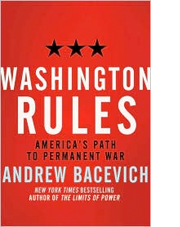
Even before the death of his son, Bacevich was an outspoken critic of American imperialist militarism and what he calls "the long war" that America can never win. I've just received two of his books, Washington Rules, America's Path to Permanent War, 2010, and The New American Militarism: How Americans Are Seduced by War, 2005. I expect to be reviewing them in due course. I'm also hoping to get my hands on his latest book, American Military and the Myth of Civilian Control.
Bacevich's world view is a refreshing contrast to the dark visions of Canada's political leadership. I guess that's because he's not just a first class intellectual but also a career soldier and father to a son whose life was sacrificed to a hopeless imperialist fantasy.
Subscribe to:
Posts (Atom)