Showing posts with label Ottawa. Show all posts

Thursday, April 18, 2019

This Is What Gives Them Away


A lot of stupid people in Canada have come to think of Athabasca bitumen as "oil." That is the single most important victory the petro-state has achieved.

It's not oil. It may be turned into oil at a distant refinery, probably in the States  but we're told even in Asia, at some time, somewhere. Until it leaves that distant refinery it's something quite different from  any conventional oil.

"They" - the federal and provincial governments, our bitumen-friendly media, and the Oil Patch - are lying to us about this stuff, filling your mind with images of something that is not. Whether it comes out of Justin Trudeau's mouth or Andrew Scheer's mouth or Jason Kenney's mouth, they're feeding you carefully contrived horse shit and, by the look of things, you've got a taste for it now.

They don't want you to trouble your precious minds with what they're really doing. They don't want you dwelling on what's really in the crap they're squeezing through their pipelines.

They don't want you dwelling on the ultra-high carbon, granulated coal in their crud - petcoke. Out of sight/out of mind. That stuff gets refined out. Then it gets sold wherever no one is too fussy about burning it. It's a lot worse, pound for pound, than brown or thermal coal, the real garbage stuff.

They'll howl like cut cats at the first mention of the lethal toxins embedded in  unrefined dilbit.
The heavy metals, rated as priority pollutants by the U.S. Environmental Protection Agency, include mercury, arsenic, beryllium, copper, cadmium, thallium, lead, nickel, zinc and silver. All are toxic. Arsenic is a known human carcinogen; cadmium can severely destroy the kidneys and other organs; and thallium is so poisonous that it pops up in Agatha Christie mysteries as a murder weapon.
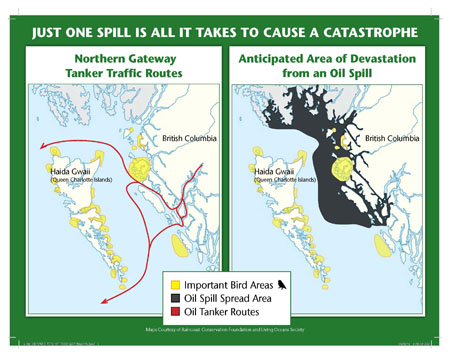
That stuff threatens environmental catastrophe wherever a dilbit pipeline runs. It threatens British Columbia's pristine coastal ecology with every wallowing supertanker that navigates our waters.

They know that a dilbit spill in BC waters is virtually beyond clean up. They know that the diluent quickly evaporates out leaving the dense bitumen to sink to the bottom, hundreds of feet down, where it can never be cleaned up and will destroy the marine food chain for many decades, perhaps forever.


They know how pernicious and devastating this crud is. That's why Trudeau's environment minister, Dame Cathy McKenna, has approved the use of Corexit as an "oil dispersent." It's nothing of the sort. It's an outrageous lie whether it comes out of Cathy's mouth or Justin's.  Corexit doesn't disperse oil, even ordinary conventional crude oil. It sinks spilled oil to the bottom. Out of sight/out of mind. It was used in Price William Sound for the Exxon Valdez. It was used in the Gulf of Mexico for the Deepwater Horizon catastrophe. It has one purpose - to make the problem go away for those who can turn their backs on what they've done.


Crews are regularly sickened by Corexit. Most of the crews that worked the Exxon Valdez spill fell seriously ill.  Just read the warning label from Nalco, the producer of Corexit.

Corexit is for use on spills on land. Nalco's clean up directions make that obvious.


"Do not contaminate surface water." As if.

There is no justification whatsoever for exposing my province, my land, my coast to this environmental disaster in waiting. All these things - the toxins, the petcoke, the acids and abrasives - could easily be refined out in Alberta, in Athabasca.

The thing is. If they were responsible - Alberta or the feds - and showed just a little respect for British Columbia and demanded that it be refined on site, it would expose how worthless this high-carbon/high-cost/low-value garbage fossil fuel really is.

Despite all this these bastards threaten us. They jail us and give us criminal records.  It's ironic that we should be going to jail, not them. It's pretty rich to hear Liberals whine that, if we don't vote for their boy, we're electing Andrew Scheer. What a laugh.

Saturday, March 23, 2019

Once Again, Ottawa Fails the Coast


British Columbia's salt water fishery is controlled out of Ottawa by the Department of Fisheries and Oceans. That's the same bunch that bungled the east coast fishery leading to the severe collapse of the once bountiful cod stocks.

Now DFO is screwing up the west coast, starting with our herring stocks.

Those herring play a vital role in maintaining the upper tiers of our food chain. They're the food stock for baleen whales and our prized salmon. Those salmon, in turn, sustain the resident orca population.  Our salmon are now endangered. So too are those magnificent orcas, who may soon also have to cope with Trudeau's armada of bitumen laden supertankers.

Why then is Mr. Trudeau's DFO still allowing our herring to be pillaged?  Ask Ian McAllister, executive director of Pacific Wild.

Pacific Wild, just a day earlier, had posted a video in which McAllister said, among other things, “We really should be leaving this fish in the water ... This is basis for the food supply of the entire Salish Sea, the basis of our coastal economy, and yet we’re turning this wild herring into fish farm pellets and cat food. This fishery should not ever have been allowed.”
...There is an echo here of the infamous standoffs on logging roads in Haida Gwaii, Clayoquot Sound, the Kootenays, the Stein Valley, the Skagit, pick your spot — and of the enduring faceoffs over tarsands pipelines and mines and dams and fish farms and tanker bans, among other so-called policy “choices” that we leave to the least qualified people in the world, politicians, to adjudicate, based on what they piously claim to be reliable science that supports their even more reliable need to shore up their prospects of re-election with evidence of economic growth and jobs for middle-class Canadians. 
Jonathan Wilkinson, our federal fisheries minister, personifies the Trudeau-era cabinet-minister-as-dittohead. “It’s in the national interest. It’s in the national interest,” they all chant about the orca-killing Trans Mountain Pipeline Expansion project, all evidence to the contrary. In the case of the herring fishery, “We make our decisions based on science,” Minister Wilkinson says reassuringly, if credulously.
And so this year, while all that science-based management has led to the closure of commercial fisheries in four other major areas of the coast — Haida Gwaii, Prince Rupert, the central coast and the west coast of Vancouver Island — the minister took the advice of his boffins and approved the extraction of 21,493 tonnes of herring in the Strait of Georgia. By Pacific Wild’s calculation, that’s 130 million fish. As of Saturday, the seine fleet had successfully killed about half that number; over the weekend, the gillnet fleet was on target to finish the job.
...At some point, you have to wonder how many fisheries scientists can dance on the head of a pin. Rightly or wrongly, Ottawa thinks the fleet can take 130 million fish out of the water without making a dent in the stock’s “long-term” ability to reproduce. Locally, confidence in that decision is low. 
Grant Scott, who chairs Conservancy Hornby Island, says his community first put on a herring festival two years ago as a seasonal celebration of the herring spawn. Within a year it had dawned on them that the festival might better be used to publicize how dire the prospects for herring are. This year, an online petition calling for the fishery to be closed has attracted close to 72,000 signatures and counting.
...To the south of the fleet, another long-term resident and observer of the Salish Sea, Stephen Hume, writes, “If science is so good at predicting abundance, why are 80 per cent of herring sites now closed? 
“We’ve fished stocks to collapse before, amid repeated assurances that the fisheries science shows harvests to be sustainable,” he reminds. “In the 1950s, overfishing of Japan’s herring led to a collapse. In the 1960s, the California sardine fishery collapsed. Herring fisheries in Alaska and B.C. were closed in the 1960s after overfished stocks collapsed. Overfishing destroyed herring stocks off Iceland, Norway and Russia around the same time. In 1972, the overfished Peruvian anchovy fishery collapsed. In 1992, Canada’s Atlantic cod went the way of the herring, sardines and anchovies. Cod stocks that had supported Newfoundland fisheries for 500 years suddenly fell to one percent of what it had been at its maximum biomass.” 
“One common factor in these serial fisheries disasters,” Hume writes, “is that regulators were convinced harvests were sustainable — until they suddenly weren’t.”
... Pacific Wild has produced an analysis — Top Ten Arguments against the Strait of Georgia commercial seine and gill net herring fishery — and, going to some lengths to reference its conclusions to available science, ends up citing DFO on almost every page. Whether that science can be trusted or not is hardly Pacific Wild’s responsibility; whether its interpretation of DFO science can be trusted, is. But one of the failings of our resource management system now, especially after the Harper years but even now in the Trans Mountain era, is that our agencies are so deeply distrusted because they are so deeply conflicted
Agencies like DFO and the National Energy Board have tremendous research budgets and their conclusions are backed by authority of law, but they’ve become what environmental lawyer Eugene Kung has referred to as “captured regulators.” They can no longer be trusted to interpret their research in the public interest because of the pressure of private interests: respectively, commercial fishing and fish farm industries, and in the case of the NEB, powerful energy interests.

Why should coastal British Columbians see the federal government as other than a predatory scourge? Instead of protecting our coast and our endangered marine life they unleash their captured regulators, the National Energy Board and DFO, and scream "national interest, national interest" to stifle anyone who stands up to them.

And, before Trudeau's fan club dismiss us as "Trudeau haters" remember this: when Trudeau wanted to fast track his Trans Mountain pipeline, before he actually bought the damned thing, he gathered top officials of all relevant ministries to assess the project. Then, before they submitted their assessments, they were all gathered together in a room and told by Trudeau's envoy those independent evaluations had better support Trans Mountain. And, voila, that's just what they did. That's not just a stacked regulator, that's a stacked PMO and it's stacked against us and our coast.


Sunday, November 23, 2014

Whether You Support Pipelines or Not, Here's Something We Can Surely Agree On.


No secret I'm opposed to both Kinder Morgan and Northern Gateway.  A sizeable majority of British Columbians are of the same mind but a significant minority supports the pipeline initiatives.  In situations like this it can be helpful to seek out areas of agreement, common ground.

Here's an idea we should all be able to endorse.  If you insist on shipping Athabasca oil to Asia, why not ship oil?  That may sound facetious but it's not.

Bad as these pipelines are, they're made far worse by what Ottawa and Alberta want to push through them - dilbit.  Dilbit is bitumen mixed with a light oil condensate called a diluent.  Bitumen is just too sludgy to push through a pipeline.  It's full of acids, toxins, heavy metals and, of course, petroleum coke or "petcoke," a granular and very high carbon form of sulfur-rich coal.  To get it through a pipeline you have to dilute it with condensate.  Even then you have to heat the mixture and propel it with powerful pumps to get it moving through the pipeline.

Pipeline opponents have plenty of reason to object to dilbit pipelines.  You're taking a product that is full of corrosives and forcing it through a pipeline under high pressure.  If you want to know what that pressurized corrosive does to a pipeline you might ask the authorities in Kalamazoo, Michigan.  Yes, and that was an Enbridge pipeline.


British Columbians have ample reason for concern because a Kalamazoo-type spill here would likely happen in the mountainous wilderness where Enbridge intends to run Northern Gateway.  That would make it more difficult to detect and extremely difficult to get crews and equipment in to attempt clean up.  A spill into a fast-moving mountain stream would spread rapidly, confounding clean up efforts and endangering the ecology for great distances.  Enbridge repeatedly balked at cleaning up Kalamazoo.  How would the company respond to a far more difficult and enormously more costly clean up in British Columbia?


Another cause for concern is the prospect of a supertanker catastrophe. Navigating those northern coastal waters with their currents and tides is challenging on a good day and, up there, good days are not abundant.  When you're tasked with moving the volumes of dilbit Enbridge is planning for Northern Gateway, you have to keep tankers sailing in and out no matter the conditions and that is a formula for disaster.


Dilbit, because of all the sludge in it, sinks.  The condensate separates out and floats to the surface where it dissipates.  The bitumen component congeals and heads for the bottom which, in a lot of places up there, can be 600-feet down and neither the governments nor Enbridge has anything that can clean up a deepwater spill like that.

So, where is this elusive common ground?  I think both sides should be able to rule out the dilbit option/problem.  How can that be done?  Refine the product on site in Athabasca.  Do it there, at the source.  Then, once you have refined out all the garbage, all you'll be transporting is conventional crude oil.  The product you send to market won't be bitumen or diluted bitumen.  The acids, the abrasives, the toxins and heavy metals, the carcinogens and the petcoke will be removed and dealt with on site in Alberta where they belong.


That doesn't mean we'd be okay with it.  The 1989 Exxon Valdez catastrophe, after all, was a conventional oil spill,the ship didn't even sink, and, a quarter century later, Prince William Sound still isn't cleaned up. However refined oil that floats is vastly preferable to hazmat oil that sinks and coats the bottom for generations, poisoning the entire marine habitat.

Another major factor is that transporting fully refined conventional crude oil significantly cuts the volume of product shipped.  The condensate isn't in there. The crud isn't in there.  All of that is removed and left behind in Alberta.  That refining process would allow a major reduction of up to 40% in the number of supertanker trips required to get the product to overseas markets.  The more tanker trips you have the more groundings or sinkings you'll have.  It's that simple.  Even pipeline supporters can understand that.

Bear in mind that the stuff Big Oil and its governmental minions want to ship, dilbit, still has to be refined somewhere.  That somewhere will be in Asia where they'll have to refine out not only the condensate but also all the crud, including the pet coke, out of the bitumen.  So what could be the objection to refining the goop in Athabasca?

What we're usually told is that it would be uneconomical to refine bitumen in Alberta.  Overseas markets, we're told, have unused refining capacity.  So what? We could not only address the hazmat issue but also create a lot of jobs and revenue by refining Athabasca bitumen on site.

I suspect the on-site refining option would be refused because it would add an unbearable burden to the sleight-of-hand trick used to portray the Tar Sands as a huge money maker.  It would also leave Alberta responsible for the energy requirements and emissions related to the refining process.

So you can see how, to a British Columbian, this smacks of a set up.  We have to accept the risk of a potentially catastrophic hazmat spill to bolster the bottom line of the Canadian Association of Petroleum Producers.  They're externalizing the risks, offloading them on the province and people of British Columbia, and we're being told they're doing it as of right.

That they're dealing us cards from a stacked deck is obvious.  One by one, Harper has stripped us of our safeguards.  He moved the West Coast oil spill emergency centre to Quebec.  He shut down entire sections of the Department of Fisheries and Oceans responsible for monitoring our coastal marine habitat. He trashed fisheries regulations. He closed essential Coast Guard installations.  He gutted the navigation regulations to accommodate the supertanker armada.  He set up an utterly fraudulent environmental review process, plainly sculpted to deliver a scripted result.  He's engaged the state security apparatus to spy on environmentalists.  Now you tell me this federal government isn't already at war with us.

When taken in the context of this litany of skulduggery, the refusal to refine this bitumen on site in Alberta can be seen in a plain light for what it is - a deliberate choice to expose British Columbia to enormous risks by transporting hazmat - hazardous materials - through highly risky conditions while simultaneously stripping us of every means we ever had to respond to catastrophe.


Thursday, February 14, 2013

The Power of the Carbon Bubble


The Carbon Bubble has arrived.  It has finally emerged as a subject for consideration and debate.   Hardly a day goes by that there isn't some discussion of the Carbon Bubble.

In case you're not familiar with it, the Carbon Bubble arises out of the calculation, based on pure physics, of how much CO2 our atmosphere can carry if we're to have much hope of staying within the 2C safety limit for global warming.

You see, once you know the maximum greenhouse-gas carrying capacity the atmosphere can be permitted to hold, you can subtract the amount of atmospheric CO2 that's already up there and come up with a remainder, just like they taught you in grade school.

Now, once you get that remainder, you can do all sorts of things with it.  For example, you can use it as a yardstick by which to measure our fossil fuel reserves or at least those already logged into the asset column by our fossil fuel industry.   You look at those reserves and figure out how much additional greenhouse gas will be generated by burning them.   And that's where it gets ugly.

There's a bit of disagreement on specifics but the overall consensus is that most of the known reserves of fossil fuels must be left untouched, safely in the ground, if our civilization is to have much hope of getting through this century.   Some estimates hold we can't use more than 20% of the reserves.     Others claim we can burn a third.

It's created an usual consensus of climate change activists and hard-nosed energy analysts.

America's fastest growing social movement [is] ''Go Fossil Free'', a nation-wide blitz calling for universities, governments and churches to freeze new investments in fossil fuel assets, and to sell what they've already got.
The impetus for the campaign is a set of simple numbers - a global carbon budget. It's a way of framing the climate crisis that is now uniting student activists and market analysts.

The former use the numbers to prosecute a moral case that the fossil fuel industry has gone rogue; the latter, for a cold-blooded calculation that trading away from carbon-heavy assets is in an investor's own interest.

The numbers were set out in a report called ''Unburnable Carbon'', which was released last year by the Carbon Tracker Initiative, a group of analysts and environmentalists in the UK. It highlighted the work of the Potsdam Climate Institute, which in 2009 produced a set of emissions scenarios together with their likely influence on global temperatures.

These are the numbers: for a low chance - one-in-five - of exceeding 2-degrees warming, we can only emit another 565 gigatonnes of carbon dioxide by mid-century. But proven fossil fuel reserves (held by listed corporations, private companies and nation states) equate to 2795 gigatonnes - five times the carbon budget. In Copenhagen in 2009, the world's governments agreed to limit warming to 2 degrees. To do so, four-fifths of our fuel must stay in the ground.

James Leaton, Carbon Tracker's research director, says this ''huge overshoot'' of reserves represents a ''carbon bubble'' in financial markets. We're on track to exceed the budget by 2028. ''Investors need to start questioning the wisdom of companies pouring more capital into developing even more reserves,'' he says.

In its World Energy Outlook for 2012, the International Energy Agency presented a similar case. Using the same research, but choosing a higher, 50-50 threshold for exceeding 2-degrees warming, it stated that two-thirds of proven reserves must stay in the ground, unless carbon capture and storage is widely deployed. (It observed that the pace of deployment of the technology ''remains highly uncertain''.)

So how can we make sense of this?   Well, it we can only burn somewhere between one-fifth and one-third of known reserves of fossil fuels, we're in a huge, unrecognized glut of carbon-based energy.  

Because there's a glut of fossil fuels they're vastly overpriced.  The actual price, the price we'll probably be heading for in the near future, will be far lower.

Because of the glut there's plenty of lower-carbon fossil fuels to go around.   Market analysts are arriving at "a cold-blooded calculation that trading away from carbon-heavy assets is in an investor's own interest." 

So, heavy-carbon assets are simply bad business.   Yet here at home we're still throwing government money and support into the development and export of the costliest, highest-carbon petroleum on the planet, Athabasca bitumen.   Anybody see anything going sideways here?   Can anybody hear that creaking of a door that's about to slam shut?

With all these alarms going off almost daily you might think the Masters of Canada's Universe would be reacting if only because we've got so much at stake.   They've bet the farm on bitumen.   And now it's beginning to look like they made a lousy bet.

Alberta's premier and Joan Cusak lookalike, Alison Redford, perhaps unwittingly referred to a "bitumen bubble" as the source of her province's current economic plight.   Her solution?   Let's double down and get pipelines built so that we can invest massively more money into Athabasca to produce two, three, maybe five times as much of the costliest, highest-carbon petroleum on the planet.   Steve Harper seems to agree with her entirely.   Maybe legislatures aren't the most fitting institutions for these people.

Monday, October 29, 2012

One Alberta Government Too Many


One thing that grates on plenty of British Columbians is that Canada has two Alberta governments, one too many.   We have a provincial Alberta government that sits in Edmonton and a federal Alberta government that sits in Ottawa.

The Alberta government in Ottawa does things the provincial Alberta government can't do.   It signs treaties with China for example.   Only the federal Alberta government could put a loaded pistol in Beijing's hand and invite them to hold it to the heads of the people and province of British Columbia should they dare stand against the environmental rape of their land and coastline by Alberta bitumen.

Once you see both Alberta governments, provincial and federal, what Ottawa is doing for Edmonton becomes logical, ordered and even sensible in a fiendish sort of way.   Nobody needs to see this state of affairs more clearly than the people of British Columbia, especially those who elected so many Conservative MPs in the last election.   Once we see that these B.C. Tories are actually serving the federal Alberta government I expect we'll be a hell of a lot less inclined to re-elected the bastards.

It's easy out here to see Harper's China tar deal as "economic treason" (as Andrew Nikiforuk terms it) yet it must look like anything but treason to either of our Alberta governments.  And there's the rub.

We can't win this politically.   When the provincial Alberta government and the federal Alberta government pile on, we don't stand a chance.   When they add mighty China to their pile for extra heft we probably won't be able to even breathe.

It's sad to know that the rest of Canada doesn't have the sand to stand up to these Alberta governments but they're conveniently lined up with their alms bowls for their share of the action.   Ontario, for example, is in line to receive many times more bounty out of the Northern Gateway than British Columbia is to receive.   Having federal and a provincial Alberta governments can make that sort of stuff happen.

The stage is set for a pretty interesting confrontation between the province and people of British Columbia in one corner and the massed power of both Alberta governments, China and their spineless minion premiers from the rest of Canada.   Anyone who can't see that as a recipe for west coast separatism?

Monday, August 13, 2012

Taking the Fight to Them


It's time to do what they fear most - connect the dots.   That means linking bitumen trafficking to the plight being inflicted on the poorest and most vulnerable peoples on Earth due to global warming.  It's a link that is irrefutable.

We know that the climate change the world is now enduring is anthropogenic, man-made.   We know that the rapidly changing climate results from warming of the atmosphere, global warming, through burning fossil fuels which generates atmospheric carbon dioxide, a powerful greenhouse gas.

We know that all fossil fuels are not created equal.   Some, such as natural gas, are less carbon-intensive than others.   Others, such as coal and bitumen, are highly carbon intensive and, as such, contribute proportionately far more to anthropogenic global warming.

We know that talk of carbon capture and sequestration remains, after decades of rambling, just that - talk, empty promises.   We know that, despite industry's abject failure to deliver on its carbon capture promise, the federal and Alberta governments are determined to facilitate the rapid and massive expansion of production and export of Athabasca bitumen, one of the world's very worst carbon-intensive fossil fuels.

We know that around the world the poor and vulnerable are being beset by climate change impacts, particularly floods and drought, that bring famine, pestilence, armed conflict, displacement and, to some, death.   And we know this is just beginning.   This is suffering of a degree and on a scale we cannot imagine.

We know that already known fossil fuel reserves exceed the amount remaining that can perhaps be safely burned by a factor of five to one.   In other words, if our civilization is to survive this century - our children, grandchildren and greatgrandchildren, eighty per cent of those fossil fuel reserves will have to be left in the ground.   This utterly discredits anyone promoting the exploitation and consumption of the worst, most carbon intensive fossil fuels.   The planet has more than adequate stocks of relatively clean, conventional fossil fuels.   There is no moral case for exploiting high-carbon intensive unconventional fossil fuels.

We know that the fossil fuel industry behaves as any other corporate entity.  It serves the interests of its investors and shareholders.   It does not serve those interests by voluntarily incurring expenses that are not mandated.   Hence, until carbon capture is mandated and industry is compelled to act, it will not act.  The promise of carbon capture, advanced by industry and our governments, is a shameless hoax.

We must accept that all of this knowledge supports certain, unavoidable conclusions.   Those who promote, enable, extract, produce and transport the most carbon-intensive, filthy fossil fuels are directly responsible for the disproportionate losses and suffering these unconventional fuels create even in distant corners of the world.    It is an immoral trade from which the riches we reap are paid for by those already impoverished and imperilled elsewhere.

Afghan heroin trafficking or Colombian cocaine trafficking inflicts social and economic devastation elsewhere.   It ruins families and destroys lives and we properly condemn it.   Canadian bitumen trafficking also ruins families and destroys lives elsewhere yet we pretend not to notice even as we move to massively ramp up production and export.

To date most opposition to Tar Sands exploitation has been focused on local outcomes - tailing ponds, destruction of the boreal forest, pipeline spills, tanker catastrophes - with scant attention to what Canada is doing to the rest of the world.   It's time that changed and time that the bitumen boosters in Ottawa, Alberta and elsewhere by tied tightly to the suffering they are causing and intend to continue to inflict.   They have to be held accountable.

Sunday, July 29, 2012

Hey Canada, Do You Really Want to Talk?


Having a conversation with a bitumen booster is like talking to a climate change denier.  It's impossible to have a broad-reaching discussion, covering all the bases.   That's because the Tar Sanders have some bases they want to bypass.   They want to narrow the conversation to play into their greatest strengths and ignore everything else.   And are they ever great at playing loose with facts.

Right now they've taken advantage of the B.C. premier's blunders and transformed the Northern Gateway debate into an issue of shakedowns and the constitution.   That lets them avoid discussing what really matters to pipeline opponents, the merits and perils of piping bitumen, or rather dilbit, at all.

The safety and environmental issues are swept aside with a nod.   Sure, fair enough, end of discussion.    They agree that the environment must be safeguarded but they don't want to talk about the reality of that problem.   They don't want to get into how Harper has effectively stripped the B.C. coast of Fisheries and Coast Guard monitors and defenders.   They don't want to explore this supposed oil spill response fleet of vessels that has been assembled; how it can operate only in good weather and calm seas (a relative rarity in the north) and how long it takes to deploy; or how the technology deployed is intended to be used on conventional oil spills and won't work on a bitumen spill.   They don't want to explain how anyone is going to deal with a heavily-laden tanker that loses power or steerage in a Hecate Strait storm where waves can reach 30-meters in height.  They don't want to talk about the closest, ocean-going tugs capable of handling a laden, supertanker failure being based in Anacortes, Washington, three to four days sailing, in good conditions, to northern B.C. They don't want to get into the pipeline operator, Enbridge's sullied and extensive safety record.   They don't want to discuss the seismic and topographical challenges the pipeline would be subject to crossing the B.C. wilderness or the problems associated with cleanup of pipeline spills in that vast emptiness.   They don't want to refute what the Coast Guard types out here are saying, that a supertanker disaster in the Hecate Strait or Dixon Entrance isn't a matter of "if" but a matter of "when and how often."   They don't want to talk about what a bitumen spill would do to the seabed 600-feet down, what it would do to the local ecology or how there's no technology in existence or coming down the pike to do anything about it.   And they sure as hell don't want to talk about the liability cut-outs planned for the Chinese supertanker operators, for Enbridge, for Big Oil and for Alberta and Ottawa that will leave British Columbia on the hook.   Why if this is such a damned good thing for Canada, such a safe venture, have all the key players put in place means to escape liability when it all goes wrong?  If the tanker operators are afraid of it, and Enbridge is afraid of it, and the oil producers are afraid of it and Alberta and Ottawa are afraid of it, shouldn't British Columbians be allowed to ask why?

They claim to agree on environmental protection and then ignore the litany of environmental perils that underlie the bitumen pipelines.   They must be working straight from the old R.J. Reynolds playbook.

They want to pretend that British Columbia's opposition is all about shaking down Alberta.   The rest of the provinces may be content to line up behind Alberta and Ottawa and demand that B.C. lie down and play dead.   We need to talk - about all the issues listed above and more - but unless we can have a discussion on these and some straight answers, there's really nothing to talk about.

Saturday, July 28, 2012

Sometimes It's the Hot Button Moments that Smoke Out Scammers


And by scammers I'm referring to the Alberta and Harper governments.   When B.C. premier Christie Clark pushed the revenue-sharing hot button in opposing the Northern Gateway pipeline/supertanker proposal, the scammers showed their hand.

Oh the country would fall apart, they crowed, if provinces could erect walls against inter-provincial transport of goods.  Imagine, they said, if Alberta began levying charges on truckloads of B.C. lumber heading to eastern markets.

Yeah, imagine that?  Only imagine those B.C. trucks plying Alberta highways, not with lumber, but with loads of hazmat cargoes, the type that can wreck ecosystems.   And imagine those B.C. trucks driven by truckers with really bad driving records who just happen to be driving without any insurance.   And imagine those trucks being owned by trucking companies that have no assets to make good on losses they inflicted.   

Imagine that because the scammers won't let on that it's true.   They don't want those details messing up their perfectly lovely straw men.

But, you see, B.C. trucks transiting Alberta do have insurance.   Alberta insists on it.  And they do have to comply with Alberta safety standards and traffic regulations.   Alberta insists on that too.  And if they cause losses while in Alberta, those losses are made good.   But they don't want the same deal for British Columbia on their pipeline scam. 

The margins on this deal are slim.   Athabasca bitumen is expensive stuff.   It's expensive to extract out of the ground, expensive to put in a transportable state, expensive to transport, expensive to process into synthetic petroleum products.   So the bottom line, if it's to be kept in the black, demands corner cutting and an awful lot of looking the other way.

The proposed pipeline operator, Enbridge's safety record is well documented and speaks for itself and it's lousy.   Yet they want British Columbia to look the other way at pipelines crossing truly remote and challenging, seismically active, mountainous terrain to be pumped into the holds of supertankers that will then ply the treacherous waters of the Hecate Strait and Dixon Entrance.   And they want British Columbia to ignore the liability cut-outs they have crafted for this scam so that, when catastrophe occurs, they can get away cheap.

From the east we hear a chorus of "jobs, jobs, jobs" and the accusations that British Columbia is a greedy spoiler trying to subvert the best thing Canada has going for it.   Maybe that's the way some see it when they don't have to bear the risks and face the losses.   That's certainly the way Alberta and Ottawa see it.   But they've opened a delightful window that lets us see through them.   We can see this thing is a set up.   Is it really our fault if we don't play along?