Showing posts with label Rossby Waves. Show all posts

Friday, November 18, 2016

The Arctic's Death Spiral


It's that bastard, Rossby. Blame Rossby.

The Arctic is again overheating a lot like last year. Winter is setting in except it's not, not really.

Something is totally off. The Arctic is super-hot, even as a vast area of cold polar air has been displaced over Siberia...“It’s about 20C [36 degrees Fahrenheit] warmer than normal over most of the Arctic Ocean, along with cold anomalies of about the same magnitude over north-central Asia,” Jennifer Francis, an Arctic specialist at Rutgers University, said by email Wednesday.

Up until October, things were relatively normal—at least, as normal as they can be in the era of record-shattering climate change. In mid-October Arctic temperatures suddenly flattened and then rose, instead of continuing downward as winter progressed. What happened?


“The Arctic warmth is the result of a combination of record-low sea-ice extent for this time of year, probably very thin ice, and plenty of warm/moist air from lower latitudes being driven northward by a very wavy jet stream.” Francis has published research suggesting that the jet stream, which travels from west to east across the Northern Hemisphere in the mid-latitudes, is becoming more wavy and elongated as the Arctic warms faster than the equator does.

Mark Serreze, who heads the National Snow and Ice Data Center in Boulder, Colo., agrees that something odd is going on....What’s happening, he explains, is sort of a “double whammy.” On the one hand, there is a “very warm underlying ocean” due to the lack of sea ice forming above it. But, at the same time, kinks in the jet stream have allowed warm air to flow northward and frigid Arctic air to descend over Siberia.

Those wavy jet stream things, they're called Rossby Waves. They plunge down toward the tropics, carrying freezing temperatures far to the south, and then soar up into the Arctic, carrying warm air to the polar region.

Last winter's Arctic heatwave triggered cyclonic winds that caused the sea ice to thin about 10 cms. or 4 inches. That meant an earlier spring/summer melt, more exposed ocean water, more heat absorption, a warmer Arctic ocean, a delayed winter freeze - you probably get the idea that this has become a vicious circle, what's being called the Arctic's death spiral. And that, kids, is what's called a natural feedback loop - the very thing we're supposed to be slashing greenhouse gas emissions to avoid triggering. Only it's already well underway.

Friday, June 10, 2016

Words Best Left Unspoken


Ever notice how a word or phrase can abruptly disappear from our language almost without anyone noticing much less wondering why?

I wonder whatever happened to "tipping points"? Where did that term go? Why did it fall off the radar?

Just a few years ago, back when we thought tipping points were decades off in the future, we read about them a lot. We were told we had to keep manmade global warming increases to this limit or that if we didn't want to awake the Sleeping Giant of nature and trigger runaway global warming.

What we were doing was bad enough. It wasn't going to be easy getting by in a climate that was 2 degrees Celsius hotter. That kind of man made warming would be awful but it was at least survivable, not like what awaited us from far greater warming resulting from natural feedback loops triggered should we cross these invisible, unknowable lines called "tipping points."

I suppose tipping points are a bit like a blind man parallel parking. That's why we had to be very, very conservative. This was no time to be pushing our luck, testing limits.

The fact is there are signs, very obvious signs, that we've already crossed some major tipping points. Nature is now running with the ball and has a clear path to the end zone.

The most obvious of these is the Arctic sea ice. Just a few years ago the Inter-Governmental Panel on Climate Change (IPCC) was warning that, if we didn't mend our GHG emission ways, the Arctic could be ice free by the end of this century, 2100.  End of the century. That gave us food for thought - tomorrow, maybe. Update: now we're looking at an ice free Arctic Ocean this year, probably, if not then next year for sure.  Why did the IPCC get it so incredibly wrong? Easy, they were working on man made warming. What we're seeing today is nature's doing. We've crossed a major tipping point. Best we stop using that word, eh?

How about a new term, "Arctic amplification"? What it means is that the loss of reflective Arctic sea ice warms the ocean and the atmosphere which warms and energizes the Polar Jet Stream which accelerates the melting of the entire Greenland ice sheet and creates these things called Rossby Waves that brings polar air deep into southern latitudes and warmer southern air high into the Arctic that increases the polar melt and on and on and on.

Think of it as a progression: tipping point, change, knock-on effect, knock-on effect, knock-on effect, more change, knock-on effect, knock-on effect... you get the picture. It's called a "feedback loop" or a positive feedback loop to be exact. Positive in that it accelerates the process of change.

You can't see the Polar Jet Stream that's playing such an important role in this but you can see its handiwork, from space no less.


Yes, the Arctic is greening which is a good thing in some ways. Nice to see plants growing and migrating but nobody can be sure how this rapid ecological change will play out.

One downside is that our northern, Boreal Forest is browning, dying out. The changes underway will cause changes to precipitation, energy and carbon cycles across the far north.

Monday, March 16, 2015

The Warming Continues to Race Ahead Where It Matters Worst.


Where does global warming matter more than anywhere else?  It matters most where it's already worst - in the Arctic.

Many of you have endured another cold, snowy winter.  Out here we've had the opposite - warm and dry conditions.  Call it climate change and blame the warming Arctic.  Bad as the winter phenomenon has become, it's the summers that could be the real threat.

We know that the Arctic is heating faster than the planet as a whole. Consequently, there is more energy in the Arctic which can be transmitted to the atmosphere. Much of the excess heat is transferred to the atmosphere in the late fall or early winter. This extra energy is connected to what’s called Arctic geopotential height, which has increased during the same times of the year. As a consequence, the Jetstream might weaken in the cold seasons.

But what about summer? Have these changes been detected then too? Well just recently, a paper was published in that answered this question. The authors, from the Potsdam Institute for Climate Impact Research and from the University of Potsdam reported on three measures of atmospheric dynamics (1) zonal winds, (2) eddy kinetic energy, and (3) amplitude of the fast-moving Rossby waves. Rossby waves are very large waves in the upper atmospheric winds. They are important because of their large influence on weather.


The authors found that the summer zonal winds have weakened. The reason for the weakening is that since the Arctic is warming faster than the rest of the planet, the temperature difference between the Arctic and the lower latitudes is getting smaller. It is this temperature difference which maintains the wind speeds. The authors also found that eddy kinetic energy is decreasing.

So what does all this mean? Well two things. First, it means that there are either fewer or less intense summer storms or a combination of both. But secondly, it means that weather patterns can get “stuck”. Storms are excellent at breaking up persistent weather patterns, and bringing cool and moist air from ocean regions to land zones. With fewer storms, “warm weather conditions endure, resulting in buildup of heat and drought.”


The authors looked to the future to inquire about how things would continue to change. They find that continued global warming will increase the risk of heat waves. We all know that the warming temperature will make heat waves more likely. But added to this, “stickiness” of weather patterns will play a big role as well.

This "stickiness" causes weather systems to stall over one area for an extended time.  It can result in heat waves that scorch crops in the fields.  As we saw in Calgary, it can stall heavy rainstorms over a place for days, storms that before this Arctic warming would move steadily from west to east.  

There's no fix for this, no cure.  The Arctic is going to continue to warm.  That changes the surface - the tundra and permafrost, the sea ice and the Arctic Ocean waters.  The tundra thaws, dries out and - peat will be peat - catches fire releasing black soot into the air that winds up coating places like the Greenland ice shield.  As the tundra goes it exposes the permafrost beneath which also melts, releasing into the atmosphere the methane it's been securely holding for hundreds of thousands of years.  The warming has caused the loss of Arctic sea ice.  The winter sea ice cover is apparently heading for a record low this year. That sea ice has kept the Arctic cold by reflecting solar radiation back into space. Remove a patch of reflective sea ice and you expose a patch of heat absorbent water.

So, sure, you've had a helluva winter but up there they've had what is for them unusually warm conditions.  Who can forget a couple of years ago when Atlanta, Georgia was paralyzed for days by snow and ice in February while a village in Alaska basked in mid-60s temperatures?  Alaska, February, 60s.  That's not the way it's supposed to work but it does now.

Here's the kicker that no one wants to talk about.  What's in store for the Arctic over the balance of this century?  

US scientists say that by the end of this century temperatures in the Arctic may for part of each year reach 13°C above pre-industrial levels.

James Overland, of the US National Oceanic and Atmospheric Administration, and colleagues, writing in the American Geophysical Union’s journal Earth’s Future, say average temperature projections show an Arctic-wide end of century increase of 13°C in the late autumn and 5°C in late spring for a business-as-usual emission scenario. 
From Russia to Europe to North America we're already getting whipsawed by the changes underway in the Arctic.  What we need to understand what we're getting now are the "early onset" impacts.  There are probably much bigger changes coming to us from the far north.

Tuesday, August 12, 2014

Severe Weather Events Linked to Some Guy Named Rossby


We owe a lot to Carl-Gustav Rossby, the Swedish-born American scientist who pioneered research into atmospheric thermodynamics at MIT and was instrumental in the university establishing America's first department of meteorology.

Today, Rossby's name is most commonly associated with this:


This image depicts what are sometimes called "Rossby Waves", the deep and meandering jet stream waves that now draw warm air from the south far up into the north and cold northern air far into the south.  Remember when Atlanta, Georgia went into deep freeze in February while a small village in northern Alaska basked in 62 degree F heat?  That was a Rossby Wave at work.  It's said to be the result of a warming Arctic and a heated, more energetic Arctic atmosphere. Atmospheric thermodynamics, get it?

Researchers have noticed that this new. undulating jet stream doesn't progress more or less steadily west to east like the old jet stream we grew up with.  Instead there are periods when it seems to stall or stop for days or weeks at a time (think Polar Vortex).   When it does stall it seems to bring extreme or severe weather events such as droughts, floods, heatwaves or freezing states.

These observations have now been analyzed by German scientists who confirm the recent increase in these "blocking patterns" that trigger severe weather events.

Climate scientists in Germany noticed that since 2000 there have been an "exceptional number of summer weather extremes, some causing massive damage to society".  So they examined the huge meanders in the high-level jet stream winds that dominate the weather at mid-latitudes, by analysing 35 yers of wind data amassed from satellits, ships, weather stations and meteorological balloons.  They found that blocking patterns, which occur when these meanders slow down, have happened far more frequently.

"Since 2000, we have seen a cluster of these events.  When these high-altitude waves become quasi-stationary, then we see more extreme weather at the surface," said Dr. Dim Coumou, at the Potsdam Institute for Climate Impact Research.  "It is especially noticeable for heat extremes."  The intense heawaves in Russia in 2010, which saw 50,000 people die and the wheat harvest hit hard, and in western Europe in 2003, which saw 30,000 deaths were both the result of blocking patterns.

These blocking patterns are also behind an increase in flash flooding of the sort that overwhelmed Calgary last year and southern California last month.  A heavy rainstorm develops and, instead of moving eastward to some other place the next day, it stays overhead in one place.

So far the research shows a correlation between Arctic warming but we'll have to wait for further computer modeling before we have clear proof of a causal link.    

Friday, September 27, 2013

"Unequivocal"


Leaving no doubt; clear; unambiguous.   The latest IPCC report concludes that mankind's influence in driving climate change is beyond doubt, clear and unambiguous.   Anthropogenic global warming is here, it's here to stay and, unless we want a better future enough to change our ways, it's going to get a hell of a lot worse in our grandkids' future, our kids' future and even in our own.

For, you see, it's already having major impacts.   Those floods in Calgary, the floods in Toronto, the floods in Colorado, the floods in Europe and across Asia?   Welcome to the new normal.   The droughts in central and southern U.S., southern Europe, Russia, Africa and the Middle East?   Welcome to the new normal.

High Arctic Oil Rig
What did we expect?  We've already warmed the Arctic twice as much as anywhere else.   Did we think that wasn't going to matter?  We heated the Arctic ocean and the atmosphere above it.   A warmer atmosphere has more energy and it holds more water vapour.   You probably learned that in high school.

Polar Jet
And now that we've got this warmer, wetter and more energized atmosphere in the Arctic, we've unleashed a very powerful Polar Jet Stream that changes the way precipitation moves through the northern hemisphere.   Instead of the gently undulating ribbon of air currents that move steadily west to east - the sort that gave us such agricultural bounty - we now have these Rossby Waves that look like an oscilloscope cranked up, that go way up north and plunge way down south, and tend to stall as they move west to east.  They can plunge Venice into a deep freeze, turning the canals solid, or bring mid-90 degree temperatures to an Alaska village in early June.  That's serious stuff.   They can also park right over places like Calgary or Colorado where they dropped a year's worth of rain in a matter of days.   Meanwhile states near Colorado remain in the grip of drought.   Go figure.


There are a lot of places in Canada, heavily populated centres, where people can write it off and say, "well it's getting a little bit warmer, so what?"   Those are places where the impacts of climate change are more subtle or even obscured by the urban habitat.  Yet there are far more but much less populated places in our country where climate change is already much more obvious, the impacts inescapable.

One of the big giveaways is species migration.  In our hemisphere plants and animals have already begun the trek north.   Marine life is coming into the north Pacific that was formerly seen only to the south.   Imagine pelicans in Victoria.  Or Humboldt squid in their hundreds washing ashore on the beaches of Tofino.

Mosquito-borne Dengue fever is beginning to enter the United States.  Some of our old pests are finding global warming to their liking.  The Lodgepole or Mountain Pine beetle population no longer has to endure the massive winter kill-off, enabling it to multiply and destroy vast swathes of our forests and they've now crossed the Rockies into Alberta.

So, we're seeing all these things already and we're only just getting started with this global warming business.  It's been said countless times before but I'll say it again - even if we stopped our greenhouse gas emissions today, existing atmospheric carbon levels will ensure we continue to warm for at least a century.   So you can count on it being worse for your kids and your grandchildren.

One thing the IPCC hasn't touched on in much depth is mankind's resilience to climate change.   How much can we take - as individuals, as communities, as nations?   That's a really tough one to answer because every individual is different.   There's great disparities in our wealth, our resources and our circumstances that come into play in answering these questions.
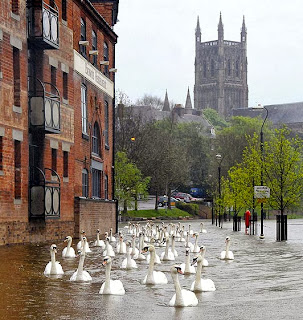
England's New Normal

Climate change is going to be tough on everyone but it's going to be a real bitch on poor people.   Here's one example - flooding.  Canadians can't get flood insurance.  If water comes in through your doors or your windows, you're on your own - at least until the government arrives to bail you out.   In the U.S., where flooding is a chronic problem, the federal government operates an insurance programme but they just had to jack up premiums.  One lady used to pay $1,700 and will soon have to pay $15,000 a year.  That, she predicts, will drop the resale value of her house by half.  That's a pretty big hit, especially if you're not rich, if that's your main or sole asset.   That's an enormous hit if you're already struggling with a hefty mortgage.


Let's put it this way, a lot of people around the world are currently occupying very devalued homes even if they don't realize it.   Maybe the Bitumen Barons of Athabasca will help out.  Nah, forget it, they're mainly foreign companies.   Maybe Ottawa will use its bitumen bounty to extend flood relief into the future.   No, that money, if it exists at all, is long gone already.   Ditto for Alberta.


But we are really, really well off.   Canada, when it comes to these things, is rich.   It's the poor countries and the poor societies that populate them that are going to take it in the neck.


...average land and sea temperatures are expected to continue rising throughout this century, possibly reaching 4C above present levels – enough to devastate crops and make life in many cities unbearably hot.

As temperatures climb and oceans warm, tropical and subtropical regions will face sharp changes in annual rainfall...

East Africa can expect to experience increased short rains, while west Africa should expect heavier monsoons. Burma, Bangladesh and India can expect stronger cyclones; elsewhere in southern Asia, heavier summer rains are anticipated. Indonesia may receive less rainfall between July and October, but the coastal regions around the south China Sea and Gulf of Thailand can expect increased rainfall extremes when cyclones hit land.

Okay, sucks to be them eh?  But it also sucks to be Australian where the people have just elected the denialist government of Tony Abbott. 

Tony Abbott's Australia

Australia is expected to experience a 6C average temperature rise on its hottest days and lose many reptile, bird and mammal species as well as the renowned wetlands of Kakadu by the end of the century..

IPCC figures show that Australia will experience an average overall increase of 2C by 2065, with that figure slightly lower at the coast. Beyond that, the temperature is expected to rise another 3C-4C by 2100.  

Rainfall patterns are set to change, with annual precipitation, humidity and cloud cover predicted to decrease over most of Australia. But for north Australia and many agricultural areas, rainfall is predicted to get heavier. Soil moisture will decrease, mostly in the south of the country.
  

In Australia, an increase in the frequency and intensity of heatwaves is expected to lead to more heat-related deaths, while warmer temperatures, changing rainfall and an influx of pests will "negatively impact" many temperate crops, such as fruit and nuts.

Yet we magnify our risks if we consider AGW climate change in isolation.   It's a huge, multi-faceted problem that poses a host of challenges yet it is compounded and in turn magnifies a variety of other pressing problems that we're also going to have to confront with our sapped strength.  We have to factor in challenges such as deforestation and desertification (the exhaustion of farmland and its transformation into sterile desert); resource depletion and exhaustion, particularly global groundwater reserves and global fisheries; overpopulation and population migration; and a host of gathering security problems including food insecurity, inequality, resource wars, terrorism and nuclear proliferation.   That list is by no means exhaustive nor does it play much role in the IPCC warnings.   Yet if we're to avoid becoming a civilization of Easter Islanders, we have no choice but to deal with global warming and all of these associated problems.

Here's the thing.   If we can't rally to act effectively on climate change our chances of being able to confront all these other challenges on our own terms are slim to nil.  That, too, is unequivocal.