There is a well-organized, well-funded effort to confuse you about climate change. It features certain scientists who comfort us with assurances that we're actually doing really well and that the global warming crowd are merely alarmists.
This movement has done its job quite well. They've found a welcome audience in those who don't want to believe the threats are real.
Here's the catch. By the time GHG emissions reach the point where they've changed our climate enough to persuade even the disbelievers - it'll be much too late to do anything very helpful to stop it.
Here's another way to look at it. Imagine you've chartered a jet. Inside the cockpit are a pilot, a co-pilot and a flight engineer. Halfway to your destination the pilot calls you up to the cockpit to tell you the aircraft has a leaky fuel tank and there's just enough left to set down safely at the nearest airport. The co-pilot agrees that you're running out of fuel and the aircraft has to be set down quickly. The flight engineer, however, disagrees. He says not to worry, the fuel gauge is probably just not working. He says just keep going.
It's up to you. You can either tell the pilot to land the aircraft or you can take your chances and keep going. Let me guess what you would choose. Assuming you're sane you would want the plane on the ground ASAP. Maybe the gauge is wonky but the place to sort that out is once you're on the ground.
There's a chance, a slight chance the global warming scientific community is wrong. That doesn't mean you bet your kids' lives on it - or would you?
Tuesday, October 31, 2006


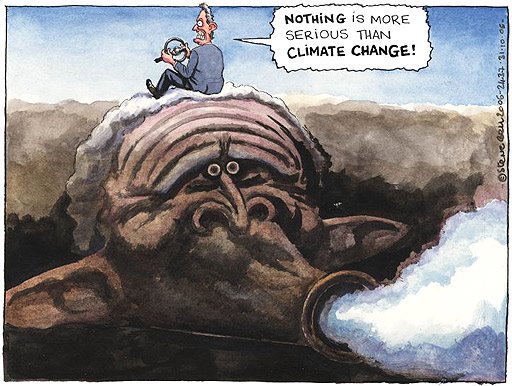
Another Dave Moment
Brigadier General David Fraser is unusual. He says curious things. The departing commander of Canadian and NATO troops in southern Afghanistan has given a farewell interview to the Globe. In it he justifies the Afghanistan mission by claiming that it's better we fight the Taliban over there than let them bring the fight to us in Canada.
Wait a second, Dave. This is the Taliban we're talking about, not al-Qaeda. The Taliban are a nasty, oppressive bunch of religious fanatics with a completely medieval outlook but they're not globetrotters. The Taliban have no history of attacking other nations not even when they were in power. Their focus is inward. They want Kabul and are determined to get it.
Maybe Dave should give us some good reason to believe the Taliban are a real danger to Toronto. Of course, he won't. General Fraser just says weird stuff. At Panjwai he told us he had the Taliban surrounded, trapped. When it turned out the bad guys were quite free to leave Panjwai in good order with their weapons and without Dave knowing about it, he proclaimed a great victory and announced he'd driven the Taliban out of Panjwai district for good. Oddly enough he's been fighting off Taliban attacks in Panjwai ever since.
In a Toronto Star interview, Fraser said that Canadian critics of "the mission" were more dangerous than the Taliban. Huh? Did he really say that? Yes he did.
The Globe interview faithfully recites General Fraser's bluster. Odd the reporter didn't ask what Dave thought of Hamid Karzai's overtures seeking negotiations with the Taliban.
Wait a second, Dave. This is the Taliban we're talking about, not al-Qaeda. The Taliban are a nasty, oppressive bunch of religious fanatics with a completely medieval outlook but they're not globetrotters. The Taliban have no history of attacking other nations not even when they were in power. Their focus is inward. They want Kabul and are determined to get it.
Maybe Dave should give us some good reason to believe the Taliban are a real danger to Toronto. Of course, he won't. General Fraser just says weird stuff. At Panjwai he told us he had the Taliban surrounded, trapped. When it turned out the bad guys were quite free to leave Panjwai in good order with their weapons and without Dave knowing about it, he proclaimed a great victory and announced he'd driven the Taliban out of Panjwai district for good. Oddly enough he's been fighting off Taliban attacks in Panjwai ever since.
In a Toronto Star interview, Fraser said that Canadian critics of "the mission" were more dangerous than the Taliban. Huh? Did he really say that? Yes he did.
The Globe interview faithfully recites General Fraser's bluster. Odd the reporter didn't ask what Dave thought of Hamid Karzai's overtures seeking negotiations with the Taliban.
Monday, October 30, 2006
What If They're Right? What If?
What if there is no Global Warming? What if they're right? What if it's all made up? What if? How about it would be the first and only time in the history of modern science that a genuine scientific concensus of this magnitude was actually wrong. It would mean that the underminers, the guys whose fly-by-night, non peer-reviewed research Big Oil throws at us, were right.
Run that through your mind a couple of times, toss it around, and decide what you really think the chances are that the global warming scientific community has this one wrong.
If the side that's has always been right for us in the past actually is right on this one, as the overwhelming majority insists, we need to get past the naysayers and stop letting them hurl obstacles in our way. That goes for Little Stevie too. Harper has to decide whether he's going to Stand Up For Canada or just stand up for the tar sands.
Run that through your mind a couple of times, toss it around, and decide what you really think the chances are that the global warming scientific community has this one wrong.
If the side that's has always been right for us in the past actually is right on this one, as the overwhelming majority insists, we need to get past the naysayers and stop letting them hurl obstacles in our way. That goes for Little Stevie too. Harper has to decide whether he's going to Stand Up For Canada or just stand up for the tar sands.
Let's Get Off This Wagon
If you're like me - and I know that at some level you are - you may be getting Headline Fatigue - a famous syndrome I just discovered where you notice you're reading the same headine - day after day after day - but someone just keeps changing the number.
I just see "Baghdad" and 31 or Baghdad and 40, 22 or 60. The story is always the same. This militia did this to that one or a convoy of police trainees or just some poor Shia or Sunni who managed to get caught at the wrong roadblock. The few facts that distinguish one victim from the next have lost meaning. It's the same story, over and over again.
You wouldn't put up with this many re-runs from your cable provider. Why are we accepting this from our government providers?
We, in the outer circle, need to start pressing inward to make these clowns start acknowledging reality. We have to get back to that safe zone again so that we can begin talking to the other side. Washington has to talk to Syria, it has to talk to Iran, and the Palestinians, and the democracy activists who undermine their cozies with Saudi Arabia and Egypt.
This insanity has got to stop. But. then again, consider this:

I just see "Baghdad" and 31 or Baghdad and 40, 22 or 60. The story is always the same. This militia did this to that one or a convoy of police trainees or just some poor Shia or Sunni who managed to get caught at the wrong roadblock. The few facts that distinguish one victim from the next have lost meaning. It's the same story, over and over again.
You wouldn't put up with this many re-runs from your cable provider. Why are we accepting this from our government providers?
We, in the outer circle, need to start pressing inward to make these clowns start acknowledging reality. We have to get back to that safe zone again so that we can begin talking to the other side. Washington has to talk to Syria, it has to talk to Iran, and the Palestinians, and the democracy activists who undermine their cozies with Saudi Arabia and Egypt.
This insanity has got to stop. But. then again, consider this:


Blame Greenland

When global warming really wreaks havoc on the planet, we can all blame Greenland. Yes, that's right, Greenland. I mean, after all, how can anyone trust an icebound country that calls itself green?
The fact is that Greenland is going to kill an awful lot of people, many millions and perhaps more. According to the British government's chief scientific advisor, Sir David King, the battle to arrest global warming has to be won before the melting of the great Greenland ice sheet becomes irreversible.
What's the deal with this ice sheet? For starters, it's really big, hence the name "great." It's big enough that, if it melts, it'll send sea levels rising 20-feet. Bye, bye New York; bye, bye London as well as vast swathes of Holland, a great deal of the South Pacific and south Asia - hell, everywhere!
Sir Dave's approach is to target GHG reduction efforts at saving the great ice sheet. Just what that means remains to be discovered but, hey, it's a good start.
Truer Words

Give Dick Cheney credit, he sometimes tells the truth even when he doesn't mean to. Now he's saying that Iraq violence is linked to the American election. Duh. Cheney and his gang have been using Iraq violence to grease their victories since 2002. The whole Bush administration has been fueled by violence, real or imagined, by or against Iraq. It saved their asses in 2004, that and a good dollop of chicanery in Ohio. Now, however, it doesn't seem to be working the same magic for the Repugs so let's use it again anyway, this time as a crutch.
Peacekeeping - A Quaint Notion?
Canada's newly-minted, "red meat" crowd like to bellow that peacekeeping is a thing of the past, irrelevant in today's infinitely more dangerous world. Who the hell says?
Is the problem peacekeeping or the shrinking amount of peace worth trying to keep? In the Busharama era of clumsy megapower blundering, we're not getting a lot of people to the table to make peace that kind, well-intentioned nations like Canada can send forces to help keep.
I really don't care how many times Globe editorialist Marcus Gee and other dimbulbs of his ilk proclaim that peacekeeping is dead, irrelevant - it's not and, so long as mankind retains any hope of a future, it never will be.
Follow their argument along. Peacekeeping is passe. Therefore, what? Why, therefore we redirect the efforts of our personnel into 21st century, hi-tech mayhem. That seems to be the default option. It isn't even debatable. If you can't be bothered to keep people from killing each other you might as well get yourself up to your neck in blood. It's like the world is critically short of people to blast away at other people. Get real.
Rambo was just a movie. Let's fight wars but only the wars we really need to fight. There are plenty of other countries that indulge their trigger happy appetites.
Countries that ought to be peacekeeping are now transforming themselves into Bush's Foreign Legion, sending their young men and women in to places where America has already screwed up. What's with that anyway? NATO = FUBAR?
Afghanistan isn't about fighting terrorism, it's about taking one side in an incredibly long-running civil war. It's about wasting the lives of Canadian soldiers to wipe GWB's backside. Enough.
Is the problem peacekeeping or the shrinking amount of peace worth trying to keep? In the Busharama era of clumsy megapower blundering, we're not getting a lot of people to the table to make peace that kind, well-intentioned nations like Canada can send forces to help keep.
I really don't care how many times Globe editorialist Marcus Gee and other dimbulbs of his ilk proclaim that peacekeeping is dead, irrelevant - it's not and, so long as mankind retains any hope of a future, it never will be.
Follow their argument along. Peacekeeping is passe. Therefore, what? Why, therefore we redirect the efforts of our personnel into 21st century, hi-tech mayhem. That seems to be the default option. It isn't even debatable. If you can't be bothered to keep people from killing each other you might as well get yourself up to your neck in blood. It's like the world is critically short of people to blast away at other people. Get real.
Rambo was just a movie. Let's fight wars but only the wars we really need to fight. There are plenty of other countries that indulge their trigger happy appetites.
Countries that ought to be peacekeeping are now transforming themselves into Bush's Foreign Legion, sending their young men and women in to places where America has already screwed up. What's with that anyway? NATO = FUBAR?
Afghanistan isn't about fighting terrorism, it's about taking one side in an incredibly long-running civil war. It's about wasting the lives of Canadian soldiers to wipe GWB's backside. Enough.
A Ray of Hope - The Washington Post

Today the Washington Post editors came out swinging to urge their president to finally act and act decisively on climate change:
"AFTER THE coming election, President Bush is likely to face a Congress more apt than the current one to take strong action on climate change. He will then face a fateful choice: Does he want to spend his final two years in office blocking action and pretending that voluntary curbs on greenhouse gases will solve the problem of global warming, or does he want to help shape solutions? At some point, conservatives will need to reconcile themselves to the problem of climate change. Some leading Republicans -- Arizona Sen. John McCain and California Gov. Arnold Schwarzenegger, most notably -- have already taken strong stands on the question. Indeed, it is difficult to imagine that the intransigence of Mr. Bush's administration on climate change will long survive his tenure, no matter who succeeds him. Will he take a hand in developing America's response to this global problem, or will he go down as the president who fiddled while Greenland melted?
"An engaged president could do much to change the political climate on climate -- which is already changing around Mr. Bush. It will take presidential leadership to put in place the sort of regulatory infrastructure necessary, over the long run, to move away from fossil fuels. Federal policy must put a price on emitting carbon into the atmosphere so that companies have an incentive to sequester carbon emissions and to develop energy sources that don't increase atmospheric greenhouse concentrations. This probably can't happen without a president willing to put his prestige and time into the issue.
"Even short of a dramatic new initiative, Mr. Bush could alleviate the country's addiction to carbon by encouraging energy efficiency. His administration has already taken constructive steps on fuel economy standards, but those standards remain insufficiently ambitious. Likewise, a huge percentage of buildings in this country will be refurbished or replaced in the coming decades; aggressively pushing design features that maximize energy savings would reduce energy use enormously without much pain.
"Ultimately, strong steps have to be taken; the chances of catastrophic consequences of global warming are too high to ignore. The longer policymakers wait, the more wrenching economically and culturally the steps are likely to prove. Mr. Bush spent his first six years emphasizing the undeniable need for more research; in his final two years, he could finally embrace the need to act."
To the Scorching Bitter End

Nobody could ever accuse John Howard of going with the prevailing winds. Of course I could say the same for the fire hydrant in front of my house.
The Aussie PM is digging in his anti-Kyoto heels in the face of the release of the Stern report on global warming. Howard steadfastly refuses to sign any agreement that doesn't include China and India and he insists that coal will remain the primary source of energy into 2050.
Howard's approach isn't unexpected even though Sir Nicholas Stern's findings point to Australia as being likely to be hardest hit by global climate change. This excerpt from the paper, The Australian:
"In a pointed reference to Australia, the report by former British Treasury head and World Bank chief economist Nicholas Stern warns that if global temperatures rise by an average of four degrees, large swaths of Australia's farming land would be rendered unproductive.
"While grim in its outlook if nothing is done, the report is optimistic that a concerted effort to develop clean coal technologies will be able to stabilise world greenhouse gas emissions.
"Described by British Prime Minister Tony Blair as the most important report he has ever received, the document says the economic impact of global warming must begin to be addressed immediately to avoid world economic catastrophe.
"Sir Nicholas estimates acting now to cut carbon emissions would cost 1 per cent of global GDP a year, about $500 million. By doing nothing, the costs at the time would be a minimum of 5 per cent and as high as 20 per cent of GDP a year.
"Australian estimates of such an impact on the energy-based economy are between $15 billion and $66 billion a year, driving down Australian wages by 20 per cent."
John Howard's head in the sand approach illustrates the Kyoto conundrum. Countries like the U.S. use the excuse (and it is nothing more than a cheap excuse) that there is no point signing on to the Kyoto protocols unless the emerging giants, India and China, do likewise. India and China, meanwhile, question why they should hop aboard until the wealthy and filthy lead the way.
We can only hope that the Stern report and a new Congress will be enough to get Washington to move on global warming and bring the rest of the gang, Ottawa included, along with them.
RFIDs - The End of Your Privacy?

You might well already have RFID technology in your house. I have. RFID or radio frequency identification is a formal term for surveillance microchips and they're really catching on. I had one implanted in my dog. If he winds up at the SPCA, they'll pass a scanner over him that will reveal his chip data. From that they'll be able to get my name, address and telephone number and will, presumably, call me to collect my hound.
RFIDs are getting really, really small and really, really cheap and there are some who think it would be a really, really good idea to pop one beneath your delicate hide and mine. In fact it may only be a matter of time.
This excerpt from a story in today's Daily Mail:
"The microchips - which are implanted under the skin - allow the wearer's movements to be tracked and store personal information about them.
"They could be used by companies who want to keep tabs on an employee's movements or by Governments who want a foolproof way of identifying their citizens - and storing information about them.
"The prospect of 'chip-citizens' - with its terrifying echoes of George Orwell's 'Big Brother' police state in the book 1984 - was raised in an official report for Britain's Information Commissioner Richard Thomas into the spread of surveillance technology.
"The report, drawn up by a team of respected academics, claims that Britain is a world-leader in the use of surveillance technology and its citizens the most spied-upon in the free world.
It paints a frightening picture of what Britain might be like in ten years time unless steps are taken to regulate the use of CCTV and other spy technologies. "
The British report isn't alarmist. In fact, some jurisdictions are already dealing with this threat to our privacy. RFID technology has been around since the patent was issued in 1973 but it has only been recently that the chip has evolved to be really small and astonishingly inexpensive - as little as five cents a piece. The chips were once "read only" but new "read and write" versions are available.
Wisconsin has banned the implantation of RFID chips in people and other jurisdictions are moving in the same direction. The RFID industry, however, isn't giving up that fight. The chairman of VeriChip corporation has been actively lobbying for the use of RFID chips for immigrants and guest workers.
Exploring the use and threat of RFID technology is far beyond the scope of this blog but this is something you need to follow. The mere threat of terrorism has already caused our governments to narrow historic civil rights, including privacy rights.
A Skinbag Stuffed with Slime

I guess this bag of dirt just can't help himself. In today's Washington Post, columnist Robert Novak, moaned about the looming election in Nicaragua and the prospect of victory for Daniel Ortega. In Novak's own words:
"The seemingly unavoidable outcome of next Sunday's election is a Nicaraguan tragedy, losing at the ballot box what was won two decades ago by the blood of contra fighters and the risking of Ronald Reagan's presidency."
The "blood of contra fighters"? Curious, isn't it? Novak is never one to avoid condemning terrorists, unless they're America's own terrorists. The CIA-sponsored Contras were a pack of murderous villains who claimed the lives of thousands of innocent Nicaraguans.
Today we condemn states and leaders we claim sponsor terrorism and yet we still cling to the myth that Reagan wasn't one of them. That rank hipocrisy couldn't happen without creeps like Novak.
Too Good to Pass Up
This is the painting that inspired Johnny Depp as Captain Jack Sparrow in Pirates of the Carribbean. By the way, the painting is apparently going to auction in London.
 Cap'n Keith
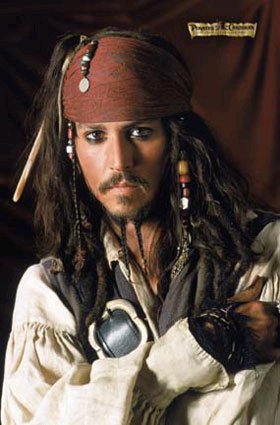 Captain Jack Sparrow
 On Time, On Target - the Stern Warning
Hey Steve. I know you don't like scientists and their techno-babble about global warming but you should like this guy. He's an economist, just like you, only a real one - Sir Nicholas Stern - and he's just released a report that says, from an economic standpoint alone, urgent steps to tackle global warming is a NO BRAINER! Did you get that Steve? Sir Nicholas says there will be enormous, long-term benefits from allocating about 1% of our GNP to fighting climate change.
Now, Steve, I'm sure your phone is ringing off the hook with calls from the oil patch and their gaggle of richly-funded global warming deniers but for God's sake man, that garbage just doesn't cut it anymore. The Alberta tories and their oil baron patrons can't call the shots any longer.
Stern has said what all the others have said, Steve. We haven't got years to squander on empty consultations and years after that to ponder emissions caps. We've got to do this now Steve, now.
We can't follow Washington on this one, pal. We have to work with other, responsible nations to force Bush's hand. Besides, the mid-terms are expected to put a brand new face on Congress, one that will likely demand action.
Today the world got a Stern warning. Steve, you've been put on notice. It's time you stood up for Canada, even if that means standing up to Alberta.
Now, Steve, I'm sure your phone is ringing off the hook with calls from the oil patch and their gaggle of richly-funded global warming deniers but for God's sake man, that garbage just doesn't cut it anymore. The Alberta tories and their oil baron patrons can't call the shots any longer.
Stern has said what all the others have said, Steve. We haven't got years to squander on empty consultations and years after that to ponder emissions caps. We've got to do this now Steve, now.
We can't follow Washington on this one, pal. We have to work with other, responsible nations to force Bush's hand. Besides, the mid-terms are expected to put a brand new face on Congress, one that will likely demand action.
Today the world got a Stern warning. Steve, you've been put on notice. It's time you stood up for Canada, even if that means standing up to Alberta.
If Votes Don't Count, Is It Democracy?
With U.S. congressional mid-term elections a week away there are renewed concerns about the electoral chicanery that marked the 2000 and 2004 votes.
If you're in a tight race, try to prevent as many as possible of your opponent's supporters from being able to vote. If that sounds sleazy and vile, well it is.
The correct term for it is "voter suppression" and The New York Times calls it "silent disenfranchisement." Remember Kathleen Harris in Florida in 2000 and her role in keeping thousands of black voters away from the polls?
The British paper, The Independent, questions whether this will turn out to be America's "dirtiest election ever" and cited these examples:
"Uproar has surrounded a key race in San Diego, where a Vietnamese immigrant, Tan Nguyen, is trying to unseat the Democrat incumbent, who is Hispanic. He has resisted calls to pull out of the race after an investigation found his campaign had sent letters to thousands of Hispanic voters warning them not to vote on 7 November if they were not legally in the US, suggesting they could face deportation.
"In Pennsylvania, a Democrat House candidate has been running attack ads on the Republican incumbent questioning his "family values" after an ex-mistress accused him of choking her.
"Several Democrats, meanwhile, have found themselves victims of spots funded by an Indianapolis businessman, Patrick Rooney, who says they want to abort black babies. "If you make a little mistake with one of your 'hos, you'll want to dispose of that problem tout de suite, no questions asked," a voiceover on the advertisement declares.
"In New York another Democratic candidate for the House, Michael Arcuri, has been struggling to recover from ads suggesting that he used taxpayers' money to dial a phone sex line. It turns out that an aide did dial a sex service once by mistake.
The demonisation of the Democrats
* MICHAEL ARCURI, NEW YORK
An ad by the National Republican Campaign Committee accused House candidate Arcuri of using taxpayers' money to dial a sex line. "Hi, sexy," a comely actress declares. One of his aides indeed dialled a sex service from campaign headquarters, but only by mistake.
* HAROLD FORD, TENNESSEE
An African-American running for Senate, Mr Ford was the subject of an ad by the Republican National Committee revealing his attendance at a Super Bowl party sponsored by Playboy. It features an actress in skimpy clothing winking and urging Mr Ford to "call me".
* STEVE KAGEN, WISCONSIN
Congressional candidate Dr Kagen was accused by the Republican Party of Wisconsin of having links to a serial killer and child rapist, a claim set out in an election mailshot. In fact, he was linked only to the man's lawyer, who had once done some legal work for him.
* JIM WEBB, VIRGINIA
The incumbent Republican senator George Allen has published excerpts from Webb's novels which contain graphic scenes of prostitution and child abuse. The Allen campaign claims that the passages show a "continued pattern of demeaning women".
* RON KIND, WISCONSIN
Republican TV ads alleged Kind "pays for sex" after he opposed an effort in Congress to end funding of sex surveys by the National Institutes of Health. The ad implies this meant Kind wanted "to pay teenage girls to watch pornographic movies with probes connected to their genitalia".
Is there a limit to this sort of thing, some point beyond which these lowlifes won't venture? If there is, it'll be one defined by voter backlash but I don't see that happening in the U.S. I hope we won't get to the point where our politicians get away with this garbage unpunished.
Remember when Kim Campbell paid the price for an ad mocking Jean Chretien's appearance? Let's just hope we stick with those values.
If you're in a tight race, try to prevent as many as possible of your opponent's supporters from being able to vote. If that sounds sleazy and vile, well it is.
The correct term for it is "voter suppression" and The New York Times calls it "silent disenfranchisement." Remember Kathleen Harris in Florida in 2000 and her role in keeping thousands of black voters away from the polls?
The British paper, The Independent, questions whether this will turn out to be America's "dirtiest election ever" and cited these examples:
"Uproar has surrounded a key race in San Diego, where a Vietnamese immigrant, Tan Nguyen, is trying to unseat the Democrat incumbent, who is Hispanic. He has resisted calls to pull out of the race after an investigation found his campaign had sent letters to thousands of Hispanic voters warning them not to vote on 7 November if they were not legally in the US, suggesting they could face deportation.
"In Pennsylvania, a Democrat House candidate has been running attack ads on the Republican incumbent questioning his "family values" after an ex-mistress accused him of choking her.
"Several Democrats, meanwhile, have found themselves victims of spots funded by an Indianapolis businessman, Patrick Rooney, who says they want to abort black babies. "If you make a little mistake with one of your 'hos, you'll want to dispose of that problem tout de suite, no questions asked," a voiceover on the advertisement declares.
"In New York another Democratic candidate for the House, Michael Arcuri, has been struggling to recover from ads suggesting that he used taxpayers' money to dial a phone sex line. It turns out that an aide did dial a sex service once by mistake.
The demonisation of the Democrats
* MICHAEL ARCURI, NEW YORK
An ad by the National Republican Campaign Committee accused House candidate Arcuri of using taxpayers' money to dial a sex line. "Hi, sexy," a comely actress declares. One of his aides indeed dialled a sex service from campaign headquarters, but only by mistake.
* HAROLD FORD, TENNESSEE
An African-American running for Senate, Mr Ford was the subject of an ad by the Republican National Committee revealing his attendance at a Super Bowl party sponsored by Playboy. It features an actress in skimpy clothing winking and urging Mr Ford to "call me".
* STEVE KAGEN, WISCONSIN
Congressional candidate Dr Kagen was accused by the Republican Party of Wisconsin of having links to a serial killer and child rapist, a claim set out in an election mailshot. In fact, he was linked only to the man's lawyer, who had once done some legal work for him.
* JIM WEBB, VIRGINIA
The incumbent Republican senator George Allen has published excerpts from Webb's novels which contain graphic scenes of prostitution and child abuse. The Allen campaign claims that the passages show a "continued pattern of demeaning women".
* RON KIND, WISCONSIN
Republican TV ads alleged Kind "pays for sex" after he opposed an effort in Congress to end funding of sex surveys by the National Institutes of Health. The ad implies this meant Kind wanted "to pay teenage girls to watch pornographic movies with probes connected to their genitalia".
Is there a limit to this sort of thing, some point beyond which these lowlifes won't venture? If there is, it'll be one defined by voter backlash but I don't see that happening in the U.S. I hope we won't get to the point where our politicians get away with this garbage unpunished.
Remember when Kim Campbell paid the price for an ad mocking Jean Chretien's appearance? Let's just hope we stick with those values.
Sunday, October 29, 2006

When God Made Canada
Once upon a time in the Kingdom of Heaven, God went missing for six days. Eventually, Michael the archangel found him, resting on the seventh day. He inquired of God, "Where have you been?"
God sighed a deep sigh of satisfaction and proudly pointed downwards through the clouds,
"Look Michael, look what I've made."
"Look Michael, look what I've made."
Archangel Michael looked puzzled and said, "What is it?"
"It's a planet," replied God, "and I've put LIFE on it. I'm going to call it Earth and it's going to be a great place of balance."
"Balance?" inquired Michael, still confused.
God explained, pointing to different parts of Earth, "For example, Northern Europe will be a place of great opportunity and wealth while Southern Europe is going to be poor, the Middle East over there will be a hot spot. Over there, I've placed a continent of white people and over there is a continent of black people."
God continued, pointing to different countries. "This one will be extremely hot and arid while this one will be very cold and covered in ice."
The Archangel, impressed by Gods work, then pointed to a large land mass in the top corner and asked, "What's that one?"
"Ah," said God. "That's Canada, the most glorious place on Earth. There's beautiful mountains, lakes, rivers, streams and an exquisite coast-line. The people from Canada are going to be modest, intelligent and humorous and they're going to be found traveling the world. They'll be extremely sociable, hard-working and high achieving, and they will be known throughout the world as diplomats and carriers of peace. I'm also going to give them super-human, undefeatable ice hockey players who will be admired and feared by all who come across them."
Michael gasped in wonder and admiration but then proclaimed. "What about balance, God? You said there would be balance?"
God replied wisely. "Wait until you see the loud-mouth bastards I'm putting next to them."
What Does This Tell You?
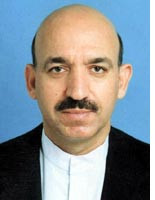
It's making headlines in newspapers in every corner of the world - Hamid Karzai is trying to cut some deal with the Taliban.
Yes, this is the same Taliban that Canadian and other NATO soldiers are in Afghanistan to defeat. Let's see - they're killing us and a bunch of other folks and we're killing them and a bunch of other folks while Hamid is trying to get a game of "let's make a deal" going.
Now, what does that tell ya?
It says a lot of things, almost none of them new.
It says that we're not going to defeat the Taliban with guns and bombs and rockets. Nope, no way in hell.
It says that Karzai knows his already thoroughly compromised and corruption-riddled government needs a deal with the Taliban just to survive.
It says that Hamid realizes that NATO's effort isn't working, that it's far too small to win this one for him.
It says that the Afghan president sees the hearts and minds of his people slipping straight through his fingers.
Meanwhile it's also reported that the Taliban has rebuffed Karzai. That says they don't see the need to make any deals.
It's also reported that the Taliban aren't going back to their mountain retreats this winter as expected. No, apparently they intend to stay and run a campaign aimed at taking Kabul.
It says that NATO is out of time and must either deploy a far larger force or start preparing to get out.
It's a Man's World? Not Much Longer
We men have done such a terrific job of running this planet that maybe it's time to let the other half show us what they can do. I, for one, think that is an idea worth tossing about.
According to The New York Times, a serious power shift from men to women is already well underway.
"We are perhaps on the first step to a matriarchal society; women will earn more money than men if current trends continue by 2028,” said Michael J. Silverstein of the Boston Consulting Group. “The trend has been escalating in the last 10 years as there has been a gradual, slow erosion of the power balance in the family, a psychic rebalancing.”
"Women, Mr. Silverstein added, are “controlling purchases and driving a shift in our economy.”
"Much of that shift has to do with education and pay. At American colleges and universities, women represent 57 percent of undergraduate classes and 58 percent of graduate classes, according to the American Council on Education. (They also hold a slight majority in the overall population.) And education, in turn, has helped to bolster salaries and income. In 2005, government data show, women who were full-time wage and salary workers had median weekly earnings of $585, or 81 percent of the $722 median for their male counterparts, up from about 63 percent in 1979."
Let's face it, she who controls the wealth is she who holds the power, or at least a good deal of it. With purchasing power comes economic clout and with that, eventually, matching political clout. And why not?
According to The New York Times, a serious power shift from men to women is already well underway.
"We are perhaps on the first step to a matriarchal society; women will earn more money than men if current trends continue by 2028,” said Michael J. Silverstein of the Boston Consulting Group. “The trend has been escalating in the last 10 years as there has been a gradual, slow erosion of the power balance in the family, a psychic rebalancing.”
"Women, Mr. Silverstein added, are “controlling purchases and driving a shift in our economy.”
"Much of that shift has to do with education and pay. At American colleges and universities, women represent 57 percent of undergraduate classes and 58 percent of graduate classes, according to the American Council on Education. (They also hold a slight majority in the overall population.) And education, in turn, has helped to bolster salaries and income. In 2005, government data show, women who were full-time wage and salary workers had median weekly earnings of $585, or 81 percent of the $722 median for their male counterparts, up from about 63 percent in 1979."
Let's face it, she who controls the wealth is she who holds the power, or at least a good deal of it. With purchasing power comes economic clout and with that, eventually, matching political clout. And why not?
Google Bombing the Repugs

One key to the Republican resurgence that swept the United States was a brilliant communications strategy that harnessed the 'alternative' media to do the far right's bidding. This involved cable outlets, like Fox, and the open-mouth radio gulag of Rush Limbaugh and Michael "Weiner" Savage. The Repugs were able to use those vehicles to set the agenda that mainstream media eventually had to follow.
American progressives have very quietly fought back by claiming the internet as their own. From all accounts they've done a pretty good job of it. Now, with mid-term elections just days away, they're launching an internet offensive - Google bombing.
Google bombing is a means of using embedded hyperlink principles to focus Google searches onto web sites that may not be particularly flattering or supportive of a particular candidate. So far, 50 Republican candidates have been targetted.
The key, according to Chris Bowers who conceived the idea, is to ensure that only credible sources are hyperlinked. Those clicking on the candidate's name must be directed to a legitimate news source, something accurate and believable.
Doubtless this will have some Repugs howling. Unlike the underhanded tactics they use, deceptive attack ads and push-polling for example, Google bombing just relies on truth. No wonder they'll find it so upsetting.
Send In Oprah
Canada's economic dinghy is tied hard aside the SS USA. It's been a terrific ride, so far. We've had a healthy balance of trade surplus from that relationship. Our industries have been integrated fully with the American economy.
Sure there have been a few bumps but you can't hitch a ride on a ship this size and not get buffeted by the wake every now and then.
Canada has done so well out of trading with the United States that we can sometimes take the whole thing for granted. We don't give a lot of attention to just where the SS USA is heading. That's too bad because it may be heading straight for the rocks and it may well take us along with it.
It's been a long time coming. For years the United States, its governments and its people have been building enormous debts. Despite a few surplus years during the Clinton administration, the Bush regime has spent like madmen, funded a war and cut taxes - all at the very same time. It takes a lot of money to do that, borrowed money, most of it borrowed abroad where you don't even get to tax back some of the interest paid out on the debt.
For years it has seemed that America was so big, so powerful, so important to the world economy that it could actually defy gravity. It posted record government deficits, record balance of trade deficits, record accumulated government debt and record individual debt and it never seemed to stop. The day of reckoning, however, is just around the corner at least according to the guy who runs America's General Accounting Office, the nation's Comptroller General, David Walker.
Walker is free to speak out. He's got job security until 2013. Now he's taking his campaign to the streets because he knows politicians don't want to speak about the looming economic crisis and people aren't much interested in hearing about it either.
The iceberg heading America's way are what they call 'entitlement' programmes: medicair, medicaid and social security. The U.S., like most western countries, has an aging population but one in which lifespans have been increased significantly in recent years. That spells a big wave of seniors calling upon these entitlements in the near future and calling on them for many more years than had been expected.
Entitlements are the iceberg but the second half of the problem is the ship that's steaming toward it, SS USA. While it should have been preparing the country for the changes coming, the governments - federal, state and municipal - have been binge borrowing. The Republicans have actually funded their tax cuts for the rich with foreign borrowings. Think about that for a moment.
Remember when Bush chastised Americans for being "addicted to oil"? That's only one addiction. The country and its people have become seriously addicted to debt. Family debt levels have never been as high. Home equity ratios have never been as low. Savings, forget about it.
America's current national debt totals roughly $8.5 trillion. The problem is it is growing at close to $2-trillion a year. If the government keeps on going, stays the course, Walker and others warn the debt could reach an adjusted figure of $46-trillion or more, roughly the net worth of every American, incluing he super rich ones.
There is only one solution and it's painful: raise taxes and slash entitlements. The fiscal mess of the U.S. federal government means there are no other choices. The country has been deliberately weakened to the point that it can't turn away from the iceberg.
There is one more problem: getting politicians to tell their constituents that they need to accept more taxes and fewer benefits. Politicians don't have that kind of courage today. An accountant who listened to Walker's speech came up with a good idea: get Oprah to convince the American people to support fiscal responsibility.
Sure there have been a few bumps but you can't hitch a ride on a ship this size and not get buffeted by the wake every now and then.
Canada has done so well out of trading with the United States that we can sometimes take the whole thing for granted. We don't give a lot of attention to just where the SS USA is heading. That's too bad because it may be heading straight for the rocks and it may well take us along with it.
It's been a long time coming. For years the United States, its governments and its people have been building enormous debts. Despite a few surplus years during the Clinton administration, the Bush regime has spent like madmen, funded a war and cut taxes - all at the very same time. It takes a lot of money to do that, borrowed money, most of it borrowed abroad where you don't even get to tax back some of the interest paid out on the debt.
For years it has seemed that America was so big, so powerful, so important to the world economy that it could actually defy gravity. It posted record government deficits, record balance of trade deficits, record accumulated government debt and record individual debt and it never seemed to stop. The day of reckoning, however, is just around the corner at least according to the guy who runs America's General Accounting Office, the nation's Comptroller General, David Walker.
Walker is free to speak out. He's got job security until 2013. Now he's taking his campaign to the streets because he knows politicians don't want to speak about the looming economic crisis and people aren't much interested in hearing about it either.
The iceberg heading America's way are what they call 'entitlement' programmes: medicair, medicaid and social security. The U.S., like most western countries, has an aging population but one in which lifespans have been increased significantly in recent years. That spells a big wave of seniors calling upon these entitlements in the near future and calling on them for many more years than had been expected.
Entitlements are the iceberg but the second half of the problem is the ship that's steaming toward it, SS USA. While it should have been preparing the country for the changes coming, the governments - federal, state and municipal - have been binge borrowing. The Republicans have actually funded their tax cuts for the rich with foreign borrowings. Think about that for a moment.
Remember when Bush chastised Americans for being "addicted to oil"? That's only one addiction. The country and its people have become seriously addicted to debt. Family debt levels have never been as high. Home equity ratios have never been as low. Savings, forget about it.
America's current national debt totals roughly $8.5 trillion. The problem is it is growing at close to $2-trillion a year. If the government keeps on going, stays the course, Walker and others warn the debt could reach an adjusted figure of $46-trillion or more, roughly the net worth of every American, incluing he super rich ones.
There is only one solution and it's painful: raise taxes and slash entitlements. The fiscal mess of the U.S. federal government means there are no other choices. The country has been deliberately weakened to the point that it can't turn away from the iceberg.
There is one more problem: getting politicians to tell their constituents that they need to accept more taxes and fewer benefits. Politicians don't have that kind of courage today. An accountant who listened to Walker's speech came up with a good idea: get Oprah to convince the American people to support fiscal responsibility.
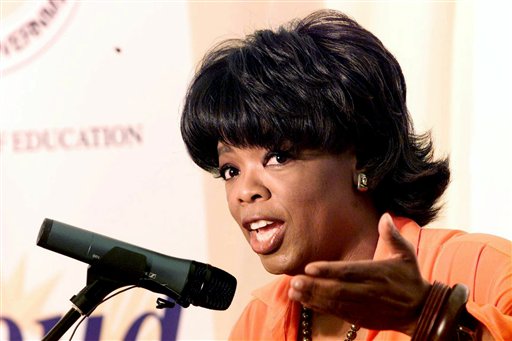 I'm sorry, we're broke
Here's how David Walker puts it, "This is about the future of our country, our kids and grandkids. ...We the people have to rise up to make sure things get changed."
We in Canada need to pay attention to this even if Americans won't. As their economy goes, so goes ours. Perhaps this would be a good time to work on diversifying our trade.
This is certainly an ideal time for us to take another good, hard look at our own debt situation. Remember how we did that when Chretien took over from Mulroney, how they explained to us the predicament we were in and what we needed to do? Our politicians have shown they can talk to us about these things and we've shown we're willing to listen and embrace fiscal responsibility.
But we've been taking a lot for granted over the last several years. Time to take a fresh look.
Saturday, October 28, 2006
The Afghan Quagmire
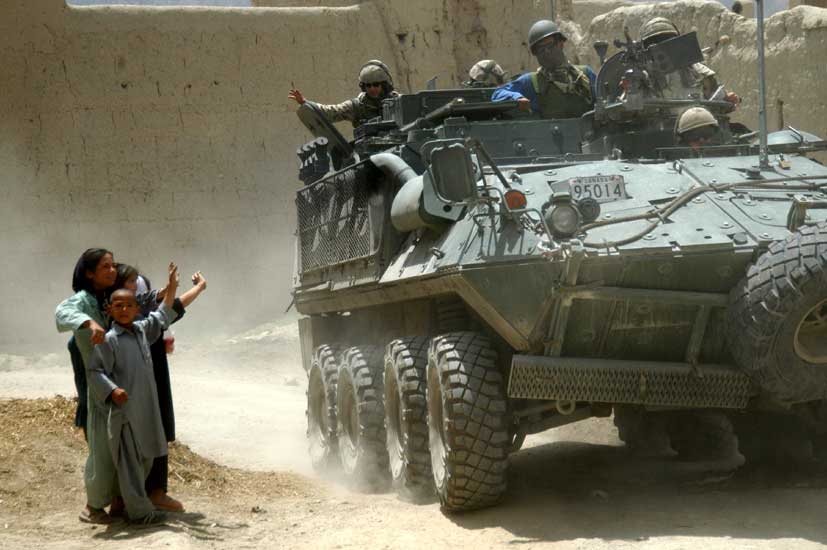
The New York Times magazine just published an eye-opening, first-person account by Elizabeth Rubin describing her journeys in Afghanistan. Here are some excerpts:
"Anticipation hung over the Alamo. Charlie Company’s next mission was a bit of deceptive theater intended to lure the Taliban into ambushing the soldiers so they could counterattack. Part of the strategy involved Lt. Nathan Shields — a smiling, easygoing officer from Rochester — posing as a gullible new commander. Meanwhile, units hiding in the mountains would block the Taliban’s escape.
"That night, a few squads hiked up a thousand feet, each soldier hauling water (temperatures in the day are usually in the 100’s), food, rifle, knife, flashlight and first-aid kit, all atop 35 pounds of armor and ammunition. The Afghan soldiers carried little besides a rifle and ammunition.
"The American infantryman’s burden is the Taliban’s biggest advantage. Fleet-footed, carrying little more than an AK and a walkie-talkie, Taliban fighters could sail over the mountains.
"The next morning we headed toward Solan, a village so unfriendly that when American soldiers airlifted in a bridge months earlier, it was burned down the next day. “We don’t know if the Taliban burnt it or the villagers,” Lt. David Patton, a tall, circumspect Texan with Task Force Warrior, said of the bridge in Solan.
“'Everyone believes in the mission,' he added, 'but there’s an underlying thought that when we leave, it’ll go back to the way it was.' As Zabul’s governor, Arman, had told me, Zabul’s religious leaders all supported the Taliban, and in Afghanistan the most powerful platform is the minbar, a pulpit where the mullah delivers his Friday sermon. So although villagers were friendly when the Americans patrolled, they refused to help rebuild a school and a bazaar, for example, fearing retaliation from the Taliban who had destroyed them.
"Ten lean men in turbans came to meet Shields, who played his role as new commander somewhat awkwardly. A strange dialogue ensued, led by one of the 10 men, Haji Gailani, whose oversize glasses, gabardine vest and cane denoted authority. He said that they didn’t deny Taliban fighters were nearby. “If you can catch those people, thank you,” he said. “If you want to slaughter my neck, please do.” There was a little nervous laughter. No, no, Shields said, of course not. Then Gailani said: “You have planes. You can hear the Taliban on your radios. And still you cannot force them out of here. How can we?”
"Others began to speak up. Planes had attacked the mountains the night before, the men said. They had heard about the bombing of civilians in Kandahar. They wanted to know if they were about to be bombed. Robbins advised them to stay near the thickest walls and shut off the lights. Then they left.
"The final draft of the U.S. military’s latest counterinsurgency manual, written under the direction of Lt. Gen. David Petraeus and Lt. Gen. James Mattis, emphasizes that if you skimp on resources, endurance and meeting the population’s security requirements, you lose. Yet for the past five years, the Pashtun provinces have been plagued by a lack of troops and resources.
"James Dobbins, President George W. Bush’s former special envoy to Afghanistan, blames the White House, which he said had a predisposition against nation-building and international peacekeeping. The Bush administration rejected Afghan and State Department appeals to deploy a peacekeeping force in the provinces, dismissed European offers of troops and had already begun shifting military resources to Iraq, Dobbins told me, while U.S. troops in Afghanistan were to be limited to counterterrorism.
“In manpower and money,” he added, “this was the least resourced American nation-building effort in our history.” In Afghanistan, the White House spent 25 times less per capita than in Bosnia and deployed one-fiftieth the troops. Much of the money that was pledged didn’t show up for years. “The main lesson of Afghanistan is low input, low output,” Dobbins said. “If you commit low levels of military manpower and economic assistance, what you get are low levels of security and economic growth.”
The entire article can be found at:
Takest That - Ye Heathen!
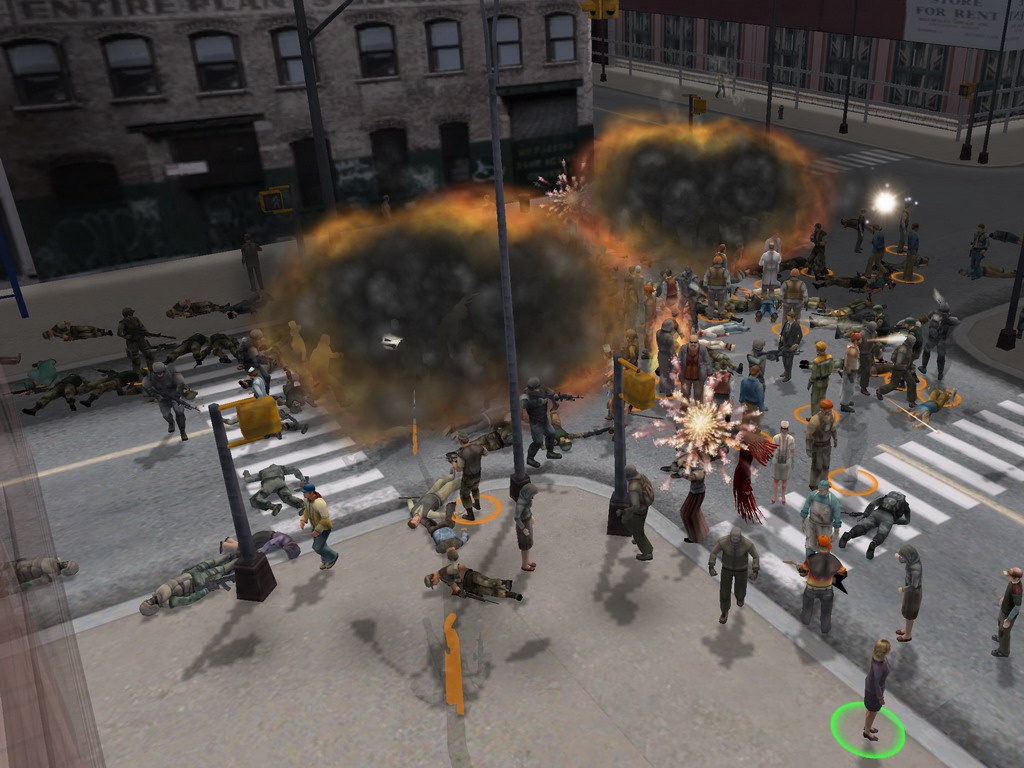
I know what Little Stevie is getting for Christmas. In the spirit of our loving, ever forgiving and redeeming Jesus Christ, Stevie will be getting "Left Behind: Eternal Force." It's a video game in which Born Again stormtroopers go around slaughtering disbelievers. Ordinary Christians don't stand a chance, don't even begin to think of what lies in store for Jews or Muslims. It's sort of like a 21st century Crusade, isn't it?
Don't worry, there are plenty of shopping days left before Christmas for you to repent your evil ways.
Let's Split the Difference
Michael Ignatieff has caught hell from some Jewish Liberals and the larger Jewish-Canadian community for branding the Israeli bombardment of the village of Qana a war crime. They contend that Israel was only defending itself from a terrorist assault and they absolutely love Little Stevie who panders to them shamelessly.
Was Qana a war crime? Well, a lot of civilians were killed and it seems that Israel really wasn't too fussy about who or where it struck.
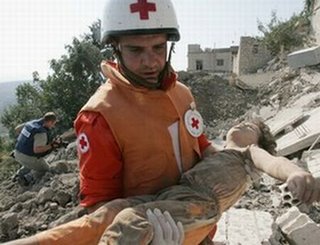
It strikes me as odd that a nation that supposedly held the absolute moral high ground in this war would be so dishonest about the way it waged that battle. Israel was alleged to have used cluster bombs. At first they denied it, then they admitted it. Israel was alleged to have used white phospherous shells. At first they denied it, then they admitted it. Now Israel is said to have used radioactive weapons in Lebanon. This time they're simply saying "no comment."
Were these war crimes? You would need to know a lot more about the circumstances in which these weapons were used to come to any conclusion. I just don't know. Here's something I do know; no matter that Hezbollah sparked this conflict and no matter that Hezbollah indiscriminately rocketed Israel throughout, what Hezbollah did in no way exempts Israel from blame and outrage at what they also did.

Maybe these weren't war crimes. Why don't we split the difference and call them something that unquestionably fits. Let's call them atrocities. That's what they were. There, doesn't that make the whole thing so much better?
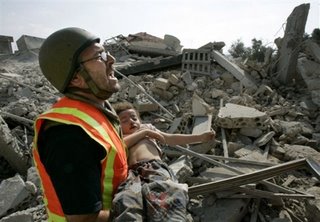
Was Qana a war crime? Well, a lot of civilians were killed and it seems that Israel really wasn't too fussy about who or where it struck.

It strikes me as odd that a nation that supposedly held the absolute moral high ground in this war would be so dishonest about the way it waged that battle. Israel was alleged to have used cluster bombs. At first they denied it, then they admitted it. Israel was alleged to have used white phospherous shells. At first they denied it, then they admitted it. Now Israel is said to have used radioactive weapons in Lebanon. This time they're simply saying "no comment."
Were these war crimes? You would need to know a lot more about the circumstances in which these weapons were used to come to any conclusion. I just don't know. Here's something I do know; no matter that Hezbollah sparked this conflict and no matter that Hezbollah indiscriminately rocketed Israel throughout, what Hezbollah did in no way exempts Israel from blame and outrage at what they also did.

Maybe these weren't war crimes. Why don't we split the difference and call them something that unquestionably fits. Let's call them atrocities. That's what they were. There, doesn't that make the whole thing so much better?
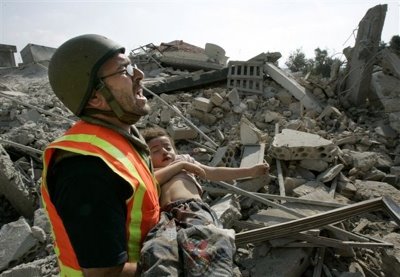
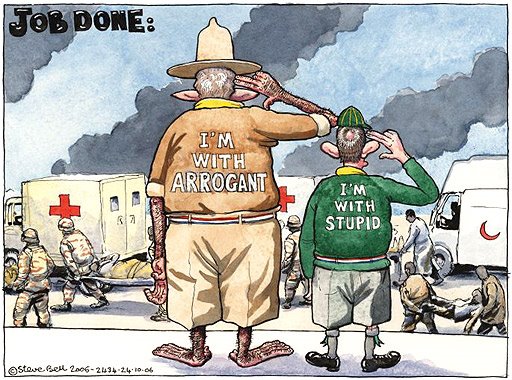
Rest Up Stevie - Monday Could Be a Bitch
Canadians have seen Stephen Harper's plan of action to combat climate change - there isn't one. Wait several years, consult, ponder, then wait another ten to fifteen years to impose GHG caps. That should keep the tar sands boys happy.
Monday could be an awkward day for Harper. On Monday the British Treasury Department will release Sir Nicholas Stern's long awaited report on the economic costs of global warming. The Stern report warns that doing nothing about global warming may be 20-times more costly to humanity than taking prompt, remedial action. Twenty times more expensive. Not ten, not fifteen, but twenty.
Stern's calculations take into account the costs of droughts, floods, hurricanes and human migration.
If the opposition needs another cudgel to smack Stevie on the head, the Stern report should work.
Monday could be an awkward day for Harper. On Monday the British Treasury Department will release Sir Nicholas Stern's long awaited report on the economic costs of global warming. The Stern report warns that doing nothing about global warming may be 20-times more costly to humanity than taking prompt, remedial action. Twenty times more expensive. Not ten, not fifteen, but twenty.
Stern's calculations take into account the costs of droughts, floods, hurricanes and human migration.
If the opposition needs another cudgel to smack Stevie on the head, the Stern report should work.
What Were They Playing At?
We know that Israel was pretty indiscriminate in its recent attack on Lebanon. We know that it used some incredibly brutal weapons, cluster bombs and white phosphorus bombs, that devastated residential areas and remain in tens of thousands to litter the Lebanese landscape.
Now there are reports that Israel might have used some sort of radiation weapon against the Lebanese. Writing in today's Independent, a British newspaper, journalist Robert Fisk reported on these radioactive weapons:
"According to Dr Chris Busby, the British Scientific Secretary of the European Committee on Radiation Risk, two soil samples thrown up by Israeli heavy or guided bombs showed "elevated radiation signatures".
"Dr Busby's initial report states that there are two possible reasons for the contamination. "The first is that the weapon was some novel small experimental nuclear fission device or other experimental weapon (eg, a thermobaric weapon) based on the high temperature of a uranium oxidation flash ... The second is that the weapon was a bunker-busting conventional uranium penetrator weapon employing enriched uranium rather than depleted uranium." A photograph of the explosion of the first bomb shows large clouds of black smoke that might result from burning uranium.
"Israel has a poor reputation for telling the truth about its use of weapons in Lebanon. In 1982, it denied using phosphorous munitions on civilian areas - until journalists discovered dying and dead civilians whose wounds caught fire when exposed to air.
"I saw two dead babies who, when taken from a mortuary drawer in West Beirut during the Israeli siege of the city, suddenly burst back into flames. Israel officially denied using phosphorous again in Lebanon during the summer - except for "marking" targets - even after civilians were photographed in Lebanese hospitals with burn wounds consistent with phosphorous munitions.
"Then on Sunday, Israel suddenly admitted that it had not been telling the truth. Jacob Edery, the Israeli minister in charge of government-parliament relations, confirmed that phosphorous shells were used in direct attacks against Hizbollah, adding that "according to international law, the use of phosphorous munitions is authorised and the (Israeli) army keeps to the rules of international norms".
"Chris Bellamy, the professor of military science and doctrine at Cranfield University, who has reviewed the Busby report, said: "At worst it's some sort of experimental weapon with an enriched uranium component the purpose of which we don't yet know. At best - if you can say that - it shows a remarkably cavalier attitude to the use of nuclear waste products."
"The soil sample from Khiam - site of a notorious torture prison when Israel occupied southern Lebanon between 1978 and 2000, and a frontline Hizbollah stronghold in the summer war - was a piece of impacted red earth from an explosion; the isotope ratio was 108, indicative of the presence of enriched uranium. "The health effects on local civilian populations following the use of large uranium penetrators and the large amounts of respirable uranium oxide particles in the atmosphere," the Busby report says, "are likely to be significant ... we recommend that the area is examined for further traces of these weapons with a view to clean up."
According to Fisk, the United States and Iran each used the Lebanese war as a testing ground for new munitions.
These reports are disturbing. Before throwing Canada's support behind Israel yet again, prime minister Stephen Harper should determine whether Israel did indeed use radiation weapons against Lebanon. If so, Canada should respond forcefully.
Now there are reports that Israel might have used some sort of radiation weapon against the Lebanese. Writing in today's Independent, a British newspaper, journalist Robert Fisk reported on these radioactive weapons:
"According to Dr Chris Busby, the British Scientific Secretary of the European Committee on Radiation Risk, two soil samples thrown up by Israeli heavy or guided bombs showed "elevated radiation signatures".
"Dr Busby's initial report states that there are two possible reasons for the contamination. "The first is that the weapon was some novel small experimental nuclear fission device or other experimental weapon (eg, a thermobaric weapon) based on the high temperature of a uranium oxidation flash ... The second is that the weapon was a bunker-busting conventional uranium penetrator weapon employing enriched uranium rather than depleted uranium." A photograph of the explosion of the first bomb shows large clouds of black smoke that might result from burning uranium.
"Israel has a poor reputation for telling the truth about its use of weapons in Lebanon. In 1982, it denied using phosphorous munitions on civilian areas - until journalists discovered dying and dead civilians whose wounds caught fire when exposed to air.
"I saw two dead babies who, when taken from a mortuary drawer in West Beirut during the Israeli siege of the city, suddenly burst back into flames. Israel officially denied using phosphorous again in Lebanon during the summer - except for "marking" targets - even after civilians were photographed in Lebanese hospitals with burn wounds consistent with phosphorous munitions.
"Then on Sunday, Israel suddenly admitted that it had not been telling the truth. Jacob Edery, the Israeli minister in charge of government-parliament relations, confirmed that phosphorous shells were used in direct attacks against Hizbollah, adding that "according to international law, the use of phosphorous munitions is authorised and the (Israeli) army keeps to the rules of international norms".
"Chris Bellamy, the professor of military science and doctrine at Cranfield University, who has reviewed the Busby report, said: "At worst it's some sort of experimental weapon with an enriched uranium component the purpose of which we don't yet know. At best - if you can say that - it shows a remarkably cavalier attitude to the use of nuclear waste products."
"The soil sample from Khiam - site of a notorious torture prison when Israel occupied southern Lebanon between 1978 and 2000, and a frontline Hizbollah stronghold in the summer war - was a piece of impacted red earth from an explosion; the isotope ratio was 108, indicative of the presence of enriched uranium. "The health effects on local civilian populations following the use of large uranium penetrators and the large amounts of respirable uranium oxide particles in the atmosphere," the Busby report says, "are likely to be significant ... we recommend that the area is examined for further traces of these weapons with a view to clean up."
According to Fisk, the United States and Iran each used the Lebanese war as a testing ground for new munitions.
These reports are disturbing. Before throwing Canada's support behind Israel yet again, prime minister Stephen Harper should determine whether Israel did indeed use radiation weapons against Lebanon. If so, Canada should respond forcefully.
An Ethical Dilemma of Life and Death
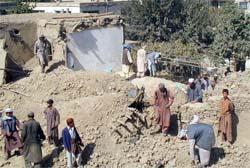
Is it right to use aerial bombardment on residential neighbourhoods? Do we have the right to kill civilians? How many Afghan deaths is it worth to save one soldier's life?
In previous posts I've come out clearly against the use of aerial bombardment on residential neighbourhoods. It's indiscriminate. It's cowardly.
I became disgusted with aerial bombardment tactics when I watched video, back in the 90's, of Israeli warplanes bombing refugee camps in Lebanon. I thought that, if the Israelis wanted to get at the Palestinian guerrillas, they damned well ought to be willing to send soldiers in to fight soldiers.
I felt the same thing watching American airstrikes on Iraqi marketplaces and bombardment of their residential areas. I was revolted at the Israeli use of cluster bombs and white phosphorous against civilian populations in Lebanon.
Now the hens have come home to roost. Now it's Canadian troops calling in airstrikes. We can't pretend any longer. We've seen the results of these tactics for two decades. Airstrikes against residential neighbourhoods kill a lot of civilians, far too many to dismiss them as unintentional collateral damage.
Don't be fooled by talk about precision-guided weapons. Sure we can guide a bomb to a very small target, the front of a house for example. However, if that precision guided system is riding the nose of a 2,000 pound bomb, precision becomes almost meaningless. That weapon is going to destroy houses and kill innocents within a very big radius of where it hits. We know that's going to happen so we can't claim these deaths are unintentional.
Sure we're saving the lives of our soldiers but at what cost? Is one Canadian soldier's life worth the lives of 10 Afghans, 20 Afghans, even 60 Afghans? We have to ask ourselves that very question.
We also have to question how these "unintentional" deaths are advancing our battle for the hearts and minds of these Afghans, the survivors? Let's see, they don't endure Taliban airstrikes. We can claim the insurgents are responsible for mingling with civilians but these still aren't insurgent bombs. What we think, of course, is secondary to which side the Afghan people blame.
The Associated Press reports that a human rights watchdog is warning NATO that these airstrikese are turning the population against the alliance:
"Human Rights Watch argued that NATO is relying too much on aircraft to attack insurgent positions. In June, the U.S. Central Command reported 340 airstrikes in Afghanistan, double the 160 strikes in Iraq in the same month, the group noted.
"'NATO should reconsider the use of highly destructive but hard-to-target weaponry in areas where there is a clear risk of considerable civilian casualties,' Zarifi said, referring to aerial bombs and missiles.
Maj. Luke Knittig, the spokesman for NATO's International Security Assistance Force in Afghanistan, said that "airpower is used extensively because it is an advantage and it can be decisive at a close fight."
Using this massive airpower against insurgent battle positions or in response to ambushes may well be justified. In other words we should have free access to these weapons when fighting out in the field or for defensive purposes. They should not be used, however, in residential neighbourhoods.
Oh My God - Has It Come to This?

His name is Harold Ford, Jr. He's black. He might just be the first Afro-American from the south to win a Senate seat. It's only been a century and a half roughly since the end of the Civil War so I guess southern voters just haven't had a chance to vote for a black guy before. I mean, it's not like there could be any other reason, could there?
Ford is the Democratic contender for the Tennessee senate seat being vacated by Bill Frist. He's said to be in an even race with his Republican opponent.
You've come a long way, baby.
He Thinks You're Ignorant - Hell, He's Counting On It
I'm serious, Prime Minister Stephen Harper really believes Canadians are ignorant. He's said that, quite openly. Here's how he belittled us before a gathering of primo, right-wing Americans:
"...it's legendary that if you're like all Americans, you know almost nothing except for your own country. Which makes you probably more knowledgeable about one more country than most Canadians."
That's just one example, there are others. Lately little Stevie has shown how foolish he thinks we must be in his provocations about the opposition support for his party's legislation. He even said that the opposition must support these bills because the Canadian people voted for them. Huh? Is he talking about that small group, the 30-odd per cent of Canadians who turned out to vote in the last election who supported him? Surely he can't be talking about the two-thirds of Canadian voters who wouldn't support him, is he?
Did you support Harper? I didn't.
Of course, Little Stevie doesn't let facts get in his way. He also doesn't let his past statements reign him in. Take a look at a couple of things he had to say when he was opposition leader in a minority Liberal government:
"If you want to be a government in a minority Parliament, you have to work with other people."
"It's the government's obligation to look really to the third parties to get the support to govern."
"And I think the real problem that we're facing already is that the government doesn't accept that it got a minority."
Oh Stevie, the hypocrisy just drips off your lips. Remember, Canadians never endorsed his legislative agenda; just a few did. You need to remember that because Harper can't.
"...it's legendary that if you're like all Americans, you know almost nothing except for your own country. Which makes you probably more knowledgeable about one more country than most Canadians."
That's just one example, there are others. Lately little Stevie has shown how foolish he thinks we must be in his provocations about the opposition support for his party's legislation. He even said that the opposition must support these bills because the Canadian people voted for them. Huh? Is he talking about that small group, the 30-odd per cent of Canadians who turned out to vote in the last election who supported him? Surely he can't be talking about the two-thirds of Canadian voters who wouldn't support him, is he?
Did you support Harper? I didn't.
Of course, Little Stevie doesn't let facts get in his way. He also doesn't let his past statements reign him in. Take a look at a couple of things he had to say when he was opposition leader in a minority Liberal government:
"If you want to be a government in a minority Parliament, you have to work with other people."
"It's the government's obligation to look really to the third parties to get the support to govern."
"And I think the real problem that we're facing already is that the government doesn't accept that it got a minority."
Oh Stevie, the hypocrisy just drips off your lips. Remember, Canadians never endorsed his legislative agenda; just a few did. You need to remember that because Harper can't.
The Other Civil War
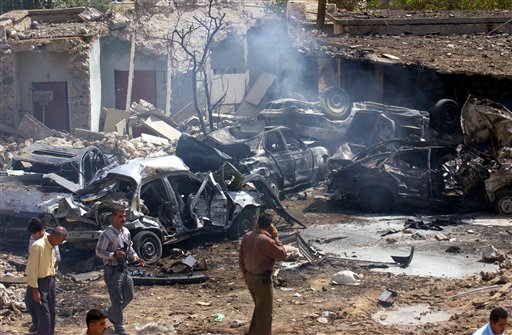 Your Car's Ready
We're bombarded with news reports about sectarian strife in Baghdad so widespread as to border on civil war. Iraq, however, is undergoing another civil war, one that could split the country.
To the north of Baghdad lies the city of Kirkuk. It is a city populated by Arab Shia from the south, by Turkomen and by Kurds. Saddam sought to Arabize Kirkuk by driving Kurds out and bringing Shia in from the south.
Kirkuk is a real prize because it sits atop and commands what is believed to be the country's second-largest oilfield. The Kurds want the city badly and the others don't want them to have it.
In order to get the Kurdish Autonomous Region to agree to join the new Iraqi federation, Baghdad had to agree to accept the new Kurdish constitution. This was a shrewdly framed document, drafted with the help of Peter Galbraith, that defines the future Kurdish state.
Saddam did little to exploit the oil resources in the Kurdish north, apparently to punish the troublesome Kurds. That means that most of it remains available for development.
When the Kurds drew their constitution, it provided for two classes of oil resources; those in development before Saddam was toppled and those that remained undeveloped. The Kurds agreed that revenues from oil fields already under development would remain Baghdad's to distribute, equitably, among all Iraqis. The undeveloped motherload, however, would remain the exclusive resource of the Kurds and their semi-autonomous government.
The Kurdish constitution made the future of Kirkuk much more important. Whoever gets Kirkuk gets the oil fields and, because they're undeveloped, a Kurdish Kirkuk would mean great wealth for the Kurdish Autonomous Region.
Who owns Kirkuk, that is the question. To decide the issue, the KAR has decided to hold a referendum in Kirkuk next year. In the meantime there's a lot of preparation to be done. This involves driving out the Shia Arabs who were brought in by Saddam and giving those houses back to their Kurdish owners. But the Kurds aren't stopping at that. They're also drawing in waves of Kurdish settlers, newcomers, to Kirkuk to tip the referendum balance next year.
Kirkuk has set the cat among the pigeons. The Sunnis are particularly sensitive to oil reserves because most of the known reserves are located within the Shia south and the Kurdish north. The Sunni are determined that Kirkuk and its oil remain part of Iraq. A recent gathering of Sunni sheiks resulted in a veiled threat. Sheik Abdul Monshad warned, "Kirkuk must never become part of Kurdistan. It is an Iraqi city and we will take all routes to prevent the divisions of Iraq."
The fear seems to be that a Kurdish Kirkuk will mean the end of hopes for a unified Iraq. It is a resulted welcomed by no one save the Kurds themselves. It is opposed by Iraq's Shia and Sunni; by Iran; by Kirkuk's Turkomen and, on their behalf, by Turkey itself, not to mention by the United States.
Suicide and roadside bombings have increased lately in Kirkuk and a trench has been dug across the southern side of the city to funnel traffic through a couple of well-manned checkpoints. At Kirkuk restaurants Arabs, Turkomen and Kurds continue to eat together. Sectarian tensions, however, are increasing. Ali Mehdi, a Turkomen member of the provincial council, warned, "the people won't accept the rule of the Kurdish parties. A civil war could break out any minute."
The Kurds know they're playing a high stakes game over Kirkuk but they recognized that when they crafted their constitution. If Kirkuk goes to the Kurds they will have little incentive to remain part of Iraq which could, in turn, lead the Shia to take the same position on the southern oilfields, effectively ending any unitary Iraq, any Iraq at all.
Friday, October 27, 2006

Memo to Stevie - Crime Is Not the Priority

A clear sign of the Reform/Alliance/Conservative party's grasp on the issues confronting Canada is the incredible focus on crime. Let me see, crime has been going down and is at levels not seen in quite a while but climate change is really taking off. Look at it this way, is your granddaughter's safety and future more at risk from climate change or from crime? I'd have to put my money on the climate change thing, wouldn't you?
Crime fighting, though, is so incredibly easy. Pass a few laws and you look really tough. People like that, especially if you've carefully fed them a hefty diet of fear by exploiting a couple of controversial cases. You scare them and then you make them feel secure. Neat trick and it's so damned easy.
Global warming and greenhouse gases are going to take some work and some sacrifice and, besides, the producers are a powerful lobby. There's plenty of money behind Big Oil's propaganda campaign on this one. Of course, let's not forget Alberta, but then again, who would? The technology doesn't exist to control GHG production from the Athabaska Tar Sands. The producers say the answers are coming, just not yet.
Picky people might say, "fine, you come up with these practical solutions to all the environmental problems you're causing, after that you dig up the gooey sands." Those people just don't understand how much the U.S. is counting on that oil and how much astonishing wealth the tar sands hold for Alberta. Pollution, well hey. It is north of Edmonton after all. Not like the good folks of Calgary are going to have to eat the stuff. Besides, if we tackle this one, who is going to battle crime?
A Day Late and A Dollar Short
Missed opportunities can be fatal and that's particularly true in warfare. Afghanistan may turn out to be a textbook example of this truism.
The west, particularly the U.S., has spent five years in Afghanistan but it has been mainly marking time. Immediately after driving the Taliban from Kabul and Kandahar we should have flooded the country with troops and aid, enough troops to provide real security to the countryside and enough aid to persuade the Afghan people that there was some good reason to support a new, central government.
Afghanistan was very much an open wound in 2001. It needed bandages and antibiotics so that it could heal. Instead we left the wound open and untreated and now we're fighting a losing battle against a once-avoidable infection.
When the Taliban were toppled, great promises of a better life were made to the Afghan people, promises that were far easier to fulfil then than they are today. These promises were important because they offered the means to create public acceptance for the Karzai government.
How do you respond to a promise that is broken? It may cause you to feel angry, distrustful, perhaps even hurt. We all know that much from experience. Why then would we expect the Afghan people to respond any differently after five years of waiting?
Afghanistan was something of a clean slate back in 2001. The Taliban were routed into the hill country bordering Pakistan. The Northern Alliance warlords were exhausted from years of fighting a civil war and hadn't yet cemented their control of the northern provinces. Opium production was at near record lows. The Pashtun south was wide open for the taking. Conditions were as good as they were ever going to get for nation-building. We let that golden opportunity slip through our fingers.
Where are we today? Karzai remains president but does not control much of his own country. The warlords have consolidated their control of the north. The Taliban has returned to contest the south. Reconstruction and infrastructure projects to bolster Karzai have faltered. The farmers have returned to opium production. Karzai's government bureaucracy has become riddled with corruption. The police are notoriously corrupt and alienate the peasants as does the army. The police and the army are known to have been well infiltrated by Taliban supporters. The army suffers from serious desertion and other problems. Now, why don't you add that all up and see how many successes we've achieved?
All of these setbacks that have resulted from doing near to nothing for five years have directly aided the Taliban insurgency. Theirs is a political war - a struggle for the hearts and minds of the Pashtun people. Every failure we've allowed to occur has been a hearts and minds issue, each and every one of them.
Just yesterday, Lt.-General Karl Eikenberry, commanding general of the combined forces command in Afghanistan, told delegates to the Asia Pacific summit that corruption and drug trafficking pose the greatest threat to coaltion efforts to "nurture a stable government." This general now thinks that the poppy-growing problem is big enough to warrant a strategy aimed at providing an alternative economy.
But once again, we're a day late and a dollar short. The opium economy has taken hold and flourished. Replacing it with some alternative economy is much harder today, perhaps even impossible. Even if this idea was attempted it would take considerable time in a situation in which too much time has already been lost.
The west, particularly the U.S., has spent five years in Afghanistan but it has been mainly marking time. Immediately after driving the Taliban from Kabul and Kandahar we should have flooded the country with troops and aid, enough troops to provide real security to the countryside and enough aid to persuade the Afghan people that there was some good reason to support a new, central government.
Afghanistan was very much an open wound in 2001. It needed bandages and antibiotics so that it could heal. Instead we left the wound open and untreated and now we're fighting a losing battle against a once-avoidable infection.
When the Taliban were toppled, great promises of a better life were made to the Afghan people, promises that were far easier to fulfil then than they are today. These promises were important because they offered the means to create public acceptance for the Karzai government.
How do you respond to a promise that is broken? It may cause you to feel angry, distrustful, perhaps even hurt. We all know that much from experience. Why then would we expect the Afghan people to respond any differently after five years of waiting?
Afghanistan was something of a clean slate back in 2001. The Taliban were routed into the hill country bordering Pakistan. The Northern Alliance warlords were exhausted from years of fighting a civil war and hadn't yet cemented their control of the northern provinces. Opium production was at near record lows. The Pashtun south was wide open for the taking. Conditions were as good as they were ever going to get for nation-building. We let that golden opportunity slip through our fingers.
Where are we today? Karzai remains president but does not control much of his own country. The warlords have consolidated their control of the north. The Taliban has returned to contest the south. Reconstruction and infrastructure projects to bolster Karzai have faltered. The farmers have returned to opium production. Karzai's government bureaucracy has become riddled with corruption. The police are notoriously corrupt and alienate the peasants as does the army. The police and the army are known to have been well infiltrated by Taliban supporters. The army suffers from serious desertion and other problems. Now, why don't you add that all up and see how many successes we've achieved?
All of these setbacks that have resulted from doing near to nothing for five years have directly aided the Taliban insurgency. Theirs is a political war - a struggle for the hearts and minds of the Pashtun people. Every failure we've allowed to occur has been a hearts and minds issue, each and every one of them.
Just yesterday, Lt.-General Karl Eikenberry, commanding general of the combined forces command in Afghanistan, told delegates to the Asia Pacific summit that corruption and drug trafficking pose the greatest threat to coaltion efforts to "nurture a stable government." This general now thinks that the poppy-growing problem is big enough to warrant a strategy aimed at providing an alternative economy.
But once again, we're a day late and a dollar short. The opium economy has taken hold and flourished. Replacing it with some alternative economy is much harder today, perhaps even impossible. Even if this idea was attempted it would take considerable time in a situation in which too much time has already been lost.
What's for Dinner, Ma?
The worst part of the Global War Without End on Terror is how it diverts our attention and energies from far more serious issues that threaten mankind. We're wasting a lot of time on GWWET that we should be devoting to questions of how to keep our civilization going for the next several generations.
The world population is growing rapidly. No one questions that. The U.S. itself just passed the 300-million population mark. China and India are each well past a billion.
What is not really growing is the amount of farmland available to grow food for this swelling population. There is more land available - particularly in our remaining rainforests - but the environmental price of putting this land into production could be horrendous.
Traditional farmlands are actually decreasing. Desertification is an increasing problem in Africa and Asia. Land is simply getting exhausted by overproduction to the point it can no longer produce food. By the way, 2006 is the "International Year of Drought and Desertification" or IYDD.
There are other stresses on existing farmland such as salinization. When irrigation is required, all it takes is small amounts of salt in the water to destroy farmland. This is what is believed to have brought the ancient Mesopotamians to ruin. The used irrigation to produce greater crops that, in turn, allowed their population to increase rapidly. However the water they were using was somewhat brackish. It wasn't enough to cause a problem for centuries but, as time passed, the salts slowly began to accumulate until they reached a threshold level at which the lands became sterile. Crop production failed and so did the Mesopotamians. Salinization is still going on around the world, even in the United States.
Will earth be able to provide enough food to feed its people? Depends on who you choose to believe. If you do a Google search on "global food production" you'll find lots of sites that claim there is and will be no problem, that the doubters are just being alarmist. The same sort of thing you get from one side of the global warming debate.
What I noticed about these "no problem" sites is how they rely on some optimistic assumptions and seem to ignore negative factors. For example, they tend to base their projections on a land inventory that continually grows whereas it is shrinking unless we savage the rainforests. They also don't like to get wet. Water and the effects of population growth and climate change on supply and distribution tend to get downplayed.
If you eliminate enough negatives you can come up with some pretty rosey projections.
Other sites that do factor in these negatives, even if discounting them to recognize uncertainty, come to less pleasant conclusions.
If you're like me you probably can't tell which side to believe. It would be great to embrace the "no problem" group but even a layman can see that they use old studies that were produced before the science of climate change was anywhere near what it is today. They don't seem to factor in the effects of the current depletion of groundwater reserves. No regard is had for the future that will see water distribution whipsawed by cycles of droughts and floods. Will water be there where it's needed, when it's needed and will it arrive in amounts that are controllable or will it be flood runoff?
Bear in mind that, as a practical matter, what we're talking about here is really a problem for the poor people of this planet. Wealthy people almost always have food to eat because they need it and they can afford to buy it. Poor people need it just as much but, when food becomes scarce, they can't afford it.
What we need right now is a full and open discussion of this issue. We need to engage the best minds and use the best science. There are far too many foundations and institutes weighing in on these questions, organizations that too often turn out to be tied to industrial interests. Even us well-to-do folks need those rainforests to be preserved and our societies will never be immune to the impact that food shortages will visit upon the poor regions.
The world population is growing rapidly. No one questions that. The U.S. itself just passed the 300-million population mark. China and India are each well past a billion.
What is not really growing is the amount of farmland available to grow food for this swelling population. There is more land available - particularly in our remaining rainforests - but the environmental price of putting this land into production could be horrendous.
Traditional farmlands are actually decreasing. Desertification is an increasing problem in Africa and Asia. Land is simply getting exhausted by overproduction to the point it can no longer produce food. By the way, 2006 is the "International Year of Drought and Desertification" or IYDD.
There are other stresses on existing farmland such as salinization. When irrigation is required, all it takes is small amounts of salt in the water to destroy farmland. This is what is believed to have brought the ancient Mesopotamians to ruin. The used irrigation to produce greater crops that, in turn, allowed their population to increase rapidly. However the water they were using was somewhat brackish. It wasn't enough to cause a problem for centuries but, as time passed, the salts slowly began to accumulate until they reached a threshold level at which the lands became sterile. Crop production failed and so did the Mesopotamians. Salinization is still going on around the world, even in the United States.
Will earth be able to provide enough food to feed its people? Depends on who you choose to believe. If you do a Google search on "global food production" you'll find lots of sites that claim there is and will be no problem, that the doubters are just being alarmist. The same sort of thing you get from one side of the global warming debate.
What I noticed about these "no problem" sites is how they rely on some optimistic assumptions and seem to ignore negative factors. For example, they tend to base their projections on a land inventory that continually grows whereas it is shrinking unless we savage the rainforests. They also don't like to get wet. Water and the effects of population growth and climate change on supply and distribution tend to get downplayed.
If you eliminate enough negatives you can come up with some pretty rosey projections.
Other sites that do factor in these negatives, even if discounting them to recognize uncertainty, come to less pleasant conclusions.
If you're like me you probably can't tell which side to believe. It would be great to embrace the "no problem" group but even a layman can see that they use old studies that were produced before the science of climate change was anywhere near what it is today. They don't seem to factor in the effects of the current depletion of groundwater reserves. No regard is had for the future that will see water distribution whipsawed by cycles of droughts and floods. Will water be there where it's needed, when it's needed and will it arrive in amounts that are controllable or will it be flood runoff?
Bear in mind that, as a practical matter, what we're talking about here is really a problem for the poor people of this planet. Wealthy people almost always have food to eat because they need it and they can afford to buy it. Poor people need it just as much but, when food becomes scarce, they can't afford it.
What we need right now is a full and open discussion of this issue. We need to engage the best minds and use the best science. There are far too many foundations and institutes weighing in on these questions, organizations that too often turn out to be tied to industrial interests. Even us well-to-do folks need those rainforests to be preserved and our societies will never be immune to the impact that food shortages will visit upon the poor regions.
Thursday, October 26, 2006
The Real Quagmire - Bush's Mind

A lot of us may not like it but George W. Bush is the de facto leader of the free world. He's also the leader of the Global War Without End on Terror. To varying degrees all western nations recognize these realities and adapt to them. That is, after all, how Canada and other NATO nations found themselves mired in Afghanistan.
There is reason to hope that the Democrats may regain control of the House of Representatives, possibly even win the Senate, in the mid-term elections next month. What that shift would mean is anyone's guess. Americans, it seems, are more in a mood to toss out Republicans than to elect Democrats and the Dems haven't done much to generate enthusiasm. The safest bet is not to expect very much beyond a bunch of congressional hearings to expose Republican corruption, neglect and abuse over the past six years.
George Bush will soldier on regardless. Iraq is simply too dangerous an issue for the Democrats to confront him in any meaningful way. That means we're all going to have to live with this president and his ways until 2008 and just hope his successor will make things right.
Why won't George Bush really change? He won't because he can't. He has a vision that's firmly embedded in his consciousness, an outlook that completely suppresses any analysis, logic or critical thinking. It was on display yesterday when Bush met with some conservative journalists in the Oval Office. Here's an account from the Washington Post:
"One of the more reality-defying aspects of President Bush's position on the war in Iraq is his insistence that we're winning.
"That was a central theme at yesterday's press conference.
"'Absolutely, we're winning,' Bush said. 'As a matter of fact, my view is the only way we lose in Iraq is if we leave before the job is done.'
"With the body counts soaring, the country descending deeper into civil war and the central government consistently unable to assert itself, how can he call this winning?
"The answer: It's becoming increasingly clear that Bush sees the war in Iraq in very simple terms. As he himself said, he believes that the only way to lose is to leave. Therefore anything else is winning -- anything else at all.
"Even if no progress is being made -- even if things are getting worse, rather than better -- simply staying is winning.
"So we're winning."
The U.S. has approximately 140,000 soldiers stuck in Iraq, losing that war. These same troops are desperately needed elsewhere to help with another rapidly failing war: Afghanistan. Top British generals have been pleading to get their contingent out of Iraq and into Afghanistan, telling Tony Blair very bluntly that, if they remain stuck in Iraq, he risks losing two wars, not just one.
However the American army in Iraq is stuck in a quagmire, the one in their president's mind.
Killing Our Own Chances?
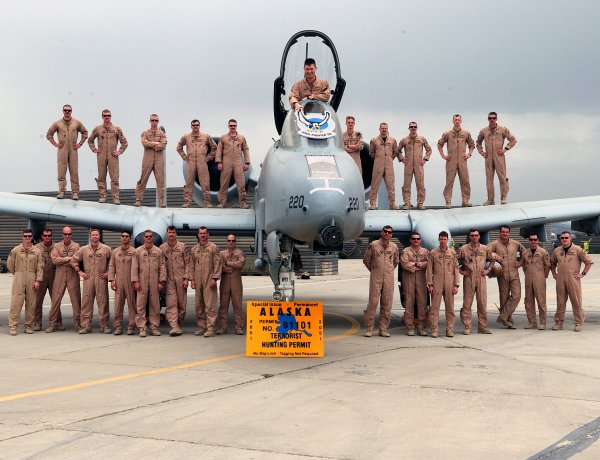
There have been several incidents lately where NATO commanders in Afghanistan have called in heavy weapons, especially airstrikes, only to find out they'd attacked Afghan civilians, not insurgents.
Today NATO is investigating a report that approximately 60-civilians died from airstrikes that, over a period of four to five hours, brought down approximately 25-houses in the village of Nangawat. This village, by the way, is in the now famous Panjwai district where, barely a month ago, Canadian and Afghan forces claimed an enormous victory in driving the Taliban out of the region.
The bombings and apparent civilian deaths are said to have been the result of three attacks the Taliban launched against NATO forces in Panjwai yesterday. At least two members of the Kandahar provincial council have claimed that the dead were indeed innocent villagers.
Spin The Course - San Fransisco Chronicle
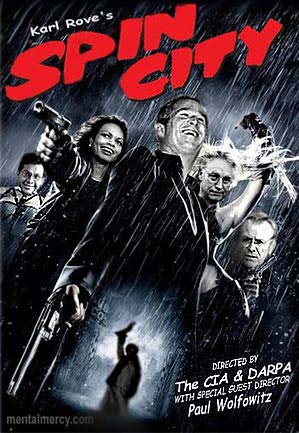
I spotted this editorial in the San Francisco Chronicle. It's so good, I'm reproducing it here, in its entirety:
"WAR IS PEACE. Freedom is Slavery. Ignorance is Strength."
Let's hope we have not reached George Orwell's "doublespeak" future depicted in his novel "1984" where the Ministry of Truth erects a giant pyramid enshrining those slogans.
But when President Bush says "stay the course" doesn't mean "stay the course," you have to start worrying about our national leadership's ability to redefine almost everything.
If there are three words that define this administration -- regarding its attitude toward governance, tax cuts the war in Iraq, etc. -- they are "stay the course."
But here's what Bush told ABC's George Stephanopoulos: "Listen, we've never been 'stay the course,' George."
According to Bush's spokesman, "stay the course" now means "a study in constant motion."
Let's be charitable. Maybe the administration is just confused -- starting with the president.
On Oct. 11, Bush said the following: "Stay the course means keep doing what you're doing. My attitude is: Don't do what you're doing if it's not working. Change." But then he added, "Stay the course also means don't leave before the job is done. And we're going to get the job gone in Iraq."
Come again?
Those running the war are now grappling with the meaning of "win" -- a semantic debate with far graver consequences than former President Bill Clinton's musings about the definition of "is."
Doesn't winning mean defeating the terrorists in Iraq, as President Bush has been telling us for years?
Apparently not. On Tuesday, Gen. Peter Pace, the chairman of the Joint Chiefs of Staff, said, "You have to define what it means to win." Winning, Pace said, now means security, good governance and a functioning economy. He gloomily predicted that terrorism in Iraq is going to be around "for the next 10, 20 or 30 years."
Remember how for months the administration pilloried anyone who wanted to set a "timetable" to end our occupation of Iraq? According to its math, "timetable" equals "cutting and running."
Now the administration is talking about its own benchmarks, deadlines, time lines -- and even timetables. Just not the kind of timetables proposed by those "cut-and-run" Democrats.
"Freedom is the freedom to say 2 plus 2 makes 4," Orwell wrote. "If that is granted, all else will follow."
Wouldn't it be great if our freedom-loving president acknowledged that 2 plus 2 equals 4 -- not some other fictional number?
Mission Accomplished? No, Seriously
If you believe that the invasion of Iraq was all about the oil, then it looks as though George Bush really can proclaim "mission accomplished."
The Baghdad goverment is facing a December deadline to introduce Iraq's new oil law and it's expected to be much more generous to the major oil companies than any deals they've gotten from Iraq's oil-producing neighbours.
Make no mistake about it: Iraq's oil reserves are vast and largely untapped. It is said to have 112-billion barrels of proven reserves and about 220-of probable oil reserves. Those figures don't include Iraq's vast, and unexplored western desert.
The greatest winners in the Iraqi oil fix will be the Big Four - Exxon, Chevron, BP and Shell. They stand poised to cut up the pie among themselves. Under Saddam, oil deals were negotiated with Russian, Chinese and French outfits but that was - under Saddam of course.
For years, leaders of Big Oil lobbied Washington for regime change in Iraq. They didn't want this prize to fall into the hands of the wrong nations. They also dreamed of the sort of deals that one could only hope to extract in normal circumstances. Big Oil wanted production service agreements ("PSA's") with the Iraqi government.
A PSA deal is a long term arrangement that grants an oil company both control of a field and extremely high profit margins. The oil company doesn't actually "own" the oil but that's pretty much irrelevant. Control of Iraq's oil resource is what counts. American control is going to see Big Oil get access and PSA's will see Big Oil gain actual control of the oil resources.
There has always been a view among some in Washington that gaining control of Iraq's oil wealth will allow the west to put the boots to OPEC. If Big Oil, rather than the Iraqi government, has control of the resource, these companies can operate independently of OPEC control, greatly undermining the cartel's global power.
The plotting and scheming behind this gambit is the stuff that would have made Machiavelli, Richelieu or Metternich squeal with delight.
Of course, nothing in Iraq is certain these days, certainly not the country's future. Big Oil needs the country to survive largely intact with a secular, federal government in Baghdad. If Iraq collapses into full-blown civil war, if it succumbs to pressures for partition or a secessionist movement in the Kurdish north or the Shia south, all bets may be off.
In other words, Washington stands to lose as much as any Iraqi does if the country fails. Do you think that reality has any bearing on George Bush's refusal to budge?
The Baghdad goverment is facing a December deadline to introduce Iraq's new oil law and it's expected to be much more generous to the major oil companies than any deals they've gotten from Iraq's oil-producing neighbours.
Make no mistake about it: Iraq's oil reserves are vast and largely untapped. It is said to have 112-billion barrels of proven reserves and about 220-of probable oil reserves. Those figures don't include Iraq's vast, and unexplored western desert.
The greatest winners in the Iraqi oil fix will be the Big Four - Exxon, Chevron, BP and Shell. They stand poised to cut up the pie among themselves. Under Saddam, oil deals were negotiated with Russian, Chinese and French outfits but that was - under Saddam of course.
For years, leaders of Big Oil lobbied Washington for regime change in Iraq. They didn't want this prize to fall into the hands of the wrong nations. They also dreamed of the sort of deals that one could only hope to extract in normal circumstances. Big Oil wanted production service agreements ("PSA's") with the Iraqi government.
A PSA deal is a long term arrangement that grants an oil company both control of a field and extremely high profit margins. The oil company doesn't actually "own" the oil but that's pretty much irrelevant. Control of Iraq's oil resource is what counts. American control is going to see Big Oil get access and PSA's will see Big Oil gain actual control of the oil resources.
There has always been a view among some in Washington that gaining control of Iraq's oil wealth will allow the west to put the boots to OPEC. If Big Oil, rather than the Iraqi government, has control of the resource, these companies can operate independently of OPEC control, greatly undermining the cartel's global power.
The plotting and scheming behind this gambit is the stuff that would have made Machiavelli, Richelieu or Metternich squeal with delight.
Of course, nothing in Iraq is certain these days, certainly not the country's future. Big Oil needs the country to survive largely intact with a secular, federal government in Baghdad. If Iraq collapses into full-blown civil war, if it succumbs to pressures for partition or a secessionist movement in the Kurdish north or the Shia south, all bets may be off.
In other words, Washington stands to lose as much as any Iraqi does if the country fails. Do you think that reality has any bearing on George Bush's refusal to budge?
Wednesday, October 25, 2006
Getting Unstuck
America seems genuinely stuck in the quagmire of today's Iraq. Experts on all sides of the debate seem to agree on one thing: there are no good options at this point. Fair enough. Not every problem can be solved, not every danger eliminated. That's life.
Sure the United States should have seen this coming. The disastrous outcome should have been just as obvious to Britain. Even Australia, with its experience of following the U.S. into Vietnam, ought to have known better. Shoulda, coulda, woulda. Bush, Blair and Howard as the Three Stooges.
Maybe James Baker's Iraq Study Group will come up with a brilliant solution after the mid-term elections in November but don't hold your breath. So, what's the solution to a situation that presents only bad options? Obviously you need to go for the least bad option.
Here's the problem with that approach. At this point, America's and Iraq's interests are becoming divergent - quickly. What is in America's best interest probably isn't in Iraq's best interest. That's just another sad fact of life.
Washington needs to find a way out of Iraq. The American people have had enough of this adventure and they're willing to show that at the polls. The leadership has failed in its foremost challenge - it has failed to keep the electorate onside. The American people have conclusively decided this war is not winnable and, even if it means the humiliation of defeat, they want out.
What of Iraq? This country has been left with a weak, ineffectual government; vicious, sectarian strife; an insurgency far beyond the capability of its indigenous army; widespread and growing support for partition among the Kurds and Shia; external influences from Iran, Syria and Saudi Arabia.
There may be no good options for the U.S., but what of Iraq's options? To survive the next few years, Iraq needs the support of its neighbours. It needs Iran to thwart any Shia secessionist movement. It needs Syria to aid the Sunni. It needs both the U.S. and Turkey to keep the Kurds in line. It needs strength from outside because it's woefully weak inside. It's hard to imagine any of these neighbours supporting a continuation of the status quo. None of them like the American presence on their doorsteps.
Washington doesn't have much leverage with Iraq's neighbours at the moment. They're not blind. They see the one nation that genuinely threatens them haplessly bogged down in Iraq and so it serves their interests to keep Iraq destabilized.
The key to this may be the complete withdrawal of America's presence in Iraq as part of a pact to secure the co-operation of the neighbours in a new Iraqi statehood. What else has America got to negotiate with? It seems it would be in everyone's interests, save for Israel, for America to withdraw from Iraq. That might just be the best option for Iraq and the United States.
Sure the United States should have seen this coming. The disastrous outcome should have been just as obvious to Britain. Even Australia, with its experience of following the U.S. into Vietnam, ought to have known better. Shoulda, coulda, woulda. Bush, Blair and Howard as the Three Stooges.
Maybe James Baker's Iraq Study Group will come up with a brilliant solution after the mid-term elections in November but don't hold your breath. So, what's the solution to a situation that presents only bad options? Obviously you need to go for the least bad option.
Here's the problem with that approach. At this point, America's and Iraq's interests are becoming divergent - quickly. What is in America's best interest probably isn't in Iraq's best interest. That's just another sad fact of life.
Washington needs to find a way out of Iraq. The American people have had enough of this adventure and they're willing to show that at the polls. The leadership has failed in its foremost challenge - it has failed to keep the electorate onside. The American people have conclusively decided this war is not winnable and, even if it means the humiliation of defeat, they want out.
What of Iraq? This country has been left with a weak, ineffectual government; vicious, sectarian strife; an insurgency far beyond the capability of its indigenous army; widespread and growing support for partition among the Kurds and Shia; external influences from Iran, Syria and Saudi Arabia.
There may be no good options for the U.S., but what of Iraq's options? To survive the next few years, Iraq needs the support of its neighbours. It needs Iran to thwart any Shia secessionist movement. It needs Syria to aid the Sunni. It needs both the U.S. and Turkey to keep the Kurds in line. It needs strength from outside because it's woefully weak inside. It's hard to imagine any of these neighbours supporting a continuation of the status quo. None of them like the American presence on their doorsteps.
Washington doesn't have much leverage with Iraq's neighbours at the moment. They're not blind. They see the one nation that genuinely threatens them haplessly bogged down in Iraq and so it serves their interests to keep Iraq destabilized.
The key to this may be the complete withdrawal of America's presence in Iraq as part of a pact to secure the co-operation of the neighbours in a new Iraqi statehood. What else has America got to negotiate with? It seems it would be in everyone's interests, save for Israel, for America to withdraw from Iraq. That might just be the best option for Iraq and the United States.
Afghanistan - a Growing Insurgency
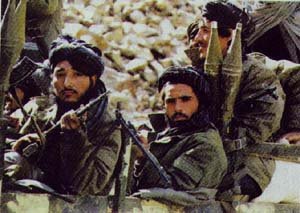
A formula for victory in Afghanistan appeared in this morning's Globe. Former government foreign policy advisor and now a professor of internationl affairs at Ottawa U., Roland Paris outlined five pre-conditions to winning in Afghanistan:
1. Stop destroying the poppy fields. Try regulating the stuff instead. Buy opium to reduce the global shortage of opium-based pain killers.
2. Clean up the corrupt police service.
3. Clean up government corruption.
4. Build a legitimate Afghan army that can defend its country.
5. Arrest the flow of Taliban fighters from their bases in Pakistan.
Professor Paris is a realist. He knows that these objectives won't be met without a wholesale increase in NATO support. He describes "the mission" as, "the most under-resourced international stabilization operation since the Second World War," pointing out we have one soldier per 1,000 Afghans whereas we had ratios of 3.5 in Haiti, 19 in Bosnia and 20.5 in Kosovo.
Paris argues that, unless NATO countries are willing to greatly increase their forces, NATO "should not wait around for conditions to worsen. It should withdraw, because the current course is a recipe for creeping defeat - and that would do untold damage to the alliance."
The Taliban are waging their war, the political war, while NATO continues to fight a mainly military war. The once mysterious Taliban are now becoming open to western journalists, undoubtedly with a view to waging their political war with the citizens of NATO states. To do this they've been giving western reporters a first-hand look at their operations.
The New York Times' Elizabeth Rubin spent time with the Taliban last summer. Some of her views:
"It is not at all clear that Afghans want the return of a Taliban government. But even sophisticated Kabulis told me that they are fed up with the corruption. And in the Pashtun regions, which make up about half the country, Afghans are fed up with five years of having their homes searched and the young men of their villages rounded up in the name of counterinsurgency.
"Earlier this month in Kabul, Gen. David Richards, the British commander of NATO’s Afghanistan force, imagined what Afghans are thinking: “They will say, ‘We do not want the Taliban, but then we would rather have that austere and unpleasant life that that might involve than another five years of fighting.”’ He estimated that if NATO didn’t succeed in bringing substantial economic development to Afghanistan soon, some 70 percent of Afghans would shift their loyalty to the Taliban."
The British newspaper, The Independent, had its David Loyn inspect the Taliban operation in Afghanistan:
"Racing across the desert in the north of Helmand province, our convoy was kicking up a dust-storm that could be seen from space. The Taliban were demonstrating their control over a wide region. These are the same Taliban that Brigadier Ed Butler, the commander of British forces in the region, said were "practically defeated" in Helmand.
"Instead, they are confident and well-armed, all with AK-47s, and many of them carry rocket-propelled grenadelaunchers.
"We passed the burnt-out remains of a Spartan armoured personnel carrier, destroyed on 1 August with the loss of three British lives. Last week the British were forced to abandon their "platoon house" at Musa Qala, and were only able to get their vehicles after a deal brokered by local tribal elders. The plan to spread goodwill from these "inkspots", and provide an environment to deliver aid, has had to be radically reviewed in the face of heavy Taliban attacks.
"Their communications equipment and vehicles are new and they have a constant supply of fresh men from the madrassas, the religious schools in Pakistan. Recently, the "Waziristan accord", which has seen Pakistani forces withdraw from parts of the tribal areas bordering Afghanistan, has made it even easier for the Taliban to manoeuvre."
"Meanwhile, the scale of institutionalised corruption practised by the Afghan National Army is shocking. They demand money at gunpoint from every driver on the main roads in the south. It was to stop just this kind of casual theft that the Taliban was formed in the first place in 1994. For the first time since then, the Taliban are now being paid again to sort out the problem."
Afghanistan is rivalling Iraq as a destination for foreign, Arab jihadists. According to the L.A. Times:
"Foreign fighters are predominantly Sunni. They increasingly prefer fighting alongside the Taliban to getting embroiled in the Sunni-versus-Shiite bloodshed in Iraq, said Caprioli, who works closely with the intelligence community at the Paris-based GEOS security firm.
"There are a certain number of foreign jihadis who aren't interested in massacring Shiites," Caprioli said. "In Afghanistan, you have NATO troops to fight as well as Americans, all the 'crusaders.' "
"In addition, veterans of combat in Iraq have made their way to Afghanistan, officials said.
"There's a definite increase in foreign fighters going to Afghanistan from all over," said a U.S. anti-terrorism official, who spoke on condition of anonymity. "They go through Pakistan. Or they train in Iraq and then keep going to Afghanistan."
Clearly the Taliban and their jihadist Arab allies are upping the ante in Afghanistan. Our politicians and generals continue to paint a rosey picture of the country as a battle that can and will be won. If that's going to happen, they'll need to substantially bolster NATO's efforts before the political war is lost.
Dick Cheney - Facts Never Get in His Way

When Dick Cheney talks about Iraq you pretty much know what's going to happen and that tends to be the opposite of what Dick Cheney claims.
Iraq had weapons of mass destruction. Iraqis would greet American forces as liberators. The Iraq insurgency is in its final throes. There's nothing this guy won't say.
Cheney, however, may be saving his best lines for last. When he does speak to the media, Cheney goes with the rightwing pundits. They lob slow pitches to him and he runs with it. Here's how the veep described Iraq just days ago on Rush Limbaugh's show:
"If you look at the general overall situation, they're doing remarkably well."
With mid-term elections looming, Cheney is obviously trying to mobilize his base - the people who are sufficiently mindless to still believe anything he says. Sad, isn't it?
Global Warming - Poor Countries' Nightmare

When it comes to global warming, we Canadians have it awfully good. Oh sure Canada as we've known it will see changes, some of them severe, but the worst will take decades to get here. Residents of poorer nations, however, are right at the front of the line. They don't have to wait at all.
Already, low-lying nations are sinking, disappearing. One of these is the South Pacific state of Kiribati. On Tuesday, Kiribati president Anote Tong warned Australia and New Zealand to prepare for a mass migration of Kiribati's population within a decade. It's a common condition of small South Pacific nations. Tarawa, another nearly flat spot and only 500-metres wide at some points has had to import sand from Australia to bolster its beaches. Now its population is being forced to relocate to whatever high ground they can find on their shrinking landmass.
It is no coincidence that the nations that produce the greatest pollution will, in most cases, be the last and least affected. If it was the other way around do you think we'd be still sitting on our hands?
Is George Bush God-Tied on Iraq?

Former German chancellor Gerhard Schroeder is no fan of George Bush. His refusal of American overtures for German participation in Iraq helped Schroeder win re-election in 2002. In his newly released biography, Schroeder takes the measure of George Bush and why he believes the U.S. president will have trouble bringing peace to Iraq:
"Again and again in our private talks it became clear how God-fearing this president was and how ruled he was by what he saw as a higher power," Mr Schroeder says in the memoirs, Decisions: My Life In Politics.
"The problem begins when political decisions seem to result from a conversation with God. We rightly criticise that in most Islamic states there is no clear separation between religion and the rule of law.
"But we fail to recognise that in the US, the Christian fundamentalists and their interpretation of the Bible have similar tendencies. If both sides claim to be in possession of the only valid truth, then there is no room for manoeuvre."
Thursday, October 19, 2006
Torture - the Demeaning Myth
A recent poll shows a signficant minority in most western nations favour the use of torture to extract intelligence. This minority demonstrates the power of myth and ignorance.
Torture doesn't work. It does not work to extract reliable information. Victims of torture either don't talk at all or else they tend to tell their interrogators whatever they want to hear.
One technique U.S. interrogators have been using is known as "waterboarding." The victim is strapped down on an inclined board, head toward the lowest end. A cloth is placed over his face and then water is poured onto the cloth. This creates the sensation of drowning and is said to be very effective - at torturing the victim.
Here is a picture of a waterboard table with a painting above it that illustrates its use:
The device shown was used in Cambodia. Apparently it was used a lot and very effectively. It was used, not to get intelligence, but to extract confessions. It seems that the Cambodians clearly understood that there was no intelligence to be had from victims on the table.
Bush & Company like torture and want to use it freely. They like it even though accounts from Iraq, Afghanistan and Guantanimo have consistently shown torture to be ineffective at producing intelligence. It makes you wonder what sort of a person the president is if he wants the power to torture so much when it doesn't work.
Torture doesn't work. It does not work to extract reliable information. Victims of torture either don't talk at all or else they tend to tell their interrogators whatever they want to hear.
One technique U.S. interrogators have been using is known as "waterboarding." The victim is strapped down on an inclined board, head toward the lowest end. A cloth is placed over his face and then water is poured onto the cloth. This creates the sensation of drowning and is said to be very effective - at torturing the victim.
Here is a picture of a waterboard table with a painting above it that illustrates its use:

The device shown was used in Cambodia. Apparently it was used a lot and very effectively. It was used, not to get intelligence, but to extract confessions. It seems that the Cambodians clearly understood that there was no intelligence to be had from victims on the table.
Bush & Company like torture and want to use it freely. They like it even though accounts from Iraq, Afghanistan and Guantanimo have consistently shown torture to be ineffective at producing intelligence. It makes you wonder what sort of a person the president is if he wants the power to torture so much when it doesn't work.
Wednesday, October 18, 2006
Why Has Nuclear Become the Rage?
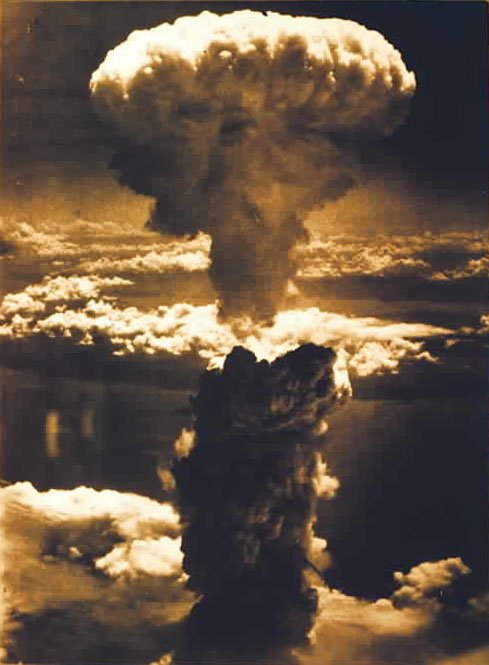 Nagasaki
The industrialized world tends to react with a mixture of anger, fear and frustration when Third World nations pursue nuclear weapon capabilities. We're so used to the big powers - the United States, Russia, China, France and Britain having these weapons that we rarely even think twice about it. Sure, they're more stable than places like Pakistan and far more so than North Korea but, then again, the big states count their nuclear weapons in many thousands. The big powers also have a considerable array of delivery systems from intercontinental ballistic missiles, to submarine launched long-range missiles, to manned bombers, to cruise missiles, even to long-range nuclear artillery.
What makes these little nations willing to risk the anger of the world, including sanctions, to get a few, small weapons of their own? Consider this analysis from Lebanon's Daily Star:
"It is interesting to note that all these countries are united by two denominators, which explain their common objective of pursuing nuclear programs.
"First, the governing regimes are ruling in an insecure and unstable domestic or regional environment. India and Pakistan are involved in a dispute over the border and territorial issue of Kashmir. The authoritarian North Korean government has not yet given up on its strategic objective of annexing South Korea.
"The threat perceptions of the ruling elites in Egypt, Iran and the GCC countries are heightened through the unresolved Arab-Israeli conflict, the unpopular US involvement in the region, and the unstable situation in Iraq. And, Iran and the GCC countries are entering a struggle over strategic hegemony in the Gulf.
"Second, in the global scenario, on the one side are the US with the world's largest defense budget and huge military capability, as well as economic powerhouses Japan and the EU. On the other side are developing countries India, Pakistan, Iran, Yemen and North Korea, none of which possess the military capabilities or the economic strength of the developed countries. North Korea, Yemen and Egypt have to deal with poor economic performance and education standards, and there is no sign of any short-term alternative to bridge the economic or military gap.
"Thus, it appears that regimes which have existed over the years in an insecure domestic or regional environment or lack trust and confidence due to economic instability have increasingly developed threat perception toward potential enemies from within their own countries or region. It is in this context that they are trying to improve their strategic position by looking for short-term solutions. Many of these regimes equate security with enhanced military power, and nuclear enrichment seems the cheaper, faster and efficient alternative to overcome their insecurities and emerge as credible powers.
"From the North Korean perspective, a nuclear bomb boosts the regime's chances of survival and gives it an advantage in negotiations with South Korea. Similarly, for Iran, acquiring a nuclear capability will help the regime use it as a tactical means to gain an upper hand in the ongoing dispute with the UAE over the Abu Musa and Greater and Lesser Tunbs islands. The Iranian regime may also attempt to develop a "containment policy" of the US influence in the region. As far as the GCC countries are concerned, it will be impossible to live with a nuclear Iran evolving as hegemon and thus they may be forced into a "nuclear race" to maintain the "balance of power" in the Gulf."
Our world seems poised on the edge of a wave of nuclear proliferation. Maybe we need to approach the problem from a new perspective. Whether India, Pakistan, North Korea or even Iran, our tired, predictable attitudes just aren't working and the nations we need to worry about know that.
Subscribe to:
Posts (Atom)