Showing posts with label Chretien. Show all posts

Sunday, June 03, 2018

The Funny Thing Is - It's Here and What Have We Done to Adapt to It?


You might not have seen video of the dramatic flash flooding that swept the historic town centre of Elliott City, Maryland, but that doesn't matter. Perhaps you didn't see the devastation of New York City and the Jersey Shore by Hurricane Sandy. Maybe you've been in a coma for the last decade and more.

Most of us, at least most of the sentient population, have experienced powerful yet "early onset" impacts of climate change. "Global Weirding" is one example. Spring weather conditions in the midst of winter. Floods and droughts. Coastal erosion. The ever poleward migration of species - birds, mammals, fish, insects, even viruses. There are shared or common impacts and others that are regional or even local, sometimes the result of topography.

Our government tells us it has a plan. It's going to introduce carbon pricing that should encourage a reduction in greenhouse gas emissions of some order by some future date, perhaps 10, certainly not more than 20 years from the date of implementation, if ever. As Catherine McKenna so fecklessly reminds us, this is a "national unity" issue first and foremost.

There are two parts to this problem. One is mitigation - cutting GHG emissions in hope of forestalling the onset of climate change. The other, the one that gets so little love, is adaptation. That goes to our resilience to withstand steadily worsening climate change impacts that we're not going to be able to avert. That is "locked in" climate change, the steadily heating atmosphere that will unleash severe storm events of increasing frequency, severity and duration. It's the sort of thing that promotes a category 3 hurricane to a full blown category 5 monster.

There are ways to blunt nature's worsening weather wedgies but they're not cheap. Some sea level rise can be contained, for a while, by constructing stronger and higher sea walls in suitable areas. Major cities can construct major floodways along the lines of the Red River Floodway, "Duff's Ditch," that Manitoba premier Roblin built in the 60s to protect Winnipeg. We know that Calgary could sure use one or more of those, Toronto too. Then there's the restoration and replacement of essential infrastructure that was engineered and constructed to meet the gentler climate demands of a time now past.

Here's one thing we know. Fixing this problem will never be cheaper than it is right now. It might have been cheaper yet if we had only started ten years ago but that is spilt milk at this point. We know it will be vastly more costly, adding in economic loss and disruption, if we keep putting this off much longer. So what's the hold up?

What's going on in your region? Are they building the road networks of the future? Are they reinforcing your bridges and overpasses? Anyone upgrading your water mains and sewers? How about your already wobbly electrical grid? Getting a new one of those? Is your public health authority preparing for the new challenges of a new climate?

You'll recognize that your government has the problem in hand because they'll be spending tens of billions, many tens of billions of dollars on climate proofing your society.

Back in 2014, when Calgary was swamped from its most recent, once in a gazillion year floods, the World Council on Disaster Management held its annual conference in Toronto.
Dr. Saeed Mirza, emeritus professor at Montreal’s McGill University specializing in structural engineering, added that the monumental infrastructure costs accumulated over decades of negligence have left Canada particularly vulnerable to catastrophic events. 
“The frequency and intensity of these events has been increasing at an escalating rate and what was a one-in-100-year event at one time may become the norm,” he said. 
“When we look at Calgary, we had a flood there in 2005 and they called it a one-in-100-year flood, while this one according to some descriptions in the news has been three times as bad.” 
Mirza estimated that Canada’s infrastructure requirements have reached a cost of about $1 trillion, while a recent survey by the McKinsey Global Institute earlier this year stated that worldwide infrastructure needs are about $57 trillion.
Now there's a handsome number, 57 trillion dollars to meet the world's essential infrastructure needs. Boy have we been robbing Peter to cut taxes for Paul!

Here's another number, one that our politicians have foremost in their minds. It's 27 trillion dollars. That's roughly the value of proven fossil fuel reserves already subscribed on global stock markets and bourses.  That number keeps our politicos tossing in their beds at night because they know if the carbon bubble bursts, most of that wealth simply evaporates causing no end of fiscal mayhem to banks, institutional investors, pension plans and, yes, government treasuries. No wonder these little shits love their pipelines so much.

Canada's approach? Oh, we'll throw 30, maybe 35 billion at the problem over 5 years. Maybe we can cook up some sweetheart deals to get the private sector to come up with another 50, maybe 60 billion that they can then fleece back from the public together with interest and hefty profits.

Here's the problem. 30 billion dollars, that's a political number that is not connected in any way to the enormity of the problem. It's just whatever they pulled out of their backsides. That much was clear when, in March of this year, a joint audit by the federal environment commissioner and the auditors general of nine provinces found that the premiers and your prime minister don't have a clue.

Neither the federal government nor the provinces have adequately assessed the risks a changing climate poses to the country and have no real idea what might be needed to adapt to it, concludes a scathing new audit released Tuesday. 
...It says while many governments have high-level goals to cut emissions, few have detailed plans to actually reach those goals, such as timelines, funding or expected results from specific actions
Assessments to adapt to the risks posed by climate change have been haphazard, inconsistent and lacking in detail, with no timeline for action and no funding, the report notes. 
It also calls Canada’s emissions goals a hodgepodge of different targets, with no consistency in how emissions are measured or whether cuts will target overall greenhouse gas outputs or just those from specific economic sectors. Only two provinces and Ottawa have actually laid out their specific 2030 emissions targets, and none are on track to meet them, Gelfand said.
Dame Cathy disingenuously steered the audit into mitigation and well clear of adaptation. Then again, she would.
“The previous government did nothing for a decade, but we’re 100 per cent committed to our target,” McKenna said. “Hard things are hard, we have a plan and we’re already seeing measurable results.”
That sounds just like what Harper used to say about Chretien - all talk, no meaningful action.  The problem didn't begin with Harper, dearie.

There's something telling that Cathy didn't even address adaptation. What it tells me is that I and you, we, and our kids and grandkids are pretty much on our own as far as this government, like its predecessors, is concerned.

What that means is that we're getting "behind the power curve" on climate change adaptation which means it will become increasingly more costly and more difficult to deal with as their dereliction mounts, year by year. Unless something changes, we're in for a hard landing.



Monday, May 21, 2018

A Question Worth Asking - Has Canada Been Captured?


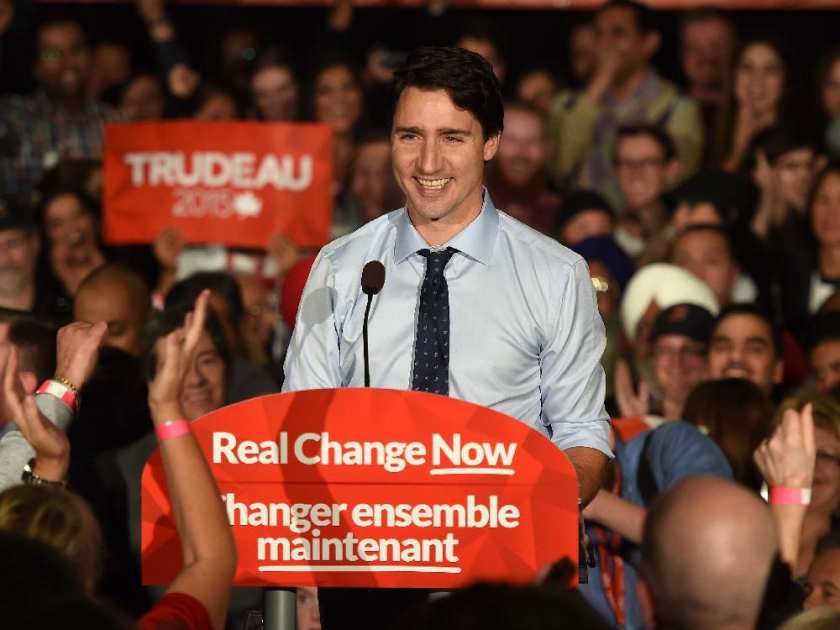
As analysis and reports stack up laying bare how much we know and everything we don't know about dilbit and Kinder Morgan's Trans Mountain pipeline, it is looking like this has nothing to do with the "national interest" as claimed by prime minister Trudeau. Instead it looks as though Trudeau is in service to some rather powerful special interests.  Who is he serving?

An article in The Tyee suggests that perhaps we're seeing the face of Canada's own Deep State, the Fossil Fuelers.

It all began with a Greenpeace energy researcher and a bundle of freedom of information documents he received that somehow had briefing notes for Andrew Leslie, parliamentary secretary to Christia Freeland. One set was for a meeting Leslie had with the CEO of a major pipeline company. The other was for a meeting between Leslie and officials of the oil patch lobby, the Canadian Association of Petroleum Producers.
...the briefing notes revealed that while Prime Minister Justin Trudeau’s Liberal government was presenting itself publicly as a stalwart defender of all things Canadian against the bullying new regime south of the border — on the environment, trade and NAFTA especially — in this instance there was celebration of the fact that Donald Trump and his administration were pro-oil and pro-pipelines.
In particular, they expressed delight over the U.S. president’s decision to approve building the Keystone XL (KXL) pipeline, which TransCanada is constructing, overturning Barack Obama’s rejection of the project. 
“We support TransCanada’s KXL project and efforts to expand its market in North America” was one of the notes’ talking points Leslie was given, consistent with the government’s public position on the pipeline. The briefing notes omitted any hint that climate change was on the agenda — and CAPP confirms the topic was not discussed during its meeting with Leslie. TransCanada and Leslie refused to respond to questions about these meetings.

For years Stewart has seen this sort of language in internal government memos, with cabinet ministers, MPs and civil servants seeing themselves as allies and partners of the energy industry. 
It’s one reason Stewart believes the oil industry constitutes a so-called “deep state” in Canada. 
“When we’re talking about a ‘deep state,’ it’s usually when supposedly democratic institutions and the will of the people is being replaced by the will of special interests,” he observes. “And I think if you look at the development of environmental policy in this country, the oil industry is so powerful, their influence is so pervasive that I think it’s fair to call it a deep state.”
...to academics, deep state is another way to refer to governments that have been captured by corporate or military/intelligence interests, or both
Captured state is a term political scientists have used for a very long time to characterize the relationship in which the government is essentially under the influence of the dominant sector of the economy,” explains Laurie Adkin, a political scientist at the University of Alberta. 
Has the federal government — along with certain provincial governments — been captured by Canada’s energy sector? 
Kevin Taft, a former leader of Alberta’s Liberal Party (2004-08) believes so. He’s the author of a new book, Oil’s Deep State. “In Canada, the fossil fuel industry has captured really key democratic institutions and in some ways has captured so many of them that it has formed what I call a deep state,” explains Taft. “So democracy stops functioning for the people and begins to function first and foremost for the fossil fuel industry.” 
Those who believe the oil industry has become a deep state point to how the political elites, whether Liberal, Conservative or NDP — from Justin Trudeau to Stephen Harper to Rachel Notley — go to bat for the industry, even if it means Canada’s greenhouse gas emissions rise and jobs are needlessly lost. Or how Canada has never forced the oil industry to curb emissions — even as the impacts of global warming become more catastrophic. And why Canada is highly unlikely to reach its targets under the Paris climate agreement.
...Deep states ...emerge in countries that are democracies. “With a captured state, there is a strong heritage of democracy,” notes Taft. A deep state occurs when numerous government departments and regulators are captured and serve specific corporate interests at the expense of public interests. “When that happens, you end up with the appearance of democracy but really you have a state within a state,” says Taft.

...it affects all political parties, no matter whether they’re on the left or right. Hence, elections become less relevant as political parties who win office eventually succumb to the fact so many government agencies are captured.

Oil sand development was largely created by government fiat. After Peter Lougheed became Alberta’s premier in 1971, the sole oil sands operation, Suncor Energy, was producing a mere 30,000 barrels a day. Now the oil sands produce 2.5 million barrels a day. 
While Lougheed encouraged development of the oil sands, he took an interventionist approach with industry, making the oil companies abide by laws, regulators and legislators. When the industry boomed in the mid-’70s, Lougheed raised royalty rates, while the federal government hit it with taxes. 
But by 1993, the balance of power was shifting. Both Premier Ralph Klein in Alberta and Prime Minister Jean Chrétien were desperate to ramp up oil sands production to boost the economy. In return, the oil industry wanted less regulation, oversight and taxation. 
Chrétien and Klein obliged. Royalties were dropped to one per cent and taxes rolled back, while environmental regulations were weakened. 
“From then on, oil sands projects would have fewer standards of accountability to democratic institutions and more accountability to investors,” says Taft. “The system of governing and managing the publicly-owned oil sands had been captured by private interests.” 
The industry boomed. By 2015, one quarter of all business investment in Canada was going to the energy sector, while oil and gas topped Canada’s exports.
The Harper Era.
The impact of this lobbying was visible when Harper was in office. From 2008 to 2012, 27 oil companies and eight industry associations registered 2,733 meetings with federal government officials. During this time, the Harper government withdrew Canada from the Kyoto climate accord, government scientists were discouraged from doing climate science and barred from speaking to the media, while the RCMP, CSIS and Canada Revenue Agency were tasked to spy on and audit groups and activists opposed to pipelines and the tar sands. 
But the coup de grâce were two omnibus bills Harper rammed through Parliament in 2012 that gutted Canada’s environmental laws, most notably the Fisheries Act and Navigable Waters Protection Act, which were viewed as impediments for building oil pipelines.
Think Tanks - Captured
The most famous is the Vancouver-based Fraser Institute, which has received funding from the U.S. oil billionaire Koch brothers and long campaigned in favour of the oil sands and pipelines while opposing climate change measures. Its staff produce a relentless stream of oped pieces for newspapers across the country. 
Canada 2020, the Ottawa-based “progressive think tank” closely allied with Trudeau, has been instrumental in shaping the Liberals. It lets industry leaders and lobbyists rub elbows with cabinet ministers and senior government officials. Among the corporate “partners” of Canada 2020 are CAPP and oil industry giants Shell, Suncor and Enbridge. 
The influence of think tanks is not to be minimized: representatives from Canada’s 10 leading think tanks appeared at least 216 times before parliamentary committees between 2000 and 2015 and were cited in the Canadian media almost 60,000 times. “It gave them and their research priceless exposure and influence in shaping government policy,” noted the Globe and Mail in December.

The Media - Captured

The oil industry advertises heavily in newspapers, on television and online. In 2013, CAPP and the Postmedia newspaper chain struck a deal whereby the media company promised to further the industry’s interests. The Postmedia papers are famous for championing the energy sector while belittling the environmental movement. A study published in 2013 by University of British Columbia and Memorial University researchers found that the Globe and Mail and National Post were failing to provide readers with a complete picture of global warming issues and underemphasizing the impacts.
Academia - Captured
The oil industry also pours millions into universities — in particular in Alberta. The University of Calgary has been beset by scandals in this regard. 
In 2011, one of its political scientists, Barry Cooper, was discovered to have transferred research funds to a climate change denial group called Friends of Science. (Cooper was also a long-time columnist with the Calgary Herald, where he poured relentless scorn on the environmental movement and any opponents of the oil sands.) 
But the topper was the Bruce Carson scandal. The federal government spent $40 million to finance a University of Calgary think tank chaired by Carson, a former senior advisor to Harper and a convicted fraudster. The institute worked with the industry on a plan to rebrand the oil sands as responsible and sustainable, and Carson co-ordinated some of his activities with CAPP. 
In 2016, Carson was found guilty of violating lobbying laws in connection with his work at the University of Calgary and fined $50,000.
Canada's Regulatory Agencies - Captured
Some critics believe key elements of the federal bureaucracy are under the industry’s sway — in particular Natural Resources Canada (NRCAN) and Environment and Climate Change Canada
“I think NRCAN has become the Department of Oil and Gas and I think Environment Canada was converted under Harper from a public service agency to a corporate concierge service to speed along the approval of oil sands projects,” says [Elizabeth] May. 
In 2015, after the Liberal government was elected, Jim Carr, the new natural resources minister, appointed Janet Annesley as his chief of staff. Annesley had spent five years working for CAPP as a vice-president, and nine years at Shell Oil before that. (Annesley was replaced earlier last year by Zoë Caron, a long-time environmental activist). 
When Catherine McKenna became environment minister, her deputy minister was Michael Martin, who had been appointed by the Harper government as chief climate negotiator for the 2009 Copenhagen climate summit, which set no firm targets for reducing greenhouse emissions.
May feels Martin pressed the Liberals to stick with the former government’s target. “There was a shift and suddenly Harper’s target was Trudeau’s target.” 
But it’s not just the federal government. Last year, internal B.C. government documents [Christy Clark's Liberals] were unearthed that revealed the province’s climate plan unveiled in 2016 had been secretly drafted jointly with CAPP and its members — in part at CAPP’s offices in Calgary.
The Crown Jewel - Captured
Then there is the National Energy Board (NEB), which has the task of reviewing things like pipeline applications. 
In recent years, the board has been accused of being heavily biased in favour of the oil industry. In 2015, for example, NEB board members met privately with Jean Charest, a former Quebec premier, who was a lobbyist for the pipeline company, TransCanada. This led to the resignation of NEB panel members when the meeting was exposed the following year. 
The NEB is also accused of not upholding the public interest when it comes to pipelines. Unifor, a trade union that represents nearly 12,000 workers in the oil industry, is opposed to pipelines designed to ship raw bitumen out of Canada, arguing it should be refined and upgraded in Canada. Over the past 30 years, nearly 20 refineries have been shuttered in Canada. 
Unifor has argued before the NEB that it should stop this trend. In a brief presented to the NEB in 2016, the union noted that by exporting raw bitumen “Canada will forego the enormous economic and employment benefits of adding value to Canadian resources through upgrading, refining, and secondary manufacturing. Not only does the bitumen export model undermine investment in value-added production over the long term, it actually threatens the security of supply to existing Canadian refineries… Incredibly, in 2014 Canada actually became a net importer of refined petroleum products: with imports of product now more than offsetting our own exports.”
The Biggest Capture of Them All - Justin Trudeau - Captured

As I argued recently, with Trudeau, just like Trump, you have to judge this prime minister by his deeds, not his words. All too often one has no relation to the other.

At the Paris climate talks his government pushed for a higher-than-expected goal — holding the planet’s rise in temperature to 1.5 degrees Celsius rather than two degrees. Trudeau also announced a plan to reduce methane emissions by up to 45 per cent from 2012 levels within the next seven years. 
But Trudeau has also undermined those goals by supporting three pipelines the industry desperately wants — Kinder Morgan, Enbridge Line 3 and Keystone XL. He also approved the $11.4-billion Pacific NorthWest LNG project to convert fracked gas in B.C. 
Prior to the election, Trudeau had promised to cut $1.6 billion in federal subsidies to the oil industry. More than two years later, this has still not happened. While recommendations to overhaul the NEB have been made, they’ve not been implemented. And the environmental laws Harper gutted have not been reinstated, although are under review.
Even the promised carbon tax on industry has been altered to give big breaks to industrial emitters like the oil and gas sector. And regulations on methane emissions have also been delayed. 
Most crucially, Trudeau has refused to place limits on the oil and gas sector’s greenhouse emissions
If you take a look at the climate plan that Canada articulated… it lays out very aggressive and ambitious plan for decarbonizing the nation,” says Abreu of Climate Action Network. “It impacts almost every sector of the Canadian economy — except the fossil fuel sector.”
A Government Wearing Petro-Blinders
Canada’s capture by the oil and gas industry’s deep state is proving ill-timed. 
“The harsh reality is that global warming is real,” says Kevin Taft. “And while much of the rest of the world is moving aggressively away from fossil fuels, Canada is going to get left behind in that transformation if we’re not really careful.”
The Tyee article provides a wonderful backdrop to help make sense of the Trudeau government's energy policy so riddled with contradictions, inconsistencies, outright falsehoods and, ultimately, cognitive dissonance.

It makes sense of the radical transformation from Trudeau 2015 to Trudeau 2018. Liberals, I'm sorry but your boy has been processed, remanufactured, and reissued to someone's liking - just not Canada's.


Saturday, March 21, 2015

The Three Eras of Canada's Democracy or How We Got to Where We Are Today.


I first voted in the 1968 elections when Pierre Trudeau and Trudeaumania led the liberals to a massive majority and I've watched Canadian democracy evolve, not always in a good way, ever since.

I've witnessed three political eras in my lifetime.

There was an Era of Rights and Freedoms, the years of Diefenbaker, Pearson and Trudeau.  Some might not realize it but Diefenbaker was a true champion of human rights.  Pearson brought Canada to the world stage as honest broker and peacekeeper.  Trudeau, of course, patriated the constitution and left us with perhaps the most important legislative enactment in our country's history, the Charter of Rights and Freedoms.  That was the zenith of liberal democracy in Canada.  It truly was our Golden Age.

Although few of us grasped it at the time, Mulroney ushered in the Era of Neoliberalism in the guise of free trade and the incremental surrender of national sovereignty to the forces of market fundamentalism.  The era of neoliberalism represented the years of Mulroney, Chretien and Martin.  Neoliberalism became our orthodoxy until it was even embraced by the New Democrats.

The third era is upon us.  It is the Era of Illiberal Democracy marked by the rise of the authoritarian state and the ascendancy of the state over the individual.  This is Canada under Stephen Harper.

I don't single out Canada for criticism.  Illiberal democracy is spreading fast throughout the world.  We are just following suit.  It's marked by a general shift to the Right, a skewing of the democratic restraints on government, and the emergence of new power structures.

Ignatieff recast the Liberals as Conservative Lite with his endorsement of a "muscular foreign policy", petro-statehood, and his unbalanced support for Israel.  Layton and Mulcair likewise embraced neoliberalism as they abandoned the Left and Blairified the NDP.

Harper has left no shred of doubt that he holds liberal democracy and especially the Charter of Rights and Freedoms in contempt.  He has sought to flout the Charter over and again, only to run afoul of the constitutional guardians, the Supreme Court.  They alone, not our opposition leaders, have ensured we have something left to fight for.

Illiberal democracy is evident in the workings of the authoritarian state.  It is manifest in voter manipulation and fraudulent elections.  It is the vehicle for rising inequality.  It is masked in secrecy and deceit.  It is the modern surveillance state.  It is the advancement of corporate interests (i.e. pipelines) over the public interest (i.e. action to thwart global warming).  We're even seeing the early onset symptoms of a permanent warfare state, outsourcing much of our foreign and military policy to another nation.

This is where we are today, the era of illiberal democracy.  Left unchecked it will worsen and our democracy will continue to be degraded.  We only have to look at America's "bought and paid for" Congress and its corporatist Supreme Court.

How to get back to real democracy is the puzzle.  It certainly cannot be achieved with Liberals as Conservatives and New Democrats as Liberals.  We cannot even the political keel under that reality and the country can only continue to list to the Right.


I fear the only antidote is progressivism, genuine bare-knuckle progressivism. Liberals need to restore their near-dead progressive wing.  New Democrats have to curb their centrism and return to their indispensable role of anchoring the Left and becoming the conscience of Parliament.  Who even speaks for labour any more?  Mulcair?  Spare me.

If we don't realize where we came from, everything great that we had accomplished, where we are today and just how we got here, we become party to ensuring the perpetuation and expansion of illiberal democracy in Canada.  We have a choice but we take it for granted at our and our children's peril.  Our freedom hangs in the balance.


Saturday, December 13, 2014

NATO Commander Says Key to Defeating ISIS Isn't Bombing


US general Philip Breedlove and Liberal leader Justin Trudeau seem to be on the same page when it comes to tackling the Islamic State.

The NATO supreme commander says the key to defeating ISIS (and other Islamist extremists) is to get at the root causes of their radicalism.

"Until we have addressed the root causes of these kinds of issues, we can expect to have to deal with these kind of issues," he said, referring to the current U.S.-led mission against the jihadist group ISIS.
Breedlove said the way to address these root causes is by focusing on bringing jobs, education, health and safety to vulnerable places, as well as figuring out how to make governments "responsive to their people."
Hmm, he seems to be saying that you can't bomb extremism out of existence. That's one of the reasons why our All the King's Horses and All the King's Men approach in Afghanistan and Iraq was such an utter failure.
Now this may come as a shock to most Tories and a good many Liberal loudmouths but you don't bring jobs, education, health and safety to vulnerable places with airstrikes and 1,000 pound precision guided bombs.  That's just playing "whack a mole" and the bad guys have shown, again and again, that they can always outlast you.
And one more thing for those Liberal ankle-biters.  Remember, it was Jean Chretien who unequivocally backed young Trudeau's opposition to RCAF air strikes in Iraq. And, please, don't refer to the Iraq conflict with loaded and inappropriate terms such as "genocide."  Genocide was the Central African Republic and the Congo where more than 5-million people were butchered.