Sunday, May 29, 2016

Can We Trust Them? Don't Hold Your Breath.


The G7 leaders have struck a pact to end fossil fuel subsidies by 2025. It sounds great, in principle, but do we have any reason to believe them?

In Canada our governments admit to annual subsidies of around 2.5 billion. Is that what will be ending? How much of that is provincial (a lot) and how will Ottawa get the western premiers to go along?

The real problem is that the amount our federal and provincial governments acknowledge is the tip of the iceberg. The International Monetary Fund (IMF) ran the numbers of all our direct and indirect subsidies - grants, deferrals, exemptions, the provision of natural capital (public property) either at no cost or below market values - and its total was just under $35 billion each and every year.

So what number are we going to be using? This is the sort of issue that Slick can get pretty weasley on. Until he acknowledges the IMF number there's absolutely no reason to believe that Ottawa will be making much of a dent in the subsidy scam.

There's no reason to think that he'll still be in charge by 2025 in any case and, besides, it's just a promise. We've heard a lot of promises from that fellow and we've learned that he doesn't always come through on his word.

As for America? Dream on.

The Weather Guy Says - It Ain't Your Grandpa's Weather Any More


He's not your TV weather guy. When he gets it wrong he's in trouble. Paul Douglas owns a company that provides weather forecasts to Fortune 500 companies that need to know what's coming and can risk a lot of money on his advice. He also, it seems, is an evangelical.

Douglas has written an excellent piece in The Guardian. Here are a few excerpts, teasers:

Whatever happened to normal weather? Earth has always experienced epic storms, debilitating drought, and biblical floods. But lately it seems the treadmill of disruptive weather has been set to fast-forward. God’s grandiose Symphony of the Seasons, the natural ebb and flow of the atmosphere, is playing out of tune, sounding more like a talent-free second grade orchestra, with shrill horns, violins screeching off-key, cymbal crashes coming in at the wrong time. Something has changed.


...by the turn of the 21st century this warming seemed to be flavoring much of the weather I was tracking, turning up the volume of extremes, loading the dice for weather weirding. Multiple strands of data confirm Earth has a low-grade fever, a warming trend that transcends periodic heat released from El NiƱo.

People ask “What’s a couple of degrees, Paul?” Well, when was the last time youwere a couple of degrees warmer? Chances are you felt miserable. And there were visible, tangible symptoms: sweating, chills, headaches, nausea. Your physician popped a thermometer in your mouth and confirmed you had a fever. Chances are you didn’t make a fuss, argue with the doctor, or deny the diagnosis.


Both NASA and local farmers confirm a longer growing seasons, with more allergens, pests and invasive species. Rainfall rates are increasing; wet areas trending even wetter. My home state of Minnesota has witnessed four separate 1-in-1,000 year floods since 2004.

A warmer atmosphere is increasing water vapor levels overhead, juicing storms, fueling an increase in flash floods in the summer, and heavier winter snows along the East Coast of the USA. “All storms are 5 to 10 percent stronger in terms of heavy rainfall” explained Dr. Kevin Trenberth, at the National Center for Atmospheric Research in Boulder, Colorado.


From the mega-blaze that swept across Fort McMurray, Alberta to repeated flooding of Houston, scorching heat in India, perpetual drought from California to Australia, and a record year for global hurricanes, typhoons and cyclones in 2015, the symptoms of a warming ecosystem are becoming harder to dismiss or deny.

In a day and age of scammers, hackers, hucksters and special interests it’s good to be skeptical. You should be skeptical about everything. Some of the biggest skeptics on the planet are scientists. In fact, science is organized skepticism. Climate and weather are flip-sides of the same coin; everything is interconnected. Climate scientists tell us the climate is warming and meteorologists are tracking the symptoms: freakish weather showing up with unsettling regularity. Even if you don’t believe the climate scientists or your local meteorologist do yourself and your kids a favor. Believe your own eyes.

Saturday, May 28, 2016

Hey, You Wanna Talk Dirt?


It's a pretty simple proposition. If there are three things that will probably kill you and you put your efforts into fighting one of them the other two that you ignored will probably kill you. If your house is on fire and you put all your efforts into fighting the fire in the kitchen your house is still going to burn to the ground.

By now most sentient people accept that climate change poses a mortal threat to human civilization, if not immediately, in two or three decades. That realization has become sufficiently widespread that our political caste, those to whom we've entrusted the reins of power, are talking of doing something about it. Maybe they will, maybe they won't. That's a cornucopia of "ifs" and "buts".

Yesterday I wrote about how humans aren't particularly well suited to dealing with existential threats. Human nature has a number of mechanisms, flaws that leave us pretty vulnerable. Sometimes we do the right thing. Sometimes we don't - ask the Maya, the Anasazi, the Easter Islanders, the Greenland Norse.

In yesterday's post I concluded by mentioning a chilling observation by Jared Diamond in the closing chapters of his book, "Collapse." Diamond argues, very convincingly, that when you have existential threats you must solve them all or you'll fail to rectify any of them. That's why I contend that if we're to tackle climate change it won't work unless we also deal with overpopulation and our massive over-consumption of Earth's resources.

Humanity is growing in total numbers and in per capita consumption. There are increasingly more of us, each (on average) consuming a growing quantity of resources - water, energy, agricultural products, goods of all descriptions. That means we're rapidly spooling up economic activity. That means more resources, more energy and more waste.

Our roster now stands at 7+ billion, heading to 9+ billion perhaps as soon as the middle of this century. To put that in perspective, we were at 3 billion in the 60s. Mankind didn't reach 1 billion until somewhere around 1814. In other words it took us 11,000 years of civilization to first reach 1 billion and just another 200 years in which to multiply seven fold.

50%, that's the number bandied about. The International Energy Agency says humans will need some 50% more energy by 2050. The UN Food and Agriculture Organization and several other august bodies figure we'll need 50% more agricultural production to feed the global herd by 2050.

Which leads me to a problem rarely mentioned in polite company - the rapid decline in our agricultural capacity. As a follow up to some courses I've done in war studies, I became curious about food security issues and regional destabilization. In reading some of the assigned materials on global food supply I came across a paper that I found sufficiently interesting to read in its entirety. That was my introduction to the problem of loss of farmland - soil degradation, desertification and so on.

It was just one paper and I had other things to do so I moved on to other things. The issue didn't seem to have a lot of traction, perhaps the danger was overstated.

Then, in December, 2014, Scientific American published an item about a UN Food and Agricultural Organization (FAO) report warning that mankind had about 60 years of farmland left. What a mind-boggling thing to say. 60 years of farmland left, what could that possibly mean? Preposterous!

Yet the UN agency warning was consistent with what I had read previously through independent study. So I followed up and found all sorts of research coming to that same conclusion. Here's the thing. Yes, we grew to 7+ billion mouths but, to fill those mouths, we had to resort to the parlour tricks of the Green Revolution - intensive exploitation of surface and groundwater resources, ever increasing applications of soil exhausting chemical fertilizers, herbicides and pesticides, and industrial-scale agricultural farming practices.

Think of it as the old-time farmer who pushes his plough horse to exhaustion until it collapses and dies. That's about where we're at with our stocks of farmland.

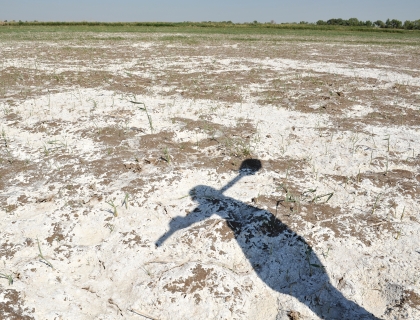
Then there's the spreading problem of salination. A lot of groundwater contains trace amounts of salt. Groundwater used for irrigation evaporates, leaving the salts behind. Over time the level of salt in the topsoil increases until it will no longer support plant life. That's what took down the Mesopotamians and our growing dependence on groundwater for irrigation has brought the problem back.

Even our most productive and well-managed agricultural areas are already degraded. Here's a map based on UN FAO data that shows you what we're dealing with - today.


I should mention that this is a commonly accepted graphic. You'll find it pretty much everywhere the subject is discussed. Now think of it, especially the red parts, in the context of human settlement. The major farming zones of the world, in China, India and the US, are in the red.

So why don't we hear about this? I came across an article in, of all places, Time Magazine where a soils expert dealt with that question. He said we don't hear about it because "it's not sexy." We're only talking about dirt. Dirt's everywhere. Don't you ever mop your floor?

Which brings us to a brief discussion about where soil comes from and where it's been going. Soil is a creation of nature. It comes from the effects of wind and sun and rain and lichens eating away at rock. Nature takes its sweet time making soil. It produces roughly one millimetre every hundred years. That's one centimetre, less than half an inch, every thousand years.

Human activity is depleting that fertile top soil at around 40-times its rate of natural generation. Think of the Dust Bowl of the Dirty 30s. You deplete the soil, drought finishes the job, winds blow it away, you're screwed so you gather up the kids, load up as much furniture as you can carry on the truck and move to greener pastures.

Soil experts think that rate of relative loss of fertile soil is going to increase, markedly so, in the next couple of decades. Whereas we're told we'll need about 50% more production to "feed the herd" our agricultural capacity is set to decline by an estimated 30% in that same interval.

Now if you look on the chart above you'll see the vast tracts of yellow territory, stable soil. Canada's sitting pretty. So is Russia. The rest not so much.

Unfortunately the yellow zones are boreal forest, tundra and bare rock. There is soil there but most of the biomass is in the plants themselves, not in the thin soil. And, as was driven home by the ongoing Fort Mac wildfires, the region is susceptible to sustained drought.

Climate change will extend normal growing temperatures northward, to be sure. What it will not do is tilt the Earth's axis of rotation to expose those northern tracts to the same sunlight exposure that supports photosynthesis in more temperate regions. In other words when it comes to the north being our salvation, you're confronted by a soils problem, a drought problem and a sunlight problem. There'll be some gain but it won't offset the damage done in our traditional agricultural areas.

There are some things that Canada and Russia can do but they're costly and dislocative and it would be hard to find the political will necessary to act. I've been working on a couple of ideas but it's not yet time to get into them. The truth is it may never be time, not before the options are foreclosed.


Straight Talk From the Senate


A number of Liberal senators say they'll oppose the Trudeau government's assisted dying legislation when it reaches the upper chamber.

Senator Jim Cowan put the argument as plainly as possible: "The wording in Carter is very clear ... there is nothing in there about it being a terminal illness, nothing about age. Any attempt by Parliament to take away rights that have been granted and confirmed by the Supreme Court is out of order and I think the bill falls short."

Senator Andre Pratte put it this way: "The bill as it's written now tries to restrict the Supreme Court ruling and ... tries to limit doctor assisted death to people who suffer from terminal illness, and that's not what the court said."  

The Trudeau government, perhaps showing instincts better associated with its predecessor, seems to have trouble fully accepting the rule of law. It's trying to squirm out from under the Charter ruling of the Supreme Court of Canada.

The SCC didn't create the Charter. Trudeau's stalwart dad did that to enshrine the rights of all Canadians and restrain government from intruding on those rights. The Court's function is to interpret the legislation and that's just what they did in the Carter case. They spoke and they spoke clearly. Trudeau is playing politics with the ruling, trying to water it down, promising he may obey the law at some time in the future. Trudeau is using a political ploy to undermine every Canadian's rights under the Charter.

Sorry, Justin, you may be a prince but you're no king.


Friday, May 27, 2016

America Suspends Supply of Cluster Bombs to Saudi Arabia


Thank God Canada doesn't produce cluster bombs or else Steffie Dion would have writer's cramp signing the contracts. From Foreign Policy:

Frustrated by a growing death toll, the White House has quietly placed a hold on the transfer of cluster bombs to Saudi Arabia as the Sunni ally continues its bloody war on Shiite rebels in Yemen, U.S. officials tell Foreign Policy. It’s the first concrete step the United States has taken to demonstrate its unease with the Saudi bombing campaign that human rights activists say has killed and injured hundreds of Yemeni civilians, many of them children.

The move follows rising criticism by U.S. lawmakers of America’s support for the oil-rich monarchy in the year-long conflict. Washington has sold weapons and provided training, targeting information, and aerial refueling support to the Saudi-led coalition fighting in Yemen. It has also sold Riyadh millions of dollars’ worth of cluster bombs in recent years.

You know who else has a fondness for using cluster weapons against civilian areas? Our other really good ally, Israel.


National Observer - How Canadian Journalists Have Failed to Solve the Murder of Their Own Profession

Vancouver's alternative media outlet, the National Observer, says that Canada needs to go after Facebook and Google for millions of dollars in unpaid taxes.

Canada's newspapers are bleeding money. The problem is a slump in advertising revenue.  When Harper came to power the feds were spending 18% of their advertising budget on the papers. Today it's just 1%.

While the print media bleeds out, 27% of the government's ad budget is now spent online. The kings of online advertising are - you guessed it - Google and Facebook.

Yet despite their substantial sales and marketing operations in Canada, both companies process all transactions in US dollars directly to their US headquarters.

Neither charges GST.

So here are the Panama Papers questions Canadians should be asking:

Do Google and Facebook receive federal government ad revenue, and if so, are they taxed on that income?

Do they pay any tax here on their Canadian earnings?


Last year the Guardian reported that Facebook’s total 2014 UK tax remittance was less than $7000, which happens to be less than the tax bill of the average British wage-earner. Using its network of corporate entities in Ireland and Cayman, Facebook had reportedly collected more than $1 billion in UK earnings tax-free out of the country, according to the Daily Mail.
Facebook pays $7,000 tax to UK, hands out $534 million in employee bonuses

That same year, according to Reuters, Google sheltered some $15 billion (CAD) in Bermuda. Its corporate tax rate has been reported as low as 2.4 per cent. And it's not paid to the countries that generate the income.

The Guardian reported in March that the European Commission is set to table legislation forcing Google, Facebook, Apple and other large multinationals to publicly disclose their profit and tax arrangements with each of the EU governments where they operate.

When overwhelming public outcry drove tax reforms in the UK, Google wascompelled to pay $240 million in back taxes. This deal still drew harsh criticism. Meantime, Facebook has similarly been forced to invoice most sales through Facebook UK rather than the Irish affiliate.

Although that arrangement was expected to yield hundreds of millions in tax to UK coffers going forward, Facebook immediately offset its UK tax liability by declaring an award of $534 million (CAD) in bonuses to its UK employees over the next three years.

When asked to provide details about its tax planning in Canada and abroad, Facebook told National Observer in a statement: “We have always, and will continue, to meet our tax obligations everywhere we operate.”

France’s Tuesday gambit is a signal that Europe has had it with the shell games.

Canada should join them.

Instead of asking the federal government to provide his own company with tax incentives and subsidies, Paul Godfrey should ask them to level the playing field and tax Facebook and Google.


Major US Study Links Cell Phones to Cancer

A new report released by the US National Institutes of Health has reignited the cell phone/cancer issue. A major, multi-year study concludes that cell phone exposure is linked to two cancers, one a brain cancer, the other a heart tumor.

Researchers at the U.S. National Toxicology Program (NTP), a federal interagency group under the National Institutes of Health, led the study. They chronically exposed rodents to carefully calibrated radiofrequency (RF) radiation levels designed to roughly emulate what humans with heavy cell phone use or exposure could theoretically experience in their daily lives. The animals were placed in specially built chambers that dosed their whole bodies with varying amounts and types of this radiation for approximately nine hours per day throughout their two-year lifespans.

“This is by far—far and away—the most carefully done cell phone bioassay, a biological assessment. This is a classic study that is done for trying to understand cancers in humans,” says Christopher Portier, a retired head of NTP who helped launch the study and still sometimes works for the federal government as a consultant scientist. “There will have to be a lot of work after this to assess if it causes problems in humans, but the fact that you can do it in rats will be a big issue. It actually has me concerned, and I’m an expert.”

The researchers found that as the thousands of rats in the new study were exposed to greater intensities of RF radiation, more of them developed rare forms of brain and heart cancer that could not be easily explained away, exhibiting a direct dose-response relationship. Overall, the incidence of these rare tumors was still relatively low, which would be expected with rare tumors in general, but the incidence grew with greater levels of exposure to the radiation. Some of the rats had glioma—a tumor of the glial cells in the brain—or schwannoma of the heart. Furthering concern about the findings: In prior epidemiological studies of humans and cell phone exposure, both types of tumors have also cropped up as associations.

In contrast, none of the control rats—those not exposed to the radiation—developed such tumors. But complicating matters was the fact that the findings were mixed across sexes: More such lesions were found in male rats than in female rats. The tumors in the male rats “are considered likely the result of whole-body exposure” to this radiation, the study authors write. And the data suggests the relationship was strongest between the RF exposure and the lesions in the heart, rather than the brain: Cardiac schwannomas were observed in male rats at all exposed groups, the authors note.

It's Not Just Americans Who Need to Fear Donald Trump. It's Humanity.

Where is Lee Harvey Oswald, now that we need him? Donald Trump vows to derail the Paris climate agreement, virtually ending any prospect of averting runaway global warming. This man is an abomination.


Now What Do You Think the Chances Are?


Was he trying to convey a message to the people that, if they vote to leave the EU, this is the future that awaits them?

There he was, Britain's own prime minister, David Cameron, in jeans and rough jacket buying a 3rd hand Nissan Micra for the little lady, Samantha Cameron, the mother of his children.

At 1,495 pounds, I'll bet Samantha has purses that cost more than the well used Nissan.

I guess Cameron was trying to go the humble, ordinary guy route to quell the controversy over his previous gift to Samantha, this, Rosie Lyburn:

Rosie is Mrs. Cameron's fashion (and social) advisor, and she costs the government some 53,000 quid a year.

The optics are ridiculous. There's an incredibly wealthy man, a child of privilege and advantage, buying a beater for his incredibly privileged and advantaged wife and apparently with little input from his "other half."

"Oh, don't worry about me dear. I'll make do with the Bentley and the driver."

Let's Remember Where and What We Were Back When

Something to dwell on over the weekend.

When It Comes to Climate Change, the Real Killer Is All In Your Mind.

It's not severe drought or epic floods, some of them lasting months or years. It's not severe storm events of ever increasing frequency, duration and intensity. It's not sea level rise. The real danger is in your mind, our minds, how we receive and process information, how we choose our fate.

When societies or civilizations collapse, one of the proximate causes is choices that either the entire community or some powerful segment of it has made. Sometimes those decisions are taken knowing that they mean eventual collapse. We are quite capable of acting in ways today that will imperil future generations. We're doing it now and we're doing it on a scale never before imagined or possible.

Jared Diamond's book "Collapse, How Societies Choose to Fail or Succeed," is a lengthy tome running to some 525 pages. To me, the essence of it is found in the 14th chapter, "Why do some societies make disastrous decisions?"

Diamond focuses on how groups make disastrous decisions and identifies four categories of situations.

"First of all, a group may fail to anticipate a problem before the problem actually arrives. Second, when the problem does arrive, the group may fail to perceive it. Then, after they perceive it, they may fail even to try to solve it. Finally, they may try to solve it but may not succeed."

1. Failure to Anticipate

The author says there are several reasons for failing to anticipate a problem before it arrives. One is having no prior experience with what could go wrong. And, here, he cites the example of early Brits colonizing Australia and thinking it would be great to import rabbits and then foxes.

"Even prior experience is not a guarantee that a society will anticipate a problem, if the experience happened so long ago as to have been forgotten. 

"...In modern literate societies whose writing does discuss subjects besides kings and planets, that doesn't necessarily mean that we draw on prior experience committed to writing. We, too, tend to forget things."

Here Diamond uses the example of the 1973 Arab oil embargo and how Americans flocked to fuel efficient compact cars only to slowly return to fuel guzzling SUVs.

Next up is "reasoning by false analogy." We assume the present mirrors something from the past. He uses the example of generals who go into wars prepared to fight the last war and get caught unawares. Here he cites the French experience with the Maginot Line.

2. Failure to Perceive

The second situation is failing to perceive a problem that has actually arrived and for this he gives three categories.

"First, the origins of some problems are literally imperceptible. For example, the nutrients responsible for soil fertility are invisible to the eye, and only in modern times did they become measurable by chemical analysis. [In many areas of the world] most of the nutrients had already been leached out of the soil by rain before human settlement. When people arrived and began growing crops, those crops quickly exhausted the remaining nutrients, with the result that agriculture failed. Yet such nutrient-poor soils often bear lush-appearing vegetation; it's just that most of the nutrients in the ecosystem are contained in the vegetation rather than in the soil, and are removed if one cuts down the vegetation."

Another category is "distant managers" for which he gives the example of a Montana timber company operated by managers in Seattle who failed to see the degradation of their forest ecology.

The most dangerous situation, one that effects almost all of us today, is creeping change known as "creeping normalcy" or "landscape amnesia."

"The prime example in modern times is global warming. We now realize that temperatures around the world have been slowly rising in recent decades, due in large part of atmospheric changes caused by humans. ...As for the time that I write these lines, President Bush of the U.S. is still not convinced of its reality, and he thinks that we need more research. The medieval Greenlanders had similar difficulties recognizing that their climate was gradually becoming colder, andthe Maya and Anasazi had trouble discerning that theirs was becoming drier."

"Politicians use the term 'creeping normalcy' to refer to such slow trends concealed within noisy fluctuations. If the economy, schools, traffic congestion, or anything else is deteriorating only slowly, it's difficult to recognize that e4ach successive year is on he average slightly worse than the year before, so one's baseline standard for what constitutes 'normalcy' shifts gradually and imperceptibly. It may take a few decades of a long sequence of such slight year-to-year changes before people realize, with a jolt, that conditions used to be much better several decades ago, and that what is accepted as normalcy has crept downwards."

Diamond then explores the companion dilemma of "landscape amnesia." He uses the example of a glacier that he and his friends regularly climbed in his youth. Decades later he went back to climb it again only to find it greatly receded. His friends, who had remained in the area, had observed the decline gradually and through this had largely lost sight of what had occurred.

3. Perceiving a Problem but Failing to Try to Solve It.

"Many of the reasons for such failure fall under the heading of what economists and other social scientists term 'rational behavior,' arising from clashes of interest between people. That is, some people may reason correctly that they can advance their own interests by behavior harmful to other people. Scientists term such behavior 'rational' precisely because it employs correct reasoning, even though it may be morally reprehensible. The perpetrators know that they will often get away with it or if the law isn't effectively enforced. They feel safe because the perpetrators are typically concentrated (few in number) and highly motivated by the prospect of reaping big, certain and immediate profits, while the losses are spread over large numbers of individuals. That gives the losers little motivation to go to the hassle of fighting back, because each loser loses only a little and would receive only small, uncertain, distant profits even from successfully undoing the minority's grab."

"A frequent type of rational bad behavior is 'good for me, bad for you and for everybody else' - to put it bluntly, 'selfish.' As a simple example, most Montana fishermen fish for trout. A few fishermen who prefer to fish for pike, a larger fish0-eating fish not native to western Montana, surreptitiously and illegally introduced pike to some western Montana lakes and rivers where they proceeded to destroy trout fishing by eating the trout. That was good for the few pike fishermen and bad for the far greater number of trout fishermen."

"An example producing more losers and higher dollar losses is that, until 1971, mining companies in Montana on closing down a mine just left it with its copper, arsenic, and acid leaking out into rivers, because the state of Montana had no law requiring companies to clean up after mine closure. In 1971 the state of Montana did pass such a law, but companies discovered that they could extract the valuable ore and then just declare bankruptcy before going to the expense of cleaning up. The result has been about $500,000,000 of cleanup costs to be borne by the citizens of Montana and the U.S.  Mining company CEOs had correctly perceived that the law permitted them to save money for their companies, and to advance their own interests through bonuses and high salaries, by making messes and leaving the burden to society."

The author then explores the "tragedy of the commons" so instrumental in environmental disasters such as the collapse of fish stocks. There the mentality is "if I don't catch that fish, somebody else will come along and take it, so it makes no sense for me to refrain from overfishing." The obvious solution, anathema to free market fundamentalism, is regulation and meaningful enforcement. In most cases to date, one of the other has been neglected.

Worsening the situation is when commercial harvesters have no long-term stake in preserving the resource.  This is commerce by plunder. Hit an area, clean it out, and move on to somewhere else. Diamond chronicles how forestry companies pillaged the once lush rainforests by purchasing leases, clear cutting, and then leaving. He contrasts this with the behaviour of timber companies that actually purchase the land, anticipate repeated harvests and implement proper land and resource management policies.

Then there's the class factor in which the interests of the elite are pursued at the expense of the rest of society.

"Especially if the elite can insulate themselves from the consequences of their actions, they are likely to do things that profit themselves, regardless of whether those actions hurt everybody else.  Such clashes... are becoming increasingly frequent in the modern U.S., where rich people tend to live within their gated compounds and to drink bottled water.  For example, Enron's executives correctly calculated that they could gain huge sums of money for themselves by looting the company coffers and thereby harming all the stockholders, and that they were likely to get away with their gamble."

In other words, the way we think, the ways in which we perceive and process information, and human nature itself are mankind's ultimate Achilles' Heel.

That's about enough for now. I'll come back (I hope) to address Diamond's thoughts on how we may perceive a problem, try to solve it, yet fail no matter how good our efforts.

One thing I want to focus on is his chilling observation, directly applicable to our species today, that there are some problems that are so inter-connected that it is futile to try to solve any of them because success hinges on solving all of them.

There are three existential threats facing humanity today - climate change, overpopulation and excessive consumption of resources. You have to solve all three of them or else you will ultimately fail on all three. These are the common threads that run through every major calamity that besets us today.

We're becoming increasingly active on dealing with climate change but we're failing to address the other two. Yet it's only when you consider them collectively that the common solutions and the daunting change that portends emerge clearly.

Thursday, May 26, 2016

Shell CEO - No Solar Until It's Profitable


Royal Dutch Shell CEO, Ben van Beurden, says the energy giant won't be moving into solar energy until it proves profitable.

I know something that might change Ben's mind. Eliminate all the subsidies, direct and indirect, that go to the fossil fuelers and direct that money, $34-billion each and every year in Canada (according to the IMF) into renewables, including solar.

We're currently paying the hydrocarbon giants not to switch to renewables and we're paying them royally with these unconscionable subsidies.  Pull the free money, top that with $30 a ton carbon taxes escalating $10 a ton every five years thereafter, and you won't have outfits like Shell sneering down their noses at renewable, clean energy.

Trudeau's Elbow From a Different Angle.

Sorry, Ruth Ellen.

Harper and Associates Consulting, Inc.

That's the formal name of Shifty Steve Harper's new company. Joining him are, oh so predictably, Ray Novak (unemployed prime ministerial ball scratcher) and Jeremy Hunt, veteran Harper advisor.

Actually, HAC Inc. is just the formal, company name. It'll be carrying on business under a different name, "STFU, Now You Listen Here!"

Don't Wanna Know. Keep It to Yourself.


Close, but no cigar.

Exxon and Chevron shareholders have voted down resolutions demanding that their companies explore their vulnerability to climate change action.

Chevron shareholders voted 41% in favour. Exxon shareholders came in at 38% in favour. Support does seem to be growing but the executive and directors remain off the hook - for now.

The number of shareholders supporting the climate-risk measures “is significant, and it will continue to grow,” said Beth Richtman,investment manager at the California Public Employees’ Retirement System, which manages about $290 billion. Calpers owns about $1 billion worth of Exxon shares and approximately $600 million in Chevron stock.

“There’s a groundswell of share owners who are going to keep pushing this forward,” she said. “We need to see them rise to the realm of best practices in terms of climate risk reporting, and we’re not there yet.”

While the shareholder votes aren’t binding, supporters of the measures declared victory even in defeat after the oil companies’ annual shareholder meetings Wednesday.
“You have to read this as a shot across the bow of the industry,” saidAndrew Logan, director of the oil and gas program at Ceres, a Boston-based nonprofit group that advocated for the proposals.

Attack of the Psycho Sheep


This one's too good to pass up.

Dateline: Rhydypandy, a village in Wales.

A flock of sheep has gone on what is being described as a "psychotic rampage" through the village of Rhydypandy after apparently eating cannabis plants dumped by a local grow-op factory.

County councillor Ioan Richard raised the alarm, saying the sheep have been "roaming the village" causing havoc by breaking into homes.

"There is already a flock of sheep roaming the village causing a nuisance," he said.

"They are getting in people's gardens and one even entered a bungalow and left a mess in the bedroom."

He warned of the dangers of the rest of the flock discovering the remains of the cannabis plantation dumped at Rhydypandy, in the Swansea valley in South Wales.

He said: "I dread to think what will happen if they eat what could well be cannabis plants - we could have an outbreak out of psychotic sheep rampaging through the village."

Dreadful, ghastly, foul - relax, it sounds like they've got the munchies. Get some chips, maybe a bag of Oreos, - problem solved. Oh yeah, you should also confiscate their rolling papers and lighters while you're at it.

Would Napoleon Have Chosen Waterloo?


The Harper/Ambrose Conservatives are gathering in Vancouver for a whoop-up. Seems like an odd place for Tories to gather. Sure it's beautiful, much nicer than any place where they still reign, but it's sort of like Napoleon going back with the boys for a reunion at Waterloo.

Vancouver wasn't Tory-friendly in the last election. The whole coast, including Vancouver Island, sent Tory candidates packing.

I suppose it could have been worse. It could have been the Maritimes but, then again, we know what Tories think of those indolent folks down east.

I'm not sure nature wants the Conservatives out here either. We've been having balmy, sunny weather. It seems that'll end this afternoon. It's going to turn cold and damp and the sunny warmth won't be back until Monday.

Mr. Ambassador, You're Not a Cop


He rose to fame by taking down Michael Zehaf-Bebeau when the gunman stormed Parliament's centre block. That probably had something to do with former House of Commons Sergeant at Arms, Kevin Vickers, being appointed Canada's ambassador to Ireland. Nice gig.

Old habits, it seems, die hard. Ambassador Vickers was in attendance in Dublin today for a commemoration of British soldiers who fell putting down the October Rising when Irish Republicans tried to take Northern Ireland by force.

Protester, meet Mr. Ambassador.

A protester wearing an "Easter Rising" t-shirt got up and yelled "this is a disgrace." Vickers intervened, tackling the man and apparently holding him until the cops could arrest him.

Kevin, great catch and everything, but... you're an ambassador, not event security. That's why they had cops there. You have to leave it up to that other nation's cops to decide if and when they'll arrest somebody. That's not your call.

The video is better than the photo:


http://www.bbc.com/news/video_and_audio/headlines/36393312

Wednesday, May 25, 2016

Another First for the Athabasca TAR Sands


You knew they're grotesque. You knew they're dirty. You knew they create massive amounts of CO2 and other greenhouse gases. The Athabasca Tar Sands are an environmental calamity.

All that and more, the "more" part being the emission of noxious, organic aerosols.

The aerosols are minute particles, roughly 1/10th the diameter of a human hair or less, that are created when chemical-laden vapours from the mining and processing of bitumen react with oxygen in the atmosphere and are transformed into solids that can drift on the wind for days.

While researchers have long thought that the oil sands must be a source of such particles, the new results, published Wednesday in the journal Nature, show that their impact on air quality is significant and of potential concern to communities that are downwind.


The oil-sands aerosols are similar in abundance to those that U.S. researchers recorded rising from the massive oil spill caused by the Deepwater Horizon drilling-rig disaster in the Gulf of Mexico in 2010. But they are ever-present.

“The oil spill lasted a few months, and the Alberta oil-sand operations are an ongoing industrial activity,” said Joost de Gouw, a Colorado-based research physicist with the U.S. National Oceanic and Atmospheric Administration, who led the oil-spill measurements.

“The take-away is that there’s more that’s emitted into the atmosphere than we’ve fully appreciated,” said Jeffrey Brook, an air-quality researcher with Environment and Climate Change Canada who participated in the oil-sands study. “There is a need to continue to improve our knowledge about where these emissions go.”

The researchers believe that many thousands of people living downwind of the Tar Sands are inhaling these invisible droplets with every breath, every day, year in and year out.

Scientists are still trying to understand the complex health effects those particles can trigger when inhaled, but they have been linked in previous studies to lung cancer, cardiovascular disease and diabetes.

How Do You Go From Emperor to Shopkeeper? Harper's AfterLife.


The rumour is everywhere. Shifty Steve Harper will resign his seat in Parliament this summer to pursue other opportunities.

One theory is that he'll set up some sort of foreign policy institute. Bad idea. While, on the international scene, Harper frequently liked to scold other leaders, he really didn't champion any notable initiative. He didn't build any grand alliances. He didn't bring peace to any troubled spot. He has no foreign policy legacy worth mentioning even if it could be recalled - and it can't.

The legendary foreign policy types tended to have vision. Harper, domestically or internationally, was never burdened by the weight of vision. No great statesmanship there - not at the United Nations (which he despised), nor at the
G7, NATO, APEC or just about anywhere else.

The alternative theory is that Harper is planning to enter business, pick up a few directorships, that sort of thing. Not sure he's cut out for that either. Personality problems. A person with dictatorial instincts might not be a good fit on a board of directors.

Brian Mulroney - there's a man who embodied directorial qualities. A jovial personality, a guy who could lean over and tell the next guy some dirty joke, a man who could seek out compromise or at least some accommodation.

Harper - he's convinced he is always, has always been, shall always be the brightest man in the room. He acts on belief, dispensing with evidence or fact. He has a low threshold for frustration, cussing out subordinates, kicking chairs across the room. He's a bully and, like all bullies, a coward - first one into the janitor's closet sort of guy. He's cold and lifeless, utterly joyless. He angers easily and cultivates grievance. Sum it all up, he really, really does not play well with others. He's a nasty, churlish little piggy.

What could he do? Maybe some third-rate burger joint franchise might work, the sort of place he could staff with guest workers from the Philippines, that sort of thing. He could hide out in the office/closet with the water heater; berate the staff all day and carry on his life as a professional shit.

I don't know. Any other ideas? Feel free to weigh in.