Saturday, July 07, 2018

The Most Obnoxious Nation on Earth


I caught a portion of a Trump performance at a recent rally that was unusually disturbing. Trump was regaling his followers with his version of the ubermensch pitch:
"We have more money and more brains and better houses and apartments and nicer boats. We are smarter than they are. They say the elite. We are the elite. You are the elite. "
That could have come from Nietzsche 150 years ago if Friedrich had lousy grammar and a grade school vocabulary.

The Gullibillies roared in approval at their fuhrer's words. 'Yes, we are smarter than they are.'

Trump has been running his mouth long enough that we know this: he may be lying but he says what he means regardless of whether it's true.

There is no jarring disconnect in logic when Trump moves on to instill an abiding sense of victimization in his followers. They're all ripping us off. They're all taking advantage of America. They're stealing your jobs.  Bad China. Bad Europe. Bad Canada. Bad Mexico. And the frothing crowd hump-danced as Trump played on.

Trump never lingers on just who was behind the theft of those jobs. Did China come over and steal them or was it an "inside job"? Was it Wall Street and America's plutocracy that chose to send those jobs offshore in pursuit of cheap labour? And aren't those the very same people, America's new aristocracy, the few (including Clan Trump) who bagged more than 80 % of the latest round of Republican tax cuts?  Golly gee, I guess it was, it is.

This was and has always been an inside job but the Gullibillies don't need to know that. They haven't spotted it yet so why bother telling them when you can blame it on "the other."

America is still by far the wealthiest nation on Earth. It has the highest per capita GDP. It consumes the lion's share of the planet's resources, especially per capita. The US dollar is the dominant world currency. The rest of the world props up America, reliably buying up its debt, year after year.

America is not a victim. It's f#@king spoiled.

MAGA - Make America Great Again. Many Americans, Trump's Gullibillies, see their country as sort of emaciated but they're only looking at their America. They don't realize there's another America that's prosperous as hell. Another America that has sucked the greatness out of their now impoverished remnant America. Another America that has sapped their economic strength and systematically dissolved their once formidable middle class, taking their former political power to boot. Another America that has fleeced them silly and for endless reasons has also destroyed the ladder of social mobility.

Trump is of that other America, the one that has robbed them blind. Look at his cabinet picks, current and former. They're all of that exclusive America. They don't break bread with the Gullibillies' America.

Hey numbnuts, wake up. Yes, your safety deposit box is empty, cleaned out. But the money is still there. It's still in the vault. Your money is now in someone else's safety deposit box and you're not getting it back. You've been MAGA'd. Oh look, the Chinese stole your money. No they didn't. It's those damned Mexicans. No, it isn't. That's not where your money went, dummy. That is where they want you to believe your money went, to the Chinese or the Mexicans, not where it actually went.

Until the Gullibillies realize that the predators they have to confront are home grown they will remain the lawful prey of people like Trump, people who can relentlessly play on their fears, their anger and their paranoia. Until they wise up, America will remain the most obnoxious nation on Earth.

Trump may tell them they're "the elite." He may even convince them they're the elite. Only he will never see them cross the foyer of Merde-a-Lardo.


"If you can convince the lowest white man he's better than the best colored man, he won't notice you're picking his pocket. Hell, give him somebody to look down on, and he'll empty his pockets for you."
President Lyndon B. Johnson, 1964.

Friday, July 06, 2018

This Doesn't Make the F-35 Obsolete but It's A Big Shove In That Direction.


Keep in mind that the F-35 is 20 year old technology.That's why it's an over-priced, overdue and under-performing bit of kit.

Lockheed sought a marketing advantage by labeling the F-35 a "fifth generation" fighter, as in a leap ahead of the competition's fourth generation warplanes.

The F-22 Raptor, the F-35, China's J-20 and J-31, Russia's Pak 50 and others such as Japan's new stealth fighter are all in the fifth generation category.

But there's a new kid on the block, a sixth generation fighter, expected to soon come out of Europe. It's a Franco-German venture that skips the fifth generation. One of the biggest differences concerns a little-mentioned blip in previous fighters - vertical tail surfaces. Vertical tails compromise the aircraft's stealth cloaking. They do tend to return radar pulses.

Aircraft like America's stealth drones or its B-2 bomber don't have vertical tails.


This video from Dassault indicates that the new Franco-German stealth fighter will be a twin engine delta wing, i.e. sixth generation.


Canada might do well to avoid following so many other countries that are taking the blind plunge off the F-35 cliff. In the meantime we can get by just fine with something less stealthy but much more affordable that the F-35.

Timothy Snyder - Is the Internet Making Us All a Bit Fascist?


Historian Timothy Snyder contends that the Gutenberg printing press was to the 15th century what the internet is to the 21st - a hugely disruptive force. And, just as the printing press transformed society of that day, leading to enormously destructive and protracted wars, so too is the internet changing us in our era, even making most of us just a little bit fascist.

If It's Good Enough for Kinder Morgan, It's Fair Enough for the Liberal Government


Kinder Morgan dodged a bullet when it flogged the TransMountain pipeline to the Trudeau government for a handsome 640 per cent return. The bullet had been fired by KM's own shareholders.
A milestone in the investor-led revolution came at the May 9 annual general meeting of Kinder Morgan, the U.S. energy infrastructure giant that wanted to build the $7.4-billion Trans Mountain pipeline from the Alberta oil sands to the company’s terminal in Burnaby, British Columbia, where the guck would be shipped to Asia (in June, the Canadian government nationalized the stalled project). At the meeting, shareholders delivered a wake-up call to the company by passing two environmental resolutions, both of which the company had strenuously resisted. 
The first simply demanded improvements in Kinder Morgan’s environmental, social and governance (ESG) reporting, or sustainability reporting. The second was the biggie. The resolution requested that by 2019, Kinder Morgan produce a detailed report on the impact of its business on the internationally recognized goal of limiting the global temperature increase to two degrees Celsius (that was the main agreement of the 2015 Paris climate change accord, which was signed by most countries, including Canada). The so-called two-degree scenario (2DS) resolution also required Kinder Morgan to tell shareholders how it plans to transition to a low-carbon future.
So, if Kinder Morgan shareholders could tell their company to come clean on climate change and its impact on the 2C goal, isn't it time that prime minister Handy accounted to his shareholders, the Canadian public, about how TransMountain will impact that very same goal, especially since he signed Canada on to the programme? Not just the pipeline but the bitumen itself and all the carbon emissions and other contaminants that we're also exporting.

C'mon, Justin. You promised to be accountable. Do some accounting, dammit.

Is Britain the Miner's Canary of Climate Change?

British firefighters tackle wildfires with
ultra modern technology - scythe and flail.

When you see a photo from India of a pedestrian's flip-flops getting stuck in the melting asphalt as he's trying to cross a street, you might ask "isn't always hot in India?" Is this really a new thing or just something that freelance photographers can now flog to western newspapers? Sure they're roasting in the Middle East. Hey, it's the Middle East. You know, the place with all the sand.

Britain, however, is not the Middle East. It's not India. It's an island where weather was once called endless drizzle or Scotch Mist, autumn and spring, with a few sunny days in the summer and a few snowy days in the winter. Most houses, including the one I lived in, weren't insulated. Only that was then and this, as they say, is now.

Britain now experiences the gamut of extreme weather events: tornadoes, hurricanes, flash floods, even seasonal droughts sometimes in rapid fire succession. Then there are heatwaves, the Emerald Isle getting scorched. That's why I nominate Britain - not India, not the Middle East, nor any other place on Earth as the miner's canary of climate change.

In today's Guardian, Simon Lewis makes an appeal for political sanity in these troubled times.
Much of the world is in the grip of a heatwave. Britain is so hot and dry that we have Indonesia-style peat fires raging across our moorlands. Montreal posted its highest temperature ever, with the deaths of 33 people in Quebec attributed to the scorching heat. And if you think that’s hot and dangerous, the town of Quriyat in Oman never went below a frightening 42.6C for a full 24 hours in June, almost certainly a global record. While many people love a bit of sun, extreme heat is deadly. But are these sweltering temperatures just a freak event, or part of an ominous trend we need to prepare for? 
Earth’s climate system has always produced occasional extreme weather events, both warm and cold. What is different about now is that extra short-term warmth – from the jet stream being further north than usual – is adding to the long-term trend of rising global temperatures. The warming trend is very clear: the US National Oceanic and Atmospheric Administration shows that all 18 years of the 21st century are among the 19 warmest on record; and 2016 was the warmest year ever recorded. Overall global surface air temperatures have risen by 1C since the industrial revolution. It is therefore no surprise that temperature records are being broken. And we can expect this to become a feature of future summers.
...many aspects of society will require deep and difficult changes, including to our own mindsets. In the summers of the future, particularly in the south of England, we will regularly live in Mediterranean-type conditions. Adapting our national infrastructure, particularly around maintaining our water supplies, updating our housing stock as it is built to retain heat, and altering how we manage our land to avoid further catastrophic fires, will all be required. It is under-appreciated that climate change will transform the very fabric of the experience of living in the UK.
This coming new reality is not high on the political agenda. Climate change is a greater threat to the UK than EU directives, terrorism or a foreign power invading. Yet the scope of our political discussion on future threats is limited to Brexit and spending on defence. Instead of this blinkered view where the future is the same as the past, we need to step out of the intense heat and take a cool look at what we are doing to our home planet.

The development of farming and rise of civilisations occurred within a 10,000-year window of unusually stable environmental conditions. Those stable interglacial conditions are over. Human actions are driving Earth to a hot new super-interglacial state. What scientists call the Anthropocene epoch, this unstable time, is a new chapter of history. Today’s heat is a forewarning of far worse to come. To live well in this new world needs political action to catch up with this changing reality. Fast.
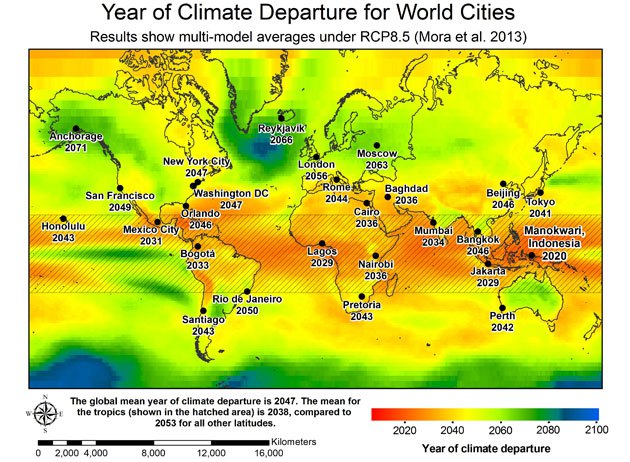
Those familiar with the "climate departure" theory that came out of the University of Hawaii in 2013 have probably been watching these record heatwaves hammering so many nations from Australia to the UK with special interest.

Climate departure could be the hallmark of irreversible global warming and it is predicted to arrive in just six or seven years, spreading across most of the world by about 2047.  It's a tricky concept to convey. It's an abrupt switch from what climate had been to a new climate, a new and hotter normal. It's sort of like flipping a light switch.

Once you're at climate departure, once that switch has flipped, every year following will be hotter than the hottest year before going back as far as 1960. That means no more cool, much less cold, years. Hot years only, very hot years, in endless succession. This graphic illustrates where climate departure will first set in and how it's expected to spread:


This doesn't mean that Reykjavik in 2066 will be as hot as Mumbai or Lagos. It will simply be hotter than Reykjavik was before climate departure which is still pretty moderate. Looking at Africa, however, you can see how climate departure will probably fuel mass migration toward Europe or a similar event out of Central America toward the US.

Another issue is how this super-heating is going to affect Atlantic waters off eastern US and across the central Atlantic to Africa, the area that spawns the hurricanes that now seasonally batter America and the Caribbean. Could something similar affect the Indian Ocean and the South China Sea?

We don't have much idea how much dislocation climate departure will cause - social, economic, political - as it sets in and slowly works its way ever poleward. We don't have much idea but we need to have at least some working idea of what's in store.

Britain is our miner's canary when it comes to climate change and that bird is definitely not chirping.

Hey, Warren. You Even Made It in The Guardian.


Our friend Kinsella has become the official critic of prime minister Handy. He's been given the nod by the New York Times and the Washington Post. Today he can claim credit for keeping the Trudeau grope story alive, this time in my favourite paper, The Guardian.

The allegation has dominated political discussion in Canada in recent days after it was highlighted by a political commentator last month. 
The reporter behind the allegation – who is also believed to be the author of the editorial – has not responded to interview requests from the Guardian. 
Trudeau addressed the allegation briefly on Monday, describing the day of the event as a “good day” and one in which he did not recall any “negative interactions”. 
After calls for an independent investigation into the claim and opposition criticism of his initial response, Trudeau addressed the issue at length on Thursday.

C'mon, Warren, be a sport.  You may be headed for greatness - the pundit who brought down the boy wonder.

Hiding Donald Trump


I know this quaint crofter's cottage up on Culloden moor.  That should do in a pinch.

Theresa May is scrambling for venues to keep the Mango Mussolini from boiling over when he visits Britain next week.  Brits are expected to demonstrate en masse and they're prepared to embarrass the hell out of the world's biggest narcissist.  That means May needs to get Trump in and the hell out of London just as quickly as possible.

Trump, who is to meet Theresa May and the Queen among others before spending two days in Scotland, will only spend the night in London on Thursday, the day of his arrival, staying at the US ambassador’s official residence in Regent’s Park, Winfield House.

Before that he will attend a gala dinner at Blenheim Palace in Oxfordshire, and the following day he will hold talks with the prime minister at her Chequers country retreat in Buckinghamshire. Both are places where protesters can be kept out of sight and earshot. 
Later on Friday he will meet the Queen at Windsor Castle before heading to Scotland for the weekend. Details as to what he will do in Scotland will be released next week. 
Activists have promised to stage protests against Trump throughout his visit, with an event planned for London on Friday expected to be the biggest. 
While he is in the capital, a giant “Trump baby” balloon, caricaturing him as a nappy-wearing infant, will be flown in the sky over Westminster after the Greater London Authority (GLA) gave the creators permission to do so.
It was supposed to be a state visit, the sort of honour given important heads of state. That would have meant the Queen having to host Trump and wife at Buckingham Palace. It's rumoured that the ordinarily cooperative Queen instead invoked the "I'm way too old for that shit" protocol.


Did Big Oil "Get" to Trudeau on the TransMountain Pipeline


It sure looked curious at the time. Kinder Morgan was threatening to abandon the TransMountain pipeline project. That wasn't a surprise because the business case for the multi-billion dollar bitumen tube looked pretty wobbly.

The surprise was when Trudeau and Morneau put on their knee pads and raced to beat Kinder Morgan's ultimatum date. Morneau flew down to Texas and promised the feds would cover any losses from delays. That didn't work so Trudeau just up and bought the damned thing, allowing the sketchy Texans to pocket a nifty 675 percent return on investment.

Why did the Liberal government so completely knuckle under to Kinder Morgan's tactics? It didn't seem to make any sense. Why would Trudeau & Co. stick the Canadian taxpayer with this fiasco?

The National Observer suggests part of it was pressure from the Oil Patch during the last Ontario election.
Canada’s largest oil and gas lobby group ran a political ground war that targeted voters in 13 Ontario “Liberal swing ridings” with billboards in “high visibility locations” in the Toronto area and 400,000 pieces of pro-pipeline literature sent via Canada Post, an ongoing National Observer / Toronto Star / Global Newsinvestigation has found. 
The details of Canadian Association of Petroleum Producers’ campaign appear in a flyer distributed at a government-sponsored summit in Vaughan, near Toronto, where the association had a booth. The flyer explained how the lobby group had engaged in a “ground campaign in Ontario targeting 13 Liberal swing ridings” between April 8 to May 29 — the period in which the federal government was deciding on the fate of the Trans Mountain pipeline expansion project.
CAPP’s campaign included 13 rallies across the country, billboards, a huge social media push and mailing hundreds of thousands of letters warning the public about their struggle to compete and gain access to new oil and gas markets, the flyer said. The Calgary-based group also sent 24,000 letters to “key decision makers” including B.C. Premier John Horgan, Alberta Premier Rachel Notley and federal National Resources Minister Jim Carr, according to the leaked CAPP document.  
The political implications of the campaign has prompted at least one political insider to call it “a warning shot” from one of Canada’s largest and most powerful lobby groups for the upcoming federal election.
With that, it seems, Trudeau's government folded like a lawn chair. The Bitumen Barons had humbled the King. There would be no further trouble from Justin during the runup to the 2019 federal elections.

And who says we don't bargain with terrorists?

Thursday, July 05, 2018

Could Climate Models Be That Far Out?


If there's been anything consistent in climate science it has been the errors in forecasts and projections. Climate science - the International Panel on Climate Change (IPCC), NASA, the Hadley Centre, National Academies of Science, Potsdam, the lot - keep understating what's coming, especially what's already "baked in" our shifting environment.

We were told that if we didn't sharply mend our ways a lot of stuff was going to happen by 2100 and a fair bit of that stuff did happen only 60 to 80 years sooner than predicted. I suppose you have some idea of what's coming next.

A new report published in Nature Geoscience says temperature increases could be double what has been predicted and, even if we do somehow, magically meet the 2 degree Celsius target for warming, sea levels could rise not a foot or two or even three but six metres. That's 19.685 feet.

The researchers say they increase the urgency with which countries need to address their emissions. 
The scientists used a range of measurements to piece together the impacts of past climatic changes to examine how a warmer earth would appear once the climate has stabilised. 
They found sustained warming of one to two degrees had been accompanied by substantial reductions of the Greenland and Antarctic ice sheets and sea level rises of at least six metres – several metres higher than what current climate models predict could occur by 2100.
Here's what 6 metres of sea level rise would mean to Florida. Adios Miami. Fairwell, Florida Keys. Good riddance, Merde a Lardo.


 Remember, what's shown here is calm weather inundation. It doesn't take into account severe storm events, storm surge inundation, etc. Heading west, the entire US Gulf Coast is in trouble. New Orleans will be gone. Houston could go too.

Keep this in mind. The latest report cited here is not some outlier.  It is not the first to predict six metres of sea level rise even if we keep warming below the 2C target. There have been others including this one from 2015.  These reports, then, may represent a building consensus of what we must prepare to accept. This is not going to go down well with the world's petro-states, including our own.

Wednesday, July 04, 2018

Themis, Wherefore Art Thou?


Themis. To the ancient Greeks, Themis was the goddess of justice.  Wiki offers this description:
She is described as "[the Lady] of good counsel", and is the personification of divine order, fairness, law, natural law, and custom.
Today, Themis is commonly depicted blindfolded, "blind justice." The blindfold was introduced during the Renaissance.

Vancouver courthouse

The blindfold represents impartiality, the ideal that justice should be applied without regard to wealth, power, or other status.
Order, fairness, law and impartiality are all cornerstones of true justice today, in those countries where true justice is still dispensed. Sadly, the United States is not among the ranks of countries that bother with true justice.

The American judicial system is corrupt, by design. Trump is about to drive another nail into the coffin of justice in the next few days when he will announce his "pick" to replace retiring Justice Kennedy on the US Supreme Court. The goal is to stack the deck with reliable conservative judges.

Trump is working through a short list of candidates cherry-picked by the Federalist Society. This arch-conservative/libertarian organization has culled the herd to a select list of reliable arch-conservative prospects. What that means is that deliberately excluded from the Federal Society's list will be any great legal minds, no matter how brilliant or deserving, that don't meet the ideological standard.

That means that America's Themis has no blindfold. To the contrary, the American supreme court can be counted on to dispense justice through an ideological filter. If your leaning matches the court's, you're in good hands. If, however, you're of the same perspective as the majority of Americans, you're screwed by a rigged system.

It's not as though there's anything underhanded in this. People like Trump don't even pretend to want an unbiased court, the only court that can dispense real justice. They have their priorities and fairness and justice aren't on their list.

What Trump is doing isn't particularly alarming. That a Republican Congress will rubber stamp his choice isn't alarming. What is really alarming is the body of American lawyers and their law societies that allow this corruption to continue, unchallenged, without a protest.

I think of lawyers in Pakistan who risked their careers, even for some their lives, to take to the streets in defiance of their government's attempts to corrupt their judicial system. Their American counterparts, by contrast, have succumbed to complacency, accepted the corruption.

You cannot obtain justice from an ideologically compromised court. You cannot have a fair court by choosing justices for their ideological bias. The American people, their political leadership, their lawyers and their judges think that's just fine.

The bottom line is that the rule of law, the cornerstone of democracy, is defeated when the judicial system is compromised.

It's Easier When You Think of It as a Form of Retardation.


One of the side effects of becoming a petro-state, a purveyor of fossil energy whether oil, gas and/or coal, is the political retardation factor. Since climate change became a recognized threat, every Canadian government, Tory and Liberal alike, has succumbed to carbon-retardation. It has made them imbecilic, even moronic.

And, yes, Justin Trudeau has carbon-retardation. He's neck deep in it. Gotta move that bitumen and that natural gas and all that coal. Sure, it's destroying the environment and it's probably already claiming lives but, hey, we'll deal with that later, eventually, long after we've squandered all those petro-bucks. Sure.

An interesting and timely article in The Guardian looks at how we can harvest the power of the moon. It focuses on tidal power - reliable, effectively unlimited and, best of all, free.

I like to head down to the beach when we're having a particularly low tide. As I gaze over the exposed sand flats I'm struck by the power of the moon to draw away all that water.  Moon power. That is energy that traces back 4.5 billion years to the collision between a Mars-size planet and Earth. It created a lot of debris, enough to form our moon, that was captured by Earth's gravitational force and has been circling the planet ever since. These tides reflect energy that's 4.5 billion years old. That is so cool. And every watt of that energy for the past 4.5 billion years has been absolutely free of charge.

The left coast is blessed with an abundance of free, renewable energy, ours for the taking.

Prevailing winds from the Pacific bring moisture laden clouds. This is where our several mountain ranges come into play.  Those clouds, trying to head eastward, wind up dumping their moisture as rain on those mountains. Mountains, being high, a few thousand feet or more, concentrate that rain into gullies. That rain water has potential energy that is transformed into kinetic energy as it races downhill. It creates the energy needed to drive turbines for electrical generation. Rain, being intermittent, the mountainous terrain facilitates the construction of reservoirs that can then run power plants. There are several environmental problems associated with these dams. Yet it is a major source of renewable, non-carbon energy. That's really good energy when you're recharging your electric car.

In other words we've got abundant hydro-electricity. And we've got wind energy. If you've ever driven (ridden) the California coast you will have seen wind turbines arrayed along ridge lines. Winds get pretty good at higher elevations. Folks who fly sailplanes (gliders) understand the power of "ridge lift." In other words, so long as Earth continues to rotate and the sun warms the seas, we'll have loads of wind power that still is untapped.

So, we've got vast untapped hydro power and wind energy. What else?

The Guardian article focuses on moon power, tidal power. It addresses the incredible tidal bore on the Bay of Fundy. Huge energy there, twice a day like clockwork.

British Columbia has plenty of tidal energy but it's not as focused as the Bay of Fundy. That said, we've got something else. Take a look at this map of Vancouver Island and the mainland.


Look at that stretch of the island between Kokish down to Campbell River. It's a natural Venturi tube, about 150 miles long as the gap between the island and the mainland sharply narrows.  As that gap narrows the currents accelerate the flow rates along that passage. That's all free energy. Free, reliable and clean energy. It's as reliable as the ocean currents themselves.

So, we've got tidal energy, hydro energy, wind energy, and the concentrated energy of the Pacific Ocean current.  Anything else? Why, of course.

There are advantages and a few drawbacks associated with any mountainous territory and British Columbia is mainly mountainous. We are part of the Pacific Rim, a.k.a. the Ring of Fire. Volcanoes and other features bring the heat from the Earth's magma to or near the surface.


 It is estimated that tapping the best sites, about 16 in total, would produce upwards of 3,000 megawatts of constant, free, clean energy.

So with all this near limitless natural, clean, renewable energy waiting to be harnessed, what's holding us back? It's that carbon-retardation thing again and our governments have it bad, really bad. We can meet our needs with clean energy, easy peasy, but we can make money (supposedly) by flogging high-carbon fossil fuels. That's the way Justin Trudeau rolls. That's the way Stephen Harper rolled. That's the way the next prime minister of Canada will roll.

That's what you call "captured" government. And if you don't believe that our federal government has been captured ask yourself why it continues to shower massive amounts of money and in-kind benefits to the Fossil Fuelers, worth upwards of $34 billion a year according to the IMF, while it doesn't invest even a tiny fraction of that into developing our abundant clean energy resources.

Tuesday, July 03, 2018

Can America 3.0 Survive?


When the 2011 Occupy movement sparked and flared and, in short order, fizzled out, a lot of people said "well, that's that." I didn't see it that way. That such a haphazard, diffuse and relatively aimless movement had mobilized so many young Americans to come together and voice their outrage and dissent was a huge achievement in its own right. It was a failure, of sorts, but what else could it be, how else could it have wound up? That was not a "storm the Bastille" crowd. And those who wrote its obituary never mentioned one thing - the grievances that had motivated those crowds had not been resolved. The unhealed wounds would continue to fester. They would or some other movement would return only, next time, it might be a far less tranquil gathering.

Then along came the counter-movement, the Tea Party, an outpouring of profoundly stupid people who embraced everything from xenophobia, nativism, misogyny, racism, fear, paranoia and every base instinct known to humankind - in other words, Trump people. He played them like a fiddle, fed them steaming horseshit by the wheelbarrow and the Gullibillies scarfed it down with relish.

Trump won the election, barely, in an electoral-college way, but only with a lot of outside manipulation. The Russians, yeah; Wikileaks, yeah; Robert Mercer and Cambridge Analytica, yeah; voter suppression and manipulation (i.e. vote tampering), yeah; an unpopular Hillary Clinton, yeah; that uppity black guy with his fancy talk who didn't know his place, yeah; the NRA, yeah; the Klan, yeah; a thoroughly gerrymandered nation, yeah.  All of this and the Mango Mussolini still lost the election by three million votes.

For years, decades, American society has been deeply divided; dangerously so at least as far back as the "hanging chads" election that brought Bush/Cheney to power. The country seemed to come together after the 9/11 attacks but not for long.

It's not easy to figure out America, to make sense of that nation-state. All countries, almost all countries, evolve with time. The constantly changing world alone sees to some of that. When I look at the United States, I see three Americas. It can look like a three act play. Sometimes it can look like a succession of three countries, three Americas: America, America 2.0 and now America 3.0.

In my mind the first is evolutionary America that spans from 1700 through the post-Civil War reconstruction to about 1900. It was when America went from colonies to a nation with an agrarian south and a mercantile north before expanding ever westward to the Pacific and the annexation of Mexico's northern territories.

That morphs into America 2.0, its greatest era. That was the 20th century that brought all the seismic events that really forged the United States and brought it to global hegemon, the uni-polar superpower. A century steeped in fire and blood. The Great War, the early progressive movement, the Great Depression, World War II, the progressive revival and the post-war emergence of the greatest, most broad-based and robust middle class the world has ever known capped off by the advent of neoliberalism, the harbinger of America's slow decline.

The new millennium ushered in America 3.0, the chapter that's unfolding now before our eyes. The arrival of wars without end, PermaWar. The military-industrial-neoconservative-Christian fundamentalist-corporate (for profit) warfighting complex. The metastasizing malignancy of inequality and the corruption of both the legislative and judicial systems. The triumph of a politicized corporate media that serves to confound, distract and manipulate rather than inform. The decline and potential extinction of democracy displaced by a modern variety of fascism. How did America become Amerika in scarcely half a century?

I was going to begin spewing out quotes from the "two Toms" - Jefferson and Paine about freedom and revolution and such but something curious happened. As I surfed around for links to my favourite quotes, the grand wisdom, I found that most everything I thought applicable to America's current contagion had already been latched onto by the Gullibillies in support of their arguments, even the wildest of their conspiracy theories.

Decades of enduring the excesses of TV evangelists should have taught me that even the Bible, especially the Old Testament, can be shamelessly cherry-picked to seemingly justify any nonsense. If you want to kill your unruly kid, it's in there. Keep slaves? It's there too.

While we come at it from different perspectives, a popular Jeffersonian injunction for all sides is his suggestion that the survival of American democracy will probably require periodic revolution. It turns out the Gullibillies are perfectly down with that idea. Then again they're probably okay with ethnic cleansing too, a means of restoration of white rule in America.

From time to time over the past half dozen years I've stumbled across news accounts and other mention of an American re-match, a second Civil War. Surely America is more divided than it has been since the bombardment of Fort Sumter in 1861. It's no simple north/south; blue/grey division this time. America today may be threatened by multiple fault lines, some of them blurry.

Chuck Thompson is his sometimes humorous book, "Better Off Without 'Em, a Northern Manifesto for Southern Secession" contends that his United States could be a much happier place if Blue State and Red State America separated amicably. One reviewer described it "as if Kevin Phillips 'American Theocracy' were being narrated by Rolling Stone's Matt Taibbi." Thompson maintains that the cultural, political and social divides were not healed by the Civil War and remain too deeply ingrained, holding back both Red State America and Blue State America. The book earned mixed reviews and plenty of scorn yet few critics were willing to dismiss it out of hand. Here's the New York Times' take on Thompson's book.

Chris Hedges describes America today as simmering in a "pre-revolutionary state." Hedges doesn't advocate revolution. He knows enough about the history of revolutions to realize that they rarely end well, even if they succeed. If you need to brush up on the subject a decent early primer is found in Crane Brinton's "Anatomy of Revolution" which, handily, is available free here in pdf.

But revolution and civil war are not identical. There can be a lot of overlap but they can also be somewhat distinct, especially in this era of "new war," the confused, pile-on conflicts that can include state actors, quasi-state actors, religious and tribal factions, rebels, insurgents (no, they're not the same), even criminal gangs, each often pursuing their own and shifting agendas.

Now I understand that, to most of us, the idea of America, the most advantaged country of all transforming into a failed state, descending into another civil war must sound ridiculous, impossible. If you feel that way I won't argue the point. I will, however, list some sources you might find helpful. Or you can Google "is America heading for a civil war" and start wading through 26,900,000 results. This question is on a lot of people's minds.

"Is America headed for a new kind of civil war?" - The New Yorker, August, 2017.

USA Today asks, "Is America headed toward a civil war?" June, 2018. That same day the paper ran a story about Representative Steve King (R. Iowa) who opined: "America is heading in the direction of another Harpers Ferry," the controversial conservative tweeted Sunday. "After that comes Ft. Sumter."

Even Foreign Policy has waded into the civil war debate. The magazine's survey of "national security experts" put the prospect at 30%. In a follow-on piece, Foreign Policy tried to imagine what a neo-Civil War might look like and concluded, as I did, that it would be something of a "new war" mish-mash.
For the United States, the shape of future homeland conflicts will be asymmetrical, distributed, and heterogeneous. A contemporary homeland conflict would likely self-compose with numerous dynamic factions organized by digital tools around ideological and affinity networks. It would likely be a patchwork of affiliated insurgency groups and their counterparts engaging in light skirmishes along the overlapping edges of their networks, mixed with occasional high-value terror attacks against soft and hard targets. Such groups are much smaller than conventional militaries and where they lack in firepower, they wield transgression. As in Charlottesville and Berkeley, the fronts are less territorial than ideological.
A Rasmussen poll released a few days ago claimed 31 per cent of Americans now think it likely that America will descend into civil war within the next five years.

Curiously enough, the American right sees the left as desperate to plunge the country into civil war. Why, refusing service to Mike Huckabee's kid in a Virginia restaurant is tantamount to sedition. It's all them damned lefties, they're the threat.

Could another civil war befall America? Perhaps, but I don't think it's likely. Far more likely, in my view, is something more akin to an insurgency waged more in cyberspace than a blood and bones struggle. It's hard to say but something has to give. The Republicans show no appetite for compromise and the Democrats complain that they're the ones who have been compromised already.

Who knows? Something has to give. What, when, how? You'll have the answers when it happens.

Interesting times.


Monday, July 02, 2018

Time Marches On. Today, in Global Security.


Here are a few plums from Foreign Policy's latest security review.

NBC News reports that Kim Jong Un has pulled a fast one on the Dotard from Merde-a-Lardo.  Even as Trump was assuring his Gullibillies that he had tamed Rocket Man and they had nothing more to fear from Kim, the North Koreans have been stepping up production of weapons-grade nuclear materials. The Wall Street Journal, meanwhile, reports that satellite reconnaissance images reveal that Kim is also expanding his solid-fuel missile production sites. Which means that Rocket Man has conned one of the greatest con-artists of our day, DJ Trump. Well done, Dotardo.

Trump's mercurial national security advisor, John Bolton, put in an appearance on CBS's "Face the Nation" yesterday and said Kim could give up his nuclear and biological arsenal within just a year. Yeah, Johnny, sure. John really shouldn't start drinking that early on a Sunday morning.

And SCL, the one time parent of now dissolved Cambridge Analytica, is reported to be conducting a lucrative trade in dodgy passports.

In the Eastern Caribbean, where SCL quietly operated in at least six countries, some of its work had an indirect objective: Assisting a lucrative trade in passports. The sales are legal, and lucrative, with the world’s rich thought to spend over $2 billion on “citizenship by investment,” or CBI. But reporting and interviews with industry insiders show how a nexus of buyers, officials, citizenship agents, and consultants has helped enable criminals and ignited political wildfires that continue to rage even now.

In at least five Caribbean nations, the company’s campaigns were backed by Christian H. Kalin, the chief executive of Henley and Partners, a London-based firm that markets and sells second passports, and helped support politicians thought to be sympathetic to Henley’s interests. With a friendly politician in office, according to people familiar with the arrangement, Henley could then become that country’s primary passport merchant, giving it the right to earn lucrative commissions on every sale.
A perfect scam. You work your election manipulation magic and a grateful head of state gives you a lucrative franchise to flog citizenship and passports.

After years of benign neglect of the Dark Continent, American special forces are getting busy waging secret wars across Africa. Barely a decade ago the Pentagon couldn't give Africa the time of day. Then the Chinese got interested and - voila - Africom.

This is sexy. The Pentagon is spending half a billion dollars to train US soldiers to fight underground.
Late last year, the Army launched an accelerated effort that funnels some $572 million into training and equipping 26 of its 31 active combat brigades to fight in large-scale subterranean facilities that exist beneath dense urban areas around the world.

For this new type of warfare, infantry units will need to know how to effectively navigate, communicate, breach heavy obstacles and attack enemy forces in underground mazes ranging from confined corridors to tunnels as wide as residential streets. Soldiers will need new equipment and training to operate in conditions such as complete darkness, bad air and lack of cover from enemy fire in areas that challenge standard Army communications equipment.
If you find this bizarre, Canada has been preparing to fight in urban centers for some years. Check this out:


See anything out of the ordinary? How about that uniform in the center of the photo?  Here's a closer image of it.


It's purpose designed to suit "the urban environment" typical of the streets, alleys and underground in Toronto, Montreal and Vancouver.

Moving on to space, you've probably heard that Trump wants to create a separate branch of the armed forces focused on achieving military domination of low-Earth space. Wired.com has a look at what a space skirmish involving the US, Russia and China would mean. In a nutshell, you would instantly be transported back to the 1950s, back when all the stuff you have now wouldn't work worth a tinker's dam. Lights out, everybody.

Okay, one more. This is about cyberwarfare and election meddling from The New York Times. American tech giants recently had a sit down with government intelligence types to figure out what could be done to help secure the mid-term elections in November. One snag -
The meeting, which was initiated by Facebook, was seen as a hopeful first step to ensure that the midterms were not a repeat of the Russian interference in 2016, said the three people who attended the meeting.

But the people who attended described a tense atmosphere in which the tech companies repeatedly pressed federal officials for information, only to be told — repeatedly — that no specific intelligence would be shared.
Oh my goodness. Seriously, I read this crap every day. It's a perpetual motion FUBAR machine spinning right in front of our eyes.

What, We're Running Out of Sand?


Apparently the global demand for construction-grade sand has reached the point where gangs now strip paradise islands of their beaches.

Our insatiable appetite for new buildings, roads, coastal defences, glass, fracking, even electronics, threatens the places we are designed by evolution to love most. The world consumes between 30 and 40bn tonnes of building aggregate a year, and half of this is sand. Enough material to build a wall 27m high and 27m wide around the equator. Sand is second only to water as a natural material extracted by humans, and our society is built on it, quite literally. Global production has risen by a quarter in just five years, fuelled by the insatiable demands of China and India for housing and infrastructure. Of the 15 to 20bn tonnes used annually, about half goes into concrete. Our need for concrete is such that we make almost 2 cubic metres worth each year for every man, woman and child on the planet. 
But what of those oceans of sand stretching from the Atlantic to the Persian Gulf – the Sahara and the Arabian Desert? The wrong kind of sand, unfortunately. Wind action in deserts results in rounded grains that are too smooth and too small to bind well in concrete. Builders like angular sand of the kind found on riverbeds. Sand, sand everywhere, nor any grain to use, to paraphrase Coleridge. A textbook example is the Burj Khalifa in Dubai, the world’s tallest skyscraper. Despite being surrounded by sand, it was constructed with concrete incorporating the “right kind of sand” from Australia. Riverbed sand is prized, being of the correct gritty texture and purity, washed clean by running fresh water. Marine sand from the seabed is also used in increasing quantities, but it must be cleansed of salt to avoid metal corrosion in buildings. It all comes at a cost.
The operative words here are the three above, "our insatiable appetite." This sand problem is an apt metaphor for what we're doing with so many natural resources.

For the past forty years and at a steadily worsening rate, man has been consuming the planet's resources, renewable and non-renewable, at levels far beyond the Earth's carrying capacity. We have ventured further and further into what's called "overshoot."  At the moment we would need almost another planet Earth's worth of resources to sustainably meet our needs.

When nature couldn't supply enough we pillaged the planet's reserves. Not enough surface water? Well, there's water down below. Groundwater, in those ancient aquifers. How much water down there? Who knows, who cares? Only now those groundwater reservoirs are being tapped out. Which brings to the forefront the greater problem, our mortal dependence on resources that are becoming exhausted.

We are depleting nature's reserves. It's called "eating our seed corn." You gorge yourselves on that leftover grain in the silos over the winter and then, come spring, you've got nothing to plant. Can you see how that ends? You may, soon enough.

With the benefit of research and analysis, we know - in hindsight, naturally - that Earth has, or rather once had, the ability to carry a human population of three billion people - max. That's three billion based on levels of population, longevity and consumption as that stood in the early 70s. We've more than doubled in number and we've also grown to live longer and consume, per capita, way more. And most of it we've financed on the resource "never, never."

The thing is, we can't stop. It's a dependency as powerful, more powerful, than being addicted to the very worst drugs. Here we are whining about carbon taxes but have you heard anyone talking about how we'll shed five, maybe six billion people - in a hurry? Why so many? This simple graph illustrates our dilemma.


See where the red line, consumption, first crosses the dotted line, carrying capacity?  That was the early 70s when we first reached three billion people. It took 12,000 years of human civilization to reach that intersection.

You'll see what happens to carrying capacity as consumption steadily increases. Carrying capacity degrades. Resources become exhausted. The planet can no longer support as many people as it once could.  And, once consumption can no longer expand it becomes a tail chase. Resources collapse, population and consumption collapse.

The latest estimates I've read hold that today, the Earth's carrying capacity can support no more than two billion people. It was three billion in the early 70s. Less than half a century later, it's just two billion. But wait. Earth's ecological carrying capacity may be starting to tank but we're still increasing, and at a rapid pace, in population and consumption and pollution of all sorts.

The floor is collapsing beneath us but our momentum is still propelling us ever higher, ever bigger, ever more demanding. We'll even pillage tropical islands for their sandy beaches. We'll fish down the food chain, exhausting the best species and settling for the best of what remains, for now. To feed ourselves we'll so overwork our farmland, with increasing applications of chemical fertilizers, insecticides and pesticides, that our agricultural production will collapse within a lifetime. We are literally working the soil to death. The UN Food and Agriculture Organization, echoing a load of research by agronomists, warned we, mankind, have 60 years of harvests left - max.

Look at that graph again. Once this starts, once that dotted line begins to plunge, and it very much has, it becomes a matter of when, not if.

Which brings me to Jared Diamond and the growing number of scientists speaking out with the same message. It's good that we're now talking about climate change. It would be great if we were serious about the problem. We're not. It would be terrific if we summoned up the resolve as a global community to decarbonize our economies and our societies just as rapidly as possible. We're nowhere near that point, not yet. But the message they're now passing to us is that we also have to resolve overpopulation and over-consumption because you can't hope to solve any of these existential challenges unless you solve all of them.

These problems are linked. They all arise out of one thing - our interaction with this extremely finite planet.

The first home I owned was a neat little 1940s bungalow on the west side in a neighbourhood of neat little 1940s bungalows. Two bedroom, one bath, L-shaped living and diningroom, small but functional kitchen. All the houses were really well kept up with lovely gardens. There was a lane out back and each house had a one-car garage. The lots, for Vancouver, were pretty generous - 50 X 110 and that allowed a decent, pleasant backyard, maybe a deck.

Those houses are all gone now. They have made way for what is called the "Vancouver Special." McMansions, lot line to lot line, with a three car garage (some, more) on the lane and more cars lining the street out front. Some of them are occupied, some aren't. Where that lot used to have one car associated with it, sometimes two, there are now four, five, even six cars.

At my birth the Earth's human population was estimated to be 2.5 billion, an all-time record. Now we've blown past 7.5 billion, heading for at least 9 billion and, by some estimates, 12.  Look at that graph again. We're propelling ourselves into overshoot as fast and as far as greed and technology can take us.

We're not done yet, not nearly. Even our own leaders shamelessly, boastfully proclaim their pursuit of perpetual, exponential growth. I suppose they haven't seen that graph. They don't know about overshoot. They didn't get the press release from the UN FAO. They haven't heard what is visible to the naked eye of scientists orbiting Earth on the International Space Station. They don't know that wildlife stocks have declined by more than half over the past four decades or that species are falling extinct at rates estimated to be as much as 1000 times normal. They don't see man's hand on the algae blooms that are choking our lakes and rivers or the coastal dead zones that have increased by a factor of five along our coasts.

You can't think about those things without realizing that pursuit of perpetual, exponential growth in the world as it is today is a crime against humanity. When you run out of stuff, hit resource "walls," it strictly a net sum game after that. You want to grow, somebody else has to shrink and that's truly diabolical when the most affluent, advantaged and wasteful bunch insist on growing and another group, often struggling for survival, have to do with even less. Meh.


Thai Cave Kids Found Alive


It's being reported that Thai rescue crews have found 12 young Thai soccer players and their coach alive inside a flooded cave. From NBC News:

The boys and their soccer coach were located nine days after first entering the Tham Luang Nang Non cave complex, Chiang Rai Gov. Narongsak Osatanakorn, said Monday night local time.

The governor said rescue teams will send doctors and food to help, but more water needed to be pumped out of the caves before those trapped can be rescued. 
“We found them safe. But the operation isn’t over," the governor said, according to The Associated Press.

Sunday, July 01, 2018

Wow, I'll Be Looking For a Star in the East Tonight!


I'm a bit of a buff when it comes to the War of 1812.  In my bookshelves sit eight historical volumes, three American, the rest Canadian.

I also have an authentic American newspaper recounting the Battle of Beaver Dams in 1813 when a marauding American force under Boerstler was tricked into surrendering to a minuscule British and Indian force by a young Irish officer, Lt. James Fitzgibbon and his dreaded but paltry force, the Green Tigers. Fitzgibbon, with only a few soldiers, was able to intercept Boerstler thanks to a very brave Laura Secord. (Newspapers of that era survive because they were made with extremely high rag content, not pulp) Fitzgibbon was a protege of Isaac Brock and served in the 49th Regiment of Foot. He went on to play a significant role in the establishment of governance in Upper Canada.

To me it was the most important war to Canada's history and our people. But for the outcome of that war, a conflict that Thomas Jefferson foresaw as America's "for the marching" I, and many of you, would have been born American. Yes, indeed, a matter of marching. Jefferson wasn't being brash. The Americans had a population of 8-million to draw from. Canada, a mere 500,000. The Americans had enough people that they had a functional road system. Most of Upper Canada was accessible only by boat. That gave the Americans huge advantages in numbers and in mobility. They could strike where and as they wished and we might be unable to position troops to stop them.

The Americans really wanted Upper Canada. They wanted it bad, real bad. They wanted Canada to be another part of the United States. Which, to me, is why that war eclipses all others. Had the Americans won, as they should have, I would have been an American and both my brother and I would have been eligible for the draft during Viet Nam.

Americans, being Americans, have a narrative about the War of 1812 that is, to be polite, utter nonsense. Which made it all the more refreshing to read an honest account of the war written by a real, live US Army major, Danny Sjuren, who in addition to combat tours of Iraq and Afghanistan also taught American history at West Point.

Yes, the United States declared war and Madison issued the declaration after learning that the British had repealed their impressment law providing for boarding American ships at sea and removing British navy deserters. Once their casus belli was eliminated, they set out to conquer Canada for the "honour" of the United States. The declaration Madison issued to the people of Canada came with an ultimatum - surrender and come to the American side or, wait for it, be enslaved. Those Americans sure loved that slavery thing.

This being Canada Day I posted this since I thought you might want to have a read of what really went on during that war as told by an American Army historian. Oh Canada, indeed.

Happy Canada Day


Made it under the wire, barely. While I'm pretty ambivalent about the whole "Canadian" thing these days my family and most of my friends remain devoted Canuckleheads.  And so, in the spirit of the day, I send you this:

Bring On the Trolls!! Historian Timothy Snyder Explains How Collusion Works And Why Trump Is Not Really Colluding with Moscow.


Perhaps you've read professor Snyder's recent book, "On Tyranny, Twenty Lessons from the Twentieth Century."

Here he explains what underlies Russia's manipulation of Trump, how the process works and what it holds in store for America. It's not a matter of collusion but something much, much worse.


Here's the next chapter, Snyder discusses the Mueller investigation.


Bread and Circuses


"Panem et Circenses" the old Roman technique of pacifying the public with free food and the spectacle of the circus.

This came to mind in reading a thoughtful essay by Cass Sunstein in The New York Review of Books, "It Can Happen Here."

Sunstein looks at the rise of authoritarianism in Germany through three books: Milton Mayer's 1955 volume, "They Thought They Were Free," Sebastien Haffner's 1939 memoir, "Defying Hitler," and a new book by Konrad Jarausch, "How Ordinary Germans Experienced the 20th Century."

The focus of this book is what life was like for ordinary (i.e. Christian) Germans during the rise of authoritarianism in Germany, the ascendancy of the Nazis and German life to the war's end in 1945.

The essay is not about drawing links between Hitler and Donald Trump or any of today's crop of authoritarians. It's about ordinary Germans, how they went about living their normal lives and how they were seduced by authoritarianism.

Here are some excerpts from Sunstein's review starting with Mayer's They Thought They Were Free.

Dotted with humor and written with an improbably light touch, it provides a jarring contrast with Sebastian Haffner’s devastating, unfinished 1939 memoir, Defying Hitler, which gives a moment-by-moment, you-are-there feeling to Hitler’s rise. (The manuscript was discovered by Haffner’s son after the author’s death and published in 2000 in Germany, where it became an immediate sensation.)*

...An American journalist of German descent, he tried to meet with Hitler in 1935. He failed, but he did travel widely in Nazi Germany. Stunned to discover a mass movement rather than a tyranny of a diabolical few, he concluded that his real interest was not in Hitler but in people like himself, to whom “something had happened that had not (or at least not yet) happened to me and my fellow-countrymen.” In 1951, he returned to Germany to find out what had made Nazism possible. 
In They Thought They Were Free, Mayer decided to focus on ten people, different in many respects but with one characteristic in common: they had all been members of the Nazi Party. Eventually they agreed to talk, accepting his explanation that he hoped to enable the people of his nation to have a better understanding of Germany. Mayer was truthful about that and about nearly everything else. But he did not tell them that he was a Jew. 
In the late 1930s—the period that most interested Mayer—his subjects were working as a janitor, a soldier, a cabinetmaker, an office manager, a baker, a bill collector, an inspector, a high school teacher, and a police officer. One had been a high school student. All were male. None of them occupied positions of leadership or influence. All of them referred to themselves as “wir kleine Leute, we little people.” They lived in Marburg, a university town on the river Lahn, not far from Frankfurt.

Mayer talked with them over the course of a year, under informal conditions—coffee, meals, and long, relaxed evenings. He became friends with each (and throughout he refers to them as such). As he put it, with evident surprise, “I liked them. I couldn’t help it.” They could be ironic, funny, and self-deprecating. Most of them enjoyed a joke that originated in Nazi Germany: “What is an Aryan? An Aryan is a man who is tall like Hitler, blond like Goebbels, and lithe like Göring.” They also could be wise. Speaking of the views of ordinary people under Hitler, one of them asked:

"Opposition? How would anybody know? How would anybody know what somebody else opposes or doesn’t oppose? That a man says he opposes or doesn’t oppose depends upon the circumstances, where, and when, and to whom, and just how he says it. And then you must still guess why he says what he says." 
When Mayer returned home, he was afraid for his own country. He felt “that it was not German Man that I had met, but Man,” and that under the right conditions, he could well have turned out as his German friends did. He learned that Nazism took over Germany not “by subversion from within, but with a whoop and a holler.” Many Germans “wanted it; they got it; and they liked it.” 
Mayer’s most stunning conclusion is that with one partial exception (the teacher), none of his subjects “saw Nazism as we—you and I—saw it in any respect.” Where most of us understand Nazism as a form of tyranny, Mayer’s subjects “did not know before 1933 that Nazism was evil. They did not know between 1933 and 1945 that it was evil. And they do not know it now.” Seven years after the war, they looked back on the period from 1933 to 1939 as the best time of their lives.
... The killing of six million Jews? Fake news. Four of Mayer’s subjects insisted that the only Jews taken to concentration camps were traitors to Germany, and that the rest were permitted to leave with their property or its fair market value. The bill collector agreed that the killing of the Jews “was wrong, unless they committed treason in wartime. And of course they did.” He added that “some say it happened and some say it didn’t,” and that you “can show me pictures of skulls…but that doesn’t prove it.” In any case, “Hitler had nothing to do with it.” The tailor spoke similarly: “If it happened, it was wrong. But I don’t believe it happened.”

Haffner, on "Defying Hitler."
Focusing largely on 1933, in Defying Hitler Haffner offers a radically different picture, in which the true nature of Nazism was evident to many Germans from the start. Just twenty-five years old that year and studying law with the goal of becoming a judge or administrator, he describes the mounting effects of Nazism on the lives of his high-spirited friends and fellow students, who were preoccupied with fun, job prospects, and love affairs. Haffner says that as soon as the Nazis took power, he was saved by his capacity to smell the rot:

"As for the Nazis, my nose left me with no doubts. It was just tiresome to talk about which of their alleged goals and intentions were still acceptable or even “historically justified” when all of it stank. How it stank! That the Nazis were enemies, my enemies and the enemies of all I held dear, was crystal clear to me from the outset."
As Haffner describes it, a form of terror began quickly, as members of the SS made their presence felt, intimidating people in public places. At the same time, citizens were distracted by an endless stream of festivities and celebrations. The intimidation, accompanied by the fervent, orchestrated pro-Nazi activity, produced an increase in fear, which led many skeptics to become Nazis. Nonetheless, people flirted, enjoyed romances, “went to the cinema, had a meal in a small wine bar, drank Chianti, and went dancing together.” Sounding here like Mayer’s subjects, Haffner writes that it was the “automatic continuation of ordinary life” that “hindered any lively, forceful reaction against the horror.”
In Haffner’s telling, the collapse of freedom and the rule of law occurred in increments, some of which seemed to be relatively small and insignificant. In 1933, when Nazi officers stood menacingly outside Jewish shops, Jews were merely “offended. Not worried or anxious. Just offended.” But Haffner insists that Hitler’s brutality and the ongoing politicization of everyday life were clear from the outset. In the early days of the regime, a self-styled republican advised him to avoid skeptical comments, which would be of no use: “I think I know the fascists better than you. We republicans must howl with the wolves.” 
Haffner catalogs the howling. Books started to disappear from bookshops and libraries. Journals and newspapers disappeared as well, and those that remained kept to the party line. Even in 1933, Germans who refused to become Nazis found themselves “in a fiendish situation: it was one of complete and unalleviated hopelessness; you were daily subjected to insults and humiliations.” Haffner sought refuge in the private domain, including with a small group of young people studying law, who had formed something like an intimate debating club. They were very good friends. One of the members, named Holz, held nationalistic views. Others disagreed, but it was all civil, the kind of energetic discussion young people often have about politics. 
The group fell apart when Holz accused Haffner of “ignoring the monumental developments in the resurgence of the German people” and of being “a latent danger to the state”—and ominously threatened to denounce him to the Gestapo.
Trump is Not Hitler, Not Yet Anyway.
[The] authors are keenly aware that their narratives offer important lessons, and these should not be lost on contemporary readers. Turkey, for example, has been sliding toward authoritarianism through tactics not unlike those of the Nazis: jailing political dissidents, attacking freedom of speech, treating critics as enemies of the state, and obliterating checks and balances. Thus far, President Trump has been more bark than bite. But some of the barks have a history that is at once ugly and revealing. The Nazis applied the term Lügenpresse (lying press) to the mainstream press; President Trump refers to the “FAKE NEWS media,” which, he says, “is not my enemy, it is the enemy of the American People!” In significant domains (including climate change), his administration denigrates science; he has even failed to fill the position of White House science adviser. The Nazis also dismissed or politicized science (especially Einstein’s “Jewish Science”) in favor of what they claimed to be the spirit of the Volk. 
If the president of the United States is constantly lying, complaining that the independent press is responsible for fake news, calling for the withdrawal of licenses from television networks, publicly demanding jail sentences for political opponents, undermining the authority of the Department of Justice and the Federal Bureau of Investigation, magnifying social divisions, delegitimizing critics as “crooked” or “failing,” and even refusing, in violation of the law, to protect young children against the risks associated with lead paint—well, it’s not fascism, but the United States has not seen anything like it before.
I've visited my go-to source for 2nd hand books, AbeBooks and ordered both Mayer's and Haffner's books.

How We Give the Third World the Double-Whammy


Here's something for Justin, the Bitumen King, to mull over this Canada Day. It's about how we petro-states are screwing over the Third World. It's not just that we're killing their people either.

A new study from Imperial College Business School found that climate risks are increasing the cost of capital for developing countries. The researchers found that for every ten dollars these countries pay in interest payments, an additional dollar is due to climate vulnerability.

The study shows that over the past decade, a sample of developing countries have endured $40 billion in additional interest payments on government debt alone. The researchers estimate that these additional interest costs are set to rise to between $146bn and $168bn over the next decade, and could exacerbate the economic challenges already faced by poor countries around the world.
Then again, they're dying off so maybe it's not the wisest investment to be throwing money their way. We could just wait ten or twenty years. They might be all gone by then.

By the way if you think Canada is being generous or even responsible with our contributions to the Green Climate Fund check this out. Be sure to look at our per capita contribution and then compare it with non-petro state European countries.

Oh Canada!!!

Even Americans Figure It Out - Eventually - When It Starts to Hurt


An increasing number of Floridians are coming to realize their state is facing a severe problem from sea level rise.  Held back by incompetent, ideologically-hidebound state governments, the people of Florida have been held back by a fullsome diet of empty assurances.

Lately it seems the public has had a small change of heart. There have been enough early-onset signs such as "sunny day" flooding that the reality of climate change and sea level rise can no longer be ignored or dismissed.

While they're fretting over what's to come they're now getting worried about what's likely to hammer them first - insurance costs. An article in the Sun-Sentinel explains their predicament.
Long before the invading sea reaches our homes, it could upend our region’s economy. And soon. 
In just two or three years, Congress may change the way it sets rates in the Federal Emergency Management Agency’s National Flood Insurance Program (NFIP) to reflect more realistic assessments of risk, including the expected impacts of sea-level rise
According to the chair of Miami’s Sea Level Rise Committee, FEMA officials believe the largest provider of flood insurance in the United States will be aligning the cost of premiums much closer to the heightened risks of flooding. And that the changes will come sooner than many expect.
... “This is a big game-changer,” Wayne Pathman says. “South Florida is ground zero, in many studies, for the economic impact of sea-level rise. So I’ve said many times that the tip of the spear of this economic issue is insurance.”

...The move to so-called “risk-based assessments” will likely jack up the cost of flood insurance to as much as wind-storm insurance “or more” in the next five to 10 years, said Pathman, a Miami attorney who is also chair of the Miami Beach Chamber of Commerce. He sees rates rising 25 percent to 60 percent in the near term, and more after that.
... As harsh as the consequences will be for our region, there are sound reasons to reform the federal program, which was created 50 years ago to help people affordably repair their homes after flooding. It is now $24 billion in debt and its authorization to issue new policies is set to end on July 31. 
The program’s finances have been battered as floods have become more frequent, damage more extensive, and about 20 percent of the 5 million policyholders pay artificially-low premiums that don’t reflect the true likelihood of flood damage. 
Against all common sense, those unrealistic rates encourage development in flood-prone zones. More than 30,000 properties have flooded an average of five times each and been rebuilt each time through the NFIP. Some of these properties have been flooded more than 30 times.
It's a devilish problem. Rising insurance rates may tank property values in the most flood-prone areas but, on the other hand, they will discourage irresponsible development that will only worsen the problems down the road. And there is a lot that can be done by way of adaptation; everything from raising roads to relocating development and essential utilities to higher ground inland. The state government won't like that because it has made Florida a retirement mecca in part by its "everyday low taxes" regime. These adaption strategies are costly and somebody has to pay. Then there's the problem of simply acknowledging the sea level rise threat which is bound to play havoc on property values in high-market, low-lying areas such as the Florida Keys.


Many years ago I helped an old fellow, now deceased, get out of bankrutpcy. He'd been fairly well-to-do and decided to build himself a gorgeous retirement home on the waterfront in Texas. The dreamhouse was well into construction when the Texas coast got hammered by a hurricane that not only swept the house away but took the lot with it. What had been his property suddenly belonged to the sea. His assets were gone but, gee, those debts. No hurricane washes them away.

A lot of folks along the Jersey Shore and elsewhere, such as the Keys, the Barrier Islands of the Carolinas and elsewhere are facing that very same predicament. Things governments do that encourage others to jump in that same boat are beyond irresponsible.

Update: as reader, Cap, points out, Trump's beloved Mar-a-Lago (which Cap renames Merde-a-Lardo, is threatened by sea level rise. Someday it may look like this:


And, yes, Trump has his resort on federal government subsidized flood insurance.