Saturday, December 21, 2019

Trump Backers Unleash New Weapon - Weaponized AI


There are powerful people willing to wreck what little democracy remains in America, anything to get Donald Trump re-elected in 2020.
Facebook and Twitter on Friday disabled a global network of hundreds of fake accounts that pushed pro-Trump messages and covered its tracks using inauthentic photos generated with the aid of artificial intelligence.

The use of AI to trick social media companies, deceive unsuspecting users and essentially create people who do not exist marked a major, troubling new development, according to disinformation researchers, who expressed fresh alarm that such tactics could have implications for the 2020 presidential election. 
The tech giants' takedown targeted the BL, a US-based media company that Facebook linked to Epoch Media Group. The organisation has criticised the Chinese government, and it has ties to the Falun Gong, a Chinese spiritual movement.
The researchers with whom Facebook shared data about the BL and Epoch Media Group described the operation in a report as "a large-scale artificial amplification factory."
More malicious actors now seek to manipulate conversation online using new, sophisticated techniques just four years after Russian agents weaponised Facebook, Google and Twitter to undermine the 2016 presidential race.
These tactics play straight into the hand of the Trump campaign. That's mainly because Trump supporters are, well, stupid. They're gullible and are guided more by base instincts than some trace of intellect and critical thought. You can feed them this shit all day long and they'll still be asking for more.

All This 'Carbon Neutral by 2050' Business. That's Nonsense.


The record speaks for itself. The current federal government, like its predecessors, can't be trusted to keep its promises. It doesn't keep its immediate promises and, as for something that's supposedly going to be done by 2050, that's a giggle at best.

Let's focus on something in the on the horizon, Canada's targets for emissions cuts by 2030. Ten years out. That's reasonable. So where do we stand as our government enters its fifth year in office?  Brace yourself.
Canada is on track to substantially miss its 2030 targets to reduce greenhouse gas emissions, new government data show. 
The numbers, released Friday, show how significant the work ahead is for Environment Minister Jonathan Wilkinson. Prime Minister Justin Trudeau asked Mr. Wilkinson to find a way for Canada to “exceed” its 2030 emissions targets in his mandate letter. The latest numbers show most of the progress made in government policies over the past year was cancelled out by other factors that raised emissions projections.
I'm pretty sure that news didn't take many Canadians by surprise. Harper was a knuckle-dragger on emissions and, since taking office in 2015, the Trudeau Liberals have been falling further behind with each passing year.

Maybe it's time to haul this sorry business before the Supreme Court of Canada. The Dutch went to their high court and they won.
The court ruled that the government had explicit duties to protect its citizens’ human rights in the face of climate change and must reduce emissions by at least 25% compared with 1990 levels by the end of 2020. 
The non-profit Urgenda Foundation, which brought the case, welcomed the “groundbreaking” judgment. The original judgment in 2015 was seen as a landmark in the then nascent field of climate litigation, and inspired similar cases across the world, from Pakistan to New Zealand.
According to the supreme court, individual nations have direct obligations under articles 2 and 8 of the European convention on human rights, covering the right to life and the right to private and family life.
I suppose Ottawa could argue that, unlike Europe, it doesn't have obligations covering the right to life even if it has promised proclaimed a climate emergency in the land.

Friday, December 20, 2019

News From the Front. Making Sense of a Decade of Climate Change Like No Other.


Look outside your window. The world you see today is not the world you experienced in 2010. It's a different world than any you've experienced, vastly different than the world of your parents and grandparents.

One of the most dangerous aspects of climate change is human nature and, especially, "creeping normalcy." That is when we see the world outside our window as "normal" as though it's how it has always been. Once it is normalized it is no longer aberrant, different, abnormal, alarming.  It's what we do, how we cope.

We're on a roller coaster. We squeal with delight as the cars plunge down the tracks but then we recover at bottom dead center and reset for the next peak.

As we close out the current decade and move into the 2020s it's useful to take stock of where we are and how we got here. The 2010s were, hands down, the hottest decade in human experience. Way hotter.

Deadly heat waves, wildfires and widespread flooding punctuated a decade of climate extremes that, by many scientific accounts, show global warming kicking into overdrive. 
As the year drew to a close, scientists were confidently saying 2019 was Earth's second-warmest recorded year on record, capping the warmest decade. Eight of the 10 warmest years since measurements began occurred this decade, and the other two were only a few years earlier.
What a decade it's been and not just for heat. Droughts, floods, wildfires from the tropics extending far inside the Arctic Circle, retreat of the glaciers, vanishing Arctic sea ice, and more that are all part of this climate witches' brew.
Again and again, scientists completed near real-time attribution studies showing how global warming is making extremes—including wildfires—more likely. 
Even more worrisome, scientists warned late in the year that many of these extremes are linked and intensify each other, pushing the global climate system ever-closer to tipping points that could lead to the breakdown of ecological systems—already seen in coral reefs and some forests—and potentially trigger runaway warming.
"Every decade or half-decade we go into a new realm of temperature. When you look at the decadal averages, it becomes pretty obvious that the climate of the 20th Century is gone. We're in a new neighborhood," said Deke Arndt, chief of the Climate Monitoring Branch at NOAA's National Centers for Environmental Information. 
"When I look at the patterns, the thing that always comes back to me is, we share one atmosphere, one climate system with people we will never meet. When we poke it here in our part of the world it can have mammoth consequences elsewhere," he said.
In Canada we're careful not to dwell on how our petro-economy "can have mammoth consequences elsewhere ...with people we will never meet." Our cherished Canadian values, how we see ourselves, aren't up to the risk of introspection.

No matter how conditions worsen, we'll always have creeping normalcy to soothe our frayed nerves.

Well, This Sounds Reconciliatory. RCMP Prepared to Fire On First Nations Defending Their Lands.


RCMP were prepared to use lethal force to clear away Wet'suwet'en protesters determined to block access to their land.
Canadian police were prepared to shoot Indigenous land defenders blockading construction of a natural gas pipeline in northern British Columbia, according to documents seen by the Guardian. 
Notes from a strategy session for a militarized raid on ancestral lands of the Wet’suwet’en nation show that commanders of Canada’s national police force, the Royal Canadian Mounted Police (RCMP), argued that “lethal overwatch is req’d” – a term for deploying snipers.
No, you sick bastard. Lethal overwatch is required in Fallujah where military forces are already engaged in heavy, door-to-door combat with al Qaeda insurgents. The historic lands of the Wet'suwet'en in northern BC are not Fallujah.


The RCMP commanders also instructed officers to “use as much violence toward the gate as you want” ahead of the operation to remove a roadblock which had been erected by Wet’suwet’en people to control access to their territories and stop construction of the proposed 670km (416-mile) Coastal GasLink pipeline (CGL). 
In a separate document, an RCMP officer states that arrests would be necessary for “sterilizing the site”
Wet’suwet’en people and their supporters set up the Gidimt’en checkpoint in December 2018 to block construction of the pipeline through this region of mountains and pine forests 750 miles north of Vancouver. 
On 7 January, RCMP officers – dressed in military-green fatigues and armed with assault riflesdescended on the checkpoint, dismantling the gate and arresting 14 people.
Then again, part of our 'cherished Canadian values' is the art of 'sterilizing'  First Nations lands. Think Ipperwash on steroids.
The Stasi RCMP were prepared to arrest children and grandparents: “No exception, everyone will be arrested in the injunction area,” a document reads. Another makes reference to possible child apprehension by social services – a troubling disclosure given the violent history of residential schooling in Canada and the disproportionate number of Indigenous children currently in the child welfare system. 
“The police are here to support the invasion of Indigenous territories,” said Tlingit land defender Anne Spice. “It is what they’ve always done. Now, they watch us when we travel to pick berries. They ‘patrol’ the roads where we hunt. They harass us and profile us under the guise of ‘public safety’.”

Since the January raid, an RCMP detachment known as the Community Industry Safety Office has maintained a large presence in an effort to forestall any resistance to pipeline construction.

What kind of Canada is this where we send sniper teams to a peaceful protest while cops, dressed in combat fatigues and wielding assault rifles, move on the protesters? On their own traditional lands. Dissent met with assault rifles and sniper teams. Cops kitted out in combat gear told to use "as much violence as you want." What message does that send them? What are the rest of us to make of that?

Let's be blunt. This is the federal government's pipeline Stasi. This is the Liberal government's doing. This falls at the feet of the prime minister, Justin Trudeau.

Thursday, December 19, 2019

He's Right. There Are Other, More Dangerous Things We Have to Deal With


So, prime minister Justin Trudeau comes out and says that the reported discontent in Alberta and Saskatchewan is not a threat to national unity.  I think Justin just grew a pair.

Now, what about the truly grave threat facing Canada? You can't play both sides, not for long.

Could America's Evangelicals Break With Trump? Cracks Emerge.


Its roots go right back to its founder, Billy Graham. The magazine, Christianity Today, is calling for Donald Trump's impeachment and removal from office and it isn't pulling any punches.
The editor-in-chief, Mark Galli, wrote: “The facts in this instance are unambiguous: the president of the United States attempted to use his political power to coerce a foreign leader to harass and discredit one of the president’s political opponents. 
“That is not only a violation of the Constitution; more importantly, it is profoundly immoral,” he wrote. 
“We believe the impeachment hearings have made it absolutely clear, in a way the Mueller investigation did not, that President Trump has abused his authority for personal gain and betrayed his constitutional oath,” Galli continued. “The impeachment hearings have illuminated the president’s moral deficiencies for all to see. This damages the institution of the presidency, damages the reputation of our country, and damages both the spirit and the future of our people.”
“He has hired and fired a number of people who are now convicted criminals,” Galli wrote. “He himself has admitted to immoral actions in business and his relationship with women, about which he remains proud. His Twitter feed alone – with its habitual string of mischaracterizations, lies, and slanders – is a near perfect example of a human being who is morally lost and confused.”
To the many evangelicals who continue to support Mr Trump in spite of his blackened moral record, we might say this: remember who you are and whom you serve,” Galli wrote. “Consider how your justification of Mr Trump influences your witness to your Lord and Savior. Consider what an unbelieving world will say if you continue to brush off Mr Trump’s immoral words and behavior in the cause of political expediency. If we don’t reverse course now, will anyone take anything we say about justice and righteousness with any seriousness for decades to come?”

h/t Trail Blazer

Wednesday, December 18, 2019

What a Way To Close Out a Decade


It's widely reported that the United States, Japan and Australia subverted the recent Madrid climate summit, deftly blocking any meaningful action to fight climate change.

Australia, isn't that ironic. The Land Down Under is enduring its 2nd consecutive day of record heat and summer is just getting started. The local met office warns that worse temperatures lie ahead. Meanwhile Australia is being swept by brush fires of near Bibilical proportions. At least they're making big money flooding China and India with thermal coal.

Leaving schadenfreude aside, we're less than two weeks away from closing out what has been the hottest decade in the history of human civilization.
Deadly heat waves, wildfires and widespread flooding in 2019 punctuated a decade of climate extremes that, by many scientific accounts, show global warming kicking into overdrive. 
As the year drew to a close, scientists were confidently saying 2019 was Earth's second-warmest recorded year on record, capping the warmest decade. Eight of the 10 warmest years since measurements began occurred this decade, and the other two were only a few years earlier. 
Arctic sea ice melted faster and took longer to form again in the fall. Big swaths of ocean remained record-warm nearly all year, in some regions spawning horrifically damaging tropical storms that surprised experts with their rapid intensification. Densely populated parts of Europe shattered temperature records amid heat waves blamed for hundreds of deaths, and a huge section of the U.S. breadbasket region was swamped for months by floodwater.
And wildfires burned around the globe, starting unusually early in unexpected places like the UK. They blazed across country-size tracts of Siberia, fueled by record heat, flared up in the Arctic and devastated parts of California. Again and again, scientists completed near real-time attribution studies showing how global warming is making extremes—including wildfires—more likely.
Okay, enough. Out of respect for the festive season there's no point getting into what's coming - tipping points, climate departure, and so on - in the coming decade.  Prepare to be surprised which, given our levels of education and free access to more information than ever, is a surprise unto itself.

Oh, by the way, Winter Solstice arrives Saturday.

It's Time We Faced Reality. FPTP is Failing Us.


Boris Johnson is the prime minister of the United Kingdom and Brits are just realizing their democracy has been pistol-whipped by a thoroughly dysfunctional electoral system - First Past The Post.  FPTP, a powerful way to defeat the will of the public at every turn.

Guardian columnist, George Monbiot, writes that politics has entered a new paradigm, one that renders FPTP toxic to democracy.

You can blame Jeremy Corbyn for Boris Johnson, and Hillary Clinton for Donald Trump. You can blame the Indian challengers for Narendra Modi, the Brazilian opposition for Jair Bolsonaro, and left and centre parties in Australia, the Philippines, Hungary, Poland and Turkey for similar electoral disasters. Or you could recognise that what we are witnessing is a global phenomenon.

Something has changed: not just in the UK and the US, but in many parts of the world. A new politics, funded by oligarchs, built on sophisticated cheating and provocative lies, using dark ads and conspiracy theories on social media, has perfected the art of persuading the poor to vote for the interests of the very rich. We must understand what we are facing, and the new strategies required to resist it.
Monbiot argues that we can no longer trust top-down government to serve the public will.
At the moment, the political model for almost all parties is to drive change from the top down. They write a manifesto, that they hope to turn into government policy, which may then be subject to a narrow and feeble consultation, which then leads to legislation, which then leads to change. I believe the best antidote to demagoguery is the opposite process: radical trust. To the greatest extent possible, parties and governments should trust communities to identify their own needs and make their own decisions.
...Mainstream politics, controlled by party machines, has sought to reduce the phenomenal complexity of human society into a simple, linear model that can be controlled from the centre. The political and economic systems it creates are simultaneously highly unstable and lacking in dynamism; susceptible to collapse, as many northern towns can testify, while unable to regenerate themselves. They become vulnerable to the toxic, invasive forces of ethno-nationalism and supremacism. 
Monbiot's answer - radical devolution.
But in some parts of the world, towns and cities have begun to rewild politics. Councils have catalysed mass participation, then – to the greatest extent possible – stepped back and allowed it to evolve. Classic examples include participatory budgeting in Porto Alegre in Brazil, the Decide Madrid system in Spain, and the Better Reykjavik programme in Iceland. Local people have reoccupied the political space that had been captured by party machines and top-down government. They have worked out together what their communities need and how to make it happen, refusing to let politicians frame the questions or determine the answers. The results have been extraordinary: a massive re-engagement in politics, particularly among marginalised groups, and dramatic improvements in local life. Participatory politics does not require the blessing of central government, just a confident and far-sighted local authority. 
Is this a formula for a particular party to regain power? No. It’s much bigger than that. It’s a formula for taking back control, making our communities more resilient and the machinations of any government in Westminster less relevant. This radical devolution is the best defence against capture by any political force.
Jenny Jones goes directly for the jugular of First Past the Post.
Of the top 39 countries on the OECD list, only Canada and the US share our love affair with FPTP. The US has awful extremes of rich and poor, while Canada does manage to come ahead of us in 19th place. Yet Canada has never had a majority socialist government. Meanwhile, progressive governments in Denmark, Norway, Germany, Iceland, Finland and Sweden have almost never been the result of a single socialist party’s majority, but are made up of leftwing coalitions – and they do OK. 
As we’ve seen, the argument that FPTP delivers strong and stable government is nonsense. I know from my own experience on the London assembly, elected via a system of PR, that a more consensual and positive politics is possible. We fought each other in elections and then worked together between them. 
PR doesn’t guarantee that things will get better, but it enables us to generate a consensus about the direction of travel, whether that is ending austerity, stopping the NHS being privatised or ending domestic violence. As Friends of the Earth has pointed out, the electorate favoured parties who take the climate emergency seriously – yet we have ended up with a government that doesn’t. This is a failure of FPTP.
A refrain that harkens back to the summer of 2015.
I hope that the Labour leadership will not only start discussing PR, but also debating how best to work with other parties to beat the Conservatives next time. Although I find compromise with other parties very hard, I didn’t enjoy the constant battle of wills on social media about tactical voting between people who were all keen to see the Tories gone from government. The Greens, Liberal Democrats and Plaid did show that it is possible to work cooperatively, but while Labour was invited to talk, it wouldn’t engage.
There are many Liberals, individuals who consider themselves progressives, who defend FPTP. When you dig through it the grounds they cite are pretty specious. When you wind up with a majority government elected by just shy of two out of five voters on the strength of a platform of solemn promises that get trashed, in undue haste and on implausible excuses, shortly after it glides into power - that's not democracy, it's autocracy. To legitimize that is obscene.

Tuesday, December 17, 2019

News from the Front

On the oceanic front.

The world's oceans are absorbing nearly a third of man-made greenhouse gas emissions. That's a good thing. Without that we would all be in a horrible mess. It's also a bad thing. Some of that CO2 turns into H2CO3, carbonic acid. That messes up the pH. The oceans become more acidic and that spells trouble for a variety of marine life, particularly shellfish.

A study just published in Nature Geoscience finds that the waters of the Pacific northwest are acidifying at twice the average rate.

On the methane front.

For those who still think that fracking is worthwhile, there's a different picture emerging thanks to a new satellite designed to monitor methane leaks around the world. It's sensors detected a methane leak at a fracking site in Ohio last year that was greater than the methane released by some entire countries.
The findings by a Dutch-American team of scientists, published Monday in the Proceedings of the National Academy of Sciences, mark a step forward in using space technology to detect leaks of methane, a potent greenhouse gas that contributes to global warming, from oil and gas sites worldwide. 
The scientists said the new findings reinforced the view that methane releases like these, which are difficult to predict, could be far more widespread than previously thought. 
The blowout, in February 2018 at a natural gas well run by an Exxon Mobil subsidiary in Belmont County, Ohio, released more methane than the entire oil and gas industries of many nations do in a year, the research team found. The Ohio episode triggered about 100 residents within a one-mile radius to evacuate their homes while workers scrambled to plug the well.
Meanwhile, on the coal front, Bloomberg reports that expansion of coal power plants in China and India ensures that coal will stay in first place for electricity generation.
The steady outlook for coal comes in spite of waning demand in industrialized nations. Europe has set a goal of zeroing out carbon pollution by the middle of the century, which would mean drastic reductions for coal. In the U.S., competition from natural gas has cut into demand for coal, despite President Donald Trump’s vows to revive the industry. 
The story is different in Asia, which will more than make up for reductions elsewhere. India, with a population of more than 1.3 billion, will see coal generation increase by 4.6% a year through 2024 to help power its growing economy. In Southeast Asia coal demand will grow more than 5% annually. China, which accounts for almost half the world’s consumption, will also have modest growth with usage peaking in 2022.

The Real Bastion of White Supremacy in America


The anchor of white privilege is America is the US Senate and there's little to nothing that will change that anytime soon.

Data for Progress, a progressive think tank and advocacy organization, is trying to raise alarm bells about the issue. In a new memo, co-founder Colin McAuliffe writes that “the Senate is an irredeemable institution” that’s biased 3 percentage points in the GOP’s favor and systematically underweights the interests of nonwhite Americans. 
Of course, the fact that the Senate gives extra weight to the interests of people who live in low-population states is not news. That’s an undemocratic, inegalitarian principle that was deliberately baked into the Senate from its inception. What’s new is that changes in American life have made its disproportionality more consequential. 
A key issue is race. As the US has gotten more diverse, that diversity has spread throughout the country unevenly. It’s not impossible for a state to be both small and diverse (Hawaii) or even small and heavily urbanized (Rhode Island), but lower-population states tend to be whiter, more rural, and less educated than average. The result is a system of “racism by proxy” that overweights the interests and opinions of white voters over those of black, Hispanic, and Asian voters.
The growing polarization of the white vote along the lines of population density and educational attainment has also supercharged the once-modest partisan skew of the Senate, making even the most popular changes to health care or minimum-wage policy an extremely heavy lift.
...For most of America’s history, meanwhile, nonwhite participation in the political process was suppressed so dramatically that the racial skew of the Senate was a non-issue. In the contemporary US, that’s not the case — America’s large and growing nonwhite minority enjoys, in theory, equal citizenship rights. But today’s Senate overrepresents white voters and significantly underrepresents nonwhite ones.
...The disproportionality of the Senate has long mattered in American politics. But it didn’t matter in a particularly partisan way until recently. Overrepresentation of rural voters manifested itself mostly in bipartisan support for things like farm subsidies, the Universal Service Fee that’s charged on phone bills, the Essential Air Service, and other relatively small-bore ways in which the federal government caters to rural interests. 
But the drift of white, working-class voters into the Republican camp has increased the scale of the tilt.
...Part of what makes the current situation difficult to cope with, however, is that it’s one thing for elected officials to shy away from commitments that are clearly unpopular (like same-sex marriage in 2006). It’s another thing entirely to avoid positions that actually are popular but just don’t play well on a skewed electoral terrain. Nevertheless, the fact remains that rural whites’ generally conservative views — especially on topics related to immigration and gun control — are given exaggerated power in the electoral process.

Why, Helllooo Ladies.


Gender equality is coming, eventually. It should be here around 2120-ish. All you have to do is hang on for just one more century.

The World Economic Forum (WEF) published its Global Gender Gap Report on Tuesday, with the Nordic countries topping the list as usual. Germany came in 10th place, doing very well in the category of political empowerment, fairly well in economic participation, but behind in educational attainment and health.
"None of us will see gender parity in our lifetimes, and nor likely will many of our children," the researchers concluded. "Gender parity will not be attained for 99.5 years."
Top performers
  1. Iceland — For the 11th year in a row
  2. Norway
  3. Finland
  4. Sweden
  5. Nicaragua 
  6. New Zealand
  7. Ireland
  8. Spain
  9. Rwanda
  10. Germany
Canada ranks 19th of the 153 countries surveyed, down from 14th in 2006.

Why Trump Cried "Uncle"


Did Donald Trump capitulate to end the trade war he started with China? Paul Krugman dissects Trump's "deal".

First and foremost, Trump wanted to slash the U.S. trade deficit. Economists more or less unanimously consider this the wrong objective, but in Trump’s mind countries win when they sell more than they buy, and nobody is going to convince him otherwise. 
So it’s remarkable to note that the trade deficit has risen, not fallen, on Trump’s watch, from $544 billion in 2016 to $691 billion in the 12 months ending in October. 
And what Trump wanted in particular was to close the trade deficit in manufactured goods; despite giving lip service to “great Patriot Farmers,” it’s clear that he actually has contempt for agricultural exports. Last summer, complaining about the U.S. trade relationship with Japan, he sneered: “We send them wheat. Wheat. That’s not a good deal.” 
So now we appear to have a trade deal with China whose main substantive element is … a promise to buy more U.S. farm goods.
Trump’s team also wanted to put the brakes on China’s drive to establish itself as the world’s economic superpower. “China is basically trying to steal the future,” declared Peter Navarro, a top trade adviser, a year ago. But the new deal, while it includes some promises to protect intellectual property, leaves the core of China’s industrial strategy — what’s been called the “vast web of subsidies that has fueled the global rise of many Chinese companies” — untouched. 
So why did Trump wimp out on trade? 
At a broad level, the answer is that he was suffering from delusions of grandeur. America was never going to succeed in bullying a huge, proud nation whose economy is already, by some measures, larger than ours — especially while simultaneously alienating other advanced economies that might have joined us in pressuring China to change some of its economic policies. 
At a more granular level, none of the pieces of Trump trade strategy have worked as promised.
The Chinese didn't drop their export prices, meaning those tariffs came out of the pockets of importers and end consumers. Worse, the Chinese retaliated against a critical part of Trump's base - farmers. A guy who is already worried about keeping his base onside to 2020 can't afford pissed off farmers.

Krugman assumes that the American people, having acquired a taste for horse shit, will believe Trump's spin claiming that he forced the Chinese to their knees no matter what their lyin' eyes tell them. Worse, Krugman says this folly, like most Trump policy, has left the US weakened.
On one side, our allies have learned not to trust us. We have, after all, become the kind of country that suddenly slaps tariffs on Canada — Canada! — on obviously spurious claims that we’re protecting national security
On the other side, our rivals have learned not to fear us. Like the North Koreans, who flattered Trump but kept on building nukes, the Chinese have taken Trump’s measure. They now know that he talks loudly but carries a small stick, and backs down when confronted in ways that might hurt him politically. 
These things matter. Having a leader who is neither trusted by our erstwhile friends nor feared by our foreign rivals reduces our global influence in ways we’re just starting to see. Trump’s trade war didn’t achieve any of its goals, but it did succeed in making America weak again.

Sunday, December 15, 2019

Australia Could Break Heat Record this Week


They have striven to become Asia Pacific's King of Coal. Now they're poised to reap the whirlwind.

With the land down under beset by massive brushfires and no end in sight, Australians are expected to set another climate change all-time-best this week, 50 Five-Ohmygawd + degrees Celsius.

The Bureau of Meteorology has warned that an unprecedented heatwave in Western Australia could make its way east and bring searing temperatures across southern Australia over the next week or so.
BOM meteorologist Diana Eadie said there had been extraordinary temperatures across WA in the last few days and this would continue over the weekend.
The high temperatures will shift eastwards and will intensify towards the end of the week.
“We’re likely to see a broad part of the country experiencing temperatures in excess of 45 degrees from Wednesday onwards,” Ms Eadie said.
“We’ll see exceptional heat and there is the potential that we could see some records broken.”
It’s possible the record for Australia’s hottest day could fall.
The South Australian outback town of Oodnadatta, located about 873 kilometres north of Adelaide and about five hours drive from opal mining town Coober Pedy, currently holds the record for the highest ever recorded temperature of 50.7C, which was set in January 1960.
The record for the highest average temperature for Australia as a whole may also be exceeded. The current record stands at 40.3 degrees and this was set in January 2013.

We Say All the Right Things But We're Not Fooling Anyone. Canada at COP25


Canada was showered with kudos at the Madrid climate summit for pledging to become carbon neutral by 2050. We said what the delegates wanted to hear which was a damn sight better than what they got from the United States or China.

But, move beyond the Ottawa greenwash, and Canada is seen for what we are - today and what we will be tomorrow - a climate pariah, a menace to the future of humanity. Out of the 61 'biggest' countries in the world, Canada ranks 55th on a scale that ranks greenhouse gas emissions, renewable energy, energy use and climate policy. We're better than the US, China, Taiwan, Korea and Australia, but not by much. It appears they're not impressed by Jason Kenney's/Teck Resources proposed mega-mine in the Tar Pits or Justin Trudeau's new expanded bitumen pipeline either. If you want the interactive map, click on the link above.


Liberalism's Swan Song? Not Yet But Soon.


Liberalism is not some immutable natural law. It's an ideology, one of many. It didn't come about by accident. It is a creature of circumstance. It has served us fairly well but times change and so do circumstances. Put bluntly, the changes that are setting in may render liberalism outdated, irrelevant. The changes setting in may usher liberalism out the door.

We know that liberal democracy is in decline in places where we once confidently thought it most secure - Britain and the United States - and even more places where it was always a rocky proposition - Hungary, Poland, Brazil, the Philippines, and so on.

Today it seems we choose our leaders according to their ability to push our buttons (paranoia, xenophobia, racism) or whether they can tell us what we want to hear with no commensurate intention of ever following through. Most of us know they're lying but we just shrug our shoulders, hold our noses, and vote for the swine anyway.

Boris Johnson and Donald Trump got elected on a bed of lies but who's to say the next bunch won't be even worse? What is the structural breaking point of liberal democracy? Stay tuned.

But what about liberalism?  As is my practice, I'll rely on the definition from Wiki:
Liberalism is a political and moral philosophy based on liberty, consent of the governed and equality before the law. Liberals espouse a wide array of views depending on their understanding of these principles, but they generally support limited government, individual rights (including civil rights and human rights), capitalism (free markets), democracy, secularism, gender equality, racial equality, internationalism, freedom of speech, freedom of the press and freedom of religion.
It's pretty much Age of Enlightenment stuff. It offered an alternative to hereditary privilege, state religion, absolute monarchy and the divine right of kings.

Israeli historian, Yuval Harari, claims liberalism was kick-started when Europe's monarchs sent armies to crush the French Revolution. The French responded with two measures - drafting everybody - men, women, children, the elderly - into service and the Declaration of the Rights of Man and of the Citizen. The Revolution held and the individual was transformed into the Citizen.  Harari contends that liberalism took hold and flourished for the next two centuries because it was thought that the individual as citizen perceived a vested interest in the state and therefore became a better soldier in time of war and a more productive worker in time of peace. It all dovetailed nicely with the Industrial Revolution and the rest, as they say, is history.

So, what has changed? The professor argues that the Second Industrial Revolution, the age of artificial intelligence and algorithms, is causing the mass citizenry to lose both military and economic value.
Aside from their unpredictability and their susceptibility to fear, hunger and fatigue, flesh-and-blood soldiers think and move on an increasingly irrelevant timescale. From the days of Nebuchadnezzar to those of Saddam Hussein, despite myriad technological improvements, war was waged on an organic timetable. Discussions lasted for hours, battles took days, and wars dragged on for years. Cyber-wars, however, may last just a few minutes. When a lieutenant on shift at cyber-command notices something odd is going on, she picks up the phone to call her superior, who immediately alerts the White House. Alas, by the time the president reaches for the red handset, the war has already been lost. Within seconds a sufficiently sophisticated cyber strike might shut down the US power grid, wreck US flight control centres, cause numerous industrial accidents in nuclear plants and chemical installations, disrupt the police, army and intelligence communication networks - and wipe out financial records so that trillions of dollars simply vanish without a trace and nobody knows who owns what. The only thing curbing public hysteria is that, with the Internet, television and radio down, people will not be aware of the full magnitude of the disaster.

On a smaller scale, suppose two drones fight each other in the air. One drone cannot open fire without first receiving the go-ahead from a human operator. The other is fully autonomous. Which drone do you think will prevail?

...In the economic sphere too, the ability to hold a hammer or press a button is becoming less valuable than before, which endangers the critical alliance between liberalism and capitalism. In the 20th century, liberals explained that we don't have to choose between ethics and economics. Protecting human rights and liberties was both a moral imperative and a key to economic growth.

...In the 21st century liberalism will have a much harder time selling itself. As the masses lose their economic importance, will the moral argument alone be enough to protect human rights and liberties? Will elites and governments go on valuing every human being even when it pays no economic dividends? ...However we are on the brink of a momentous revolution. Humans are in danger of losing their economic value, because intelligence is decoupling from consciousness.
Harari argues that, whereas intelligence and consciousness once were considered two sides of the same coin, that symbiosis is now being challenged.
We should remind ourselves of the fate of horses during the Industrial Revolution. An ordinary farm horse can smell, love, recognise faces, jump over fences and do a thousand other things far better than a Model T Ford or a million-dollar Lamborghini. But cars nevertheless replaced horses in the handful of tasks that the system really needed.
The author believes that algorithms render most of humanity redundant, obsolete, unnecessary.
Even doctors are fair game for the algorithms. The first and foremost task of most doctors is to diagnose diseases correctly and then suggest the best available treatment. If I arrive at the clinic complaining of fever and diarrhoea, I might be suffering from food poisoning. Then again, the same symptoms might result from a stomach virus, cholera, dysentery, malaria, cancer or some unknown new disease. My physician has only a few minutes to make a correct diagnosis, because that is all the time my health insurance pays for. This allows for no more than a few questions and perhaps a quick medical examination. The doctor then cross-references this meagre information with my medical history, and with the vast world of human maladies. Alas, not even the most diligent doctor can remember all my previous ailments and check-ups. Similarly, no doctor can be familiar with every illness and drug, or read every new article published in every medical journal. To top it all, the doctor is sometimes tired or hungry or perhaps even sick, which affects her judgment. No wonder that doctors sometimes err in their diagnoses or recommend a less-than-optimal treatment.
Harari admits there are a lot of hurdles that still stand in the way of robotic AI displacing human doctors but he notes that these technical problems, however difficult, need only be solved once.

The training of a human doctor is a complicated and expensive process that lasts years. When the process is complete, after a decade of so of studies and internships, all you get is one doctor. If you want two doctors you have to repeat the entire process from scratch. In contrast, if and when you solve the technical problems hampering [AI medicine], you will get not one, but an infinite number of doctors, available 24/7 in every corner of the world. So even if it costs $100 billion to make it work, in the long run it would be much cheaper than training human doctors.

Harari writes of the "useless class," the massive populations that in the coming century, if not sooner, may become superfluous.  In the context of neoliberal economics and its perpetual exponential growth model, the very idea of a useless class seems heretical. They are the essential consumer class and, without ever more of them, endless growth becomes impossible. In the context of a more grounded reality than neoliberalism permits, I think Harari, not the neoliberals, is right.

The very limited and all too finite capacity of our biosphere, Earth, doesn't need eight billion humans or ten or twelve or even three billion. Eventually humanity, if it is to survive, will have no choice but to find means to live in harmony with our environment. That means growing smaller - much, much smaller. The significance of the individual and all the human rights and freedoms that have propelled our growth to such malignant proportions will be degraded.

The author has a theory of a new human. An elite, genetically-modified super human sufficiently advanced to be compatible with a world run by robotics and artificial intelligence. An elite that has no need for democracy or liberalism or, for that matter, the bulk of humanity. I won't get into that, not now. "Homo Deus" read the book. You're bound to find a good many of Harari's arguments very persuasive.

Climate Change - It's Not for Everybody, Not Yet.


Climate change is but also isn't a global problem. Every nation is experiencing it but both the pace and severity of the impacts vary widely. We're not all in the same boat.

As a general rule, the closer a nation is situated to the equator, the worse the impacts. "Climate Departure" for example is predicted to set in over the next few years in the tropics. The more temperate countries will have two, perhaps three decades before they taste the lash. By the time Climate Departure reaches Vancouver, parts of the tropics could already be transformed into uninhabitable wasteland.

So there's a latitudinal divide that separates more vulnerable states from somewhat more advantaged nations. But there's more to this divide than just latitude. There's also wealth. The poorest nations tend to be more tropical, equatorial. The nations that really count, the wealthiest, are the developed nations, the industrial giants, that are in more temperate zones.

So we're not in the same boat. Our lifeboat is reserved for first class passengers. Steerage will simply have to look out for themselves. We hear they're pretty good swimmers.

It doesn't have to be that way but it probably will be. The rich nations of the north could dig down deep and help the poorest and most vulnerable but that would be, well, inconvenient. We would have to restructure our economies. We would have to embrace - in a meaningful way - notions of fairness and equity, the sort of ideas that Jaysus preached. What's that line? "Sharing is caring." Only that's not really in our nature, is it?

It's not like we don't also have to shoulder our burdens.  We know that we're responsible for most of the greenhouse gas emissions that have fired up the atmosphere to turn the tropics into ovens. We know that we're largely responsible for the plight of the poorest and most vulnerable. We have to live with that guilt but, hey, we'll get over it. Everyone is just going to have to move on, provided "those people" don't get any ideas about moving our way.

Jason Kenney isn't going to lose any sleep about "those people" but, then again, neither is Justin Trudeau. Sure, Jason's open-pit mega mine and Justin's new and expanded bitumen pipeline are only going to worsen the considerable plight of those impoverished little brown people but, well, somebody had to do it to them. If it wasn't us gifting them a hellish near future it would be someone else. Besides we've already promised a "climate emergency." We've gotta keep our word. What, that wasn't a promise? That was a declaration, a proclamation? You could've fooled me.

via GIPHY


Saturday, December 14, 2019

We've Got Gas. Right, Who Doesn't?


British Columbia's former Liberal premier and grifter-in-chief, Christy Clark, vowed that the province's abundant reserves of natural gas would be our ticket out of debt and deficits.

Even Clark's successor, NDP premier Jim Horgan, has it bad for natural gas. He can't get enough of the stuff.

The problem with natural gas is that there's a glut of it and plenty of jurisdictions have it in abundance. That glut has kicked the floor out of LNG prices
A decade ago, natural gas was heralded as the fuel of the future. In shale fields across the country, hydraulic fracturing uncorked a lucrative new source of supply. Energy giants like Exxon Mobil and Chevron snapped up smaller companies to get in on the action, and investors poured billions of dollars into export terminals to ship gas to China and Europe.
Then things changed.
Chevron, [America's] second-largest oil and gas giant after Exxon, said on Tuesday that it would write down $10 billion to $11 billion in assets, mostly shale gas holdings in Appalachia and a planned liquefied natural gas export facility in Canada. The move was an energy company’s clearest acknowledgment yet that the industry has been far too optimistic about the prospects for natural gas.
...Some analysts said the gas slump could persist for some time because the cost of wind and solar energyhas tumbled in recent years, making those renewable sources of energy more attractive to power producers. And while gas exports are climbing, growing production of the fuel in Qatar, Russia and Australia threatens to drive down international prices over the next few years.

...Gas producers have struggled in part because New York and other Northeastern states have made it harder to build pipelines to transport the fuel. But analysts point to a far bigger problem: The industry is just producing too much gas. In some oil fields where gas bubbles to the surface with crude, it has become cheaper for producers to burn the gas than gather it and send it to market. 
“Natural gas is in the tank,” said Patrick Montalban, president of Montalban Oil & Gas Operations. “We’re looking at a project right now of over 200 wells in Montana that are for sale, but they are uneconomic. Not only are the wells uneconomic, the gathering of the gas is uneconomic.”
...In a recent report, Morgan Stanley estimated that demand for natural gas would grow for a few years but fall 13 percent between 2020 and 2030 as utilities increasingly switch to wind and solar power. Future regulations or a carbon tax put in place by lawmakers worried about climate change could accelerate the transition to renewables. 
Exports offer perhaps the greatest growth potential for American natural gas. But even as companies build more liquefied natural gas export terminals across the Gulf Coast, competition from Russia and Qatar is intensifying and analysts fear there could soon be a global glut of gas.
The Canadian venture that Chevron's looking to ditch? That's the proposed LNG plant in Kitimat. The American giant took a 50 per cent stake in that project and now just wants to unload it.

In late June, finance minister Bill "Job Churn" Morneau announced that Ottawa was chipping in $275 million fossil bucks for what he boasted was the "largest private sector investment in Canadian history."


Friday, December 13, 2019

Jaysus, I Never Imagined It Was That Bad,


The editorial board of the Irish Times writes:  "The radical right has not been sidelined in the Conservative Party, it has taken over the Conservative Party."

Boris Johnson was the airburst. The fallout comes next.
Some cling to the hope that Johnson, freed from reliance on the radical Eurosceptic right, might pursue a softer Brexit, perhaps by having Britain remain in the EU customs union. That’s wishful thinking. The radical right has not been sidelined in the Conservative Party; it has taken over the Conservative Party. Yet while the Brexit endgame, if far from locked down, today looks clearer – much to the relief of Dublin and other European capitals – Johnson’s parliamentary party will now include a clutch of MPs whose constituents have social and economic needs and expectations that the government cannot meet without changing course in key policy areas. That will be one of the recurring tensions of the next five years.
IT calls the United Kingdom "a country coming apart at the seams."

It was, Johnson said, an election result that would “bring our nation together”. That’s hardly true even of Johnson’s own nation, England, which remains bitterly divided over Brexit. But more broadly, the very idea of the United Kingdom as a multi-national state is now in doubt. The SNP’s surge in Scotland, the march of English nationalism and the election of more nationalist than unionist MPs in Northern Ireland all point to the fragility of a union that now looks in real peril. That may well be what is most significant about Thursday’s vote. Boris Johnson and his fellow Brexiteers have united their party, but their country is slowly breaking apart.
By now I think we're all suffering from chronic Brexit fatigue.  Over the past two years we became bored of it.  Thank gawd for Speaker Bercow or nobody would have paid the slightest heed.

Winning an essentially rigged, First-Past-the-Post election, BoJo is managing to use a distorted gauge to claim a majority mandate even though his party was well behind on the popular vote. Once again, FPTP perverts and defeats democracy. This time the fallout is neither irrelevant or inconsequential. What just happened in Britain is going to leave scars.

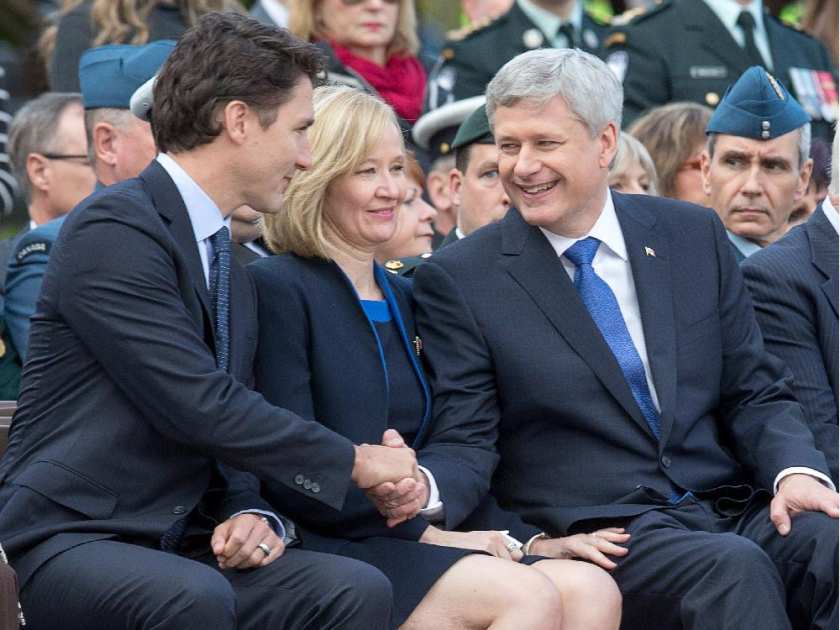
Could Justin Trudeau Bring Stephen Harper Back to Life?


Michael Harris sees a Stephen Harper comeback in the cards.
...sources within the Conservative party have been telling me of an internal faction eager to see Andrew Scheer gone in order to make way for the return of Stephen Harper as party leader.

...So who might be next up? As the Christmas ditty goes, it’s beginning to look a lot like Harper, everywhere you go.

As one Senator put it to me on background, “While the avalanche of criticism mounts, no one is talking up a successor. Who is waiting in the wings, ready to go, straight out of the box? Only one person is ready. Stephen Harper, come on down!”
...Despite their various talents, none of these potential candidates [Lisa Raitt, Michael Chong, Peter MacKay, Erin O'Toole and Rona Ambrose] has anything like the network that Harper maintains to this day within the CPC. That includes a coveted spot on the Conservative Party Fund. Perhaps that’s why Harper himself had this to say to an audience at Stanford University’s Graduate School of Business in February 2018, less than a year after Scheer became leader:
“I think I probably could still easily be leader of my party if I wanted to. I mean, I’m the de facto founder of my party.” 
Hubris or honesty? Both actually. 
A guy named MacKay had a little to do with creating the CPC back in 2003. But Harper’s vaunted opinion of his leadership prospects may be accurate. It gained major traction from a November 2019 Abacus Data poll that asked 3,000 respondents over the age of 18 this question: Andrew Scheer or Who?
“Our test of potential alternatives to Mr. Scheer finds none, except for Mr. Harper, are preferred over Mr. Scheer among those who voted Conservative in the last election,” wrote David Coletto, one of Abacus’s founding partners.
The very idea of another term in power for Sideshow Steve is pretty dreary, especially with the holiday season approaching. It's more than dispiriting. It's infuriating.

It's not that hard to remember back four years when Justin Trudeau came from third place to a majority win, largely on the strength of his solemn promise to implement electoral reform. He assured us that would save and protect us from another thug like Stephen Harper. No more First-Past-the-Post shenanigans to defeat the popular will of Canadians, no siree.  Those days were over.

Only Justin had other plans. Once in power with an admittedly false majority he figured he was set to repeat his victory in 2019 so long as he kept FPTP alive and kicking. So he conjured up a feeble excuse that convinced no one except his most ardent fanboys and reneged on his solemn promise. Then he proceeded to break other promises and sully himself in scandals to the point where he almost got his ass handed to him in 2019 by a third-rater whose only claim to fame was a summer help counter-clerk job at an insurance agency.

If Michael Harris is right and I hope to hell he's wrong, it will be Justin Trudeau who paved the way for a Stephen Harper comeback.  Who knows? When the part-time insurance clerk managed to garner more votes than Trudeau's Liberals, do you think Harper would fare any worse?

The Afghanistan Papers, How Canada Lost the War With the Taliban.


I may be wrong. Perhaps choosing to wage a war in a manner by which it can never be won isn't the same as "losing." However, no matter how much lipstick you put on that pig, it still feels like losing because it sure isn't winning.

When I launched this blog back in 2006, Canada's war in Afghanistan was very much on my mind.  The trauma of the 9/11 attacks on Washington and New York was still relatively fresh. Even if we didn't want to admit it, we were keen on dishing out a little payback.

We'd chosen not to join Bush/Blair in the Iraqi adventure but we could still bang away at something in Afghanistan.  Those were heady days. Remember Rick "The Big Cod" Hillier, the general who sweet talked prime minister Paul Martin into authorizing the Kandahar gig? Canada was going to step up to the plate. No more wimpy peace keeping. We were going to kick some Islamist ass. As the Americans put it, we were "gonna git some."

We were gonna git a lot. Kandahar province to be precise. That's the city of Kandahar and the province of Kandahar - a big and nasty chunk of the nation of Afghanistan. Canada hadn't fought a war since Korea but we were warfighters now.

It just didn't feel right. I had long been fascinated by insurgency/guerrilla warfare - Algeria, Malaya, Viet Nam, that sort of thing. I had read Caesar's commentaries on the Gallic wars and the memoirs of T.E. Lawrence ("of Arabia) in WWI. I'd read about the Ostrogoths and the Visigoths, Attila and Theodoric, and how they operated.  Patterns emerged, mistakes were repeated again and again.

Then I heard about his guy named Petraeus, US Army general David Petraeus. I read about Petraeus and this team of experts drawn from military and civilian ranks whose job it was to glean all the lessons on unconventional warfare from the past two millennia. They were going to boil it all down. We were going to learn from all the mistakes and the less frequent successes of the past and digest this wisdom in a new field manual for the United States Army and Marine Corps, FM 3-24.  The Economist published an intriguing review:
"FM 3-24 Counterinsurgency” makes awkward reading for those trained in the notion of out-manoeuvring and annihilating an enemy force. Now American troops must be “ready to be greeted with either a handshake or a hand grenade” and must be “nation-builders as well as warriors”. Under the new doctrine, fighting insurgents involves “armed social work”. 
“Sometimes doing nothing is the best reaction,” says the manual. The best weapon is sometimes none at all. The prime objective is not to kill as many insurgents as possible but to maximise support from the local population. Above all, troops must adapt quickly. 
"Instead of isolating themselves in large camps and driving around in armoured vehicles, the manual advises American troops to live “close to the populace”, move on foot, sleep in villages and patrol by day and night. Each company should have a political as well as a “cultural” adviser. Platoons should assign their best soldiers to intelligence and surveillance, even at the cost of firepower. Forget the chain of command: decisions should be taken by consensus where possible.
Soldiering is only one strand. It must be entwined with others—including providing essential services, promoting good governance, building up local security forces and devising an information policy to counter insurgents' propaganda. 
"The 282-page manual reads at times like a litany of the things America has done wrong in Iraq. But those arguing for withdrawal will find little solace. Insurgencies, it says, “are protracted by nature”. America and its allies must show the “ability, stamina, and will to win”. 
"Moreover, counter-insurgency cannot be done on the cheap. It requires large amounts of manpower—some 20 to 25 members of security forces for every 1,000 civilians. The 483,000 combined coalition and Iraqi forces (of dubious quality and loyalty) fall well short of the 535,000 to 670,000 required to secure Iraq.
That's 20 to 25 foot soldiers for every 1,000 civilians.  That's not including the support personnel. Boots on the ground. Kandahar has a population of 1.15 million.  At 20 soldiers per, that would be a combat force of 23,000 gun-totin' soldiers.

But the Big Cod assured Paul Martin he could handle the job with a total force of 2,000 personnel. Out of that number he'd be lucky to field 1,000 to 1,200 combat soldiers on any given day. Not 23,000. Maybe, on a good day, 1,200.

There's only so much you can do with numbers like that and not much of that very effectively. We became a garrison force, popping up here and there during the day with our armoured vehicles and our artillery and our air support and scurrying back behind the safety of the wire in our garrison camps at night. It was a big pointless, futile game of "whack-a-mole."

Canadian journalists reported that we were winning the war. How? How in hell were we winning the war? One name comes to mind, PostMedia's Matthew Fisher. To listen to him tell it, we were bagging one decisive victory after another. Operation Medusa, the battle of Panjwai, dealt a mortal blow to the Taliban insurgents in Kandahar - supposedly.

I contacted a journo from the old Knight-Ridder news service, a guy who ran the hills with the Mujaheddin during the Soviet occupation. He said the only way you won is if you've got a mountain of dead bodies to prove it. Otherwise they've just used the intricate network of irrigation canals to fade away until they're ready to return. And so they did.

Our war was largely cruising around in light armoured vehicles, trolling for IEDs and we did find our share of those. And then we mustered on overpasses along the "Highway of Heroes" to honour their returning caskets.

As this orgy of pointless deaths continued a few inconvenient truths began to leak out. There was one young Canadian subaltern, a lieutenant as I recall, who said that back when we were supposedly whipping the Taliban's ass we were in fact nearly overrun by a force of illiterate Afghan farmboys with their Korean War vintage assault rifles and RPGs.  Oddly enough we didn't hear from him again.

We got familiar with some new names - Haliburton, Blackwater and such. These were corporations who provided "contractors" to assist military forces in Afghanistan and Iraq. These contractors, however, weren't engineers and medics. They were retired combat veterans and they carried guns, often better stuff than the military forces had. They were paid a lot too and it wasn't for building roads either.

Then along came former US Army commander turned academic, Andrew Bacevich's 2010 book, The New American Militarism (reviewed here, here and here).  The author explored how what Eisenhower once labeled the military-industrial complex had metastasized into something far worse, a military-industrial-neoconservative-evangelical/fundamentalist-commercial warfighting complex. The corporate sector was no longer just the arsenal of America's military, it was the military's 'for profit' warfighting partner and its riches were vast enough to keep the party going.

Which brings us, nearly a decade since Bacevich's expose and double that since this fiasco started, to what are being called the "Afghanistan Papers."  The common take on this story is that the folks back home were fed a rich diet of lies to conceal that we, our young people, were fighting unwinnable wars.

But there's a darker side to this business, one that's not mentioned in the news reports, one that corroborates Bacevich's denunciation of America's commercial warfighting complex that has its fangs and claws sunk deeply into America's "bought and paid for" Congress.

This revelation comes straight from the mouth of retired general, Trump national security advisor, convicted felon, Michael Flynn.
The “Afghanistan Papers,” as the Post calls the report, have drawn comparisons in their scope and granular detail with the Vietnam-era Pentagon Papers, published in the New York Times in 1971. In both wars, “The presidents and the generals had a pretty realistic view of what they were up against, which they did not want to admit to the American people,” Daniel Ellsberg, who leaked the Pentagon Papers, told CNN’s Brian Stelter. 
Positivity bias. Michael Flynn, U.S. President Donald Trump’s former national security advisor, was the director of intelligence for the International Security Assistance Force in Afghanistan from 2009 to 2010. He provides just one of many disturbing takes on the U.S. war effort. “There is an inherent bias in the intel community because they want to get money, they want to exist, and they want to grow,” he said in an interview
Expanding on why field intelligence reports were more negative than the upbeat progress reports presented to the U.S. public, Flynn said that policymakers “are going to be inherently rosy” in their assessments. Later in the interview, he said, “There is a machinery that is behind what we do, and it keeps us participating in the conflict because it generates wealth.”
"Because it generates wealth." Quelle surprise. It goes on and on and on because no one in high office and no one in the top ranks of the military has the integrity to stand up and expose it, to say "enough, no more."


1935. Smedley D. Butler. A retired US Marine Corps Major General. A two-time recipient of America's highest military achievement, the Medal of Honour. There was a man with enough integrity to warn that "War is a Racket."

In War Is a Racket, Butler points to a variety of examples, mostly from World War I, where industrialists, whose operations were subsidized by public funding, were able to generate substantial profits, making money from mass human suffering. 
The work is divided into five chapters: 
War is a racket
Who makes the profits?
Who pays the bills?
How to smash this racket!
To hell with war! 
It contains this summary:"War is a racket. It always has been. It is possibly the oldest, easily the most profitable, surely the most vicious. It is the only one international in scope. It is the only one in which the profits are reckoned in dollars and the losses in lives. A racket is best described, I believe, as something that is not what it seems to the majority of the people. Only a small 'inside' group knows what it is about. It is conducted for the benefit of the very few, at the expense of the very many. Out of war a few people make huge fortunes."
We got dragged into a place we never should have gone. Our dead and our wounded, their families and their loved ones, and every other Canadian worth their salt deserve an accounting, some explanations, facts not lies. We need to know we have military leaders who won't try to play us, who won't put their ambitions ahead of the national interest. We've got some housecleaning to do.