Showing posts with label Athabasca Tar Sands. Show all posts

Monday, May 20, 2019

Just Make Sure No One's Looking


Ottawa is preparing to relax regulations governing the release of effluent from some Tar Sands tailing ponds. It was bound to happen in the Great Northern Petro-State of Canada.

Ottawa and the Alberta government are in the early stages of crafting new rules with industry to authorize discharges of treated effluent into the Athabasca River, even though the sector’s biggest companies have yet to show they can effectively clean the toxin-laced water on a commercial scale. 
The federal government is targeting final regulations for 2022 modelled on existing rules that authorize releases from metal, mineral and diamond mines, provided contaminants are within regulated limits for “deleterious” substances under the federal Fisheries Act, according to documents obtained by The Globe and Mail. The changes would also require approval under Alberta’s Environmental Protection and Enhancement Act.
Now, don't worry. It'll all be done right, just as it always has been - in a way, sort of, sometimes. It's better if you don't look, just sayin'.

Ottawa says it would put in place stringent environmental controls before permitting any discharges, seen by some as a necessary step for cleaning up the tailing ponds and restoring them to their predevelopment state 
The industrial waste has attracted international scorn for killing migratory birds, including the deaths of 1,600 ducks in a Syncrude Canada Ltd. tailings pond in 2010 that led to a $3-million penalty for the company. 
In 2015, the Alberta government eased regulations and began developing policy and criteria for tailings water release after the industry said it could not meet more stringent cleanup standards.
Let's unpack that. The Bitumen Barons knew that they were bound by "stringent cleanup standards" when they built all those tailing ponds. They went ahead and built those leaky tailing ponds and filled them with all manner of toxic crap knowing full well about those "stringent cleanup standards." Then, after the deed was done they went to the Alberta government whining "I don't wanna" and so the Alberta government watered down those "stringent cleanup standards" to suit the industry. Now Ottawa is jumping on the dirty tailings bandwagon.

Those tailing ponds are a constant threat to the world's third largest watershed, the Mackenzie.

What could possibly go wrong?

There's an answer to that question in a companion piece in today's Globe. Think of it as the "orphan well hustle." It's sort of like reverse asset laundering. The giants unload 'end of life' wells onto companies that have no money for clean up costs. How in hell do they get away with that? Well the article describes them as "pliant regulators," a common feature in petro-states.

Thursday, April 25, 2019

Ford Says Ontario Has Done Enough.


At least there's something Doug Ford can thank his Liberal predecessor for - cutting Ontario's greenhouse gas emissions. He's positively boastful about that, to the point where he's shining an unwanted light on his anti-climate tax comrades, Kenney and Moe.

Doug Ford's government in Ontario is now insisting the province should not be expected to do more than its "fair share" to meet Canada's national commitment to reduce greenhouse gas emissions.
But Ford's definition of "fair" might present a significant challenge to the rest of the country — particularly Ford's conservative allies in Alberta and Saskatchewan. 
Under Kathleen Wynne's Liberal government, Ontario was committed to reducing its emissions by 37 per cent below 1990 levels by 2030. While tearing down large portions of that government's climate agenda, Ford's Progressive Conservatives settled on a less-ambitious target: a cut of 30 per cent below 2005 by 2030.

That new provincial target matches the national target. It's also (conveniently enough) within reach already. As the Ford government now loudly notes, Ontario's emissions have declined by 22 per cent below 2005 levels. 
"Today's report confirms Ontario has decreased emissions by 22 per cent since 2005, while the rest of Canada's input continues to increase," Rod Phillips, Ontario's environment minister, said last week when the federal government released the latest inventory of Canada's emissions. "Families in Ontario have already paid a significant cost for these efforts, yet the federal government continues to ask us to pay more than our fair share."
But what is the real picture? It's pretty grim. A recent report from the University of Western Ontario's Ivey School of Business shows Canada's greenhouse gas emissions by province, both overall and per capita.

Ford says Ontario has done enough and it's now up to the "rest of Canada" to do their share.

Here are some of the findings from the summary to the Ivey report:


• Canada’s greenhouse gas (GHG) emissions currently represent about 1.6 percent of the global total. Canada is among the top 10 global emitters and one of the largest developed world per capita emitter of GHGs. 
• Canadian federal governments have committed to reduce annual GHG emissions from the current level of 726 megatonnes (Mt) to 622 Mt in 2020 and 525 Mt in 2030. • Within Canada, GHG emissions vary widely across provinces ranging from 267 Mt in Alberta to 1.8 Mt in PEI in 2013. 
• In per capita terms, Saskatchewan and Alberta are among the developed world’s largest emitters at 68 and 67 tonnes respectively.* Per capita emissions in BC, Ontario, and Quebec are in the 10-14 tonne range, comparable to best performers in Western Europe. 
• For provinces with announced GHG emission targets, the level of ambition varies widely. Alberta plans to increase emissions towards 2020, and then return to today’s levels by 2030, while Ontario Quebec and Manitoba plan to reduce emissions by 56, 27 and 8 Mt respectively. 
• Even if all provincial targets were fully achieved, Canada would still need to reduce GHG emissions by an additional 45 Mt in 2020 and 55 Mt in 2030 to meet its international commitments.
* The Ivey analysis was before the federal government's report this week showing that the Tar Sanders massively understated their GHG emissions from bitumen extraction.

So, since Ontario, Quebec and British Columbia have the lowest, per capital emissions, "comparable the best performers in Western Europe," while Saskatchewan and Alberta, by contrast, are off the chart even using their dodgy numbers, Ford must be referring to his comrades in arms, Kenney and Moe. They're the dirty buggers, the climate wreckers, and they should be easy pickings for Justin Trudeau. Wait, I'm sorry, when it comes to bitumen Trudeau is in their canoe.

No matter how much they shuck and jive, the petro-provinces and the petro-state simply cannot get past this:
According to the latest statistics, Canada emits about 1.6 percent of the world’s GHG emissions.  Despite this relatively low share, Canada is among the top 10 global emitters on an absolute basis, and stands firmly in the top 3 for emissions per capita. By way of comparison, Canada’s population makes up about 0.5 percent of the world total so that our emissions’ share is about 3 times our population share.
Trudeau acolytes at this point tend to drag out SFU economist Mark Jaccard's recent comment that, thanks to the Dauphin, Canada is the climate change envy of the world. It's not. We are among the top 10 overall global emitters even though we're just half a per cent of the world by population and, yes, we are "firmly in the top 3 for emissions per capita." That might make us the envy of Saudi Arabia or Venezuela but the rest of the world, really?

Monday, April 22, 2019

Those Ever So Tarry Sands


You know your country has descended into a petro-state by the arguments it invokes to excuse itself. The classic Tory line that's now the Liberal line is that, gee shucks, Canada is such a minor player that even if we stopped flogging bitumen it wouldn't really change much. Even Environment Canada is beating that dead horse.

Much like the unfunded quarter trillion dollar clean up cost for Athabasca's tailing ponds, the enormity of Tar Sands emissions is never really addressed. Maybe a little bit, but so what, not that bad... Out of sight/out of mind.
Pollution from fossil fuels in Canada continues to grow by staggering amounts, with the oilsands sector alone responsible for more carbon pollution than all of B.C. or Quebec in 2017, says the federal government in its latest climate change report to the United Nations. 
The newest edition of Canada’s National Inventory Report, covering data up to two years ago, shows that the oil and gas sector was responsible for 195 million tonnes, or megatonnes (Mt) of greenhouse gas emissions in 2017, up eight Mt from 2016.
The oilsands, a region in Alberta and Saskatchewan that constitute almost all of Canada’s 173 billion barrels of proven oil reserves, generated 81 Mt of pollution in 2017, making up 41 per cent of the sector’s emissions. 
That is larger than all the pollution generated by the entire economies of British Columbia that year, at 62 Mt, or Quebec's at 78 Mt. It is also larger than emissions reductions that have been seen in other parts of the country.
How Trudeau screwed the pooch.
The NDP government of Alberta Premier Rachel Notley, which was defeated in Tuesday night's provincial election, had promised to set an absolute cap of 100 Mt of carbon pollution from the oilsands. Premier-designate Jason Kenney's United Conservative Party is expected to undo Notley's climate policies, including her cap on oilsands pollution. 
But the sector, which has represented about two per cent of Canada's economy according to federal government estimates, was responsible for 400,000 direct and indirect jobs in Alberta in 2016. It has historically opposed proposals to introduce tough national climate change policies.
The last thing Canada should be doing is building pipelines.
"Increases in emissions from the tarsands are undoing all the progress being made in other sectors," said Keith Stewart, senior energy strategist with Greenpeace Canada, in a statement. 
"If we are serious about protecting communities from climate-fueled floods, wildfires and other extreme weather, the last thing Canada should be doing is building new pipelines to expand oil production and exports. Either we act like this truly is a crisis that threatens our health and survival, or we sleepwalk towards disaster. It's as simple as that and our politicians are currently choosing the second option."


Friday, April 05, 2019

Norway Shines a Light We Don't Care to See


Little Norway and it's big sovereign wealth fund, the world's largest, are once again leading the way, this time by plunging into alternative clean energy investment. Not for the first time Norway is demonstrating how screwed up Canadian energy policy has become and will continue to be until we get competent political leadership that, sadly, is nowhere on the horizon.

The first time was when Norway adopted Peter Lougheed's advice on managing fossil energy resources. Norway went by Peter's book. Alberta, they had this guy named Klein with other ideas. The Norse quietly went around gathering their North Sea resource wealth, banking it in their sovereign wealth fund, and ultimately amassed a fortune. Klein, and every incompetent yahoo who followed him plunged his province onto a whipsaw of boom and busts that Albertans periodically celebrate with bumper stickers reading, "Dear God, please give us another oil boom and, this time, we promise we won't just piss it all away."  God must be tired of hearing that.

Part of that Norwegian miracle is not pissing their wealth away. That means they have to find ways to invest their money that will deliver reliable returns and grow their fund ever larger.  And they've chosen to invest in clean, renewable energy.
Norway’s $1tn oil fund, the world’s largest sovereign wealth fund, is to plunge billions of dollars into wind and solar power projects. The decision follows Saudi Arabia’s oil fund selling off its last oil and gas assets. 
Other national funds built up from oil profits are also thought to be ramping up their investments in renewables. The moves show that countries that got rich on fossil fuels are diversifying their investments and seeking future profits in the clean energy needed to combat climate change. Analysts say the investments are likely to power faster growth of green energy. 
Norway’s government gave the go-ahead on Friday for its fund to invest in renewable energy projects that are not listed on stock markets. Unlisted projects make up more than two-thirds of the whole renewable infrastructure market, which is worth trillions of dollars.
You see, Norway has an approach that could be summed up in a word, oh let me see, "responsible." By contrast, Canada's politicians have been as responsible as a crack addict. They're like junkies when it comes to royalties. They'll take whatever pittance the foreign energy giants throw their way. Then, when they do get some money, like their own bumper stickers admit, they just "piss it all away." It's gone, they have nothing to show for it.

The Globe's Gary Mason touched on Alberta's juvenile recklessness in a recent column, "Jim Prentice was Right."

In the run-up to the 2015 election, then-Alberta Premier Jim Prentice was asked by an interviewer about the perilous state of the province’s finances, which had recently taken a nasty negative turn as a result of a precipitous drop in oil prices.

“In terms of who is responsible,” Mr. Prentice said at the time, “we all need to look in the mirror, right. Basically all of us have had the best of everything and have not had to pay for what it costs.”

...And in Alberta, there are many people who can’t handle the truth. 
The fact is, the province’s fiscal situation isn’t much different today than it was for Mr. Prentice, and Alison Redford before him, and Ed Stelmach before her and Ralph Klein before him. You get the idea. Alberta still relies on the vagaries of the oil industry to pay many of its bills, which is as foolish a strategy now as it was when it first began decades ago.
Actually, you could convincingly make the argument it’s an even worse concept in these times, given the increasingly complex, and unpredictable, nature of a global energy market witnessing a world transitioning away from fossil fuels.
Too many in Alberta want to believe that a new pipeline will fix all that ails the province. That’s a fantasy, one that even the political leaders running to govern the province understand (but won’t admit publicly). A new pipeline would provide a temporary fix, and it would stanch, for a few years, the fiscal bleeding that is taking place. But ultimately, all it would do is allow the government to return to using oil revenues to balance the books, allow a province to live beyond its true means for a few more years.
Justin and Rachel and Jason think that British Columbia should bear the environmental risk of their "Piss It All Away" game, that we should give into these thugs and their crack addict mentality. They feel entitled, there's no other word but "entitled" to put our pristine coastal waters at risk of environmental catastrophe so that they can live beyond their means, just a little bit longer.

I know, let's consult the ancient Greek goddess, Themis.


Now, put permanent environmental catastrophe in one pan, we'll call it British Columbia, and in the other you put rapidly evaporating bitumen royalties that we'll call Alberta. As Peter Lougheed so clearly warned, they just evaporate, leaving ruin in their wake.  Wow, the environmental catastrophe hasn't changed but that gotta-have-it cash, it's gone. There's a clear winner - British Columbia.

Look at that. I haven't even mentioned the climate change impacts of high-carbon, pet coke laden dilbit or the quarter trillion dollar cleanup nightmare of the Athabasca Tar Sands tailing ponds. We'll surely get to that another time.

Today this is just about the puerile recklessness of Justin, Rachel and Jason and the thuggery in the way they threaten and imperil my province, British Columbia, and my coast, the Salish Sea.

Thursday, June 07, 2018

Good News for the Environment = Bad Tidings for Prime Minister Pipeline


If it's as good as they say it is - and, with these "breakthroughs" that's always a very big "if" -  the fossil energy industry could be kaput. Sorry, Justin. Sorry, Rachel. Sorry, Jason. Sorry, Andrew. Sorry, Big Oil. WooHoo, British Columbia.

An article in Financial Post claims a BC company has come up with a breakthrough technology to capture and transform atmospheric carbon, carbon dioxide, into fuel for cars, trucks and jets.

In an article published Thursday in the peer-reviewed journal Joule, Carbon Engineering outlines what it calls direct air capture in which carbon dioxide is removed from the atmosphere through a chemical process, then combined with hydrogen and oxygen to create fuel.

“If these aren’t renewable fuels, what are?” said David Keith, professor of applied physics at Harvard University, lead author of the paper and principal in Carbon Engineering.

At least seven companies worldwide are working on the idea. Swiss-based Climeworks has already built a commercial-scale plant. 
It costs Climeworks about US$600 a tonne to remove carbon from the atmosphere. Carbon Engineering says it can do the job for between US$94 and US$232 a tonne because it uses technology and components that are well understood and commercially available.
Winning the cost war.
Carbon Engineering’s fuel costs about 25 per cent more than gasoline made from oil. Oldham said work is being done to reduce that. 
Because the plant currently uses some natural gas, by the time the fuel it produces has been burned it has released a half-tonne of carbon dioxide for every tonne removed from the air. That gives it a carbon footprint 70 per cent lower than a fossil fuel, he said. 
That footprint would shrink further if the plant were all-electric. And if it ran on wind- or solar-generated electricity, the fuel would be almost carbon neutral.

Playing into BC's hand.
“What you need is a way to make a fuel in a place where you’ve got really cheap low-carbon power, and that will power the airplane. That’s the core idea here.” 
Putting a price on carbon has been crucial to Carbon Engineering’s development, said Oldham. 
“We would not be in business if carbon pricing did not exist.”
If the key is to find really cheap, low-carbon power for the extraction/processing operation that means solar, wind, hydro-electric and/or thermal-electric. British Columbia has vast untapped supplies of thermal-energy. It's what you get in mountainous terrain. And, as for hydro-electricity, we've also got that in abundance. That's also what you get from mountainous terrain along the west coast of any continent.

So, let's say this Carbon Engineering outfit is legit and they manage to produce renewable, i.e. "clean" hydrocarbon transport fuels at or below current fossil fuel prices, there goes the market for the sort of fossil fuels we're dependent upon today. Places that can produce the least costly, low-carbon power for recycling atmospheric carbon will have energy independence from the fossil fuel industry.

The logical extension of this is that nations that don't have an abundance of fossil fuel reserves but have the ability to produce renewable energy at competitive cost would be able to harvest atmospheric carbon to produce their own transport fuels. That would throw a huge wrench into OPEC and its parasite producers such as Canada.

Carry that one step further and you come to the Athabasca Tar Sands and Trudeau's Trans Mountain pipeline, both essentially DOA. If Carbon Engineering's technology pans out, Canada's days as a petro-state are finished -except for the aftermath.

Wouldn't that be ironic if a British Columbia company brought down the very jurisdictions that have been pressuring, even threatening, the province to bow to the petro-state?

Monday, May 21, 2018

A Venture Capitalist on Why Kinder Morgan's Pipeline and the Tar Sands Make No Sense.


The CEO of Chrysalix Venture Capital says "let's get honest about the outlook for the Alberta oil sands and Trans Mountain." In Wal van Lierop's opinion, neither makes any financial sense any longer. In other words, Trudeau and Morneau appear to be leading Canada into a huge economic blunder.

If we were to think of the energy transition as a baseball game, we could see the stages of its progression over the past decade. In the first inning, coal lost to gas in the competition for power generation in North America and Europe; solar and wind lit up the scoreboard with incredible cost reductions in the second inning; but in the third, shale oil and gas rallied, creating an energy boom in U.S. gas and making that country the international swing player -- supplanting OPEC in that position.

Now we are entering the fourth inning, with a playing field of abundant cheap energy and midway through the ball game it looks like the players highest on the cost curve will be the ones striking out. Those players will likely include both new projects in Arctic oil and the oil sands, as their business case makes them weak in a game where cost is key.
Not all oils are equal: 
When oil prices rise above $50, shale producers can make a profit. Theoretically, oil-sand producers can compete at that price level but the upfront capital intensity and long scale-up times put oil-sand producers in a very disadvantaged position for any new projects. 
The costs of converting oil-sands oil to gasoline or jet fuel means there will always be about a $10 or more discount; so that discount has nothing to do with pipelines: oil-sands expansions should actually be competitive at $40 for new capital investments to make sense.
Trudeau's wobbly Trans Mountain gamble:
This leads to considering the business case for the Kinder Morgan pipeline: 
Terminal and shipping infrastructure adds another negative of $2-$3 on this line because receivers on the demand side have in the past years created new facilities to quickly load and unload massive ships of a size that cannot sail below the Vancouver bridges. As a result, Alberta needs to be able to compete below $37, while in new projects, it most likely needs north of $50 to be in the money. 
To make things worse, not just the cost of supply has changed in the past four years; there are also significant changes on the demand side with the targeted refineries on the east coast of China recently benefiting from the improved economic relationship with Russia, while on the other hand environmental regulations have tightened. Both give Alberta oil a further disadvantage. 
Historically, a pipeline builder would like to see off-take agreements for more than 50 per cent of the capacity for at least 15 years, preferably 20, before giving the go-ahead. The Chinese don’t do this type of off-take contracts. At maximum you’ll get an agreement for a few years, which is then followed by another round of tough negotiations. Energy is a commodity business where cost is king. 
On this basis, we would have to presume that the Alberta and federal governments hadn’t seen the Kinder Morgan order book before they announced an intention to financially support the company’s pipeline, because that may show a rapidly deteriorating business case. Of course, some will argue that my numbers are incorrect, and there could be a margin of error. My point is that all stakeholders need clarity on this matter. They need a better understanding on how strong the business case for Kinder Morgan is, or if this investment could turn into a “soon to be stranded“ asset. The departure of all oil majors and many large financial institutions from the province of Alberta is also a sign that should be taken into account.
There is some group Trudeau is trying to help, perhaps salvage. Could it be Canada's banks or institutional investors? He's doubling down on a bad bet so it's plain he's not looking out for the interests of the Canadian public.

It's becoming increasingly apparent that the people of BC are getting sold out by our prime minister and it sure as hell isn't so he'll have a "compromise" that secures token carbon taxes either. The incoming premier of Alberta is going to tell him where to shove his carbon taxes. The premier of Saskatchewan will sing the same refrain. Depending on the Ontario election coin toss, Trudeau may face the leaders of provinces equaling half the country against him and, let's face it, we know how quickly he folds when the political winds are not at his back.

Isn't it time Justin came clean with us?

Wednesday, March 28, 2018

Hey, Canada is in the Spotlight Again. In Case You Couldn't Guess It's About the Tar Sands.


The Guardian does like to periodically remind us that, when it comes to climate change, nice, decent, oh so polite Canadians are utter swine. And they've got a point.

Justin, he's all for the Tar Sands. Why, that's how Canada is going to have a green future. Why didn't he just tell us he's figured out how to turn lead into gold? That would be more plausible.

The latest in The Guardian is a report on how Justin's Bitumen Buddy, Donald Trump, has nurtured investment in "extreme" fossil fuels, a.k.a. Athabasca bitumen.

Bank holdings in “extreme” fossil fuels skyrocketed globally to $115bn during Donald Trump’s first year as US president, with holdings in tar sands oil more than doubling, a new report has found. 
A sharp flight from fossil fuels investments after the Paris agreement was reversed last year with a return to energy sources dubbed “extreme” because of their contribution to global emissions. This included an 11% hike in funding for carbon-heavy tar sands, as well as Arctic and ultra-deepwater oil and coal. 
US and Canadian banks led a race back into the unconventional energy sector following Trump’s promise to withdraw from Paris, with JPMorgan Chase increasing its coal funding by a factor of 21, and quadrupling its tar sands assets. 
Chase’s $5.6bn surge in tar sands holdings added to nearly $47bn of gains for the industry last year, according to the report by NGOs including BankTrack, the Sierra Club and Rainforest Action Network (RAN).
C'mon, you know that news is music to Justin and Rachel's black, black hearts. They've heard the warnings that increasing exploitation of this toxic sludge will be enough to guarantee runaway global warming but, hey, there's money to be made and somebody else does all the work.

When you cast your ballot next year and you reflect back on  how Justin's Liberals acquitted themselves in their term as a solid majority government, and you think of those troubling questions such as the Saudi Death Wagon deal or all the broken promises, especially electoral reform, and you're still undecided, throw a handful of bitumen sludge on the scale. It won't tell you how to vote but it will greatly help you figure out how not to vote.

Thursday, December 15, 2016

Norway's StatOil Bails on Tar Sands, Takes Half-Billion Dollar Loss


The Norse know a couple of things about oil - how to make money from oil and how to hold onto it. It's how their government amassed the world's largest sovereign wealth fund now worth a million kroner for every man, woman and child in the country. We, especially Alberta, might have done well to follow Norway's example but... spilled milk, I suppose.

Making money and holding onto it also entails getting out of deals when the time comes. And that time has come for Norse oil giant, StatOil, in Athabasca. The company has announced it'll take a 550-billion USD loss to sell off its assets in the Athabasca Tar Sands.

The international company, which has operations in 37 countries, with about 21,000 employees worldwide, said the decision was about reducing costs as well as cutting its greenhouse gas emissions.

"Today we announced @Statoil exit of oil sands which bends our cost and emission curves," said Bjørn Otto Sverdrup, a senior vice-president in charge of sustainability at Statoil, on Twitter. "Building resilience."


"Building Resilience" - is that Norse for getting out while the getting's good? Maybe, this time, Ottawa should be listening. Carbon Bubble anyone?


UPDATE

As for listening you might find Dan Greenford's take on his session with Marc Garneau enlightening.


..Our purpose was to discuss challenges Canada faces to meet its expressed climate targets. There are many arguments against the proposed Trans Mountain pipeline expansion and the building of other new pipelines to carry oil sands, but we believe one reason is enough — that new pipelines are directly at odds with a transition aligned with averting catastrophic climate change. The math is clear and simple — Canada doesn’t need new pipelines if we are to honour our climate policy commitments.

Garneau has said that the government did its climate homework and that its decisions were based on sound policy.

Earth scientist David Hughes has provided lucid analysis and has said with conviction: “Short of an economic collapse, it is difficult to see how Canada can realistically meet its Paris commitments in the 14 years remaining without rethinking its plans for oil and gas development.”

As for other arguments, there are too many to list exhaustively here. For starters, even if we intend to sell the heavy crude from the oilsands, the most likely outcome is that no one will buy it. New reserves were recently discovered in the Permian Basin three times larger than that of the Bakken Formation. The heavy crude from the oilsands is a marginal resource. It will not be sold in a carbon-constrained world. Prices will remain low indefinitely due to an adequate remaining supply of cheaper, more accessible resources. This says nothing of it being one of the most environmentally damaging forms of oil extraction. For all these reasons and more, including economic costs, it must be the first oil source left buried.

We relayed this to the minister and none of it really seemed to make it through. His response was “we’ll have to wait and see what happens”. When it comes to the health of our environment and our economy, a “wait and see” strategy is irresponsible. Whatever happened to the precautionary principle?


Friday, September 11, 2015

Stephen Harper's Oily Comeuppance

A Saudi prince once said that the Stone Age didn't end because man ran out of stones.  The Age of Oil may be headed for the same fate.  A Goldman Sachs outlook suggests the price of crude oil will hover around $45 a barrel for the next year or so and could even hit $20.

That's not good news for self-styled 'energy superpowers,' i.e. Canada.  Richard Fantin of Canadian Trends has an insightful report of what's in store for his province, Alberta, and it makes for grim reading.

Remember when then Liberal leader, Michael Ignatieff, proclaimed Athabasca the "beating heart of the Canadian economy for the 21st century"? Remember, "Iggy"? Oh, you would rather forget? I see.

That's the problem with betting the farm on the idea of flogging the world's highest-carbon and costliest oil.  It's like eating too many of those Pringles with Olestra. Something bad is bound to happen in your pants.

Poor Stephen Harper. He's devoted his entire premiership to Canada's Alberta's bituminous bounty. He rode roughshod over every possible obstacle, sweeping aside fisheries, navigation and marine habitat regulations; transforming Canada's National Energy Board into a blatantly kangaroo tribunal; even harnessing the state police and security agencies into service of Big Oil, all on the taxpayer's dime.

They knew it was a race and that time might not be on their side. Harper even brought in a repeat offender jailbird to be his envoy to the Oil Patch, brought the guy right into the PMO (which, judging by recent revelations, must have felt like a second home to Bruce Carson).

At one point Harper's then natural resources minister, Joe "Leatherback" Oliver, let slip the urgency of getting bitumen to "tidewater" and into the holds of supertankers. Oliver, perhaps imprudently, noted that if these pipelines weren't brought online and soon, Canada was at risk of bitumen becoming a "stranded asset."

The world is moving toward carbon pricing (no, it's not the idea of the opposition leaders) and even Harper is going to be hard pressed not to follow suit.  It could be a "perfect storm" - low oil prices, high-cost/high-carbon oil, carbon taxes.  As Richard Fantin noted, the squeeze is already causing Big Oil to 'cut corners' on its operations and that usually translates into shoddy maintenance, monitoring and, eventually, more oil spills.

If we're to have any hope of avoiding the worst climate change outcome, runaway global warming, the world is going to have to decarbonize very soon. The first fossil fuels to be abandoned will be the high-cost and the high-carbon. Coal, while relatively cheap, is very high-carbon and there's no shortage of US coal companies going bankrupt these days.  Bitumen, while not as high-carbon as coal, is the highest carbon fossil oil and, unlike coal, it's also costly to produce.

Harper gambled everything on bitumen, including Canada's reputation abroad. He and his government have brainwashed Canadians into believing the Tar Sands are indispensable to our economy whereas bitumen revenues really only represent 2% of Canada's GDP.  Two per cent doesn't sound like much but it's Heaven and Earth to the province of Alberta where royalties are treated as general revenue to fund essential services.

Albertans have a term for it. During boom times they "piss it all away" and when boom turns to bust in the oil patch the province dives headlong into recession. They've institutionalized a bubble economy. If you organized your household finances that way people, especially your creditors, would heap scorn and derision on you. In no time you would find yourself in a very ugly place.

There's more than schadenfreude to this. I don't live in Alberta. I live in British Columbia, coastal British Columbia.  Out here the collapse in world oil prices may be enough to halt Stephen Harper's pipeline/supertanker obsession. Let us pray.


Friday, March 06, 2015

"Extraordinarily Dirty" - What Obama Thinks of Athabasca Bitumen

Barack Obama didn't pull any punches in giving his opinion about Alberta's bitumen.

Obama said he was still not sure whether he would approve Keystone, the $8-billion TransCanada Corp. project that would send oil from Alberta and the Northern U.S. to refineries in Texas. But he was more critical than ever, telling a South Carolina audience that the pipeline would create few jobs, pose a risk to Nebraska farmland, and “benefit, largely, a foreign company.”

“The reason that a lot of environmentalists are concerned about it is the way that you get the oil out in Canada is an extraordinarily dirty way of extracting oil,” he said during a question-and-answer session.


Thursday, February 26, 2015

Newsweek's Obituary for the Athabasca Tar Sands

Is it time for the Barons of Bitumen to wave the white flag?  That seems to be the case according to an article from the latest NewsWeek, "Keystone and the Riddle of the Tar Sands."

...some of Alberta’s crude has made its way to market, but so much slower than it could have, or was projected to, that producers, refiners, shippers, banks and other investors in tar sands development are beginning to wonder whether they have backed a good play by investing over $160 billion to turn tar into oil.
So the economic stranding process has already begunFive global energy giants—Shell, Total, Suncor, Statoil and Occidental—have cut bait on major bitumen deposits in Alberta, in which they had already invested billions. Suncor has just slashed another billion dollars from its capital spending program and $800 million more from operating expenses. And as oil prices slide lower, commercial and investment banks are reconsidering future underwritings. An industry that recently envisioned doubling production over the next 20 years is now looking at something closer to the opposite: a halving of production or worse in far fewer than 20 years.
American media coverage of the tar sands has focused primarily on the approval of the Keystone XL Pipeline, which, if completed, would carry 830,000 barrels of Athabasca crude, every day, to the world’s largest refining center near Houston next to a booming export hub.
Because American and Canadian politicians and oil executives have lobbied so hard for its approval, Americans tend to believe that construction of Keystone will secure the future of the tar sands. Not true. To even approach a break-even point, at least four other pipeline routes will be needed to carry bituminous crude to the world’s market: two to the Canadian west, one to the East and one to the North.
If two or three of those lines are somehow stopped, and that’s quite likely to occur, the stranding of the tar sands will escalate, Canada will cease being a petro-state, and its business leaders will begin their search for yet another staple to drive its national economy.
The article singles out Stephen Harper for scrutiny, labeling him Canada's Ted Cruz.
...Canada’s tar sands booster-in-chief is Prime Minister Stephen Harper, an Alberta-based petrolero who rose to prominence in politics as chief policy officer of the Reform Party, Canada’s version of the American Tea Party. Founded in 1987, Reform merged in 2000 with the floundering Progressive Conservative Party to form a new and almost unbeatable national coalition calling itself the Canadian Conservative Reform Alliance. (After adding Partyto its name, it became CCRAP and was nicknamed “see-crap.”) Harper became party leader of CCRAP, which has since won two national elections. It’s as if Ted Cruz became the Republican front-runner and won the White House twice.
...In Calgary, he became an outspoken and eloquent opponent of Pierre  Trudeau’s National Energy Plan, which seemed set upon nationalizing Canada’s last staple resource. While there is still talk of nationalizing oil and tar sands oil in Canada, and in some polls a majority of Canadians support the idea, that couldn’t possibly happen with Harper in power.
At the 2012 World Economic Forum in Davos, Switzerland, Harper announced that the expanded production and export of tar sands bitumen was a national priority. Canada, he predicted, was set to become an energy superpower. In Ottawa, he took immediate and aggressive steps to weaken environmental protections like the Navigable Waters Protection Act, which was hindering pipeline construction, and to fast-track tar sands production.
...If Canada’s tar sands do one day become stranded, the equivalent annual emissions of over 65 coal-fired plants and 50 million passenger vehicles will remain underground. And a lot of the credit (or blame) will go to environmental activists, aboriginal communities, litigious farmers and groups like GreenpeaceNRDC and 350.org, which have added to their anti-pipeline advocacy a campaign to pressure institutional investors to divest their “Big Fossil” holdings. Even before divestment began, nine out of 10 tar sands producers’ stocks had underperformed the market. So they are vulnerable. 
...While assets like the tar sands should be stranded, because mining and burning them will raise the temperature of an already overheated planet a degree or more, they are more likely to become stranded because they are either unable to reach market or have lost market value.
The sad irony is that before Canada selected tar sands crude to be its staple export, the country was poised to become a major global contributor to clean energy. It had signed climate treaties, promoted solar energy, developed hydroelectric power and had a prosperous renewable-energy industry under sail, for which the country possessed all the necessary natural and financial resources.
Then one powerful neoliberal free-market zealot decided to double down on high-carbon fuels and announce to the world that tar sands would become the next nation-building staple for his country.
It appears he was wrong about that, which would not be a bad outcome for the planet.


Sunday, November 23, 2014

Whether You Support Pipelines or Not, Here's Something We Can Surely Agree On.


No secret I'm opposed to both Kinder Morgan and Northern Gateway.  A sizeable majority of British Columbians are of the same mind but a significant minority supports the pipeline initiatives.  In situations like this it can be helpful to seek out areas of agreement, common ground.

Here's an idea we should all be able to endorse.  If you insist on shipping Athabasca oil to Asia, why not ship oil?  That may sound facetious but it's not.

Bad as these pipelines are, they're made far worse by what Ottawa and Alberta want to push through them - dilbit.  Dilbit is bitumen mixed with a light oil condensate called a diluent.  Bitumen is just too sludgy to push through a pipeline.  It's full of acids, toxins, heavy metals and, of course, petroleum coke or "petcoke," a granular and very high carbon form of sulfur-rich coal.  To get it through a pipeline you have to dilute it with condensate.  Even then you have to heat the mixture and propel it with powerful pumps to get it moving through the pipeline.

Pipeline opponents have plenty of reason to object to dilbit pipelines.  You're taking a product that is full of corrosives and forcing it through a pipeline under high pressure.  If you want to know what that pressurized corrosive does to a pipeline you might ask the authorities in Kalamazoo, Michigan.  Yes, and that was an Enbridge pipeline.


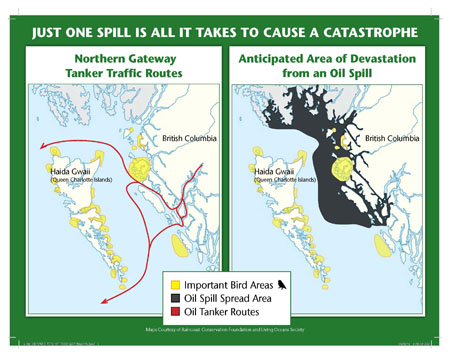
British Columbians have ample reason for concern because a Kalamazoo-type spill here would likely happen in the mountainous wilderness where Enbridge intends to run Northern Gateway.  That would make it more difficult to detect and extremely difficult to get crews and equipment in to attempt clean up.  A spill into a fast-moving mountain stream would spread rapidly, confounding clean up efforts and endangering the ecology for great distances.  Enbridge repeatedly balked at cleaning up Kalamazoo.  How would the company respond to a far more difficult and enormously more costly clean up in British Columbia?


Another cause for concern is the prospect of a supertanker catastrophe. Navigating those northern coastal waters with their currents and tides is challenging on a good day and, up there, good days are not abundant.  When you're tasked with moving the volumes of dilbit Enbridge is planning for Northern Gateway, you have to keep tankers sailing in and out no matter the conditions and that is a formula for disaster.


Dilbit, because of all the sludge in it, sinks.  The condensate separates out and floats to the surface where it dissipates.  The bitumen component congeals and heads for the bottom which, in a lot of places up there, can be 600-feet down and neither the governments nor Enbridge has anything that can clean up a deepwater spill like that.

So, where is this elusive common ground?  I think both sides should be able to rule out the dilbit option/problem.  How can that be done?  Refine the product on site in Athabasca.  Do it there, at the source.  Then, once you have refined out all the garbage, all you'll be transporting is conventional crude oil.  The product you send to market won't be bitumen or diluted bitumen.  The acids, the abrasives, the toxins and heavy metals, the carcinogens and the petcoke will be removed and dealt with on site in Alberta where they belong.


That doesn't mean we'd be okay with it.  The 1989 Exxon Valdez catastrophe, after all, was a conventional oil spill,the ship didn't even sink, and, a quarter century later, Prince William Sound still isn't cleaned up. However refined oil that floats is vastly preferable to hazmat oil that sinks and coats the bottom for generations, poisoning the entire marine habitat.

Another major factor is that transporting fully refined conventional crude oil significantly cuts the volume of product shipped.  The condensate isn't in there. The crud isn't in there.  All of that is removed and left behind in Alberta.  That refining process would allow a major reduction of up to 40% in the number of supertanker trips required to get the product to overseas markets.  The more tanker trips you have the more groundings or sinkings you'll have.  It's that simple.  Even pipeline supporters can understand that.

Bear in mind that the stuff Big Oil and its governmental minions want to ship, dilbit, still has to be refined somewhere.  That somewhere will be in Asia where they'll have to refine out not only the condensate but also all the crud, including the pet coke, out of the bitumen.  So what could be the objection to refining the goop in Athabasca?

What we're usually told is that it would be uneconomical to refine bitumen in Alberta.  Overseas markets, we're told, have unused refining capacity.  So what? We could not only address the hazmat issue but also create a lot of jobs and revenue by refining Athabasca bitumen on site.

I suspect the on-site refining option would be refused because it would add an unbearable burden to the sleight-of-hand trick used to portray the Tar Sands as a huge money maker.  It would also leave Alberta responsible for the energy requirements and emissions related to the refining process.

So you can see how, to a British Columbian, this smacks of a set up.  We have to accept the risk of a potentially catastrophic hazmat spill to bolster the bottom line of the Canadian Association of Petroleum Producers.  They're externalizing the risks, offloading them on the province and people of British Columbia, and we're being told they're doing it as of right.

That they're dealing us cards from a stacked deck is obvious.  One by one, Harper has stripped us of our safeguards.  He moved the West Coast oil spill emergency centre to Quebec.  He shut down entire sections of the Department of Fisheries and Oceans responsible for monitoring our coastal marine habitat. He trashed fisheries regulations. He closed essential Coast Guard installations.  He gutted the navigation regulations to accommodate the supertanker armada.  He set up an utterly fraudulent environmental review process, plainly sculpted to deliver a scripted result.  He's engaged the state security apparatus to spy on environmentalists.  Now you tell me this federal government isn't already at war with us.

When taken in the context of this litany of skulduggery, the refusal to refine this bitumen on site in Alberta can be seen in a plain light for what it is - a deliberate choice to expose British Columbia to enormous risks by transporting hazmat - hazardous materials - through highly risky conditions while simultaneously stripping us of every means we ever had to respond to catastrophe.


Monday, April 15, 2013

B.C. Economist Slams Bitumen Scam


She's even using the "F" word, as in fraud.   And Robyn Allan says the fraud, on the Canadian people, is being perpetrated by the federal and provincial governments, Big Oil, Enbridge, a rightwing think tank, a major bank and, of course, their media waterboys.

In her latest critique Allan makes several points:

. Bitumen is a "junk" crude which, because it requires upgrading and complex refining and considerable transportation costs, "has always sold at a discount" that has "not changed significantly" and the change "isn't related to pipeline capacity."

. While major oil companies and their supporters complain they are suffering greatly due to the price discount, they are mostly integrated companies involved in upgrading and refining, and are boasting to their shareholders that their profit margins from processing operations have soared due to the cheaper Canadian crude they process.

. Western Canadian consumers were gouged to the tune of roughly 14 cents a litre in 2012 because these discount prices are not passed on at the gasoline pumps.

. The "supply glut" at the U.S. industry hub of Cushing, Okla., was "largely industry induced" and will be sorted out within the next "year or so" - long before the proposed Keystone XL pipeline and the Enbridge and Kinder Morgan projects could ever be completed.

Enbridge issued a statement last year challenging a previous Allan critique suggesting Northern Gateway would harm the Canadian economy.

University of Calgary economists, the sort that Enbridge likes best, can dispute Allan's claims, or at least some of them.  Then again they only have to preach to the choir.

What none of the major parties in Ottawa or the government of Alberta or the Fraser Institute or Enbridge or Big Oil can refute is the existence of a global carbon bubble out of which only the cleanest, low-carbon fossil fuels are expected to remain viable.  That rules out the highest-carbon petroleum option, Athabasca bitumen.  Alberta premier Redford has already lamented the bitumen "bubble" that has plunged her province into debt and deficits.   Harper minion, Joe Oliver, has carelessly muttered the word "stranded" in the context of Athabasca bitumen.

These types know that time is not on their side and, unless they get those pipelines built and tanker ports running ASAP, it's quite likely they never will be.


Washington and Beijing Talk the Talk, Now Must Learn to Walk

They're the world's two biggest national economies and the world's two biggest emitters of greenhouse gases.  It's encouraging then that the United States and China have announced an agreement to "accelerate action to reduce greenhouse gases by advancing cooperation on technology, research, conservation, and alternative and renewable energy."

Their joint statement goes to the heart of climate change denialism and drives a stake right through it. In a joint and quite powerful statement on the dangers of climate change, the two sides said they “consider that the overwhelming scientific consensus regarding climate change constitutes a compelling call to action crucial to having a global impact on climate change.”

The two sides state that manmade climate change is having “worsening impacts, including the sharp rise in global average temperatures over the past century, the alarming acidification of our oceans, the rapid loss of Arctic sea ice, and the striking incidence of extreme weather events occurring all over the world.”

Alden Meyer, spokesperson for the influential Union of Concerned Scientist in the United States, said the agreement “is potentially a very significant development, coming as it does from the world’s two biggest economies and greenhouse gas emitters.”

Their sentiments are in the right place but it remains unclear how they will translate those into effective action.   China, for example, seems tied to plans to build many hundreds of new, coal-fired power plants.   The United States has Congressional Republicans, with the assistance of some Democrats, all too eager to thwart any steps to decarbonize America's economy.   And what of the Keystone XL bitumen pipeline to transmit a river of bitumen into the U.S.?   What of the Northern Gateway and Kinder Morgan pipelines to transmit even more bitumen to China?
 
In the world that Beijing and Washington seemingly envision, how can there be any place for coal or other high-carbon fossil fuels such as Athabasca bitumen?  Surely the "alternative and renewable energy" options must be targeted at eliminating consumption of the most environmentally unviable fossil fuels.

The joint statement is certainly encouraging but it remains to be seen what it may become in practice. 


Wednesday, November 21, 2012

There's Still a Chance

 Here's what you need to know.   Today there is 25 per cent more atmospheric CO2 than there was in 2000.

On the books right now are plans for the construction of 1,200 more coal-fired power plants that will create emissions equal to another China, today's greatest greenhouse gas emitter ahead even of the United States.

The world is straying further away from commitments to combat climate change, bringing the prospect of catastrophic global warming a step closer, a UN report said on Wednesday. The warning came as nearly 200 governments prepare to meet in Qatar for international climate negotiations starting next Monday.

The warning of increasing emissions came as fresh evidence was published showing the last decade was the warmest on record for Europe. The European Environment Agency (EEA) said all parts of the region had been affected, with higher rainfall in northern Europe and a drying out in the south, bringing flooding to northern countries including the UK, and droughts to the Mediterranean.

According to the United Nations report, drawing on research from more than 50 scientists, the widening gap between countries' plans and scientific estimates means that governments must step up their ambitions as a matter of urgency to avoid even worse effects from warming. "The transition to a low-carbon, inclusive green economy is happening far too slowly and the opportunity for meeting [scientific advice on emissions targets] is narrowing annually," said Achim Steiner, executive director of Unep.

This gap between the cuts needed and the cuts planned brings the prospect of dangerous levels of climate change - entailing more extreme weather including floods, droughts and fiercer storms, such as those witnessed this year - much closer.

Even if countries manage to change direction in time and meet the emissions-cutting targets they have committed to in the past three years, the gap will still be large - about 8 Gt by 2020. To meet scientific advice, countries would have to agree to much bigger curbs on emissions than they have yet done - and there is little chance of that happening at the next round of annual climate negotiations, which begin on Monday in Doha, Qatar. At the fortnight-long talks, ministers are expected to set out a few more details of how they will work towards their agreed plan of drawing up a new global climate change treaty by 2015, to come into effect from 2020.

Steiner put on his optimistic face and said "there's still a chance" that world governments could prevent the worst but only if governments avoid becoming "locked in" to high-carbon infrastructure (can you say Tar Sands?).

And what are Canadian leaders going to do with our remaining "chance"?   Well, from Mulcair to Trudeau to Harper, they're all going to support the expansion of the Athabasca Tar Sands production several times over.   They're all on the very same page when it comes to ensuring Canada is indeed "locked in" to a high-carbon economy.

Wednesday, October 03, 2012

Giant Tar Sands Lakes for Athabasca

Big Oil has figured out it's way too expensive to fill in their bitumen mines with soil and far, far cheaper to simply transform them into lakes.

Here's the kicker.   Big Oil says we'll have to wait for several generations to find out whether these lakes turn into pristine ponds or toxic pits.   They call it an industrial experiment.

It may take a century to find out what is left around Fort McMurray. Because the lakes, 30 of them, will be built by Canada’s oil sands industry. When the companies mining heavy crude from northeastern Alberta finish their work, they intend to pump water into old mine pits, some with toxic effluent at their bottoms, before leaving the area to biological processes to restore it to health.

If those plans go according to form, oil sands miners will leave behind broad stretches of new shore perched beside waters clean enough for fish and people. Success on this front would vindicate industry pledges to limit the mark it leaves on an area now home to sprawling open-pit mines.

But the coming lake district also highlights the scale of the ecological gamble under way in the province. The 30 bodies of water will be what are known as end pit lakes, left behind because it’s less costly to fill a mine with water than dirt. Their size and scale are laid out in a new document produced by Alberta’s industry-funded Cumulative Environmental Management Association.

This is a total crapshoot, in the sense that no one has ever done this before. But really, what are your options?” said one person familiar with the report, which will be released this week.

Perhaps the only certainty is that the lake district will cover substantial ground. The exact size is subject to changing mining plans – including some from projects not yet built – but it seems likely they will take up, in aggregate, more than 100 square kilometres as part of a series of artificial watersheds spreading over 2,500 square kilometres. By comparison, Toronto occupies 630 square kilometres.

The lakes are a project that will engage several generations. Each stands to take a century of work to plan, mine out and establish into a functioning ecological feature. From the moment workers end mining and begin filling the lakes, it could take fully 40 years before governments begin certifying them as environmentally sustainable, the 436-page CEMA report estimates.

Now imagine if you could rob a bank and the tellers agreed to give you a hundred year head start before they called the cops.   And remember, these are the same companies that, until very recently, ran TV ads pledging to restore these pits to pristine condition, as good or better than they found them.

Sunday, July 29, 2012

Hey Canada, Do You Really Want to Talk?


Having a conversation with a bitumen booster is like talking to a climate change denier.  It's impossible to have a broad-reaching discussion, covering all the bases.   That's because the Tar Sanders have some bases they want to bypass.   They want to narrow the conversation to play into their greatest strengths and ignore everything else.   And are they ever great at playing loose with facts.

Right now they've taken advantage of the B.C. premier's blunders and transformed the Northern Gateway debate into an issue of shakedowns and the constitution.   That lets them avoid discussing what really matters to pipeline opponents, the merits and perils of piping bitumen, or rather dilbit, at all.

The safety and environmental issues are swept aside with a nod.   Sure, fair enough, end of discussion.    They agree that the environment must be safeguarded but they don't want to talk about the reality of that problem.   They don't want to get into how Harper has effectively stripped the B.C. coast of Fisheries and Coast Guard monitors and defenders.   They don't want to explore this supposed oil spill response fleet of vessels that has been assembled; how it can operate only in good weather and calm seas (a relative rarity in the north) and how long it takes to deploy; or how the technology deployed is intended to be used on conventional oil spills and won't work on a bitumen spill.   They don't want to explain how anyone is going to deal with a heavily-laden tanker that loses power or steerage in a Hecate Strait storm where waves can reach 30-meters in height.  They don't want to talk about the closest, ocean-going tugs capable of handling a laden, supertanker failure being based in Anacortes, Washington, three to four days sailing, in good conditions, to northern B.C. They don't want to get into the pipeline operator, Enbridge's sullied and extensive safety record.   They don't want to discuss the seismic and topographical challenges the pipeline would be subject to crossing the B.C. wilderness or the problems associated with cleanup of pipeline spills in that vast emptiness.   They don't want to refute what the Coast Guard types out here are saying, that a supertanker disaster in the Hecate Strait or Dixon Entrance isn't a matter of "if" but a matter of "when and how often."   They don't want to talk about what a bitumen spill would do to the seabed 600-feet down, what it would do to the local ecology or how there's no technology in existence or coming down the pike to do anything about it.   And they sure as hell don't want to talk about the liability cut-outs planned for the Chinese supertanker operators, for Enbridge, for Big Oil and for Alberta and Ottawa that will leave British Columbia on the hook.   Why if this is such a damned good thing for Canada, such a safe venture, have all the key players put in place means to escape liability when it all goes wrong?  If the tanker operators are afraid of it, and Enbridge is afraid of it, and the oil producers are afraid of it and Alberta and Ottawa are afraid of it, shouldn't British Columbians be allowed to ask why?

They claim to agree on environmental protection and then ignore the litany of environmental perils that underlie the bitumen pipelines.   They must be working straight from the old R.J. Reynolds playbook.

They want to pretend that British Columbia's opposition is all about shaking down Alberta.   The rest of the provinces may be content to line up behind Alberta and Ottawa and demand that B.C. lie down and play dead.   We need to talk - about all the issues listed above and more - but unless we can have a discussion on these and some straight answers, there's really nothing to talk about.

Wednesday, July 25, 2012

Bitumen's Oh So Dirty Little Secrets

There are some things that never come up when discussing the Athabasca Tar Sands or shipping bitumen to China.

The difference between bitumen and conventional oil never comes up.  Bitumen isn't oil.   In it's processed, or upgraded, form its a sludge that has to be diluted and heated in order to pump it through pipelines. 

Bitumen is diluted with a chemical soup brought to our shores in tankers and pumped via pipelines to Alberta.   Once they're combined you have a product called "dil-bit" or diluted bitumen that can then be heated and pumped at high pressure through pipelines.

Dil-bit is nasty stuff.   It contains high levels of pipeline eating acids and abrasives.  It literally scours the pipeline walls as it passes through them.  It also contains high levels of heavy metals, carcinogens and other toxins.  It's wicked stuff.

Dil-bit is necessary for just one purpose - to enable bitumen to be transported to distant refineries where it can be turned into synthetic crude oil and other petroleum products.

By now you may be asking the routinely unasked and never answered question, why dil-bit?   Why bother transporting this dangerous product to refineries thousands of miles away, placing everything between the Tar Sands and the distant refineries at unnecessary risk?   Why not simply complete the refining of bitumen in Alberta and then ship much more benign, far less hazardous synthetic crude to overseas markets?   Interesting question and the key to this whole sordid business.

Foreign customers want the raw stuff delivered to them because they have excess refining capacity.   It's actually cheaper to ship dilutent in tankers to Alberta and the mixed dil-bit back to these remote refineries than to pay to have the stuff refined, on site, in Alberta.  And because, dangerous as that might be, it greatly improves the bottom line royalties that Alberta and Ottawa get for nothing.  In other words, it's better to leave British Columbia  at enormous risk of environmental catastrophe than to do the right thing and refine the gunk in Alberta.

You see, bitumen as a petroleum source is a dodgy proposition.  It's expensive stuff to extract and process and ship.   That really narrows the profit margins.   Andrew Coyne inadvertently made the point in his latest piece where he discussed the suggestion that we "should build a pipeline to carry oil from Alberta to the eastern provinces and beyond," which he noted the powers that be admit, "the economic case isn't there."

In other words it's not economical to ship Alberta sludge east.   That's a losing proposition.   But it is economical, profitable, to send it to tankers at docks on the B.C. coast.   Yet that too is only profitable if you don't have to carry the cost of British Columbia's environmental risks on your books.

But there's another reason why Ottawa and Alberta don't want to refine their crud in Alberta. The refining process would require a great deal of energy and generate significant amounts of carbon emissions neither Ottawa nor Alberta want to carry on Alberta's already overburdened books.   So, out of sight/out of mind, just so long as British Columbia carries the risks.

Bitumen or refined, synthetic crude.   That ought to be what this battle is about.   At least synthetic crude can have the abrasives, acids, carcinogens and heavy metals refined out of it.   And synthetic crude oil, unlike bitumen, floats and so gives us a chance of containing coastal spills.   And with only refined, synthetic crude being shipped we would need just half the tanker trips, cutting the already high risks by almost half.   But Ottawa and Alberta don't want to do that.   They don't want to do the right thing.   So long as British Columbia carries the risks, why should they trouble themselves with carbon emissions, energy demands and putting their bitumen into a relatively safe form?