|
| Foggy Rasmussen |
Why do I get the feeling that there are some in the West who would welcome a
conflict with Russia?
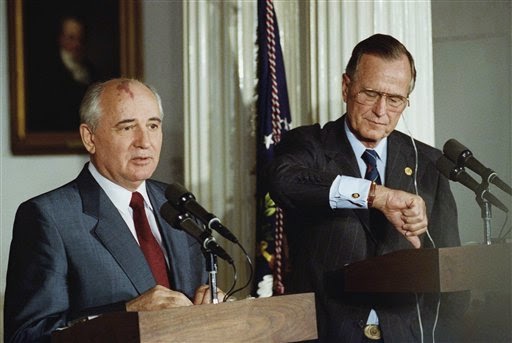
I watched a documentary last night on the final two years of the Soviet Union, the Gorbachev-George H.W. Bush years. Some great commentary came from Bush Sr.'s Soviet-affairs expert, a Princeton prof, Stephen F. Cohen.
Cohen described attending a mini-summit between Bush and Gorbachev to deal with the sudden collapse of east Germany and the prospect of German reunification. Bush rattled Gorbachev when he suggested that, as a unified state, the eastern sector of Germany should also become a part of NATO. Gorbachev held out until Bush agreed that Germany would be it, NATO would not thereafter expand further eastward. Poland, Czechoslovakia, Hungary would remain buffer states.
Gorbachev's fatal mistake, said Dr. Cohen, was in believing America would keep its word. Instead, once Germany was safely in the bag, NATO proceeded to rapidly swallow up every country in Eastern Europe it could admit to the alliance.
As NATO, at the insistence of Bush/Cheney, spread right up to Russia's doorstep, we taught the Russians the utter folly of believing anything we said, even when it came in the form of a promise.
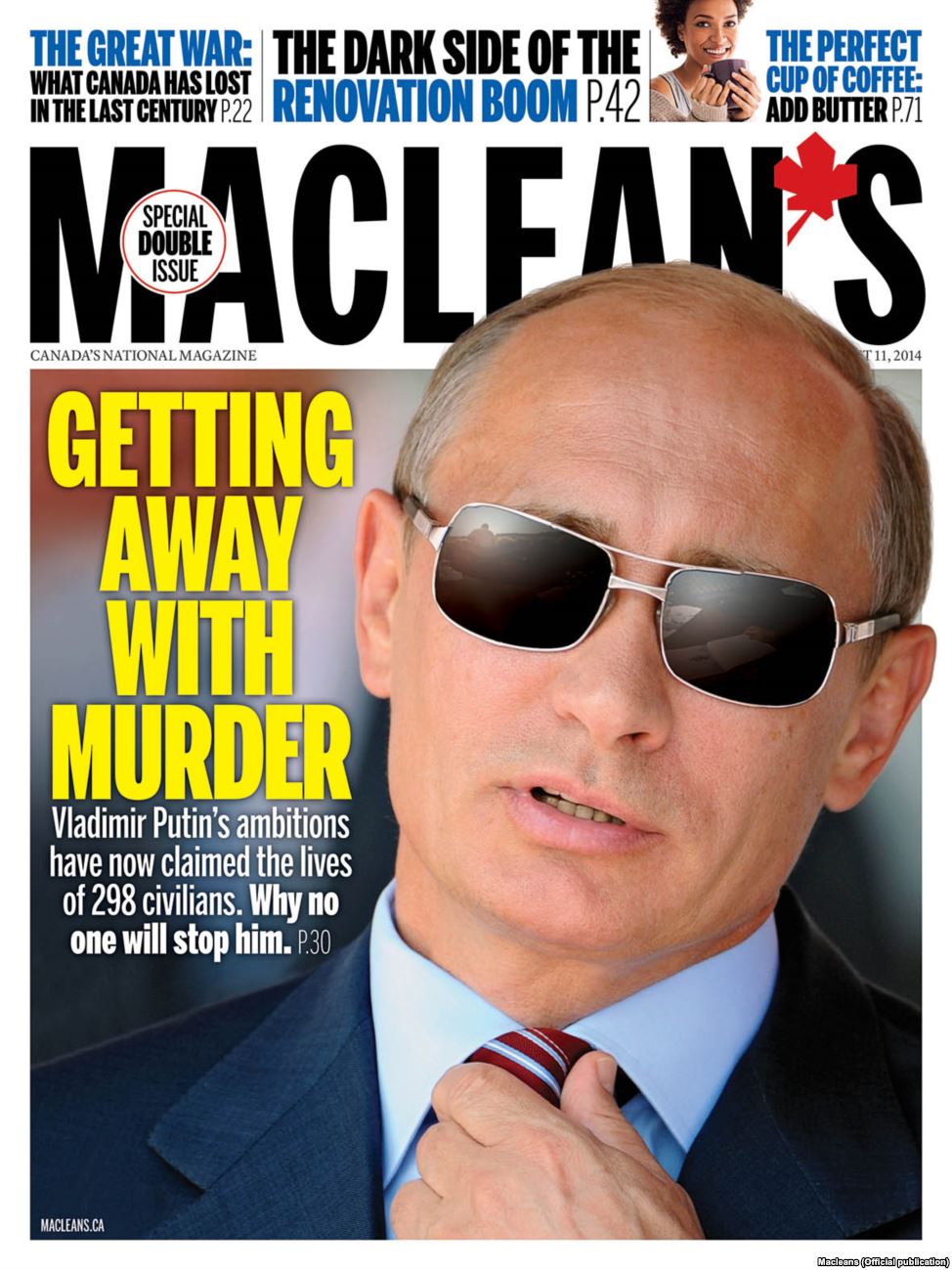
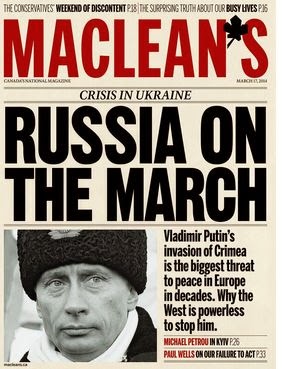
It is in this context that we need to consider how Vladimir Putin perceives our quite deliberate and calculated meddling in the Ukraine. In an act of raw aggression, we facilitated the coup by pro-Western dissidents that toppled the admittedly corrupt but nonetheless democratically elected pro-Russian government.
Now that shoot-from-the-lip warhawk, NATO Secretary-General, Anders Fogh (Foggy) Rasmussen, has announced NATO is to deploy permanent combat forces at new bases in Eastern Europe to counter supposed Russian designs on the Baltic states.
Said Rasmussen, "
We have to face the reality that Russia does not consider NATO a partner."
Lest you think this notion of a major war between Russia and the West is fear-mongering, the same Dr. Cohen who advised GHW Bush in his dealings with Gorbachev to end the Cold War is warning that a nuclear war is indeed possible and he's even calling for "
Patriotic Heresy."
Excerpts from Cohen's address to the US-Russia Forum held in Washington in mid-June:
We meet today during the worst and potentially most dangerous American-Russian confrontation in many decades, probably since the Cuban missile crisis of 1962. The Ukrainian civil war, precipitated by the unlawful change of government in Kiev in February, is already growing into a proxy US-Russian war. The seemingly unthinkable is becoming imaginable: an actual war between NATO, led by the United States, and post-Soviet Russia.
Certainly, we are already in a new cold war, which escalating sanctions will only deepen and institutionalize, one potentially more dangerous than its US-Soviet predecessor the world barely survived. This is so for several reasons:
—The epicenter of the new cold war is not in Berlin but on Russia’s borders, in Ukraine, a region absolutely essential in Moscow’s view to its national security and even to its civilization. This means that the kinds of miscalculations, mishaps and provocations the world witnessed decades ago will be even more fraught with danger. (The mysterious shoot down of a Malaysian jetliner over eastern Ukraine in July was an ominous example.)
—An even graver risk is that the new cold war may tempt the use of nuclear weapons in a way the US-Soviet one did not. I have in mind the argument made by some Moscow military strategists that if directly threatened by NATO’s superior conventional forces, Russia may resort to its much larger arsenal of tactical nuclear weapons. (The ongoing US-NATO encirclement of Russia with bases, as well as land and sea-based missile defense, only increases this possibility.)
—Yet another risk factor is that the new cold war lacks the mutually restraining rules that developed during the forty-year cold war, especially after the Cuban missile crisis. Indeed, highly charged suspicions, resentments, misconceptions and misinformation both in Washington and Moscow may make such mutual restraints even more difficult. The same is true of the surreal demonization of Russia’s leader, Vladimir Putin—a kind of personal vilification without any real precedent in the past, at least after Stalin’s death. (Henry Kissinger has pointed out that the “demonization of Vladimir Putin is not a policy; it is an alibi for the absence of one.” I think it is worse: an abdication of real analysis and rational policy-making.)
—Finally, the new cold war may be more perilous because, also unlike during its forty-year predecessor, there is no effective American opposition—not in the administration, Congress, establishment media, universities, think tanks, or in society.
Cohen goes on to lament how the voice of reason is no longer heard in the United States where, he contends, a new form of McCarthyism has taken hold.
...in our democracy, where the cost of dissent is relatively little, silence is no longer a patriotic option. (Personally, as an American, I have come to feel this more strongly, even moral indignation, as I watch the US-backed regime in Kiev inflict needless devastation, a humanitarian disaster and possibly war crimes on its own citizens in eastern Ukraine.)
...I turn now, in my capacity as a historian, to that orthodoxy. The late Senator Daniel Patrick Moynihan famously said: “Everyone is entitled to his own opinions, but not to his own facts.” The new cold war orthodoxy rests almost entirely on fallacious opinions. Five of those fallacies are particularly important today:
—Fallacy No. 1: Ever since the end of the Soviet Union in 1991, Washington has treated post-Communist Russia generously as a desired friend and partner, making every effort to help it become a democratic, prosperous member of the Western system of international security. Unwilling or unable, Russia rejected this American altruism, emphatically under Putin.
Fact: Beginning in the 1990s, again with the Clinton administration, every American president and congress has treated post-Soviet Russia as a defeated nation with inferior legitimate rights at home and abroad. This triumphalist, winner-take-all approach has been spearheaded by the expansion of NATO—accompanied by non-reciprocal negotiations and now missile defense—into Russia’s traditional zones of national security, while in reality excluding it from Europe’s security system. Early on, Ukraine, and to a lesser extent Georgia, were the ultimate goals. As an influential Washington Post columnist explained in 2004, “The West wants to finish the job begun with the fall of the Berlin Wall and continue Europe’s march to the east.… The great prize is Ukraine.”
—Fallacy No. 2: There exists a nation called “Ukraine” and a “Ukrainian people” who yearn to escape centuries of Russian influence and to join the West.
Fact: As every informed person knows, Ukraine is a country long divided by ethnic, linguistic, religious, cultural, economic and political differences—particularly its western and eastern regions, but not only. When the current crisis began in 2013, Ukraine had one state, but it was not a single people or a united nation. Some of these divisions were made worse after 1991 by corrupt elite, but most of them had developed over centuries.
—Fallacy No. 3: In November 2013, the European Union, backed by Washington, offered Ukraine’s President Viktor Yanukovych a benign association with European democracy prosperity. Yanukovych was prepared to sign the agreement, but Putin bullied and bribed him into rejecting it. Thus began Kiev’s Maidan protests and all that has since followed.
Fact: The EU proposal was a reckless provocation compelling the democratically elected president of a deeply divided country to choose between Russia and the West. So too was the EU’s rejection of Putin’s counter-proposal of a Russian-European-American plan to save Ukraine from financial collapse. On its own, the EU proposal was not economically feasible. Offering little financial assistance, it required the Ukrainian government to enact harsh austerity measures and to sharply curtail is longstanding economic relations with Russia. Nor was the EU proposal entirely benign. It included protocols requiring Ukraine to adhere to Europe’s “military and security” policies, which meant in effect, without mentioning the alliance, NATO. In short, it was not Putin’s alleged “aggression” that initiated today’s crisis but instead a kind of velvet aggression by Brussels and Washington to bring all of Ukraine into the West, including (in the fine print) into NATO.
—Fallacy No. 4: Today’s unfolding civil war in Ukraine was caused by Putin’s aggressive response to Maidan’s peaceful protests against Yanukovych’s decision.
Fact: In February 2014, radicalized Maidan protests, strongly influenced by extreme nationalist and even semi-fascist street forces, turned violent. Hoping for a peaceful resolution, European foreign ministers brokered a compromise between Maidan’s parliamentary representatives and Yanukovych. It would have left him as president of a coalition, reconciliation government until new elections in December 2014. Within hours, violent street fighters aborted the agreement. Europe and Washington did not defend their own diplomatic accord. Yanukovych fled to Russia. Minority parliamentary parties representing Maidan and predominantly western Ukraine, among them Svoboda, an ultra-nationalist movement previously anathematized by the European Parliament as incompatible with European values, formed a new government. They also nullified the existing constitution. Washington and Brussels endorsed the coup, and have supported the outcome ever since. Everything that followed, from Russia’s annexation of Crimea and the spread of rebellion in southeastern Ukraine to the civil war and Kiev’s “anti-terrorist operation,” was triggered by the February coup. Putin’s actions have been mostly reactive.
—Fallacy No. 5: The only way out of the crisis is for Putin to end his “aggression” and call off his agents in southeastern Ukraine.
Fact: The underlying causes of the crisis are Ukraine’s own internal divisions, not primarily Putin’s actions. The primary factor escalating the crisis since May has been Kiev’s “anti-terrorist” military campaign against its own citizens, now mainly in the Donbass cities of Luhansk and Donetsk. Putin influences and no doubt aids the Donbass “self-defenders.” Considering the pressure on him in Moscow, he is likely to continue to do so, perhaps even more, but he does not control them. If Kiev’s assault ends, Putin probably can compel the rebels to negotiate. But only the Obama administration can compel Kiev to stop, and it has not done so.
Cohen's insights are a warning to us all. We're being fed a load of lies pouring from some very bellicose mouths that could be steering us on a course that leads to war, perhaps even nuclear war, between Russia and the West. As the German financial newspaper,
Handelsblatt, warned earlier this month, we are all being "
mentally mobilized" for war.