Showing posts with label Ukraine. Show all posts

Wednesday, March 29, 2017

That Could Touch a Nerve


There was a quiet and barely noticed event at last year's Republican convention when Donald Trump was officially chosen as the party's presidential candidate. It involved one plank of the official Republican platform that called for America to provide "lethal defensive weapons" to Ukrainian forces fighting off Russian intrusions. Of all the policies in the platform it alone was something the Trump campaign couldn't abide and so it was quietly pulled, shelved.

When it was noticed and questions raised, Team Trump responded with apparent surprise and confusion. No one seemed to know how that had happened. Then campaign chairman Paul Manafort who had been on the Russian payroll to the tune of several millions of dollars denied he had anything to do with it. Not Paul, no, never.

On Sunday’s [July, 2016]“Meet the Press,” Manafort said that the effort to keep the platform from supporting arms for Ukraine, which I first reported last month, “absolutely did not come from the Trump campaign.”


Trump, when questioned, said he heard about it but only after the fact. He didn't know who was behind the deletion of that policy.


Months later it emerged that Trump's campaign advisor on national security, J.D. Gordon, admitted that he was responsible for getting the platform policy scrapped and did so at Trump's direction. Gordon also had a number of meetings with the Russian ambassador, Sergey Kislyak.

Diana Denman, the GOP delegate who proposed amending the Ukraine platform to include the "lethal weapons" language, contradicted Gordon's version of events in an interview with Business Insider in January. She said Gordon and another Trump campaign representative asked the cochairmen of the subcommittee to table the amendment after she read it aloud.

"Two men sitting over to the side of the room — I had no idea who they were but later found out they were Trump representatives — jumped up and tore over to get behind the three cochairmen," she said.

Gordon then left the room to make a phone call, Denman said. Equal parts confused and angry over her proposal being scuttled, Denman said she confronted Gordon about whom he was calling.

"I'm calling New York," Gordon replied, according to Denman.

"I work for Mr. Trump, and I have to clear it," she recalled him saying, apparently in reference to the amendment.


Joining Gordon at some meetings with ambassador Kislyak, was this guy, Carter Page. Page is now said to be one of the individuals under FBI investigation.

All of which now brings us to Russia and Ukraine and NATO and, again, those pesky "lethal defensive weapons."

Yesterday the U.S. House Armed Services Committee held a briefing session with four star general Curtis Scaparotti, commander of the US European Command and Supreme Commander of NATO.

Scaparotti told the Congressmen that Russia has put NATO back on a warfighting footing. Beginning around the 17:00 mark he discusses Ukraine and, at 18:30, renews the call for the US to provide lethal defensive weapons to Ukrainian forces.


Which puts Trump's top general in Europe, the Supreme Commander of NATO, foursquare at odds with the general's own commander in chief now widely suspected of being compromised by the same Russians that so worry general Scaparotti.


Friday, July 17, 2015

It's Hard to Believe We Were That Stupid

Just as Europe undermined the EU so too did we undermine, potentially fatally, the North Atlantic Treaty Organization.  Both organizations foolishly indulged in a promiscuous bout of expansion that has left them unwieldy, incoherent and perhaps even dangerous.

This is EU Europe:


This is NATO:


Both began and operated quite well with a small, well integrated membership, capable of reliably cooperating to achieve clearly understood objectives.  And then they both got just a little whorish in the bacchanal that marked the collapse of the Soviet Union.

Oh my, look, there's one missing - the Duchy of Grand Fenwick.


How they got left out I'll never know.  I guess Bush and Cheney forgot about them in their race to march NATO to Russia's doorstep.

When it comes to NATO it might be a good idea to cull the membership herd, especially if we see the E.U. beginning to come part at the seams.  There are a lot of scary people and movements waiting in the wings to exploit that chaos and we might not find their table manners exactly pleasing.

Don't forget that Article 5 business, the "mutual aid" clause that says an attack on one NATO member is an attack on all.  There's no Article 5(b) that covers the situation where one NATO member attacks another.  Worse yet, there are some NATO aspirants that might like nothing better than to provoke a regional adversary (can you say Russia?) and then drag in the NATO muscle. Think Georgia. Think Ukraine.

NATO was built to face threats from without, namely the Soviet bloc.  It cobbled together nations of the Western European tradition on an implied assumption of shared values and principles. What a happy bunch of chaps - well, except for those uppity French.  DeGaulle, you know.

NATO picked up some dodgy characters in its rampage of expansion to the East. Take Hungary, which joined in 1999.  Sixty years earlier it joined another alliance, the Axis powers.  And today you wouldn't consider Hungary a particularly enthusiastic adherent to democracy.  Sort of like the little kid who's standing still in the corner of the pool.  You just know he's peeing.

It's like having more kids than you can possibly feed. When you get the urge to add a few more, don't.  And try to get the kids you do have educated and out the door as soon as you can.

Quick, put a call through to Grand Fenwick. I need to speak to the Duke.          

Wednesday, June 24, 2015

Austerity's Silver Lining - Arms Race Update


A couple of headlines this morning got me thinking that the West's embrace of austerity might not be all bad.  Of course it's probably just wishful thinking.

The first article concerns a refreshingly nuanced and balanced lecture delivered by former US ambassador to Russia, Jack Matlock.

In a lecture at King's College London, Jack Matlock said that the crisis in Ukraine is increasingly comparable to what he saw during his time as ambassador during the turbulent end of the Cold War. "We see increasingly implicit military confrontations and I'm beginning to wonder, could this result in something which is almost the functional equivalent of the Cold War," he said.

According to Matlock, an explanation for the crisis in Ukraine and worsening relationship between Russia and the West does not simply lie with the actions of Russian President, Vladimir Putin.

"Is it just a matter of Russia violating international norms and law, is there more to this story? There is no question that Russia has violated international law, that the way they conducted the referendum of the Crimea and then annexed it, was a violation of a number of agreements.

"However, all of us should recognise that as brutal and aggressive as Russian policy is, ultimately it is prompted by…feeling…that US and West in general…are trying to encircle and strangle them," he said.

Following a decision made at the recent G7 summit to continue imposing sanctions on Russia, and the steadily increasing popularity within Russia of its President, Matlock argues that the West needs to reconsider its own policies to "bring the results that we want."


The second headline concerns the newly minted NATO sec-gen Jens Stoltenberg claiming that the alliance will not get dragged into an arms race with Moscow.  I suspect Stoltenberg's comforting assurance is really code for the obvious.  With most of the peoples of the Western nations already under the heel of brutal austerity policies, their governing classes are keenly aware of what might befall them should they try to pump up their defence spending to 3 or 4% GDP to play the arms race game with Vlad Putin.  After all, you can't have defence and the ultra low, corporate tax cuts demanded by your corporate masters.

A silver lining?  Maybe, maybe not.  Well, we're plenty ready to sacrifice the environment and our grandkids future to the whims of corporatism.  Surely defence spending is a paltry bauble in the greater scheme of commercial morality.


Friday, April 24, 2015

You'll Never See Vlad Putin the Same Way Again

If there's one guy who doesn't get any slack from the Western media, it's Russian strongman, Vlad Putin.  We vilify Putin at every turn and, while he certainly brings some of it down on himself, we make sure to depict ourselves as the guys in the white hats while we heap scorn on him.

It's time to reset our compass and there's no one better to do that than Princeton prof Stephen F. Cohen who has been involved with post-Soviet Russia since he served as an advisor to George H.W. Bush during the fall of East Germany. According to Cohen, Putin is as much our creation as his own.

As Russia’s leader, Putin has changed over the years, especially in foreign policy but also at home. His first impulse was toward more free-market reforms, anti-progressive taxes. He enacted a 13 percent flat tax—Steve Forbes would’ve been ecstatic, right? He offers [George W.] Bush what Clinton never really offered Yeltsin: a full partnership. And what does he do? On September 11, 2001, he called George and said, Whatever you want, we’re with you. Bush says, Well, I think we’re going to have to go to war in Afghanistan. And Putin said, I can help you. We’ve got major resources and assets in Afghanistan. I even have an army over there called the Northern Alliance. I’ll give it to you! You want overflight? It’s all yours!

How many American lives did Putin save during our land war in Afghanistan? And do you know what a political price he paid in Russia for that? Because his security people were completely against it.

...Oh, yeah. You think they minded seeing America being brought to its knees? They’d been invaded so often; let America get a taste of it! But Putin assumes he’s achieved what Yeltsin couldn’t and that this benefits the Russian state. He has a real strategic partnership with America. Now, remember, he’s already worried about his radical Islamic problem because Russia has nearly 20 million Muslim citizens of its own. Russia sits in the East and in the West; it’s on the front lines.

What does Bush give him in return? He expands NATO again and he unilaterally withdraws the United States from the Anti-Ballistic Missile Treaty, the bedrock of Russia’s nuclear security— it’s a complete betrayal. Is that how you repay somebody who’s helped you save the lives of your citizens? This is where the word “betrayal” begins to enter into the discourse.

...I’ve heard him called, among right-wing Russian intellectuals, an appeaser of the West. Soft. You can hear this today: Mariupol? Odessa? Should’ve taken them a year ago; they belong to us. What’s he thinking? Why is he discussing it? [Mariupol and Odessa are two contested cities in the southeastern region of Ukraine.]

So Putin sets his course, and then comes this famous speech he gives in 2007 in Munich, with McCain sitting in the front row. Putin says just what I told you. He says, Look, we want to be your partner; this is what we’ve wanted to be since Gorbachev. We believe in the common European home. But every time we turn to you or we negotiate with you or we think we have an agreement with you, you act like a hegemon and everybody has to do exactly what you say if they want to to be on your side.

Putin has come to tell them that America is risking a new Cold War with more than a decade of bad behavior towards post-Soviet Russia. John McCain interprets this as the declaration of a new Cold War.

Cohen argues that America is massively damaging its own national security by its bellicose approach to Putin over Ukraine.

I think the Ukranian crisis is the greatest blow to American national security— even greater than the Iraq war in its long-term implications— for a simple reason: The road to American national security still runs through Moscow. There is not a single major regional or issue-related national security problem we can solve without the full cooperation of whoever sits in the Kremlin, period, end of story.

Name your poison: We’re talking the Middle East, we’re talking Afghanistan, we’re talking energy, we’re talking climate, we’re talking nuclear proliferation, terrorism, shooting airplanes out of the sky, we’re talking about the two terrorist brothers in Boston.

Look: I mean American national security of the kind I care about—that makes my kids and grandkids and myself safe—in an era that’s much more dangerous than the Cold War because there’s less structure, more nonstate players, and more loose nuclear know-how and materials…. Security can only be partial, but that partial security depends on a full-scale American-Russian cooperation, period. We are losing Russia for American national security in Ukraine as we talk, and even if it were to end tomorrow Russia will never, for at least a generation, be as willing to cooperate with Washington on security matters as it was before this crisis began.

Therefore, the architects of the American policy towards Russia and Ukraine are destroying American national security—and therefore I am the patriot and they are the saboteurs of American security. That’s the whole story, and any sensible person who doesn’t suffer from Putin-phobia can see it plainly.

...The truth is, not everything depends on the president of the United States. Not everything, but an awful lot does, and when it comes to international affairs we haven’t really had a president who acted as an actual statesman in regard to Russia since Reagan in 1985-88. Clinton certainly didn’t; his Russia policy was clownish and ultimately detrimental to U.S. national security interests. Bush’s was reckless and lost one opportunity after another, and Obama’s is either uninformed or completely out to lunch. We have not had a statesman in the White House when it comes to Russia since Reagan, and I am utterly, totally, 1000 percent convinced that before November 2013, when we tried to impose an ultimatum on Yanukovych—and even right now, today—that a statesman in the White House could end this in 48 hours with Putin. What Putin wants in the Ukraine crisis is what we ought to want; that’s the reality.

Maybe it's time we realized that the West, led by an increasingly bellicose Permanent Warfare State, has some fence-mending to do for our sake as much as anyone's.  

Friday, March 20, 2015

Germany Alarmed at NATO's (and America's) Ginned Up Claims on Ukraine

A Warmonger and a Fearmonger
Angela Merkel thinks that Germany (and the rest of the West) is being conned by NATO and the U.S. inflating the Russian threat to the Ukraine.

General Philip Breedlove, the top NATO commander in Europe, stepped before the press in Washington. Putin, the 59-year-old said, had once again "upped the ante" in eastern Ukraine -- with "well over a thousand combat vehicles, Russian combat forces, some of their most sophisticated air defense, battalions of artillery" having been sent to the Donbass. "What is clear," Breedlove said, "is that right now, it is not getting better. It is getting worse every day."

German leaders in Berlin were stunned. They didn't understand what Breedlove was talking about. And it wasn't the first time. Once again, the German government, supported by intelligence gathered by the Bundesnachrichtendienst (BND), Germany's foreign intelligence agency, did not share the view of NATO's Supreme Allied Commander Europe (SACEUR).

The pattern has become a familiar one. For months, Breedlove has been commenting on Russian activities in eastern Ukraine, speaking of troop advances on the border, the amassing of munitions and alleged columns of Russian tanks. 

Over and over again, Breedlove's numbers have been significantly higher than those in the possession of America's NATO allies in Europe. As such, he is playing directly into the hands of the hardliners in the US Congress and in NATO.

...But Breedlove hasn't been the only source of friction. Europeans have also begun to see others as hindrances in their search for a diplomatic solution to the Ukraine conflict. First and foremost among them is Victoria Nuland, head of European affairs at the US State Department. She and others would like to see Washington deliver arms to Ukraine and are supported by Congressional Republicans as well as many powerful Democrats.

...To be sure, neither Berlin's Russia experts nor BND intelligence analysts doubt that Moscow is supporting the pro-Russian separatists. The BND even has proof of such support.

But it is the tone of Breedlove's announcements that makes Berlin uneasy. False claims and exaggerated accounts, warned a top German official during a recent meeting on Ukraine, have put NATO -- and by extension, the entire West -- in danger of losing its credibility.

At the beginning of the crisis, General Breedlove announced that the Russians had assembled 40,000 troops on the Ukrainian border and warned that an invasion could take place at any moment. The situation, he said, was "incredibly concerning." But intelligence officials from NATO member states had already excluded the possibility of a Russian invasion. They believed that neither the composition nor the equipment of the troops was consistent with an imminent invasion.

The experts contradicted Breedlove's view in almost every respect. There weren't 40,000 soldiers on the border, they believed, rather there were much less than 30,000 and perhaps even fewer than 20,000. Furthermore, most of the military equipment had not been brought to the border for a possible invasion, but had already been there prior to the beginning of the conflict. Furthermore, there was no evidence of logistical preparation for an invasion, such as a field headquarters.

...there are many at NATO headquarters in Brussels who are likewise concerned about Breedlove's statements. On Tuesday of last week, Breedlove's public appearances were an official item on the agenda of the North Atlantic Council's weekly lunch meeting. Several ambassadors present criticized Breedlove and expressed their incredulity at some of the commander's statements.

...Although President Obama has decided for the time being to give European diplomacy a chance, hawks like Breedlove or Victoria Nuland are doing what they can to pave the way for weapons deliveries. "We can fight against the Europeans, fight against them rhetorically," Nuland said during a private meeting of American officials on the sidelines of the Munich Security Conference at the beginning of February.

...Nuland has also been open -- at least internally -- about her contempt for European weakness and is famous for having said "Fuck the EU" during the initial days of the Ukraine crisis in February of 2014. Her husband, the neo-conservative Robert Kagan, is, after all, the originator of the idea that Americans are from Mars and Europeans, unwilling as they are to realize that true security depends on military power, are from Venus.

When it comes to the goal of delivering weapons to Ukraine, Nuland and Breedlove work hand-in-hand. On the first day of the Munich Security Conference, the two gathered the US delegation behind closed doors to discuss their strategy for breaking Europe's resistance to arming Ukraine.

What a tag team, "Made in America" fear mongers and war mongers.  It's dismaying to realize that our own government, and a good number of our opposition, are right in there with them.  NATO is pretty obviously bent.  Instead of a military, mutual-defence alliance it has been allowed to become a very dangerous instrument of geo-politics.  Enough.


Wednesday, March 11, 2015

Deadlier Than Putin's Missiles. The IMF Pays Ukraine a Visit.

The International Monetary Fund has worked its magic on Ukraine.  The carrot is about $17-billion in bailout funding.  The stick is the market price of natural gas. Soon the democracy-loving Ukrainians will see their gas bills soar nearly threefold.


While Kiev will have to help poorer families pay for pricier gas, the cost of that assistance pales in comparison with what artificially cheap local gas cost the government. The IMFestimated in 2012 that cheap gas cost Ukraine about 5 percent of its prewar GDP per year.


Bringing gas tariffs back to something resembling market prices will also curb energy consumption and provide more incentive for Ukraine to produce its own natural gas. Together, that promises to further reduce Ukraine’s reliance on imported Russian gas, potentially removing one of the sharpest arrows in Moscow’s geopolitical quiver.

Ukrainian gas consumption has fallen from 108 billion cubic meters (bcm) per year in 1993 to about 42 bcm today, thanks in part to a dismal economy in the 1990s and the phaseout of Soviet-era heavy industry. With the reform package, Ukraine could further trim the amount of gas it needs to import from Russia, which last year fell to the lowest level in 15 years.

What's unclear is how Ukraine's already wobbly economy will handle the energy shock.  Josh Cohen, an ex-US State Department staffer who handled economic reform projects in the former Soviet Union thinks the IMF medicine Poroshenko has swallowed will be toxic for Ukraine.

We have seen this story before. During the 1990s, when I worked at the U.S. Agency for International Development (USAID) in the office charged with managing economic reform projects in the former Soviet Union, I observed that the type of austerity now being required of Ukraine was the standard prescription for countries in economic crisis. The leading Washington financial institutions, such as the IMF, World Bank, and U.S. Treasury Department, were passing out this one-size-fits-all solution. And it almost never worked.

Russia was the classic case. In the midst of the political shock caused by the breakup of the Soviet Union, neoliberal reformers supported by the West instituted a policy of so-called "shock therapy" involving an end to price controls and large cuts in government spending and subsidies. The result was a plunge in Russia’s GDP and inflation rates averaging 20 percent per month. As the poverty rate climbed to a full 55 percent of the population, there was a widespread political backlash against austerity led by Russian Vice President Alexander Rutskoy, who termed the reforms "genocide" and led a failed attempt to overthrow President Boris Yeltsin in 1993.

...Kiev’s decision to implement similarly painful austerity measures during its own political turmoil is doomed to fail in the same way, leading to even more instability and crisis in a country that has had more than its share of both over the past year.

...Reforms that reduce corruption and cut government spending and subsidies are necessary if Ukraine is ever going to come close to reaching its economic potential. However, with a collapsing economy and an ongoing war, Kiev needs a semblance of stability far more than shock therapy.

Ukraine is currently in economic free-fall. After estimating that the economy would shrink 5 percent in 2014, the IMF now predicts a 6.5 percent drop in the country’s GDP, while some analysts think it could be as high as 10 percent.

...Despite the economic crisis, the IMF’s loan requires Kiev to enact a series of policy changes, all of which will accelerate the collapse of the economy and decrease the purchasing power of ordinary Ukrainians.

The IMF demands that Ukraine make immediate cutbacks to reduce the fiscal deficit. To meet this requirement, Kiev has already enacted a series of laws raising excise and property taxes, reduced social income support expenditures for retirees and public employees, frozen Ukraine’s minimum wage, and cut public-sector wages.

Another target is the energy sector. Ukraine is required to increase natural gas and heating tariffs for consumers by 56 percent and 40 percent in 2014, respectively, and by 20 to 40 percent annually from 2015 to 2017. At the same time, as gas prices increase sharply, gas subsidies to end users will be completely ended over the next two years.


...This overall combination of increased taxes and energy costs, decreased wages and social expenditures, and growing inflation is more akin to a Kevorkian prescription for Ukraine’s economy then a recipe for a return to economic growth. Given that a USAID-funded opinion survey released in April found that a majority of Ukrainians already oppose higher energy tariffs and prices, the political consequences of austerity could be explosive.

The West could help Ukraine through this economic crisis. As a recent Bloomberg editorial noted, "In Ukraine, the IMF will in essence be trying an economic solution to a geopolitical problem." Indeed, Kiev’s decision to implement austerity in the middle of a bitter civil war is foolhardy for both financial and political reasons: Wars cost money — lots of it — and unsurprisingly, Poroshenko has already announced $3 billion in additional defense spending for this year. Given that the second tranche of the IMF’s loan is $1.4 billion, the ongoing costs of the war make it extremely unlikely that Ukraine will be able to meet the IMF’s fiscal and financial targets.

But the political problems with shock therapy for Ukraine are even greater. The austerity program will further alienate the very citizens of Donbass, the restive eastern region currently hosting the worst fighting. If the country will ever be put back together, the people of the east must feel that Kiev takes their concerns into account. Unfortunately, by implementing austerity when industrial output has as of July declined by 29 percent year-on-year in Donetsk and a whopping 56 percent in Luhansk, the government in Kiev provides just the opposite message to the east.


Oh boy, another failed state to add to our ever growing list of interventions - Kosovo, Libya, Afghanistan and now Ukraine.  Perhaps we should put our plans on shipping them weapons on hold until we get assurances they won't just sell them to Putin's side for pocket money.

Wednesday, March 04, 2015

China Tells U.S. to Back Off over Ukraine

The message was delivered by China's ambassador to Belgium, Qu Xing, but it pretty obviously came straight from Beijing - back off Obama.  Ambassador Qu went on to blame the conflict between Russia and Ukraine on 'games' played by the West, especially the United States.

He said the "nature and root cause" of the crisis was the "game" between Russia and Western powers, including the United States and the European Union.

He said external intervention by different powers accelerated the crisis and warned that Moscow would feel it was being treated unfairly if the West did not change its approach.

"The West should abandon the zero-sum mentality, and take the real security concerns of Russia into consideration," Qu was quoted as saying.

His comments were an unusually public show of understanding from China for the Russian position. China and Russia see eye-to-eye on many international diplomatic issues but Beijing has generally not been so willing to back Russia over Ukraine.

Thursday, February 12, 2015

A Big Deal With Low Confidence - Ukraine


Angela Merkel and Francoise Hollande seem to have pulled it off - a peace deal to end the civil war in Ukraine.  What no one is even asking is if there's a chance it will hold.

The shooting stops at 5 p.m. ET Saturday.  Like all ceasefires the warring parties are free to go at it hammer and tong right up to the last minute (and they usually do in these situations).  Then a withdrawal protocol comes into effect for the removal of heavy weapons out of firing range (25-70 kms.) from a demarcation line.

No peacekeepers.  The Kiev government doesn't want them, supposedly because it fears Russia would use it as an excuse to flood the place with troops friendly to Moscow.  There are observers who suspect Kiev might have other reasons for not wanting prying eyes on its territory.

Kiev is supposed to amend its constitution to afford new rights and powers to the separatist-controlled regions of Donetsk and Lugansk where there'll also be new elections.  I wonder what issue the voters will be deciding?  That sounds like a slow-burning fuze.

Peace - in our time.  Where have I heard that before?

Saturday, February 07, 2015

Are We Really Willing to Go To War over Ukraine?

Would you be okay if it was your kids in uniform going off to a shooting war with the Russians over Ukraine?

The whole idea seems fantastic, ridiculous.  We tend to dismiss it as unimaginable but giving it short shrift can be lethal.

Earlier this week three words caught my attention - "une guerre totale."  That was the prospect French president Francois Hollande foresaw if there was no quick resolution to the conflict between the warring sides in the Ukraine and between Moscow and Kiev.

Total war.  That's something we've not done for quite a while.  Even at the top ranks of our militaries there's no one around who has any experience of it.  Our military and political leadership resemble more, say, 1914 than in 1918 or 19459 (and, trust me, that's not a good thing).

Modern Total War (MTW).  If you want an idea of what that means, go back to the extensive research on nuclear weapons escalation and use that as your "start" point.  We already had the ability, several times over, to obliterate life on this planet when this business began.  Sure, we've cut the inventories overall but so what?  There's still far more than would ever be needed to turn Earth into Mars, all in under 15-minutes. When was the last time 15-minutes had that relevance in your life?

One of the reasons  WWI went so horribly wrong was that almost no one had the foggiest idea of how it might play out.  Neither side went into that war expecting to be dragged down into years of murderous trench warfare.  Both sides went into the war with large contingents of cavalry - guys on horses with swords and lances.  They didn't have mass deployment of machine guns on their minds, that's for sure.  They didn't foresee aerial warfare, chemical weapons, the introduction of tanks to the battlefield - and so much more.

Add to our naivete, a thick layer of hubris.  We think we can deploy a rapid response force of 5,000 soldiers that can quickly accordion into 30,000 to nip any Putin adventurism in the bud.  NATO has "an erection lasting more than four hours" for that one.  At the top levels of the Alliance the bellicosity is searing. Maybe they're reminiscing of NATO's studly days staring down the Soviets back in the 60s.  Are we so blinded with our sense of superiority that we imagine a shooting war with ten or twenty thousand troops wouldn't escalate to something far exceeding our contemplation?

Here at home we've got no end of Chickenhawks busily banging the war drums lately.  Ignatieff introduced the Liberals to the notion of a "muscular foreign policy" and it seems to have stuck.  There's no overt, "you're either with us or with the terrorists" policy in Canada but the opposition parties sure act as though there was.  Every morning Mulcair steps outside to test which way the winds are blowing while Trudeau conferences his Bay Street advisers for his orders of the day.

We seem to want to militarize any real estate we can occupy within spitting distance of the Russian border.  NATO talks about establishing "forward bases" in the Baltic states, lest Moscow get designs on their sovereignty.  The very nature of forward bases is to define a front, a military front, and we're pressing it right up hard against Putin's doorstep.  What could possibly go wrong?

And, on our side, we've already broken into various camps.  There's NATO snarling angrily, straining against its chains, eager for the fray.  Then there's the US and Britain tossing about the idea of arming the Ukrainians, conveniently leaving unmentioned what probably follows such a bold move.  That puts them at odds with Hollande and Merkel who perhaps see the dangers more clearly and are on their, self-described last ditch tour to defuse the conflict before other nations get sucked into the malestrom.

It seems like we've amassed the perfect circumstances for backing ourselves into a war that we probably would regret fairly quickly.  It's as though we're caught in a process that has no "reset" button.  Hollande seems to acknowledge as much with obvious resignation.

Maybe all sides are already in this too deep to back down.

This reminds me of getting stuck taking shelter from a gale in a northern inlet on what had been a floating logging camp.  It consisted of a number of vintage wood buildings sitting atop rafts of cedar logs.  The buildings were being repurposed, renovated.  The one we were inside had the plaster and lathe removed to reveal old Vancouver newspapers stuffed inside for insulation.

We obviously had a few hours to wait so I opened a few of these old papers going back to from 1936 to around 1941.  There were daily accounts of Hitler's armies on the move through Europe and Japan's assault on China.  As I read them I wondered how we didn't foresee world war returning and dragging us all in yet again.  How could anyone read these reports, day by day, month after month and think anything else?  And yet we did for it was unimaginable to us in those years that we would inevitably get swept up into a world on fire.

Merkel's right, keep Ukraine out of NATO.  We don't need another country able to pull the Article 5 trigger.

In my view the 'grand bargain' that we need to bind the West and Russia requires a zone of buffer states between NATO and Russian positions.  It would mean Old NATO, the original members, stepping back.  Yet I think that possibility is already foreclosed.


Thursday, February 05, 2015

Vlad Putin - NATO's Indispensable Enemy


Vlad Putin has given NATO - well, nothing less than a reason to exist a little longer.

With the collapse of the Soviet Union, NATO was a headless chicken, running around aimlessly, still on its feet but just.  The North Atlantic alliance pretty much took whatever gig it could get.

NATO bombed Serbia to "liberate" Kosovo.  Don't ask how well that has gone for the Kosovors.  45% unemployment, rampant crime, a hopelessly corrupt government, that sort of thing.

NATO upped its game to jump into Afghanistan.  No need to ask how well that turned out.

NATO went back to bombing in Libya. a drawn out fiasco that helped oust Qaddafi, eventually, but also gave al Qaeda a golden window of opportunity to get established in North Africa and they made the most of it.  Today Libya is reeling, on the cusp of becoming a true failed state.

Now NATO's real members are busy playing aerial "whack-a-mole" in Iraq, lobbing bombs on ISIS which, according to some observers, is something of a replay of our campaign in Libya.

If NATO is becoming a bit gun shy it's for good reason.  Fortunately it has a friend in Vlad Putin.  The Russian has allowed NATO to do what it does best - glower menacingly.  No guns, no bombs.  We're not that stupid.  It's Ukraine after all or the remaining part of it.  Who in his right mind really wants a shooting war with Russia over Ukraine?  It's right on Russia's border.  They can pour in any time.

If NATO can't actually liberate Ukraine, it can use it as a pretext for a brand new Cold War, the very thing NATO does best.  Experience shows that's a very extended-run gig.  It can last for decades, the military equivalent of Wayne Newton in Vegas.  We get to patrol with our jets.  They get to patrol with theirs. We get to mass our tanks in their vicinity and they mass their tanks along ours. Our subs go here, theirs go there.  We're all getting new missiles, subs and nuclear warheads anyway so the timing is near perfect.

Let the games resume.

Wednesday, February 04, 2015

Obama Comes Clean. Putin Didn't Plot to Seize Crimea.

Go Ahead, Pick One.
Oh my, my, what comes out of the mouth of that man!

The Western narrative we've been force fed by liars like Harper and his collaborators on the other side of the aisle, is that Vlad Putin plotted to use the unrest in Ukraine to seize Crimea.  Hillary openly compared Putin to Hitler seizing the Sudetenland for Lebensraum.

While we were busy watching the Super Bowl, Barack Obama was on another channel being interviewed by Fareed Zakaria when he dropped this:

“Mr. Putin made this decision around Crimea and Maidan not because of some grand strategy, but essentially because he was caught off-balance by the protest in the Maidan (in February 2014) and (Ukraine’s then-president Viktor) Yanukovych fleeing after we (the U.S. and the European Union) had made a deal to broker power in Ukraine.”

Those who've followed this affair will remember that President Yanukovych was being pressed by Russia to join a new central Asian trade and political bloc envisaged by Putin, while the EU and U.S. wanted Ukraine to join the EU (and NATO).

Believing that the Maidan demonstrations last February had been secretly contrived by the West (easy for Putin to suspect because of the presence of EU representatives, as well as an American Assistant Secretary of State and a visit to Kiev by CIA officials), Putin retaliated by adroitly seizing Crimea, for many years a Russian territory, but Ukrainian only since 1954.

The Russians ...seem to feel themselves under assault by the West, and indeed there are many in Washington who want to see Putin and his government overthrown, convinced that Americanizing the world is the next step in the nation’s destiny.

Nuclear war is considered a possibility by both sides, for the first time since 1990. But why? The U.S. and its European allies have been the aggressors in this whole unnecessary confrontation. They are the ones who can call it off. There is zero gain in it.

Certainly, the Germans and other Europeans are aware of this. As in the old days of the Cold War, the calculations of deterrence and first-strike advantage are relevant. The U.S. seems motivated by the determination to stay Top Dog. The Russians may be motivated by fear.


Great, just great.  We've got a gaggle of neoliberal dickheads scheming to topple the head of a nation that has the second, if not the first-largest nuclear arsenal on the planet.  What could possibly go wrong?


Monday, October 20, 2014

Harper's Experiment to Wrap Canadians in "Protective Stupidity" Mission Accomplished?


The Tyee's Murray Dobbins laments the success Stephen Harper has had, with the powerful support of a shamelessly collaborative media, at manipulating the Canadian public.

Harper's amoral political calculations about who and when to bomb people has little to do with any genuine consideration of the geopolitical situation or what role Canada might usefully play -- or even in what Canada's "interests" are. So long as he is prime minister it will be the same: every calculation will be made with the single-minded goal of staying in power long enough to dismantle the post-war activist state. The nurturing of his core constituency includes appeals to a thinly disguised pseudo-crusade against Islamic infidels, a phony appeal to national security (preceded by fear-mongering) and in the case of Ukraine, a crude appeal to ethnic votes.

Reinforcing this legacy is a mainstream media that lets him get away with it, and in particular, refuses to do its homework while the bombing -- or posturing -- is taking place and then refuses to expose the negative consequences of the reckless adventures. The result is what cultural critic Henry Giroux calls "the fog of historical and social amnesia."

The three most obvious examples are Harper's extremist policy in support of Israel, his joining with France and the U.S. in the catastrophic destruction of the Libyan state and his infantile posturing on the Russia-Ukraine conflict. And now we have Harper's mini-crusade (six fighter bombers for six months) against ISIS or the Islamic State. With rare exceptions the media has gone along with him at every turn, treating Canadians as children incapable of navigating the nuances of foreign policy.
Regarding Israel, Harper, with widespread support in the media, has gone so far as to try to establish criticism of Israel as a kind of Orwellian "thought crime." By declaring repeatedly (and even threatening supportive legislation) that criticism of Israel was anti-Semitic, Harper hoped to establish what Orwell referred to as "protective stupidity" -- a kind of mass denial of the obvious. Freud referred to it as "knowing with not knowing" and when it comes to most of Canada's military adventures, it is epidemic. 

In Afghanistan the war went for so long that the facts eventually broke through the protective stupidity, but only partially. Even with the total failure of the mission to accomplish a single worthwhile goal, it is likely that most Canadians still see it as having been a "good war."

As Giroux puts it: "Neoliberal authoritarianism has changed the language of politics and everyday life through a poisonous public pedagogy that turns reason on its head and normalizes a culture of fear, war and exploitation."

Harper's response to the Russia-Ukraine conflict has been similar: a maximum of infantile, simplistic sabre rattling rhetoric with an absolute minimum of reflection on the historical context or even the immediate facts of the situation. This is foreign policy for the willingly -- if not willfully -- ignorant. We are encouraged -- or perhaps enlisted is a better word -- to treat facts and history with a disdain bordering on contempt. Facts, context, history and thoughtful anticipation of the consequences of our actions -- all of this is for sissies and Putin apologists. The nay-sayers are all Neville Chamberlain clones.

...there will be no lasting consequences for governments -- Harper's or anyone else's. The structure of protective stupidity is in place and without a radical change in consciousness the current political consensus will prevail. All will be forgotten.

...Which brings us to the Islamic State. Here, too, the conventional approach to making intelligent foreign policy is cast aside on the basis of reacting to a handful of Westerners being beheaded (as happens on a regular basis already to citizens of Saudi Arabia). Can it be possible that our policy making has been reduced to this level of drunken barroom reaction? We know that the ISIS did this precisely to provoke a Western military response. But "we don't know." We prefer denial and the simplistic -- the notion that we can correct 25 years of imperial hubris, ignorance and gross incompetence by Western powers by bombing our own creation.

Tuesday, September 02, 2014

NATO Leaders Huddle and Fume While Putin Chuckles

NATO's Drang Nach Osten


There'll be an absolute glut of righteous indignation when NATO leaders convene this week in Wales to decide whatever to do with that big bad bully, the Russian Bear, Vladimir Putin.  Meanwhile, as The Guardian's Simon Jenkins writes, Putin will be kicking back in Red Square laughing his ass off.

It is currently impossible to hear a speech or open a newspaper in which defence experts do not beat their breasts, bang their drums and demand "the west stand firm... show resolve... teach Russia a lesson... show Putin who is boss."  They call for more economic sanctions - which have never seemed more counterproductive.  They demand backing for Ukraine, aid for Kiev, support for other border states, more spearhead battalions and seemingly endless rapid reaction forces.  But they all end up asserting "we cannot mean war" and "a diplomatic solution is inevitable.

All intelligence out of Moscow says the same, that this bombast merely emboldens Putin.  He can do what he wants in eastern Ukraine, because he has an army there and it enjoys widespread support among the Russian-speaking population.  There is no question Putin has infringed the integrity of Ukrainian sovereignty. But so did America in its Latin American "sphere of influence" during the cold war.  Meanwhile, Britain kowtowed to China for economic gain and Olympic glory when Beijing was treating Tibet far worse.

Foreign policy always involves double standards.  The best policy is to avoid one's own weaknesses and instead test those of one's opponents.  Peace and trade were slowly eroding the juggernaut of Russian power across eastern Europe. Now Nato's pseudo-support for Kiev has played to Putin's one strength: his support among Russian peoples along his borders.  Kiev, the EU and Nato have played a dangerous game with Russia over Ukraine for years.  Putin has laid down a marker for an armistice, talks on autonomy, one that is bound to look like a victory for him.  It is for Kiev to pick it up.  Nato can go on swilling champagne in Wales.


Saturday, August 30, 2014

Banging the War Drum - Washington Post


It was earlier this month that the German financial newspaper, Handelsblatt, warned of the dangerous spread of war fever throughout Europe.  The paper found that Europeans were being "mentally mobilized" for war.

Something eerily similar is happening in America.  In today's Washington Post, columnist Anne Applebaum questions whether the European people today are all that different from the complacent, care free Polish population in the summer of 1939.

Instead of celebrating weddings, they [the Poles] should have dropped everything, mobilized, prepared for total war while it was still possible. And now I have to ask: Should Ukrainians, in the summer of 2014, do the same? Should central Europeans join them?

I realize that this question sounds hysterical, and foolishly apocalyptic, to U.S. or Western European readers. But hear me out, if only because this is a conversation many people in the eastern half of Europe are having right now. In the past few days, Russian troops bearing the flag of a previously unknown country, Novorossiya, have marched across the border of southeastern Ukraine. The Russian Academy of Sciences recently announced it will publish a history of Novorossiya this autumn, presumably tracing its origins back to Catherine the Great. Various maps of Novorossiya are said to be circulating in Moscow. Some include Kharkiv and Dnipropetrovsk, cities that are still hundreds of miles away from the fighting. Some place Novorossiya along the coast, so that it connects Russia to Crimea and eventually to Transnistria, the Russian-occupied province of Moldova. Even if it starts out as an unrecognized rump state — Abkhazia and South Ossetia, “states” that Russia carved out of Georgia, are the models here — Novorossiya can grow larger over time.

Applebaum foresees not merely a Russian invasion and conquest of Ukraine but outright genocide of the sort visited on Jews by the Nazis.

Russian soldiers will have to create this state — how many of them depends upon how hard Ukraine fights, and who helps them — but eventually Russia will need more than soldiers to hold this territory. Novorossiya will not be stable as long as it is inhabited by Ukrainians who want it to stay Ukrainian. There is a familiar solution to this, too. A few days ago, Alexander Dugin, an extreme nationalist whose views have helped shape those of the Russian president, issued an extraordinarystatement. “Ukraine must be cleansed of idiots,” he wrote — and then called for the “genocide” of the “race of bastards.”

Applebaum even warns of a sinister plot whereby Putin will rain nuclear weapons on Eastern Europe.

...the dissident Russian analyst Andrei Piontkovsky, has recently published an article arguing, along lines that echo Zhirinovsky’s threats, that Putin really is weighing the possibility of limited nuclear strikes — perhaps against one of the Baltic capitals, perhaps a Polish city — to prove that NATO is a hollow, meaningless entity that won’t dare strike back for fear of a greater catastrophe. Indeed, in military exercises in 2009 and 2013, the Russian army openly “practiced” a nuclear attack on Warsaw.
Is all of this nothing more than the raving of lunatics? Maybe. And maybe Putin is too weak to do any of this, and maybe it’s just scare tactics, and maybe his oligarchs will stop him. But “Mein Kampf” also seemed hysterical to Western and German audiences in 1933. Stalin’s orders to “liquidate” whole classes and social groups within the Soviet Union would have seemed equally insane to us at the time, if we had been able to hear them.
But Stalin kept to his word and carried out the threats, not because he was crazy but because he followed his own logic to its ultimate conclusions with such intense dedication — and because nobody stopped him. Right now, nobody is able to stop Putin, either. So is it hysterical to prepare for total war? Or is it naive not to do so?
Wow from conquest to genocide to nuclear war, Applebaum beats that war drum to death.  Hers is a self-fulfilling prophesy.


Friday, August 29, 2014

Oh, Crap! Sorry, I Meant the Ukraine.


Vlad Putin, it seems, has a response to the hectoring recently from the likes of Sideshow Steve Harper and John Baird and others - "meet me in the Arctic."

The Guardian reports that Putin has had enough of Western criticism of Russian involvement in the Ukraine whose government he likens to Nazis.

Hours after Barack Obama accused Russia of sending troops into Ukraine and fuelling and upsurge in the separatist war, Putin retorted that the Ukrainian army was the villain of peace, targeting residential areas of towns and cities like German troops did in the former Soviet Union.

...And he made a pointed reference to the Arctic, which with its bounteous energy reserves and thawing waterways is emerging as a new potential conflict between Russia and its western rivals.  "Our interests are concentrated in the Arctic.  And of course we should pay moire attention to issues of development of the Arctic and the strengthening of our position," Putin told a youth camp outside Moscow.

Ukraine's prime minister, Arseny Yetseniuk, meanwhile says he'll try to bring Ukraine into NATO.  Oh no you won't, Arseny.  The "run to NATO" gambit was already tried by Georgia and it failed.  We're not going to fight your war.  Obama has already said America won't be going to war with Russia over Ukraine. Harper/Baird, both classic chicken hawks, love to talk tough but have so defunded Canada's armed forces that we won't be much help beyond hot air.  Besides, we just got put on notice that our problems with Putin aren't in Ukraine.  They're in our own backyard, the Arctic.

Thursday, August 28, 2014

Big Summit Next Week - Maybe the Biggest in Years


NATO leaders gather in Wales next week for what could be the alliance's most important summit in years.  Instead of focusing on housekeeping issues to tidy up the not very successful adventure in Afghanistan, alliance members will find their plates full with developing approaches to the Ukrainian chaos and the rampaging Islamic State in Iraq and Syria.

Jan Techau, director of Carnegie Europe, writes that, around the world, all eyes will be on NATO and the alliance had better get it right.

...the alliance must embrace deeply uncomfortable truths. In its relationship with Russia, NATO is now in a confrontation with a country it deemed a partner (albeit a difficult one) until only a few months ago. Short-term crisis management passed off smoothly, with a surprising degree of unity among 28 member states that hold very different views on the situation’s security relevance. But now, alliance strategy must shift from crisis management to the long game.
NATO needs to achieve three goals. First, it must provide credible reassurance to those allies that feel threatened by Russia. Second, it should keep the door open for a possible improvement in diplomatic relations. Third, it must make clear that the alliance’s security guarantee does not apply to Ukrainian territory while supporting the government in Kiev in its daunting security sector reforms.
...With respect to IS, NATO’s position is both easier and more difficult at the same time. It is easier because the turmoil in Iraq and Syria does not fall into the alliance’s immediate remit. It is more difficult because the seemingly unstoppable expansion of the jihadists’ reach confronts Europeans and Americans with a daunting question: Will the West eventually have to go to war against IS? If the West’s indirect containment strategy—propping up the Kurdish Peshmerga as the group’s opponents—fails, and if the regional powers remain largely passive, Western troops on the ground may be unavoidable. 
...So far, the West fears the costs and the unintended consequences of intervening in a politically, ethnically, and religiously hypercharged part of the world more than it fears the jihadists’ further expansion. That may change. Don’t expect the Wales summit to tackle this head-on. But do expect this topic to hang over the meeting like a dark cloud.
...A larger-than-usual crowd will tune in when NATO leaders congregate in Wales. The summit will be followed closely not only in Europe but also around the world. It will be used as an indicator of whether the West is still alive. And it will tell audiences in Moscow, Beijing, Tokyo, Seoul, Tel Aviv, Damascus, Cairo, and elsewhere whether Europeans are still willing to play a military role and how loyal the United States is as an ally.

Tuesday, August 26, 2014

Inching Ever Closer to a Shooting War with Russia

Foggy Rasmussen


Why do I get the feeling that there are some in the West who would welcome a conflict with Russia?

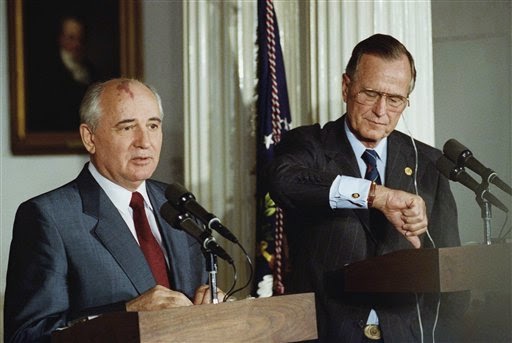
I watched a documentary last night on the final two years of the Soviet Union, the Gorbachev-George H.W. Bush years.  Some great commentary came from Bush Sr.'s Soviet-affairs expert, a Princeton prof, Stephen F. Cohen.

Cohen described attending a mini-summit between Bush and Gorbachev to deal with the sudden collapse of east Germany and the prospect of German reunification.  Bush rattled Gorbachev when he suggested that, as a unified state, the eastern sector of Germany should also become a part of NATO.  Gorbachev held out until Bush agreed that Germany would be it, NATO would not thereafter expand further eastward.  Poland, Czechoslovakia, Hungary would remain buffer states.


Gorbachev's fatal mistake, said Dr. Cohen, was in believing America would keep its word.  Instead, once Germany was safely in the bag, NATO proceeded to rapidly swallow up every country in Eastern Europe it could admit to the alliance.

As NATO, at the insistence of Bush/Cheney, spread right up to Russia's doorstep, we taught the Russians the utter folly of believing anything we said, even when it came in the form of a promise.

It is in this context that we need to consider how Vladimir Putin perceives our quite deliberate and calculated meddling in the Ukraine.  In an act of raw aggression, we facilitated the coup by pro-Western dissidents that toppled the admittedly corrupt but nonetheless democratically elected pro-Russian government.

Now that shoot-from-the-lip warhawk, NATO Secretary-General, Anders Fogh (Foggy) Rasmussen, has announced NATO is to deploy permanent combat forces at new bases in Eastern Europe to counter supposed Russian designs on the Baltic states.

Said Rasmussen, "We have to face the reality that Russia does not consider NATO a partner."

Lest you think this notion of a major war between Russia and the West is fear-mongering, the same Dr. Cohen who advised GHW Bush in his dealings with Gorbachev to end the Cold War is warning that a nuclear war is indeed possible and he's even calling for "Patriotic Heresy."

Excerpts from Cohen's address to the US-Russia Forum held in Washington in mid-June:

We meet today during the worst and potentially most dangerous American-Russian confrontation in many decades, probably since the Cuban missile crisis of 1962. The Ukrainian civil war, precipitated by the unlawful change of government in Kiev in February, is already growing into a proxy US-Russian war. The seemingly unthinkable is becoming imaginable: an actual war between NATO, led by the United States, and post-Soviet Russia.
Certainly, we are already in a new cold war, which escalating sanctions will only deepen and institutionalize, one potentially more dangerous than its US-Soviet predecessor the world barely survived. This is so for several reasons:
—The epicenter of the new cold war is not in Berlin but on Russia’s borders, in Ukraine, a region absolutely essential in Moscow’s view to its national security and even to its civilization. This means that the kinds of miscalculations, mishaps and provocations the world witnessed decades ago will be even more fraught with danger. (The mysterious shoot down of a Malaysian jetliner over eastern Ukraine in July was an ominous example.)
—An even graver risk is that the new cold war may tempt the use of nuclear weapons in a way the US-Soviet one did not. I have in mind the argument made by some Moscow military strategists that if directly threatened by NATO’s superior conventional forces, Russia may resort to its much larger arsenal of tactical nuclear weapons. (The ongoing US-NATO encirclement of Russia with bases, as well as land and sea-based missile defense, only increases this possibility.)
—Yet another risk factor is that the new cold war lacks the mutually restraining rules that developed during the forty-year cold war, especially after the Cuban missile crisis. Indeed, highly charged suspicions, resentments, misconceptions and misinformation both in Washington and Moscow may make such mutual restraints even more difficult. The same is true of the surreal demonization of Russia’s leader, Vladimir Putin—a kind of personal vilification without any real precedent in the past, at least after Stalin’s death. (Henry Kissinger has pointed out that the “demonization of Vladimir Putin is not a policy; it is an alibi for the absence of one.” I think it is worse: an abdication of real analysis and rational policy-making.)
—Finally, the new cold war may be more perilous because, also unlike during its forty-year predecessor, there is no effective American opposition—not in the administration, Congress, establishment media, universities, think tanks, or in society.
Cohen goes on to lament how the voice of reason is no longer heard in the United States where, he contends, a new form of McCarthyism has taken hold.
...in our democracy, where the cost of dissent is relatively little, silence is no longer a patriotic option. (Personally, as an American, I have come to feel this more strongly, even moral indignation, as I watch the US-backed regime in Kiev inflict needless devastation, a humanitarian disaster and possibly war crimes on its own citizens in eastern Ukraine.)
...I turn now, in my capacity as a historian, to that orthodoxy. The late Senator Daniel Patrick Moynihan famously said: “Everyone is entitled to his own opinions, but not to his own facts.” The new cold war orthodoxy rests almost entirely on fallacious opinions. Five of those fallacies are particularly important today:
Fallacy No. 1: Ever since the end of the Soviet Union in 1991, Washington has treated post-Communist Russia generously as a desired friend and partner, making every effort to help it become a democratic, prosperous member of the Western system of international security. Unwilling or unable, Russia rejected this American altruism, emphatically under Putin.
Fact: Beginning in the 1990s, again with the Clinton administration, every American president and congress has treated post-Soviet Russia as a defeated nation with inferior legitimate rights at home and abroad. This triumphalist, winner-take-all approach has been spearheaded by the expansion of NATO—accompanied by non-reciprocal negotiations and now missile defense—into Russia’s traditional zones of national security, while in reality excluding it from Europe’s security system. Early on, Ukraine, and to a lesser extent Georgia, were the ultimate goals. As an influential Washington Post columnist explained in 2004, “The West wants to finish the job begun with the fall of the Berlin Wall and continue Europe’s march to the east.… The great prize is Ukraine.”
Fallacy No. 2: There exists a nation called “Ukraine” and a “Ukrainian people” who yearn to escape centuries of Russian influence and to join the West.
Fact: As every informed person knows, Ukraine is a country long divided by ethnic, linguistic, religious, cultural, economic and political differences—particularly its western and eastern regions, but not only. When the current crisis began in 2013, Ukraine had one state, but it was not a single people or a united nation. Some of these divisions were made worse after 1991 by corrupt elite, but most of them had developed over centuries.
Fallacy No. 3: In November 2013, the European Union, backed by Washington, offered Ukraine’s President Viktor Yanukovych a benign association with European democracy prosperity. Yanukovych was prepared to sign the agreement, but Putin bullied and bribed him into rejecting it. Thus began Kiev’s Maidan protests and all that has since followed.
Fact: The EU proposal was a reckless provocation compelling the democratically elected president of a deeply divided country to choose between Russia and the West. So too was the EU’s rejection of Putin’s counter-proposal of a Russian-European-American plan to save Ukraine from financial collapse. On its own, the EU proposal was not economically feasible. Offering little financial assistance, it required the Ukrainian government to enact harsh austerity measures and to sharply curtail is longstanding economic relations with Russia. Nor was the EU proposal entirely benign. It included protocols requiring Ukraine to adhere to Europe’s “military and security” policies, which meant in effect, without mentioning the alliance, NATO. In short, it was not Putin’s alleged “aggression” that initiated today’s crisis but instead a kind of velvet aggression by Brussels and Washington to bring all of Ukraine into the West, including (in the fine print) into NATO.
Fallacy No. 4: Today’s unfolding civil war in Ukraine was caused by Putin’s aggressive response to Maidan’s peaceful protests against Yanukovych’s decision.
Fact: In February 2014, radicalized Maidan protests, strongly influenced by extreme nationalist and even semi-fascist street forces, turned violent. Hoping for a peaceful resolution, European foreign ministers brokered a compromise between Maidan’s parliamentary representatives and Yanukovych. It would have left him as president of a coalition, reconciliation government until new elections in December 2014. Within hours, violent street fighters aborted the agreement. Europe and Washington did not defend their own diplomatic accord. Yanukovych fled to Russia. Minority parliamentary parties representing Maidan and predominantly western Ukraine, among them Svoboda, an ultra-nationalist movement previously anathematized by the European Parliament as incompatible with European values, formed a new government. They also nullified the existing constitution. Washington and Brussels endorsed the coup, and have supported the outcome ever since. Everything that followed, from Russia’s annexation of Crimea and the spread of rebellion in southeastern Ukraine to the civil war and Kiev’s “anti-terrorist operation,” was triggered by the February coup. Putin’s actions have been mostly reactive.
Fallacy No. 5: The only way out of the crisis is for Putin to end his “aggression” and call off his agents in southeastern Ukraine.
Fact: The underlying causes of the crisis are Ukraine’s own internal divisions, not primarily Putin’s actions. The primary factor escalating the crisis since May has been Kiev’s “anti-terrorist” military campaign against its own citizens, now mainly in the Donbass cities of Luhansk and Donetsk. Putin influences and no doubt aids the Donbass “self-defenders.” Considering the pressure on him in Moscow, he is likely to continue to do so, perhaps even more, but he does not control them. If Kiev’s assault ends, Putin probably can compel the rebels to negotiate. But only the Obama administration can compel Kiev to stop, and it has not done so.
Cohen's insights are a warning to us all.  We're being fed a load of lies pouring from some very bellicose mouths that could be steering us on a course that leads to war, perhaps even nuclear war, between Russia and the West.  As the German financial newspaper, Handelsblatt, warned earlier this month, we are all being "mentally mobilized" for war.