Showing posts with label Syria. Show all posts
Showing posts with label Syria. Show all posts
Thursday, May 10, 2018
So, Let's Get this Straight.
Trump, despite the advice and warnings of America's security/intelligence agencies and his country's major allies, gives in to Netanyahu's propaganda campaign against Iran, and walks away from the Iran nuclear weapons deal.
Iran, therefore, in an act of crushing military stupidity, fires a missile barrage at Israeli targets in the occupied Golan Heights. So lethal is the Iranian barrage that no one is even hit.
Israel immediately retaliates, bombing the shit out of Iranian military installations in Syria.
This couldn't possibly be a set-up, could it? The timing of these events is pure coincidence, right?
Why does Reichstag Fire keep coming to mind? There's just that powerful stench of someone really spoiling to start a war.
Meanwhile, today's Guardian editorial contends that Trump is sowing the seeds of war on Iran. Foreign Policy columnist and Harvard prof, Dr. Stephen Walt, sees the same war clouds gathering.


Friday, April 13, 2018
Well, With the Week He's Had Who Wouldn't Want to Let Off a Little Steam?
The United States has launched missile strikes against government targets in Syria. This time Britain and France tossed in a few missiles of their own, brothers in arms sort of thing, I suppose.
Trump announced the strikes in an address to the nation Friday evening. “The purpose of our action tonight is to establish a strong deterrent,” he said, against the production and use of chemical weapons, describing the issue as vital to national security. Trump added that the United States is prepared “to sustain this response” until its aims are met.Details of the attack are still sketchy at best. There's no word on any action by the Russians either. They had threatened to use their S-400 systems to shoot down incoming American missiles. Russia had also warned it would retaliate against US installations should its bases in Syria be targeted.
Trump asked both Russia and Iran, backers of Assad, “what kind of nation wants to be associated” with mass murder and suggested that someday the United States might be able to “get along” with both if they change their policies.
Trump's remarks indicate that the US and perhaps the French and British are preparing for a sustained air and missile campaign.
Thursday, March 08, 2018
I've Got an Idea to Rescue Justin From His Slump

Unfair or not, Justin Trudeau has taken a hit in the public's mind over his pretty clumsy trip to India. With JT et famille sporting an elaborate wardrobe of Bollywood's best fashions, the Indian press took the piss out of him pretty relentlessly. The local scribblers piled on.
Now Trudeau's approval numbers have dropped to within spitting distance of Tory leader, Andrew Scheer's. That's Andrew "Chuckles" Scheer people, a guy with all the charisma of a recycled catheter.
Maybe JT should consider upping his game. He could start by reversing himself and honouring a major campaign promise - electoral reform. I would like it even better if he went for electoral reform and pipelines but that's probably too much to ask.
Trudeau promised that 2015 would be our last first-past-the-post election. In short order he reneged on that committment but his "can't" sounded more like "won't." His claim that it wouldn't work here, even though it works elsewhere, was utterly unconvincing. We would even accept the preferential ballot option if he insisted. Just do it.
Or maybe Justin can change course. Maybe he should transform himself from just another free trade mule into a Renaissance Man befitting of his legendary father. (full disclosure. what follows is taken from an email I wrote to a fellow blogger this morning)


Then along came Libya, a not so tidy war that Obama basically offloaded on Europe. Harper staged a victory fly past over Parliament Hill for that one even as Libya itself descended into an intractable, second phase civil war, this one substituting Islamist radicals for Gadhafi.


Or maybe Justin can change course. Maybe he should transform himself from just another free trade mule into a Renaissance Man befitting of his legendary father. (full disclosure. what follows is taken from an email I wrote to a fellow blogger this morning)
I have long argued that Canada needs some serious redecorating. Ever since George H.W. Bush started this “coalition of the willing” business, America has treated certain allies, Canada included, as its de facto Foreign Legion. Desert Storm was, arguably, a good cause – driving Iraq out of Kuwait. Kosovo – meh. Afghanistan, well we all lost our minds at the 9/11 attacks streamed live into our livingrooms. We even bent the rules around Article 5 in that, 1) – the US never attacked by Afghanistan, and 2) – at the time the US invoked Article 5 it was not truly “under attack.” Picky, picky.
Where we lost the plot was when Bush/Cheney decided America should turn to invading Iraq rather than finishing what it had begun in Afghanistan. We knew from Hans Blix and his team of UN inspectors that Saddam wasn’t hiding a mountain of WMDs. It was pretty obvious that Washington thought it could roll in and basically grab the oil for US energy giants. Why was the only Iraqi ministry US forces secured the oil ministry?
The US decided to offload much of the Afghan mission to free up troops for Iraq and wanted a Foreign Legion. Rick “Big Cod” Hillier talked Paul Martin into taking the combat gig in Kandahar with a laughably token force of just 2,000 personnel, no more than half combat ready, to a province whose area and population mandated a combat force of between 20 to 30,000. Martin didn’t know any better. Hillier probably did know, definitely should have known , but obviously didn’t tell his prime minister. It’s right there in the US Army/Marine Corps field manual, FM-3/24.

We lost our war in Afghanistan, the first military defeat in Canadian history. We lost badly. War is a state of armed conflict used to achieve a political outcome. That sought outcome was defined by Stephen Harper. We were there to stay. We would never cut and run. We would stay until the Taliban had been vanquished, effectively eradicated. We would make Afghanistan safe for democracy and a restoration of human rights (as they had once enjoyed under the country’s last king). We did none of those things. The Talibs are resurgent. The government is a hopelessly corrupt amalgamation of warlords from five main ethnic groups. Little boys’ bums are all the rage again and the struggle for women’s rights languishes. Meanwhile we definitely chose to cut and run.

Then along came Libya, a not so tidy war that Obama basically offloaded on Europe. Harper staged a victory fly past over Parliament Hill for that one even as Libya itself descended into an intractable, second phase civil war, this one substituting Islamist radicals for Gadhafi.
Syria? ISIS has been driven out, more or less, for now. It has been reduced from a rebellion to an insurgency to what is today essentially a terrorist movement. That’s the thing with these guys. They can morph from one state to another, often rather effortlessly, and that enables them to be flexible, mobile. They’ll be back, probably in another guise.
I have gone on at some length on these events because the world has become no safer for all of our post 9/11 misadventures. If anything we’ve demonstrated, repeatedly, that all the King’s Horses and all the King’s Men are no longer a sure path to a meaningful, lasting victory. We have all the watches but the bad guys have all the time.

We are returning to a more challenging era, one akin to the last Cold War, another win that we utterly failed to consolidate as we allowed triumphalism to get the better of us. That Doomsday Clock is now closer to midnight than it has been since the Cuban missile crisis. Around the world but particularly in Europe, Eurasia, South Asia, Southeast Asia, the greater Asia Pacific region all the way to Australia, Russia and China, everyone is madly rearming.
America is being overtaken, economically, by China which is fast making inroads into the Middle East, Africa and even South America (whatever happened to the Monroe Doctrine anyway?). We have seen a number of these major power transitions over the centuries. At various times in the modern period the dominant spot belonged alternately to the Spanish, the French, the Dutch, the Brits and now the Americans. Before that came the Greeks, the Romans, the Mongols, etc.

Here’s the thing. History tells us that these transitions tend to be difficult. Two-thirds of them result in war. Is war in the offing between the U.S. and China? From what I’ve read over the past ten years, China’s military leadership is quietly bellicose. At some level they want to exact revenge for China’s “century of humiliation” at the hands of us white folks – Opium Wars, etc.? That thought came to mind when I found an essay in the Proceedings of the US Naval Institute wherin an acting service officer complained bitterly that China was overtaking the United States “without a fight” as though that was unthinkable.

It would be tempting to dismiss that view as the work of a hothead only his sentiments go deeper in that, all the way back to the Project for a New American Century, the neo-cons (Cheney, Rumsfeld, Feith, Perle, Wolfowitz, Libby et al) developed an “over my dead body” policy prescription that was subsequently embodied in the Bush Doctrine. That doctrine provided that America reserved the right to institute pre-emptive war against any nation or group of nations that challenged America’s economic and military domination. Seriously, look it up.
The backbone of American airpower today and into the future are its stealth warplanes, the F-22 and F-35. Those are not dual purpose aircraft. They’re not defence oriented. There are simply too few F-22s to handle the job and the F-35 has a series of deficiencies that make it marginal in the air defence role. They are primarily offensive weapons designed to “take the fight to the enemy” and not just any garden variety enemy either. They are purpose built to operate in heavily defended, hostile airspace. One American general called the F-35 his “kick in the front door” weapon. Do you remember that the Japanese ran a dress rehearsal of their Pearl Harbour attack to test their shallow-draught Long Lance torpedoes in an appropriate anchorage? The USAF staged a similar “proof of concept” exercise called Operation Chimichanga that simulated a stealth first strike attack on China. Do you the Chinese maybe didn’t hear about that?

Whether it’s North Korea or the South China Sea or maybe just two countries getting into each other’s faces, this is not a very placid time. For Canada, however, it may be a time to begin loosening the ties that bind us to American foreign and military policy, perhaps by aligning Canadian policy more directly with our western European allies. It doesn’t mean we won’t pick up the phone when Washington calls but maybe just not on the first or even the twenty-first ring.
If you follow this global rearmament business as I do you’re drawn to the conclusion that the world has absolutely no shortage of state of the art weaponry. State of the art everything. Hell even the city state of Singapore has six modern and very capable submarines.
How about we zig where everyone else chooses to zag by decoupling ourselves from Washington and restoring our credibility as an honest broker nation? Communications between rival nations (at all levels) are apt to become more strained in this overheated and armed-to-the-teeth milieu that has become our new reality. The need for a trustworthy intermediary may be greater now than ever before in Canadian history. It's a job suitable for the nation that gave the world the concept of peacekeeping, an initiative that earned Mike Pearson the Nobel Peace Prize.
Tuesday, October 17, 2017
Now There's an Idea
Brookings Institute fellow Ranj Alaaldin has a clever idea about how Trump can strike back against Iran, back the Iraqi Kurds in their independence struggle against the Shiite-controlled central government in Baghdad.
The Kurds and their Peshmerga have always been America's best allies in the region going back well before Saddam was driven out of Kuwait.
The Kurds are a people without a homeland. The French and British had promised them they would get just that during WWI after the Ottomans, Germany's ally, were toppled. That led to the Treaty of Sevres in 1920.

But then along came a fierce Turkish nationalist, Ataturk, threatening to give the Brits and the French another bloody nose and so they folded and replaced Sevres with the Treaty of Lausanne in 1923 that restored Turkey to the boundaries that stand today.

While they were at it, the Brits and the French carved up the rest of the Ottoman empire between themselves creating new nations including Syria, Iraq and Iran. It was called the Sykes-Picot or Asia Minor agreement.

France was to have control of A while the Brits got B. The deal was drawn strictly for European convenience and ignored all the ethnic, religious, linguistic and cultural realities on the ground. That also meant that the Kurdish homeland was carved up among Iraq, Iran, Syria and Turkey where, as ethnic minorities, they fared pretty much as minorities fare in the Middle East.

The Brits and the French made a horrible mess of it, lumping Shiite minorities with Sunni majorities here, Sunni minorities with Shia majorities there, Arabs here and Persians there. A formula for the conflicts that have persisted ever since.
Right now Trump is really pissed with Iran but he's also pissed with Iraq, Syria and, more recently, Erdogan's Turkey. The only group that has given America no grief is the Kurds. And wouldn't it plant a burr under the saddle of the Turks, the Syrians, the Iraqis and especially the Iranians if Trump backed the Kurdish north's independence from Baghdad?
Then again, given America's record of winning wars in that region, maybe Trump will sit this one out.
Tuesday, October 11, 2016
Bang the War Drums. Rattle those Sabres. Mental Mobilization for War Proceeds Apace.
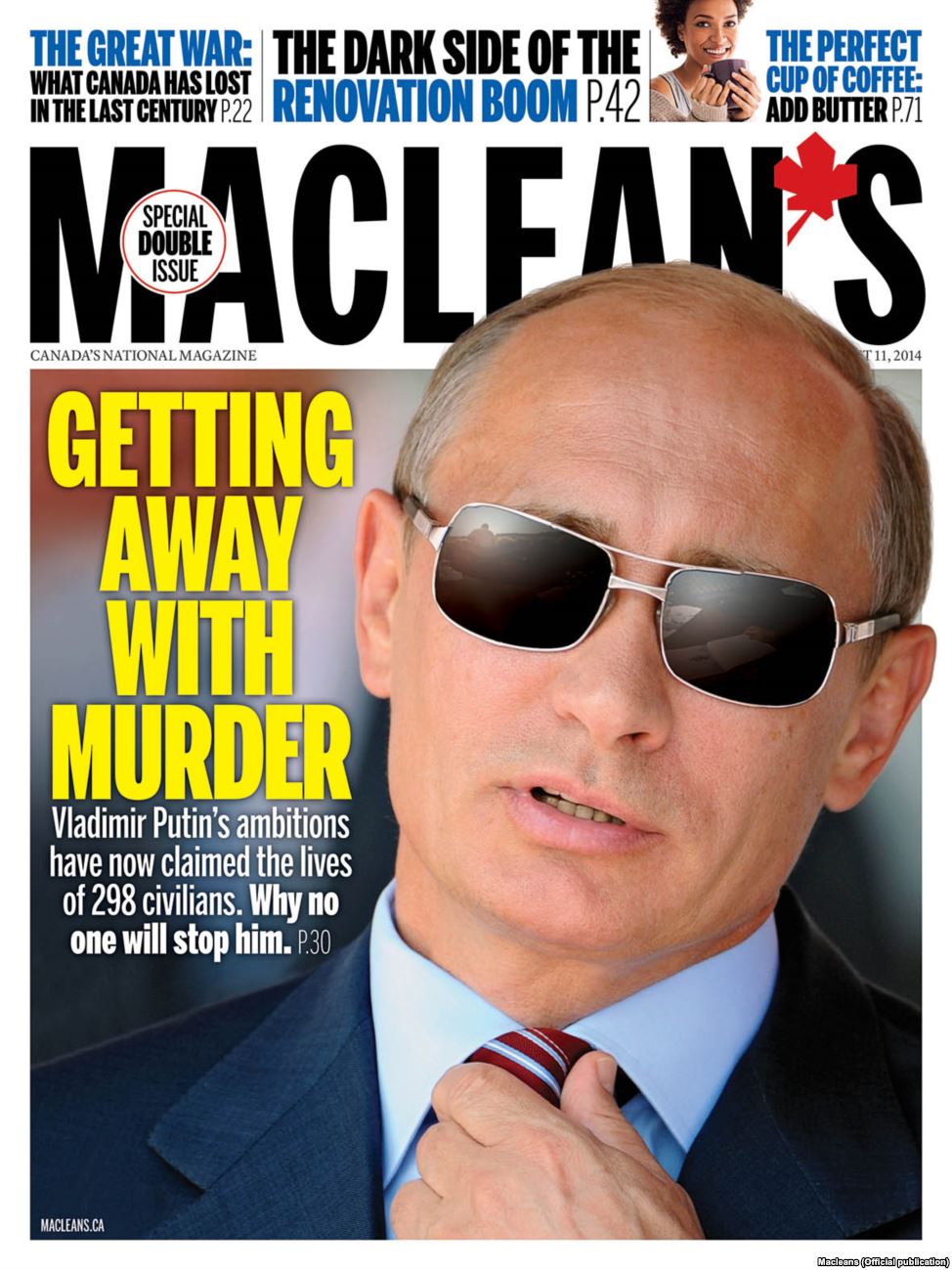
It's a form of conditioning, something we're not very good at detecting. We are being mentally mobilized for war, something that begins by demonizing our adversary.
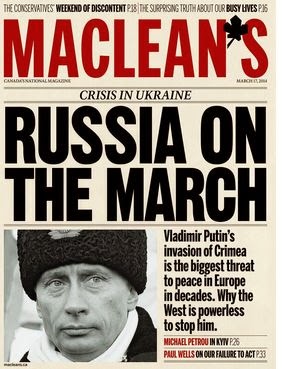
The warning came in the form of an editorial in the German financial paper, Handelsblatt. It offered the chilling observation that, in the wake of the Russian takeover of Crimea, the people of the West were being "mentally mobilized for war."

No mention of NATO's decade long march to Russia's doorstep.

No mention of how Washington fueled the uprising in Ukraine.


"The world has got to a dangerous phase," former Soviet leader Mikhail Gorbachev said in an interview with state news service RIA Novosti on Monday.
Now America seems to be drifting into a muzzle-to-muzzle confrontation with Russia in Syria. Having already been outmaneuvered by Putin in the Syrian civil war, partly a function of America's war fatigue with its 15-year long and no end in sight conflicts in the Middle East, Washington may not have as many options remaining as it would like.

Is the United States trying to provoke war with Russia? Probably not. Is the United States deliberately trying to menace Russia? Absolutely. The map above illustrates how close NATO forces in the Baltics are to Moscow. Imagine a similar deployment of Russian forces that close to Washington. Yet we treat it as tantamount to an act of war when Russia deploys Iskander missiles to its sovereign Baltic territory of Kaliningrad.

This nonsense, this drift, has to stop. We have to revisit the idea that we are responsible for creating the very conditions in which nations have backed themselves into protracted and bloody wars in the past.
Wednesday, October 14, 2015
Could Syria Become the 21st Century Sarajevo?

There were plenty of proxy wars during the Cold War only back then the principals had enough sense to avoid direct clashes. That was then, this is Syria where today we find the rival superpowers circling each other inside the same phone booth.
You could search the world over and never find one place where so many players are gathered as Syria.
First up is the Alawite government of Bashar Assad.
Then there's the original rebels, Syrian Sunnis.
Then we have the Sunni Islamists - the 'moderate' al Nusra, an affiliate of al Qaeda, and the far nastier Islamic State, ISIS.
The United States and its minions have been waging a bombing campaign against ISIS, first in Iraq and later also in Syria. It's been the standard, ineffective "whack a mole" stuff.
Turkey finally got off the fence and began its own air campaign only they're less concerned about ISIS than they are at bombing Syrian Kurds.
The United States was supporting the Syrian rebels with equipment and training until it discovered the rebels were surrendering all that gear to al Nusra and al Qaeda. Can't be having that. So the United States is now supporting Syria's Kurds which is really pissing off Turkey's Erdogan.
Recently three more places have been set at the table of mass mayhem. Here sit Russia, Hezbollah and now Iranian forces all supporting Bashar Assad. Latest word has it that Iran has not only sent in units of the Revolutionary Guard but also a contingent of warplanes. They seem to be focused mainly on the moderate Syrian rebels but they also take on the Sunni Islamists every now and then.
It's hard to keep track of how many nations are waging air wars in Syria. There's the Syrian air force, naturally, its strength replenished by replacement aircraft from Russia. There's the US Air Force and the League of Vassals, America's aerial Foreign Legion that, naturally, includes a Canadian contingent plus strike fighters from France, Britain, Australia and other European states plus Jordan and a half-hearted effort from a few Gulf States.
We want to battle ISIS. The other side seems intent mainly on attacking Syrian opposition rebels. The Turks prefer to bomb Syrian Kurds, the very group the US is still supporting. Nobody is bombing Assad, the guy who sparked the original fighting, and, with the Russians riding shotgun, it's hard to imagine the Western coalition going after him any time soon.
Syria, which is almost the same size as the state of Washington (just over twice the size of New Brunswick), suddenly has an awful lot of warplanes buzzing overhead at cross purposes. The Russians have also introduced their highly lethal S-300 surface to air missile batteries. Turkey, meanwhile, is clamoring for the US and Germany to reactivate their Patriot missile batteries in support of their NATO partner. Eventually someone may fire one of those things.
The Americans have been snookered by Putin and this is bound to have geopolitical ramifications throughout the Middle East. Will the Saudis and the Egyptians tolerate Shiite Iran's military presence in Syria? Will they pile on?
Could Syria become the Sarajevo of the 21st century, the place where a proxy war becomes a shooting war between the West and Russia? Those expert in these matters warn these eyeball to eyeball confrontations are the sort of situations in which rival powers can back into direct conflicts neither one of them truly wants to initiate.
Wednesday, October 07, 2015
As Clear as Mud
In under 2-minutes, the BBC explains who is fighting whom in Syria. It's as clear as mud.
Friday, September 11, 2015
Get Used to It. This Is Just Beginning.

I'll bet we won't be nearly so caring and concerned about this sort of thing ten years from now. Our hearts may harden and our purse strings may tighten.
This Syria business? At its root lies one thing - climate change. Syria got hit with a major drought that triggered severe food shortages. What relief Assad dished out he ensured went mainly to his fellow Allawites, the Shia minority. Left largely to fend for themselves was Syria's Sunni majority. And then it was on.
This sort of unrest is tailor made for exploitation by radicals and, in Syria, that was a perfect opportunity for ISIS to step in. Pretty soon it turned into a Battle Royal with the Syrian rebels, the Syrian government and ISIS all fighting each other, a formula for never-ending Hell on Earth.
In a way, today's Syrian refugees are the lucky ones. They're the first wave and Europe is remarkably opening its doors to accommodate them. Don't expect the welcome mat to be out for the next bunch and the one after that and the one after that...
The former leader of Britain's Liberal Democratic party, Lord Ashdown, warns that, without immediate and drastic action to arrest climate change, the Syrian exodus will be a mere "rehearsal" for a vast humanitarian catastrophe to follow.
“The numbers we now have of refugees fleeing battle zones are going to be diminished into almost nothing when we see the mass movement of populations caused by global warming.”
He said evidence of the impacts of climate change was plain to see: “You need only to fly over some of the areas that are being affected – like the Naga Hills on the border of India and Burma, or vast areas of the Ganges delta – to see clearly what’s happening.”
Tahmima Anam, a Bangladeshi writer and novelist, says that 50,000 people migrate every month to Dhaka, the capital city, because rising sea levels are making their villages uninhabitableand their arable land impossible to cultivate.
In both the UK and the US, military leaders are aware of the growing threat from climate change and expect to be ordered to react to its effects.
Yes, you read that right. Western military leaders are preparing to respond to these challenges, including if deemed necessary, arresting migrations. And, yes, you know what that means. If you don't, get your hands on a copy of Gwynne Dyer's 2008 book, "Climate Wars."
From people I speak with, it's apparent that we're intellectually distanced from this. Sure it's happening but, you know, not here. We're Canada, that forgotten land north of the United States. That is nothing more than whistling past the graveyard and that is hardly a strategy for dealing with a world heading into chaos.
We would do well to heed Lord Ashdown's warning:
“The Syrian crisis is simply a dress rehearsal for an immense climate-fuelled disaster, which I think will begin to be felt within the next decade, perhaps within five or six years from now.”
Asked what his priorities would be for a government facing mass migration of this sort, Lord Ashdown replied: “Once the crisis is upon you, it’s too late to start working out your priorities.
We would do well to heed Lord Ashdown's warning:
“The Syrian crisis is simply a dress rehearsal for an immense climate-fuelled disaster, which I think will begin to be felt within the next decade, perhaps within five or six years from now.”
Asked what his priorities would be for a government facing mass migration of this sort, Lord Ashdown replied: “Once the crisis is upon you, it’s too late to start working out your priorities.
Sunday, August 09, 2015
The Point of No Return?

A friend sent me a link to a Rolling Stone article, "The Point of No Return: Climate Change Nightmares are Already Here." It's a relatively complete and accurate synopsis of the state of our climate-changed world today. Fair warning - it's a dismal read that you may find upsetting before you sit down to Sunday dinner (if you still do that sort of thing). Here's my follow up:
For the first time people in their 30s and younger have to contemplate the possibility that their lives will end not by mishap or natural cause but out of the chaos of climate change.
Some, such as climate scientist and professor, Guy McPherson, who maintains the blog “Nature Bats Last,” have already thrown in the towel. Articles are now appearing about how the main occupational hazard of client science types has become severe depression.
Even in Canada the political response is to talk about vague, “political” targets for reducing emissions by a certain percentage by a certain date in hopes of staying within another “political” number, the 2C target – neither of which is anchored in science. In the result we’re staying behind the problem, never daring to actually get in front of it even though that’s the only place where we can hope to achieve any effective result.
Because we don't know where the point of no return is (if we haven't already crossed it), the only avenue for effective action on climate change requires that we get ahead of the challenge and do everything necessary to stay there. Nothing short of that will work. The current approach will buy as bit of extra time but nothing more.
Our leadership can’t think beyond the notional emissions reduction scenarios. They see this in the context of atmospherics. The equally existential challenge of ocean acidification isn’t even on their horizon.
The most lethal mistake they’re making is to take climate change in isolation, de-linking it from the companion threats of over-population and over-consumption.
At my birth the world’s population stood at the entirely sustainable 2.5 to 2.8-billion level. Now, in just one lifetime, we’re nearing 7.5-billion and heading to 9 by 2050 or earlier. At my birth society, from the developed world to the Third World, had far lower per-capita consumption. Today there are ever more mouths to feed and they are likewise growing ever more voracious in their consumption of resources far beyond our planet’s carrying capacity. Just a decade ago World Overshoot Day fell in mid-October. This year it arrived on August 13.
Natural feedback loops evidence tipping points already crossed. Dr. McPherson, as of last month, has catalogued about 60 of them so far. He concludes that we’ve woken the sleeping giant, nature, and from here on in, our feeble efforts to reduce future emissions are a hollow gesture. I hope he’s not right but I don’t see where he’s wrong.
We debate the rate of climate change onset and the severity of its impacts but rarely in the context of our global civilization’s resilience to endure or even survive them. We’re doing next to nothing on adaptation. While Calgary was flooded, much of the city underwater, an annual symposium of an engineering group dealing with natural disasters was held in Toronto (which had itself been flooded weeks earlier). One of the leading experts, a professor emeritus from McGill, suggested Canada is in dire need of new and reinforced infrastructure that he estimated would cost upwards of a trillion dollars. Instead our federal government is budgeting a meaningless $50-million a year which doesn’t keep up to the ongoing decay.
The simple fact is we’re not resilient. To the contrary, the rise of
today’s global civilization over the past 30-years has been built on defying the
need for resilience, rejecting posterity. Ours has become a world of maximized
production/maximized consumption in which the guiding philosophy has become “I
can so I will” and rejects any notion of whether we “should.” We institutionalize people who think that way - some are criminals, some are lunatics. Some we elect to Parliament.
In March, the UN Food and Agriculture
Organization (FAO), released a study that found most of the planet’s arable
farmland will be gone in just 60-years, the victim of the intensive, industrial
agriculture we practice in order to feed today’s 7+ billion people. I had read
about this in an online course I’d taken on global food supply a month or two
earlier. Even good farmland, as in Europe and North America, is already somewhat
degraded and the use of chemical fertilizers, pesticides and herbicides is
stripping the soil ever faster.
Sure, food production is at record levels but that's obscuring the important part. We're producing this volume of food through intensive agriculture and chemical conjuring tricks associated with industrial agriculture that are depleting the very soil growing this bounty. And we're utterly dependent on that. It's not like we can quit and let nature recover. That's not an option until we're prepared to allow an enormous percentage of our global population simply die (with the proviso that we'll somehow manage to survive the world war(s) that this triggers).
I have no doubt that this is going to be on us far sooner than we imagined and we’re facing a fairly sudden collapse. Our societies, that collectively constitute our global civilization, are already astonishingly unbalanced and it won’t take much to tip us over. When Iran records a “wet bulb” temperature of 74C and the dry temp in Baghdad hits 53C where do you imagine this is going. And, of course, this year we’re in store for a super El Nino which causes global temperatures to spike even higher. These are impacts that can destabilize countries, exacerbate old tensions - ethnic, social, religious - triggering unrest and conflict. The devastating war in Syria arose out of the impacts of severe drought.
Several years ago it was found that, as we eject ourselves from the Holocene and get sucked into the Anthropocene, we would embark on a temperature regime in which every year would be hotter than the hottest year experienced in the previous 150-years. Every year. It's predicted to begin around 2020, first in the Caribbean, and overtaking every other nation by 2047. That may have already begun. That will, of course, result in a super-heated atmosphere which, with ever greater surface evaporation and transpiration, will sharply increase atmospheric water vapour, the most powerful greenhouse gas of them all and usher in a new paradigm of severe storm events of increasing frequency, intensity and duration. And yet we are and apparently intend to remain mortally dependent on infrastructure that is aged, rapidly deteriorating and, in any event, designed to meet the needs of a climatic age that’s long gone.
It would be nice to believe that we're finally playing catch up but we're not. We haven't even identified where we have to be and by when in order to catch up and, without that, the idea of ever getting ahead of these challenges before we get overtaken by devastating events is a grand and dangerous delusion.
Monday, May 11, 2015
The Final Chapter for Bashar Assad

Things are not looking up for Syrian strongman, Bashar Assad.
His first problem is the Sunni Muslim coalition of Turkey, Qatar and Saudi Arabia (ordinarily not the best of friends) that has materialized for the sole purpose of running Assad out of Damascus.
The advances are not only a sign of the Assad regime's weakness, said Mario Abou Zeid, a research analyst with the Carnegie Middle East Centre, but also indicative of the strength of the new alliance between the three Sunni power brokers.
Their desire to force a shift in the balance on the ground in Syria before further negotiations about the country's future are held to have finally over-ridden long-held regional differences, he said.
"This regional group has forced those opposition groups and various factions fighting on the ground to fight under one umbrella," he said.
"By creating this 'Army of Conquest' and by supporting it, having the Nusra Front as its main pillar and surrounded by the remnants of the Free Syrian Army as well as groups such as Ahrar al-Sham, Jaish al-Islam and others, this type of cooperation … has been a tremendous success."
The model is now being copied in areas such as the Qalamoun – the mountain ranges between Lebanon's Bekaa Valley and Syria – where opposition forces this week began a fierce battle against the Islamic State, Syrian regime forces and the Hezbollah militants fighting alongside them. This is a three-sided conflict - on one side are the Nusra Front and its allies backed by Qatar,Turkey and Saudi Arabia, on the second side are Hezbollah, the Syrian regime and Iran and on the third side is the so-called Islamic State.
Assad also faces the threat of a coup. The president has already arrested his spy chief, Ali Mamlouk.
Mr Assad is struggling to keep together the regime's "inner circle", who are increasingly turning on each other, sources inside the presidential palace said.
Even before Mr Mamlouk's arrest, the web of intelligence agencies with which the regime has enforced its authority for four decades was in turmoil, with two other leaders killed or removed.
Last month, Rustum Ghazaleh, the head of the political security directorate, died in hospital after he was attacked by men loyal to General Rafiq Shehadeh, his opposite number in military intelligence, who was in turn sacked.
Worst of all, Der Spiegal reports that Assad is running out of troops and has been forced to recruit mercenaries, now mainly from Afghanistan.
In order to prevent the collapse of Syrian government forces, experienced units from the Lebanese militia Hezbollah began fighting for Assad as early as 2012. Later, they were joined by Iranians, Iraqis, Pakistanis and Yemenis -- Shiites from all over, on which the regime is increasingly dependent. But the longer the war continues without victory, the more difficult it has become for Assad's allies to justify the growing body count. In 2013, for example, Hezbollah lost 130 fighters as it captured the city of Qusair and has lost many more than that trying to hold on to it. Indeed, Hezbollah has begun writing "traffic accident" as the cause of death on death certificates of its fighters who fall in Syria.
The Iraqis have almost all returned home. Rather than fighting themselves, they largely control the operations from the background. The Iraqi militia Asa'ib Ahl al-Haq, for example, organizes the deployment of Pakistani volunteers in Syria. But no ethnic group is represented on all of the regime's fronts to the degree that the Afghan Hazara are. Exact numbers are hard to come by, but some 700 of them are thought to have lost their lives in Aleppo and Daraa alone. What's worse, most of them don't come completely on their own free will.
It's hard to ever count a guy like Assad out but his regime does appear to be unraveling even as his opposition coalesces into something far more effective. Will this coalition dissolve once Syria is sorted out or will they continue to reduce ISIS in the field?
Thursday, April 02, 2015
"Whack a Mole" is No Way to Wage War.

We spent a decade in Afghanistan playing whack-a-mole, essentially achieving nothing. We had no coherent vision of what 'victory' might even look like much less how it could be achieved. In the result we never committed anything remotely like the size force that would have been necessary to keep the insurgents at bay in Kandahar province long enough for the government to establish its authority there.
Now we're in for a bombing campaign against ISIS forces in Iraq and Syria. What are we trying to achieve or is this just more whack-a-mole? Now ISIS is in all sorts of places where we're not even thinking of bombing their forces - Yemen, some of the Gulf States, several North African countries, Indonesia, Pakistan, even - gulp - Afghanistan.
We're supposedly bombing ISIS because it, if anyone really knows what that constitutes, has declared war on Canada. What, in a YouTube video? That's all we need to spend half a billion dollars on a bombing campaign? Oh, I know, they did mention the West Edmonton Mall and everything. Sounds awfully ominous to me.
Just explain to me how a six pack of CF-18s flying out of Kuwait can deter an attack on the West Edmonton Mall? Surely we would have to defeat ISIS outright to eliminate that threat. Yet we're not even pretending that we're going to do that, nothing remotely close. We're not bombing them in Yemen or the Gulf States. We're not bombing them across North Africa or in Indonesia, Pakistan or Afghanistan. We're not even inflicting losses on them approaching the rate at which they're attracting recruits.
As I wrote a few days ago, our approach to fighting our declared enemy, ISIS, is very much akin to the Brits thinking they could defeat Hitler by liberating the Channel Islands. So what in the name of Thor is the purpose of this nonsense?
If anything, we're doing just enough to get them sufficiently pissed off with us that they might actually figure it's worthwhile to bomb the West Edmonton Mall and, if they do, I'm sure I'll be sorry they got to it before I did.
Of course Harper never does anything without a collateral purpose and it's way past obvious that he's using his personal, mini-war on terror, to avoid his voters noticing just what a mess this belief-based prime minister has made of the Canadian economy.
This is not the first time that Harper has used "the troops" for his partisan, political advantage.
Oh yeah, one other thing. Randy, the beached cod, Hillier stood up on his tail fin recently to condemn Parliamentarians who missed the vote on the ISIS mission expansion/extension. Randy, a bit of self-criticism coming from you would be really refreshing at this juncture. Why don't you explain how you made such a complete botch-up of our minuscule "mission" to Afghanistan? What were you smoking when you assumed Canada could tackle the combat mission in all of Kandahar province with a piddling garrison force of just 2,500 soldiers? Why did our numbers remain static as the Taliban's numbers in Kandahar soared over those wasted years? What made you think you could defeat a determined insurgency with a minute garrison force anyway? I remember when I first saw you. It was when you were interviewed after conning the Martin government into the Kandahar combat gig when you assured Canadians we were going over there to wipe out "a few dozen... scumbags." You were full of shit then, you've been full of shit ever since and you're full of shit now. Sit down and STFU, if you please.
So, we're back into whack-a-mole warfare and we're bound to achieve as much as whack-a-mole warfare ever can or does. I think most of us cannot bring ourselves to grasp the notion that Canadian forces were decisively defeated in Afghanistan. We did not achieve our objectives and when we fled the field, 'they' were still in charge. Sorry, but that's defeat.
Can somebody remind me, what is it that follows Hubris anyway?
Sunday, March 29, 2015
That Burnt Smell, That Hissing Sound? That's the Fuze.
 |
| Ready to Rumble |
Obama and the Euros are trying to calm the situation, urging a negotiated peace between Yemen's Sunni government and the Houthi rebels but, according to the ICG, the mixed up gaggle of players aren't in the mood for talking.
No major party seems truly to want to halt what threatens to become a regional war. The slim chance to salvage a political process requires that regional actors immediately cease military action and help the domestic parties agree on a broadly acceptable president or presidential council. Only then can Yemenis return to the political negotiating table to address other outstanding issues.
The Huthi-Hadi divide is the most explosive, but it is not the only conflict. Tensions are also unsettling the recent marriage of convenience between the Huthis and former President Ali Abdullah Saleh, who, after being deposed in 2011, has taken advantage of popular dissatisfaction and tacitly allied himself with the Huthis against their common enemies to stage a political comeback through his party, the General People’s Congress (GPC), and possibly his son, Ahmed Ali Abdullah Saleh. Divisions in the south, which was an independent state prior to its 1990 union with the north, are rampant as well. Southern separatists are internally split and suspicious of Hadi, a southerner who supports continued unity with the north. Then there are al-Qaeda and a nascent Islamic State (IS) movement, both determined to fight the Huthis and take advantage of the state’s collapse to claim territory.
...GCC [Gulf Cooperation Council - the Sunni Arab states] countries have lost faith as well and are increasingly committed to reversing Huthi gains at virtually any cost. Saudi Arabia considers the Huthis Iranian proxies, a stance that pushes them closer to Tehran. Throwing their weight behind Hadi, the Saudis moved their embassy to Aden and reportedly bankroll anti-Huthi tribal mobilisation in the central governorate of Marib and the south. They lead efforts to isolate the Huthis diplomatically, strangle them economically and, now, weaken them militarily. In turn, the Huthis denounce Hadi as illegitimate and offer $100,000 for his capture. They have conducted military exercises on the Saudi border and likely will harden their position in response to Saudi military intervention. They are less dependent on Tehran than Hadi and his allies are on Riyadh, but on today’s trajectory, their relative self-sufficiency will not last long. They are already soliciting Iranian financial and political support.
...Without minimum consensus within and beyond its borders, Yemen is headed for protracted violence on multiple fronts. This combination of proxy wars, sectarian violence, state collapse and militia rule has become sadly familiar in the region. Nobody is likely to win such a fight, which will only benefit those who prosper in the chaos of war, such as al-Qaeda and IS. But great human suffering would be certain. An alternative exists, but only if Yemenis and their neighbours choose it.
This is a perfect example of what's being called "new war." It's a furball of state and non-state actors. Governments, including outside nations, rebels, insurgents, militias, terrorists and criminal organizations. It's a very fluid type of warfare that commonly features shifting alliances among the parties and widely differing and at times irreconcilable political and territorial objectives. In the context of a negotiated peace, it really is the equivalent of herding cats.
We're not built for this stuff. We like our combat "old war" style. Good guys versus bad guys; winners and losers; war and peace. We don't know what to do when peace is not a realistic option, certainly not an outcome we can dictate. That's when we do what we Westerners have been doing since Algeria and Viet Nam. It's what we did in Afghanistan and Iraq and it's partially responsible for the hot mess that is the Middle East today. We go into a place, toss it over, hang around for a decade or so and then leave. We cannot accept, despite our persistent lack of success, that we're on a path to near certain failure. It's right there in the user guide - our side gets to win. End of story. What, can't these people read?
UPDATE - The United Nations has thrown in the towel, pulling all UN personnel out of Yemen, a measure that's seen as dashing all hopes of a negotiated deal of any sort.
One other thought. If this business in Yemen is the opening salvo in a grand, Sunni versus Shiite regional war, let's hope Harper has plans to get our people out of the Middle East on short notice. If this thing blow up, everyone might start looking like the enemy.
One other thought. If this business in Yemen is the opening salvo in a grand, Sunni versus Shiite regional war, let's hope Harper has plans to get our people out of the Middle East on short notice. If this thing blow up, everyone might start looking like the enemy.
Saturday, February 21, 2015
You'll Need More Than a Six-Pack for That Job.
 |
| Well, that was the idea anyway. |
Brace yourselves. In a move that could send chills down the spine of every member of ISIS, it's been revealed that Canada is 'considering' expanding its war effort to Syria and, gasp, Libya too.
Libya? That's that place that Gaddafi guy used to run. We bombed the hell out of him three or four years ago. It was "mission accomplished" all around. We even had a victory flypast over Ottawa brought to you by the ever-triumphalist Harper government.

I know we won because Steve and Mrs. Steve and Peter MacKay and that Army guy and Steve's ceremonial valet all gathered on the front steps of the Centre Block to bask in the glory of our great victory.

Except it turns out that the Canadian Armed Forces, under Steve's management, proclaim victory a lot more than they achieve it. But how were they to know that, by dragging out the air war in Libya by a staggering 161-days, they would leave the place in a state of chaos just perfect for al Qaeda and, eventually, ISIS to get established in North Africa.
So now we're tossing the idea around of another grand victory in Libya, Syria too, in an expansion of "our" war against ISIS. I know because our newly minted Defence Minister, the oh so martial Jason Kenny, said as much to CBC's Evan Soloman.
Not only that but our Closet Clausewitz says there's 2,000 other countries ready to stand up with us.
"Obviously there are practical limits to our ability to operate around the world, but we will look at our options to see where we can have the most impact, where we're most needed," he said. "That requires ongoing consultation with our allies. We don't just decide these things unilaterally."
"Obviously we're in Iraq at the invitation of that government in a mission of, I think, over 2,000 countries being coordinated by the United States. If we can help meaningfully in the fight against ISIL elsewhere we'll give that consideration," the minister said.
Jason, this one is for the luxury lawn furniture set and the Caribbean cruise. Name 500 of those 2,000 countries and their capitals. (psst - don't tell Wiki. they think there's only 206 countries, the damned fools.)

Yes, Jason, you hit it on the head when you pointed out that, "there are practical limits to our ability to operate around the world." Your government has slashed our defence budget to levels not seen in generations. You have given Canada a navy smaller than at any time since prior to WWII. Our aircraft and helicopters are old and worn out. When we do go to defend the Baltics or bring the Hammers of Hell down on the heads of ISIS, we send a paltry six-pack of CF-18s because it's all we can afford. There are practical limits and your government's neglect has been setting most of them.
Sunday, November 23, 2014
It's Called "Blowback"

Our confused, incoherent, even knee-jerk response to ISIS appears to be backfiring on us, at least in Syria. There, it's reported, US air strikes are driving anti-Assad groups - outfits we've supported like the Free Syrian Army - into the arms of ISIS.
US air strikes in Syria are encouraging anti-regime fighters to forge alliances with or even defect to Islamic State (Isis), according to a series of interviews conducted by the Guardian.
Fighters from the Free Syrian Army (FSA) and Islamic military groups are joining forces with Isis, which has gained control of swaths of Syria and Iraq and has beheaded six western hostages in the past few months.
Some brigades have transferred their allegiance, while others are forming tactical alliances or truces. Support among civilians also appears to be growing in some areas as a result of resentment over US-led military action.
“Isis now is like a magnet that attracts large numbers of Muslims,” said Abu Talha, who defected from the FSA a few months ago and is now in negotiations with other fighters from groups such as the al-Nusra Front to follow suit.
Assam Murad, a fighter from a 600-strong dissident FSA brigade near Homs said: “There’s no way we would fight Isis after the US military campaign against them.”
Some Syrian resistance fighters find the American policies more than hypocritical:
Omar Waleed, an FSA fighter in Hama, north of Damascus, said: “I’m really scared that eventually most of the people will join Isis out of their disappointment with the US administration. Just have a look on social media websites, and you can see lots of people and leaders are turning to the side of Isis.
“We did not get any weapons from the US to fight the regime for the last three years. Only now US weapons arrived for fighting Isis.”
Once again, All the King's Horses and All the King's Men, aren't really getting the job done. We've become accustomed to this "just add water and stir" sort of warfare where we send six warplanes here and six warplanes there without much regard for what they can accomplish or how. Consider it warfare by gesture.
Oh well, ISIS or FSA, they're all Arabs. I suppose we were bound to get around to bombing them sooner or later anyway.
Thursday, November 06, 2014
When My Enemy's Enemies Are Still My Enemies

One of the greatest mistakes we make in the conduct of modern warfare is to make our conflicts suit a politically palatable narrative. It can seem as though the spin doctors are as powerful as the generals which might explain why they seem to do an equally marginal job at it.
We went to war in Afghanistan with a fairly powerful narrative about al Qaeda and the Taliban that was, at first, highly persuasive to the public. They practically demanded that we wipe them from the face of the Earth. Then, because the narrative was at odds with the facts, we gradually lost interest. After a decade of full contact "Whack-a-Mole", we loaded up our shipping containers and left.
The Talibs are back in force in Afghanistan. al Qaeda used Washington's invasion of Iraq to re-invent itself and, since then, has spawned a network of franchise operations that extends to the westernmost regions of North Africa.
Iraq. Oh, that's right. Western forces hung around there for years, nurtured a brutal and corrupt sectarian government that could never hold the place together, and, as is our way, got bored and left.
The flavour of this year is ISIS, the Islamic State. President Obama has given the US and America's Foreign Legion (that includes us) our marching orders. We're to bomb ISIS into fragments from the skies over Iraq and, maybe, Syria.
To justify our current war we need a narrative of ISIS as a rabid, bloodthirsty band of religious fanatics intent on creating a Caliphate to rule the region and, ultimately, the world. Take down ISIS and problem solved. Except that, as usual, the narrative is at odds with the facts.
ISIS isn't the real problem. It's a symptom of a nascent, Shiite versus Sunni religious war, a sectarian Muslim holy war, that reaches beyond the borders of Syria and Iraq and already reaches into Pakistan, Iran, Lebanon and Saudi Arabia and could spread even farther.

A Shiite village in Sunni-dominated Saudi Arabia was attacked by Sunni militants. The House of Saud is deeply worried about the country's Shia minority who are the majority in the same areas as many of the country's best oil reserves. The Saudis fear Iran could move to annex its Shiite minority region (as the Russians did in Ossetia and Crimea). From Lebanon's Daily Star:
With civil wars in Iraq and Syria now being fought along mainly sectarian lines, Saudi Arabia's Shia minority feels increasingly vulnerable in a country where anger is rising among the majority sect at the plight of Sunnis in other countries.
Sunni jihadis now speak about Shiites as the greater enemy to members of their sect than the Western governments that were formerly their most hated foes. The Saudi government has done little to stem a corresponding upsurge of provocative language there.
"For sure criticism of Shiites by clerics and religious television stations creates the atmosphere where this can happen. In our own schools the teachers tell our cchildrenthat we are not Muslims," said a witness of the shooting who did not want to be named for fear of repercussions.
Of course this isn't just a Sunni versus Shiite sectarian war. It's fundamentalist Sunni Islam, of the type practiced by the sheikhs and princes of the Gulf States, versus moderate Sunni Islam, Christians and other groups too. The Kurds of Iraq and Syria now engaged in heavy fighting against ISIS are a perfect example.
And a pot this full is almost too tempting for others not to stir. The Lebanese accuse Israel and the Sunni extremists of trying to spark a civil war to bring down their country.
Israel and Islamist militants are seeking to ignite civil war in Lebanon, General Security head Abbas Ibrahim wrote in an editorial published Thursday.
"Independence Day arrives while Lebanon battles the odds ...in an ordeal not destined to end until [Lebanon's] inevitable victory in the battle for existence and identity in the face of organized terrorism, which is seeking to ...strike at its elements of existence through inciting [sectarian] strife and setting the stage for a civil war by targeting the military institution and other security agencies."
"Zionism is equally as dangerous [a threat] as takfiri terrorism," he said.
Without naming them, Ibrahim said takfiri groups - clearly indicating ISIS and the Nusra Front - in addition to Israel have similar objectives, while each party "is trying to strengthen its status."
Israel is tacitly allied with Saudi Arabia and the Gulf States in opposition to Iran. What Saudi Arabia is really up to was conveyed by Prince Bandar-bin-Sultan to the former head of Britain's MI6, Sir Richard Dearlove.
Some time before 9/11, Prince Bandar bin Sultan, once the powerful Saudi ambassador in Washington and head of Saudi intelligence until a few months ago, had a revealing and ominous conversation with the head of the British Secret Intelligence Service, MI6, Sir Richard Dearlove. Prince Bandar told him, "The time is not far off in the Middle East, Richard, when it will be literally 'God Help the Shia.' More than a billion Sunnis have simply had enough of them."
Somebody recruited, trained, armed and funded ISIS. Who could that be? One of our confusing pack of allies perhaps? Almost certainly. We know that ISIS has been lavishly funded by the affluent sheikhs and princes of Saudi Arabia, Kuwait and Qatar. It's the same bunch that raised al Qaedsa and ISIS and will raise the next gang of radical Islamists we'll have to fight. And these are our allies.
The old "my enemy's enemy" business no longer applies in the Middle East. We have no allies worthy of the name. We seem to be getting dragged into a sectarian bloodbath we can't control and certainly cannot fix. We may be bombing the Sunni fundamentalist outfit, ISIS, at the moment but we didn't fail in Iraq or Afghanistan for want of bombs. If anything we demonstrated, again and again, that All the King's Horses and All the King's Men are far from decisive in these confused conflicts.
We have gone into a war - again - on the strength of a narrative at odds with reality and that, naturally makes almost no sense. It is a hallmark of the truly miserable calibre of political and military leadership we endure today.
If we really want to show the flag by bombing the hell out of someone, let's go where we might actually do some good. Let's defend Lebanon.
Friday, October 17, 2014
The Madness of King Stephen

As excuses for war go, claiming a conflict to be "noble" is really scraping the bottom of the barrel. It's something you resort to when there's simply nothing left to pull out of your ass. "Squires, attend your Lords. Summon the Heralds. To the jousts! Ah, there's a noble scent to the air."
Perhaps Harper had to call our adventure in Iraq noble because the default option would have been "insane." Insane in the popular sense of doing the same thing over and over and expecting a different result. It's that sort of insane.
Over at Foreign Policy, Harvard international relations prof, Stephen Walt, serves up an op-ed, "Uncle Sucker to the Rescue," in which he explains that Obama is repeating the same mistakes that have plagued American excursions in the Middle East for decades. While Walt focuses on Obama, his views do help make some sense of Harper and his Quixotic quest for a noble war.
Ever since the first Gulf War, U.S. leaders have routinely exaggerated the threat that the United States faced in Iraq and/or Syria. ...Why is threat inflation a problem? When we exaggerate dangers in order to sell a military, we are more likely to do the wrong thing instead of taking the time to figure out if a) action is really necessary and b) what the best course of action might be. When a great power gets spooked by some grisly beheadings and decides it just has to "do something," the danger is that it will decide to do something unwise.
A recurring problem in the conduct of U.S. foreign policy has been the insistence that no problem can be solved if Uncle Sam isn't leading the charge. By portraying IS as a direct threat to America and by rushing to attack it, however, we are telling the Iraqis, Kurds, Turks, Saudis, and everybody else that the cavalry is on the way and that they don't need to do much themselves. No wonder we can't get the Shiite-led government in Baghdad to be less corrupt, more inclusive, and more effective; no wonder we can't get Turkey to focus on IS instead of the Kurds; and no wonder we can't get the Saudis to do more to stop the flow of money and poisonous ideas to extremist groups. Simple equation: The more Washington promises to do for them, the less our local partners will do for themselves.
...Frankly, after all the resources we've poured into Iraq and Afghanistan, and the meager cooperation we got from our putative allies there, I would think America's "staying power" wouldn't really be an issue. Instead of pouring good money (and possibly U.S. lives) down that particular rat hole, I'd like to see the people who are most directly affected start fighting this one for themselves. Unless the Turks, Jordanians, Kurds, and other Iraqis are willing to get their acts together to contain these vicious extremists, even a protracted and costly U.S. effort will amount to little.
Sorting Out Conflicting Priorities
...the neoconservatives in the Bush administration hoped that toppling Saddam would be the first step in a campaign to transform most of the region into a sea of pro-American democracies. Once it became clear that Iraq had no WMD program, the goal of spreading "liberty" throughout the region took on greater salience. This objective led U.S. officials to focus more attention on holding elections than on achieving genuine reconciliation or creating political institutions that actually worked. Plus, we had no idea what we were doing.
A similar problem afflicts our efforts in the region now. Is it more important to defeat IS, remove Bashar al-Assad from power in Syria, or keep Iran isolated and halt its nuclear program forever? Because these goals are inherently contradictory -- weakening IS helps Assad, cooperating with Iran against IS might require compromising more on the nuclear issue, etc. -- it is almost impossible to pursue all three simultaneously. But I can't tell which of these (and other) goals the Obama administration regards as most important. And if we keep trying to pursue all three, we probably won't achieve any of them.
Today, the Obama administration seems surprised that the Turkish government is more worried by Kurdish nationalism than by IS, and that many Sunnis in Anbar think Baghdad and various Shiite militias are a greater threat than IS is. The reality is that other states, tribes, sects, and groups have their own interests, and those interests don't conveniently coincide with the prevailing orthodoxy in Washington, D.C. That doesn't mean their view is right and that U.S. politicians are wrong, but successful diplomacy has to start by recognizing that no two states see things exactly the same way and others sometimes understand their own interests better than we do. Then, you have to work to find whatever common ground might exist. And if there isn't enough common ground to make the strategy work, be ready to walk away.
The final error -- sadly, one all too typical of recent U.S. foreign policy -- is that we are promising the moon and delivering moon pies. The Bush administration promised that the invasion of Iraq would be short, easy, and would pay for itself. Bush also told us the United States would eliminate all "terrorists of global reach." Trying to eliminate a particular tactic used by many diverse groups was a fool's errand, especially when U.S. military intervention tends to reinforce the extremists' narrative and helps them replenish their ranks with new recruits. The United States is still in Afghanistan today -- and so are the Taliban -- and it is congratulating itself on convincing the Afghan government to let us stay for a few more years. And now we are headed back into Iraq. Osama bin Laden may be dead and gone, but the endless war that he foresaw would sap U.S. strength and weaken existing Arab governments is still underway.
...Obama now promises to "degrade and destroy" IS. He is succumbing to the same tendency to overstate what U.S. military power can accomplish in this context. Air power alone cannot "destroy" IS, because it is too imprecise an instrument and because the extremists can blunt its effectiveness by dispersing its own forces and mingling with the local population, thereby producing an unacceptable risk of civilian casualties. We can try training the Iraqi army again and we can back various Iraqi tribes and militias, but our earlier training efforts clearly failed and our experience in Afghanistan suggests that this is more likely to lead to warlordism and renewed sectarian fighting than it is to produce a stable political order.
The bottom line. It's a regional war being waged, to the suiting of both sides, by Western infidels. The people who could put a lasting end to it aren't there - the Saudis, Egypt, the Gulf States. They've got soldiers and tanks right up the yin-yang sitting back in their barracks watching endless reruns of old Eurovision contests.
The oil sheikhs and princes are quite content to see the West dragged into an indefinite skirmish in Shiite-leaning Iraq and Syria even if we may leave their latest Frankenmonster, ISIS, a bit bruised and battered. We have demonstrated that our "All the King's horses and all the King's men" style of war-waging, the "noble" kind is never decisive, never yields a worthwhile outcome.
I wonder if they think we're mad? I wonder if they're counting on it?
Saturday, October 11, 2014
What Are We Getting Ourselves Into?

Before long the Middle East will look like a parking lot for Western jet fighters. The place will be awash in Hornets and Super Hornets, F-16s, F-22s, Eurofighters and Rafales and Tornados. They'll be flying about over Syria and Iraq searching for something, anything to bomb into rubble and pulp.
Nobody thinks that airstrikes are going to win this "conflict" with IS or ISIS or ISIL or whatever they happen to be called this week or next. We'll run out of targets first. Then what?
The job unfinished, we will probably succumb to "mission creep." Airpower didn't do the trick, let's switch to the ground game. It will be sold to us as a choice in which we have no other choice. We'll do it because we must.
At this early point it's timely for us to dwell a bit on just what we've gotten ourselves into. Is this a war or, as I suggested a few days ago, just a bunch of battles strung together a bit incoherently? Do we have an actual enemy or are we just banging away at the group fronting for the actual enemy we work so hard to avoid recognizing?
Are we standing, unaware, on the very edge of WW III? That's not my question but it is being asked in some very high places.
Dr. Anthony Cordesman, of the Centre for Strategic and International Studies, rebukes the US in a paper he published on Thursday. On the great difficulty of implementing coalition-based strategy, he writes: "This is particularly true when the US fails to honestly address its own problems and mistakes, minimises the costs and risks involved, and exaggerates criticism of its allies."
...But ask him about that Franz Ferdinand moment and suggestions pour out of him. Syria could shoot down a Turkish aircraft; the humanitarian dimension could be messed up; human displacement - "you can surely count on people to not understand that intervening to deal with a few thousand people can displace hundreds of thousands"; if IS advanced to a position from which it "threatened all of Iraq"; Iraq's Sunnis could refuse to co-operate with the new Shiite dominated government in Baghdad; if violence broke out between Turkey and its Kurdish minority and Iraq's Kurds attempted to join in; if the Assad government in Syria was to stop up its bombing of rebel forces "it could become a political problem too big to ignore"'; and lastly, if IS was to lash out with a campaign of terrorist attacks that would provoke demands to escalate the coalition campaign.
"Fully agreeing" with the idea that the conflict has been miscast as war in two countries, rather than as a regional or even bigger conflict, veteran White House adviser and CIA analyst Bruce Riedel's response to questions was a dire email in which he posits the current crisis in a seriously global framework.
"Al Qaedaism, the ideology, is stronger today than ever, thanks to the failure of the Arab Spring [which we welcomed] and the battlefield has expanded from Mali to Pakistan and beyond to Australia and Europe," he writes.
"The worst nightmare for me is a terror attack that provokes Indo-Pakistan war; second, is a Mubai-like attack in a Western city."
Another veteran observer of the region warns this is going to take years, possibly decades to play out and during that interval could well spill out across the Middle East/South Asia region.
"There is a serious risk that the entire region will blow up," Lakhdar Brahimi warned in an interview with Der Spiegel magazine, in which he predicted dire consequences for Syria, Iraq, Jordan and Lebanon. "The conflict is not going to stay inside Syria. It will spill over into the region. It's already destablising Lebanon [where there are] 1.5 million refugees."
Analysing the global misreading of how events might unfold in Syria, Brahimi harped back to an earlier assignment in his career": "It reminds me a lot of 1999 - then, I resigned from my first assignment as a UN special envoy to Afghanistan, because the UN Security Council had no interest in Afghanistan, a small country, poor, far away. I said one day it's going to blow up in your faces - it did [and] Syria is much worse."
And as for the notion implicit in the rhetoric of Obama and his coalition cheerleaders, that Syria somehow is to be rescued by and into the civilised world, Brahimi thinks otherwise - "It will become another Somalia. It will not be divided as many have predicted. It's going to be a failed state, with warlords all over the place."
Subscribe to:
Posts (Atom)