Showing posts with label NDP. Show all posts
Showing posts with label NDP. Show all posts
Tuesday, May 07, 2019
A Green Wave? No, But Possibly a Green Ripple.
It was just a by-election. Even if the governing party had an outside chance (it didn't, the Liberal brand out here rarely is competitive) voters "punish" the part in power in by-elections or so goes the claim.
This is generally reliable NDP territory. Up my way the Conservatives dominated for a while but this riding is also now held by the New Dems.
So perhaps it shouldn't be surprising that the Liberals came a dismal fourth in a seven candidate field.
It's hard to tell whether yesterday's release of the UN report on the looming biodiversity crisis had much impact on the voting but it couldn't have helped the mainstream parties much.
Then there's Trudeau's pipeline. I would love to think the Liberals' drubbing reflected a bit of that discord.
In a blatant display of electoral cowardice the Trudeau government has been tossing around the idea of withholding its decision on the Trans Mountain pipeline expansion until after the general election in October. Hmm, I wonder what that's all about? Duh. For that perfidy alone the Liberals should be driven out of every riding in British Columbia.
Sorry, Grits, but your guy had his chance. We even fawned over him when he went surfing at Tofino. Sooo dishy. Only he turned into a dud. He's such a pale shadow of the Trudeau we knew and liked and, even those that didn't like him, respected. Hard to respect this guy with his patronizing speeches delivered in school marm style.
As for the NDP, well Jagmeet did chum the waters for his party's candidate. Even Maxime had his PPC lawn signs everywhere, often eclipsing all the other parties'. Far right lunacy doesn't sell too well out here.
What does this mean for my party, the Greens? It's a morale booster, for sure. It draws attention to the Greens as an alternative to what I call the "old school" parties and inspires hope for much greater gains in October. Too many still think of the Greens as a single-issue movement, a predictable lie spun by party hacks all too well steeped in prevarication.
For me, and I suspect plenty of others, that whole "strategic voting" ploy is over. Don't tell me that a vote for the Greens is a vote for Scheer. No it's a vote for the Greens. Slag the Greens as much as you like but look at yourself in the mirror first.


Sunday, March 24, 2019
Instead of Whinging About Boomers, Explain Yourself.

Millennials and Gen-Xers are fond of blaming the Boomer generation for their woes. Cheap talk from people who vote for parties that keep the Canadian petro-state locked into fossil fuels. That means young-ish Conservative supporters, and young-ish Liberal supporters, their NDP counterparts to boot.
Don't complain about your condition, don't blame others, if you wish to support those who have delivered your fate. The Liberals we Boomers supported are not the wet cardboard Liberals of today. We supported the Liberal Party of Laurier, St. Laurent, Pearson and Pierre Trudeau, not this sham of a party that now holds power.
So many of this new bunch like to brand themselves "progressives" but there's nothing remotely progressive in supporting those parties, not with the looming danger of plunging the world into catastrophic climate change just 12 years off.
What is progressive in a leader who lavishes solemn promises to win votes only to discard them, one by one, after he has succeeded in duping a hopeful public?
A broken promise is bad enough in private life. It is worse in the field of politics. No man is worth his salt in public life who makes on the stump a pledge which he does not keep after election; and, if he makes such a pledge and does not keep it, hunt him out of public life.
If there is one overarching progressive principle it is to improve the well being of the people, now and in the future. Wrapped up in that is the duty to leave the country a better place than you found it. Even Edmund Burke, the father of modern conservatism, espoused that much. So did this guy:
- Of conservation I shall speak more at length elsewhere. Conservation means development as much as it does protection. I recognize the right and duty of this generation to develop and use the natural resources of our land; but I do not recognize the right to waste them, or to rob, by wasteful use, the generations that come after us. I ask nothing of the nation except that it so behave as each farmer here behaves with reference to his own children. That farmer is a poor creature who skins the land and leaves it worthless to his children. The farmer is a good farmer who, having enabled the land to support himself and to provide for the education of his children, leaves it to them a little better than he found it himself. I believe the same thing of a nation.
Of that generation of men to whom we owe so much, the man to whom we owe most is, of course, Lincoln. Part of our debt to him is because he forecast our present struggle and saw the way out. He said:"I hold that while man exists it is his duty to improve not only his own condition, but to assist in ameliorating mankind."It is inevitable in neoliberalism that the loyalty the elected owe those who put them in office, the voting public, is instead to various degrees given to others, powerful interests, special interests, the corporate sector - firms such as KPMG, SNC-Lavalin, any of the fossil fuel giants of Athabasca.
- For every special interest is entitled to justice, but not one is entitled to a vote in Congress, to a voice on the bench, or to representation in any public office. The Constitution guarantees protection to property, and we must make that promise good. But it does not give the right of suffrage to any corporation.
- The absence of effective State, and, especially, national, restraint upon unfair money-getting has tended to create a small class of enormously wealthy and economically powerful men, whose chief object is to hold and increase their power. The prime need to is to change the conditions which enable these men to accumulate power which it is not for the general welfare that they should hold or exercise. We grudge no man a fortune which represents his own power and sagacity, when exercised with entire regard to the welfare of his fellows.
At many stages in the advance of humanity, this conflict between the men who possess more than they have earned and the men who have earned more than they possess is the central condition of progress. In our day it appears as the struggle of freemen to gain and hold the right of self-government as against the special interests, who twist the methods of free government into machinery for defeating the popular will. At every stage, and under all circumstances, the essence of the struggle is to equalize opportunity, destroy privilege, and give to the life and citizenship of every individual the highest possible value both to himself and to the commonwealth."Job Churn" - carrying the burden of the special privileges of another beggars us all. Morneau, the prime minister's very affluent finance minister, has the audacity to tell our people that we, and especially our children, will just have to accept a future of job churn, lifetime membership in the new precariat. Wealth for the few, insecurity and worse for most. That the man was brazen enough to say that and not be rebuked or contradicted by this man Trudeau, speaks volumes for this government's supposed progressive nature.
Practical equality of opportunity for all citizens, when we achieve it, will have two great results. First, every man will have a fair chance to make of himself all that in him lies; to reach the highest point to which his capacities, unassisted by special privilege of his own and unhampered by the special privilege of others, can carry him, and to get for himself and his family substantially what he has earned. Second, equality of opportunity means that the commonwealth will get from every citizen the highest service of which he is capable. No man who carries the burden of the special privileges of another can give to the commonwealth that service to which it is fairly entitled.
- No man should receive a dollar unless that dollar has been fairly earned. Every dollar received should represent a dollar’s worth of service rendered-not gambling in stocks, but service rendered. The really big fortune, the swollen fortune, by the mere fact of its size, acquires qualities which differentiate it in kind as well as in degree from what is possessed by men of relatively small means.
- The right to regulate the use of wealth in the public interest is universally admitted. Let us admit also the right to regulate the terms and conditions of labor, which is the chief element of wealth, directly in the interest of the common good. The fundamental thing to do for every man is to give him a chance to reach a place in which he will make the greatest possible contribution to the public welfare. ...No man can be a good citizen unless he has a wage more than sufficient to cover the bare cost of living, and hours of labor short enough so after his day’s work is done he will have time and energy to bear his share in the management of the community, to help in carrying the general load.These passages capture the spirit of progressivism. This is not some Communist Manifesto. It is, instead, taken from a speech given by Teddy Roosevelt to a farmer's gathering in Osawatomie, Kansas in 1910. In this speech, Roosevelt drew heavily from the words of Abraham Lincoln.
The object of government is the welfare of the people. The material progress and prosperity of a nation are desirable chiefly so long as they lead to the moral and material welfare of all good citizens. Just in proportion as the average man and woman are honest, capable of sound judgment and high ideals, active in public affairs,-but, first of all, sound in their home, and the father and mother of healthy children whom they bring up well,-just so far, and no farther, we may count our civilization a success.These passages are not an exhaustive compendium of progressive thought. They simply convey the focus and spirit of progressivism, once powerful influences that have long been purged from this modern politic and, by its absence, the decline of liberal democracy.
Simply being somewhat to the left of the Conservatives doesn't earn you the laurel of progressive. Being a progressive is about the relationship between government and the public, government and the individual, government and the corporate sector and other special interests. It is not compatible with the neoliberal order embraced on both sides of the aisle in our House of Commons.
The Liberal Party may be slightly, very slightly progressive socially but not to the extent that pries loose the grip of neoliberalism that pervades the party.
Don't sing the praises of those young people around the world striking for action on climate change if you intend to support the very politics they march against. You can't be on their side and work against them at the same time.
Tuesday, February 19, 2019
Washington Post - Could the Green Party Spell Trouble for Justin Trudeau in October?
Despite that, the Washington Post asks if the Green Party of Canada could be bad news for Trudeau in the looming election.
With the federal election expected to begin in the late summer or fall, Canada’s political parties are preparing to battle for as many of the country’s 338 ridings as they can — and prognosticators are warming up, too. Will the Liberals hold on to government? Will they retain their majority? Which issues are going to dominate the campaign?
For months, the Liberals and Conservatives have been in a fairly close one-two race — with the latter picking up steam. Most polls have the former in front. Commentators and pundits, me included, have been saying that the smart money is on Prime Minister Justin Trudeau hanging on to government, perhaps with a reduced majority. He remains popular — or popular-ish, depending on which polls you read.
The economy is doing well on aggregate. A start-up party led by disgruntled former Conservative member of Parliament (and former cabinet minister) Maxime Bernier is set to drain support from his old crew. And the New Democratic Party (NDP), with whom the Liberals compete for left and center-left votes, are currently weak.
But in politics, as in life, there are threats you know about and threats you don’t. And then there are wild cards. Enter the Green Party of Canada. Led by Elizabeth May — one of the hardest-working parliamentarians in the country, a deeply informed and fierce debater, and a long-term champion for doing what it takes to address climate change — the party, for years, has had one seat in the House of Commons. That tracks with the Greens’ success around the country — not much of it. Until recently.
In the 2017 British Columbia election, the local Green Party went from one seat to three in the provincial parliament, about doubling its popular support from 8 percent to nearly 17 percent. It ran the idealist campaign: saying no to money from unions and corporations, distancing itself from the old punch-counter-punch of the Liberals and the NDP, doubling down on a clean environment platform and the need for, you know, a habitable planet. In 2018, in Ontario, Mike Schreiner made history as the first Green elected to the legislature in that province. In New Brunswick, after a wacky election, the Greens are benefiting from growing public support, drawing from the Liberals.
And in Prince Edward Island, some are suggesting the Greens could make history by winning the election and forming government — a year out from the race, they are effectively tied for first place. Recently in Maclean’s, Jason Markusoff profiled the party, asking, “Where in Canada will the Greens win next?”
The Greens are clearly a growing force.
Federally, in November, Green Party leader May was polling at 11 percent as preferred prime minister — tied with the NDP leader Jagmeet Singh. Now her party is hovering around 7 percent on the aggregate polling numbers. That’s good news for them and potentially bad news for Trudeau. As David Coletto, CEO of Abacus Data, put it on Twitter: “Many, including me, say a weak NDP helps the [Liberals] in 2019. But if the Greens pull 8-10% of the vote, that’s tough for the [Liberals].”
I think he’s right. He concludes, “I’m starting to think that @JustinTrudeau’s greater threat is @ElizabethMay, not @theJagmeetSingh.” Agreed, again, although I’d add that the combination of the two is a particularly serious challenge for Trudeau, especially if either — or both — parties perform well in some of the 34 ridings the Liberals carried by 5 percent or less in 2015 (out of 70 such nail-biter contests in total).
The Liberals may not be past their best-by date yet — Canadians typically grow tired of federal governments after a few rounds — but they’ve been in government long enough that running the smiling 2015 “Hope and hard work” campaign will be tricky. They’re no longer the scrappy underdog on a quest to unseat the embattled, mean Conservative prime minister. They’re now the ones who broke a promise on electoral reform. They’re the ones who have struggled to build a pipeline — they had to buy the project from the private sector for it to even have a chance — that opponents claim is inconsistent with the government’s environmental agenda. They’re the ones pushing a (morally right and necessary) carbon tax backstop against the will of several (morally wrong and intransigent) provinces. They’re also the target of routine, increasingly nasty attacks from the Conservatives. And now they’re facing a growing scandal over alleged involvement by the prime minister’s office in an attempt to protect the Montreal firm SNC-Lavalin from prosecution over its alleged business practices in Moammar Gaddafi’s Libya.
The Greens, on the other hand, are rising across the country. Modestly, sure. But notably. They don’t come with baggage. They can run the optimist, hopeful-crusader campaign underwritten by credibility as guardians of the sacred environmental trust — as the environment, day by day, is becoming a more salient issue for voters. Plus, May (as I said, a strong debater) is set to take part in the leaders’ debates in 2019 thanks to rule changes. She’ll be a force onstage. All of that is good news for the Greens and bad news for the other parties. It’s also good news for voters who want and deserve a range of credible options on the ballot.
Tuesday, May 30, 2017
Okay, Justin, Now Tell Us What Those Facts Are
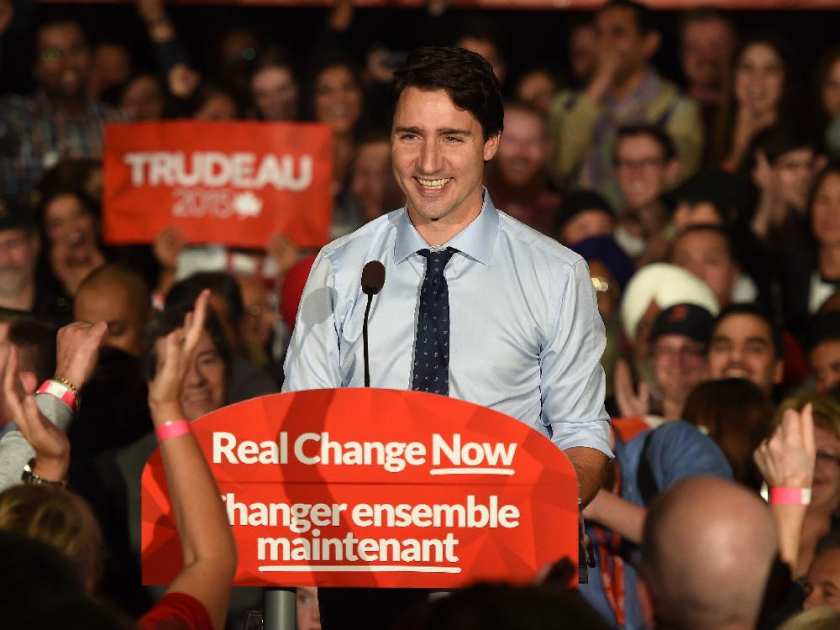
Serial bullshitter, JustinTrudeau, was quick off the mark to defend the Kinder Morgan bitumen pipeline expansion in the wake of the announcement that the NDP, backed by the provincial Greens, will form the next government of British Columbia.
With a straight face the prime ministerial bullshitter defended his government's decision to toss out his election campaign promises and approve the hazmat pipeline.
"The decision we took on the Trans Mountain pipeline was based on facts [and] evidence, on what is in the best interest of Canadians."
What Canadians would those be, Justin? It can't be the companies behind it. They're American. It can't be the supertanker armada owners. They're offshore. So I suppose you've defined Canadians as everybody except me and those like me, the majority of the people of British Columbia who stand opposed to this damned pipeline, the same people who just tossed Christy Clark and her Liberals out of office.
Believe me when I say that doesn't come as a shock. We got over that when you turned into just another greasy opportunist and reneged on your solemn promise that there would be no pipeline without First Nations approval and "social licence" (the consent of the municipalities through which the pipeline would be routed).
Save the righteous indignation you jackass. What about that other promise of yours, that your government's decisions would follow the science? There's plenty of science involved in this decision and you've got plenty of scientists to advise you. Show us your science, Slick. What do your scientists tell you?
Let's see these "facts" you talk about. Why have you not laid all that out already? This isn't about facts. They're not on your side. This is about political opportunism of the very worst kind. This is real Harper-grade shit. At least have the decency to wear that proudly.
What are the facts behind the stellar spill record of Canada's pipeline operators? What are the facts about what happens when there's a dilbit spill in our coastal waters. We've got plenty of evidence on record - from Canadian naval commanders to mariners to Coast Guard experts - that tanker accidents are inevitable. It's not a matter of "if" but "how often." All that evidence was given at your rigged National Energy Board hearings.
What are the facts about what happens when dilbit pours into our coastal waters with their tides and currents and storm-tossed waters? Does it float in a nice blob where it can be sucked up and safely removed? Or does it, as the facts state, head to the bottom, delivering all the acids and heavy metals, all the carcinogens, to the seabed and into our marine environment?
What about your government's concession that you're powerless when that spill happens? What concession, what admission, what smoking gun? That evidence comes from your enviromin, Dame Cathy's approval of the use of Corexit as an oil spill dispersant.
The Americans used Corexit on the Exxon Valdez spill. It sickened the clean up workers. BP used it on the Deepwater Horizon disaster. It sickened clean up workers and people of the Gulf coast. It plagues the Gulf fishery to this day and will for years, perhaps decades to come. The thing is, those were conventional crude oil spills, kid's stuff compared to bitumen.
If it's facts you want, Slick, read the manufacturer's warning labels:


Corexit isn't an oil dispersant. In an open water spill, Corexit causes the oil to sink straight to the bottom where it can contaminate the marine ecology for many, many decades.
This is "in the best interests of Canadians"? I always thought I was one of those Canadians. It doesn't seem quite that way any longer. Thanks for the heads up.
Wednesday, November 04, 2015
We're All Neoliberals Now. Let's Change That.

One thing that struck home during our extended election campaign was how our mainstream political parties have become deeply invested in neoliberalism. While it has several descriptions, reflective of its insidious vagueness, neoliberalism is the merger of political and economic ideology most often called "free market fundamentalism." It is a sort of merger of political and commercial/corporate powers usually born out of the surrender of incidents of political sovereignty through multi-national financial and trade agreements.
It's a process akin to the tactics of a boa constrictor whose victims often fail to realize the severity of their predicament until its too late. That's an apt analogy for how we have, for decades, been conditioned to our role as prey.
Neoliberals have been very successful in conditioning a large segment of the electorate to see themselves as 'taxpayers' rather than 'citizens,' a feat that isolates them from public debate beyond how government impacts their wallets and readies them to accept 'transactional democracy,' where money dictates policy for the powerful often at the expense of everyone else.
Nobel laureate economist, Joe Stiglitz, explores legislated inequality in his book, "The Price of Inequality." Modern inequality, he explains, is neither market nor merit-based to any significant degree. It is legislated and comes in a plethora of forms from tax treatment (exemptions, reductions, deferrals), to grants and subsidies, to the transfer of public resources at far less than market value. The 'taxpayer' public is particularly blind to these government giveaway programmes having been groomed to venerate the rich as the "job creators" whose success "trickles down" to the masses. In reality cooperative lawmakers ensure that the nation's wealth actually "trickles up" to those who least deserve it. It is a malignancy known as "rent-seeking."
Another triumph of neoliberalism has been in conditioning working class Canadians, white and blue collar, to support capital over labour and acquiesce to the decline of unionism. For all the legitimate criticisms of the union movement, it has been freely demonized by the neoliberals and their political minions as regressive and an economic scourge. We've lost sight of the role unions play as the cornerstone of a healthy, robust middle class, the ladder of social mobility, and a vehicle to maintain the balance between labour and capital without which inequality flourishes.
We have been conditioned, groomed, to be submissive to neoliberalism, powerless, incapable even of rallying to our own defence. Harnessed to the myths and scourges of neoliberal ideology, we are clearing the path for increasing inequality and the corrosion of social cohesion and it's a road that leads to illiberal democracy and a gradual rise of economic feudalism.
The legacy of Stephen Harper will be how well he moved us down this path during his decade in power. It's a legacy he shared with his collaborators, Layton, Mulcair and Ignatieff.
It's time we charted a new path while that option is still open to us.
I strongly urge you to watch this Days of Revolt interview.
Saturday, August 08, 2015
Dippers, Beware of a Left Wing Insurgency
Britain's Labour Party may offer a cautionary tale for today's Blairified New Democrats. Layton and Mulcair have been Harper's handmaidens in His quest to shift Canada's political centre far to the Right. In fairness, the Libs have done their share of the heavy lifting too, transforming the party of Laurier, St. Laurent, Pearson and Trudeau (the real one) into the Conservative-Lites.
It's probably less seismic for the Libs than the New Dems, the former "principled" party, the "conscience of Parliament." However, like their Labour colleagues before them, the abandonment of the Left has been accepted as the price of power. And how has that worked out for the Brits?
Blair, with his lap dog support of America, his lies and his illegal war, was Labour's wrecking ball. The party found no salvation in Blair's successor, Brown, leaving the way clear for the Conservatives to come to power. Labour's Ed Milliband tried to revive his party's fortunes but, in a surprise election outcome, David Cameron scored a solid majority win.
Milliband stepped down and Labour licked its wounds, hoping a new leader somewhat to the Right of Milliband would restore the party to its former glory. Instead, the Cameron victory laid the groundwork for a civil war in the Labour ranks led by dark horse, Jeremy Corbyn.
His lead in constituency nominations, the flow of endorsements from union executives, the jumpy responses of rival campaigns, the rising panic among many Labour MPs and the enthusiasm he is generating at the leadership hustings increasingly suggest that Jeremy Corbyn has become the candidate to beat. A man whose previous highest public office was chairman of the Haringey council planning committee three decades ago might, in six weeks’ time, be leader of the opposition and Labour’s putative candidate for prime minister. With hindsight, the surprise is that we have been surprised. We should have seen this coming. The stresses induced by austerity and a revolt against political elites have been splitting the left all over Europe. From Greece to Spain to Germany, the traditional governing parties of the centre-left are being challenged by insurgent populist movements from the redder end of the spectrum. In the case of Greece, the old order has been supplanted by the new, though not with positive results for that unhappy country.
...Since its birth, British Labour has been a rainbow coalition of socialists, social democrats and social liberals. It has been a church broad enough to encompass those on the most leftwing side of the aisle who think there is a lot to admire about the thinking of Karl Marx to people on the far side of the other aisle who might call themselves liberal centrists or even Christian democrats if they were in a different country. The Labour church has a history of doing the splits. It did so in the 1930s. Again in the 1950s. And again in the 1980s. You could almost say we were due for one.
...Those with a vote in the contest who are still unsure which Labour party they should be backing have been provided with a clarifying test by Dave Ward, the general secretary of the Communication Workers Union. Announcing the CWU’s endorsement of the MP for Islington North, Mr Ward declared that the union’s executive had acted on medical advice: “There is a virus within the Labour party and Jeremy Corbyn is the antidote.” “The virus” being the Blairites.
...The big truth that is being exposed by this battle is that Labour is really two parties and they can no longer stand each other’s company. The social democrats despair that those to the left always pull Labour into suicidally unelectable positions from which it takes years to recover before the party sees power again. The socialists rage that the pragmatists make so many compromises in the pursuit of power that it ends up not being worth it. Really, they’d be happier if they could go their separate ways. Then the electorate could choose between an offer from the centre-left and one from further left.
It's probably less seismic for the Libs than the New Dems, the former "principled" party, the "conscience of Parliament." However, like their Labour colleagues before them, the abandonment of the Left has been accepted as the price of power. And how has that worked out for the Brits?
Blair, with his lap dog support of America, his lies and his illegal war, was Labour's wrecking ball. The party found no salvation in Blair's successor, Brown, leaving the way clear for the Conservatives to come to power. Labour's Ed Milliband tried to revive his party's fortunes but, in a surprise election outcome, David Cameron scored a solid majority win.
Milliband stepped down and Labour licked its wounds, hoping a new leader somewhat to the Right of Milliband would restore the party to its former glory. Instead, the Cameron victory laid the groundwork for a civil war in the Labour ranks led by dark horse, Jeremy Corbyn.
His lead in constituency nominations, the flow of endorsements from union executives, the jumpy responses of rival campaigns, the rising panic among many Labour MPs and the enthusiasm he is generating at the leadership hustings increasingly suggest that Jeremy Corbyn has become the candidate to beat. A man whose previous highest public office was chairman of the Haringey council planning committee three decades ago might, in six weeks’ time, be leader of the opposition and Labour’s putative candidate for prime minister. With hindsight, the surprise is that we have been surprised. We should have seen this coming. The stresses induced by austerity and a revolt against political elites have been splitting the left all over Europe. From Greece to Spain to Germany, the traditional governing parties of the centre-left are being challenged by insurgent populist movements from the redder end of the spectrum. In the case of Greece, the old order has been supplanted by the new, though not with positive results for that unhappy country.
...Since its birth, British Labour has been a rainbow coalition of socialists, social democrats and social liberals. It has been a church broad enough to encompass those on the most leftwing side of the aisle who think there is a lot to admire about the thinking of Karl Marx to people on the far side of the other aisle who might call themselves liberal centrists or even Christian democrats if they were in a different country. The Labour church has a history of doing the splits. It did so in the 1930s. Again in the 1950s. And again in the 1980s. You could almost say we were due for one.
...Those with a vote in the contest who are still unsure which Labour party they should be backing have been provided with a clarifying test by Dave Ward, the general secretary of the Communication Workers Union. Announcing the CWU’s endorsement of the MP for Islington North, Mr Ward declared that the union’s executive had acted on medical advice: “There is a virus within the Labour party and Jeremy Corbyn is the antidote.” “The virus” being the Blairites.
...The big truth that is being exposed by this battle is that Labour is really two parties and they can no longer stand each other’s company. The social democrats despair that those to the left always pull Labour into suicidally unelectable positions from which it takes years to recover before the party sees power again. The socialists rage that the pragmatists make so many compromises in the pursuit of power that it ends up not being worth it. Really, they’d be happier if they could go their separate ways. Then the electorate could choose between an offer from the centre-left and one from further left.
Friday, June 12, 2015
Well, That's a Relief!

Israel has officially absolved itself of any wrongdoing in the murder of four Palestinian kids killed on a Gaza beach last summer.
The kids - they were children - had a soccer ball in play when an Israeli patrol boat opened fire on them with explosive shells. Unfortunately, for the Israelis, foreign journalists witnessed the slaughter.
The New York Times’s Pulitzer prize-winning photographer Tyler Hicks, who witnessed the incident, though from a different angle to the Guardian, wrote in a blog at the time: “A small metal shack with no electricity or running water on a jetty in the blazing seaside sun does not seem like the kind of place frequented by Hamas militants, the Israel Defence Forces’ intended targets.
“Children, maybe four feet tall, dressed in summer clothes, running from an explosion, doesn’t fit the description of Hamas fighters, either.”
Oh well, it was only four kids and, besides, they were Palestinian kids, worse yet they were Gazans. All three Canadian parties supported Israel's "Dahiyeh" campaign against Gaza that saw civilians butchered by the hundreds so what's four kids in the greater scheme of things?
And, yes, those are news photos of those kids (the three who survived the first round) running for safety just seconds before they too were killed.
Monday, May 04, 2015
Shoot to Kill - Anyone, Everyone

Israeli soldiers willfully targeted civilians in last year's war on Gaza.
Testimonies provided by more than 60 Israeli soldiers who fought in last summer’s war in Gaza have raised serious questions over whether Israel’s tactics breached its obligations under international law to distinguish and protect civilians.
The claims – collected by the human rights group Breaking the Silence – are contained in dozens of interviews with Israeli combatants, as well as with soldiers who served in command centres and attack rooms, a quarter of them officers up to the rank of major.
They include allegations that Israeli ground troops were briefed to regard everything inside Gaza as a “threat” and they should “not spare ammo”, and that tanks fired randomly or for revenge on buildings without knowing whether they were legitimate military targets or contained civilians.
..Post-conflict briefings to soldiers suggest that the high death toll and destruction were treated as “achievements” by officers who judged the attrition would keep Gaza “quiet for five years”.
The Israeli campaign itself was one giant war crime. It featured the now-standard Israeli tactic of Dahiyeh, the deliberate targeting of essential civilian infrastructure - water plants, sewage treatment plants, power utilities before moving on to hospitals, schools and finally residential neighbourhoods. This is outrageously contrary to the laws of war and international agreements such as the Geneva Conventions.
Yet the Liberal Party supports these atrocities, masking it under the guise of "self defence." Let's not forget that Mulcair also was on side with this at first until he sensed that the wind had shifted and conveniently reversed himself.
Are You Supporting Politics of Nihilism?
2030. You do realize that's just 15-years away. Do you realize that 15-years is a heartbeat when it comes to making fundamental change?
So, what's so important about 2030? Plenty. By then we'll be experiencing climate change impacts that are disruptive and difficult to bear. Take your head out of the sand, look around you - all around, and you'll see many of these impacts are already here and they're growing.
We're coping, more or less, at least most of us. There's a certain leeway, call it resilience. We've got resilience, so far. However, as the challenges grow and worsen, our resilience, our ability to absorb them, wanes.
We think those of us in temperate zones can adapt to warming of 2C by 2100. No one is under any illusions we can equally cope with 4C of warming. 2C is a game changer. 4C is game over.
Yet 4C is now a distinct possibility and, if we want to avoid 4C, we have to choose to avoid it. We have to do the things necessary to achieve that outcome. We have to make the choices and do the necessary things and we have to 'choose and do' within the remarkably limited time still available to us.
Top world experts at Germany's Potsdam Institute use the example of carbon capture and sequestration (CCS) to make their point. CCS as a viable, mature technology is still about 10-years off. 2025. But developing CCS is one thing, implementing it is quite another. To get CCS up and running on any meaningful scale will take another two decades, possibly three. That would be 2045 to 2055.
The thing about CCS is that it's used as a sop to justify continuing our extraction and consumption of fossil fuels. It's a "don't worry, be happy" parlour trick. It's a way to obstruct us from making the choices and doing the necessary things to avoid 4C and it will contribute greatly to our prospects of getting to 4C or worse. Not for nothing have the fossil fuelers seduced us with grand promises of CCS for so many years.
The scientific community has reached a strong consensus view that, if we're to have any reasonable chance of salvaging a 2C world, we have to leave at least 80% of already known fossil fuel reserves in the ground, unburned. There's a choice. It's pretty straightforward.
So, how do we restructure our economies and our societies so that we can leave 80% of known fossil fuel reserves untouched, safely in the ground? What must we do? How are we going to go about this? How much time do we have to choose, how much time to plan, how long will it take to implement our choices? Hint: it's going to take a while. Hint: it's not an open-ended option. Time is not on our side.
As far as Canada's political parties are concerned, none of the leaders vying to run the country wants to make this fundamental, potentially existential choice lest, in making the choice, they risk political consequences. Look, we've seen it before. When Dion proposed the Green Shift initiative, the great Layton every bit as freely as Harper, used it as a cudgel to beat Dion senseless. Layton showed how low the bar of Canadian political leadership has fallen and it's nauseatingly low. Mulcair is even more opportunistic.
I get a lot of this, "we've got to vote (liberal/ndp) because we've got to get rid of Harper." Really, why? If all three parties are inherently nihilistic, it's my obligation to reject them all. No, sorry. My vote, I get to set the bar and I will not vote for anyone below it - which includes Messrs. Harper, Mulcair and Trudeau.
ISIS? You have to be kidding. The assault on Canada is already underway and it has nothing to do with Islam. If anything it's more affected by Christian fundamentalism and political partisanship.
The bottom line - if your party doesn't openly endorse the need to leave high-carbon fossil fuels, especially coal and bitumen, in the ground, then you're supporting and empowering the politics of nihilism. There is no fence-sitting on this one.
So, what's so important about 2030? Plenty. By then we'll be experiencing climate change impacts that are disruptive and difficult to bear. Take your head out of the sand, look around you - all around, and you'll see many of these impacts are already here and they're growing.
We're coping, more or less, at least most of us. There's a certain leeway, call it resilience. We've got resilience, so far. However, as the challenges grow and worsen, our resilience, our ability to absorb them, wanes.
We think those of us in temperate zones can adapt to warming of 2C by 2100. No one is under any illusions we can equally cope with 4C of warming. 2C is a game changer. 4C is game over.
Yet 4C is now a distinct possibility and, if we want to avoid 4C, we have to choose to avoid it. We have to do the things necessary to achieve that outcome. We have to make the choices and do the necessary things and we have to 'choose and do' within the remarkably limited time still available to us.
Top world experts at Germany's Potsdam Institute use the example of carbon capture and sequestration (CCS) to make their point. CCS as a viable, mature technology is still about 10-years off. 2025. But developing CCS is one thing, implementing it is quite another. To get CCS up and running on any meaningful scale will take another two decades, possibly three. That would be 2045 to 2055.
The thing about CCS is that it's used as a sop to justify continuing our extraction and consumption of fossil fuels. It's a "don't worry, be happy" parlour trick. It's a way to obstruct us from making the choices and doing the necessary things to avoid 4C and it will contribute greatly to our prospects of getting to 4C or worse. Not for nothing have the fossil fuelers seduced us with grand promises of CCS for so many years.
The scientific community has reached a strong consensus view that, if we're to have any reasonable chance of salvaging a 2C world, we have to leave at least 80% of already known fossil fuel reserves in the ground, unburned. There's a choice. It's pretty straightforward.
So, how do we restructure our economies and our societies so that we can leave 80% of known fossil fuel reserves untouched, safely in the ground? What must we do? How are we going to go about this? How much time do we have to choose, how much time to plan, how long will it take to implement our choices? Hint: it's going to take a while. Hint: it's not an open-ended option. Time is not on our side.
As far as Canada's political parties are concerned, none of the leaders vying to run the country wants to make this fundamental, potentially existential choice lest, in making the choice, they risk political consequences. Look, we've seen it before. When Dion proposed the Green Shift initiative, the great Layton every bit as freely as Harper, used it as a cudgel to beat Dion senseless. Layton showed how low the bar of Canadian political leadership has fallen and it's nauseatingly low. Mulcair is even more opportunistic.
I get a lot of this, "we've got to vote (liberal/ndp) because we've got to get rid of Harper." Really, why? If all three parties are inherently nihilistic, it's my obligation to reject them all. No, sorry. My vote, I get to set the bar and I will not vote for anyone below it - which includes Messrs. Harper, Mulcair and Trudeau.
ISIS? You have to be kidding. The assault on Canada is already underway and it has nothing to do with Islam. If anything it's more affected by Christian fundamentalism and political partisanship.
The bottom line - if your party doesn't openly endorse the need to leave high-carbon fossil fuels, especially coal and bitumen, in the ground, then you're supporting and empowering the politics of nihilism. There is no fence-sitting on this one.
Thursday, March 26, 2015
New Contest. Spot the Progressive!
I'll bet you've got inside yourself some sense of progress, progressive, progressivism. Even bad people have a little.
The question today is whether progressivism remains a real construct in Canadian politics. Have our political parties become so neoliberal as to eradicate progressivism?
Let's take a look at some of the major problems of the day. You think of how a progressive would respond. Then compare that of any of the three main parties seeking power today.
What about an easy one, Palestine? How would a progressive respond to that volatile and worsening problem? How would Harper, Trudeau and Mulcair respond? Short of condemning Israel for its half century of enslavement of a people, how would a progressive respond?
See what I'm getting at? Take a problem. Here's a partial list: climate change, health care, education, inequality, bitumen trafficking, Arctic Canada, democratic deficit, free and fair elections, freedom of information, press freedom, corporatism... you could easily spend half a day tacking items onto this list. Just pick a couple or a few and try to envision what would be a progressive approach to them. Then "contrast and compare" that with the thin gruel being offered up by our major political parties.
Who knows, maybe you'll be able to Spot the Progressive. Somehow I doubt it.
The question today is whether progressivism remains a real construct in Canadian politics. Have our political parties become so neoliberal as to eradicate progressivism?
Let's take a look at some of the major problems of the day. You think of how a progressive would respond. Then compare that of any of the three main parties seeking power today.
What about an easy one, Palestine? How would a progressive respond to that volatile and worsening problem? How would Harper, Trudeau and Mulcair respond? Short of condemning Israel for its half century of enslavement of a people, how would a progressive respond?
See what I'm getting at? Take a problem. Here's a partial list: climate change, health care, education, inequality, bitumen trafficking, Arctic Canada, democratic deficit, free and fair elections, freedom of information, press freedom, corporatism... you could easily spend half a day tacking items onto this list. Just pick a couple or a few and try to envision what would be a progressive approach to them. Then "contrast and compare" that with the thin gruel being offered up by our major political parties.
Who knows, maybe you'll be able to Spot the Progressive. Somehow I doubt it.
Sunday, March 15, 2015
The Gamble - High Stakes for Harper, Trudeau and Mulcair

The collapse of world oil prices is reverberating through Canada's petro-provinces; Alberta, Saskatchewan, Newfoundland and Labrador; and the fallout should yet might not be a major issue when Canadians go to the polls for a dominant fragment of eligible voters to decide who will govern our flagging petro-state, Canada.
Watch for Stephen Harper to try to control the election narrative as never before. In previous elections against Dion and Ignatieff, Harper's pitch was "there's nobody better to handle the economy and, besides, look at this dork." He defeated the Dion Liberals for a Conservative minority and, quite predictably, the Ignatieff Liberals for a Conservative majority.
This time the Harper narrative will shift. Just as Afghanistan lost its political lustre when everything Harper had said he would accomplish turned to dust, this time we won't hear much about the economy. Harper won't want to run on the state of the Canadian economy and no one would. What's called for is a bit of electoral bait and switch. This time it will be all about the dreaded terrorists and that dork, Trudeau. It's a contest in which Harper already has Trudeau partially disarmed.
By supporting Bill C-51, Trudeau and Company have given themselves two choices. They can agree with Harper that C-51 is somehow needed, even at the expense of our democracy and civil liberties. Or the Trudeau Libs can allow themselves to be seen as willing to sacrifice our democracy and civil liberties in a cynical effort to retain their edge over Harper.
The trouble with C-51 - for starters - is that it presupposes that our existing criminal and state security powers aren't adequate to meet the terrorist threat. That's never been demonstrated. Where's the proof? There is none, none at all.
It's telling that we haven't explored what, if anything, went wrong with our homebrew terrorist attacks or what we can do within the existing system to shore up our vulnerabilities. We have pretty clear laws. We have lots of personnel and we can hire more if needed. We have some pretty solid intelligence resources. No one has made the case for C-51 and, here's the important part, Conservative or Liberal they're not even trying.
There's been no attempt to balance the often conflicting objectives of freedom and security. Ben Franklin warned that those who sacrifice freedom for the sake of security deserve (and usually get) neither.
C-51, for so long as its odious provisions remain on the books, alters the relationship between the Canadian people and their government. Our freedoms are diminished while the government's powers over us are increased. Dissent can be criminalized. The state security apparatus can be invoked to intimidate us. An American energy company snaps its fingers and the
Taken on its own, C-51 is bad enough. Add it to the multi-layered cloak of neoliberalism that has infested all three of our major parties and it becomes something else again.
Harper is steaming ahead with C-51 precisely because he knows the Trudeau Libs will crater just as they're doing. He knows that Trudeau fears (yes, that's the word "fear" and it comes with an inescapable stench) that standing up for Canadians by opposing C-51 could cost the Liberals votes in October. What Trudeau doesn't realize is that his capitulation to Harper's will can only further divide and weaken Harper's opposition. Harper gets to play to his base. Trudeau gets to fracture his support. Meanwhile the undecided are increasingly less able to distinguish the Conservatives from the Liberals by what they each stand for and, worse, what they both stand for.
You know what else Harper sees in Trudeau's boot-licking? It's the perfect set up for yet another electoral Donnybrook between the NDP and LPC. It's a gift to Tom Mulcair and to Stephen Harper and there's little doubt that Mulcair will use Trudeau's perfidy as a club to beat the Liberal leader to a pulp. If Ignatieff hadn't been enough to drive me out of the Liberal ranks, I expect this would have. Sap the NDP's uncertain strength, focus its energies mainly on Trudeau, while compelling Trudeau to defend the Liberals from attacks on both fronts and the ultimate winner is - Stephen Harper. Mulcair can't resist a second term as leader of the official opposition. It's just too good to pass up and he won't.
At the end of the day the real losers will be you, me, and Canada.

Sunday, February 15, 2015
A Timely Scottish Warning for the New Democrats

Scottish Labour is suffering from a ...to some extent self-inflicted – process of attrition. The process began in the mid-1990s, as Blair and Brown exchanged Labour's post-war interventionism for a programme of liberalised markets and finance-led growth. In response, Salmond carefully manoeuvred the SNP into the vacant left-of-centre space. The strategy worked. Research from the period confirms that Scots started to view the SNP as a progressive alternative to Blairism.
The first big break came at the 2003 Holyrood election: Labour lost 250,000 constituency and 225,000 list votes, the single biggest fall in its vote share at any point over the devolutionary era. Left-leaning voters – notably Catholics, trade unionists and public sectors – bled-away from Labour, moving first towards smaller, more radical parties such as the Greens and the SSP, and then towards the SNP, resulting in ever-larger electoral gains for Salmond.
The decisive rupture occurred last year, when traditional Labour strongholds such as Glasgow, North Lanarkshire and Dundee rejected the party line and voted in favour of independence. Appalled by the flaccid conservatism of the Better Together campaign, large numbers of working-class Scots (although by no means all) embraced constitutional radicalism. On 18 September, Scottish Labour won the referendum and saved the Union, but it did so at the cost of Labour Scotland.
The only appropriate term for what is happening to Scottish Labour is "Pasokification". Just as Greek voters abandoned PASOK, the established party of Greek social democracy, for Syriza, so Scottish voters are abandoning Labour for the SNP (albeit more gradually and under less acute conditions). Clearly, neither Salmond nor Sturgeon is Alexis Tsipras, and the current Scottish government can be frustratingly cautious in its approach to reform. But the overarching trend is unmistakable: in Scotland, the old left hegemony is breaking down and a new one forming in its place.
So play silly bugger centrist all you like, Mulcair, but keep an eye over your shoulder - the left one.
Wednesday, February 04, 2015
What Neoliberalism Has in Store For You
 |
| click to enlarge |

From Le Monde, a timely explanation of how disastrous neoliberalism continues to thrive despite an endless string of economic disasters and what it holds in store for you even as you continue to vote for those who inflict it. Hint. Neoliberalism is class warfare and it's being waged in our own Parliament against us.
Even neoliberal proponents recognize that it is a crisis-ridden system. In his popular book Why Globalisation Works, Financial Times columnist Martin Wolf writes: “Between 1945 and 1971, in what might be called the “age of financial repression”, there had been only thirty-eight crises in all.... Then, between 1973 and 1997, there were 139 crises. The age of financial liberation has, in short, been an age of financial crisis” (3).
Neoliberal policies have been implemented from 1973 in Pinochet’s Chile, in the UK and US under Thatcher and Reagan in the 1980s and then across increasing swathes of the world. These policies include, privatization, the de-regulation of the financial sector, increasing openness to foreign trade and investment, and cuts to public welfare spending. Supporters of neoliberal policies argue that these will increase economic efficiency as state regulation of the economy is replaced by more accurate ‘market signals’. These are held to be better at encouraging and allocating investment, which in turn leads to higher economic growth and greater benefits for the economy and population as a whole.
So why do so many Western governments, including your own, embrace neoliberal, market-fundamentalist policies? That's because it's actually successful only not in promoting a healthy economy to benefit all. Its success lies in the quiet transfer of economic and political power out of your pocket and into the pocket of those it's actually intended to benefit.
In his film Inequality for All, Robert Reich, who was Bill Clinton’s labour secretary between 1993 and 1997, documents the collapse of US wages over the last four decades. In the late 1970s the typical male US worker was earning $48,000 a year (inflation adjusted). By 2010, the average wage had fallen to $33,000 a year. Over the same period the average annual income of someone in the top 1% of US society rose from $390,000 to $1,100,000.
Neoliberal policies aim to reduce wages to the bare minimum and to maximize the returns to capital and management. They also aim to demobilise workers’ organisations and reduce workers to carriers of labour power — a commodity to be bought and sold on the market for its lowest price. Neoliberalism is about re-shaping society so that there is no input by workers’ organisations into democratic or economic decision-making. Crises and austerity may not be intentionally sought by most state leaders and central bank governors, but they do contribute significantly towards pursuing such ends. Consequently, these politicians and leaders of the economy do not strive to put in place new structures or policies that will reduce the recurrence of crisis.
There is one downside for proponents of neoliberal policies however. Because they generate socio-economic crisis they erode public confidence in politics and economic policy. It is here that progressive political organisations can highlight the class basis of neoliberalism and propose a realistic alternative that favours the majority of the world’s population, not the minority.
It's hard to imagine that today's 'permanent warfare state' could ever have arisen absent neoliberalism and the commodification of state violence into for-profit warfare. Likewise disaster capitalism is utterly dependent on the life support of neoliberalism. What you need to understand is that, until we throw these people out of Parliament - the lot of them - this is only going to get worse, not just for you but even more so for your children and theirs.
Sunday, November 23, 2014
Okay you Liberal Bastards, What Now?
Trudeau the Lesser's Liberals did backflips to support Israel's brutal outrage against Gaza's civilian population this summer. It was as though no one had ever heard the Israeli military's term, Dahiyeh. Of course you didn't need any fancy terms to see that Israel was brutally - and quite illegally - targeting Gaza's Palestinian population completely in flagrant violation of human rights laws and the laws of war. That much is obvious when the side with strike jets takes down the public's water and sewage plants and then moves on to hit schools and hospitals, even clearly designated UN refuge sites. I was never so disgusted with the Liberal Party, not even under Ignatieff.
The Dippers worked off the same page until Mulcair woke up and realized he was bound to piss off some old school progressives in the NDP ranks. Then he hemmed and hawed and - waffled.
Well now your boy - and he is your boy - Benny Netanyahu has let his other fascist shoe drop. This time it's not Palestinians under Israeli occupation but Arab and Christian Israelis who are Netanyahu's target. The Israeli prime minister and his cabinet by a 2-1 margin have passed a bill that defines Israel as the nation-state of the Jewish people.
Critics, including cabinet opponents, say the new law reserved "national rights" for Jews only and also delisted Arabic as Israel's second official language.
So Justin - and Tommy - now you're backing a country that's both fascist and racist. Is there any principle you won't compromise in your bootlicking pursuit of votes?
The Dippers worked off the same page until Mulcair woke up and realized he was bound to piss off some old school progressives in the NDP ranks. Then he hemmed and hawed and - waffled.
Well now your boy - and he is your boy - Benny Netanyahu has let his other fascist shoe drop. This time it's not Palestinians under Israeli occupation but Arab and Christian Israelis who are Netanyahu's target. The Israeli prime minister and his cabinet by a 2-1 margin have passed a bill that defines Israel as the nation-state of the Jewish people.
Critics, including cabinet opponents, say the new law reserved "national rights" for Jews only and also delisted Arabic as Israel's second official language.
So Justin - and Tommy - now you're backing a country that's both fascist and racist. Is there any principle you won't compromise in your bootlicking pursuit of votes?
Monday, September 01, 2014
Restoring the Vox Populi

Some thoughts for this, Labour Day.
The voice of the people. Oh, how long has it been since that really meant anything? In Canada and many other advanced countries, polls show that people are being governed without much if any regard to their views, their concerns.
It's sort of like standing, waiting at the civic bus stop for a bus that just keeps passing you by.
Canadians want action on climate change. Are they going to get it? No. Canadians want action on inequality. Are they going to get it? Don't be ridiculous.
The American people utterly loathe their federal government, their Congress. Does it matter? Hell no! The vox populi has been discounted to the point of near total irrelevance.
Governments don't do what we want them to do. Governments don't deal with things we want dealt with, the things that cause us worry and insecurity.
There used to be a notion that at the heart of democracy lay the consent of the people to be governed. To the extent that ever meant something it has been superceded by the ascent of neoliberalism and the corporatist state.
You get to vote and that's about all you get. There is no longer much of a role for the vox populi. There's still a vox, a voice alright and it is reaching the ear of the political or ruling classes only it's not your voice. It's the voice of energy and commerce and high finance that has the ear of those you supposedly elect to office.
Think I'm kidding? Go back four years to the reign of Ignatieff. Do you remember when he summoned a "thinkers' conference" to map out a new strategy for a Liberal Canada? The speakers list spoke volumes for it was massively dominated with CEOs and "management consultants." Ignatieff wasn't there to formulate policies that would resonate with the voting public, solutions to their needs and concerns. His focus was Bay Street, not Main Street. As the Ignatieff Liberals turned their backs on ordinary Canadians, so did ordinary Canadians turn their backs in the next election sending the Liberals from Sussex Drive to Stornoway to Motel 6 out on the Gloucester highway.
The simple fact is that you can't consent to be governed without a reasonable understanding of how you're to be governed. Without that understanding, there's no informed consent to be governed. You're simply consenting to be ruled. And even that hollow consent is being coerced out of you through the application of misinformation, outright deceit and fear-mongering.
Your vote used to mean something back when parties offered up a real spectrum of vision and policy. You knew what made one party distinct from the others and they worked to champion policies that might suit the voting public.
Today our body politic lies on the life support of neoliberalism. Iron lungs all around. Even the NDP has embraced neoliberalism. There's a term for what's happening. It's called "depoliticization." Politics is being shut down, its place taken over by grey suits stuffed with wet cardboard. Administrators, not leaders. Mere technocrats, doing sums. The public, quite conveniently for the corporate state, is disengaging, tuning out. Why bother if no one will speak to your concerns? Why bother if no one hears your voice? Even before you begin to tune out you're already out of the loop.
How then do we reverse this? How do we get their ear? How are we to get our voices heard by those we elect, those who are duty bound to serve us? How do we make them responsive to our concerns, our needs?
How indeed? I don't know. I do know that we need to get these people we elect to listen to us and that means they need to stop listening like attentive lap dogs to those who do not elect them. We need to drum into their heads the prescient words spoken by Teddy Roosevelt more than a century ago. These words:
...our government, national and State, must be freed from the sinister influence or control of special interests. Exactly as the special interests of cotton and slavery threatened our political integrity before the Civil War, so now the great special business interests too often control and corrupt the men and methods of government for their own profit. We must drive the special interests out of politics.
...every special interest is entitled to justice but not one is entitled to a vote in Congress, to a voice on the bench, or to representation in any public office. The Constitution guarantees protections to property, and we must make that promise good, but it does not give the right of suffrage to any corporation.
...The citizens of the United States must effectively control the mighty commercial forces which they have themselves called into being.
There can be no effective control of corporations while their political activity remains.
We no longer "effectively control the mighty commercial forces that we have called into being." Those mighty commercial forces too often have the ear of those we elect to represent us.
Wresting political control away from these commercial forces may be the key to reclaiming our democratic freedoms. The thing is I just cannot see that happening under either Trudeau or Mulcair or any other Liberal or New Democrat. Like others I'm coming to accept that if we cannot rehabilitate the Liberal and New Democratic parties, we need to stop wasting our efforts and put them into building a new party, a genuinely political party, one that speaks for Canadians and speaks to their concerns. It's pointless to seek solutions in neoliberalism.
Saturday, August 23, 2014
It's Not That We Disagree, It's That I Despise Your Ideas

When ever I read another article and view another series of photographs of the carnage Israel has inflicted on the civilian population of Gaza and then think of the Netanyahu apologists, Trudeau and Mulcair, I despise them and any party that would tolerate much less follow their views. That these two greasy opportunists haven't been tossed to the street for their blatant pandering tells me all I need to know about the Liberal Party and the New Democrats.
Our general election is less than a year away, possibly much sooner if Harper sees a window of opportunity in which to catch the opposition off balance. Trudeau is said to be the odds-on favourite and the ranks of non-Conservatives fairly swoon at the idea of someone "less worse" to replace Harper in ruining Canada.
We have, for years, been ruled by a despotic, manipulative, chronically secretive and dishonest, bully boy. Stephen Harper set out to dislocate Canada's political centre far and permanently to the right. Fulsomely aided and abetted by the parliamentary lap dogs we still call Liberals and New Democrats, Stephen Harper has succeeded. With the shameless collaboration of the so-called "opposition" parties, Canada is now firmly in the grasp of neoliberalism. It's all free market capitalism from here on in and democracy and social justice be buggered.
It is the fundamental duty of the Liberal and New Democrat leaders to campaign to restore Canada's political centre to its natural place. Polls and studies show that, despite occasional claims to the contrary, the public remains slightly centre-left. The Canadian people have been abandoned not just by the Conservatives but also the Liberals and New Dems.
"Less worse" is not an acceptable standard on which to support anyone and certainly not for the sake of replacing Harper with a Harper-lite. That's merely substituting a coward for a fiend. At the end of the day it may be a difference devoid of much distinction.
I understand all the arguments about how it is unwise for opposition parties to unveil policy in advance of an election campaign. What puts the lie to that is the Green Party whose clear and sensible platform is available for all to see on its web site. That platform sets a useful standard by which to measure both Liberals and New Democrats in the election that draws ever closer. Prepare to be abjectly disappointed.
The 2015 election is not one that I look forward to if only because I expect disappointment on a grand scale from Harper's rivals.
They'll make vague promises about electoral reform and call for more studies and position papers but the reform they can and should make if we're foolish enough to hand them the keys is voting reform in the Commons. Anything that's not a confidence vote should be a free vote. Whipped votes should be a last resort.
They'll probably support the already unviable bitumen mining industry with energy policies that are inconsistent, contradictory and unrealistic. Mulcair says "no tankers" but I don't believe him for a minute. If Canada is to make a meaningful effort to mitigate the impacts of climate change we will have to make hard decisions about the very future of Athabasca.
They will ignore that other grave threat to Canada's democratic freedom - our corporate media cartel. Only the Greens are honest enough to recognize this threat and call for a break up of the cartel through divestiture, the only effective way to undo toxic concentration of ownership and monopolistic cross-ownership of media outlets. The Canadian people need the greatest diversity of voices expressing opinions of the widest range across the entire political spectrum. That's how ideas and information are conveyed to nurture a genuinely informed public capable of exercising their political franchise.
Inequality, that wrecking-ball of the middle class that corrodes social cohesion leaving the many vulnerable to the few, is getting scant attention from Trudeau or Mulcair. I've not heard either of them acknowledge that most inequality has very little to do with merit or market-forces but is a largely legislated outcome arising from tax policy, subsidies and deferrals of all sorts, and the surrender of natural resources, the property of all Canadians, either free or at far-below market value.
I have yet to hear Mulcair or Trudeau acknowledge that fighting the scourge of inequality entails more than narrowing gaps in wealth and income but, even more, depends on bolstering equality of opportunity that requires rehabilitating our public education and healthcare systems. If we want productive young people, we must ensure that they are able to access advanced education that is affordable. We have to see funding health care and education not as a cost but as an investment.
They will avoid mentioning the urgent need to restore the balance between labour and capital so fundamental to the maintenance of social cohesion and prosperity. Labour didn't abandon Andrea Horwath because it preferred Wynne's table manners.
They will not commit to the sort of national works programme Canada so badly needs to construct essential infrastructure capable of withstanding climate change impacts throughout this century. We are struggling with infrastructure designed and built to cope with the climate we enjoyed in the 19th and 20th centuries. The Halocene is over. The Anthropocene is here to stay. Even 'early onset' climate change is already visiting us with severe storm events of increasing frequency, intensity and duration. We have to invest an enormous sum of money into this because, if we don't, the costs and losses will be even greater.
We need a foreign policy more akin to what we had in the post-WWII decades, not the 'muscular' foreign policy so admired by Ignatieff and Harper. The world is awash in guns and soldiers to wield them. It doesn't need Canada's paltry warfighting ability. We can do far more good furnishing what has become so scarce today - superlative peacekeeping forces and global, "honest-broker" mediation. We've gone the "All the King's horses and all the King's men" route. We did it in Libya and Afghanistan. Just marvel in awe at our grand successes.
These are all matters that speak to the future of Canada and the wellbeing of our people, both today and for generations to come. These are matters beyond the myopia of neoliberalism. We have lost invaluable time during Harper's machinations. We don't have the luxury of squandering even more time on those who are in line to succeed him.
Wednesday, March 05, 2014
Dog in the Manger Mulcair Won't Back Federalists in Quebec Election
He claims to be the leader of the official opposition for Canada but Tom Mulcair says he'll stay neutral in the Quebec provincial election. Why won't he support the federalist side? Does he think the federal parties should steer clear on some principle? No, it's because he's "waiting for the day there is an NDP in Quebec."
So, Canada be buggered, no provincial NDP, no assistance from the official opposition. Good on ya, Tommy. Now we see your true colours. Party over country, Tom. I always suspected as much.
Update - it didn't take long for some Dipper to claim I 'smeared' Mulcair. This fellow maintained that Mulcair is a fierce federalist. Well, I'm going to go by Mulcair's own words. He stated, quite clearly, that he'll be remaining "neutral" in this election and he said he was going to stay neutral because there's no Quebec NDP in this election. Presumably if the NDP was running candidates in the Quebec election, Mulcair would be federalist in a heartbeat. That's certainly what he indicated.
I know on Planet Dipper any criticism of Tom Mulcair has to be a cheap smear but this is Canada, planet Earth.
So, Canada be buggered, no provincial NDP, no assistance from the official opposition. Good on ya, Tommy. Now we see your true colours. Party over country, Tom. I always suspected as much.
Update - it didn't take long for some Dipper to claim I 'smeared' Mulcair. This fellow maintained that Mulcair is a fierce federalist. Well, I'm going to go by Mulcair's own words. He stated, quite clearly, that he'll be remaining "neutral" in this election and he said he was going to stay neutral because there's no Quebec NDP in this election. Presumably if the NDP was running candidates in the Quebec election, Mulcair would be federalist in a heartbeat. That's certainly what he indicated.
I know on Planet Dipper any criticism of Tom Mulcair has to be a cheap smear but this is Canada, planet Earth.
Sunday, February 23, 2014
Canada's Mythical Middle Class and the Quislings of Parliament Hill

The government likes to say it's all about the middle class. So, too, the opposition parties. On Parliament Hill it seems Canada's middle class is virtually surrounded by a sea of friends, each clamouring to outdo the other to lend a hand, give a leg up. With friends like that in high places, those of the middle class can surely look forward to a bright and prosperous future.
Except that it's a load of crap.
An internal report prepared for the Harper government by Employment and Social Development Canada and pried out of the cold dead Tory hands by Canadian Press via a freedom of information demand, paints a much different, far less rosy picture of the state of Canada's middle class and the future that awaits them.
"The wages of middle income workers have stagnated," it says, referring to the period from 1993 to 2007. "Middle-income families are increasingly vulnerable to financial shocks."
The document, drawing on three years of "internal research," was prepared for the department's deputy minister, Ian Shugart, shortly before the resumption of Parliament last fall.
"In Canada, political parties are making the middle class a central piece of their agendas," notes the presentation.
"The market does not reward middle-income families so well," says the report. "As a result, they get an increasingly smaller share of the earning's pie" compared with higher-income families.
The Cheney-inspired, neo-conservative government of Harper, Flaherty, Oliver et al, seem happy enough to watch the middle class devolve into an American-style 'precariat' while the spoils of their labour increasingly accrue to the wealthy. Mulcair and Trudeau, with their pledge not to increase taxes, appear to be walking in lockstep with Harper.
"Over the medium term, middle-income Canadians are unlikely to move to higher income brackets, i.e., the 'Canadian dream' is a myth more than a reality."
When judging the culpability of our parliamentarians for this deplorable condition, remember this. Most inequality today and most of the stagnation of the middle class isn't market-driven or merit-based. It is legislated, the creature of statutes written and passed on Parliament Hill. Harper knows it. Mulcair knows it. Trudeau, unless he's an idiot, knows it. It's about time we got some straight talk from these characters - not from Harper of course but at least from our own.
Wednesday, November 27, 2013
New Democrats, Take the Hint, We Need You to Go Home.

Hard as it's been to watch the Liberals morph into Conservative-Lite, it was vastly harder to witness the NDP slip its moorings on the left and migrate to the centre to become Latter Day Liberals.
Under Layton and Mulcair, the NDP abandoned the flank in a shameless bid for power and Canada is much the worse for it. Just when we needed the balancing force of the Left more than at any time in the past half century it stands deserted.
If Canadians are to weather the challenges of the 21st century, the overwhelming majority of Canadians and not merely the top 5 per cent, we absolutely must have a strong Left presence in our politics. Without that presence we will have a devilish time dealing with forces that will sap our social cohesion - inequality, climate change, globalization, the assault on organized labour and collective bargaining, corporatism, our dysfunctional electoral system and other grave threats to our democracy.
Canada doesn't need another liberal party. The voters said as much just days ago in four by-elections.
Canada needs a party of the Left. Marginally a tad left of the other guys doesn't cut it when they've all headed off to the Right. Canada needs a party willing to unapologetically stand for lofty principles to both inspire and guide the public and to keep the other parties at least a little more honest.
If the New Democrats are really done with the Left, then they should pack up and clear out and make way for a new party of principle, a new "conscience of Parliament." That's what Canada is lacking and what the country needs now more than ever.
Sunday, April 28, 2013
That Decision Just Got a Lot Easier
Looks like I'll be voting NDP in the upcoming British Columbia elections. I had some qualms about backing the NDP or my party of choice, the Greens, especially when it appeared the NDP already have this election in the bag.
Problem solved. The Greens aren't fielding a candidate in my riding. They're contesting 58 of the 85 ridings and mine isn't one of them. I'm hoping the Greens have stood down to avoid undermining the NDP's chances of ousting the Liberals in a riding that The Tyee has concluded is "too close to call."
Oh well the Liberals and Christy Clark have to go but I'm not wildly enthusiastic about the New Dems. Adrian Dix seems like a decent enough fellow but experience shows that doesn't cut much ice within the rough and tumble internal politics of the B.C. NDP. Mike Harcourt was a thoroughly decent fellow and a good premier in his turn. Yet he got toppled, stabbed in the back, by British Columbia's last NDP premier, another Clark, Glenn Clark. And it was Glenn Clark who almost single-handedly delivered Gordon Campbell's conservative Liberals a massive sweep to power.
I've listened to what Adrian Dix has had to say on the campaign trail and I think he's ready to govern my province. I'm still left in doubt about whether he's strong enough to govern his party.
Problem solved. The Greens aren't fielding a candidate in my riding. They're contesting 58 of the 85 ridings and mine isn't one of them. I'm hoping the Greens have stood down to avoid undermining the NDP's chances of ousting the Liberals in a riding that The Tyee has concluded is "too close to call."
Oh well the Liberals and Christy Clark have to go but I'm not wildly enthusiastic about the New Dems. Adrian Dix seems like a decent enough fellow but experience shows that doesn't cut much ice within the rough and tumble internal politics of the B.C. NDP. Mike Harcourt was a thoroughly decent fellow and a good premier in his turn. Yet he got toppled, stabbed in the back, by British Columbia's last NDP premier, another Clark, Glenn Clark. And it was Glenn Clark who almost single-handedly delivered Gordon Campbell's conservative Liberals a massive sweep to power.
I've listened to what Adrian Dix has had to say on the campaign trail and I think he's ready to govern my province. I'm still left in doubt about whether he's strong enough to govern his party.
Subscribe to:
Posts (Atom)