Thursday, November 30, 2006

Thatcher Walks


Colin Thatcher has been given full parole. After spending 22-years behind bars for the murder of his ex-wife, Jo Ann Wilson, the National Parole Board has decided his risk to offend is 'manageable within the community.'

Thatcher says he's learned the importance of keeping his temper in check, "I'm not going back to prison for some silly violation."

Are We Ready for a Spring Offensive?


We'd better hope America has a contingency plan to throw tens of thousands of soldiers into Afghanistan on short notice.

The dismal failure of the NATO summit showed that the Afghanistan mission is to remain desperately undermanned. Even retired general Lewis MacKenzie has repeatedly urged NATO to reinforce its numbers by at least another 30,000. Fat chance.

The International Herald Tribune's Ahmed Rashid writes from Peshawar, Pakistan that the NATO summit portends a larger war:

"In the future annals of the spread of Islamic extremism and Al Qaeda, the NATO meeting this week will almost certainly be considered a watershed. Germany, Spain, Italy and France, which refused to allow their troops in Afghanistan to go south to fight the Taliban, and other member states who refused to commit fresh troops or equipment, may well be held responsible for allowing Afghanistan to slip back into the hands of the Taliban and their Qaeda allies.

"Such desperately depressing considerations arise from the fragile state of the Afghan government, the massive surge in Taliban attacks this year, the collapse of civil authority in wide swathes of the country and the rise in opium production, which is funding not just the Taliban, but a plethora of Afghan, Kashmiri, Central Asian, Chinese and Chechen Islamic extremist groups based on the Pakistan-Afghanistan border.

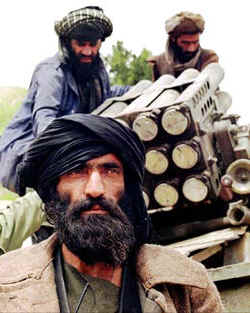
"Last summer the Taliban planned to capture Kandahar - the second-largest Afghan city - and set up an alternative government. They were only just thwarted by the sacrifices of NATO British, Canadian, Dutch and American troops and their Afghan allies, who fought pitched battles with battalion-size Taliban units - battles the likes of which the West had not experienced since the Korean War.

"Tribal leaders in Peshawar and along the border now say that the Taliban are recruiting thousands of fighters in Pakistan and Afghanistan for a full-scale, multipronged offensive in the spring, which will open so many fronts in southern Afghanistan that present NATO forces will be unable to cope. This time the target is Kabul and the government of President Hamid Karzai.
The Taliban will fully understand and exploit NATO's failure to respond to these threats. NATO's inaction will also cause massive demoralization among the Afghan people and encourage warlords and drug traffickers to prepare for the coming anarchy.

"Most significantly, NATO's decision will pave the way for further interference by neighboring states, which helped fuel the civil war in Afghanistan throughout the 1990s.

"Pakistan's military regime, which provides clandestine support to the Taliban and has refused to accept NATO and U.S. plans to arrest the Taliban leaders on its soil, has long calculated that in time the West will walk away from Afghanistan. Pakistani officials are already convinced that the Taliban are winning and are trying to convince NATO and the United States to strike piecemeal deals with the Taliban in the south and east, which eventually could develop into a Pakistani- brokered Taliban coalition government in Kabul."

Rashid's assessment of conditions on the ground on Afghanistan is pretty grim. If the Taliban are massing a force of many thousands to swarm Afghanistan in the spring, somebody - Pakistan, the US or NATO - needs to attack them pre-emptively and very soon.

Japan Flirts With Nukes


"Japan is capable of producing nuclear weapons, but we are not saying we have plans to possess nuclear weapons."

That's what Japanese foreign minister, Taro Aso, told a parliamentary committee today. This message comes at a time when the Japanese government is looking at rewriting the country's constitution that prevents it from creating an offensive military capability.

Aso called for a renewed debate on Japan's anti-nuclear stance but added that the constitution does not prohibit Japan from acquiring nuclear weapons for defensive purposes.

"Possession of minimum level of arms for defence is not prohibited under Article 9 of the constitution," he said. "Even nuclear weapons, if there are any that fall within that limit, they are not prohibited."

A Real Career-Ender

Poor Dr. Kendal Myers. He's finished, done. From Whitehall to Washington they want his head. Myers has commited the mortal sin - of stating the obvious.

At an academic forum in Washington the senior State Department analyst said that for all Britain's attempts to influence US foreign policy, "we typically ignore them and take no notice. It's a sad business."

Other observations from Dr. Myers:

"It was a done deal from the beginning, it was a one-sided relationship that was entered into with open eyes ... there was nothing. There was no payback, no sense of reciprocity."

"What I think and fear is that Britain will draw back from the US without moving closer to Europe. In that sense, London's bridge is falling down."

Tony Blair has repeatedly justified his pro-Washington stance by claiming Britain had an essential role to play by co-operating in order to influence American policy. Myers certainly burst that balloon.

It's now reported that Dr. Meyers is contemplating early retirement. Quelle surprise.

So if ever faithful ally Tony Blair gets nothing from Bush, just how much do you think Harper is going to achieve by kneeling at Shrub's feet?

Wednesday, November 29, 2006

NATO Versus Democracy

If the Afghanistan experience accomplishes nothing else, it may provoke a thoughtful analysis of what the alliance is and, more importantly, what it is not.

Politicians and pundits alike moan that a failure of the Afghan mission will doom NATO. Unfortunately they don't tend to explain why that fate must befall the alliance.

From the outset, Afghanistan wasn't a natural fit for NATO intervention. Yes, the United States had been attacked but not by Afghanistan. The attackers were a gang of Islamic radicals, mainly Saudi, and not a single Afghan among them. What blame fell to the Taliban is simply that they tolerated al-Qaeda training camps in their territory. Remember, al-Qaeda was all too welcome in Afghanistan, even by the US, when it first arrived to fight the Soviet forces. It played a significant role in ousting the Soviet occupation and, as such, it would have some standing with the Taliban afterwards.

Five years later and no one has shown the slightest participation in or even knowledge of the 9/11 plot by the Taliban nor, for that matter, their participation in any other al-Qaeda skullduggery.

So the United States was not being attacked by Afghanistan or by the Taliban but, by virtue of the attack alone, we all agreed to intervene in the ongoing civil war between the Northern Alliance and the Taliban, siding with the northern warlords.

After routing the Taliban and al-Qaeda into the mountains of Tora Bora, the United States showed gross negligence in failing to finish them off. Instead it diverted its forces into a contrived war of choice against Iraq.

When the US invasion toppled Saddam and destabilized Iraq, al Qaeda took full advantage of the opportunity to regroup and redeploy into this fertile territory. Note that there's been no similar Taliban insurgency or terrorism in Iraq. The hard truth is that the Taliban is no more threat to America in Iraq today than it ever was in Afghanistan prior to the American intervention.

The Taliban is, however, a very real threat to the government of Hamid Karzai, America's handpicked President of Afghanistan. I suspect the northern warlords might be an equal threat to Karzai were he to move to control their provinces, disarm their militias and meddle in their affairs. This raises the difficult question of whether the Taliban resurgence is an actual insurgency or merely a civil war in which the West is, again, taking sides.

These unanswered, often unasked, questions run through the public aversion to the Afghanistan mission in several NATO nations. Without answers it is very difficult to weigh the true merits and necessity of this intervention and it creates the appearance that NATO is simply doing George Bush's bidding.

If a NATO member's populace strongly oppose a mission such as Afghanistan where no member is genuinely under attack, does the alliance have any business trying to coerce support? Surely that will doom NATO more certainly than the success or failure of the Afghan mission. The strength of NATO rests in it not being called to action except when it is absolutely necessary to defend another member state. That is what it was intended to do and nothing more. We stray from that path at our peril.

NATO cannot be allowed to trump democracy.

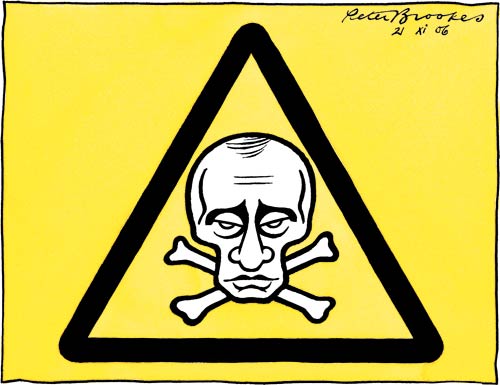
Was Litvinenko a Nuclear Smuggler?

According to the Italian who met Alexander Litvinenko on the day he fell ill, the former Russian spy confessed during their meeting to having smuggled nuclear material out of Russia for his masters at the FSB, formerly the KGB.

Mario Scaramella, an academic and examining magistrate in Rome and Naples, came to London to meet Litvinenko to discuss a death threat aimed at both of them.

Scaramella says he has been investigating the smuggling of radioactive materials by the KGB and its successors. He has claimed that the Soviet Navy laid 20 nuclear torpedoes in the Bay of Naples where they supposedly remain to this day.

Superpower Canada - A Sure Thing?

What is a superpower except a nation that enjoys dominance over most other nations? If that's close to right, Canada may be on a path to superpower glory.

How's that you say? Well, according to climate change guru and creator of the Gaia Theory, James Lovelock, we may be headed for a world in which the population of earth will drop to around 500-million, all of them living in the Arctic:

"'We are not all doomed. An awful lot of people will die, but I don't see the species dying out,' he told a news conference.'A hot earth couldn’t support much over 500 million.'

“'Almost all of the systems that have been looked at are in positive feedback ... and soon those effects will be larger than any of the effects of carbon dioxide emissions from industry and so on around the world,' he added.

"Lovelock said temperature rises of up to 8C were already built in and while efforts to curb it were morally commendable, they were wasted.'It is a bit like if your kidneys fail you can go on dialysis -- and who would refuse dialysis if death is the alternative. We should think of it in that context,' he said. 'But remember that all they are doing is buying us time, no more. The problems go on,' he added.

"In London to give a lecture on the environment to the Institution of Chemical Engineers, he said the planet had survived dramatic climate change at least seven times.

“'In the change from the last Ice Age to now we lost land equivalent to the continent of Africa beneath the sea,' he said.

“'We are facing things just as bad or worse than that during this century. There are refuges, plenty of them. 55 million years ago ... life moved up to the Arctic, stayed there during the course of it and then moved back again as things improved. I fear that this is what we may have to do,' he added.

"Lovelock said the United States, which has rejected the Kyoto Protocol on cutting carbon emissions, wrongly believed there was a technological solution, while booming economies China and India were out of control."

Will This Man Rule Iraq?


In an interview with MSNBC yesterday, Washington Post Pentagon reporter, Thomas Ricks, said the Pentagon is seriously weighing dropping its support for the existing, multi-ethnic Iraqi government in favour of Shia strongman rule under Muqtada alSadr.

Ricks said the Pentagon has concluded that alSadr's star is rising in Iraq. It is believed that, if an election was held today, he would win almost all seats in the Shia region, including Baghdad. The inability of the Maliki government to control terrorism and lawlessness in Iraq has led the Pentagon to now favour Shia rule under alSadr even to the exclusion of Sunni Iraqis.

There have been rumours for months that Washington was rethinking its commitment to democracy for Iraq and mulling over the benefits of a return to strongman rule.

Meanwhile, ignoring their own responsibility for the violence that besets Iraq today, all manner of Americans are freely laying the blame on the Iraqis themselves which many believe marks the prelude to withdrawal of US troops.

"Thomas Donnelly, a hawkish defense expert at the Center for Strategic and International Studies, said he considers blame a legitimate issue. 'Ultimately, just like success rests with the Iraqis, so does failure,' he said. 'We've made a lot of mistakes, but we've paid a huge price to give the Iraqis a chance at a decent future.'

"The blame game has also been playing out somewhat divisively within the secretive Iraq Study Group. The bipartisan commission, led by former secretary of state James A. Baker III and former congressman Lee H. Hamilton (D-Ind.), is deliberating policy recommendations to put forward next month.

"'I'm tired of nit-picking over how we should bully the Iraqis into becoming better citizens of their own country,' former CIA Middle East expert Ray Close wrote in an e-mail to the other advisers to the study group.

"Several other experts of various political stripes said this tendency to dump on Baghdad feels like a preamble to withdrawal.

"'It's their fault, and by implication not ours, is clearly a theme that's in the air,' said retired Army Col. Andrew J. Bacevich, a Vietnam veteran and longtime skeptic of the war in Iraq. It reminds him, he said, of the sour last days of the Vietnam War, when 'there was a tendency to blame everything on the 'gooks' -- meaning our South Vietnamese allies who had disappointed us.'"

The days of the Maliki government may be numbered in months, perhaps weeks. alSadr has already begun his moves by withdrawing from the Baghdad government. At the end of the day, Washington may have no choice but to annoint him strongman ruler of Iraq.

The Pakistani View - NATO's Losing

One factor that bedevils NATO's Afghanistan mission more than any other is neighbouring Pakistan. It has a sizeable population, a heavily-armed military, even nuclear weapons. It is politically unstable and its military and security services are heavily influenced by Islamic fundamentalism. The central government has been unable to control Pakistan's border regions with Afghanistan where Pashtuns and Baluchs feed the Taliban insurgency in Afghanistan. Although George Bush has named Perves Musharraf a key ally in the Global War Without End on Terror, Musharraf himself isn't safe even in his own capital.

Pakistan is invested heavily in Afghan politics. It has long favoured the Taliban, if only as a means of ensuring its own influence in Afghanistan especially over Indian overtures. Pakistani forces seem much more willing to go after al-Qaeda agents than Taliban leaders.

NATO is already on the defensive in southern Afghanistan. It doesn't have nearly enough troops to do more than try to keep the Taliban at bay in selected parts of the southern provinces. It can't begin to deploy the size of force that would be needed to seal off the Afghan/Pakistan border, the Taliban lifeline. Any notion of pre-emptive strikes against insurgent strongholds within Pakistan is out of the question.

It isn't particularly surprising then to read Ahmen Rashid's report from Islamabad in today's Sidney Morning Herald claiming that Pakistan's foreign minister has urged his NATO counterparts to recognize reality and negotiate with the Taliban:

"SENIOR Pakistani officials are urging NATO countries to accept the Taliban and work towards a new coalition government in Kabul that might exclude the Afghan President, Hamid Karzai.

"Pakistan's Foreign Minister, Khurshid Kasuri, has said in private briefings to foreign ministers of some NATO member states that the Taliban are winning the war in Afghanistan and NATO is bound to fail. He has advised against sending more troops.

"Western ministers have been stunned. 'Kasuri is basically asking NATO to surrender and to negotiate with the Taliban,' said one Western official who met the minister recently.

It is inconceivable that NATO has reached the point where its leaders would entertain Kasuri's suggestion. One person to whom the idea isn't that outlandish - Afghanistan President Hamid Karzai. He's been sending diplomatic peace overtures to the Taliban for quite a long time. Of course, Karzai is hardly independent of Washington as he would need to be to cut a deal with the Taliban. It is difficult to imagine any American government, Democratic or Republican, countenancing an Afghan coalition government that incorporated the Taliban.

Kasuri's comments, however, may be seen as a wake-up call by NATO. If the Pakistanis genuinely perceive the Taliban to be winning, we'd better not count on this supposed ally to go beyond hedging its bets. What our generals have identified as the key to winning in Afghanistan - Pakistan itself - may already be lost to us.

Tuesday, November 28, 2006

Even Surprise Visits are Too Dangerous Now

When President Bush gets together with Iraqi PM Maliki on Wednesday, they'll be meeting in Jordan. It's reported that Baghdad is now considered far too dangerous for Bush to visit. It makes you wonder why he refuses to admit that Iraq is in the grip of a civil war?

According to Mr. Bush, al-Qaeda is responsible for the sectarian violence now spreading through Iraq. Does that mean that Shia Iran is now off the hook?

Acknowledging the fact of civil war would be awkward for the American president. It would bring into question the viability of the Maliki administration and possibly leave the US in a position where it had to take sides. Of course it would also be lethal to the little support George Bush can muster at home for the Iraq occupation.

The question is how long the United States can sit this one out?

We'd Better Get Busy - We've Got a Lot of Killing to Do

Let's see - Spring, 2008. That's just a year and a half from right now. By then, we're told, the Afghan Army will be ready to start taking control of the country's security. This from Jaap de Hoop Scheffer, NATO Secretary General. Of course, Jaap has left himself a world of wiggle room. He qualified his prediction by saying the Afghan Army will "be gradually taking control."

That could mean anything from safeguarding the presidential latrine to securing some of the tame provinces in the north. Just don't expect them to be taking over in Helmand or Kandahar provinces by then. No, we'll probably still be there for that job.

It looks as though President Bush and de Hoop Scheffer were successful in strongarming some concessions from France, Germany, Italy and Spain, albeit begrudgingly. They've sort of said their troops might be authorized to take part in combat in the south in certain circumstances.

France said it will decide on combat deployment on a case by case basis. Spain and Italy said their contingent might be made available to fight "in extreme circumstances." Ditto for Germany.

Now you would have thought the NATO leaders would feel secure in Riga, Latvia but guess again. According to the Times of London, the summit is defended by 7,000 Latvian troops and 2,000 NATO soldiers backed by helicopters and two warships in Riga's harbour.

The NATO Secretary General's remarks about handover are a sop to those who need to tell their constituents that there is light at the end of the tunnel. Actually wishy-washy seems an apt description of the summit so far.

It would be interesting to know how much damage we need to inflict on the Taliban and rebellious peasants before Afghanistan will be safe to hand over to any Afghan Army. At the end of the day, can we kill enough of them to make a difference?

A "Fixer" for Afghanistan?

The Australian reports sources at the NATO summit in Riga as saying they want a high-powered "international fixer" to sort out the mess in Afghanistan.

While NATO concentrates on holding the Taliban at bay, they want backup in the form of a heavyweight political initiative to push through democratic reforms and an anti-drug policy.

"Our problem is that we're getting on with the security and reconstruction, but there's no one person appointed who can make sure the Afghan Government gets on with issues such as disarming the warlords," the senior source in Riga said.

Bush Looks for the Sunni Side of the Street

The guy can't help himself. Everytime he hears Shia he sees Iran and then he sees red. That's preventing George Bush from finding any useful solution to his problems in Iraq.

The White House seems to be courting the Sunni world to somehow take over and sort things out in Iraq. That overlooks two huge problems - a Shia majority that will no longer tolerate Sunni interference and their Shia benefactor, Iran. Even the Kurds in northern Iraq are unlikely to welcome an Arab Sunni intrusion.

President Bush is never going to get the answers he wants to hear on Iraq. They simply don't exist. Getting Saudi Arabia and Jordan involved is all well and good but there's little they can do to quell the civil war without the agreement and support of Iran and Syria. So long as Washington has Tehran in its sights, getting the essential Iranian co-operation is unlikely, if not out of the question.

Now there's a proposal for quasi-partition in the form of a 3-state federalism for Iraq. That would leave the oil-rich Shia south and the oil-rich Kurdish north and the resource barren Sunni middle. It would also entail sorting out who will control several key cities, including Kirkuk, and an awful lot of ethnic adjustments. The Shia would probably go for it and the Kurds already have that degree of autonomy and more. Neither group, however, is in the mood to share their resource wealth with the minority associated with their decades-long repression.

Much as he doesn't want to, much as he would been seen as humbled, George is going to have to negotiate an Iraqi peace package with Iran and with Syria and he's going to have to come bearing gifts. Right now he's throwing a diplomatic tantrum, giving both the cold shoulder. Let's hope he gets over that and pretty quickly.

Now It's Howard's Turn


The past year has seen the Western media begin to stand up and say what's long needed saying about our far right leaders. They all seem to be afflicted with the same disorder - a profound detachment from reality.

The Aussie newspaper, The Australian, is no bastion of leftie sentiment so I found columnist Philip Adams' screed against John Howard pretty bold.

"One can only wonder what form of the ailment our poor Prime Minister has developed. Or is it something else? Not dementia, but a different dimension. Is he living in one of those parallel universes? Are we glimpsing him through wormholes? Whereas every sane person in the US - including members of the administrations damaged or destroyed by the war - acknowledge that the Vietnam conflict was both a folly and a calamity, Howard still says it was the right thing. And he said it in Vietnam, as a guest of the Government, sitting beside the well-known draft dodger George W. Bush. That millions died as a consequence of Western stupidity doesn't seem to concern him. If not barking madness, Howard's utterances were very bad manners.
Howard and his friend were there to discuss even greater fiasco, another US-Australia joint misadventure. The US has now been bogged down in Iraq for longer than they were in World War II. The casualties and costs soar, yet in George and John's parallel universe, things are going well.

"But the real world - particularly the American electorate - disagrees. The fiasco began in shared dementia about weapons of mass destruction, Baghdad links to 9/11, a fantasy about blossoming democracy. Reagan's blurring of realities was never so destructive. The Iraq war will have consequences immeasurably more damaging to its region and the world than three Vietnams. Even Tony Blair knows that. But not the US President and certainly not the Australian Prime Minister.

"In Howard's dimension or dementia, the strangest things happen. Refugees try to drown their babies and asylum-seekers are terrorists. Again and again, one tries to connect the PM's beliefs or actions with any objective reality.

"Consider other madnesses appearing from the wormholes or as symptoms of dementia. While the war on terror has been stoking up terrorism, the infinitely more terrifying prospect of climate change was ignored. Worse still, both Howard and Bush ridiculed it. While choosing or pretending to believe the tawdriest intelligence on Iraq from debased agencies, they chose to neglect the collective intelligence of the entire scientific community.

"Yes, the Hawke government deserves a decade's blame, but in Howard's decade the facts were incontrovertible. Now we've a dangerously belated and deranged response. Nuclear power might, just might be a factor in 20 years. That's a grand total of four decades of denial and delay. This is not policy. It is further procrastination. Even more shamefully, like Tampa, it's wedge politics.

"No matter how sorry the state of affairs, Howard is never sorry. Not about the stolen generation, not about the Vietnam War. Not about WMDs and the other excuses for Iraq. Not about his secret collusions with Bush that had Australia committed to invasion months before we were told - and not about the squalid backroom dealings of the AWB with Baghdad of which, of course, he claims to have known nothing. Howardism means never having to say you're sorry.

"In Howard, Australia has had its most reckless leader. In Howardism we've had an insane approach to local politics and international affairs that has shamed the nation and continues to put it in harm's way. The electorate increasingly understands this yet shrugs it off. That's Howardism too."

Is it any wonder that Stephen Harper has embraced John Howard so warmly?

Isotopes - Bargain Prices!

The hunt is on to find out who slipped polonium-210 to Russian defector Alexander Litvinenko. Fingers have been pointed at Russia as the source of this isotope but the Russians are flatly denying it.

Maybe we should be blaming the internet. Polonium-210, said to be 100 billion times deadlier than cyanide can be bought freely on the internet. United Nuclear Scientific Equipment and Supplies in New Mexico offers a small amount of the isotope in a small, disc shaped container for - get this - $69.

According to the San Francisco Chronicle, Nuclear Scientific's website warns the company:

"... will occasionally terminate and refund orders if we feel you are juvenile posing as an adult, inexperienced with the materials ordered, or using our products to make any sort of explosive device." How thoughtful.

Too Risky to Say "Sorry"


Canada decided to apologize and generously compensate the children of Chinese immigrants from many decades past who were forced to pay a head tax to get in. Now it's Britain's turn.

Tony Blair is about to apologize to the victims of Britain's once-flourishing slave trade. Well, actually it's more of a lament than an apology because we know how expensive apologies can become.

In his typical "oh gosh" manner, Blair deftly skirts the sticky part of this business: "It's hard to believe that what would now be a crime against humanity was legal at the time." I guess it was legal because the government of the day made it so in the Slave Trade Act, and that's good enough for Tony.

It's estimated that somewhere between 10 and 28-million Africans were sent to the Americas and sold into slavery over nearly four centuries. Britain alone managed to transport upwards of 300,000 Africans a year in its fetid, disease-ridden slave ships.

Harper's Best Shot? I Hope Not.

Stephen Harper had better make a much stronger argument to his fellow NATO leaders in Riga than he did in this morning's Globe & Mail. If not, we're screwed. Harper, together with the Dutch P.M., wrote an op-ed piece extolling all their successes in Afghanistan to date and their claims were overwhelmingly unimpressive.

Glossing over any suggestion of setbacks and outright failures, Harper used the classic Orwellian language of his mentor in Washington, the standard "war is peace" thing. How are we doing in Kandahar, Steve? "There is still hard work to be done there with boots on the ground." Is that Harperese for the bad guys are taking control of more of the province because we don't have remotely enough troops there and our policies are driving the locals into the arms of the insurgents? "Still hard work to be done." Yeah, right Steve. Lots of it and more every day.

How 'bout this one? "We will continue to vigorously support Afghan efforts to strengthen the rule of law, tackle corruption, and take action against illegal narcotics." So, we're already vigorously supporting the effort to strengthen the rule of law. I guess we're doing that by leaving those kids in prison down the road in Kandahar for refusing their fathers' attempts to sell them, right? And how we must be vigorously supporting the efforts to tackle corruption. How's that going, Steve? Are we rounding up the corrupt cops who are driving the peasants over to our enemy? I mean these cops are helping the guys shooting at us.

Then there's the vigorous effort against illegal narcotics. I assume these would be the same narcotics, raw opium, by which the Afghan farmers put food in the mouths of their kids, right Steve? So what are we doing to give them another way of sustenance, of survival, before we wipe out their crops? Doesn't just destroying their poppy crops simply drive them into the all too welcoming arms of the Taliban?

So Steve's got three points: security, corruption and drugs and the record belies his claims of progress. In fairness he hasn't rolled out the "Mission Accomplished" banner. Much as I'm sure he'd like to, that wouldn't help his effort in Riga to get other nations to jump into this mess.

Maybe the Globe piece is just for the benefit of people at home. Maybe he's keeping his A game for the leaders in Riga. He'd better hope he's got a much more convincing pitch to deliver in Latvia because those leaders know better than to buy this nonsense.

Monday, November 27, 2006

Extremists And Other Vermin

As the name of this site suggests, I don't like extremism - political, religious, social or economic. Extremist philosophy is, by its very nature, the view of cranks, the shrill voice of a malignant minority. In politics, extremists don't try to embrace the moderate majority or even move them toward their radicalism. What they do has been repeatedly shown by the Bush regime, now being aped by the Harper regime. They try to intimidate moderates, instil fear in them, appeal to every base instinct they can provoke in the majority. They work outside the moderate majority, work around them, because that is the only way they can prevail. Their tactic is to use deceit to sow confusion and fear. They don't persuade, they manipulate and they're masters at it.

Bush and Rove believed they could transform Republican rule into a right-wing dynasty that would carry on far past the political horizon. Stephen Harper, to begrudgingly give him his due, is far shrewder. He knows he isn't going to shift the political centre in Canada. He knows his radical view has a limited shelf life. He knows he'd better loot the till before the boss returns.

Harper is a man of seemingly limitless contradictions and hypocrisy. He speaks of principle, he's been doing that since he came to Ottawa. He seems to have a set of principles to suit any circumstance, every occasion. In opposition, Harper had one set of principles. He often displayed missionary zeal in denouncing supposedly arrogant overreaching by the Martin, minority government. When Harper managed to fool a bare minimum of Canadians needed to win the keys to 24 Sussex Drive, all those old principles were tossed into a cardboard box and stowed in the closet to make way for a new set of principles that reflected an arrogance the Libs never even dreamed of.

I don't like Stephen Harper. I really doubt whether he's emotionally balanced. I fear for the damage he may leave Canada in his wake. Let's hope he's gone soon, very soon.

The Diabolical Nature of the Far Right

Prisoner Just Loaded with Secrets

I think people of reason and good faith have a hard time digesting what they hear from the far right, whether that be George Bush, Stephen Harper or any of the loons who lead either Christian or Muslim fundamentalism. That's not to say that they don't understand each other. They do that perfectly. Witness how Harper apes Bush in much that he says and does. Those two are on the same page, joined at the hip.

Here's one example of their sort of thinking. It surfaced in US court proceedings involving a Muslim captive who was held in a secret, CIA prison and subjected to "alternative" interrogation techniques. This fellow would like to discuss that experience with the court but the US government objects.

The United States says that, by subjecting people to torture - er, these "techniques", they're letting the detainees/victims in on top secret, classified information and, therefore, should be forever forbidden from talking about their experiences.

In one affidavit filed on behalf of the CIA it said that the government feared Mr. Kahn might reveal, "the conditions of detention and specific alternative interrogation procedures."

Of course, if you gag detainees, they'll have little or no chance of keeping out incriminating statements they made under torture. Neat trick, eh? To the far right, this makes perfect sense. Ask yourself, does it make sense to you?

First Kelowna, Now the UN


Canada's first nations haven't had much luck with the Conservative Reform Alliance Party of Stephen Harper. Harp doesn't seem to care very much for the natives or their issues.

First he kicked over the Kelowna accord, an agreement reached by the last Liberal government after a year and a half of negotiations with the provinces, territories and five aboriginal groups. The money to finance the deal was even set aside in the budget.

"Not signed" screamed the Tories on assuming power. No deal, it was just nonsense, and so on. Kelowna was dead and will stay that way unless we get rid of the Harpies.

Not content with reneging on the Liberal promises, Harper is taking action at the United Nations also where Harper Canada is joining the usual suspects - the US, Australia, New Zealand and Russia in trying to undermine the UN Declaration of Rights of Indigenous Peoples.

The declaration, which the Liberal government helped push through the UN, is, according to the Toronto Star: "...aimed at setting minimum standards for the dignity, survival and well-being of the world's indigenous people, who are the poorest and least advantaged in their countries."

The non-binding declaration was the product of negotiations that took 20-years but Harper complains that it's "unclear" and should be renegotiated. Now there's a statesman for you.

This Should Help You Sleep at Night

The radiation poisoning of former Russian spy Alexander Litvinenko has renewed interest in the theft of radioactive material from poorly-guarded nuclear facilities in the former Soviet Union. According to The Observer:

"More than anything, the death of the London-based former KGB spy has placed Russia's still thriving trade in radioactive material under scrutiny. 'From the terrorism threat standpoint, these cases are of little concern but they show security vulnerabilities at facilities,' said an IAEA spokesman.

"One of the few figures available, on a database compiled by researchers at Stanford University in the US, revealed that about 40kg of weapons-usable uranium and plutonium were stolen from poorly protected nuclear facilities in the former Soviet Union between 1991 and 2002. Although the IAEA has no confirmation of polonium finding its way into the underground trade, there have been several unconfirmed reports of thefts.

"In 1993 the Bulletin of Atomic Scientists reported that 10kg of polonium had disappeared from the Sarov, which produces the rare radioactive material and is described as Russia's own version of Los Alamos, the US government's nuclear research base in New Mexico.

"Globally there have been more than 300 cases during the past four years where individuals have been caught trying to smuggle radioactive material. In 2005 there were 103 confirmed incidents of trafficking and other unauthorised activities involving nuclear and radioactive materials, many involving Russia."

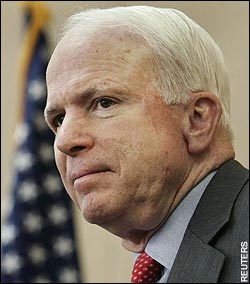
A Warning About John McCain


I'm one of those who likes John McCain even though I often part company with his ideas - on Iraq for example. However my fondness for the guy has turned a bit shakey after reading an article on McCain by Matt Welch in today's L.A. Times which depicts the Arizona senator as a wolf in sheep's clothing:

"Sifting through McCain's four bestselling books and nearly three decades of work on Capitol Hill, a distinct approach toward governance begins to emerge. And it's one that the electorate ought to be particularly worried about right now.

"McCain, it turns out, wants to restore your faith in the U.S. government by any means necessary, even if that requires thousands of more military deaths, national service for civilians and federal micromanaging of innumerable private transactions. He'll kick down the doors of boardroom and bedroom, mixing Democrats' nanny-state regulations with the GOP's red-meat paternalism in a dangerous brew of government activism. And he's trying to accomplish this, in part, for reasons of self-realization.

"'A rebel without a cause is just a punk, ' he explains. 'Whatever you're called — rebel, unorthodox, nonconformist, radical — it's all self-indulgence without a good cause to give your life meaning.'

"What is this higher power that ennobles McCain's crankiness? Just as it is for many soldiers, it's the belief that Americans "were meant to transform history" and that sublimating the individual in the service of that "common national cause" is the wellspring of honor and purpose. (But unlike most soldiers, McCain has been in a position to prod and even compel civilians to join his cause.)

Liberals and conservatives alike fail to truly reflect his views, McCain writes, because 'neither emphasizes the obligations of a free people to the nation.' His main governmental inspiration is Teddy Roosevelt, the 'Eastern swell who became a man of the people,' whose great accomplishment was 'to summon the American people to greatness.' In Roosevelt's code, McCain writes approvingly, it was 'absolutely required that every loyal citizen take risks for the country's sake.' This is an essentially militaristic view of citizenship, one that explains many of McCain's departures from partisan orthodoxy. Unlike traditional Republicans, he will gladly butt into the affairs of private industry if he perceives them to be undermining Americans' faith in government; unlike Democrats, he thinks the executive branch generally needs more power, not less.

"If his issues line up with yours, and if you're not overly concerned by an activist federal government, McCain can be a great and sympathetic ally. But chances are he will eventually see a grave national threat in what you consider harmless, or he'll prescribe a remedy that you consider unconscionable. Nowhere is that more evident than in his ideas about the Iraq war.

"McCain has been banging the drum from nearly Day One to put more boots on the ground in Iraq. 'There are a lot of things that we can do to salvage this,' he said on "Meet the Press" on Nov. 12, 'but they all require the presence of additional troops.' McCain is more inclined to start wars and increase troop levels than George W. Bush or Bill Clinton. He has supported every U.S. military intervention of the last two decades, urged both presidents to rattle their sabers louder over North Korea and Iran, lamented the Pentagon's failure to intervene in Darfur and Rwanda and supported a general policy of "rogue state rollback." He's a fan of Roosevelt's Monroe-Doctrine-on-steroids stick-wielding in Latin America. And — like Bush — he thinks too much multilateralism can screw up a perfectly good war.

"The price of all this war-making, in money and manpower, would be staggering; it's hard to imagine without a draft (McCain has long been a fan of mandatory national service, at the least). But the costs to his political ambitions may even be greater. The nation is in no mood for the war we've got now, let alone a doubling-down on Iraq and ramped-up unilateralist tough talk in the Middle East. The trend lines of public opinion on these counts are not pointing in McCain's direction."

Cloud Mysteries of the Far North

Scientists in Eureka, Nunavut Territory, are trying to figure out a mystery in the local clouds. Less than a thousand miles from the North Pole, they're finding droplets of water in the clouds when, that far north, they should be ice particles. From the Associated Press:

"With NASA reporting that 2005 was the warmest year on record worldwide, the debate over global warming marches on, but not here. The American and Canadian scientists at the Eureka Weather Station in the northern Canadian territory of Nunavut, like the Inuit who are seeing their native habitat thaw, are beyond questioning the existence of climate change.

"'If we compare the debate over the theory of evolution with the debate over the theory of global warming - global warming's a whole lot more certain at the moment,' said Jim Drummond, a University of Toronto physics professor and chief investigator for the Canadian Network for the Detection of Atmospheric Change.

"...water clouds are more likely to warm the Arctic atmosphere than ice clouds, since the liquid clouds retain more heat radiated by the Earth's surface. "This means that the ice-to-water ratios in clouds may be very important in controlling the Arctic surface temperatures and how it melts."

"In Nunavut, the melting is keenly felt. 'In the old days, we used to have 10 months of winter; now it's six,' said Simon Awa, an Inuit leader and deputy minister for the environment of Nunavut who was on the trip to Eureka. 'Every year we're getting winter later and later.'

"For these 155,000 people of Canada, Greenland, Russia and the United States, it means less time to hunt caribou, walrus and polar bear. Studies show that average winter temperatures have increased as much as 7 degrees in the Arctic over the last 50 years. The permafrost - ground that is continually frozen for at least two years - is thawing, imperiling polar bears and forcing other animals to migrate farther north.

"The walrus have moved farther away, said Awa. 'So you're taking more time out, away on the land hunting.' Meanwhile, families back home are forced to eat store-bought food that is costlier and less healthy.

"'The majority of the world's population hasn't really felt the global warming,' said Awa. 'But right now in the Arctic and in Nunavut, we're really worried because it's already affecting us. We are a thermometer of the world for what could happen.'"

Peace Triggers Fight


Lisa Jensen is about to discover that peace comes with a price. Jensen's Christmas decor includes a wreath styled as a peace sign and that's got her neighbours in Pagosa Springs, Colorado up in arms.

The Loma Linda Homeowners' Association has told Jensen to remove the wreath or face fines of $25 a day. Apparently the peace symbol offends some residents who have children in Iraq and feel the wreath is an anti-war protest. Others complain the wreath is satanic.

The President of the Homeowners' Association, Bob Kearns, ordered the architectural control committee to direct Jensen to take down the wreath. When they refused, Kearns simply fired them. So far Jensen is digging in her heels.

To the Scots, "Nation" Means Nation


Scotland and Britain seem to be nearing the point of departure. A recent poll conducted for the Daily Telegraph revealed that 52% of Scots want independence and 59% of the English would like Scotland gone. That's getting close to concensus.

Here's Peter Preston's take on the problem in today's Guardian:

"Voters aren't stupid. They have absorbed the lessons of European union, of Czech and Slovak plumbers, and seen national borders and currencies lose their old salience. Of course, Scotland may endure a bumpy ride, but not an impossible one. If the Scots want to push off, let them, because they can't go far. And meanwhile England would like some of its money back, as well as a decent answer to the West Lothian question.

"The debate may petrify the political classes, but it barely makes it through the door of the saloon bar. Quite simply, we have ceased to care as much as we did. A free Scotland? Sure, if they vote for it. A united Ireland? Why not, on the same terms? The world is a more malleable place."

Best Stick With Pups and Kittens


Want a pet for the kids? Do them a favour and stick with dogs or cats instead of the exotics. You may regret it if you don't.

The Associated Press reports that, "..exotic animals captured in the wild are streaming across the US border by the millions with little or no screening for disease."

More than 650 million critters - from kangaroos and kinkajous to iguanas and tropical fish - were imported legally into the United States in the past three years, according to U.S. Fish and Wildlife Service documents obtained by The Associated Press under the Freedom of Information Act.

``A wild animal will be in the bush, and in less than a week it's in a little girl's bedroom,'' said Darin Carroll, a disease hunter with the U.S. Centers for Disease Control and Prevention.

"Zoonotic diseases - those that jump to humans - account for three quarters of all emerging infectious threats, the CDC says. Five of the six diseases the agency regards as top threats to national security are zoonotic, and the CDC recently opened a center to better prepare and monitor such diseases.

"The Journal of Internal Medicine this month estimated that 50 million people worldwide have been infected with zoonotic diseases since 2000 and as many as 78,000 have died.

"U.S. experts don't have complete totals for Americans, but partial numbers paint a serious picture:

-Hantavirus, which is carried by rodents and can cause acute respiratory problems or death, has sickened at least 317 Americans and killed at least 93 since 1996.

-More than 600 people have been sickened since 2000 with tularemia, a virulent disease that can be contracted from rabbits, hamsters and other rodents. At least three people have died.

"Some of the scariest diseases to emerge since 2001 also have been tied to exotic animals: One of the first times the deadly Asian bird flu reached the West was in eagles smuggled aboard a plane to Europe. Likewise, severe acute respiratory syndrome, or SARS, is believed to have jumped to people from caged civet cats in a Chinese market. The cats are believed to have gotten the virus from bats."

The End Game Begins

I'm drawn a lot to Iraq lately because what's about to happen there will have a tangible, if threatening, impact on the West, Canada included.

The media in Britain and the US have pretty much pronounced Iraq a lost cause, so you can expect an already leery public to become even more disenchanted with this adventure. Despite the best plans of the generals and the resolve of a few politicians, the collapse of public support dooms any hope, albeit unrealistic, of staying to salvage Iraq.

In today's Guardian, Gary Younge writes that the lying that precedes withdrawal has already begun:

"Those in the west who fear that withdrawal will lead to civil war are too late - it is already here. Those who fear that pulling out will make matters worse have to ask themselves: how much worse can it get? Since yesterday American troops have been in Iraq longer than they were in the second world war. When the people you have "liberated" by force are no longer keen on the "freedom" you have in store for them, it is time to go.

"So the crucial issue is no longer whether the troops leave in defeat and leave the country in disarray - they will - but the timing of their departure and the political rationale that underpins it.

"For those who lied their way into this war are now trying to lie their way out of it. Franco-German diplomatic obstruction, Arab indifference, media bias, UN weakness, Syrian and Iranian meddling, women in niqabs and old men with placards - all have been or surely will be blamed for the coalition's defeat. As one American columnist pointed out last week, we wait for Bush and Blair to conduct an interview with Fox News entitled If We Did It, in which they spell out how they would have bungled this war if, indeed, they had done so.

"So, just as Britain allegedly invaded for the good of the Iraqis, the timing of their departure will be conducted with them in mind. The fact that - according to the foreign secretary, Margaret Beckett - it will coincide with Blair leaving office in spring is entirely fortuitous.

"More insidious is the manner in which the Democrats, who are about to take over the US Congress, have framed their arguments for withdrawal. Last Saturday the newly elected House majority leader, Steny Hoyer, suggested that the Americans would pull out because the Iraqis were too disorganised and self-obsessed. "In the days ahead, the Iraqis must make the tough decisions and accept responsibility for their future," he said. "And the Iraqis must know: our commitment, while great, is not unending."

"It is absurd to suggest that the Iraqis - who have been invaded, whose country is currently occupied, who have had their police and army disbanded and their entire civil service fired - could possibly be in a position to take responsibility for their future and are simply not doing so.

"Iraq has suffered decades of colonial rule, 30 years of dictatorship and three years of military occupation. Most recently, it has been trashed by a foreign invader. The troops must go. But the west has to leave enough resources behind to pay for what it broke. For that to happen, the anti-war movement in the west must shift the focus of our arguments to the terms of withdrawal while explaining why this invasion failed and our responsibilities to the Iraqi people that arise as a result of that failure.

"...the problem with Vietnam was not that the US invaded a sovereign country, bombed it to shreds, committed innumerable atrocities, murdered more than 500,000 Vietnamese - more than half of whom were civilians - and lost about 58,000 American servicemen. The problem with Vietnam was that they lost. And the reason they lost was not because they could neither sustain domestic support nor muster sufficient local support for their invasion, nor that their military was ill equipped for guerrilla warfare. They lost because it takes a while to complete such a tricky job, and the American public got bored."

Even Israelis Get the Global Warming Thing


Just to be an Israeli is to live with danger, real or imagined, from Iran to Syria, Hezbollah to Hamas, rocket barrages to terrorist suicide bombings. Odd then that some, such as Danny Rabinowitz, writing in Haaretz, see a greater danger looming for all Israelis:

"The struggle to save mankind from global warming is first and foremost a battle for awareness. The evasive human consciousness specializes in denial, and in denial of widespread dangers. We know how to devote ourselves to the sweet joys of life and to transfer responsibility for mending the world to technology or to politicians. Sometimes this denial is naive and sometimes it is fed by economic interests; but it imprisons mankind in a situation that is reminiscent of a critically injured person who is being taken to the operating theater on a stretcher, rushing through the hospital corridors. A doctor runs alongside the patient, talking all the while. The doctor realizes that the patient must remain conscious to survive and begs him not to fall asleep.

"The environmentalist movement, which for 20 years now has been playing the part of the doctor pleading with the patient not to fall asleep, has been joined by another strong and important player - the British Stern report, which was embraced in full by the Blair government. The report found that the economic price to be paid for damages caused by climate changes that have already occurred is several times higher than the price involved in lowering the emission of greenhouse gases and stopping the process of global warming.

"Just as in the case of Andrew Marshall, the senior Pentagon futurist who several years ago wrote a secret report warning that global warming was threatening world peace, this time too it is worthwhile for the injured man to open his eyes and ears.

"It is difficult to listen, and the material is complicated, but internalizing it and translating it into political decisiveness are the only chance. Instead of driving ourselves crazy with fears about the next war or terror attack that will kill one in a thousand of us, instead of worrying about the price of the Playstation 3, it is worth our while to start thinking seriously about how children and grandchildren will survive the 21st century."

Where Cops Are Hunted

Establishing anything resembling a functioning government in Iraq ultimately depends on creating a viable security force, that is to say an effective army and an equally effective police service. So, how's that going? You guessed it.

Will Weissert of the Associated Press interviewed an Iraqi policeman named "Kalid":

"The 22-year-old police officer wraps a black scarf around his face when on patrol. He sleeps in the station and sees his new bride only a few hours a month. He watches his colleagues get shot and blown to pieces and wonders if he will be next.

"'I have to wear a mask because I'm from the city. When I do my duty the guerrillas can recognize me,'' said Kalid, who said having his last name appear in print would put his life in danger.

"'If they find out who I am, they will kill me within the hour. I hope they don't do it in front of my wife. I hope they don't make her watch.'

"Insurgents who cannot get to U.S. forces often attack Iraqi policemen instead. Officers have been shot while praying in mosques, killed by grenades lobbed into their living rooms, tortured and dumped in riverbeds, and obliterated by roadside bombs that shred their pickup trucks.

In October, 18 police officers were slain in Fallujah and its outskirts. That was down from the summer months, when an average of one policeman was killed every day.

"'I'm a cop in Philly, but being a cop in Fallujah isn't like being a cop in Philly,'' said Maj. Brian Lippo, a Marine reservist from Philadelphia who heads a police transition team in the city. 'These guys aren't doing accident reports or domestic violence calls. They are hunted.'''

Okay, You Can Go Home Now - Even the Energy Giants Now Accept the Fact of Global Warming


Things have taken a turn for the worse for the well-paid micro industry of global warming deniers.

The 'good times' have stopped rolling now that the Democrats have retaken control of Congress and the oil industry leaders have wasted no time in learning the right steps to the Dem's tunes as reported by the Washington Post:

"'We have to deal with greenhouse gases,' John Hofmeister, president of Shell Oil Co., said in a recent speech at the National Press Club. 'From Shell's point of view, the debate is over. When 98 percent of scientists agree, who is Shell to say, 'Let's debate the science'?'"

"Hofmeister and other top energy company leaders, such as Duke Energy Corp.'s chief executive, James E. Rogers, back a proposal that would cap greenhouse gas emissions and allow firms to trade their quotas.

"Paul M. Anderson, Duke Energy's chairman and a member of the president's Council of Advisors on Science and Technology, favors a tax on emissions of carbon dioxide, the most prevalent greenhouse gas. His firm is the nation's third-largest burner of coal.

"Exxon Mobil Corp., the highest-profile corporate skeptic about global warming, said in September that it was considering ending its funding of a think tank that has sought to cast doubts on climate change. And on Nov. 2, the company announced that it will contribute more than $1.25 million to a European Union study on how to store carbon dioxide in natural gas fields in the Norwegian North Sea, Algeria and Germany."

Sorry guys, it must've been great while it lasted. Still, the Dems didn't pick up any seats in Canada where they're still living with a far-right, ideology-driven government. Maybe the denial game still has a future in Canada.

Is Denial Contagious?

Time columnist Joe Klein writes that his president's only remaining option in Iraq is how to withdraw 'creatively.' Klein cites recent testimony of CIA Director Michael Hayden as proof that there is nothing left to win and precious little left to salvage in Iraq:

"Iraq no longer exists as a coherent governmental entity. It is being atomized, according to CIA Director Michael Hayden, into 'smaller and smaller groups fighting over smaller and smaller issues over smaller and smaller pieces of territory.'

"Hayden's testimony before the Senate Armed Services Committee a few weeks ago was largely overlooked, but it is stunning. He called the level of violence in Iraq 'satanic.' He said that as the violence increases, 'the center disappears, and normal people acting not irrationally end up acting like extremists.' In other words, if you're a resident of Baghdad, the most rational response is to seek protection from one of the militias—al-Qaeda if you're Sunni, the Mahdi Army if you're Shi'ite—or to get out of town. 'It's impossible to get your teeth fixed in Baghdad,' a U.S. intelligence official told me recently. 'All the dentists have left the country.'"

Klein points out that the CIA Director's assessment isn't shared by many military leaders if, for no other reason, that they simply are not trained to think that way, to brook any idea save for victory:

"Now, finally, the uniformed brass seem poised to speak more candidly. But that doesn't make a military solution to this disaster any more plausible. 'You know, we're trained to complete the mission,' a senior military officer told me. 'And that's our reflex reaction, to come up with a can-do plan—'Here's how you fix it, sir!' But we may lack perspective now. The situation may be reaching the point of no return.' Indeed, the best advice for the military to give the President at this point may not be how to "win" in Iraq—but how to withdraw creatively, how to limit Iran's influence in the Shi'ite regions of the south, how to keep special-operations and quick-strike units based in the region, poised to attack al-Qaeda operations on a regular basis. The United States has lost the war in Iraq, but the "long war" against Islamist extremism will surely continue. The most pressing issue now is how not to lose the battles to come."

The dismal reality on the ground in Iraq will be on everyone's mind, save perhaps Stephen Harper's, at this week's NATO summit in Riga. Washington's obsession with Iraq has undermined the effort in Afghanistan and the strained alliance. A month ago intelligence reports told of foreign jihadis now choosing Afghanistan over Iraq because it offered the chance to kill infidels instead of attacking other Muslims. NATO needs and deserves relief in the form of a transfer of large numbers of US and British troops now being tied down in Iraq. How America responds to the situation in Afghanistan may well hinge on the strength of denial afflicting not only George Bush but also his generals.

Sunday, November 26, 2006

The Face of Leadership

In a recent Guardian column, William Keegan wrote a terrific passage about former US Treasury Secretary, Larry Summers, on globalization and leadership:

"At the end of a year when the world has seen the death of champion of the inside left JK Galbraith and champion of the outside right Milton Friedman, Summers invokes the wisdom of Galbraith declaring, 'In the US, the political pendulum is swinging left. The best parts of the progressive tradition do not oppose the market system; they improve on the outcomes.' He adds: 'Galbraith was right when he observed: "All of the great leaders have had one characteristic in common: it was the willingness to confront unequivocally the major anxiety of their people in their time. This, and not much else, is the essence of leadership".'

"Summers concludes that 'meeting the needs of the anxious global middle is the economic challenge of our time'."

There Goes the Neighbourhood


And they had money and everything! Islamist candidates swept into office in the latest runoff in Bahrain, the super-rich island state in the Gulf. That spells trouble for the ruling Sunnis in a nation in which two-thirds of the people are Shia. Oh, oh.

Other candidates, women and secular liberals, got thrashed. One woman got elected and no libs although there are four libs still awaiting runoff votes. The voter turnout was 72%.

According to The Guardian: ``It looks like our parliament will be dominated by people who see themselves only as Sunnis or Shiites,'' said Fowad Shihab, a political science professor at Bahrain University. ``These are the same Islamists that are gaining control across the Arab world.''

No Regrets


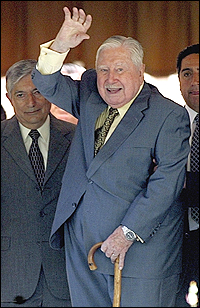
He's dodged it for years from Europe to South America, always just slipping through the fingers of justice. Now, former Chilean tyrant Augusto Pinochet took the opportunity of his 91st birthday to take responsibility for everything that happened during his brutal dictatorship. Augusto seems to have adopted the policies of George Bush and Don Rumsfeld - accept responsibility so long as it doesn't come with any consequences.

Pinochet, in his acceptance speech, accepted responsibility but with no apology or regret. What he did, he said, including the assassination of democratically elected President Salvadore Allende, was simply for the good of Chile. Along the way his regime subjected the Chilean people to arrest and torture and a good measure of murder to boot. More than 3,000 Chileans died at the hands of his security forces.

While he held power Pinochet wasn't a complete pariah. Henry Kissinger was a pal, Ronald Reagan liked him and so did this tart:


Augusto didn't miss the opportunity to explain that it was necessary to murder President Allende (23 bullets in the back if memory serves) to protect the country's "integrity" which is a funny word for copper mines.

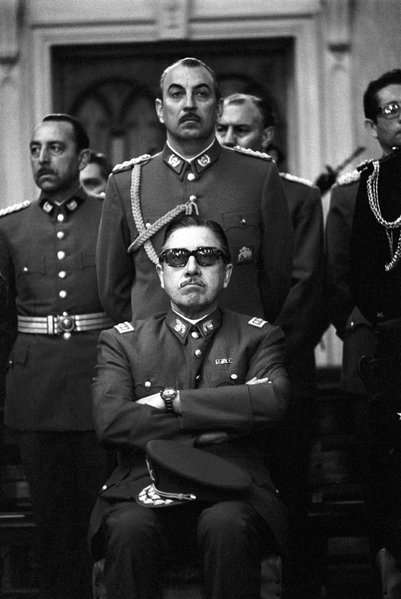
He also sent greetings to his homeboys, "...my comrades in arms, many of whom are imprisoned, suffering persecution and revenge." Oh, those poor butchers. Imagine, made to stand trial. Now what kind of guy can feel sorry for such animals? Here's a younger Augusto and the boys from the good old days:


Saturday, November 25, 2006

Hidden Costs of the Tar Sands


The Athabasca Tar Sands are a huge boon to the province of Alberta. One of the greatest blessings for the province's politicians and oil execs is that the tar sands are so far north - out of sight, out of mind. You wouldn't want that mess in your back yard, you wouldn't want it within fifty miles of your back yard.

The tar sands are literally the world's filthiest oil source. Extracting synthetic oil from the sandy tar produces vast amounts of GHG, other air pollutants, water pollutants and soil contamination. Harper likes to talk about "principle trumping the almighty dollar" - yeah sure, Steve, just so it's not at home, eh?

There are problems associated with tar sand mining and refining that will cause significant effects to your pocketbook in years to come. One of these is natural gas prices. If you've got a gas-fired water heater or furnace of fireplace, you can expect to face hefty increases in your utility bills in coming years because of the tar sands' insatiable appetite for natural gas.

Let's see - we take the cleanest fossil fuel, natural gas, and squander it in a filthy process to produce a dirty fossil fuel, oil, to fill America's gas tank. You gotta like the logic there. Oh yeah, right, I forgot - the almighty dollar.

Here's moe detail on the tar sands/natural gas conundrum from energybulletin.net:

"Production of "oil" from the tar sands is a very energy-intensive process. Production estimates for 2025 are that the energy input will require between 1.6-2.3 billion cubic feet (bcf) of natural gas per day, approximately equal to the planned maximum capacity of the proposed Mackenzie Valley gas pipeline (1.9 bcf/d) out of northern Canada, or about one-fifth of anticipated daily Canadian gas production. Pipelines or no, the energy requirements of the projects planned for tar sands development already exceed the amount of available natural gas from the entire Mackenzie River project. Virtually all estimates for natural gas usage in tar sands operations by 2015, just 10 years hence, exceed the projections for available amounts of natural gas. Something has got to give.

"In another respect, using natural gas for tar sands development creates a political issue for Canada due to its obligations under the North American Free Trade Agreement (NAFTA). The NAFTA issue arises because if Canada uses natural gas for tar sands development, that nation will have that much less gas available for export to the U.S. But also under the terms of NAFTA, Canada cannot reduce natural gas exports to the U.S. unless it also reduces natural gas consumption within Canada. And because sometimes it gets cold in Canada in the wintertime, there may be a domestic Canadian political issue wrapped up in all of this."

Maybe Stevie ought to take some time out of "nation building" to start giving us some straight talk about how he's going to protect our natural gas supply. He won't because he isn't.

Then, as the report points out, there's the issue of water:

"Another limitation on tar sands expansion is that processing capacity is limited by water supply. Much water is already being recycled using current technology, but current production techniques require 1-2 barrels of "makeup" water per barrel of product. It will be imperative to develop technology that uses less water or that recycles even more of the water being used. And doing this is not nearly as easy as you might think.

"Surface water flows, principally from the Athabasca River, are simply inadequate to meet forecast needs. And deeper water, from underground aquifers, is saline and must be diluted with fresh water or otherwise desalinated. Whoops. This will require more of that energy input stuff.

"Immense amounts of water are currently being discarded into settlement ponds, in which it may take 200 years for the smallest particles to settle down to the bottom. Meanwhile, the water is toxic, and mixed with exceedingly high levels of heavy metals and other exotic elements that you probably do not want to eat. Some of these impoundment ponds are many miles in area, and will pose an environmental problem or hazard for many centuries."

Lots of room for principles here but don't hold your breath. Rona ain't ridin' to the rescue.

Wouldn't it be grand if we told the tar sands companies to find ways to resolve these problems before they go digging for any more bitumen? They tell us all the answers are just around the corner, the technology is coming. Is it?

The technology may in fact be developed but how willing will producers be to foot that substantial bill on an energy project that already has unbelievably low "energy return on investment" ratios of somewhere between just 5-10%? With those margins there's not much incentive to take responsibility for cleaning up tar sand extraction.

The worst part is the EROI (return on investment) only recognizes the producers' costs. It makes no allowance for the environmental and social costs inflicted by the tar sands project but, then again, why should it? You and I will be footing that bill.

Hey Steve, stop shoving that Chinese fella around and let's talk about your principles.

It's a Civil War

All we've heard for months is how Iraq is teetering on the edge of civil war or is descending into civil war or risks civil war. That's all nonsense. Iraq is in a state of civil war. There is underway in Iraq an actual civil war and there's no point dodging that reality.

Here's a useful discussion of the meaning of "civil war" from the Freeman Spogli Institute for International Studies at Stanford University:

"Politics aside, however, the definition of civil war is not arbitrary. For some -- and perhaps especially Americans -- the term brings to mind all-out historical conflicts along the lines of the U.S. or Spanish civil wars. According to this notion, there will not be civil war in Iraq until we see mass mobilization of sectarian communities behind more or less conventional armies.

But a more standard definition is common today:

1) Civil war refers to a violent conflict between organized groups within a country that are fighting over control of the government, one side's separatist goals, or some divisive government policy.

By this measure, the war in Iraq has been a civil war not simply since the escalation of internecine killings following the bombing of a Shiite shrine in Samarra in February, but at least since the United States handed over formal control to an interim Iraqi government in June 2004.

Here's why: Although the insurgents target the U.S. military, they are also fighting the Shiite-dominated Iraqi government and killing large numbers of Iraqis. There is little reason to believe that if the United States were suddenly to withdraw its forces, they would not continue their battle to control or shape the government.Political scientists who study civil war have proposed various refinements to this rough definition to deal with borderline cases. One issue concerns how much killing has to occur -- and at what rate.

2) For a conflict to qualify as a civil war, most academics use the threshold of 1,000 dead, which leads to the inclusion of a good number of low-intensity rural insurgencies.

Current estimates suggest that more than 25,000 Iraqis have been killed in fighting since the U.S.-led invasion in March 2003 -- a level and rate of killing that is comparable to numerous other conflicts that are commonly described as civil wars, such as those in Lebanon (1975-1990) and Sri Lanka (beginning in 1983).

The organization -- or rather, disorganization -- of the warring communities in Iraq means that a large-scale conventional conflict along the lines of the U.S. Civil War is unlikely to develop. More probable is a gradual escalation of the current "dirty war" between neighborhood militias that have loose ties to national political factions and are fighting almost as much within sectarian lines as across them.

This is roughly what happened in Lebanon and at a lower level in Turkish cities in the late 1970s. Ethnic cleansing will occur not as a systematic, centrally directed campaign (as in Bosnia), but as a result of people moving to escape danger."

There, that resolves it. There's no more 'descending' or 'teetering' necessary. There's no reason to hush up to avoid recognizing yet another failure by the U.S. and British. This specious argument that they can't leave lest Iraq descend into civil war is utter nonsense. Iraq is in a full-blown civil war. Now, we can start figuring out how this will end. A good start would be to get the coalition forces out of there if only to stop fueling the insurgency.

Lawrence Martin Cuts Harper To The Bone

Interesting piece by Lawrence Martin in today's Globe. He analyses whether Harper's bold initiatives are driven by the wellbeing of Canada or merely vote-pandering. On issues such as Quebec as a Nation, GST cuts, the softwood lumber sellout, environmental protection and global warming, the Afghanistan mission and day care, Martin shows that they're all pretty much political maneuvering.

Martin lays a lot of the blame at the feet of our media:

"Higher standards might prevail if the media focus was less on the politics of every government action and more on how the decisions affect the wellbeing of the country. It used to be that when politically driven considerations superseded the national interest they were exposed and scorned, not saluted."

Yes Lawrence but that was before Ibbitson, Marcus Gee and their ilk were appointed Harper cheerleaders at your paper.

Harper Cuts More Climate Change Programmes


According to The Globe, Harper is about to take the axe to government climate change programmes again. With the integrity of a nest of pit vipers and the nerve of a canal horse, the Tories are even "...asking public servants to help manage the 'fallout' by explaining why their positions should disappear." I'd love to know the carrot and stick behind that sleaze.

Speaking of sleaze, the article also reveals that - surprise, surprise - Rona Ambrose hasn't been terribly honest about this business. E-mails obtained by the Liberals under FOI confirm that government officials were directed to excise references to Kyoto from the government's global warming site. When asked directly about this in June, Ambrose claimed the question was "ridiculous." Rona Ambrose is a sleaze.

Simply Beautiful

This Isn't Going to Please the Neighbours

The Toronto Star reports that a Canadian may have assumed command of the insurgency within Iraq. The man, who apparently goes by the name Abu Abdul Rahman, left Canada in 1995. He's being associated with a new and bolder insurgency that is confronting American troops in Iraq.

According to The New York Times, insurgent camps are now training their recruits in military tactics so the can stand and fight U.S. forces instead of relying on hit and run attacks. This sounds similar to what has been experienced by NATO forces in Afghanistan in recent months.

This Should Help Settle Things Down

I thought I'd explore the Shia/Sunni divide and where it stands today. The Iraq civil war is being fought along Shia/Sunni lines and, if partition comes, it will also probably be along those same religious lines. But what of the state of Shia and Sunni faiths in the rest of the M.E.?

Things aren't great between them, even outside Iraq. The Shia world is primarily non-Arab. They're a minority sect throughout the Islamic world and the majority faith in Iran, Iraq, Azerbaijan and parts of Yemen, Afghanistan and Pakistan. The Sunni dominate the balance of the Islamic world. Here's a map:

Dark Green = Shia

There is a bitter rivalry underway between al-Qaeda (Sunni) and Hezbollah (Shiite). Al-Qaeda leaders are said to be alarmed at the growing prestige of Hezbollah among the people of the Sunni M.E., especially after Israel's last failed invasion of Lebanon. There is speculation that this factor played a role in the Palestinian uprising four months later but there is no proof of that.

The tensions between Hezbollah and al-Qaeda are a threat to both of them but there is much that they share in common. Both believe that Israel must be destroyed. Here's the hook - militant Shia and militant Sunni believe the conquest of Israel will usher in the "End of Times" and bring paradise on earth.

No one is sure how this rivallry will play out in the next couple of years but is expected that the civil war in Iraq will have a ripple effect in parts of the Arab M.E. One thing that is certain: a lot of civilians are going to be caught in the middle of these extremists.


Friday, November 24, 2006

Do I Have to Tell You Again? Stop Eating the Cats!


Beijing has finally let the cat out of the bag. Okay, I'm sorry. Remember SARS? Who doesn't? Well a joint China-Hong Kong research team has announced they've determined that SARS spread to humans from civet cats.

Hong Kong scientists have long speculated that the Sudden Acute Respiratory Syndrome virus was spread to humans by the civet cat, a popular delicacy in parts of China, and then developed the ability to rapidly spread from human to human.

So, next time when they pass the kitty platter, just say "no".

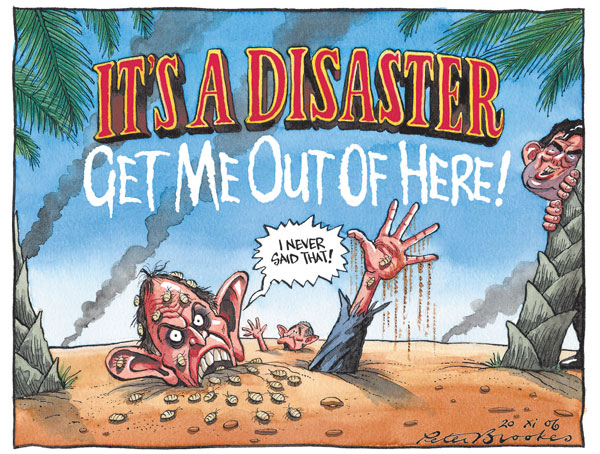
Just What Did Tony Blair Say to David Frost?

Has Tony Blair gone mad? Alistair Mant speculates in the Sidney Morning Herald in an article entitled "The Madness of King Tony":


Tony Blair's recent interview with Sir David Frost got a few observers quite worried about the Prime Minister's state of mind. His response to Frost's observation that Iraq has been "so far pretty much of a disaster" was so far removed from reality as to be alarming. It is worth noting the Prime Minister's reaction in full:

"It has [been a disaster] but, you see, what I say to people is: 'Why is it difficult in Iraq?' It's not difficult because of some accident in planning, it's difficult because there's a deliberate strategy - al-Qaeda with Sunni insurgents on one hand, Iranian-backed elements with Shia militias on the other - to create a situation in which the will of the majority for peace is displaced by the will of the minority for war."

It's not easy to deconstruct this statement. It seems to say: "It's not our fault. Our plan was excellent. It's just that the bad guys didn't do the right thing - it's so unfair."

Note also his difficulty with the word "disaster" - in his mind, Iraq is "difficult". And note too that Blair doesn't tell Frost what he actually believes, only what he says to people.

Blair has worried some observers before. As long ago as March 2003, the distinguished former politician Matthew Parris wrote an astonishing piece for The Times entitled: "Are we witnessing the madness of Tony Blair?"

In it, he drew attention to the "fierce intensity" of Blair's self-belief and to his wild optimism and grandiosity, quite out of step with messy reality. He also, in passing, linked this messianic quality with the Prime Minister's well-known religiosity. Alistair Campbell, then Blair's press secretary, always insisted "We don't do religion!" But the press corps knew better.

Those who work with Blair refer to his frequent rumination "it's all very difficult!" - which they take to mean "we don't do difficult". So Parris's observation that Blair prefers a kind of vague but well-meaning optimism to admitting to and grappling with failure, is supported by Abse's experience nearly 20 years earlier. He observes that Blair's rhetoric is of "trust and honour; of compassion, conviction, vocation; of humanity, integrity, community, morality, honesty and probity; of values, standards, faiths and beliefs". He is a politician but he aspires to be more than that.

Sir Christopher Meyer, the British ambassador in Washington during the Iraq build-up, reminds us in his book DC Confidential that Blair doesn't "do" detail either.

If it is true that prominent politicians are often impelled to act out private grief in their public lives, this may explain their frequent recourse to bizarre or self-destructive behaviour. In retrospect, Blair's personal decision to take Britain into Iraq seems to verge on the suicidal, politically speaking. But perhaps the need for approval and acceptance by a powerful father figure swamped all other considerations.

Once that decision was taken, in opposition to all the most expert advice, the Prime Minister was launched on a sea of "bullshit". But not lying - his moral code will not condone a deliberate lie. What's the difference?

Professor Harry Frankfurt, the eminent Princeton philosopher, explains the distinction between lying (the deliberate attempt to deceive) and bullshitting (which the bullshitter is likely to believe - and which may well be true). The point of bullshit (as Frankfurt explains in his important monograph On Bullshit) is not concerned with truth or falsehood but with the carrying forward of an impression which supports a general thesis about the world at large and especially about the "bullshit artist" himself. The admirable thing about the liar is that he has a kind of respect for the truth, because he must apprehend it in order to contradict it. For the bullshit artist, truth is an irrelevance.

So when politicians tell untruths they are frequently expressing a deeper truth which is embedded in their wounded self-view. And of course the fact that both Blair and Bush are religious means that they are both capable of faith in the undemonstrable. Bush is also probably quite sincere in what he says - Frankfurt might argue that his particular line of bullshit serves the underlying purpose of demonstrating to an extended, and sceptical, Bush family, that he is not a stupid failure burdened by an addictive personality after all. So, terrifying as it may seem, he probably believes every word he says. The US Vice-President is another matter.

So, are we just unlucky to have two important political systems led by people damaged in this way? Not really. The point is that people like Blair and Bush are impelled to strive for the top and, given a surface plausibility and unlimited self-belief, often achieve it. Never forget the wise words of the great 17th-century French essayist Jean de la Bruyere: "Men fall from great fortune because of the same shortcomings that led to their rise."

Carbon Trading Snake Oil

A scam fostered with good intentions.

Western nations are rich compared to the rest of the world. Thus it's almost irresistable when faced with a threatening problem to opt for paying a modest price to make it go away.

That's the essence of the carbon trading racket. If you pollute too much, you can fix everything by simply paying some needy third world bugger to curb his pollution or to do something "carbon friendly" like planting trees. He cleans up his act and you get to take credit for it by sending him a few bucks. You can just keep going at it because there'll never be a shortage of poor folks ready to take your money.

It sounds okay - not great but okay - in theory but the policy is riddled with holes in practice. The tree planting business, for example, is really dodgy. It is difficult to determine with any degree of certainty how much carbon is going to be absorbed by each tree. Then the carbon captured by that tree will, of course, simply be spewed back out when the tree is felled, naturally or by logging, and the tree either decomposes or is burned. This assumes that the parties to the programme are actually honest and their effort verifiable.

The biggest problem, however, is that this deludes us into believing we can keep riding this merry-go-round instead of actually slashing our own carbon production. We have to break that delusional dependency and there's no magic solution.

Are Americans Turning a Corner?

Sometimes you find inspiration in unusual places. I did today in an article written by columnist Rami Khouri in Lebanon's Daily Star:


"I've just spent seven weeks in the United States and encountered hundreds of students, professors and other ordinary citizens all around the country who share a set of powerful ideas - personal liberty, pluralism, and equal rights and opportunities guaranteed by the rule of law. Yet America also runs into great difficulties when it takes its ideals around the world on the back of its army trucks and air force planes. Consequently, American society is tempered today by some humility, anchored in genuine perplexity.

"The militant arrogance and aggressive self-assuredness that often defined American public and foreign policy in recent years have given way in places to a more humble spirit of inquiry. Everywhere I went, Americans asked the same questions: Why does the world resist American attempts to promote democracy? Why do so many people all over the world criticize the US? Why is the American "noble" mission in Iraq going so badly?

"Based at Stanford University in northern California, then at Northeastern University in Boston, I traveled throughout the land and heard citizens everywhere ask honest questions about how the US should best behave in the world. I encountered only the rare wild accusations about Arabs and Muslims or equally jingoistic assertion that "America knows best." If the world changed for Americans after 9/11, it seems to be changing again these days, and for the better.

"Typical were the questions I had from a class of over 300 students at Northeastern University on globalization and international affairs - itself a sign of the growing interest here in learning about the world, rather than sending the troops abroad to rearrange it. A few energized students slammed me as a "raving fanatic" and asked how I dared to deliver my "ideologically skewed views in a society with freedom of thought," and I thanked them for their candor and for keeping me on my toes."

Khouri's comments deliver a ray of hope that many Americans have finally broken free of the 9/11 trauma and subsequent propaganda that fueled their confusion, fear and anger and are willing again to approach the world and its problems with a broader, more balanced and yes, nuanced, outlook. There is hope.

The Definition is Irrelevant


The debate over whether Quebec should be recognized as a nation is too often focused on what we mean by "nation", how we define it, the word's significance. The real issue, from everything I've witnessed in the past, isn't in the definition but in the expectations the word unleashes.

This isn't like the way we once gave beads to Indians. No, the gift of "nation" to many Quebeckers brings with it expectations of some degree of genuine sovereignty and the trouble arises when they realize we have no intention of delivering that. Nobody likes crass manipulation for political advantage, especially not if they come to realize they're the targets of it.

If you stir up the embers, you're likely going to rekindle the fire.

This Is What Our Soldiers Are Up Against


You won't get this unvarnished reality from Stephen Harper or any other Afghanistan cheerleaders but we need to understand the rot that is today's Afghanistan, the rot we're expecting our soldiers to give their lives to defend.

Here's a very different look at what's going on over there from Kathy Gannon of the Associated Press:

"But government help hasn't reached many Afghans, and much of the country has returned to the same 1990s anarchy and lawlessness that gave rise to the Taliban's iron-fisted rule.

"Taliban fighters defend villagers against criminal gangs which often are linked to the government, he said. They don't perform the arbitrary arrests and searches that are conducted by the Western troops who occasionally patrol the region. Also boosting their ranks are Western air strikes that often kill civilians along with combatants.

"If this is all they are going to do for us, is kill us, they should get out," shouted Ghulab Shah, a middle-aged man from Ashogho in southern Kandahar after nine of his neighbors were killed as they slept when a NATO bomb blasted their home.

"Kandahar governor Asadullah Khalid shares the frustration. "How are we supposed to bring security to the country with this kind of thing happening?" he asked.

"The government, he said, can replace the houses destroyed in the raids. "But who do you build a house for if they are all dead?"

"The Taliban defeat in 2001 provoked a backlash against their harsh rule and a surge in support for the new government. From Zabul province in southeast Afghanistan, 2,000 young men went to Kabul to sign up for the new national army or police forces.

"All returned, police officials say, frustrated by poor salary or perceived ethnic bias in the new government. All but four joined the Taliban, they said.

"And to the common people, criminal gangs abetted by the police and military are as big a threat in many areas as the fundamentalist militia, said Noor Mohammed Paktin, Zabul's police chief.

"'Many times when they say Taliban attacked cars on the highway, it is thieves, sometimes ... with the help of the police,' Paktin said in his office in Zabul's provincial capital, Qalat.

"Roads through the province are dangerous. Even the highway between Kabul and Kandahar, built with U.S. money and hailed as a symbol of Afghanistan's post-Taliban rebirth, is normally empty by early afternoon because of checkpoints run by the Taliban, thieves or rogue police.

"Today, local officials say, most of Zabul province is under Taliban control. In Kandahar and Helmand provinces in southern Afghanistan, government influence is restricted to the capital cities and a few district headquarters, according to Najibullah, a career police officer who asked that his full name not be used, for fear of being disciplined.

"Rather than try to defend the village of Musa Qalat in Helmand Province, Najibullah said, British soldiers and their Afghan army allies pulled out in mid-October. They handed villagers 200 rifles and, in essence, wished them luck.

"'In Musa Qala the government is there only in name,' Najibullah said.

"Police morale is low, he said, and officers have not been paid in months. About 70 of his 350 men have quit. "Why am I fighting?" Najibullah said. "Because I am a career military man and I should defend the government. But I know that from the ministers right down to the soldiers they are all thieves."

"Some Afghans who welcomed the U.S.-led troops five years ago now resent them. Even after years of operating in Afghanistan, Najibullah said, NATO and U.S. forces still get caught in the middle of tribal feuds and ancient grudges, raiding homes or attacking villages on dubious tips.

"The Taliban have also made an ally of Afghanistan's endemic poverty.

"They recruit many disaffected and unemployed young men within Afghanistan and in places like the Qari Jangel refugee camp in Pakistan's remote southern Baluchistan province, said Christopher Alexander, deputy special representative of the U.N. secretary general in Afghanistan.

"Pakistani authorities ordered the camp closed in April, but it remains open. Local officials say the order comes from the United States, and they refuse to enforce it.

Alexander called cross-border support for the Taliban "very strong."

"He said only a few of the fighters in southern Afghanistan are ideologically committed Taliban, or foreign jihadists. Most, he said, are simply Afghan villagers drawn to the movement by tribal honor, frustration or the need for a job."

And our answer to this is to muster another 2,500 troops? These are problems that are endemic to Afghanistan and they're fatal to everything we're trying to accomplish there. Odd, isn't it, that our leaders can't bring themselves to debate this?
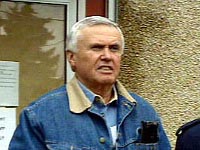
Times Toons


From the Times of London

We Forgot to Liberate Half of Aghanistan's People

The liberated one? She'd be the one in blue.

Our leaders can't help themselves. Every time they want to jumpstart enthusiasm for the go-nowhere mission to Afghanistan, they trot out the liberation of the Afghan people. We got rid of the Taliban. We got Karzai installed in their place. The people are now free.

What a load of rubbish. Power has changed hands, yes. That power, however, hasn't gone where we intended it to go. Karzai's power is minimal, his remit not extending much past Kabul. Warlords rule the north. The Taliban are gaining control of more territory in the south. Yet none of this matters much to one segment of Afghan society - its women.

Our leaders trotted out their ladies' auxillery, Laura Bush and Cherie Blair, to trumpet the liberation of Afghan women in the wake of the ouster of the Taliban. Half the population, free from the yoke of gender intolerance. Yeah, right.

About the only freedom Afghan women are exercising these days is the freedom to take their own lives. The rate of suicide among Afghan's newly liberated women folk has seen such an alarming rise that they just held a conference on the problem in Kabul a few days ago.

But surely Afghan's new crop of female legislators can deal with it, right? No, wrong. According to The Independent, they're kind of busy right now just trying to stay alive:

"Those who should be in the best position to help, women MPs, another supposed sign of the brave new Afghanistan, are themselves facing violence and intimidation. Malalai Joya, at 28 one of Afghanistan's youngest MPs, regularly changes addresses because of death threats. "When I speak in parliament male MPs throw water bottles at me. Some of them shout 'take and rape her'.

"'Many of the men in power have the same attitude as the Taliban. Women have not been liberated. You want to know how women feel in this country? Look at the rate of suicide,' she said.

"Nasima Niazi, who represents Helmand, the centre of British operations, is frightened to go back to her constituency. 'During Eid I went to visit relations and friends. I had to constantly change my burqa because I was so worried that I was being followed. Obviously it is not possible for me to represent my constituents, women or men, under these circumstances.'"

This reality beggars the notion of Afghan democracy pitched so readily by Harper and O'Conner and Hillier and Fraser and, from the wings, Lewis MacKenzie. This war isn't about democracy or the liberation of Afghan women or bringing freedom to Afghan peasants beset by corrupt police. If it was, we'd be pointing our guns in both directions.

Stirring Up the Pot


Russia seems to be getting in everybody's face these days. Yesterday came the release of classified documents showing that the US and Britain aquiesced to Russia's invasion of the Baltics a year before Hitler invaded the Soviet Union. The disclosure days before the NATO summit in Riga was pure coincidence, according to Moscow.

Today Russia confirmed the first deliveries of its Tor - M1, anti-aircraft missile systems to Iran. They'll likely be deployed just in time to be launched against any US or Israeli warplanes that may pay a visit to Iranian nuclear sites.

Russia is definitely stirring the pot. These provocations can't be sitting too well with Washington. From Iraq to Iran, North Korea, Syria, Russia and China there are signs of a growing indifference to American foreign policy. Washington badly needs to restore its credibility. There is simply too much at stake to let this continue.

Two Hours

Recently the US adjusted its troop deployment in Iraq to bring more forces in to quell violence in Baghdad. We were told that Baghdad was the key to preventing full-scale civil war. It probably is.

Yesterday's numbers speak for themselves. Carnage on a record scale, at least until tomorrow or next week. There was one incident in yesterday's violence, though, that was telling of just how bad this civil war has become.

For two hours yesterday, a gang of about 30-Sunni militiamen, armed with assault rifles, machine guns and rocket propelled grenades, brought the Shia-controlled, Iraqi Health Ministry offices under fire. This, is in Baghdad. This went on for two hours. Only after two hours of assault did Iraqi security forces and American helicopter gunships show up to drive the gunmen away.

Two hours to respond to an attack inside what is now a heavily-armed fortress. Two hours - those are people who just don't want to go out in the rain.

The response to the attack on the health ministry doesn't bode well for the Iraqi government's prospects of quelling this civil war. It appears that both the Iraqi government and the American forces are reluctant to get drawn into the middle of this madness.

The Iraqi government tried to put Baghdad under a lockdown today but to no avail. Shia militia are reported to be storming Sunni mosques today, the Muslim holdy day, in retaliation for yesterday's carnage.

At last count, seven mosques were reported to have been attacked, three completely destroyed. Government forces were unable, or unwilling to stop them. A group of Shia legislators meeting at Sadr's headquarters fix the blame for the violence on the presence of American forces and demand a withdrawal of US troops.

Welcome to Anarchy Central.

Thursday, November 23, 2006

Did London and Washington Sell Out the Baltics to Stalin?


Moscow has decided to stir things up before next week's NATO summit in Riga. Russia has released declassified documents showing that the US and Britain secretly approved a Soviet occupation of the Baltics a full year before the Nazis invaded Russia.

Apparently the rationale was that the Baltics were necessary to form a buffer for Soviet defence against a German invasion.

The Guardian says the NDVK dossier contains documents likely provided by such British traitors as Kim Philby and Donald MacLean.

Moscow denies the timing of the release of these documents was intended to cause a rift at the NATO summit. No, not likely.

Nuance is Everything

As recently as a year ago, American politicians and military types liked to say of Iraq that it was "still winnable." It's now obvious that still winnable has a greater meaning - it means "we're struggling" or even losing. Still winnable means there is an immediate need to turn things around or else.

America's ambassador to Kabul, Ronald Neumann, seemed to give that message today when he urged the Karzai government to take advantage of the expected winter lull in fighting to clean up its act:

“Next year is likely to be just as bloody as this year, but the fight is still winnable,” he said.

“We have a window of opportunity to improve governance before the Taliban regroup for their spring offensive.”

Overreaching? Big Expansion for NATO


According to a report in the Financial Times, arms will be twisted - hard - at next week's NATO summit in Riga to get the 16-member states to agree to a substantial beefing up of the troubled alliance.

NATO is already having a frustrating time getting more member support for the mission in Afghanistan as nations other than the US, Britain, Canada and Holland are unwilling to permit their forces to be deployed on combat operations in the south.

Washington clearly wants a more robust NATO, one that is capable of tackling two major operations at once. Given that the alliance is already under considerable strain from the relatively limited Afghanistan campaign it is difficult to imagine many of the member states embracing this 'two war' concept.

One sign that the summit probably won't be as productive as hoped in Washington and London is that the agenda has now been whittled down to two working sessions totalling only 24 hours. It also appears that the American initiative for an expanded NATO partnership with Australia, South Korea and Japan may be a non-starter. Australia has already indicated it's not interested.

Ortega Turns Nicaragua's Face South

Nicaraguan president-elect Daniel Ortega says he wants to work for a unified Central America. In a speech given in Guatemala City, Ortega says Nicaragua needs new trading partners beyond its neighbouring countries and the United States. He referred to the Mercosur bloc of Brazil,
Argentina, Paraguay, Uruguay and Venezuela along with the more leftist Bolivarian pact of Cuba, Bolivia and Venezuela.

Needless to say, Ortega's comments won't be welcome in Washington. Reports this week indicate the US may be ready to build a new, permanent airbase in the Mosquitia region of Honduras. It was from this same region that American-sponsored Contra rebels launched attacks on Nicaragua widely believed to have caused the deaths of 30,000 Nicaraguan peasants.

It will be interesting to see how America's military presence in Honduras evolves if Ortega comes to present a real threat to Washington's presence in Central America.

Did the CIA Whack Bobby Kennedy?

I know how that sounds, but that's the story coming from the venerable BBC.

http://news.bbc.co.uk/2/hi/programmes/newsnight/6169006.stm

The Fundy Papers

This is how fundamentalists saw liberals a century ago. Nice to know that some things just don't change.


See, They're Not So Different

A. What do America's religious right, the Christian fundamentalists, and their Islamic fundamentalist counterparts have in common? B. What value do the United States and Turkey have in common?

Answer A. Both support Creationism and both utterly loathe Charles Darwin's theory of evolution. A 768-page, lavishly illustrated book entitled "Atlas of Creation" is being delivered to schools and libraries throughout Turkey. The tract argues that Darwinism is the actual root of terrorism.

Answer B. In a survey of public acceptance of evolution, Turkey came in dead last among the 34 nations studied, forcing the United States to settle for second place in the 33rd slot.

Amen, Brother


Okay, so invading Iraq hasn't been all that great an idea for the U.S. On the other hand, it was a pretty good deal for al-Qaeda (see next post "Played For a Fool") but it doesn't stop there. Israeli Prime Minister Ehud Olmert is also tickled with how it worked out for his country.

In a speech to visiting American Jews, Olmert says the invasion of Iraq was just dandy from Israel's perspective:

"I stand with the president because I know that Iraq without Saddam Hussein is so much better for the security and safety of Israel, and all of the neighbors of Israel without any significance to us," added Olmert, who was speaking in English.

"Thank God for the power and the determination and leadership manifested by President Bush."
Of course, after the way the Lebanon fiasco turned out, it can't take much to please Olmert.

See, Bush has made everybody happy - except maybe for the Iraqis, and the Brits and, I suppose, the American people, and....

Oh gosh, I almost left out Iran and Syria. They're both pretty happy with the changes President Bush has brought to Iraq. Let's see, the winners are: Israel (supposedly), al-Qaeda (obviously), Syria (vicariously) and the Grand Prize Winner - Iran.

Amen, Brother.

Played For a Fool, Part Deux

Last Friday I posted a story about an al-Qaeda double agent who spied for the British and the French governments. This fellow, in an interview with BBC, told how a prominent al-Qaeda leader captured by the Americans fed deliberately false information to Washington to lure the White House into doing al-Qaeda's bidding.

Here's Gwynne Dyer's take on this foolishness:

"Why Bush himself went along with it is an enduring mystery, and Maureen Dowd's hypothesis that it's really driven by Oedipal conflict ("Dad didn't take Baghdad, but I will") is as good as any. But the invasion would have happened without Libi's lies. It would even have happened without 9/11, if the neo-cons had got their way.

"The point is that al-Qaeda wanted to attack Saddam itself, but was happy to have the U.S. invade Iraq and overthrow him instead because it knew that in the long run it would benefit from the ensuing war of resistance against foreign occupation. I have been saying this all along, because I know a little about how Salafists think, and quite a lot about how terrorist strategies work. However, Nasiri's revelations are the first circumstantial evidence that al-Qaeda leaders actively tried to encourage the U.S. invasion.

"Every day that U.S. troops have been in Iraq since March 2003 has been a day when they served the purposes of al-Qaeda. Every day that they remain, they will continue to serve its purposes."

It's more than sad, it's pathetic.

Dan McTeague Sets the Record Straight

There was less than met the eye to Stephen Harper's bravado with Chinese President Hu over the Celil case, a lot less. Dad McTeague sets the record straight in the latest edition of the online newspaper, Embassy:

www.embassymag.ca/html/index.php?display=story&full_path=/2006/november/22/celil

As usual, there's a lot more show than substance to Stephen Harper.

And Some Days the Bear Eats You


President Bush hasn't had a good time of it lately but, after the last two days, he must be wondering what's next?

First his daughter Barbara gets her purse lifted from beneath her table at an Argentine restaurant while under the watchful eyes of the Secret Service.

Then, during a stopover in Hawaii, the White House acting travel director, Greg Pitts, gets rolled coming out of a Waikiki nightclub at 2 a.m. Another wallet gone.

After that, three motorcycle cops crashed while escorting the president on his way to an air base for his trip home. Two of the officers were seriously injured during the mishap on rain-drenched roads.

The fourth incident, actually the earliest, came in Vietnam when Air Force One crapped out, forcing the president to hop a lowly 757 for his trip to Indonesia.

Sometimes things just don't work out.

The Appeal of Authoritarianism

For months I've argued that democracy has no natural home in either Afghanistan or Iraq; that we can't simply impose something we ourselves took centuries to evolve into. Here's another take on that same point by Ian Bremmer writing in Slate:

"Beginning in 2000, newly elevated President Vladimir Putin restored Russian stability by concentrating political power in the Kremlin, curbing free expression in the country's media, and consolidating economic power in the hands of the state. (The tripling of oil prices over the last four years has made his work much easier.) This forceful reimposition of order has earned Putin a 70-plus-percent approval rating. Broadly speaking, Russians have chosen the order that flows from authoritarianism over the chaos they believe was generated by ill-considered attempts to impose Western-style democracy.

"The people of Afghanistan may already be headed toward the same conclusion. Afghans have nothing like the collective sense of national identity that Iraqis have developed over the last several decades or Russians over the last several centuries—and the elections that made Hamid Karzai president of Afghanistan are even less likely to generate lasting democracy.

"Building democracy in a state with no democratic history is the work of decades—and it can't be done on the cheap. Investing considerable human, political, and financial capital in support of the construction of democracy in two such states simultaneously, acting as if national elections and good police work will create an inexpensive and self-sustaining momentum toward stable political pluralism, is foolhardy.

"Democracy and the open society needed to nourish it requires more than peaceful elections. It demands the steady long-term development of governing institutions that are independent of one another, trump the power of the country's dominant political personalities, and earn the faith of its citizens.

"The United States can continue to try to safeguard Iraq's security until that nation's political leaders forge the compromises needed to begin the long-term process of democratization. But American and British troops will not remain in Iraq indefinitely, because American and British taxpayers won't allow it.

"Iraqis may be pleased with that option as well. When people face the daily uncertainties of life in a dangerously unstable country, they value stability above all else. Freedom from fear trumps the freedom to vote. Until Iraq's Shiites, Sunnis, and Kurds are finally free from fear of sectarian attack and economic exclusion, they will demand stability—just as Russians demand a strong president instead of a strong presidency. Many Iraqis will pledge allegiance to those who can protect them from other Iraqis.

"The process of democratization creates instability in Iraq, Russia, Afghanistan, and any other state in which democracy remains an import. Democratization releases repressed demand for change, and previously disenfranchised players scramble for the first time for a share of the country's political and economic spoils.

"Authoritarians are much better than democrats at quickly bringing order in such a frightening environment. This is mainly because it is easier and more efficient to impose martial law than to build political consensus. The volatility of democratic transitions creates demand for authoritarianism. If a country has more experience with dictators than with democrats, this demand may be second nature.

"In the end, this option might not be as unsavory as it sounds. Before Iraq can become a democracy, it must become a country safe enough for open political debate. As so many have argued, the violence in Iraq requires a political, not a military, solution. And as Bismarck once said, politics is the art of the possible."

Bremmer's right. We don't have a snowball's chance of installing democracy in Afghanistan. We have to stop using that notion as a justification for the "sacrifice" of our soldiers' lives. Maybe we need to re-open the debate Harper so undemocratically shut down. But we won't. We'll stick silly little plastic magnets on the back of our cars and that way ignore the reality of what we're doing to the Afghans and our own soldiers.

Whoops, Lost Sight of That One

Remember back to what seems so very long ago. Go all the way back to September, 2001. Remember when THIS is what we all wanted?

Don't Forget the Parting Gifts

The Harper government is big on law and order, real big. It regularly tells us about how we need to reinforce the deterrence factor of our criminal laws - get tough on crime, stop coddling the villains even those as young as ten.

With this upstanding morality you might be forgiven for thinking that, when we nabbed a foreign spy working in our midst, we would throw the book at him if only "pour encouragez les autres." Guess again.

According to our Public Safety Minister, Stockwell Day, we'd like it if he'd just leave and we're guessing the mystery man would like that too. Here's how Stockwell put it; "I think he would be happiest if he did that."

Let's see - when we catch a foreign agent committing espionage in Canada, we don't want him to become 'unhappy'? That should strike fear in the hearts of Russia's SVR, foreign intelligence agency. Now I don't know much about spying, mainly what I picked up from Le Carre and those spy scandals of the 50's and 60's, but, when we get one of these guys aren't we supposed to bleed him for information?

Maybe not, but at least let's not forget the parting gifts.

Tactics But Where Is The Strategy?

Stephen Harper can periodically show tactical brilliance. Seizing the moment to promote acknowledgement of Quebec nationhood was one example. The brilliance wasn't in the acknowledgement itself but in the way it was manipulated to create something of a fait accompli.

Tactics, however, are no substitute for strategy. Tactics win battles but, unless they're formulated to support a winning strategy, they can actually lose wars and this is Harper's shortcoming.

When I was a kid the corner store sold "grab bags." For five cents (yes, it was that long ago) you got your pick from a tray of small, paper bags. You had to pick first and then find out what was inside that paper bag. Stephen Harper is taking a grab bag approach to the Quebec nation debate. Actually, he's more like the shopkeeper and he's making us pick the grab bag.

Steve's a bully. He likes to push people, forcing them to make decisions without giving them enough time to consider their choices. A brilliant tactic because it keeps your opposition off balance and induces them to do your bidding. I think that's what he's doing this time too.

It's a standard approach in the US Congress. Pass something into law first and then argue about what it means. If the minority don't go along with it, they can be cast as unpatriotic or cowardly. Only after they're in the trap does the majority decide what the legislation they all voted to support will actually mean. That's the essence of right-wing democracy.

Harper, of course, doesn't have a majority but he doesn't need one this time. I doubt that he really cares much whether his motion succeeds in parliament. Either way he gets the political gravy that he's counting on to generate a majority government. It's all form over substance. He's hoping he can make Quebec nationalists believe they've finally met an Anglo PM sympathetic to their aspirations and thereby take Quebec votes away from both the Libs and the Bloc.

Here's my take on what Harper is up to. I have long believed that Stevie's real interests aren't in Canada but in Alberta. I think he understands that his far-right agenda has a short wick on the national stage, that the clock is ticking. He realizes that the Canadian people are much too centrist to be swayed to his policy preferences although they can be nudged that way in the short term. This puts him in a "seize the day" mentality. Get what you can before you get the boot. He's got the helm so he might as well steer the ship his way until the mutiny.

I may sound paranoid but I think the Quebec initiative is a way to achieve Harper's real goal of a fundamental devolution of federal powers to the provinces. Give it to Quebec and how can you refuse to do the same for, say, Alberta or every other province? Stripping Ottawa of its jurisdictions, and associated spending powers, is the ultimate gift to a cash-rich province, soon to be a nation. A profoundly weakened Ottawa would be a blessing to the Oil Patch, especially the tar sands boys.

Harper saw what happened to Meech Lake and the Charlatan Accord. He knows they set a precedent of submitting major constitutional changes to the referendum process. The Quebec gambit may circumvent the referendum process or simply render it irrelevant. That would then clear the way for rapacious provinces to devour the federal roast until they're sated.

There is no Clyde Wells today to put the brakes on this risky business, to demand that we first define what "nation" is going to mean in the context of Quebec. There is no one today in a position to force an open debate on devolution of federal powers. Stephen Harper intends to use his tactics to effectively gag anyone who might be willing to stand up for federalism and the federalist cause.

I doubt very much that Stephen Harper has a national strategy behind this maneuvre. If he has any strategy at all, it's limited to the future of Alberta.

Hey Vlad, Heard From Stevie?

Little Stevie could hardly wait to puff up his chest and let us in on how he gave Chinese President Hu a piece of his mind, a tongue-lashing that rocked Hu back on his heels. Wow, now there's a man of action, a Fearless Leader (if you get the drift).

Has anybody heard Steve mention how he tore a strip off Vlad Putin for running spies in Canada? I would have thought someone as courageous as our Tom Terrific PM would have wasted no time in reprimanding Putin and reminding him he'd better be careful because he's messing with a future energy superpower.

I know. Let's get Putin and Harper in the ring for a little martial arts, one-on-one, a chance for Stevie to really put the smackdown on the scheming Russkie.

Wednesday, November 22, 2006

Rona's Empty Admission

Rona Ambrose was a national humiliation in her performance before the world in Nairobi. Here's an interesting take on Rona from the online publication, "Embassy, Canada's Foreign Policy Newsweekly":

"When it comes to climate change, Canada is a big player because, as the PM likes to say, "Canada is an emerging energy superpower." This country's wealth of oil, gas and hydropower makes its Kyoto voice morally and practically influential.

"Lambasted by her critics, Minister Ambrose is still praised by her friends for telling it like it is in Nairobi. Canada, she said, in an unusually partisan note for an international conference, had failed to live up its Kyoto commitments. "Truth and honesty in government" said her supporters. "Just what we all wanted."

"Well, yes...and no. Truth in admitting a failing in international relations has to be like truth in the confessional. It's only of value if the admission of the sin includes a plan for its correction–or at least a vow to stop doing the harmful thing over and over again.

"The minister's mea culpa has merit only if she is prepared to put forward a plan to meet Kyoto. As most everyone back in Calgary knows, climate change and Canada's energy superpower status are intrinsically bound up with each other.

"Canada will go on to meet and even exceed Kyoto standards for greenhouse gas emissions only when it publicly makes an accounting of the present and future activities of its energy and transportation industries.

"If there is an epicentre for this process, it is probably in the heart of the Alberta tar sands.

"A great place for mea culpas, sure. But a better place to first publicly catalog how it fits into meeting Kyoto requirements. And then to take federally enforced steps to limit the global harm."

The Far-Right Malignancy


The core problem of far-right governments is that they reside on the fringe, the heartland of radicals and extremists. When these governments rule, they empower their journalistic handmaidens who become emboldened to their own vile extremism. In the US this mob runs a gamut from Hannity and O'Reilly to Coulter and Savage.

Today, Michael Savage (formerly Michael Weiner) used the Michael Richards, comedy club frenzy to lambaste liberals:

"This is an interesting story, but this is what the subtext of liberalism really is. Under the surface, if you get them in a room alone, I guarantee you they'd say the same sort of hateful things about Catholics and about Jews and about straights and about soldiers."

This drivel from a creep who recently ridiculed Ethiopians by claiming they "have flies around their eyes" and calling for immigrants to return to "the fetid societies... they ran from."

The Myth of Victory Over The Taliban


One of my favourite columnists from The Guardian is Simon Jenkins. He has a terrific ability to see through political smokescreen and reveal the obvious.

Here are a few excerpts from Jenkins' take on Blair's puffery about defeating the Taliban:

"Tony Blair was talking to soldiers he had sent to fight the toughest guerrillas on earth for control of southern Afghanistan. He told them: "Your defeat [of the Taliban] is not just on behalf of the people of Afghanistan but the people of Britain ... We have got to stay for as long as it takes."

"The prime minister's brain has clearly lost touch with reality. Even under the Raj there was no conceivable way Britain could conquer and hold the arc of territory to which Blair was referring. It stretches from the Persian Gulf through Iranian Baluchistan and Afghanistan to Pakistan. No central government has come near to controlling this region, and its aversion to outside intervention is ageless and ruthless, currently fuelled by the world's voracious appetite for oil and opium. But it poses no threat to world security.

"The sole basis for Blair's statement is Mullah Omar's hospitality to the fanatic, Osama bin Laden, at the end of the 1990s. As we now know, this was never popular (an Arab among Pashtuns); after 9/11, when the Taliban had collaborated with the west over opium, either Bin Laden would eventually have had to leave or the Tajiks would have taken revenge for his killing of their leader, Sheikh Massoud. Even the Pakistanis were on his tail. Either way, Talib Afghanistan was no more a "threat" after 9/11 than were the American flying schools at which the 9/11 perpetrators trained.

"So what is Blair getting at? He once confessed to his hero, Roy Jenkins, that he regretted not having studied history at Oxford. He never spoke a truer word. The concept of world security as holistic and vulnerable to incidents such as 9/11 is nonsensical. Politics is not a variant of the Gaia thesis, in which each component of an ecosystem depends on and responds to every other. There is no butterfly effect in international relations. For want of a victory in Helmand, the Middle East is not lost, nor for want of victory in the Middle East is western civilisation lost.

"While terrorism can take on different guises, it is not new and is not a threat to human society to rank with a world war or a nuclear holocaust - as the home secretary, John Reid, has absurdly claimed. Terrorist incidents are the outcome of someone's mental pathology and are of no political significance - unless cynical leaders in a targeted community choose otherwise.

"What is sad about Blair's statement is not its strategic naivety but the psychology behind it. Why have the leaders of Britain and America felt driven to adopt so wildly distorted a concept of menace? In an analysis of terrorism in the latest New York Review of Books, Max Rodenbeck offers plausible but depressing answers. They include the short-term popularity that war offers democratic leaders, the yearning of defence chiefs and industries to prove the worth of expensive kit and, in Iraq's case, "the influence of neoconservatives and of the pro-Israeli lobby, seeing a chance to set a superpower on Israel's enemies".

"All this is true, but I sense a deeper disconnect. The west is ruled by a generation of leaders with no experience of war or its threat. Blair and his team cannot recall the aftermath of the second world war, and in the cold war they rushed to join CND. They were distant from those real global horrors. Yet now in power they seem to crave an enemy of equivalent monstrosity. Modern government has a big hole in its ego, yearning to be filled by something called a "threat to security".

That Says It All


US Senator John McCain wants more American troops in Iraq, a lot more. He believes his country's goals for Iraq are unachievable without them. It's a problem common to Afghanistan where the shortage of forces, boots on the ground, is even greater.

Today, however, John McCain dared to take the debate to the next step, one where Bush and Harper and Blair don't have the courage to go:

"I believe victory is still attainable. ...But without additional combat forces we cannot win this war."

"As troubling as it is, I can ask a young marine to go back to Iraq. What I cannot do is ask him to return to Iraq, to risk life and limb, so that we might delay our defeat for a few months or a year. That is more to ask than patriotism requires. It would be immoral and I could not do it."

John McCain is absolutely right on this point. Whether you support or oppose the American mission in Iraq or the NATO mission in Afghanistan, it is immoral to leave our troops to risk life and limb to fight a campaign where they're so outnumbered that the outcome cannot be in doubt.

That's what the Harper government is doing to Canada's troops in Kandahar province. We voluntarily took responsibility for that province yet sent a force that was ridiculously too small for the job. Those soldiers have done a terrific job, magnificent, but we can't ask them to win victories that would require a force many times their size.

Canada's major domo on military affairs and Tory cheerleader, former general Lewis MacKenzie, entered the fray in an opinion piece in today's Globe & Mail finally acknowledging that the NATO mission is fatally undermanned and calling for another 30,000 combat troops for Afghanistan. I found the timing sort of odd. Where was this MacKenzie wisdom when it might have been useful, back when Harper rushed through a Commons debate on extending the mission? Why is this only coming out of MacKenzie's mouth now? More importantly, why did Lewis MacKenzie not raise the obvious point we heard from John McCain, that's it's immoral to expect soldiers of a hopelessly undermanned force to risk life and limb to postpone the inevitable?

I guess John McCain is a lot more soldier than Lewis MacKenzie.

Tuesday, November 21, 2006

Just Because

The Worst Part Is, They're Probably Right

Ever since the idea of an American victory in Iraq evaporated the debate has been about whether the US forces should leave. Last year it was fashionable to say that American forces in Iraq were actually fueling the insurgency. So they are. The pitch today, however, is that the United States must not leave because it would all be so much worse if they did.

They're probably right. A departure of American forces from Iraq will probably spark a measure of instability that will lead to increased violence and death. Let's change a few words around. Instead of "A departure of American forces", let's say "When the American forces depart" and leave the timing entirely out of it. That way you can say "When the Americans leave next year" or "When the Americans leave in four years" almost interchangeably. Do that and add the words, "it will probably spark a measure of instability that will lead to increased death and violence."

The ongoing American presence in Iraq is fueling the insurgency, increasing violence. Fair enough. When the Americans withdraw their presence that will increase the levels of violence. Hard to dispute that. What's missing from this perplexing equation is that so much of this violence will occur regardless of whether the Americans stay for one year or four. That's because much of the violence has nothing at all to do with the Americans themselves, except for their role in precipitating it.

America toppled Saddam. You won't find any disagreement about that. When they got rid of Saddam, however, they let the genie out of the bottle. That act ordained what remains to be played out whether it's next year or two years from now or six or whatever. The Americans 'enabled' the civil war that exists today but they didn't create it. The distinction goes a long way to explaining why the US has been so hapless to control it, much less stop it. The cork in the bottle was Saddam. They pulled the cork from the bottle. They released the genie but they didn't create the genie.

Those of us who feel Washington shouldn't have done it are well-intentioned but the argument is irrelevant, moot. What's done is done and it will be played out - eventually.

There's no good answer but not all options are equally bad. Here's one that may cause the least damage: get US forces out and Muslim forces in. Mix'em up, so they're a blend of Shia and Sunni but leave them all under a single, unified command with American oversight.

This won't prevent sectarian violence, there's no way of guaranteeing that. It may, just may, however make the dangers the responsibility of the greater Arab Muslim world, removing the infidels from the equation.

Just imagine, then the United States might be able to take all those relieved divisions and place them under NATO control to address all the problems they created by turning their backs on Afghanistan five years ago.

Just a thought.

They Can Hardly Wait But They Won't Be Waiting for Long


Isn't this nice, we're all agreed, even the Bloc Quebecois. Canada's lucky last survivor of the First World War will receive an all-expenses paid, state funeral. We're down to three finalists - Lloyd Clemett and John Babcock, 106, trailed by youngster Dwight Wilson, a paltry 105. The judges still haven't decided about Babcock, however. A cloud hangs over his chances of a caisson ride due to the fact that he had the nerve to become a naturalized American citizen not to mention that he lives way out in Spokane, Washington. Think what that's going to cost to ship Babcock back to Ottawa.

Let's not make a spectacle out of these wonderful, old fellows, especially in this time of highly-exploited images of military patriotism. Let's show them our sincere appreciation and leave them to go through this with their dignity untramelled by us, unexploited by us.

Here's an idea. Why don't we honour all of the 619,000 Canadians who served in that miserable and futile meat-grinder with a national minute of silence when we can all gather our thoughts in memory of their collective sacrifice?

But, if we have to go through with this faux pagentry, at least legislate a state holiday for the event. The idea of people having to come home after work to try to catch highlights on CBC Newsworld is nothing short of obscene.

You'll Need that Passport After All


A story that just appeared in The Guardian claims that, beginning January 23rd, all air travellers, even Americans, entering the U.S. will be required to present passports.

The new policy is scheduled to be announced tomorrow by Homeland Security Secretary Michael "Katrina" Chertoff.

This change sets new rules for Americans, Canadians and Mexicans who previously did not require passports.

Chertoff's announcement comes as a survey conducted for the American tourism industry revealed that 54% of international travellers said they were treated with arrogance and rudeness by US Customs. 39% of them chose America as the least travel-friendly, more than twice the number who chose the Middle East.

Science Stands Up To Religion

You never would have heard them even a year or two ago but scientists are now standing up to one has called "the long nightmare of religious belief."

The rise of the religious right has been marked by outbreaks of anger from creationists seeking to suppress evolutionists. In US courts the evolutionists managed to prevail - just. Now, after taking this battering, science leaders are fighting back. This article from the New York Times shows how the fight is going:

"Maybe the pivotal moment came when Steven Weinberg, a Nobel laureate in physics, warned that “the world needs to wake up from its long nightmare of religious belief,” or when a Nobelist in chemistry, Sir Harold Kroto, called for the John Templeton Foundation to give its next $1.5 million prize for “progress in spiritual discoveries” to an atheist — Richard Dawkins, the Oxford evolutionary biologist whose book “The God Delusion” is a national best-seller.

Or perhaps the turning point occurred at a more solemn moment, when Neil deGrasse Tyson, director of the Hayden Planetarium in New York City and an adviser to the Bush administration on space exploration, hushed the audience with heartbreaking photographs of newborns misshapen by birth defects — testimony, he suggested, that blind nature, not an intelligent overseer, is in control.

Somewhere along the way, a forum this month at the Salk Institute for Biological Studies in La Jolla, Calif., which might have been one more polite dialogue between science and religion, began to resemble the founding convention for a political party built on a single plank: in a world dangerously charged with ideology, science needs to take on an evangelical role, vying with religion as teller of the greatest story ever told.

After enduring two days of talks in which the Templeton Foundation came under the gun as smudging the line between science and faith, Charles L. Harper Jr., its senior vice president, lashed back, denouncing what he called “pop conflict books” like Dr. Dawkins’s “God Delusion,” as “commercialized ideological scientism” — promoting for profit the philosophy that science has a monopoly on truth.

That brought an angry rejoinder from Richard P. Sloan, a professor of behavioral medicine at Columbia University Medical Center, who said his own book, “Blind Faith: The Unholy Alliance of Religion and Medicine,” was written to counter “garbage research” financed by Templeton on, for example, the healing effects of prayer.

With atheists and agnostics outnumbering the faithful (a few believing scientists, like Francis S. Collins, author of “The Language of God: A Scientist Presents Evidence for Belief,” were invited but could not attend), one speaker after another called on their colleagues to be less timid in challenging teachings about nature based only on scripture and belief. “The core of science is not a mathematical model; it is intellectual honesty,” said Sam Harris, a doctoral student in neuroscience and the author of “The End of Faith: Religion, Terror and the Future of Reason” and “Letter to a Christian Nation.”

“Every religion is making claims about the way the world is,” he said. “These are claims about the divine origin of certain books, about the virgin birth of certain people, about the survival of the human personality after death. These claims purport to be about reality.”

By shying away from questioning people’s deeply felt beliefs, even the skeptics, Mr. Harris said, are providing safe harbor for ideas that are at best mistaken and at worst dangerous. “I don’t know how many more engineers and architects need to fly planes into our buildings before we realize that this is not merely a matter of lack of education or economic despair,” he said."

Before you start posting angry comments, I'm very much struggling in the middle of this one. My mind is anything but made up. That said, I have difficulty grasping the fury of those who contend for bibilical inerrancy. At least I'm trying to work my way through it.

A New NATO?


The NATO alliance is already under strains in Afghanistan that some speculate may bring the organization to collapse. Now, there's a move afoot - driven by the US - to extend NATO's commitments by way of a "partnership" deal between the alliance and Finland, Sweden and - wait for it - Australia, Japan and South Korea. This initiative was disclosed today by U.S.Under Secretary of State of Political Affairs, Nicholas Burns.

Since Washington has been treating NATO as its own Foreign Legion, it's hardly surprising that it would want to extend the alliance's responsibilities to Asia. Let's hope we get some serious debate about this in Parliament well before the NATO summit in Riga at the end of this month. Better yet, let's not take the alliance for granted and postpone any decision on this until all member states have an opportunity to thrash it out in their legislatures.

Chinese Revenge

According to The Globe, China's ambassador to Canada used a speech to a business group in Ottawa today to take a shot at Harper. Lu Shemin got applause from the businessmen when he said that relations between the two countries are not improved by "standing on rooftops and pointing fingers."

I guess as far as the business crowd was concerned it was China 1 Harper 0 in the international bitch-slap competition.

Let's Settle This Like Gentlemen

The countless woes of the Middle East are complex and, as we've seen, utterly confounding to Western meddlers. In my previous career I found that the line about not being able to see the forest for the trees is often very true. Sometimes when you step back you see amazing things you missed by looking too closely. I think we're doing a bit of that in the M.E.

How can Western nations hope to bring peace to the M.E. so long as there are powerful undercurrents of conflict that are not being addressed? Here's one: Sunni versus Shia Muslims. That's a problem that isn't isolated to Iraq but reaches across the Islamic world. It erupts, periodically, into clashes such as the Iraq/Iran war, but it always simmers in the background adding a dimension of inchoate conflict that can make solving other issues vastly more complicated, even impossible.

Just how much can we achieve until this dispute is resolved? Better yet, is there anything we can do to help or force these sects to find peace between themselves? There has been a lot of bad blood and distrust between them that continues, even on a national level, today.

Our hopes for democracy to flourish in the Muslim world are probably unrealistic until internal problems such as these are brought under control. Remember, our own democracy didn't really take hold until we were able to find enough common ground among ourselves.

History - Does It Have To Be So, Well "Historical"?


One of the big problems plaguing the West's approach to the Middle East is our routine refusal to consider the history of trouble spots. When Israel attacked Lebanon this summer, Harper acted as though the history of that conflict began with the kidnapping of three Israeli soldiers. His self-inflicted myopia made it easy for him to take sides but impossible for him to really weigh what it all meant.

Today in Lebanon we have a Christian minister assassinated, presumably at the hands of Syria or some Syrian-backed elements such as Hezbollah. It's very hard to understand what's going on in Lebanon unless you take a look at its troubled history. Fortunately a summary of that history appeared in today's International Herald Tribune:

"Following is a timeline of Syrian power in Lebanon, with reporting from The New York Times and Reuters.

APRIL 1975 -- Clashes that are later seen as the start of Lebanon's 15-year civil war erupt in Beirut.

JUNE 1976 -- Syrian troops enter Lebanon to restore peace.

OCTOBER 1976 -- Arab conferences establish a predominantly Syrian peacekeeping force.

JUNE 1982 -- After repeated Palestinian incursions from southern Lebanon, Israel begins a full-scale invasion. The Syrian Army is ousted from Beirut.

SEPTEMBER 1982 -- President-elect Bashir Gemayel was killed when a bomb shattered the headquarters of his Lebanese Christian Phalangist Party in east Beirut.

MAY 1983 -- Israel and Lebanon sign a peace accord detailing the withdrawal of Israeli troops.

MARCH 1984 -- Under intense pressure from Syria, the Lebanese government cancels its peace agreement with Israel.

MARCH 1989 -- The Maronite Christian leader in Lebanon, Gen. Michel Aoun, declares a "war of liberation" against the Syrian presence.

OCTOBER 1989 -- The Lebanese National Assembly takes a step toward ending the civil war by endorsing the so-called Taif Accord, which calls for Syria to pull its troops back to the eastern Bekaa region but does not set a date for a full pullout.

OCTOBER 1990 -- In one of the last moves of the civil war, Syria's Air Force attacks the Lebanese presidential palace, and General Aoun takes refuge in the French Embassy. Through the early 90's, Syrian dominance in the country becomes less overt.

OCTOBER 1998 -- Emile Lahoud, a general who is backed by Syria, is elected president by Parliament.

MAY 2000 -- Israel ends its occupation of southern Lebanon.

DECEMBER 2000 -- In a surprise move, hundreds of Syrian soldiers leave Beirut and settle in the Bekaa region near the border, though thousands still remain in the country.

2003 -- Syria carries out two partial troop withdrawals, in February and July, bringing its force in Lebanon to about 16,000 soldiers, down from about 30,000 troops in mid-2000.

SEPTEMBER 2004 -- Despite criticism from the U.N. Security Council, Parliament bows to Syrian pressure and extends Mr. Lahoud's presidential term by three years.

OCTOBER 2004 -- Prime Minister Rafik Hariri and his cabinet resign in protest over Syria's dominant role in Lebanese government.

DECEMBER 2004 -- A united Lebanese opposition denounces the Syrian presence and calls for a new government. Later, Syria for the first time admits the presence of its secret service in Lebanon and says it will dismantle the operation.

FEBRUARY 2005 -- Mr. Hariri and 14 others are killed in a car bombing in Beirut.

JUNE 2 -- Samir Kassir, journalist opposed to Syria's role in Lebanon, is killed in Beirut by bomb in his car.

JUNE 21 -- George Hawi, a former Communist Party leader and critic of Syria, is killed in Beirut by bomb in his car.

DECEMBER 12 -- Gebran Tueni, a staunchly anti-Syrian member of parliament and Lebanese newspaper magnate, is killed by a car bomb in Beirut.

NOVEMBER 21 -- Industry Minister Pierre Gemayel is killed by gunmen as his convoy drives through the Christian Sin el-Fil neighbourhood of Beirut."

Of course, this timeline only deals with Syrian involvement in Lebanon. The overall problem is greater than that and naturally extends to the Palestinian/Israeli conflict and other factors. If nothing else, this shows what a confusing mess is represented in today's Lebanon and how much it needs international help to achieve its promise that is impossible without stability.

Damn, There Goes Quebec - Blame the Scots


A fascinating piece by David Goodhart in today's Washington Post. Scotland, it seems, could decide to bolt from the U.K.:

"London, England - One of the world's most successful multinational states, and a key ally of the United States, could in a few months time start to unravel: I mean, of course, the United Kingdom of Great Britain and Northern Ireland.

"The process will be set in motion if the pro-independence Scottish National Party (SNP) ends up the largest party in the Scottish parliament after elections next May. This is a distinct possibility. The break up of the UK will not be inevitable even if the SNP do dominate the parliament, but it will certainly make the political classes of Britain -- and perhaps of the U.S. and the main EU states too -- think hard about the point and value of the union to them. (Ironically, the elections will come just a matter of days after the 300th anniversary of the creation of modern Britain when the Scottish and English parliaments were merged in 1707.)

"Most people in England who think about these things assumed that the "Scottish question" had been dealt with when, as one of the first acts of the Blair government elected in 1997, it announced the creation of a devolved Scottish parliament with wide ranging powers over domestic matters. But disillusionment with the performance of that parliament (and the UK parliament in London), the long-standing belief that the English "stole" Scotland's oil and gas, and the postmodern temptations of identity politics, have put independence back on the agenda (a recent opinion poll found 51 percent of Scots favoring it).And a new front has now been opened up in the independence debate from the political right. Writing in the latest issue of London-based Prospect magazine, Michael Fry, a conservative Scottish historian, argues that the only way to revive the moderate right in Scotland and to better reflect the country's conservative Calvinistic soul is for former Tories like himself to back the SNP. If enough Tories heed Fry's advice it makes the likelihood of a SNP victory in May even more likely.

"Losing Scotland's 5 million people would not be a huge blow to England's size (more than 50m) and would not damage its main economic and cultural assets. But it would dent its standing in the wider world and might call into question things like the UK's permanent membership of the UN security council. More important it would be another depressing victory for tribalism. The Anglo-Scottish double act has been a rare example of successful multi-culturalism, with the moral earnestness of the Scots leavening the famous pragmatism of the English. On a more practical note, the Ireland model -- with its dynamic economy, and national self-confidence -- is increasingly popular in SNP circles. Yet Ireland looks far more like America than the social-democratic Scandinavian states that the left-wing Scots Nationalists admire. To emulate the Irish model, the Scots would probably need to cut public spending by one-third, not a good start to life as an independent nation."

A Ray of Hope for Clean Energy?


It won't be here anytime soon, it may not be here soon enough at all, but at least they're giving it a shot. Today France, along with five other EU states, sealed a pact to begin work on a nuclear fusion reactor.

This is not your typical, Homer Simpson reactor. Fusion energy is said to be safer, cleaner and cheaper than the reactors we've come to know and distrust.

The experimental reactor is to be built in the Provence region but we may have to wait up to three decades for it to evolve into a practical, demonstration reactor. A fusion reactor reproduces the sun's power source, produces no greenhouse gases and little nuclear waste and runs on hydrogen readily extracted from water, or so we're told.

Some environmentalists criticize the venture as a distraction from the global warming debate but the technology is certainly worth exploring, at least until someone comes up with a better alternative.

Scott Brison's Nudie Advantage


So, Scott Brison showed us his backside, so what? Maybe it portends Liberal leadership. After all, Kim Campbell did the nudie thing, posing behind her court gowns, and she became Prime Minister - well, sort of, for a little while.

Where Peace Comes To Die


Another interesting piece from today's Haaretz, this one by Bradley Burston. In it he sets out "ten ways to make sure that peace stays dead":

1. There is only one side to any story. My side.

2. The people on the other side, children included, are undeserving of sympathy.

3. Even the maimed and the dead on the other side are undeserving of sympathy.

4. The term massacre may only be used to describe casualties on my side.

5. The automatic fire, bombing, shelling or other lethal action taken by my side are acts of self-defense. If there are fatalities as a result of fire by my side, whether intentional or incidental, they deserved to die.

Pro-Israel version I: Palestinian terrorists are to blame for the deaths, as they operate in residential areas, drawing fire that kills innocent civilians.

Pro-Israel version II: They're all terrorists. They all deserve what they get.

Pro-Palestinian version I: Suicide bombings, Qassams and drive-by's are the only defense that a vastly out-gunned people has against well-armed occupation forces.

Pro-Palestinian version II: All Israelis ultimately serve in the army, so all are legitimate targets.

6. The concept of drawing comparisons of moral equivalency or mutual responsibility for violence is, in all cases, obscene, disgraceful, artificial, mendacious. All political, military, social and religious modalities can be reduced to pure victims and pure villains, which is to say, Us and Them, which is to say, Us and animals/murderers/mass-murderers/racist genocidalists/Nazis/Hitler.

Option 7A: The goal of the left, the center, this newspaper, its writers, even some of its readers, is the destruction of the state of Israel.

Option 7B: The destruction of Israel is a worthwhile goal.

8. If I am a pro-Israel extremist, responding to a pro-Israel moderate, I should attack and dismiss the writer as a whiner, a crybaby, a defeatist, a moron, a wimp, an imbecile, a self-hater, an extreme leftist, naïve, brainwashed, a pipe-dreamer, duped by the pro-Arab bias of the mass media, a traitor.

9. If I am a pro-Palestinian extremist, responding to a pro-Palestinian moderate, I should immediately dismiss the writer as a sell-out, a fool, misguided, an Uncle Tom, unaware of the real facts, duped by a the pro-Israel bias of the mass media, a traitor.

10. The depth of my conviction, that is, the degree of my extremism, is directly proportional to the distance from my home to the Holy Land. The farther away, the more foaming-at-the-mouth my fanaticism.

Gee Brad, you've got a point there. In fact, you've got ten of them.

Wallowing Behind the Power Curve

One of the biggest problems for Canada from a Harper government is that he started so late in the game. His Washington neocon idols have already botched everything up on their side and been publicly humiliated by American voters. Still, Stevie seems determined to run the same scams here including undermining the global warming initiative.

Why is this a problem for Harper? One problem is television. We've watched this scam being played out in the states and we know it when we see it. Another problem is that the American people aren't putting up with the global warming denier stalls any longer. The third problem is that US legislators are likely to take serious action on this issue, making Stevie look like a fool with his thumb stuck up his backside.

Here's an idea of what's happening south of the border from the Seattle Post Intelligencer:

"In the coming months, however, the world will hear a lot from Washington about joining the insiders - the Europeans and other industrial countries committed to reducing their emissions of greenhouse gases. The weight of science, economics and politics is pushing the world's biggest emitter in that direction.

"The science will grab headlines in February, when an authoritative U.N. network of 2,000 scientists issues its first detailed update in six years of the state of climate research. It will present "much stronger evidence" that manmade emissions are changing the climate, says chief scientist Rajendra K. Pachauri.

"That's not surprising: The atmosphere's accumulation of carbon dioxide and other heat-trapping gases, spewed skyward by industry, transportation and agriculture, climbed to record levels again last year.

"The economics made news just before the Nairobi conference, when Britain issued a detailed, high-level report making the case that cutting emissions now is much cheaper than suffering extensive global economic damage later from rising seas and other effects of climate change.

"Political pressure built in the United States in September when California imposed state-level reductions on greenhouse gases. But the real shift occurred Nov. 7, when voters put the Democrats, largely in favor of mandatory U.S. caps on emissions, back in power in Congress.

"They have Republican allies on the issue, including Arizona Sen. John McCain, a prospective 2008 presidential candidate. And opinion polls show the U.S. public rallying around the idea of more forceful action on climate change.

"A week after the elections, three new Senate committee chairmen put President Bush on notice that they would push for "caps" legislation. "We urge you to work with us," they said in a letter."

The United States isn't the only greenhouse gas bad boy about to change course. Coal-addicted (and coal rich) Australia is now proposing to begin building a chain of reactors to produce up to 30% of that country's power needs - and that's just for a start.

Memo to Steve: Dick Cheney doesn't have a stranglehold on this issue any more and pretty soon Alberta won't either. Time to get with the programme Steve or get out of the way. You're making Canada look very, very bad.

A Voice of Reason from Israel


It's becoming increasingly harder for voices of moderation on any side of the Middle East turmoil to be heard so it was refreshing to read this editorial from the Israeli newspaper Haaretz:

TIME FOR DIPLOMACY

"Since the shelling of Beit Hanun that ended in 19 civilian deaths, including those of women and children, Israel's political and diplomatic establishments have been busy deflecting condemnation and thwarting diplomatic initiatives.

"Prime Minister Ehud Olmert and Israel's envoy at the UN Danny Gillerman harshly attacked a UN General Assembly resolution to dispatch a team to investigate the tragic incident. Foreign Minister Tzipi Livni sharply criticized a Spanish-French plan that proposes a cease-fire and an international force to monitor its implementation. At the same time, senior Israeli spokespeople are calling on UN members to join in a battle of the Titans against Iran's nuclear program.

"In light of the continued Qassam fire, which has killed a Sderot resident and critically wounded several others, the government and the army are becoming increasingly aware that the key to breaking the cycle of violence does not lie in the strength of Israel Defense Forces firepower in the Gaza Strip, or even in the scope of ground offensives in Beit Hanun. More and more ministers, many from Kadima, are calling for a search for a solution via diplomatic channels.

"Already a few weeks ago, Housing Minister and acting Justice Minister Meir Sheetrit called on Olmert to announce immediately his willingness to negotiate with the Arab side on the basis of the Arab League peace initiative and the 2002 Saudi Arabian plan.

"Environment Minister Gideon Ezra yesterday recommended that Israel declare a unilateral 10-day cease-fire in Gaza and work to fortify moderate forces in the territories. Livni proposes talking to the Palestinians about an interim arrangement that would allow the establishment of a Palestinian state in temporary borders based on Stage B of the road map.

"The premier, who went to Washington empty-handed and returned with no news, does not make do with rejecting ideas for defrosting the deep freeze in the political arena. Olmert, who with the end of the second Lebanon war eulogized the convergence plan and has not presented any alternative, criticized colleagues in yesterday's cabinet meeting who raised initiatives for public discussion. He accused them of irresponsible behavior, explaining that they are "members of cabinet, not the debate team."

"The prime minister's contribution to efforts to extricate ourselves from the dead end was yanking the rug out from under the developing Palestinian government before it even came to be. "What is developing there is not a government of experts, but a political agreement that serves Hamas and Fatah," Olmert snapped.

"Olmert should listen closely to Livni, who warned at the cabinet meeting that without an Israeli political initiative, the regional "political vacuum" would continue to invite initiatives from other nations that are not in Israel's best interests.

"It is not just the policymakers' obligation to make political proposals. It is the public's right to know where it is being led."

Was It Something He Said?


Yesterday, three out of four defendants standing trial for genocide/crimes against humanity in Rwanda boycotted the trial in protest against Romeo Dallaire. They didn't like the fact that their accuser was testifying by video link which, comes to think of it, may just help avoid getting sliced and diced by machete-wielding thugs. The court wisely dismissed their objections and general's testimony continues. Maybe these guys just didn't like what they knew they were bound to hear.

Monday, November 20, 2006

Who In Hell is Tom Harris?

This is him, Tom Harris

If you've posted a blog on the global warming denial industry, you've probably received a comment from Mr. Tom Harris criticizing your piece or your sources. When I learned that I wasn't the only one who had gotten 'the message' from Harris I went to my friends at Sourcewatch.org. Turns out they've got quite a file on the guy.

At his blog: www.clmatechange.blogspot.com, Harris presents himself as a P.Eng. in Thermofluids and Executive Director of the Natural Resources Stewardship Project or NRSP.

Do a Sourcewatch check on NRSP and, OMG!, who do you find as this organization's Chairman but noneother than global warming denier generalissimo, Tim Ball. And the hits just keep on comin'. Although NSRP maintains it has no direct connection with the Calgary-based climate change denial cabal, Friends of Science, Dr. Ball is one of that group's loudest spokesmen.

Mr. Harris comes to us fresh from a stint with APCO Worldwide which, if you watched Bob McKeown's piece on the Fifth Estate, is a well-known PR firm associated with Philip Morris and its campaign to deny any link between cigarettes and cancer.

Have some fun. Go to www.sourcewatch.org and run your own searches on Tom Harris, Tim Ball, Friends of Science, Natural Resources Stewardship Project, APCO Worldwide and some guy named Phillip Morris. You'll be glad you did.

He Said What?

Pyjama Party?

I read this several hours ago but somehow it didn't sink in until just now. Did our control freak prime monster really boast that he bitch-slapped President Hu of China? Harper said that he came away from a very brief conversation with Hu with the "distinct impression, if I may say that, that the Chinese aren't used to that from a Canadian government." What possible reason was there for such a puerile boast except to pump up this goof's self-image? Memo to Dingbat: Don't throw gratuitous shots at the world's emerging economic superpower. These things have a way of coming back in spades.

The Japanese Take on Marine Conservation


The annual Japanese dophin hunt
- the sea runs red

Every Little Bit Counts


Once again California sets the example for the rest of us clots. Having the guts to stand up to the fishing fleet, California regulators have put in place America's most extensive range of marine sanctuaries where fishing will be outlawed. They mean business. Some of the areas designated as marine protected zones overlap with some of the state's most productive fishing zones. What's the logic behind that? Sounds like they want to protect the areas were the fish are. Hmm, go figure. Conservationists hope California's programme will serve as a model for other states and countries. Let's hope.

It's Not Just For Rush Anymore

Oxycontin, When Only the Best Will Do
Take It from Rush - You Just Try, I Dare You

According to the Canadian Medical Association, pill-popper Rush Limbaugh knew a good thing when he... well, you know. They're a category of prescription drugs called Opioids, made famous by right-wing loudmouths under the brand names of Oxycontin, also known as "hillbilly heroin." Along with Percocet and morphine, these opioids have bumped heroin from its #1 spot everywhere except Vancouver and Montreal where junkies still prefer the classics.

Should Abizaid Be the Next To Go?


The top US commander in the region, General John Abizaid, hasn't got much to show for his efforts in the Middle East. He just can't come up with a winning strategy for Iraq and he's tried several. Now he's slumped back into "stay the course" mode. In the meantime he's making speeches claiming that Islamic militancy, if unchecked, could lead to World War Three. World war? With whom? Iran, Syria, the whole Muslim world? Is it just the frustration talking?

Abizaid is right in contending that some answer must be found to defuse Islamic militancy but the military role will be just a small part of the answer. Maybe it's time for General Abizaid to step down and clear the way for fresh minds with new outlooks. If he's shown anything, it's that he doesn't have any good ideas left but, then again, maybe there is no "Made in America" solution to this one.

This Is Gonna Sting

While George Bush and Tony Blair stumble and fumble to try to find something that works in Iraq, Bush's arch-nemesis, Iranian President Mahmoud Ahmandinejad is about to give them fits. Iran has announced that it will hold a summit next week with the Iraqi president, Talabani, and the Syrian president, Bashar al-Assad. A spokesman for Iraq's legislature said the three are to meet to discuss the security situation and regional stability.

It Wasn't Long in Coming - Weaponizing Space

Barely three months ago, President Bush unveiled America's new and very aggressive space policy. Under this new deal, America will brook no effort to restrain its options in space, including the deployment of weapons, and reserved the right to "deny adversaries the use of space capabilities hostile to US national interests."

Put simply, if anyone is going to put weapons in space it will be the United States and only the US.

Bush's tough talk doesn't seem to have deterred China which is now thought to be on the verge of deploying its own weapons systems in space according to this report in today's Christian Science Monitor:

"New alarms are sounding over signs that China may be developing space weapons, reinforcing suspicions that the People's Liberation Army is increasingly interested in the final frontier as a theater of war.

"The latest alert came Thursday from an independent panel - created by Congress to assess the economic and security situations in China - that questions Chinese intentions and urges lawmakers to lean on the Bush administration to talk with Beijing about curtailing space militarization.

"Concerns about China's intentions rose in September, with a report that China in recent years has tested a ground-based laser against US reconnaissance satellites. The presumed aim: to be able to blind them, temporarily or permanently. The report, published in Defense News, suggested that the Bush administration has been mum on the issue because it needs China's help in dealing with North Korea's nuclear-weapons program.

'In addition, members of the Senate Intelligence Committee have taken note of a recent incident "that has them very concerned," says Gregory Kulacki, a China specialist for the Union of Concerned Scientists' Global Security Program. Members wouldn't disclose details, he continues, so "we're not sure what it is, but they said it didn't involve lasers."

"The incident might involve tests of a solid-fuel rocket the Chinese are developing, Dr. Kulacki speculates. China tested an early model, dubbed the KT-1, in 2002 and 2003. The tests reportedly failed. But China has pressed ahead, developing a follow-up KT-2. It's a three-stage rocket designed to loft nearly 1,800 pounds into low-Earth orbit. Such a rocket would be capable of launching minisatellites aimed at disabling US satellites, he adds. Moreover, perfecting solid-fuel, multistage motors could also allow China to build smaller, antisatellite rockets that could be launched from a jet fighter - similar to the three-stage weapon the US tested in 1985.

"Divining Chinese intentions is tough, analysts agree, and the difficulty of piercing the bamboo curtain can lead to misinformation. Kulacki, of the Union of Concerned Scientists, recalls efforts to track down reports that China was developing a "parasitic" satellite that could sidle up to another satellite and explode or jam it. The "program" was listed in some Pentagon reports, but he and a colleague tracked it to a blog maintained in China by someone professing an interest in the Chinese military's use of space.

"One way to try work around the lack of information, Dr. Wortzel says, is for the two militaries to agree on rules for behavior in space and for addressing suspicious events. During the cold war, he notes, the US and the Soviet Union agreed to keep hands off each other's reconnaissance and early-warning satellites - even as they researched antisatellite weapons. That's still the practice, he says. The Chinese have approached the State Department on this issue, with no success so far, he adds."

A Grotesque Conflict of Interest

A lot of wars go on long after the military conflict is decided. That typically happens when the loser refuses to accept reality. This is especially true when the loser is the same politician who launched the misadventure in the first place.

From the last century we have the awful examples of the Kaiser, Tojo and Hitler. Countless thousands, probably millions, died because they wouldn't surrender even when their defeat was obvious.

Today we have George Bush, Tony Blair and a gaggle of lesser political leaders who continue dragging their own people and others through failed wars because the alternative is personally unacceptable. These politicians are in a horrible conflict of interest, stubbornly postponing the verdict of history at the expense of the lives of others. It makes their very nations hostage to their folly.

We trust our leaders to resort to war only as a last alternative. Look how freely they betray our trust and, in the process, perpetrate a very grotesque conflict of interest.

A Window Into Afghan Corruption

This excerpt from an article in today's The Independent:

Syed Mahmood Gailani, a member of parliament from Ghazni, is grappling with some of these problems. He and fellow MPs have been asked to look into the construction of a failed dam and find out who was responsible.

Mr Gailani, 28, polled the third largest number of votes in the country as an independent candidate in the general election and is seen as one of Afghanistan's future leaders. "I am going to Ghazni City in an armed convoy because the road is so dangerous and this is meant to be one of the main roads in the country," he said. "I cannot go to any of the outlying areas. We also cannot go to the dam by road because of the Taliban. We need to fly there, and if a helicopter is not available the journey would be wasted.

The government is warning many MPs in private not to go to their constituencies because they might get killed. So this is not exactly democracy working. Corruption is a huge problem and I am afraid people close to President Karzai are heavily involved. People are asking what has happened to the billions of dollars of aid money, given by the international community, which was supposed to have been spent in Afghanistan. There is no accountability.

"Take this dam for example, its cost is anything between $700,000 [£370,000] and $2m, there are no proper accounts. The NGO involved and the locals are blaming each other. The ones to suffer are the poor."

Hundreds of these poor queue outside one of the country's largest civilian hospitals, Sehateful, for treatment every day. India and Japan supply most of the medicine for a children's clinic and a group of volunteer Indian doctors is working there.

Amrullah, 29, a casual labourer, has brought his eight-year-old son, Khairulla, suffering from a heart condition, for treatment. "The doctors here are good people. But my son needs an operation and I don't think they can do that here.

"In other hospitals, they want bribes to give you treatment. I went to one where they could do the operation and they wanted $600. How will I get that kind of money? My son cannot go to school, he cannot walk, but there is nothing I can do. We had a lot of hope when the Taliban went but there is very little of that now."

Adult patients, turning up at a rate of a thousand a day, have to pay for treatment. Dr Nooral Haq Yousifzai, the acting director, said: "The government gives $1,500 for three months. That just lasts a few days. We look after the acute emergencies. For everyone else we give a shopping list and they have to buy the supplies from the bazaar if they want treatment.

Shake Hands With The Devil


A true Canadian hero, former General and now Senator, Romeo Dallaire, gets a chance today to bring justice to some of the top villains of the Rwanda massacres of 1994. 800,000 Tutsi and moderate Hutus were slaughtered by Hutu extremists. Two of them are now standing trial; Augustine Bizimungu, former Rwandan army chief of staff and Augustine Ndindiliyimana, who headed the country's military police.

This story from The Guardian:

"Both of the accused, who deny the charges including genocide, are well known to Gen Dallaire. He was appointed as the UN's force commander in Rwanda in 1993 and given the job of overseeing a peace accord between the Hutu-led government and Tutsi rebels. Less than a year later, President Juvénal Habyarimana's plane was shot down over Kigali airport and the government and army helped spark the mass killings.

"The UN security council rejected Gen's Dallaire's repeated requests for extra troops. Though his presence during the genocide is now seen as having helped save thousands of lives, Gen Dallaire was initially made a scapegoat for the international community's failure.

"In 1998 he returned to Africa to testify at the international criminal tribunal for Rwanda, a traumatic experience he describes in his book about the genocide, Shake Hands With the Devil. "The memories, the smells and the sense of evil returned with a vengeance," he wrote.

"Within 18 months he was given a medical discharge from the military. He is now a Liberal senator in Canada."

I Couldn't Help Myself


The caption in the Vietnamese paper, Nahn Dan, reads:

PM Dung Receives Canadian Counterpart

A Roadmap to Denial

If you're interested in some of the powers behind the global warming denial industry, check out this interactive site:

Let's Call the Whole Thing Off


For some time I've held the opinion that the Afghanistan government of Hamid Karzai is hopelessly compromised and beyond salvation. The sad reality is that Karzai was plopped into place by Washington and then promptly abandoned. Without the clout that he needed in the first three years of the post-Taliban era his political power dwindled and, with it, the promise of a better future for Afghanistan.

Karzai was stared down by the Northern Alliance warlords, some of them thoroughly disreputable types. To hang onto power he had to make accommodations with them that corrupted the country's judicial system and law enforcement service and fatally wounded hopes of a stable, productive Afghanistan. There were many power vacuums in this fiasco and the predictable groups wasted no time moving in to fill them. The Taliban is just one of these opportunists.

What to do? The corruption within Karzai's government is lethal, terminal and a powerful recruiting tool for the Taliban. It's a disease that he is powerless to cure. Holding the Taliban at bay, even if we could do that, won't remedy the Kabul government's core deficiencies.

NATO can probably hold its positions for another two years, possibly three, if 'the mission' doesn't tear the alliance to shreds. Just what sort of government will there be in Kabul by the time we leave? Maybe the best thing we can do is to start over again. Scrap the Karzai government. Oust the thugs and criminals from their positions of power and try to find decent people from whom we can forge a new Afghan government.

The biggest pitfall to salvaging Afghanistan is the same one that's plagued the place and doomed Karzai from the start - we want to do it all on the cheap. Maintaining the status quo simply isn't an option because it's been proven not to work. Why squander more of our soldiers' lives unless we're prepared to do what is necessary and not just militarily?

At this point it's going to take a huge amount of money and vastly more troops to succeed. It's also going to take an approach to Afghanistan that reaches beyond political posturing for the voters back home. If we're not willing to make that investment and accept these ongoing sacrifices, let's do the responsible thing and get out. Afghanistan doesn't need our help to fail.

This very thing is being proposed for Iraq by the former UN envoy to that country, Lakhdar Brahimi, from The Independent:

"'There is a refusal to accept that the so-called process is not working. It collapsed a long time ago. They should sit down and put something else up. What we need is a serious attempt at national reconciliation that has never taken place,' said Lakhdar Brahimi, the Algerian diplomat who put together the first blueprint for the transfer of sovereignty to Iraqis after the overthrow of Saddam Hussein in 2003.

"He added that 'what is very, very disturbing is that the militias killing Iraqis are actually in the government. In other words part of the government is part of the problem.' He also warned that allowing Iraq to break up into three parts, as advocated by some politicians and commentators in the US and Britain, would produce 'chaos, first inside Iraq, and then all over the region'.

"Asked whether the "window of opportunity" had already closed for Iraq, Mr Brahimi replied: 'It's never totally closed. The thing is to know how to reopen it, but after how many thousands more are dead?'"

Hedges Slams Harper

In August I reviewed Chris Hedges' book, "War is a Force that Gives Us Meaning." It's a great read from a fascinating journalist. Hedges has covered just about every war over the past 15-years. As a Harvard grad with a Masters in Divinity of all things, he brings a fresh perspective to the infinitely popular business of mass slaughter. He also has some helpful insights on today's religious right:

"The moral certitude of the state in wartime is a kind of fundamentalism. And this dangerous, messianic, brand of religion, one where self-doubt is minimal, has come increasingly to color the modern world of Christianity, Judaism and Islam. Dr. James Luther Adams, my ethics professor at Harvard Divinity School, used to tell us that we would end our careers fighting an ascendent fundamentalist movement, or, as he liked to say, 'the Christian Fascists.'"

Now Hedges has written an article in The Nation warning about Stephen Harper's dangerous links to American fundamentalism:

"Harper's combination of bellicosity, slash-and-burn attitude toward Canadian social programs and religious fervor makes many Canadians nervous. Unfortunately for Canada, Harper has a lot of American help. James Dobson has set up a Canadian branch of his Focus on the Family three blocks from the Parliament Buildings in Ottawa. The organization, called the Institute of Marriage and Family Canada, provides political expertise to and otherwise supports Harper's allies in the bid to turn Canada into an Americanized Christian state. Dobson, who rails against Canada's defense of gay rights and legalization of same-sex marriage, buys radio time in Canada to attack the nation's tolerance of gays and calls for legislation to roll back these measures. The proliferation of new Christian groups is dizzying, with organizations such as the National House of Prayer, the Institute for Canadian Values and the Canada Family Action Coalition, whose mission is "to see Judeo-Christian moral principles restored in Canada," publishing election guides, working with sympathetic legislators and mobilizing Canadian evangelicals in local and national campaigns. These groups turn frequently to American Christian leaders like Jerry Falwell, who came to Canada two years ago for an "Emergency Pastors Briefing" to rally 400 evangelical ministers against a bill before Parliament that included a provision making it a hate crime to denounce homosexuals. Other stalwarts, like former Christian Coalition leader Ralph Reed and televangelist John Hagee, have come north to spread their toxic message to the newly energized Canadian evangelical church. And in the Harper government they have found not only a willing convert but an important ally.

"Harper's hold on power, like that of George Bush, is shaky. He too has no clear mandate to transform Canada, but this has not stopped his minority government from steadily undermining social programs and a once enlightened foreign policy that liberal Americans could only envy. The tools he is using are familiar to many Americans, who stood sleepily by as Pat Robertson and other religious bigots hijacked the Republican Party and moved into the legislative and executive branches of government. As I walk the windy streets of Toronto I wonder if those who push past me will wake up and see in Harper's government our own malaise or watch passively as Canada becomes a demented reflection of George Bush's America."

Hedges has given us a warning we ignore at our peril.

More Strange Noises from the Toolbox


It's bound to happen every now and then when you appoint a self-made, neocon tool to head your editorial board. In today's paper, the sinister pen of Marcus Gee appeared, predictably enough, in an opinion piece attacking the UN report on the apparent clash of civilizations between "Western" (Christian) and Muslim nations.

Marcus just can't give up the idea that America's invasion of Iraq was all about 9/11. In dismissing the report's contention that "the invasion of certain Muslim countries by Western military forces and their continued presence in these countries" contribute to violence in the region, Gee retorts:

"This completely ignores that the current wars in Iraq and Afghanistan did not predate the 9/11 terrorist outrage against U.S. civilians, but were a response to it."

Marcus just can't bring himself to acknowledge that Bush, Cheney, Rumsfeld and their underlings had Iraq squarely in the crosshairs from the moment they took office. The 9/11 attacks simply provided them a much needed opportunity to exploit public trauma and present a list of contrivances to justify attacking Iraq. Sorry Mr. Gee, Iraq had nothing to do with 9/11 - even Cheney admits that now. You should too.

One Way to Stop Atrocities

For years I've considered the practice of powerful nations to use aerial bombardment against residential neighbourhoods nothing short of a cowardly atrocity. Far more often than not, the attack winds up killing innocent civilians, especially women and children. In order to keep up this vile slaughter, the guys with the planes and the bombs spew out the same old crap about collateral damage and mistakes and then do it all over again.

Finally, a bunch of Palestinians have found a way to stop it. As soon as the Israelis warned the locals to clear out, they didn't. Instead they did just the opposite. Hundreds of protesters swarmed the building housing the intended targets. Men stood vigil at night, women replaced them at dawn. The Globe carried this reaction from the Palestinians and Israelis:

"Palestinian prime minister Ismail Haniyeh of Hamas arrived at Mr. Baroud's home later in the morning to show his support.

"'We are so proud of this national stand. It's the first step toward protecting our homes, the homes of our children,' he told reporters, climbing onto the roof.

"Eventually, the Israeli army called off the air strikes because of the crowds, according to a spokeswoman.

"'What happened over the weekend was very worrisome to us,' Noa Meir said.

"'Not only are they using their civilians as human shields, they continue to endanger the lives of our civilians with their rocket attacks,' she said. 'It presents us with a very difficult dilemma because we want to do everything possible to keep civilians out of harm's way, but we need to protect our people by ending rocket fire.'

"She acknowledged that the army saw no easy answer to the problem."

Israel has a perfect right to defend itself - against those who actually attack it - but it has routinely taken an unacceptable toll of civilian life in the process. Israel has great weapons and great soldiers. Israeli forces are virtually unstoppable, they can go pretty much wherever they please. Let them use all these advantages to go in and get the people they actually want. Just leave the jet bombers on the ground and leave the civilians to live another day.

It Was Bound to Happen


First you become spineless, then you become irrelevant - then they find someone who'll do your job on the cheap.

Who am I referring to? Why the scribes who write for our media. They're about to become the latest victims of outsourcing and, alarming as that is, they deserve it. For years our journalists have knelt reverently at the feet of globalization and the corporate transformation of our society. They had it coming.

Take a look at this from the International Herald Tribune:

PARIS: The rush of job recruiting ads on MonsterIndia.com tells the story of the latest class of workers to watch their trade start migrating to another continent.

"'Urgent requirement for business writers,' reads one ad looking for journalists to locate in Mumbai. 'Should be willing to work in night shifts (UK shift.)'

"Another casts for English-speaking journalists in Bangalore with "experience in editing and writing for US/International Media.'

Remote-control journalism is the scornful term that unions use for the shift of newspaper jobs to low-cost countries like India or Singapore with fiber-optic connections transmitting information all around the world.

"More than two years ago, Reuters, the financial news service, opened a new center in Bangalore. The 340 employees, including an editorial team of 13 local journalists, was deployed to write about corporate earnings and broker research on U.S. companies. Since then, the Reuters staff at the center has grown to about 1,600, with 100 journalists working on U.S. stories.

"The company has also moved photo editing work from Canada and Washington, D.C., to Singapore.

"More expansion is planned in India, according to David Schlesinger, Reuters global managing editor, who said costs were significantly lower in India, although the competition to recruit financial journalists there was increasing."

There never was much job security in journalism but there's less now and even less to come.

Sunday, November 19, 2006

Another NATO Retreat?


Al Jazeera reports negotiations are underway between tribal elders and NATO officials for withdrawal of NATO forces from the troubled Panjwai district of Kandahar province. It was in Panjwai where, just two months ago, Canadian general David Fraser claimed a great victory over the Taliban and yet where fighting has continued ever since.

A Canadian pullout from Panjwai would follow similar withdrawals by British forces in neighbouring Helmand province. NATO says no such negotiations are underway but the Afghan government doesn't sound convinced. Advisor Jan Mohammed says:

"Leaving that district to Taliban means changing that district to a Taliban stronghold, to a Taliban centre," he said.

"Step by step the Taliban will go to other districts and demand the same thing and will keep demanding the same thing. That is the Taliban’s main goal…to get foreign forces out."


Okay, We're Idiots


One of the leading journalist/authors writing on global warming is Briton, George Monbiot. Excerpts from his latest book, "Heat, How to Stop the Planet from Burning," were recently serialized in The Guardian. It was Monbiot who exposed the direct links between the tobacco lobby and the global warming denial industry.

In a Canadian Press article, Monbiot was asked what he thought of the Harper government's Clean Air Act:

"'Oh!' he says, his disgust clear in that single syllable. 'It seems, to a complete outsider, to be a misreading of the national mood. That bill was treating people like idiots, both lumping together local pollution with carbon dioxide pollution, and talking about the intensity of carbon emissions. It's almost like putting up a sign saying 'I think the people of this nation are suckers.'

"The Harper government, he says, is becoming an international embarrassment because of its environmental policies.

"'That Canadians are living in a fool's paradise, that they picture themselves as being environmentalist but their carbon emissions show they are as damaging to the planet as the U.S. and Australia,' he said.

"They have to act quickly or 'have on their conscience a major contribution to what could turn out to be deaths of hundreds of millions of people.'

"And that means taking political action; protesting bad government policy, and supporting any leader who is prepared to do the right thing, for whatever reason, added the author.

"Said Monbiot: 'We just have to make this work, it doesn't matter why we make it work, it doesn't matter who makes it work, if people are going to make it work we have to support them.'

As if we needed another reason to drive the Tories out of government.

Waste Not, Want Not?

Hey, it's not like they need them any more! China has finally admitted that it's been selling organs harvested from executed prisoners. Many of the recipients are said to be foreigners willing to pay big to avoid waiting lines.

One example cited by the L.A. Times was 69-year old Californian, Mabel Wu, who picked up a cherry-condition kidney in the Taiping People's Hospital for a paltry $40,000. She was told that the 'donor' was a 30-year old male. Said Ms. Wu: "I am very happy with this transplant. I got a good kidney."

Man, Are We Messing Up!

Picture this scenario. You're a fisherman, dependent on the sea for your living. Lately your catch has been dwindling, a lot. Every morning you see your neighbour wrestling a 40-pound bag of toxic chemicals down to the end of your dock where he dumps it into the sea. Every day, week in and week out, year in and year out. Do you think you might tell him to stop it?

Okay, next scenario. This time you're the person manhandling the 40-pound bag of toxins to the end of the dock and pouring it into the sea. You would never do that, right? Well, that's probably just what you are doing - every day, week by week, month on month. How do you like yourself now?

In the November 20 edition of The New Yorker, Elizabeth Kolbert has written a piece entitled "The Darkening Sea - What carbon emissions are doing to the ocean." It's worth reading if you can get your hands on it.

The article notes that research involving seventy thousand seawater samples from around the world has shown that nearly half of all the carbon dioxide that humans have produced since the start of the 19th century has been absorbed by the sea, causing a 30% rise in ocean acidity levels.

"This year alone, the seas will absorb an additional two billion tons of carbon, and next year it is expected that they will absorb another two billion tons. Every day, every American, in effect, adds forty pounds of carbon dioxide to the oceans."

Kolbert reports on the work of climate scientist Ken Caldeira of the Carnegie Institution who has studied the effects of ocean acidification from carbon emissions. It turns out it's bad news for all things marine that build shells from coral to plankton to crustaceans. These creatures rely on alkaline seawater levels. When pH turns less alkaline their shells dissolve. Ooops.

Caldeira describes the problem this way, "I think there's a whole category of organisms that have been around for hundreds of millions of years which are at risk of extinction - namely, things that build calcium-carbonate shells or skeletons. ...if we cut our emissions in half it will take us twice as long to create the damage. but we'll get to more or less the same place. We really need an order-of-magnitude reduction in order to avoid it."

Like just about everything in the marine world, the calcium-carbonate critters are an essential and integral part of most other lifeforms. It is estimated that somewhere between one million and nine million distinct species are dependent on coral reefs and therefore at risk by the changing ocean pH.

A lot of research is needed to determine which species are most at risk of extinction but included are everything from mollusks to core marine feed stocks such as plankton and krill. The scientist who coined the term 'biological diversity', Thomas Lovejoy puts the problem this way:

"For an organism that lives on land, the two most important factors are temperature and moisture. And for an organism that lives in the water the two most important factors are temperature and acidity. So this is just a profound, profound change. It's a systemic change. You could have food chains collapse, and fisheries ultimately with them, because most of the fish we get from the ocean are at the end of long food chains."

Another scientist put it this way: The risk is that at the end we will have the rise of slime."

And what is Canada doing about it? Ask Rona Ambrose. No wait, don't ask, what's the point?

Played for a Fool

Ever since WWI and Lawrence of Arabia, guerrilla warfare has been a well-studied science. Conventional, or "big army" warfare is, by contrast, highly complex and dependent upon a matrix of military, economic, industrial, demographic, diplomatic and geographic factors all working in a more or less productive mix. Insurgency isn't so sharply wedded to extraneous factors and contingencies. Its strength is its very simplicity, pitting small and primitive against large and sophisticated and, far more often than not, winning in the bargain.

America's invasion of Iraq was al-Qaeda's dream, a chance for the terrorist movement to reinvent itself and recover from the thrashing it had endured in Afghanistan. These people wanted an American war in the Middle East and they wanted that war to be waged in Iraq. They wanted it so much that they actively lured the White House into it.

BBC recently aired an interview with "Omar Nasiri", the cover name used by a Moroccan who spent years playing both sides in this affair working for al-Qaeda while also operating as a double agent for western intelligence agencies. Nasiri described how ibn Sheikh al-Libi waged a highly successful disinformation effort after being captured by US forces in Afghanistan.

"He said Ibn Sheikh al-Libi, who ran training camps in Afghanistan, told his US interrogators that al-Qaida had been training Iraqis.

"Libi was captured in November 2001 and taken to Egypt where he was allegedly tortured. Asked on BBC2's Newsnight whether Libi or other jihadists would have told the truth if they were tortured, Nasiri replies: "Never".

"Asked whether he thought Libi had deliberately planted information to get the US to fight Iraq, Nasiri said: "Exactly".

"Nasiri said Libi "needed the conflict in Iraq because months before I heard him telling us when a question was asked in the mosque after the prayer in the evening, where is the best country to fight the jihad?" Libi said Iraq was chosen because it was the "weakest" Muslim country.

"It is known that under interrogation, Libi misled Washington. His claims were seized on by George Bush, vice-president, Dick Cheney, and Colin Powell, secretary of state, in his address to the security council in February, 2003, which argued the case for a pre-emptive war against Iraq.

"Though he did not name Libi, Mr Powell said "a senior terrorist operative" who "was responsible for one of al-Qaida's training camps in Afghanistan" had told US agencies that Saddam Hussein had offered to train al-Qaida in the use of "chemical or biological weapons".

"What is new, if Nasiri is to be believed, is that the leading al-Qaida operative wanted to overthrow Saddam and use Iraq as a jihadist base. Nasiri also says that part of al-Qaida training was to withstand interrogation and provide false information."

The bitter truth is that Sheikh Libi didn't pull the wool over the Americans' eyes, he didn't have to work very hard to deceive them. All he had to do was tell them what they wanted to hear so that Bush, Cheney and Rumsfeld could simply ignore the hard intelligence they were getting from their own agencies. It worked because these people are fools, willing dupes. Libi did nothing that Chalabi wasn't able to pull off for his own ends. Both played these people like violins and the American military, the American people and everyone else drawn into Washington's coalitions will be paying for their idiocy for years, even decades to come.

If you think Afghanistan is going to turn out any better, look at the inept civilian leadership behind that one too.

A Perfect "Lose-Lose" Situation


If anyone knows a lost cause when he sees one, it's Henry the K. As chief foreign policy guru to Richard M. Nixon, Henry Kissinger had to steer the United States through the end days of its utter failure in Vietnam. It wasn't easy and it wasn't pretty despite the "peace with honour" packaging that fooled no one.

So, when Hank calls "quagmire" he probably knows what he's talking about and, today, he's talking plenty.

Henry Kissinger has made two fundamental pronouncements: America cannot win militarily in Iraq and Iraq isn't ready for democracy. No victory, no democracy. According to The Guardian:

"Kissinger presented a bleak vision of Iraq, saying the U.S. government must enter into dialogue with Iraq's regional neighbors - including Iran - if progress is to be made in the region.

"'If you mean by 'military victory' an Iraqi government that can be established and whose writ runs across the whole country, that gets the civil war under control and sectarian violence under control in a time period that the political processes of the democracies will support, I don't believe that is possible,' he told the British Broadcasting Corp."

Kissinger didn't hold out any greater hope for democracy in Iraq, according to the L.A. Times:

"Instead of holding elections and trying to build democratic institutions from the ground up, Kissinger said, the United States should focus on more limited goals: preventing the emergence of a 'fundamentalist jihadist regime' in Baghdad and enlisting other countries to help stabilize Iraq.

"He said he would have preferred a post-invasion policy that installed a strong Iraqi leader from the military or some other institution and deferred the development of democracy until later. 'If we had done that right away, that might have been the best way to proceed,' he said.

"In Iraq, he said, elections, the centerpiece of the administration's political strategy, merely sharpened sectarian differences. 'It [was] a mistake to think that you can gain legitimacy primarily through the electoral process,' he said."

Thursday, November 16, 2006

Phased Withdrawals Just Make Sense

Ever notice how those who argue most stridently against phased withdrawals from Iraq and Afghanistan are the very same people who got us into these messes and left us stuck there? These wars have shown us that 21st century military leaders lack the ability to 'finish the job' and won't admit when they've failed no matter how obvious the evidence of their failure.

We've been in Afghanistan for five years - about the same time it took to fight and win WWII. Where are we today? We're stuck in a mess that's worse than it's ever been in those five years. The government we chose to create has become a joke. Warlords rule at least half the country. The bureaucracy and the judicial system are corrupt. The police security force is massively corrupt and oppresses the Afghan people, driving them into the arms of the Taliban insurgency. Opium has become the economic engine of this impoverished country and we're intent on destroying it. The people in the Pashtun south are increasingly turning away from the Kabul government and toward the insurgent Taliban. We have an overwhelming advantage in firepower but the Taliban have the initiative and their control in the countryside is expanding. The Taliban numbers are increasing substantially while NATO struggles to add 3% to its force. In Kandahar province, Canada has roughly one soldier per ten square miles of territory or one combat soldier per 25-square miles.

Add that up and what do you have? We know we're not going to defeat the Taliban militarily, even our defence minister admits that. We know we can't win unless we seal off the border with Pakistan yet we're seriously short of enough troops to fight the Taliban within Afghanistan and have none to spare for this other, essential task. We know the whole thing will come undone without a floor to ceiling purge of corruption within the government we established and yet we have no means to pull that off. We know that we have to create an "alternative economy" to supplant the opium trade but have done nothing to identify and create such an economy.

What has our side achieved in five years? How near are we to victory, to the point where we can unfurl "Mission Accomplished" banners? Our military leaders say they'll need decades to prevail in Afghanistan, even as they keep falling behind. Will they be singing the very same song ten years, twenty years from now?

Maybe, just maybe we'd all be better off if we started imposing some timetables here - not on the Afghans but on our own generals. Maybe we need to tell them precisely what we expect from them, clear benchmarks, and by when. Let's identify what we need out of this. If we give them that, then they can tell us what they'll need in order to deliver. Of course our politicians won't do that because they know what they'll hear and they don't want to hear it. But we need to hear it because we need to decide, sooner rather than later, whether we're really prepared to spend the lives of a lot more of our young men and women to achieve some measure of victory.

If we don't have the will to do what it takes to sort out Afghanistan - beginning with scrapping the hopelessly compromised Kabul government and starting all over - let's at least admit that and get on with phased withdrawals.

I've Tried, I Really Have Tried

I have tried to give Stephen Harper the benefit of the doubt but all I got for it was a lot more doubt. This guy is giving clear signs of full-bore megalomania.

Stevie seems bent (and I mean that) on transforming Canada into something of his own image. When he speaks of it there's often an obvious element of grandiosity in his words. Can you see Steve's biceps bulging?

He presents Canada as an energy "superpower." Just what is that? Superpowers throw their weight around. They're superior to ordinary states, lesser nations. They dominate others and bend them to their will. Let's see: we're environmentally devastating northern Alberta in order to pump massive amounts of SUV juice to the United States and that makes us a superpower? How 'bout "SuperDupe" instead? It's a neat trick to leave the enormous pollution related to the production of American oil in Canada. We get the fallout and the blame, they get the gas. Super! Power! Okay, I get it. Only a real chump would take this rotten business as making Canada a super anything.

Then there's Little Stevie's war of words with China. Hey, you can't be a world leader of a superpower without taking a few swings at the big guys. Washington is out, they're Steve's buddies, mentors even. Europe doesn't give a damn about Ottawa. Not many biggies left except, of course, China.

Then you come up with a nice, muscular pitch such as "human rights trumps money" and you're off to the races. Little Stevie stands up for human rights even against the superpowerful China. Gee, we really must be a superpower to do that, eh? The buttons on his shirt begin to pop as Steve's pecs flex powerfully.

Of course China really doesn't give a hoot about this self-righteous freak show in a suit. Who would? If Steve was really concerned about human rights, maybe he'd stop kissing Hamid Karzai's ass and use his Superpower clout to tell the Afghan puppet that we won't tolerate his people selling their daughters or the rampant corruption in the Afghan police that oppresses his people. Karzai is too small a target and, besides, criticizing him wouldn't look good for "the mission." Aim big, aim high - China Smackdown!

Oh, oh - the bulging is spreading, fast and it's heading south of the beltline. Somebody's about to get - well you know, screwed. Oh my God, it's US - the megalomaniac is coming for us! We're next. Run, head for the hills.

Wednesday, November 15, 2006

Al Qaeda - So Very Yesterday

Out to Pasture?

Might as well call off the hunt for bin Laden and Zawhiri, not that anyone seems to be beating the bushes too hard to find them any longer. A research group at the US military academy has released a study claiming that these two notorious villains don't much matter any more, at least not to radical Islamic extremists.

Jihadism has spread broadly and rapidly despite the west's efforts at keeping al Qaeda and its leaders on the run. The report found that radical Islam, popularly called Salafism, has become so entrenched in the Arab world that Salafis now consititute a majority or a significant minority of Muslims in the Middle East and North Africa. Instead of the old-style, al-Qaeda training camps, the new Jihadis are getting their education from their movement's many internet sites.

So much for nipping the problem in the bud - that was so 2001.

Finally - Someone Held Accountable for Iraqi WMDs

At last, three people may be heading to jail over Iraq's weapons of mass destruction. There is a hitch. They're Danes and they're on trial for leaking Danish secrets, namely that the whole notion of Iraqi WMDs was largely based on unsubstantiated information churned out by British and American intelligence agencies.

The Danish government wasn't happy about the reporters' revelations, given that it has been shown to have jumped aboard Bush's coalition of the willing on the strength of this nonsense. Hey, somebody's got to pay!

How Low Can Fox Go?


O.J. Simpson is back with a new book and a feature television interview on Fox. The book, entitled "If I Did It", purportedly describes O.J.'s take on how he could have done it - hypothetically of course.

His publisher has already called the book a 'confession.' Quelle surprise! No word on how much Fox is paying for the interview which is supposed to air, in two parts, November 27 and 29.

27593-112 Checks Into the Grey Bar Hotel


Jack Abramoff has taken up residence in a federal prison in western Maryland. The notorious agent of Congressional corruption moved in today to begin serving a 6-year sentence. The once high-flying lobbyist will be getting a new job - probably in the prison kitchen - where he'll earn somewhere between 12 and 40-cents an hour. Of course, with all expenses found, that could add up to dozens, maybe even hundreds of dollars over time.

Abramoff, or 27593-112 as he'll be known for the next few years, continues to co-operate with federal prosecutors investigating corrupt lawmakers in Washington. His impact was felt in the last congressional elections. Ties to Abramoff cost Tom Delay his seat and played a big role in bringing down Montana Republican Senator Conrad Burns. I guess you could say Abramoff played a pivotal role in delivering the U.S. Senate back to the Democrats. Maybe Jack's not so bad after all.

The Dog Ate Her Homework!


Rona Ambrose gave her best shot in Nairobi today. It's all the Liberals fault. Canada can't meet its Kyoto obligations because of the Liberals. Let's see, it's 2006. The Kyoto deadline is 2012. That's almost six years to get caught up, to close the gap between our obligations and what we can achieve.

We fought and won WWII in six years. Greenhouse gas emissions are a tougher nut to crack than Hitler and Tojo? Really?

The Reform Conservatives promised to make right all the Liberal failures. Odd that they seem to be willing to take a pass on this one.

Ambrose inherited a ministry with a full complement of experts. She's had ten months to make something happen. What has she come up with? Zero, nada, zilch - unless you count whiny excuses. Expect her to keep shuckin' and jivin', weavin' and dodgin' and blaming the Liberals until a bunch of Liberals serious about climate change drives her and the rest of them out of office.

They're Still Singing "Stay the Course"


Iraq is a fiasco. Afghanistan is a fiasco without the same recognition. They both have one thing in common - western politicians and generals who constantly warn that leaving will make the ongoing civil wars in these countries much worse.

Isn't it curious that we keep getting the same message from people who can't come up with any answers on how to solve the dilemma. They've had years to find solutions - to muster the necessary resources and ideas - to the problems facing these failed states. The NATO mission to Afghanistan is woefully undermanned. We all know that and so do they. This failure, of itself, undermines our effort. The answer? Just hang in there.

If Harper and O'Conner can't tackle this simple and obvious problem, how are they going to deal with the greater problem of getting a viable government established in Kabul? By the way, they're losing on that problem also just as they've given up on the opium problem, the corruption problem, the human rights abuses, the warlord problem and everything else except trying to keep the Taliban at bay.

We just keep getting the same tired old 'stay the course' message from - from a bunch of losers who've shown themselves incapable of resolving even the simplest problems. Pulling out of Afghanistan is losing the cause and that should be avoided provided our leaders can present us with a reasonable plan that has a reasonable prospect of success. They don't want to pull out? Fine, give us a viable alternative.

Where Will You Draw Your Line?

Let's face it, we've already signed death warrants for hundreds of thousands of innocents and that will probably just be a fraction of the devastation to be suffered by the time we force our governments to act responsibly on the GHG problem.

Climate change is here and it's already killing people and displacing people at an ever increasing pace and we all have to take some personal responsibility for that. It's not good enough to blame the fossil fuel industry or Detroit automakers or our spineless politicians because we're all doing our bit in some measure. At the individual level, we're doing our share through overconsumption. We're also making a huge contribution by remaining silent while politicians such as the real Mr. Dithers do the bidding of the oil patch north and south of the border.

They won't stop until you make them stop.

Tonight, the Fifth Estate, CBC, Bob McKeown exposes the global warming 'denial industry.' If you still have nagging doubts about the reality of climate change, take a look at the powerful forces working to sow confusion in your mind.

Tuesday, November 14, 2006

A "Nuclear Free" Middle East

Who needs nuclear weapons in the Middle East? Israel? Iran? Egypt?

The only nuclear power in the region at the moment is Israel. Why does Israel need such weapons? It is surrounded by hostile neighbours. It is outnumbered. That pretty much sums it up.

Israel faces two threats - conventional military attack and terrorist attacks. Nuclear weaponry certainly provides a deterrent to a conventional military threat but are there better options? What more could Israel want than a guarantee of its survival from the United States? What Arab nation would attack Israel if it meant bring down the awesome destruction of the American military on their own heads? The United States may be pretty hapless at fighting insurgencies but it is the most powerful state on the planet in terms of conventional warfare.

Israel's nuclear arsenal is a poor option in battling terrorism. Even if terrorists did attack Israel with chemical or biological agents, retaliation with nuclear weapons would only be another act of terrorism but on a potentially much greater scale in terms of slaughter of innocents.

Even if the case could be made for a nuclear response to some action against Israel, wouldn't it be better if Washington made that decision rather than Tel Aviv? It's time to force Israel to surrender these weapons on condition that Iran scrap its nuclear weapons programme and other Middle Eastern states commit to keeping out of the WMD business also.

Bridging the Divide with Islam

A UN report released today reinforces the obvious - the Palestinian issue poses the greatest cause of tension between Muslims and the West.

"Our emphasis on the Israeli-Palestinian conflict is not meant to imply that it is the overt cause of all tensions between Muslim and Western societies," write the report's authors, a group of academics and present and former government officials from 19 different countries. "Nevertheless, it is our view that the Israeli-Palestinian issue has taken on a symbolic value that colors cross cultural and political relations ... well beyond its limited geographic scope."

This, from the Christian Science Monitor:

"In a statement, Mr. Kofi Annan said it was clear that religion is not at the root of current tensions.

"The problem is not the Koran or the Torah or the Bible,'' Mr. Annan said. "The problem is never the faith, it is the faithful and how they behave towards each other."

"That sentiment was echoed in an editorial published in the Houston Chronicle on Sunday by three of the report's authors, who also said that political repression in the Muslim world contributes to extremism.

"Denying peaceful opposition movements the freedom to express their views and jailing their supporters generate anger and resentment, encouraging some to join violent groups,'' wrote Mr. Tutu, former Indonesian foreign minister Ali Alatas, and Andri Azoulay, an advisor to Morocco's King Muhammed VI.

"When Western governments lend their support - tacitly or overtly - to authoritarian regimes, they become part of the problem," the authors wrote.

The Turner Fizzle

He promised 'disturbing revelations' but, in the end, he just came across looking disturbed. Exiled MP Garth Turner had his press conference and produced a few letters from the Conservatives saying he was out, now and for all time, and offering no explanation. Fed up with the party system, Turner said he was resigning his conservative party membership. Ho-hum.

This was Turner's boy who cried 'wolf' moment. He promised much and teased the Ottawa media into giving him a forum and wound up delivering virtually nothing. Maybe that's why Harper dumped him - he's boring.

Peace for the Middle East

Let's hope that Tony Blair and George Bush, along with their cronies, finally face reality and accept that peace for the Middle East must begin in Palestine. They've tried everything else from sanctions to regime change and they've nothing to show for it but failure.

Here's the deal - the Arab Peace Initiative. It's not very long and it's not complex or confusing. It just makes sense:

"The Council of Arab States at the Summit Level at its 14th Ordinary Session,

Reaffirming the resolution taken in June 1996 at the Cairo Extra-Ordinary Arab Summit that a just and comprehensive peace in the Middle East is the strategic option of the Arab countries, to be achieved in accordance with international legality, and which would require a comparable commitment on the part of the Israeli government,

Having listened to the statement made by his royal highness Prince Abdullah bin Abdul Aziz, crown prince of the Kingdom of Saudi Arabia, in which his highness presented his initiative calling for full Israeli withdrawal from all the Arab territories occupied since June 1967, in implementation of Security Council Resolutions 242 and 338, reaffirmed by the Madrid Conference of 1991 and the land-for-peace principle, and Israel's acceptance of an independent Palestinian state with East Jerusalem as its capital, in return for the establishment of normal relations in the context of a comprehensive peace with Israel,

Emanating from the conviction of the Arab countries that a military solution to the conflict will not achieve peace or provide security for the parties, the council:

1. Requests Israel to reconsider its policies and declare that a just peace is its strategic option as well.

2. Further calls upon Israel to affirm:

I- Full Israeli withdrawal from all the territories occupied since 1967, including the Syrian Golan Heights, to the June 4, 1967 lines as well as the remaining occupied Lebanese territories in the south of Lebanon.

II- Achievement of a just solution to the Palestinian refugee problem to be agreed upon in accordance with U.N. General Assembly Resolution 194.

III- The acceptance of the establishment of a sovereign independent Palestinian state on the Palestinian territories occupied since June 4, 1967 in the West Bank and Gaza Strip, with East Jerusalem as its capital.

3. Consequently, the Arab countries affirm the following:

I- Consider the Arab-Israeli conflict ended, and enter into a peace agreement with Israel, and provide security for all the states of the region.

II- Establish normal relations with Israel in the context of this comprehensive peace.

4. Assures the rejection of all forms of Palestinian patriation which conflict with the special circumstances of the Arab host countries.

5. Calls upon the government of Israel and all Israelis to accept this initiative in order to safeguard the prospects for peace and stop the further shedding of blood, enabling the Arab countries and Israel to live in peace and good neighbourliness and provide future generations with security, stability and prosperity.

6. Invites the international community and all countries and organisations to support this initiative.

7. Requests the chairman of the summit to form a special committee composed of some of its concerned member states and the secretary general of the League of Arab States to pursue the necessary contacts to gain support for this initiative at all levels, particularly from the United Nations, the Security Council, the United States of America, the Russian Federation, the Muslim states and the European Union."

It's not perfect but it can be workable.

Just Checking