Showing posts with label America. Show all posts

Friday, April 26, 2019

Mexico Bumps Canada as America's Largest Trading Partner


Despite all of Donald Trump's bluster about Mexico and its people, America's southern neighbour has become its largest trading partner.
U.S. census data released last week showed that Mexico’s trade with the United States rose to $97.4 billion for the first two months of the year — enabling it to leapfrog ahead of Canada ($92.4 billion) and China ($90.4 billion).

“The fact that this surprises a lot of people is a reflection of the ignorance in the United States about this theme,” said Luis de la Calle, a former undersecretary of the economy here. “Mexico is a very important market for the United States, and it’s going to become the biggest market for the United States in the world.” 
It’s not quite there yet. For the first two months of the year, Mexico was the second-biggest export market for the United States, trailing Canada $45.8 billion to $42.1 billion. Exports to America’s southern neighbor were flat compared with the same period in 2018.
Much of the U.S.-Mexico commerce involves multinational firms that send products back and forth across the border as part of a giant, integrated manufacturing process that has flourished since the North American Free Trade Agreement took effect in 1994. 
“For the rest of the world, the U.S. is a market — that’s true for China, Korea, et cetera,” De la Calle said. “With Mexico and Canada and the United States, we trade in order to produce things together.”

Tuesday, April 23, 2019

Another American Outrage - Have They Abandoned Decency?


What do the United States, Russia and China have in common? Several things and they're almost always bloody awful for mankind and human civilization.

The latest concerns a resolution coming up today before the UN Security Council aimed at combatting the use of rape as a weapon of war. How could any country stand against that? Well, where there's a will there's a way.
The German mission hopes the resolution will be adopted at a special UN security council session on Tuesday on sexual violence in conflict. 
But the draft resolution has already been stripped of one of its most important elements, the establishment of a formal mechanism to monitor and report atrocities, because of opposition from the US, Russia and China, which opposed creating a new monitoring body.
Even after the formal monitoring mechanism was stripped from the resolution, the US was still threatening to veto the watered-down version, because it includes language on victims’ support from family planning clinics. In recent months, the Trump administration has taken a hard line, refusing to agree to any UN documents that refer to sexual or reproductive health, on grounds that such language implies support for abortions. It has also opposed the use of the word “gender”, seeing it as a cover for liberal promotion of transgender rights.
...“If we let the Americans do this and take out this language, it will be watered down for a long time,” a European diplomat, who asked to remain anonymous because of the sensitivity of the negotiations, said. “It is, at its heart, an attack on the progressive normative framework established over the past 25 years.” 
“Until the Trump administration, we could always count on the Americans to help us defend it. Now the Americans have switched camp,” the diplomat said. “Now it’s an unholy alliance of the US, the Russians, the Holy See, the Saudis and the Bahrainis, chipping away at the progress that has been made.”
Know who'll be cheering on America today? Kinsella's newfound buddy, Andrew Scheer, and his far right, oh so white, religious nutjobs. This American effort to thwart the resolution is right up their back alley.

As for the United States, it's moments like this that make me remind myself that more voters chose the deeply flawed Clinton over Trump in 2016. That same populace, however, chose to leave the Senate in his enablers' hands in 2018 even as they delivered the House to the Democrats. We'll know, or at least I will, whether to continue this 'benefit of the doubt' business in November, 2020, when we see if the American voting public give Trump a second term. If they do it will be much harder to carry that notional distinction.

Tuesday, May 29, 2018

You May Not Like These Odds


The odds aren't good. Three times out of four, the result is war. Such is the nature of superpower politics. Over the centuries superpowers have come and gone. There have been 16 instances where a dominant power was muscled out by an ascending power. 12 of those ended in war. It's called the "Thucydides Trap."

Today we're on the cusp of America's uni-polar moment being ended by the ascendancy of China giving rise to a multi-polar world in which America is still prominent but not dominant.

This transition would be perilous in ordinary times only we are not in anything remotely ordinary times. On the world stage there are no end of stressors that are in play and building. The circumstances of the key players are in flux and quite uncertain. They may make a peaceful transition much less likely.

There is the economic rivalry between China and America that will reshape access to markets and already scarce resources. China is already muscling into what had been America's sphere of influence from Asia Pacific to the Middle East to Africa and even South America. Russia is likewise moving to extend its influence into former American preserves. India, well India is just getting started but it is not developing its blue water navy to suit narrow parochial aspirations.

If all this sounds a bit much remember that it wasn't much more than 300 years ago that China and India were the world's two largest economies. They don't need our help remembering what once was or imagining what may be again. China is already there. India's GDP is now almost five times greater than America's as recently as 1980.

Economic and geo-political rivalries almost inevitably manifest in military rivalries. This is also underway.  On a daily basis America's unsurpassed military demonstrates its power but it also demonstrates its weakness. The conflicts since 9/11, called by some the "long war" or "perma-war" have revealed how often all the King's Men and all the King's Horses utterly fail to deliver meaningful victories despite costs running to several trillion dollars.

America still outspends the rest of the world on its military but it gets lousy bang for its military buck. Its military adversaries, China and Russia, get a lot more mileage out of their yuan and rubles. Both Russia and China focus their spending on gaining superiority in a few critical technologies such as hyper-velocity weapons that can neutralize America's numerical superiority. They don't waste their money on trying to match, neutralize or counter every American technology in every corner of the globe. China has focused on A2/AD - anti-access/area denial - to defend their sovereignty and their immediate sphere of influence and hegemony over the Chinese mainland and Asia Pacific.

The key adversaries are also well into a renewed nuclear arms race. Russia has deployed two new submarine designs said to be world-leading technology. It has deployed two new missile systems and new warheads to go with them. The Kremlin is known to have developed a nuclear powered, nuclear armed, robotic torpedo/submarine that is said to have a range of thousands of miles and is virtually unstoppable. The United States is rearming with new submarines and a number of new nuclear warheads including some low-yield, "mini-nukes" that risk lowering the "first use" threshold. Most recently China has announced it intends to develop newer, ultra-quiet technology submarines, new missiles and, of course, new warheads.

China still trails the US in "bleeding edge" technology but defence analysts and senior American officers warn they're catching up faster than anyone had imagined.

There are other stressors some global but some which will also impact and potentially destabilize the key adversaries. Climate change, overpopulation and over-consumption of essential resources are the big three but there are others.

China and the United States face serious problems with sea level rise, droughts and floods. Both countries face threats to fresh water resources and food security. China will have to contend with rivals for access to Himalayan headwaters, India and Pakistan, which are also nuclear armed.

Oh, and did I mention that the United States has a lunatic in the White House? That can't help.

At this point, let's turn to Foreign Policy's Graham Allison who offers five lessons the leaders of these key adversaries need to keep foremost in their minds.

Lesson 1: War between nuclear superpowers is MADness. 
The United States and the Soviet Union built nuclear arsenals so substantial that neither could be sure of disarming the other in a first strike. Nuclear strategists described this condition as “mutual assured destruction,” or MAD. Technology, in effect, made the United States and Soviet Union conjoined twins — neither able to kill the other. 
Today, China has developed its own robust nuclear arsenal. From confrontations in the South and East China Sea, to the gathering storm over the Korean Peninsula, leaders must recognize that war would be suicidal. 
Lesson 2: Leaders must be prepared to risk a war they cannot win. 
Although neither nation can win a nuclear war, both, paradoxically, must demonstrate a willingness to risk losing one to compete. 
Consider each clause of this nuclear paradox. On the one hand, if war occurs, both nations lose and millions die — an option no rational leader could choose. But, on the other hand, if a nation is unwilling to risk war, its opponent can win any objective by forcing the more responsible power to yield. To preserve vital interests, therefore, leaders must be willing to select paths that risk destruction. Washington must think the unthinkable to credibly deter potential adversaries such as China.


Lesson 3: Define the new “precarious rules of the status quo.” 
The Cold War rivals wove an intricate web of mutual constraints around their competition that President John F. Kennedy called “precarious rules of the status quo.” These included arms-control treaties and precise rules of the road for air and sea. Such tacit guidelines for the United States and China today might involve limits on cyberattacks or surveillance operations. 
By reaching agreements on contentious issues, the United States and China can create space to cooperate on challenges — such as global terrorism and climate change — in which the national interests the two powers share are much greater than those that divide them. Overall, leaders should understand that survival depends on caution, communication, constraints, compromise, and cooperation.
Lesson 4: Domestic performance is decisive. 
What nations do inside their borders matters at least as much as what they do abroad. Had the Soviet economy overtaken that of the United States by the 1980s, as some economists predicted, Moscow could have consolidated a position of hegemony. Instead, free markets and free societies won out. The vital question for the U.S.-China rivalry today is whether Xi’s Leninist-Mandarin authoritarian government and economy proves superior to American capitalism and democracy. 
Maintaining China’s extraordinary economic growth, which provides legitimacy for sweeping party rule, is a high-wire act that will only get harder. Meanwhile, in the United States, sluggish growth is the new normal. And American democracy is exhibiting worrisome symptoms: declining civic engagement, institutionalized corruption, and widespread lack of trust in politics. Leaders in both nations would do well to prioritize their domestic challenges. 
Lesson 5: Hope is not a strategy. 
Over a four-year period from George Kennan’s famous “Long Telegram,” which identified the Soviet threat, to Paul Nitze’s NSC-68, which provided the road map for countering this threat, U.S. officials developed a winning Cold War strategy: contain Soviet expansion, deter the Soviets from acting against vital American interests, and undermine both the idea and the practice of communism. In contrast, 
America’s China policy today consists of grand, politically appealing aspirations that serious strategists know are unachievable. In attempting to maintain the post-World War II Pax Americana during a fundamental shift in the economic balance of power toward China, the United States’ real strategy, truth be told, is hope. 
In today’s Washington, strategic thinking is often marginalized. Even Barack Obama, one of America’s smartest presidents, told the New Yorker that, given the pace of change today, “I don’t really even need George Kennan.” Coherent strategy does not guarantee success, but its absence is a reliable route to failure.

Thucydides’s Trap teaches us that on the historical record, war is more likely than not. From Trump’s campaign claims that China is “ripping us off” to recent announcements about his “great chemistry” with Xi, he has accelerated the harrowing roller coaster of U.S.-China relations. 
If the president and his national security team hope to avoid catastrophic war with China while protecting and advancing American national interests, they must closely study the lessons of the Cold War.
All good advice, especially the last part, except that Trump doesn't care to study anything - the man doesn't read - and he's surrounded himself with dangerous ideologues, people like Pompeo and Bolton, real freaks who think Dr. Strangelove was a documentary, in fact their favourite.

Thursday, February 15, 2018

It Wasn't Just a Crazed Kid with an Assault Rifle At that Parkdale High School Yesterday. He had Company, America's "Bought and Paid For" Congress Were In That School At His Side..


I watched Lawrence O'Donnell interview a father whose 15-year old daughter was at the Parkdale, Florida high school where 17 people, mainly students, were gunned down yesterday. The man's daughter had not been harmed but he was visibly upset by the event and what she had gone through as she and her classmates huddled to the sound of rapid gunfire.

O'Donnell asked the dad what he wished to say to America's senators and representatives. It was pretty blunt. "Stop taking the blood money." He wanted them to stop taking money from the gun lobby, especially the National Rifle Association.

Poll after poll have shown that the American people support gun control by a solid margin but the public will and the public interest cannot overcome the powerful combination of the gun lobby, particularly the NRA, and a "bought and paid for" Congress that wallows at the nadir of moral and ethical corruption.

Last night Jimmy Kimmel looked at a few congressmen and the NRA cash they have pocketed over the years.  Here are a few:  Richard Burr, R., senator North Carolina, $6,986,620; Roy Blunt, R., Mo., senator, first elected 2011, $4,551,146; Marco Rubio, R., Fla, $3,303,355; and my favourite, Joni "Cut their Balls Off" Ernst, R., Iowa, and just into her third year in the Senate, a whopping $3,124,273. That's a million NRA clams a year for reformer Joni. Not bad for a girl who boasts that she grew up on a farm castrating hogs. You go girl.

Now that's not to say that Rubio hasn't done well from the NRA and yesterday, as his state ran red with the blood of his dead highschool constituents, Rubio fended off demands for gun control with the now standard, "it's too soon to be having this conversation."

It was just two weeks ago that The Economist released a survey of the world's true democracies. The United States didn't make the cut.

The US was downgraded from a "full democracy" to a "flawed democracy" in the same study last year, which cited the "low esteem in which US voters hold their government, elected representatives, and political parties."

The study has five criteria: Whether elections are free and fair ("electoral process and pluralism"), governments have checks and balances ("functioning of government"), and whether citizens are included in politics ("political participation"), support their government ("political culture"), and enjoy freedom of expression ("civil liberties").

Let's put it this way. The Economist reviewers obviously bent over backwards to give the U.S. even a "flawed democracy" rating.  "Free and fair elections." Really, are you kidding? Political participation?  No, no, no. The NRA politically participates. The Koch brothers politically participate. The people? Not a chance.
Political culture, popular support for the government? Trump's numbers are in the ditch. Public support for Congress is in the toilet. Did they even look at the rise of extremist, fringe politics in America?

America is not a democracy. It was founded as a republic, not a democracy. While it developed pretty strong democratic aspirations during the 20th century, Reagan and his successors collectively put that nonsense back in the box, in part by ushering in the age of neoliberalism. America is a plutocracy and the popular vote doesn't matter, not until those voters throw out their vile, corrupted government. And, until they do, rivers of blood will continue to roll down the hallways of their kids' schools.

N.B. That pink AR above? That's a little girl's toy. However - wait for it - you can also buy the real thing, a fully functional AR-15 in hot pink. God Bless Amerika.

Monday, December 04, 2017

A Fitting End to a Country Grown Too Old


Remember when North America was called the New World? Well, in some ways, it's rather old, very old. The United States boasts of being the world's oldest constitutional democracy and, even if that means brushing a few other nations such as Switzerland under the carpet, it clings to that claim.

These are, however, technicalities. The United States has not been a functioning democracy for a good many years. The gang that launched this enterprise, the Founding Fathers, weren't fond of democracy. (see Louise Isenberg's, "White Trash, the 400 Year Untold History of Class in America.") And it's not surprising that today's Ruling Fathers are following so closely in their footsteps.

In 2014 two American professors, Martin Gilens (Princeton) and Ben Page (Northwestern) published a paper entitled, "Testing Theories of American Politics: Elites, Interest Groups and Average Citizens." Their study, published by Princeton, revealed how America's Congress had fallen under the control of narrow, monied interests to the exclusion of the public interest. Congress no longer served the American people. It served the emerging oligarchy, the Donor Class. Democracy, at least liberal democracy, was over, extinguished.

Even senator Lindsey Graham recently exhorted his Republican colleagues to back the hopelessly corrupted tax bill by openly warning that if it failed, "the financial contributions will stop."  In other words, Congressional Republicans had taken the King's shilling, had grown dependent on these wealthy donors, and now must do their bidding. That is nothing less than a blatant confession of utter corruption.

In yesterday's New York Times, Thomas Mann and Norman Ornstein wrote of how America was now broken, perhaps irreparably, by the Republican Party.

If in 2006 one could cast aspersions on both parties, over the past decade it has become clear that it is the Republican Party — as an institution, as a movement, as a collection of politicians — that has done unique, extensive and possibly irreparable damage to the American political system.


Trump is the culmination of a rancid corruption that goes back several years.  I can remember when then Republican House leader John Boehner strolled the floor of the house depositing white envelopes on the desks of his party's members. Inside were cheques from the tobacco industry and they arrived just as the House prepared to take up that year's tobacco subsidies.


Since Boehner's walk on the House floor we've had the US Supreme Court decision in Citizen's United, as fine a piece of corporatist corruption as perhaps any in America's history, and now the culmination of the America's transition to transactional government, the Republican tax bill.

In an act of sublime stupidity, Trump's Gullibillies believed they were voting to "drain the swamp." The stupid fools could not see they were instead electing a government of swamp creatures who would strip them of everything from their democracy to their health care and burden them with even more debt that they and their kids and grandkids will be left to shoulder. Fools, damned fools.

In today's Guardian, Dana Nuccitelli sees the same moral and intellectual perversion in the Republican tax gambit as in the GOP's policy on climate change.

The parallels between the Republican Party positions on taxes and climate change are striking. Both are morally appalling and reject the available evidence and expert opinion.

The Initiative on Global Markets’ panel of economic experts was recently asked about the Republican tax plan. Among the experts who took a position either way, there was a 96% consensus that the plan would not substantially grow the economy more than the status quo, and a 100% consensus that it would substantially increase the national debt.
...

Economists also agree that we should be paying down the debt when the economy is going strong. When the next recession inevitably strikes, governments need monetary flexibility to respond. That’s when it makes sense to run a deficit (for example, see the 2009 stimulus package, which helped pull the US out of the Great Recession and cost less than the Republican tax plan).

These Republican economic contradictions make no sense, but they’re familiar to those of us who follow climate change news. The only consistency in climate denial is in its contradictions – deniers claim global warming isn’t happening, but it’s a natural ocean cycle, and caused by the sun, and galactic cosmic rays, and Jupiter’s orbital cycles, and it’s really just a Chinese hoax, and in any case it’s not bad.


And the Gullibillies, fed a rich diet of lies, keep faith with the faithless. They're taking it up the arse and they don't even realize it.

A 2012 survey found that Americans who only watch Fox News are less informed than Americans who watch no news at all. At the time, 55% of Americans including 75% of Republicans reported watching Fox News. The network is powerful – a recent study found that Fox News might have enough influence to tip American elections – and on the whole it prioritizes ideological messaging over factual accuracy.

Trump’s attacks on the so-called “fake news” media have further eroded Republicans’ trust of news sources that lack a conservative bias. As David Roberts wrote for Vox:

The US is experiencing a deep epistemic breach, a split not just in what we value or want, but in who we trust, how we come to know things, and what we believe we know — what we believe exists, is true, has happened and is happening … the right has created its own parallel set of institutions, most notably its own media ecosystem … “conservative media is more partisan and more insular than the left.”

Because so many conservatives rely on right-wing media sources for their news, it’s easy to misinform them through a constant stream of lies.

For example, Trump’s Treasury Secretary Steve Mnuchin promised that his department would produce an analysis showing that the tax cuts will pay for themselves. One economist in the department leaked to the New York Times that such an analysis doesn’t exist and Treasury staffers weren’t even asked to study the issue. It was a lie. Mnuchin also claimed the plan would only raise taxes on Americans who earn more than $1 million a year – the exact opposite of reality and another blatant lie. In fact, the entire Republican case for their tax plan was based on lies.

Similarly, climate denial is based on endless myths and misinformation – Skeptical Science has catalogued and debunked about 200 of them. And recent research showed that these myths are quite effective at misinforming their audience.


This brings to mind Kevin Phillips' 2005 book, "American Theocracy." In one chapter of the book, Phillips explores how previous global hegemons rose to dominance and then fell again.

...conductors of the orchestra of American hubris wave star-spangled batons and the chorus resounds: Washington rules, the world manufactures for the United States, and our current-account deficit reflects nothing more than global anxiety to invest in U.S. prosperity. Who knows, the Treasury may even be planning a statue of an American consumer supporting the world on his back.

However, if pride goeth before a fall, cocksureness about the manageability of U.S. public and private indebtedness may as well, given threats that range from debt crises to currency humiliation. Crippling indebtedness is like the ghost of leading world economic powers past, a familiar Shakespearean villain come to stalk the current hegemon.

...None of these hegemons [Holland, Spain and Britain] started with well-developed finance. They began with simpler vocations. Castile, the heart of Spain, was a culture of high-plateau wool growers and skilled soldiers who had spent centuries reconquering the Iberian peninsula from Muslim emirs before conquistadores found gold and silver in Central and South America. The Dutch, as we have seen, had a unique talent for vocations having to do with ships, seas and winds. The English pioneered coal development and superseded the Dutch as masters of the seas. But after several generations of success in soldiering, seafaring, or manufacturing, these peoples, in their respective heydays, were drawn farther in the direction of globalism, financial services and capital management.

...Excluding the unusual case of Spain, the leading economic powers have followed an evolutionary progression: first, agriculture, fishing and the like, next commerce and industry, and finally finance. Several historians have elaborated this point. Brooks Adams contended that 'as societies consolidate, they pass through a profound intellectual change. Energy ceases to vent through the imagination and takes the form of capital.'

In 1908, ...Winston Churchill, then president of the British Board of Trade, vented a similar historical interpretation in finding 'the seed of imperial ruin and national decay' in 'the unnatural gap between the rich and the poor' and 'the swift increase of vulgar jobless luxury.'

...The word "rentier" - meaning a person living off unearned income - comes from the French, as do so many other words connected with money and plunder: financier, profiteer, buccaneer. Over the last four centuries, however, it was first Spain, then Holland and Great Britain, and now the United States that created the most notable rentier cultures. Each ultimately became vulnerable as a result.

...Because intermittent high debt ratios were so central to the evolution of each of the leading world economic powers, each became comfortable - too comfortable - with debt as a long-standing experience, practice, and tactic. Particular overconfidence was instilled by memories of how often previous debt problems had been surmounted, even at extreme levels (100 to 200 percent) of GDP or GNP.

...Understandable as this cockiness might be, history teaches a crucial distinction: nations could martial the necessary debt-defying high-wire walks and comebacks during their youth and early middle age, when their industries, exports, capitalizations, and animal spirits were vital and expansive, but they became less resilient in later years. During these periods, as their societies polarized and their arteries clogged with rentier and debt buildups, wars and financial crises stopped being manageable. Of course, clarity about this develops only in retrospect. However, even though war-related debt seems to have been part of each fatal endgame, the past leading world economic powers seem to have made another error en route. They did not pay enough attention to establishing or maintaining a vital manufacturing sector, thereby keeping a better international balance and a broader internal income distribution than financialization allowed."

This history was written, repeatedly, over several centuries. Phillips, a Republican stalwart, penned these passages in 2005. Here we are on the eve of 2018 with America staring down this very same gun barrel. The insanely stupid Gullibillies don't realize their predicament or that it's the Republicans' finger on the trigger.


Wednesday, November 01, 2017

And This Is Where We Need to Worry


China is in the process of ascending to superpowerdom, displacing America from its perch. And the US Navy is worried that they'll get away with it without a fight.

There have been instances where a dominant power, an empire, yields to another peacefully. The transition from the British Empire to American dominance is a fine example. However the experts tell us that nearly two thirds of these events result in warfare at some point in the transition.

Jeebus but it sounds like the Americans want to repeat the Alamo only on a global, possibly nuclear scale.

"PRC is the most pressing threat in the Pacific," one U.S. military official in the region said, using the acronym for the People's Republic of China. While North Korea is a near-term issue, "it's a fight we could win," the official said — but he worries about a fight with China.

Among the U.S. concerns: China's controversial island-building, theft of technology, currency manipulation, cyberattacks, and both military and non-military aggression.

The U.S. military officials in the region warn that China's ultimate goal is to become dominant by slowly making changes to the international order. China will use the laws it likes, ignore the ones it doesn't and eventually other nations will have to adapt, thereby re-setting the rules in China's favor.

"China is on a path to win without a fight," one official said.

No fair, China. Who do you think you are becoming dominant by slowly making changes to the international order, the United States of America? Imagine the nerve, using laws you like, ignoring ones you don't and eventually leaving other nations to adapt, thereby re-setting the rules in China's favour? Hey, rice-munchers, only America gets to do that.

What's that awful stench? Oh yeah, that's American hypocrisy. China, doing much the same as America did in the immediate postwar era when the rest of the world was still in rubble and ashes.

Chairman of the Joint Chiefs of Staff Gen. Joe Dunford returned from a six-day trip to the Pacific late Monday night. He agreed that while North Korea is the immediate threat to the U.S., China is the enduring threat.

"China's path of capability development," said Dunford, "and their efforts I think to address our power projection capability, our ability to deploy when and where necessary to advance our interests, is very much the long-term challenge in the region."

The official said the U.S. military spends a lot of time making sure they don't forget about the long-term existential problem.

"We are ready" for North Korea, the official said. But the peer-level fight with China "is the real challenge."


The Americans refuse to concede how much they're doing to antagonize China. The latest move is their alliance with India to contain China and, if desired, cut off Beijing's sea access even across its own waters, the East and South China Seas. Would America tolerate that sort of thing along its Pacific coast. Not in a million years. Only subordinate nations have to endure that sort of provocation.

America has no sense of how deeply some Chinese, especially China's military leadership, perceive their "Century of Humiliation" at the hands of Europeans and Americans. And that's what makes this transition so dangerous, so worrisome. There's a reason why China is moving to quickly narrow the weapons technology gap with the United States. In some critical areas, such as hypersonics, it's thought they're already well ahead of the Americans.

The Chinese know that, while America has to squander its national treasure on immensely wasteful spending to maintain a military presence in most every corner of the world, they can bring Goliath down if they can defeat it in one or two core technologies. America's greatest weakness is America.

That said, America might not be able to abide China's ascendancy without going to war over it. Remember the Bush Doctrine? Remember when Bush, on behalf of America, reserved the right to launch pre-emptive war against any nation or group of nations that endangered America dominance, economic or military? I remember.

Thursday, November 03, 2016

Russia and the GOP Have the Same Goal for America - Chaos - Or How We Know Who'll Win the American Election - Trump, No. Clinton, No. Putin, Of Course.

Republican Congressional leaders have been pretty outspoken about one thing - if Hillary Clinton wins the presidency, they plan on making the gridlock that beset the Obama administration even worse, much worse. They will plunge the government and, to some extent the country itself, into chaos.

Perhaps not coincidentally that's an agenda shared with Russian strongman, Vlad Putin. From Foreign Policy:

The desired result in this election has not necessarily been the presidency of Donald Trump. In fact, he seems to them to be rather disposable. The mission is sowing disruption, chaos. And in doing that, Putin will have accomplished something for himself, regardless of who wins next week: a deeply fractured American system, once held up as a shining alternative to Moscow’s style of power, now tarnished beyond recognition.

Even more importantly, Putin will have shown himself to be able to project power far beyond where anyone would have suspected. It’s no longer just in his backyard, like in Georgia and Ukraine — not even in the Middle East. Putin is now able to bring his tactics of asymmetric warfare deep into the belly of his greatest foe, the world’s last superpower. “Putin wants to show himself as a player who can’t be forced to do what America wants and that he can do what he needs, whether the others like it or not,” says independent political analyst Masha Lipman. “Today, everyone understands that you might not like Russia, you might hate it, you might be scared of it, you might want to punish it, but you can’t do anything about it. It can do what it wants."


“If Trump wins, of course they’ll drink champagne in the Kremlin, but not for long,” says former Putin advisor and political analyst Gleb Pavlovsky. “Then they’ll realize that nothing is resolved and that the election of Trump will lead to more chaos. But that’s what we’re selling — chaos.”

If Clinton wins, Putin won’t mind that he’ll be dealing with a president who had to climb over a mountain of Kremlin propaganda and interference to get to the White House. Bitter? Fine. But at least you’ll know that we’re stronger than you thought. “How can it be a regional power if it was the central topic of the third debate?” Markov asks.


“It doesn’t matter who’s president,” Lipman says. “Any kind of turmoil or internal split that’s hard to overcome, that is good for Russia. If your powerful opponent is disabled from within, it works to your advantage.” It also greatly undermines a central tenet of U.S. foreign policy, one that has driven Putin to distraction: democracy promotion and the idea that striving toward American values is a force for positive change in the world. “‘They said our elections are no good, but look at their elections, look at this much-touted democracy,’” Lipman says of the Russian view. “That is much more important than a single person.


Are the GOP Planning to Make America (And the World) Even Worse Off If Trump Loses?


Think Vlad Putin is a threat to America? The Russian thug can't hold a candle to what Mitch McConnell and Paul Ryan have in store for their Star Spangled Bungle if they fail to take the White House on November 8.

Few would argue that the legislative branch of America's federal government - Congress - has been utterly dysfunctional over the 8-years of the Obama administration, particularly the House of Representatives. Far more energy has been invested in seeing that nothing gets accomplished by the Republican dominated House and Senate than in actually doing anything. The GOP leadership has acted as though they were elected to subvert the government, not serve it - and America.

An article in The New Republic warns that the GOP could become even more extreme under a Clinton presidency.

“I think if Clinton should get elected, I guarantee you in one year she’ll be impeached and indicted,” Trump’s top surrogate, Rudy Giuliani, told conservatives in Iowa on Wednesday. “It’s just going to happen. We’re going to sort of vote for a Watergate.”

We know from recent history what Republicans mean when they say, in effect, “elect us or there will be gridlock”: They mean they will paralyze government unless they control it all. In 2009 and 2010, this manifested in the weaponization of the filibuster. When Republicans cobbled together more power after the 2010 midterms, they threatened government shutdowns and took the country to within hours of an artificial solvency crisis that would’ve caused a national if not a worldwide economic crisis. Once Democrats began passing bills and issuing regulations, Republicans turned to federal courts, inventing novel, opportunistic legal theories and interpretations in the hope that conservative judges and the conservative Supreme Court would use them as pretext for vacating Obama’s agenda. In this, they have frequently succeeded.

If Republicans retain the Senate, it’s likely that they will prevent Clinton from filling Supreme Court vacancies. Notably, almost nobody in the party is intervening to promise swift confirmation for qualified nominees, to counter those who are promising indiscriminate obstruction. This would amount to a legitimation crisis, unprecedented in our modern history, but astonishingly it wouldn’t constitute the most troubling possible outcome.

If Democrats reclaim the Senate, but can only confirm Clinton’s nominees by further eroding the filibuster, Republican voters will extend the presumption of illegitimacy from Clinton to her nominees and then to their legally binding decisions. Filling the existing vacancy with a liberal justice would effectively turn the Roberts Court into the Kagan Court, which would begin issuing decisions that conservatives abhor almost immediately. But if conservatives perceive the president who appointed the decisive justice as illegitimate, they will reject the new Court’s rulings and pressure their state governments to annul them. (If you think Republican states wouldn’t ignore court orders out of sheer determination or panic, you haven’t been paying attention this election cycle.)


A Republican-controlled Senate could make mischief well beyond judicial vacancies, too, by denying Clinton a cabinet or refusing to fill key administrative vacancies in agencies across government. Imagine, for instance, that Republicans investigate Clinton’s administration—as they’ve prematurely promised to do—and she claims executive privilege over White House communications. Republicans can simply refuse to confirm any more nominees of any kind until she hands the information over. They could concoct nearly any excuse for doing this, in fact, or they could do it just for sport.

You know who this really terrifies? A lot of America's top military commanders, that's who. Military affairs correspondent, Mark Urban, touches on this in his 2014 book, "The Edge," in which he chronicles the hollowing out of Western military superiority.

Urban offers this warning from General Stan McChrystal: "...the most fundamental threat to the US comes not from abroad, but from the failure of our educational system.Absent the ability to produce skilled workers and an educated electorate, it will be impossible to compete in the world."

US Navy admiral, Bill Fallon, finds the issue of political gridlock in Washington deeply disturbing. "Our biggest problem is really domestic, our seeming inability to clean up our act here at home politically and economically."

America's prowess in the years ahead is dependent on foreign creditors, including one or more of its major rivals, continuing to be willing to buy American government debt denominated in American dollars. A refusal to buy American debt at current favourable interest rates or a switch to one or more alternate currencies for debt purchases could be devastating for the world economy, but especially America's, and for America's military posture abroad.

If the GOP turns on their nation's government, effectively bringing Washington to its knees, it could trigger "a run on the banks" by foreign creditors and tempt America's military rivals to exploit the situation to expand their presence and influence whether in northeastern Europe, the South China Sea, the Middle East or even Africa.

In the post-Soviet era, America saw the world as its backyard. That sort of dominance becomes intrusive, resented and invites push back when weakness or opportunities are discerned.

If the GOP does carry through with its threats to bring America low the world could become a markedly more dangerous place, almost overnight.


Tuesday, March 24, 2015

Did Bibi Spy on Barack? Easy Answer? Of Course.

Israel has never been reluctant to spy on its global benefactor, the United States. Now Washington is accusing Israel of having spied on American negotiations with Iran for a nuclear enrichment treaty.

The apparent decision by the White House to leak the allegations is the latest symptom of the growing gulf between Barack Obama’s administration and Binyamin Netanyahu’s government over the Iran talks, in which the Israeli leader suspects US officials of being ready to make too many concessions at the expense of Israeli security. Intelligence analysts suggested that the leak reflects the degree of anger in Washington at Netanyahu’s actions, and could mark a more serious blow to the already tottering relationship.

The leak has come exactly a week before a deadline for the US-Iranian negotiations in Lausanne to produce a framework agreement.

According to the report, the US has long been aware that Israel is among the shortlist of countries with the most aggressive intelligence operations targeting America, alongside Russia, China and France. It said American diplomats attending the talks in Austria and Switzerland were briefed by US counterintelligence officials about the threat of Israeli eavesdropping. It also raised the possibility that Israel gathered intelligence about the US position by spying on other participants in the negotiations, from western Europe, Russia, China or Iran. US intelligence had previously provided help to the Israelis to spy on the Iranians, the report said.

The fact is that Israel has a rich history of spying on the hand that feeds it some $3-billion a year.

The most infamous case was that of Jonathan Pollard currently serving a life sentence.  By some accounts Pollard may be released from prison this November.  Netanyahu has repeatedly pressed various American presidents to free Pollard at one point claiming it would be an appropriate reward for Israel suspending the expansion of illegal settlements in the Palestinian territories for three months.

In the 60s, Zalman Shapiro was suspected of smuggling weapons-grade uranium from his processing plant in Pennsylvania to Israel.  In 1985, US businessman Richard Smyth was convicted of shipping about 800 nuclear bomb triggers disguised as "radio tubes" to Israel.

Then there's this eye-opening summary of Israeli spying against the United States published in 2004 in CounterPunch.

Overall, it seems that Israel was second only to the Soviet Union in spying on America, at least until the recent ascendancy of China.

Saturday, January 24, 2015

Ditto What Australia Said. America Can Be a "Dangerous Ally"


Former Australian prime minister (1975-83), Malcolm Fraser, fears his country's dependence on the United States could drag Australia into a war not of its own choosing, a war with China.

In Fraser's book, he describes how Australia's blind faith in the UK before World War II left the country unprepared for war. He then goes on to say that currently many feel more vulnerable because of the country's dependence on the United States. What Fraser and many Australian leaders fears most is that the United States will get Australia involved in a coflict not of its own making. "Australia effectively ceded to America the ability to decide when Australia goes to war," said Fraser.

Fraser labelled the United States a "dangerous ally" as Australia has become progressively more enmeshed in American strategic and military affairs since the end of Cold War.

Just as with the armed conflicts in the Middle East, Fraser said that the conflict in Ukraine took place partially due to Washington's attempt to include Ukraine in NATO. He went on to blame the United States lack of historical understanding towards Russia on the matter.

Washington's policy to "contain" China can eventually lead to trouble for Australia. Believing that the United States will eventually use Australia as a base to attack China, Fraser suggested the removal of all American military facilities from Darwin in the north and Pine Gap in the center of the country as soon as possible. The former Australian leader added that the country should be more independent of the United States in both defense and foreign affairs. While recommending that Australia shore up its diplomatic activities throughout Asia and at the UN, he also suggested an increase in defense spending to 3% of the country's GDP.


Tuesday, August 26, 2014

In Drought News


Central America continues to reel under severe, multi-year drought.  Guatemala has declared a state of emergency in 16 of the country's 22-provinces.  Experts believe the impact on agriculture could soon leave hundreds of thousands of families without food.

As America's west coast and southwest continue to be plagued by drought, an article at Treehugger examines how Americans might look to Canadian waters to ease their pain.  The article revives a long-forgotten idea to dam James Bay and divert the excess freshwater via canal to Georgian Bay on Lake Huron. Presumably the diverted James Bay water would then be drawn into the U.S. via the Mississippi River.

In Australia, farmers are bracing for a possible, late season El Nino to worsen an already serious drought.

When a scorching drought struck eastern Australia in 2006, cattle farmers Robyn and Paul Kendal had to slaughter nearly all their livestock and spend around a year of their normal turnover on feed to keep the remainder alive.
With a recurrence of El Niño, the weather pattern behind the drought, looming and dry conditions already affecting an area larger than South Africa, another major drought could be one struggle too many for farmers such as the Kendals.
"In 2006, we saw the lowest amount of rains here since records began...and we still haven’t recovered from that even today," said Robyn Kendal, whose 3,000-acre (1,215 hectares) cattle farm is about 500 km (300 miles) southwest of Sydney.
China's agricultural heartland is said to be experiencing its worst drought in 63-years.  In Brazil, severe drought is impacting agriculture and urban water supply. The city of Sao Paolo could run dry within a few months.
Across the Middle East and East Africa, most of the conflict hot spots - Syria, Iraq, Lebanon, Somalia and Sudan - reveal how destabilizing drought can be in vulnerable countries.
The good news is that world cereal grain production is up this year thanks to good crops in the U.S., the E.U. and India.


Friday, February 28, 2014

If the U.S. Was in Russia's Position, How Would It React to Russian Meddling in Canada or Mexico that Threatened America's Security?


The Ukraine sits right on Russia's doorstep.  It is the land route to Russia's Black Sea naval base at Sevastopol by which the Russian navy can access the Mediterranean.  Severing Russia's naval access to the Med is thought to be why the U.S. has been meddling in Ukrainian affairs, funding the pro-western group that topped the country's pro-Russian president, leaving the country bloodied, badly divided and at risk of separation or worse. 

Quite predictably we're awfully quick to turn all sanctimonious in our admonitions to Putin in Moscow.   How would we react if the shoe was on the other foot?

What if Russia saw an opportunity to meddle in Mexico's affairs to topple the pro-U.S. government and put in a friendly regime that would welcome a Russian military presence south of the Rio Grande?  A few Russian air force bases, a naval facility or two, maybe an armoured training range in the Sonoran desert and possibly a few medium-range missile batteries, for self-defence only of course.

I think it's safe to say the U.S. would create some pretext to militarily intervene before the first runway was constructed.  Remember Grenada?  The Gringos have a short fuse at the suggestion of anyone else, especially Russia, meddling in their backyard.  Yet they have it in their heads that it's okay when they do just that to the Russians.

The Russians are a heavily armed yet nervous people with a long memory of foreign aggression.  If the Americans want to reinstate the Cold War their manipulations in Ukraine are an ideal way to start.  Washington is already playing a clumsy yet dangerous containment game against China with the Asia Pivot.  This is a real good time to drive Moscow and Beijing even deeper into each other's arms - and armouries.

Saturday, August 03, 2013

Could "America's Quiet Environmental Revolution" Sound Last Call for Athabasca Bitumen?

A PostMedia article discusses what it calls America's "quiet environmental revolution," a nationwide, broadbased movement away from fossil fuels toward non-carbon alternatives.

Even the most unlikely Americans are taking up the carbon-free challenge, often viewing it as a path to energy independence. Kentucky Republican congressman Thomas Massie, for instance, built himself a solar home and lives off the grid. He also drives an electric car. Yet at the same time he opposes government attempts to impose environmental regulations.

In the greater scope of America’s gluttonous fossil fuel appetite, these clean energy initiatives could be mistaken as insignificant. Yet they carry all the signs of a quiet revolution gradually emerging in cities and states across the nation. They are slowly reshaping the energy landscape in spite of a federal government that remains gridlocked over climate change legislation.

“What we have seen regarding energy policy is that almost all Americans regardless of their political orientation are decidedly for clean energy future for America,” said Edward Maibach, a professor at George Mason University who tracks public opinion on climate change.

“It’s a transition that they would like to see happening now,” he said.

Being PostMedia, the article frames the discussion in the context of a threat to Canada.

In light of Maibach’s research, Obama’s recent attack on Keystone does not appear so puzzling and off-the-cuff as it did at first blush. Rather, it appears part of a grand strategy — supported by the majority of Americans — to wean the nation off fossil fuels.

So far, slightly more than 25 states have set energy efficiency targets and 35 have renewable energy targets. The U.S. energy picture is changing faster than predicted and posing new economic and political challenges for Canada that go well beyond Keystone.

Canadian energy companies might have to seek new and more distant markets. And Prime Minister Stephen Harper, who has tied his energy and climate change policies to those of the U.S., might have to think up new ones.

What the article avoids mentioning is the Sword of Damocles hanging over Athabasca's head - the Carbon Bubble. (more here, here, and here.)  Of all the unconventional fossil fuels, Athabasca bitumen is perhaps the most exposed to the Carbon Bubble.  Leaving aside the environmental problems associated with its production, bitumen is expensive to extract, expensive to transport and expensive to refine.  It may be the ultimate high-cost/high-carbon fossil fuel.

It's not going to take much to burst that Carbon Bubble.  That will come when institutional investors finally flee the high-carbon fossil fuels and America's quiet environmental revolution could be just the thing to trigger the stampede.

It's a safe bet, judging from Harper's unseemly haste to get bitumen "to tidewater" that he's only too aware that the clock is ticking, time is running out.

Thursday, January 17, 2013

An American Makes the Case for Public Healthcare

Public healthcare works.   Ask any American senior citizen.   The Washington Post's Harold Meyerson explains:

...a funny thing happens to Americans’ life expectancy when they age. The U.S. mortality rate is the highest of the 17 nations until Americans hit 50 and the second-highest until they hit 70. Then our mortality ranking precipitously shifts: By the time American seniors hit 80, they have some of the longest life expectancies in the world.

What gives? Have seniors discovered the Fountain of Youth? Do U.S. geriatricians outpace all our other physicians?

Part of the answer is Darwinian: Those Americans who have been less able to access reliable medical care, maintain good diets and live in neighborhoods that are not prey to gun violence have disproportionately died off before age 80. That isn’t natural selection but social selection — the survival of the economically fittest in a nation that rations longevity by wealth.

But the larger part of the answer is that at age 65, Americans enter a health-care system that ceases to be exceptional when compared with the systems in the other 16 nations studied. They leave behind the private provision of medical coverage, forsake the genius of the market and avail themselves of universal medical insurance. For the first time, they are beneficiaries of the same kind of social policy that their counterparts in other lands enjoy. And presto, change-o: Their life expectancy catches up with and eventually surpasses those of the French, Germans, Britons and Canadians

In other words, public healthcare works just fine for Americans if only they're lucky enough to make it to 65 in order to get it.  Meyerson concludes:

What’s truly exceptional about America, it turns out, is the indifference we show to our compatriots, the absence of the kind of national solidarity more evident in the nations that surpass us on all these lists. Mitt Romney may have lost the election — thankfully — but his relegation of 47 percent of his fellow Americans to history’s scrap heap evinces a spirit that suffuses all too many of our institutional arrangements and social relations. So Americans don’t live so long. So what?

Saturday, November 17, 2012

It All Sounds Good Until They Shoot Back

It's no accident that our fondness for resorting to military violence is inversely proportional to the risk that our target might inflict the same violence on us.   Put another way, we're all for whacking people so long as they can't whack back.

How fond would Benny Netanyahu be of targeted assassinations if Hamas had the ability to retaliate in kind?

How likely would Barack Obama be to resort to drone warfare in distant lands if the other side had the ability to send manned drones into U.S. airspace?

It begs the question of how we're going to cope with a "peer" adversary, a country such as China or Russia or a bunch of them in an alliance?

Cruise missiles are great as long as they're all heading in one direction but if cruise missiles start going in both directions then you're into a new game entirely.

We've become accustomed to this monopoly on violence business, far too much so.   It won't last.   It never has and it never will.  It didn't even exist for most of my lifetime and I'm pretty sure it'll be gone before I am.

Sadly, as Andrew Bacevich chronicles in The New American Militarism, in the post Cold-War era, military force or threats of force came to supplant diplomacy as his country's principal instrument of foreign policy.   That sort of hair-trigger diplomacy has led to America's military fiascos in Iraq and Afghanistan.

It's estimated that, four years from now, when Obama leaves the White House, China's economy will surpass that of the United States.   How will America's "muscular foreign policy" (to use Ignatieff's unfortunate words) sit with this ascendant China?

These are timely questions given that Elmer's backward boy, Peter MacKay, is currently hosting his Halifax International Security Forum.   For Pete this seems to be a largely masturbaTory exercise in imagining that Canada has a serious role to play in global security on just about everything from Syria to China.


Pete spent today doting on another pile of aging gristle, the late Senator John McCain who championed the imposition of a "no fly" regime over Syria.   McCain, who said his own people are "too war weary" for another ground war, envisions surrounding Syria with American Patriot missile batteries to shoot down any Syrian government aircraft that take to the Syrian airspace.   That, of course, would mean positioning American missile batteries in Lebanon, the Golan Heights, Jordan, Iraq and Turkey.   Good luck with that, John, and thanks for playing.


Thursday, November 15, 2012

The Terrible Reach of Citizens United

America's advance as a true corporatist state was given a huge boost by the USSC's decision in Citizens United.   That decision launched the United States into its first $6-billion election.

Money talks and it talks loud and clear in America's "bought and paid for" Congress.   When then Republican House leader John Boehner can stroll the floor distributing tobacco lobby cheques just prior to a vote on tobacco subsidies, the situation goes far beyond lousy optics.

American business, it seems, is discovering that buying political allegiance is a game that can be played elsewhere.   Once you've got legislators in your pocket, why not add a few grateful judges to round out your stable?

Big money flowed into judicial elections this year.   Fortunately, according to justiceatstake.org American voters didn't bite, not this time.

This year’s court-related campaigns also featured interesting side-stories, including spending by super PACs, entry by the Koch brothers into judicial elections, national politicians seeking to unseat an Iowa justice, and a viral video with TV stars that helped elect a high court candidate.

“The arms race around our courts is growing worse, but voters are seeing through campaigns to make courts more political and less impartial,” said Bert Brandenburg, executive director of Justice at Stake.

The line held, this year, but the independence of America's judiciary remains in very real peril.


“Judicial elections this year were characterized by attack ads, record-breaking spending, and outsized influence by special interests,” said Alicia Bannon, Counsel in the Brennan Center’s Democracy Program. “As judges face increased pressure to act like politicians, the integrity of our courts is at risk.”

Political parties and independent groups dominated this year’s races, in many cases relying on secret money that does not appear in campaign finance disclosure filings. More than 50% of all TV ads came from non-candidate groups, compared with roughly 30% in 2010.

Corporatists spent big in the election and, by all appearances, weren't terribly effective.   Unfortunately there is enough at stake that they'll be back again next time, probably with different approaches.  This is a trial and error exercise.

Tuesday, November 13, 2012

Blue Versus Red - a War of the Wealthy

The ever widening gap between Red and Blue America exists mainly among the wealthy.

The New York Times reports that a study based on exit polls shows lower-income Americans, whether from Blue or Red states, tend to favour the Democratic Party.  The divide seems to be the battleground of more well-to-do voters.

To picture this, imagine two alternative universes for the 2012 election. In the first, only individuals making less than $50,000 a year can vote; in the second, only those making more than $100,000 a year can. Based on exit polls from Election Day, we have a decent idea of how these scenarios would play out.

In the first universe, Barack Obama wins in a 1984-style landslide, with a near sweep of the Electoral College and around 60 percent of the popular vote.

In the second universe, Mitt Romney wins with a healthy 54 percent of the popular vote. Though he still carries the red states, a landslide remains out of his grasp — wealthy voters in blue states like New York and California still support Obama by comfortable margins.

Remarkably, this same pattern has occurred in every presidential contest over the past twenty years. Lower-income voters consistently support the Democratic candidate in nearly every state. Upper-income voters, on the other hand, are more mixed in their political views: wealthy voters in Mississippi are strongly Republican while wealthy voters in Massachusetts are strongly Democratic. Extensive analyses of survey information from these elections show that this relationship holds even when controlling for age, race, sex and education.

In other words, contrary to what you have heard, there’s only a strong red America-blue America split toward the top of the income distribution. Toward the bottom, the electoral map is a sea of blue.

It still seems hard to grasp that when rich and poor are tabulated together, Obama edged out Romney by just a couple of points.  That suggests an America today of enormous affluence in which lower-income voters make up a small minority.

Monday, October 29, 2012

The Rape-Happy States of America

I stumbled upon this in the comments section of another blog, did a bit of searching, and found out it is true - in more than half of the American states, a rapist can sue for custody or visitation rights.  31 in fact.

In the wake of Todd Akin's comments about pregnancy rarely resulting from "legitimate rape," lawyer Shauna Prewitt highlights a reality for women in that situation in a column on CNN: In a majority of states, attackers are afforded the same rights as other fathers. 

Prewitt, herself a rape survivor who gave birth to a daughter as a result of her attack, explains that  31 states have no laws that bar rapists from seeking custody or visitation rights. For Prewitt that astounding fact is personal. Her rapist attempted to get custody of her daughter, "but thankfully I got lucky and his visitation rights were terminated," she said, according to a profile of her by The Am Law Daily's Brain Baxter. She added: "I'm not sure I would have made the decision I did had I known I might be tethered to my rapist for the rest of my life."

A Nation Chock Full of Crazy People


Looking at the United States today or at least the Tea Party half of it is like sneaking into an old-time carnival Freak Show.   There is a big chunk of the American population seriously detached from reality and some of those actually ran for the Republican presidential nomination - you know who I'm talking about Michelle, you too Newt.   There are plenty more, crazy people like Inhofe, Akins and Mourdock looking for seats in Congress and a good many of them will win.   In today's America, being crazy is no bar to success, none whatsoever.

The crazy bowl may be full to the brim but there's always room for just one more.   This time he's anti-gay Christian leader John McTernan.    Pastor John knows why America is getting hammered by Hurricane Sandy.   God is punishing the country for its tolerance of homosexuality.

“God is systematically destroying America” as punishment for the “homosexual agenda.”

“Both candidates are pro-homosexual and are behind the homosexual agenda. America is under political judgment and the church does not know it,” McTernan wrote on his website.

McTernan also uses religion in his attempt to rationalize why the storm is hitting now, explaining that it’s been 21 years since the “perfect storm” hit New England in 1991.
 
“21 years breaks down to 7 x 3, which is a significant number with God. Three is perfection as the Godhead is three in one while seven is perfection.”

Crazy?   Hell yeah, batshit crazy and, in America, you can take that shit straight to the bank.

Saturday, October 27, 2012

How to Kill Democracy, the Ultimate How-To Guide

Remember when voter intimidation was considered an outrage, a threat to democracy?   That was then, this is now.

The oligarchs are moving very powerfully and relentlessly to dismantle democracy and the battleground is the Greatest Democracy on Earth (TM), the United States.

From disinformation services that spew outright falsehoods and propaganda to inculcate fear, confusion, targeted frustration and anger in an ignorant populace; to vote-rigging and the use of electronic voting technology tailor-made for manipulation; to voter ID laws that suppress minorities and the poor; to outright intimidation of working Americans by the rich and powerful, America remains a democracy in name only.

Michael Paarlberg, writing in The Guardian, reports that in America today, a "wrong" vote can cost you your job.

 Romney Stage Props Ordered to Take the Stage or Else
 A number of Romney backers took it upon themselves to spell out more clearly to their workers what "the best interest for their job" really means. David Siegel, CEO of Florida's Westgate Resorts, emailed his employees that a second term for Obama would likely give him "no choice but to reduce the size of this company". Republican donor-activists Charles and David Koch were no less subtle when they sent 45,000 employees of their Georgia Pacific paper company a list of whom to vote for, warning that workers "may suffer the consequences" if Obama is re-elected.

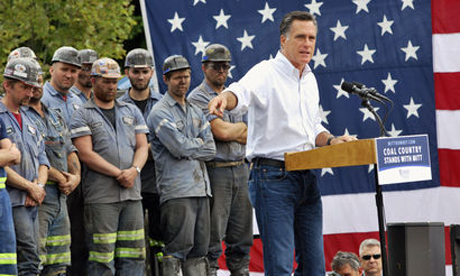
Florida-based ASG Software CEO Arthur Allen informed his employees that he was contemplating a merger that would eliminate "60% of the salaries" of the company – should Romney lose. In Ohio, coal mine owner Robert Murray left employees in no doubt that they were expected to attend a Romney rally – off the clock and without pay. In Cuba, at least they pay workers for show demonstrations.

...News outlets, on the other hand, are merely confused.

"Can your boss really tell you who to vote for?" asked the Atlantic incredulously, before concluding the answer is "probably yes". Should this be a surprise? Seeing that your boss can legally tell you to do nearly anything else, down to what you may wear, when you may eat and how often you may go to the bathroom (and, if he wishes, demand samples when you do), the question comes across as a little naïve. So, too, is the corollary "Can you be fired for expressing political views at work?" Again, the answer is probably yes, which should only be a shock to anyone who has never held a job in an American private-sector workplace.

In truth, as an "at-will" (that is, non-union) employee, you can be fired for much less. In Arizona, you can be fired for using birth control. If you live in any one of 29 states, you can be fired for being gay. You can be fired for being a fan of the Green Bay Packers if your boss roots for the Bears

Lest you think employer authority ends when you clock out, only four states – California, Colorado, New York and North Dakota – protect workers from being fired for legal activity outside of work. For the rest, workers can and have been fired for anything from smoking to cross-dressing, all in the privacy of their homes. The growing practice of employers demanding job applicants to hand over their Facebook passwords underscores the blurring of the work-life divide in this information age.

...Brooklyn College political scientist Corey Robin sees a historical pattern:
"During the McCarthy years, the state outsourced the most significant forms of coercion and repression to the workplace. Fewer than 200 people went to jail for their political beliefs, but two out of every five American workers was investigated or subject to surveillance.
"Today, we're seeing a similar process of outsourcing. Government can't tell you how to vote, but it allows CEOs to do so."
Robin concluded:
When workers are forced to go to rallies in communist countries, we call that Stalinism. Here, we call it the free market.
This is a wake-up call for Canadians.   When will we hear any of our political leaders denouncing America's malignant democracy and calling for the sort of safeguards essential to keep this contagion from sweeping across our borders?

We're bound to be smug about this just as Americans were for more than two decades.   Yet we need to realize what is happening today is the inevitable result of corporatism, the merger of corporate and political power, the phenomenon Mussolini defined as "fascism."