Showing posts with label fossil fuel. Show all posts

Wednesday, May 01, 2019

BRITAIN WINS! Parliament Declares Climate National Emergency


From CNN:

Lawmakers in the UK Parliament have declared "an environment and climate emergency," making it the first country in the world to do so, according to the opposition Labour Party. 
The motion was called by Labour Party leader Jeremy Corbyn. 
WE DID IT! Thanks to pressure from the Labour Party, the UK just became the first country to declare an environment and #climateemergency. Now it's time for real action to tackle climate change. Share this. pic.twitter.com/hOheWxQQHf—  
The Labour Party (@UKLabour) May 1, 2019

I realize I've flogged this story pretty relentlessly lately but I only did that because it's so important for life on Earth, all life on Earth.

What we need to do now, here in Canada, is turn on the petro-pimps, the fossil fuelers and their political handmaidens and tell them they have no place in Canada's future. They won't switch their allegiance back to the people of Canada and our future until they fear us again. As Jeremy Corbyn put it this morning, "we have no time to waste."


And what did we accomplish on the climate emergency front today? Why, it was Bill Morneau boasting about how our fracked gas/LNG venture shows that Canada can still deliver on big, carbon-energy projects. And then Justin went groveling to Jason Kenney.
Ottawa is vowing to exempt certain non-mining projects that use steam to extract crude from deep under the earth — known as in-situ projects — as long as Alberta Premier Jason Kenney maintains a hard cap on emissions from his province's oil sector.
Is that a prime minister you can respect?

May Day. M'aidez. Mayday.

p.s. yes, I know, Scotland and Wales previously declared a climate change state of emergency.

Friday, March 22, 2019

About that Kinder, Gentler, Cleaner Fossil Fuel Industry


Petro-states tend to become lap dogs for the fossil fuel giants that feed them revenues. They wind up, to some degree, in bed together.

Canada is no exception.

The federal government is so in thrall to the fossil fuel industry that it has bought a multi-billion dollar pipeline just to keep them happy, money that it may never recoup.

This is the same government that uses its other face to proclaim climate change the gravest threat facing the nation. Pretty neat trick, eh?

In recent years the fossil energy giants have gone to considerable lengths to greenwash their activities. They routinely tell us they're doing their bit to help our endangered planet.

But that is greenwash, eco-bullshit.

The largest five stock market listed oil and gas companies spend nearly $200m (£153m) a year lobbying to delay, control or block policies to tackle climate change, according to a new report. 
Chevron, BP and ExxonMobil were the main companies leading the field in direct lobbying to push against a climate policy to tackle global warming, the report said. 
Increasingly they are using social media to successfully push their agenda to weaken and oppose any meaningful legislation to tackle global warming.
...After the Paris climate agreement in 2015 the large integrated oil and gas companies said they supported a price on carbon and formed groups like the Oil and Gas Climate Initiative which promote voluntary measures. 
But, the report states, there is a glaring gap between their words and their actions. 
The five publicly listed oil majors – ExxonMobil, Shell, Chevron, BP and Total – now spend about $195m a year on branding campaigns suggesting they support action against climate change.
But the report said these campaigns were misleading the public about the extent of the oil companies’ actions because while publicly endorsing the need to act, they are massively increasing investment in a huge expansion of oil and gas extraction. In 2019 their spending will increase to $115bn, with just 3% of that directed at low carbon projects.
These guys, with the collaboration of political Quislings, are out to bring on catastrophic climate change. There is money to be made, many hundreds of billions of dollars to be raked in, some 27 trillion dollars of proven fossil reserves to be extracted, and that's enough to buy a planet's worth of politicians.

You think SNC-Lavalin has the government's ear? Whatever that is, it's nothing compared to having that government in bed, willing to spend many billions to build you a high-capacity pipeline to flood world markets with dangerously toxic, high-carbon bitumen.

Tuesday, February 03, 2015

The Clean Energy Light at the End of the Tunnel


High carbon energy's days are numbered.  A report from IRENA, the International Renewable Energy Agency, predicts a 40% drop in the cost of renewable energy over the next few years.  That should more than offset the recent drop in oil prices and consign the highest cost/highest carbon fossil fuels to the dustbin of history.

IRENA's report, "Renewable Power Generation Costs in 2014, states that biomass, hydropower, geothermal and onshore wind are all competitive with or cheaper than coal, oil and gas-fired power stations, even without financial support and despite falling oil prices. The report was released at IRENA's annual conference in Abu Dhabi this month.

Solar photovoltaic (PV) power generation is leading the cost decline, with solar PV module costs falling 75% since the end of 2009 and the cost of electricity from utility-scale solar PV falling 50% since 2010.

In a separate report issued by Deutsche Bank this month, the cost to generate power through solar power was predicted to drop by 40% over the next three to four years. Deutsche Bank has also reported that the cost of rooftop solar power is expected to beat coal and oil-fired plant energy costs in just two years.

All of this is in keeping with the warning UBS, the world's largest private bank, circulated to its clients this summer.  The bank warned investors that conventional power utilities were on their way out due to the cost efficiency of solar power and battery technology advancements.

In language more closely associated with green NGOs, the bank with assets of more than $1.5tn says it expects a paradigm shift away from large-scale conventional power plants. “Power is no longer something that is exclusively produced by huge, centralised units owned by large utilities. By 2025, everybody will be able to produce and store power. And it will be green and cost competitive, ie, not more expensive or even cheaper than buying power from utilities,” say the authors, who urge their financial clients to “join the revolution.”

“Solar is at the edge of being a competitive power generation technology. The biggest drawback has been its intermittency. This is where batteries and electric vehicles (EVs) come into play. Battery costs have declined rapidly, and we expect a further decline of more than 50% by 2020. By then, a mass [produced] electric vehicle will have almost the same price as a combustion engine car. But it will save up to €2,000 (£1,600) a year on fuel cost, hence, it will begin to pay off almost immediately without any meaningful upfront ‘investment’. This is why we expect a rapidly growing penetration with EVs, in particular in countries with high fossil fuel prices.”
The expected 50% reduction in the cost of batteries by 2020 will not just spur electric car sales, but could also lead to exponential growth in demand for stationary batteries to store excess power in buildings, says UBS. “Battery storage should become financially attractive for family homes when combined with a solar system and an electric vehicle. As a consequence, we expect transformational changes in the utility and auto sectors,” it says. “By 2020 investing in a home solar system with a 20-year life span, plus some small-scale home battery technology and an electric car, will pay for itself in six to eight years for the average consumer in Germany, Italy, Spain, and much of the rest of Europe.”

Clearly this is the death knell of Harper's bitumen boosters. Institutional investors won't want to tie up their assets in long-term commitments to high carbon fossil fuel production.


Friday, November 21, 2014

Top British Tories Slam Tony Abbott. Carol Goar Gnaws on Harper.

Who better to give Australian prime minister Tony Abbott a real hiding but a number of prominent Tories.  Real Tories, not what passes for conservative under the Harper regime.  Real Tories, as in the Brits.

The attitude of Prime Minister Tony Abbott to the global challenges of climate change is "eccentric", "baffling" and "flat earther", according to a group of senior British Conservatives.

The group, including Prime Minister David Cameron's Minister for Energy and a former Thatcher Minister and chairman of the Conservative Party, says Mr Abbot's position on climate change represents a betrayal of the fundamental ideals of Conservatism and those of his political heroine, Margaret Thatcher.

In a series of wide-ranging, separate interviews on UK climate change policy with The Age, they warn that Australia is taking enormous risks investing in coal and will come under increasing market and political pressure to play its part in the global battle against climate change. 

They could as easily be speaking of our own "flat earther" prime minister and all the other flat earthers who populate both sides of the aisle in the House of Commons.

A  former chairman of the British Conservative Party, Lord Deben said Mr Abbott has betrayed the fundamental tenets of conservatism itself.

 "I have no doubt that people like David Cameron will be saying to Tony Abbott 'look conservatives are supposed to conserve, they are supposed to hand on to the next generation something better than they received themselves'."

Tim Yeo, chairman of the UK's parliamentary select committee on energy and climate change and a former environment minister under John Major, likened those who question the existence and the science of climate change as "the flat earthers of the 16th century".

"Some of us are very perplexed. I was last in Australia at the beginning of last year, before the election and had conversations with people on both sides of the political divide. I was amazed at some of the views.

 "If I was Australian, I'd be concerned if my country's economic future and prosperity became dependent on continued coal export."  

Meanwhile, TorStar's Carol Goar observes that Stephen Harper is also fast running out of places to hide.

Harper still has a few allies. Australian Prime Minister Tony Abbott shares his view that it would be economic folly on impose “a job-killing carbon tax” on energy producers. He can make common cause with the remaining climate change holdouts: Libya, Turkey, Saudi Arabia, Venezuela, Iran and Egypt.
But he has become increasingly isolated and Canada’s relations with its allies and trading partners are showing the strain. French President François Hollande made a vain plea to Harper to act on climate change during his visit to Ottawa last month. The 120 heads of state who attended September’s United Nations Climate Summit in New York noted his absence. His aggressive lobbying for the Keystone XL pipeline alienated Obama.
On his latest foreign trip, the prime minister paid lip service to the environment. When the U.S. and China announced their game-changing deal to slash greenhouse gas emissions, he grudgingly welcomed the breakthrough. “For some time we have been saying we favour an international agreement that would include all the major emitters,” he said. But he made no move to cut or cap Canada’s fossil fuel emissions. 
...Skeptics discount these vague promises. Harper will procrastinate, shift the focus, then move into election mode. His deft political footwork at last weekend’s G20 summit in Brisbane suggests they’re right. He succeeded in eclipsing Canada’s poor environmental record by boldly confronting Russian President Vladimir Putin over his incursions into Ukraine.  
...Harper is a master strategist. He knows how to get around obstacles, divide his opponents and silence his critics. He has navigated his way through trickier junctures than this.
But the moment Canadians decide they don’t want to be on the wrong side of the climate change issue, his last bulwark will buckle.


Thursday, October 23, 2014

Why Does Stephen Harper Hate Renewable Energy?


Born into an oil company family, Stephen Harper's rise to petro-politics has been uninterrupted from his days in the Calgary mailroom of Imperial Oil all the way to his arrival at Sussex Drive.

Harper doesn't like to talk about climate change and he's even less disposed to doing anything about it.  That's hardly surprising given that he's Canada's top fossil fueler.

We know that Harper is a bitumen booster but how many of us realize that he's deeply, ideologically predisposed against renewable energy?  It's something Naomi Klein explores in her new book, "This Changes Everything."

Klein contends that clean, renewable energy and the private sector simply don't mix.  The focus of fossil fuels is profit, first and foremost.  The focus of renewables is clean energy.  Renewable energy can be competitive with fossil energy for the consumer but it's more of a break-even proposition for the producer.  Break-even is not the desired outcome for the private sector but it's just fine for the public sector.

Renewable energy, therefore, threatens the neoliberal mantra of 'the private sector does everything best'.  Renewables, in effect, transfer a sizeable segment of the economy out of the private sector and back into the public sector.  This directly clashes with Harper's free market prime directive.  It offends his worldview.  He'll have no part in revealing just how much the public sector can do far better than the private sector.  He seeks to dismember government, not to make it work for the people.

And so the world will be held hostage to the fossil fuel fetish of people like Stephen Harper and his Aussie boy toy, Tony Abbott.  Unfortunately both sides of the aisle in the House of Commons are awash in fossil fuelers.  Still it's a good and ample reason to finally purge neoliberalism from the ranks of the Liberals and New Democrats.


Friday, August 29, 2014

World's Largest Private Bank, UBS, Says Fossil Energy is Toast


The Swiss banking giant, UBS, says renewable energy is the hands down winner and conventional power generation is finished.

In a briefing paper sent to clients and investors this week, the Zurich-based UBS bank argues that large-scale centralized power stations will soon become extinct because they are too big and inflexible and are "not relevant" for future electricity generation.  Instead the authors expect it to be cheAper and more efficient for households and businesses to generate their own energy to power their cars and to store any surplus energy in their own buildings even without subsidies.

"Solar is at the edge of being a competitive power generation technology.  The biggest drawback has been its intermittency.  This is where batteries and electric vehicles (EVs) come into play.  Battery costs have declined rapidly, and we expect a further decline of more than 50% by 2020. By then a mass [produced] electric vehicle will have almost the same price as a combustion engine car.  But it will save up to 2,000 euros a year on fuel cost, hence, it will begin to pay off almost immediately without any meaningful upfront "investment." This is why we expect a rapidly growing penetration with EVs, in particular in countries with high fossil fuel prices.

The expected 50% reduction in the cost of batteries by 2020 will not just spur electric car sales, but could also lead to exponential growth in demand for stationary batteries to store excess power in buildings, says UBS. "Battery storage should become financially attractive for family homes when combined with a solar system and an electric vehicle.  As a consequence, we expect transformational changes in the utility and auto sectors.  By 2020 investing in a home solar system with a 20-year life span, plus some small-scale home battery technology and an electric car, will pay for itself in six to eight years for the average consumer in Germany, Italy, Spain and much of the rest of Europe."

Australia is already going through something like this.  There, widespread adoption of rooftop solar power systems in residential and commercial properties, is savaging the bottom line of conventional power utilities.   With fossil fuel prices rising and solar costs dropping rapidly along with price breakthroughs in battery technology, the writing could be on the wall especially for high cost/high carbon fossil fuels.  Sorry, Athabasca, but you really should have seen this coming.

Tuesday, March 12, 2013

It's Still Fossil Fuel

The Japanese have successfully tapped seabed methane clathrates, also known as "flammable ice."   Deposits of compressed and frozen methane are fairly common in northern waters.  British Columbia has looked at exploiting them.

The gas field is about 50km away from Japan's main island, in the Nankai Trough.

Researchers say it could provide an alternative energy source for Japan which imports all its energy needs.

Offshore deposits present a potentially enormous source of methane but also some environmental concern, because the underwater geology containing them is unstable in many places.

 A Japanese study estimated that at least 1.1tn cubic metres of methane hydrate exist in offshore deposits.

This is the equivalent of more than a decade of Japan's gas consumption.

Tuesday, January 22, 2013

They Call It "The Point of No Return" Study


Greenpeace has come up with a roster of planned oil, gas and coal projects that it calls "carbon bombs."

Prepared by the consultancy firm EcoFys, the study lists 14-major projects that will increase global greenhouse gas emissions by a civilization-wrecking 20%.   That's where the "point of no return" part comes in.

The largest contributors will be China's five north-western provinces, which aim to increase coal production by 620m tonnes by 2015, generating an additional 1.4bn tonnes of greenhouse gases a year.

Australia's burgeoning coal export industry, already the largest in the world, is in second place due to its potential growth to 408m tonnes of shipped resource a year by 2025, resulting in an annual 760m tonnes of CO2.

Meanwhile, controversial exploitation of oil and gas reserves in the Arctic could release 520m tonnes of CO2 a year, with further major emissions set to flow from other new fossil fuel frontiers, such as tar sands oil in Canada and shale gas in the US.

The EcoFys report is quite blunt:

...a handful of governments and a small number of
companies in the fossil fuel industry are pushing these
projects, apparently without a care about the climate
consequences. In November 2012, the IEA said in its
annual World Energy Outlook that no more than one-third
of the carbon contained in the proven reserves of fossil
fuels can be released into the atmosphere by 2050 if
the world is to achieve the 2°C goal.8 The development
of these new coal, oil and gas projects would come at
a time when climate scientists are increasingly linking
alarming extreme weather events to climate change.9
These extreme weather events include Hurricane Sandy
in October 201210, droughts in the US in 201211 and
201112, heat waves and forest fires in Russia in 201013,
and the European heat wave in 2003 that killed tens of
thousands14. The disasters the world is experiencing
now are happening at a time when the average global
temperature has increased by 0.8ºC15, and they are
just a taste of our future if greenhouse gas emissions
continue to balloon.


...The huge gap between what governments say they are
doing to prevent catastrophic climate change and what
they are actually doing is most evident with these 14
projects. The governments that have approved them have
all agreed that the global average temperature must be
kept below 2°C.


If the governments supporting the projects in this report
help push the world past the point of no return, the
great irony will be that the resulting climate chaos was
preventable. The technology for avoiding the emissions
from these projects and for reducing overall global
emissions exists right now.


...The world is clearly at a Point of No Return: either replace
coal, oil and gas with renewable energy, or face a future
turned upside down by climate change.


The report is an indictment of the petro-politics in Canada's Parliament, Conservative, Liberal and New Democrat alike.

Monday, December 03, 2012

Whether You Excavate It or Pump It or Frack It Out of the Ground, It's All Fossil Fuel

We get all sorts of stuff out of the ground and it's all lethal, every BTU of it.   Some of it, for example natural gas, is less lethal.  Some of it, heavy crude and coal, is especially lethal.   But, still, burn enough of any of it and you consign civilization as we have known it for 3,000 years to extinction.

We're discovering new reserves of Civilization Eradicator all the time.   China, heavily dependent on imported oil and coal, is about to get into fracking Big Time.   The United States and Canada are already heavily into fracking.   You could even say we're "Mother Frackers."   And coal?  Oh yeah, baby.   We dig coal, we really do, and then we either burn it ourselves or ship it as fast as we can to Asia so they can make the crap that lines the shelves at Wal-Mart.

Bitumen.   Makes no sense.   The last Albertan who understood the perils and pitfalls of the Athabasca Tar Sands was recently buried with full state honours.   Shhh, keep this on the QT, but there's a reason Alberta is still running in the red despite this supposed underground gooey windfall.

And now we're licking our lips in anticipation of getting at massive reserves of oil beneath the Arctic sea bed just as soon as our massive fossil fuel consumption clears away the rest of the Arctic sea ice.   Christ boys but we're gonna be rollin' in it then.

Oh sure, climate change is the greatest threat ever to face mankind.  There, okay we said it.   Now, let's move on.   Those fossil fuels aren't going to bring themselves out of the ground.   That's hard work, so hard that we can only do it with generous government subsidies and enormous fossil fuel industry tax and royalty deferrals.  But let's not get bogged down in details.  It's fossil fuel, isn't it?   And that makes us rich, doesn't it?   And that may hurt our grandkids, even make their lives living hell, but you can't look to the future and take care of business in the present.

And we may be on course for 4 degrees C of warming by 2100, perhaps even 6 degrees, but 4, 6 those are little numbers, single digits, nothing.   And besides, do you think you'll be around in 2100?  Don't be silly.

The 21st will be the Century of Fossil Fuels if we stay on our current course.   With the reserves we already have on the books and all the new fossil fuels we're uncovering we have four, maybe five times as much as we need to truly bake this planet.   At least some of us will get rich doing it.  Let's get cracking, er, fracking.

Saturday, June 30, 2012

If It Looks Like a Duck and Quacks Like a Duck, It's Probably Global Warming


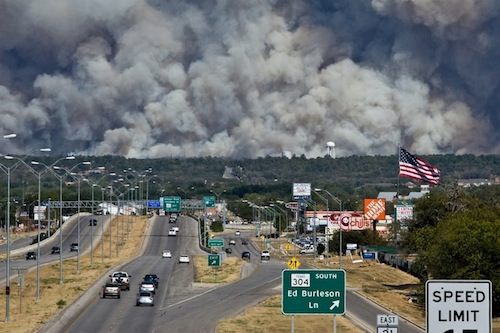
You may have heard about the waves of wildfires sweeping across Colorado for the past several weeks that continue to rage with no end in sight.   Welcome to the new era, the era of Global Warming.

"'What we're seeing is a window into what global warming really looks like," said Princeton University's Michael Oppenheimer,  a lead author for the UN's climate science panel. "It looks like heat, it looks like fires, it looks like this kind of environmental disaster … This provides vivid images of what we can expect to see more of in the future."

"In Colorado, wildfires that have raged for weeks have killed four people, displaced thousands and destroyed hundreds of homes. Because winter snowpack was lighter than usual and melted sooner, fire season started earlier in the US west, with wildfires out of control in Colorado, Montana and Utah.


"The high temperatures that are helping drive these fires are consistent with projections by the UN Intergovernmental Panel on Climate Change (IPCC), which said this kind of extreme heat, with little cooling overnight, is one kind of damaging impact of global warming.

Others include more severe storms, floods and droughts, Oppenheimer said.

"The stage was set for these fires when winter snowpack was lighter than usual, said Steven Running, a forest ecologist at the University of Montana.

"Mountain snows melted an average of two weeks earlier than normal this year, Running said. "That just sets us up for a longer, drier summer. Then all you need is an ignition source and wind.'"

Britain, meanwhile, has come off an extended, nationwide drought to endure widespread, once a century flooding.   Severe storms and torrential rains have triggered flash floods, power outages, the closure of rail lines and the evacuation of hundreds of homes.   This, too, is a predicted outcome of global warming - cyclical severe droughts and floods.


The reality is that we have already broken the Earth's hydrological cycle.  We have heated the atmosphere which causes it to absorb and hold more water vapour.   Those trillions of tonnes of water vapour change precipitation distribution patterns.   Some regions get passed over and wind up in sustained drought, as in the American southwest.   Other regions now receive torrential rains and flooding.   Drought or flood, the affected regions are hammered.   That is not the sort of conditions necessary for agriculture.   It makes little difference whether crops wither in the field from drought or rot away under floodwaters.   It makes little difference whether cattle die of drought or drown.  For a world that the UN FAO has already declared to be now in a permanent state of food insecurity, the fracturing of our traditional hydrological cycle, so instrumental in mankind's growth to 7+ billion people, is potentially devastating.

But, as we were told this week by the CEO of Exxon Valdez ExxonMobil, sure fossil fuels are warming the planet but, don't worry, be happy, we'll adapt.   Rex Tillerson told the Council on Foreign Relations that concern about climate change, drilling and energy dependence are overblown.

"We have spent our entire existence adapting. We'll adapt," he said. "It's an engineering problem and there will be an engineering solution."

Well, since Mr. Tillerson has broached the subject, perhaps we should consider his views on adaptation.  Adapt how, to what, on whose tab, Mr. Tillerson?

Adaptation is costly and it's money down the drain.   Adaptation is perpetual, ongoing.   Adaptation is the supply of a commodity, services and materiel.   Adaptation draws from the economy essential revenues that could be put to use elsewhere.

Adaptation comes in two flavours - public sector and private sector or some combination of both.  Think Disaster Capitalism.   Yet governments today have been so effectively defunded that the private sector will likely have a powerful edge in future adaptation initiatives.   And, as we have seen in so many other areas, the more private sector a field becomes, the more market-driven, the less universal it turns out to be.

Adaptation is not uniformly viable.   There's a lot more "me" and a lot less "we" in it despite Tillerson's sophistry.   The countries and peoples who will need the greatest, most powerful adaptation strategies also happen to be the poorest, most vulnerable, and most heavily impacted by global warming.   Tillerson's facile commentary pretty obviously excludes these peoples as irrelevant, invisible.

But maybe we ought to regard Tillerson's adaptation remedy in the context of Big Tobacco.  Throughout the West, the tobacco industry is being sued for many hundreds of billions of dollars in damages for the costs governments have borne from smoking-related illness.   Why should Big Fossil be treated any differently?  Why should we not look to oil, coal and gas company assets to fund adaptation measures necessitated by the burning of fossil fuels?   We know from the track record of Tillerson's own company in paying damages to those who lost so much from the Exxon Valdez tanker disaster that we can't trust Big Fossil to own up.

If nothing else we should be having a frank discussion with Mr. Tillerson and the other Tillersons who make up Big Fossil about just what responsibility they think they should bear in the question of adaptation.  That's a talk that's already long overdue.