Showing posts with label adaptation. Show all posts

Wednesday, January 22, 2020

The New Oracles


We've got new oracles to advise the government how to get out of the current high-carbon death spiral with our asses more or less intact.

They're called the Canadian Institute for Climate Choices and the feds have funded them for five years to the tune of $20-million.

No one knows how quickly the world is going to cut carbon pollution, CEO Kathy Bardswick said in an interview, and Canada must make decisions that account for the uncertainty, rather than be paralyzed by it. 
In either a high-carbon or low-carbon future, “there’s a substantial impact on the country,” Bardswick said. “What we’re trying to say is, ‘Yes, we agree there’s uncertainty, and we agree that these scenarios can play out quite differently, and the implications can be quite dramatic. But that doesn’t mean that we wait and see — we’ve got to be able to plan within that context.’”
CICC opened with an 80-page report  that may or may not steer the petro-feds in the right direction. (Hint - let's see what Ottawa does with the proposed Teck mega-mine in the Athabasca Tar Sands. If they greenlight that this is probably a waste of $20-million on another silly gesture.)
Drawing on extensive economic and scientific research, the report sketches out two broad scenarios, with two possible outcomes in each one. 
In the first scenario, a massive economic metamorphosis has occurred. Nations around the world cut their pollution severely over the next 10 years, reaching the Paris Agreement goal. Global demand for fossil fuels has plummeted, and proven reserves are left in the ground. A majority of electricity comes from renewables like solar, wind and bioenergy, while nuclear capacity triples and heavy industry is largely decarbonized.
In the other scenario, carbon pollution continues to be pumped into the air unchecked, and the world fails to achieve the Paris Agreement’s goal, leading to runaway climate change: collapse of ecosystems, accelerating global heating, coastlines that sink underwater, relentless extreme weather and mass societal unrest. 
Canada must be prepared for that world, too, the report says, or it will become “caught in a continual cycle of impact and recovery.” People will be injured or killed, or suffer poor air quality and contaminated water, as insurance skyrockets and companies lay off workers. Food and water shortages drive war, conflict and humanitarian disasters, which reach Canada’s shores.
As the saying goes, you can lead the feds to water but you can't make 'em drink.


Sunday, June 03, 2018

The Funny Thing Is - It's Here and What Have We Done to Adapt to It?


You might not have seen video of the dramatic flash flooding that swept the historic town centre of Elliott City, Maryland, but that doesn't matter. Perhaps you didn't see the devastation of New York City and the Jersey Shore by Hurricane Sandy. Maybe you've been in a coma for the last decade and more.

Most of us, at least most of the sentient population, have experienced powerful yet "early onset" impacts of climate change. "Global Weirding" is one example. Spring weather conditions in the midst of winter. Floods and droughts. Coastal erosion. The ever poleward migration of species - birds, mammals, fish, insects, even viruses. There are shared or common impacts and others that are regional or even local, sometimes the result of topography.

Our government tells us it has a plan. It's going to introduce carbon pricing that should encourage a reduction in greenhouse gas emissions of some order by some future date, perhaps 10, certainly not more than 20 years from the date of implementation, if ever. As Catherine McKenna so fecklessly reminds us, this is a "national unity" issue first and foremost.

There are two parts to this problem. One is mitigation - cutting GHG emissions in hope of forestalling the onset of climate change. The other, the one that gets so little love, is adaptation. That goes to our resilience to withstand steadily worsening climate change impacts that we're not going to be able to avert. That is "locked in" climate change, the steadily heating atmosphere that will unleash severe storm events of increasing frequency, severity and duration. It's the sort of thing that promotes a category 3 hurricane to a full blown category 5 monster.

There are ways to blunt nature's worsening weather wedgies but they're not cheap. Some sea level rise can be contained, for a while, by constructing stronger and higher sea walls in suitable areas. Major cities can construct major floodways along the lines of the Red River Floodway, "Duff's Ditch," that Manitoba premier Roblin built in the 60s to protect Winnipeg. We know that Calgary could sure use one or more of those, Toronto too. Then there's the restoration and replacement of essential infrastructure that was engineered and constructed to meet the gentler climate demands of a time now past.

Here's one thing we know. Fixing this problem will never be cheaper than it is right now. It might have been cheaper yet if we had only started ten years ago but that is spilt milk at this point. We know it will be vastly more costly, adding in economic loss and disruption, if we keep putting this off much longer. So what's the hold up?

What's going on in your region? Are they building the road networks of the future? Are they reinforcing your bridges and overpasses? Anyone upgrading your water mains and sewers? How about your already wobbly electrical grid? Getting a new one of those? Is your public health authority preparing for the new challenges of a new climate?

You'll recognize that your government has the problem in hand because they'll be spending tens of billions, many tens of billions of dollars on climate proofing your society.

Back in 2014, when Calgary was swamped from its most recent, once in a gazillion year floods, the World Council on Disaster Management held its annual conference in Toronto.
Dr. Saeed Mirza, emeritus professor at Montreal’s McGill University specializing in structural engineering, added that the monumental infrastructure costs accumulated over decades of negligence have left Canada particularly vulnerable to catastrophic events. 
“The frequency and intensity of these events has been increasing at an escalating rate and what was a one-in-100-year event at one time may become the norm,” he said. 
“When we look at Calgary, we had a flood there in 2005 and they called it a one-in-100-year flood, while this one according to some descriptions in the news has been three times as bad.” 
Mirza estimated that Canada’s infrastructure requirements have reached a cost of about $1 trillion, while a recent survey by the McKinsey Global Institute earlier this year stated that worldwide infrastructure needs are about $57 trillion.
Now there's a handsome number, 57 trillion dollars to meet the world's essential infrastructure needs. Boy have we been robbing Peter to cut taxes for Paul!

Here's another number, one that our politicians have foremost in their minds. It's 27 trillion dollars. That's roughly the value of proven fossil fuel reserves already subscribed on global stock markets and bourses.  That number keeps our politicos tossing in their beds at night because they know if the carbon bubble bursts, most of that wealth simply evaporates causing no end of fiscal mayhem to banks, institutional investors, pension plans and, yes, government treasuries. No wonder these little shits love their pipelines so much.

Canada's approach? Oh, we'll throw 30, maybe 35 billion at the problem over 5 years. Maybe we can cook up some sweetheart deals to get the private sector to come up with another 50, maybe 60 billion that they can then fleece back from the public together with interest and hefty profits.

Here's the problem. 30 billion dollars, that's a political number that is not connected in any way to the enormity of the problem. It's just whatever they pulled out of their backsides. That much was clear when, in March of this year, a joint audit by the federal environment commissioner and the auditors general of nine provinces found that the premiers and your prime minister don't have a clue.

Neither the federal government nor the provinces have adequately assessed the risks a changing climate poses to the country and have no real idea what might be needed to adapt to it, concludes a scathing new audit released Tuesday. 
...It says while many governments have high-level goals to cut emissions, few have detailed plans to actually reach those goals, such as timelines, funding or expected results from specific actions. 
Assessments to adapt to the risks posed by climate change have been haphazard, inconsistent and lacking in detail, with no timeline for action and no funding, the report notes. 
It also calls Canada’s emissions goals a hodgepodge of different targets, with no consistency in how emissions are measured or whether cuts will target overall greenhouse gas outputs or just those from specific economic sectors. Only two provinces and Ottawa have actually laid out their specific 2030 emissions targets, and none are on track to meet them, Gelfand said.
Dame Cathy disingenuously steered the audit into mitigation and well clear of adaptation. Then again, she would.
“The previous government did nothing for a decade, but we’re 100 per cent committed to our target,” McKenna said. “Hard things are hard, we have a plan and we’re already seeing measurable results.”
That sounds just like what Harper used to say about Chretien - all talk, no meaningful action.  The problem didn't begin with Harper, dearie.

There's something telling that Cathy didn't even address adaptation. What it tells me is that I and you, we, and our kids and grandkids are pretty much on our own as far as this government, like its predecessors, is concerned.

What that means is that we're getting "behind the power curve" on climate change adaptation which means it will become increasingly more costly and more difficult to deal with as their dereliction mounts, year by year. Unless something changes, we're in for a hard landing.


Thursday, March 29, 2018

I'll Bet You Didn't Know That...


They don't have a clue. Your federal government and our various provincial governments are in the same boat. None of them has assessed the risks we face from climate change or what we need to do to adapt to it.

This is kicking the can down the road and whistling past the graveyard at the very same time.

They don't want to know. If they knew they might have to tell us what's coming. If we knew what's coming we then might ask them what in hell they're doing about it. And if they had to tell us what they're doing about it - essentially squat - then we might scorn them or, worse, compel them to do something about it and there's no room in their plans for that sort of Herculean undertaking.

It's so much easier if we all gaze out over the stern and pretend that iceberg off the bow isn't there at all.

This isn't misfeasance any more. It's full blown malfeasance. It's not just doing something wrongfully, carelessly, perhaps negligently.  It's deliberate wrongdoing.

They don't want to deal with this on their watch. It's too big, too scary, too fraught with political risk.

Back in June, 2014, large parts of Calgary were underwater as The World Council on Disaster Management held its annual conference in Toronto, which itself had recently experienced a freak flood.  The message was that Canada's outdated and decaying essential infrastructure was vulnerable to natural disasters.

Dr. Saeed Mirza, emeritus professor at Montreal’s McGill University specializing in structural engineering, added that the monumental infrastructure costs accumulated over decades of negligence have left Canada particularly vulnerable to catastrophic events.

“The frequency and intensity of these events has been increasing at an escalating rate and what was a one-in-100-year event at one time may become the norm,” he said. 
“When we look at Calgary, we had a flood there in 2005 and they called it a one-in-100-year flood, while this one according to some descriptions in the news has been three times as bad.” 
Mirza estimated that Canada’s infrastructure requirements have reached a cost of about $1 trillion, while a recent survey by the McKinsey Global Institute earlier this year stated that worldwide infrastructure needs are about $57 trillion. 
“In terms of funding, the amounts of money are truly frightening and there’s no government in the world that can find the kind of money necessary to bring existing infrastructure up to par,” Gordon said. 
The lack of political will is one of the biggest obstacles to infrastructure funding, which is why Mirza proposed that Canada adopt a best practices solution to addressing our climbing infrastructure costs.
"No government in the world can find that kind of money." Okay, but what if we don't? What if we don't replace essential infrastructure,what then? Have you ever been to a Third World country?

What we do know is that the costs of not acting, the costs of waiting until that essential infrastructure fails, will be substantially greater. That's because there will be economic loss atop the costs of replacing the infrastructure. And then you'll see "trickle down" in action with the velocity and power of a sledgehammer in freefall.

The taxes our parents' and grandparents' generations invested in that infrastructure was integral to the prosperity that their descendants, us, enjoyed. Only we also liked the idea of "everyday low taxes" which meant we didn't want to pay for those same things when it came our turn. We didn't pay for routine maintenance. We didn't pay for replacement. We haven't built for the next generations as those before ours freely did for us.

Which allows me to segue into a book I'm about to read, John Kenneth Galbraith's "The Affluent Society." First published in 1958 I've picked up the 1984 4th edition. I got  hooked by this passage from The Times Literary Supplement.
Why worship work and productivity if many of the goods we produce are superfluous - advertising 'needs' created by high-pressure advertising? Why grudge expenditure on vital public works while ignoring waste and extravagance in the private sector of the economy. Classical economics was born in a harsh world of mass poverty, and it has left us with a set of preconceptions hard to adapt to the realities of our own richer age. And so, too often, 'the bland lead the bland.' Our unfamiliar problems need a new approach.
It sounds more relevant today than ever. The problems, perhaps novel in the post-war prosperity, are now commonplace and extensive.

Tuesday, December 05, 2017

It's Just a Sense, a Feeling.


If there's one thing we need to get much better at it's learning to deal with the unexpected.

It's a huge understatement to note that, on so many fronts, we're already passing through uncharted waters. Human lifespans being as brief as they are, life experiences can be very limited in depth and breadth. And so when change sets in, seismic change, and the ground begins shifting beneath your feet it's natural to become confused, disoriented.

A lot of what's happening today, the early onset stuff, was not foreseen by us just a decade or two ago. It can be incredibly depressing to think back to the 80s and 90s and the relative stability and security we enjoyed in those days and then look at what is upon us now.

Many science types tell us we're on the verge of a mass extinction event, the sixth in Earth's history. Extinction. Try to wrap your head around that. Delving into that idea reminds us that we, and most of the species trying to share this planet with us, are merely the latest iteration of life on Earth. We are the dominant species today but we weren't in earlier times. The human species didn't exist in these previous eras. Other life forms did going back about 3.8 billion years. Some other life form was the dominant species in each of those eras.  And those former species, plant and animal, died and were buried and became the coal, oil and gas that we've used to trigger the extinction of life in our era. Ah, the irony.

Our base of knowledge today is greater than at any time in the history of mankind. We amass data faster than we can hope to process it. There is no much information at your fingertips and yet you can only access it in slivers and even that in a most haphazard fashion.

We once imagined a future extending into something akin to infinity, at least in a practical context. Hitler proclaimed a thousand year Reich. Now, as our knowledge base expands at explosive rates, we struggle to foresee where we might be twenty, thirty or forty years down the road. We just don't know.  It wasn't that long ago that the Intergovernmental Panel on Climate Change warned that, if we didn't slash greenhouse gas emissions and pronto, dire change such as the loss of Arctic sea ice might be upon us by the end of the century, 2100. They were attempting to peer 90 years into the future and yet they were out by 70 years. It can feel like you're driving down a highway at full speed in a dense fog.

Our demonstrated inability to gauge the pace of the onset of climate change, arguably the greatest threat to mankind and life on Earth generally, is unsettling. What else have we overlooked? What else have we gotten wrong?

Even those who resist doing anything to mitigate against climate change, i.e. abandoning fossil fuels, are more open to adaptation strategies. In Florida, for example, they might refuse to accept the link between global warming and sea level rise and yet they're quite open to planning to adapt to sea level rise. However how do you adapt unless you have a pretty good idea of what is coming and by when? The later you leave it the fewer good options you may have remaining when you do decide to act. On the other hand should you act too soon, perhaps on flawed assumptions, you may squander irreplaceable assets pointlessly. Decisions, decisions.

You might not be able to save the first little piggy's house or the second little piggy's house but there may be things you can do to ensure that all three piggies are getting along when it comes time to take refuge in the third little piggy's sturdy brick house. When you think about it, the first little piggy and the second little piggy become dependent for their very survival on the generosity of the third little piggy. It's the third little piggy who has to share his abode and presumably his pantry to keep all three alive. That's what you call "social cohesion."

Imagine how well that wolf would have dined had the piggy community been as profoundly divided as our societies are today. Imagine if those piggies were as divided economically, politically, racially and socially as we are today, hostile and distrusting of each other.

What if there had been a political pig caste who groomed the little piggies with lies and fear and anger and suspicion, manipulating them for the political caste's own benefit? Isn't that what's happening to us today? Our trust in government and in each other is being eroded, diluted.

I have a cousin in the States. While he's not uneducated it's plain that his worldview and his social senses are shaped by FOX News, Limbaugh, Alex Jones (or this sphincter) and that crowd. The world he sees and the world we see are radically and irreconcilably different. He believes. He takes what he selectively hears on faith. And the only way to maintain that belief is to dismiss fact and evidence-based information as the stuff of conspiracies. The real world is one giant plot, a hoax, intended to lure him into some diabolical trap. Once you're in his place, Pizzagate and chem-trails become all too believable.

And so we sail into the uncharted waters of the unknown and perhaps unknowable with a crew ready to mutiny against itself and no one at the helm. I've got a sense, a feeling, that this is not shaping up well.


Wednesday, April 26, 2017

Now Here's a Number That Won't Leave You Yawning - I Hope


How does 90-trillion dollars sound? Got your attention?

The global impact of our rapidly warming and fast melting Arctic could create losses from the destruction of roads and buildings upwards of 90-trillion George Washingtons.

The Arctic Council reports that, "Arctic warming could have cumulative net costs from 2010-2100 of between $7 trillion and $90 trillion, it said, with harm exceeding benefits such as easier access for oil and gas exploration and shipping."

That's the T-word, not the B-word. Trillion dollars, lots of trillions of dollars.

Junior, our petro-prime minister, ain't gonna like this:

Among recommendations, the report said Arctic states and those interested in the region "should lead ... global efforts for an early, ambitious and full implementation" of a Paris Agreement in 2015 among almost 200 nations to limit warming.

Justin Trudeau isn't thinking in terms of early, ambitious or full implementation of the Paris climate agreement. He's thinking more along the lines of eventual, possibly, very limited and partial implementation - something a little more tailored to his partisan political interests. Jesus, I hope he's figuring to make a bundle off bitumen trafficking because we'll be looking at a pretty steep bill to cover the damages.

Wednesday, December 07, 2016

When the Skies Open


Living in the rainiest part of Canada, the legendary "wet coast," one tends to understand rain as others sometimes might not.

Out here we are steeped in the high winds and heavy rains that blow in from the Pacific. But the situation has been changing in recent years. The rains have been getting heavier, the winds seemingly stronger. Rains that wake you up in the middle of the night from a dead sleep. Happens a lot lately. Winds so strong and turbulent that the rainfall switches direction before your eyes and sometimes seems almost horizontal.

A few years ago we received this Biblical deluge. It started as abruptly as it finished, no more than 18-minutes, like a tap turning on and off. No rain, rain, no rain. Yet, in that brief interval, we received so much rain that it produced this:


Here's the thing. This is early onset stuff. We're just getting started.

When the skies open up and deluge an area, the results can be catastrophic, with roads washed out and homes destroyed by the resulting flash floods. Such extreme downpours are already occurring more often across the US, but a new study finds that as global temperatures rise, storms could dump considerably more rain and skyrocket in frequency.

The study, in the journal Nature Climate Change, suggests that storms that now occur about once a season could happen five times a season by the century’s end, a 400% increase.

And when such storms do occur, they could produce up to 70% more rain. That means that an intense thunderstorm that would today drop about 5cm (2 inches) of rain would drop 9cm in the future.


How much worse will it get? That depends on a number of factors from how quickly we can decarbonize our societies and our economies to how well we manage upgrading and replacing essential infrastructure such as storm sewers and floodways. So far neither the United States nor Canada has got an effective, coherent plan to deal with this threat to our homes, our communications, and our agriculture.

Saturday, October 22, 2016

An Affliction of the Mind or Why We Can't Handle Climate Change


We're just too set in our ways to have any real hope of tackling the basket of looming existential challenges facing mankind and, for that matter, pretty much all life on Earth.

Forget everything else. Forget overpopulation, over-consumption of essential resources, terrorism and nuclear proliferation, forget everything except climate change. The thing is, if we can't respond effectively to climate change we don't have a snowball's chance in hell of resolving the others. As a global civilization, we're going down.

Which leads me to Andrew Simm's essay in The Guardian in which he explores the self-defeating process of using conventional thinking in response to the climate change dilemma.

The problem with ...scenarios that emerge in the mainstream, is the intellectual editing that occurs before they even begin. Most share two overwhelming, linked characteristics that strictly limit any subsequent room for manoeuvre. Firstly the demand for energy itself is seen as something innate, unchallengeable and unmanageable. It must be met, and the only question is how.

Secondly, the assumption remains that the principles and practices of the economic model that has dominated for the last 30 years will remain for at least the next 30 years. There is no sign yet of the ferocious challenge to neoliberal orthodoxy happening at the margins of economics shaping mainstream visions of our possible futures. The merest glance at the history of changing ideas suggests this is short-sighted.

There are reasons why we need to get a move on with tackling energy demand. Extreme weather events abound. Record flooding in North Carolina in the United States follows record flooding in Louisiana earlier in the year. While no individual event can be described a direct cause and effect relationship, increasingly heavy rainfall and flood events are consistent with climate models for a warming world.


...What sort of scenarios should we be looking at then? We can learn from the impoverished Brexit debate that was marred by binary choices cloaked in wilful misinformation. For the whole population to fully understand our options, and the choices and challenges embedded in them, we should be thinking as openly and broadly as possible. We can look at how far techno-fixes will get us, and at the maximum speed and scale of change that market mechanisms and the pricing of carbon are likely to deliver. In both, the different impacts on rich and poor need assessing.

But we should go further to assess the pros and cons of radical scenarios for changing how we live and work.

Rarely considered but important variables come from new economics, including the shorter working week, the share economy, shifts in corporate ownership and governance, and intelligent but deliberate measures for economic localisation. Compare these to the “stumble on”, or business as usual scenario, in which we give up control of our future to a permanently destabilised climate change, but also assess seriously the consequences of the argument for planned so-called “de-growth” of the economy.

At the height of the 2008 financial crisis, the UK government promised to “go beyond the conventional thinking” to put things right. It never did, but with the climate crisis there is no choice. Conventional thinking is off-course and contradictory.

Without a balanced, comparative assessment of strategies to align energy use and industry with inescapable climate action, we won’t be able to choose the best possible future.


Now, assuming that climate change became an imperative at least 20 years ago, look at how each of our governments, Conservative and Liberal, over that period approached this problem. A good place to start, perhaps, is to look at where Canadian government has come today. Today they're talking about some token carbon price that may or may not take effect in 2018. I think Simms could have been describing the Trudeau regime when he wrote, "Conventional thinking is off-course and contradictory." Yet that is where we are and, so long as our petro-pols on both sides of the aisle pack the House of Commons, that's where we're going to remain.

This is Canada where our environment minister proclaims she is "as much an economic minister as I am an environment minister." Dame Cathy doesn't even grasp the inherent conflict in that. It's as though she's the minister for tobacco production and the minister of health in some blended portfolio. She's oblivious to Canada's urgent need for a full time and powerful environment minister ready and able to go toe to toe with reluctant premiers and with her cabinet colleagues who are entrusted with economic matters whether that be trade, resources or foreign affairs. We're a petro-state, Cathy, and we can't get by with a part-time environment minister who folds at every scowl of some provincial tyro. Maybe that's why Trudeau singled her out for that portfolio. Maybe he wanted a reliable milquetoast. If so, he chose wisely.


Tuesday, October 11, 2016

Our New Normal


I've noticed it. Chances are good you have too. "It" is the marked change in local precipitation patterns.

I live in a place where we're used to pretty torrential downpours from squalls coming off the Pacific. They manifest in heavy rainfall and very high winds that can give the rains a horizontal effect. That had been the baseline for heavy storms.

It's not unusual today to experience significantly heavier rains of increasingly longer durations. Word has it we're in for a 4-day deluge starting later this week.

We all remember the floods that hit Toronto, then Calgary and just recently, Nova Scotia. In my town we had a massive downpour that lasted exactly 18-minutes, start to finish, but dumped enough water, about an inch and a half, that cars were floating down the mainstreet that itself was just a gently sloping block distant from the sea. Environment Canada has now issued a warning that we'll be hammered by heavy rains and high winds courtesy of four fronts that will arrive between Wednesday night and Sunday.

Now research is suggesting that Hurricane Sandy grade flooding is becoming the "new normal."

The frequency of floods of the magnitude of Hurricane Sandy, which devastated parts of New York City in 2012, is rising so sharply that they could become relatively normal, with a raft of new research laying bare the enormous upheavals already under way in the US due to climate change.

These findings and two other fresh pieces of research have highlighted how the US is already in the grip of significant environmental changes driven by warming temperatures, albeit in different ways to the processes that are fueling hurricanes.

The number of storms with Sandy-like floods is rising exponentially

An analysis of past storms and models of future events as the planet warms has shown that Sandy-like floods have become three times more common in the New York area since 1800. This frequency is set to climb further, from once every 400 years to once every 90 years by 2100, due to the effects of sea level rise alone.

Worse still, when the impact of future storm conditions, supercharged by the warming oceans and increased atmospheric moisture, is considered, New York could be swamped by Sandy-level flooding as frequently as once every 23 years by the end of the century, according to research led by Princeton University.

...Michael Mann, a climatologist at Penn State University, said that the studies deal with very different processes but are “examples of climate change impacts that are already threatening us here in the US and around the world, the devastating and unprecedented wildfires in Alberta last spring and the coastal flooding and massive loss of life from Hurricane Matthew being just the latest reminders, and which will only worsen if we do not act on climate”.

But the federal government, Justin's government, isn't taking this lying down. It's going to introduce carbon pricing. So? That won't do bugger all to answer our problem. The problem is what scientists call our "broken hydrological cycle." We've already heated the atmosphere. Warmer air (1) holds more water vapour which only (2) warms the air that much faster but also (3) shifts global precipitation patterns (4) triggering severe weather events of increasing frequency, intensity and duration and (5) creating both sustained and cyclical flooding and droughts. I don't care if you scored a D- in physics, you can still understand that.

This is where Justin hasn't thought things through. For the sake of political cover he's casting his carbon price as "revenue neutral." The taxes collected will be returned to the provinces in which they're harvested to go into general revenues and onward to whatever groups the governments of the day choose to reward. In this era of "everyday low taxes" that revenue doesn't have much chance of going where it's most needed.

So, where is that money most needed? It could be invested in adaptation measures to at least blunt the impacts of our broken hydrological cycle. Early 20th century storm sewer systems don't meet the demands of 21st century deluges. Cities need floodways. In my view the money collected should be directly linked to measures to cope with the impacts arising out of the problem on which the tax itself is justified. Sort of like diverting excise taxes on tobacco products to defray the cost of medical treatment of lung diseases. The whole yin/yang thing.

We have to start getting our minds about public policy responses to these challenges. So far that's just not happening.

Friday, September 26, 2014

Hey, Think You're Resilient?


"Resilience."  It's the new climate change buzz word.  It applies to individuals, communities, institutions, and infrastructure.

Resilience is the ability to bounce back from repeated climate change impacts. It's the ability to withstand repeated floods, for example.  That might require making your home resilient by having it mounted on stilts well above ground level.  It might entail constructing new floodways to channel flash floods away from communities.

Resilience planning was one topic of discussion at the 2014 World Climate Week summit in New York.

It's not just the Third World that is taking up the issue of resilience.  In the United States, the Department of Homeland Security is exploring ways of protecting the infrastructure of American cities from climate change impacts.

"Increasingly, we've moved ...from a security focus to a resiliency focus," said Caitlin Durkovich, assistant secretary for infrastructure protection at Homeland Security, an agency better known for its fight to curb terrorist threats.
Durkovich spoke Thursday on a panel at the Rising Seas Summit, a three-day conference organized by the U.S.-based Association of Climate Change Officers to discuss tools and ideas on building resiliency, particularly against rising sea levels.
In the aftermath of 2012's Hurricane Sandy, which devastated large swathes of the Northeastern U.S and caused over $60 billion in damages, Durkovich said her department reviewed the task of rebuilding with a new focus on "how to think about baking in resilience from the get-go."

To that end, she said, she has assembled a team of specialists, including city planners, in conjunction with the National Academy of Science to develop better tools for planning.
...the Portland, Maine area is being looked at in terms of risks from rising sea level, how floods might be mitigated and how to deal with saltwater intrusion into what had been bodies of fresh water. The results will then be shared with other coastal communities, she said.
California, which has the country's second longest coastline after that of Alaska, also is looking increasingly at climate change adaptation and resilience, said fellow panelist Ken Alex, senior policy advisor and director of the California Governor's Office of Planning and Research. 
He said California derives about $1 billion annually from its emissions cap-and-trade program, which sells greenhouse gas emissions permits, and the state has decided that all that revenue must be spent in ways "linked to resilience."
You'll find no comparable effort underway in Canada.  Ottawa could care less.  It doesn't want to discuss climate change impacts or resilience planning.   That costs money, potentially up to a trillion dollars or more, and the Harper regime, having defunded the federal government, now quests for a balanced budget.  

Which means the problem devolves to the provinces.  At least that's what I had expected when I contacted my own town's municipal engineer.  We're a seaside resort town.  We depend on summer tourism revenue.  We have these amazing, shallow beaches where kids can frolic safely in the salt water.  Parents love it.  It brings them here in droves.  

So what, I asked, is being done to prepare for sea level rise?  I fully expected to hear of some provincial task force underway to guide all the coastal communities, including Vancouver and Victoria, on what to expect and preparations for meeting the impacts - resilience.  No, sorry, nothing of the sort.

Our provincial government is standing idle, leaving it to our municipalities to do their own studies and planning.  Apparently the none-too-liberal Liberal government doesn't want to find itself in a spot where it's asked to help fund resilience initiatives for coastal communities.  

It's this "head in the sand" approach that is going to backfire on us and it's not just a coastal problem.  Across the country, long-neglected infrastructure is failing.  Much of it is old and in poor upkeep and now it has to withstand climate change impacts for which it was never designed.  It's a looming, trillion dollar nightmare.

We're not a society that remains capable of raising that kind of money.  We won't accept the tax burden.  The idea that infrastructure spending is an investment in our communities, our safety and our prosperity into the future is too ethereal for us, an affront to our need for instant gratification.  Let someone else do it, at some other time.  Kick it down the road.  

Unless we manage to kick this selfish mentality, we have already become part of a dying society.  Go to the Third World.  See what happens when infrastructure collapses.  Watch torrents of freshwater erupt from the streets while there's nothing to be had from the taps.  Encounter washed out bridges that don't get repaired.  Experience rotating power outages, streets plunged into darkness.  

We're left to repair an overpass or to fix a broken water main when one fails but that does nothing to overhaul an entire system that is in decay.  That is merely putting out fires, not preparing for the future.


Tuesday, August 20, 2013

Hurricane Sandy Task Force or The Three Little Pigs


Little pig, little pig
Let me come in
Not by the hair on my chinny, chin, chin
Then I'll huff and I'll puff and I'll blow your house in.

Obama's Hurricane Sandy Rebuilding Task Force has released a report urging Americans to be like the little pig who built his house of bricks, not the unfortunate little pigs who built their houses of straw and sticks.  The warning is the Big, Bad Wolf isn't done yet, not yearly.   He's coming back.

The 200-page report contains 69-recommendations for action, on a regional scale, to prepare for future natural disasters of increasing frequency and severity.  It focuses on improving government responses both in nature and timing and on encouraging reconstruction standards to better meet what's likely coming.

Shaun Donovan, the secretary of Housing and Urban Development who led the taskforce, said the strategy would "protect families, small businesses and communities across the region and the taxpayers' investment in them, from the risks posed by sea level rise and more extreme weather events – risks that are made worse by the reality of a changing climate."

Donovan said the strategy would serve as a model for communities across the US facing such risks. The report calls for more streamlined assistance for such communities, and explores how to advance energy infrastructure, to ward off outages and fuel shortages and better telecommunications in areas likely to be crippled by power failures.

In the past year alone, there have been 11 separate weather- and climate-related disasters across the US, with estimated losses at $1bn each, Donovan said. Sandy was the second costliest hurricane in US history, after Katrina, which in 2005 caused $108bn in damage, or $128bn adjusted to 2012 dollars, according to the National Hurricane Center report earlier this year.

"We know that every dollar we spend today on hazard mitigation saves us at least $4 in avoided costs if a disaster strikes again" said Donovan. "By building more resilient regions, we can save billions in taxpayer dollars."

Thursday, March 28, 2013

Americans Want Climate Change Protection, Just Not the Bill


Stanford researchers have found Americans believe in climate change and acknowledge the risks but just don't want to pay for the measures that would be needed to deal with them.

The survey, commissioned by two departments at Stanford University, the Woods Institute for the Environment and the Center for Ocean Solutions, was the first to investigate public attitudes towards planning for a future of sea-level rise and extreme storms.

It found a sharp disconnect between Americans' acknowledgement of climate risks – which was high – and their willingness to pay for solutions.

"I think it's a real challenge for them," said Jon Krosnick, the Stanford professor who oversaw the survey. "I think there is a fundamental disconnect."

Those surveyed were especially wary of setting up a direct confrontation with natural forces, such as building sea walls or trucking in sand to eroding beaches. They did not see the point of paying people to leave areas at risk from extreme storms and rising seas.

The survey found high awareness of the risks of climate change – and broad acceptance of the need to plan for a hotter and more unpredictable climate. Some 82% of respondents believed in the existence of climate change. More than 70% believed climate change would lead to dangerous sea-level rise and more damaging storms. And a strong majority of those surveyed said it was important to act on climate change.

Some 80% believed the cost of coastal protections should be carried by those living in coastal communities.

Could climate change transform America into an "every man for himself" society?  Could it leave the country divided?   Or is this research simply another reflection of a greater disconnect that currently afflicts American society, leaving it weakened and divided at the time when it most needs cohesiveness?

Sunday, December 09, 2012

We'll All Be Singing This Tune Before Long


It goes like this:

"If we had had more ambition [on emissions cuts from rich countries], we would not have to ask for so much [money] for adaptation. If there had been more money for adaptation [to climate change], we would not be looking for money for loss and damage. What's next? Loss of our islands?"

That retort was delivered by Ronald Jumeau, representing the Seychelles, to the U.S. negotiator at the now concluded Doha climate summit.   The developing countries actually reached an agreement - to throw more money (supposedly) at the poor and vulnerable countries most heavily impacted by global warming.

Only this time there's a difference.   Instead of funding adaptation measures, we're promising to pay them damages for injuries and loss we have caused them.   Only we're desperately hedging to find something, anything else to call it.   After all, we don't want to admit responsibility, do we?

The US had strongly opposed the initial "loss and damage" proposals, which would have set up a new international institution to collect and disperse funds to vulnerable countries. US negotiators also made certain that neither the word "compensation", nor any other term connoting legal liability, was used, to avoid opening the floodgates to litigation – instead, the money will be judged as aid.

There we go.   We'll just call it "aid."  And we'll pay it, if indeed we pay it at all, on some ad hoc basis to our liking.   And, if we run true to course, if you're a good little country you might get some but if you're a bad little country, the uppity kind, you'll probably be out of luck.

As I read Jumeau's remark I was left to wonder when our own, national emissions impact bill will come due?   Who will fund our adaptation costs here on the coast?   And who will compensate us for our losses?

Sure, we should all pay, perhaps an assessment by province, according to each province's population and per capita greenhouse gas emissions.  Oh dear, that would cause some problems.   Okay, sure, it's Alberta again.  Alberta, of course, seeks great wealth by extracting and exporting bitumen that's processed into a heavy oil, mixed with dilutents and then piped out of province.  It's so filthy, so carbon-intensive, that the stuff is refined elsewhere, keeping those emissions off the books.  But, as reported by the Pembina Institute, if Alberta were a country, its per capita greenhouse gas emissions would be higher than any other country in the world.

No problem, we'll just price carbon emissions wherever and however they're generated, from sea to sea to shining sea.   That would make sense, wouldn't it.   Equality, fairness, polluter pays.

Except the Harper junta sees things differently.  Generalissimo Estoban Harper himself would like to see some carbon, his province's coincidentally, treated differently than other carbon, your province's.  You see if we priced carbon emissions fairly, equally, it would be another blow to the conjuring act of subsidies and deferrals and outsourced emissions necessary to keep up the illusion of Athabasca prosperity.  And that simply won't do.

So we're going to have a sector-based emissions pricing policy and by "sector" we mean bitumen production versus everything else.  That will also probably delay implementation of carbon pricing and ensure it's kept well out of the petro-state danger zone.

And so it's unrealistic to expect major efforts to decarbonize our economy and our society.   Ain't gonna happen if we're to multiply bitumen production several fold and every major petro-party which unless you're Green includes yours seems onside with that.   And we can probably wrangle about carbon pricing a good long time, your grandkids might wind up negotiating that.

So when it comes to funding adaptation and paying to cover damage and loss from climate change, there are two scenarios, neither of them good for coastal Canadians.   One is that the fossil fuel fetish continues in which case adaptation and compensation costs will be politically inconvenient and swept under the carpet.  The other is that the fossil fuel bubble bursts sending the foreign oil companies racing out of town and flushing Alberta's economy straight down the toilet, leaving the province with uncollectable revenues,  debt and economic dislocation similar to that of the Third World.

It's time the Feds had a viable carbon pricing regime actually collecting hundreds of millions of dollars annually to fund climate change adaptation, especially for coastal Canada.   That means talking about what is happening and what is coming.   That means putting a price tag on it (independently audited, of course) that Canadians can actually see.   That means making polluters pay, all of us, and finally encouraging alternative energy solutions.

That means responsible government, something we haven't had for far too long.

Thursday, November 29, 2012

The Narrow Scope of Climate Change Adaptation


The rearguard argument of the fossil fuelers is that "we'll adapt."   Don't make a big deal out of this, we'll find ways to cope.

It's the same argument that we, the major emitters, are making to the poorest and most vulnerable nations - learn to adapt.   We're even supposed to be (but aren't) putting up hundreds of billions of dollars to help them do just that.   There, problem solved, now let's move on.

Except we're now finding that adaptation strategies tend to have a limited threshold beyond which they simply no longer work.

"People in developing countries have been learning to adapt to increasing salinity, erratic rains and, in some instances, frequent flooding as the climate changes. But a new study has taken a closer look at some of these adaptation strategies and found that, past a certain threshold, they cease to work.

The study, by the UN University (UNU) for the Loss and Damage in Vulnerable Countries Initiative, dispatched researchers to locations in five poor countries - the Gambia and Kenya in Africa; Bangladesh and Bhutan in Asia; and the Federated States of Micronesia in the Pacific Ocean.

In Micronesia, 92 percent of respondents from the island of Kosrae, where sea levels are rising at alarming rates, were experiencing adverse impacts despite their efforts to adapt. This was also true of 87 percent of farmers interviewed in Punakha District, in Bhutan, where people have been trying to cope with increasingly erratic monsoon rains. About 70 percent of rice farmers in Bangladesh’s Satkhira District say measures taken to adapt to increasing soil salinity are failing.


In western Kenya’s Budalangi Division, 72 percent of respondents living near the River Nzoia and Lake Victoria, where people are exposed to frequent flooding, said their coping strategies were not working, and around 66 percent of residents interviewed in the Gambia’s North Bank Region said they were unable to cope with drought anymore, reported Koko Warner, a scientist at UNU and scientific director of the Loss and Damage in Vulnerable Countries Initiative.


No matter how tightly we screw our eyes shut, we in the industrialized world are directly responsible for this.   These truly vulnerable people are carrying the consequences of the idustrialization from which we profited so richly.   Like it or not, fixing this will be the test that defines what kind of people we really are.

Saturday, June 30, 2012

If It Looks Like a Duck and Quacks Like a Duck, It's Probably Global Warming


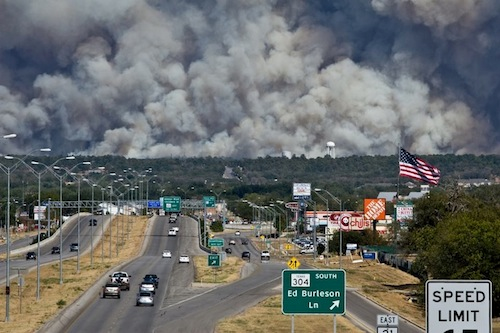
You may have heard about the waves of wildfires sweeping across Colorado for the past several weeks that continue to rage with no end in sight.   Welcome to the new era, the era of Global Warming.

"'What we're seeing is a window into what global warming really looks like," said Princeton University's Michael Oppenheimer,  a lead author for the UN's climate science panel. "It looks like heat, it looks like fires, it looks like this kind of environmental disaster … This provides vivid images of what we can expect to see more of in the future."

"In Colorado, wildfires that have raged for weeks have killed four people, displaced thousands and destroyed hundreds of homes. Because winter snowpack was lighter than usual and melted sooner, fire season started earlier in the US west, with wildfires out of control in Colorado, Montana and Utah.


"The high temperatures that are helping drive these fires are consistent with projections by the UN Intergovernmental Panel on Climate Change (IPCC), which said this kind of extreme heat, with little cooling overnight, is one kind of damaging impact of global warming.

Others include more severe storms, floods and droughts, Oppenheimer said.

"The stage was set for these fires when winter snowpack was lighter than usual, said Steven Running, a forest ecologist at the University of Montana.

"Mountain snows melted an average of two weeks earlier than normal this year, Running said. "That just sets us up for a longer, drier summer. Then all you need is an ignition source and wind.'"

Britain, meanwhile, has come off an extended, nationwide drought to endure widespread, once a century flooding.   Severe storms and torrential rains have triggered flash floods, power outages, the closure of rail lines and the evacuation of hundreds of homes.   This, too, is a predicted outcome of global warming - cyclical severe droughts and floods.


The reality is that we have already broken the Earth's hydrological cycle.  We have heated the atmosphere which causes it to absorb and hold more water vapour.   Those trillions of tonnes of water vapour change precipitation distribution patterns.   Some regions get passed over and wind up in sustained drought, as in the American southwest.   Other regions now receive torrential rains and flooding.   Drought or flood, the affected regions are hammered.   That is not the sort of conditions necessary for agriculture.   It makes little difference whether crops wither in the field from drought or rot away under floodwaters.   It makes little difference whether cattle die of drought or drown.  For a world that the UN FAO has already declared to be now in a permanent state of food insecurity, the fracturing of our traditional hydrological cycle, so instrumental in mankind's growth to 7+ billion people, is potentially devastating.

But, as we were told this week by the CEO of Exxon Valdez ExxonMobil, sure fossil fuels are warming the planet but, don't worry, be happy, we'll adapt.   Rex Tillerson told the Council on Foreign Relations that concern about climate change, drilling and energy dependence are overblown.

"We have spent our entire existence adapting. We'll adapt," he said. "It's an engineering problem and there will be an engineering solution."

Well, since Mr. Tillerson has broached the subject, perhaps we should consider his views on adaptation.  Adapt how, to what, on whose tab, Mr. Tillerson?

Adaptation is costly and it's money down the drain.   Adaptation is perpetual, ongoing.   Adaptation is the supply of a commodity, services and materiel.   Adaptation draws from the economy essential revenues that could be put to use elsewhere.

Adaptation comes in two flavours - public sector and private sector or some combination of both.  Think Disaster Capitalism.   Yet governments today have been so effectively defunded that the private sector will likely have a powerful edge in future adaptation initiatives.   And, as we have seen in so many other areas, the more private sector a field becomes, the more market-driven, the less universal it turns out to be.

Adaptation is not uniformly viable.   There's a lot more "me" and a lot less "we" in it despite Tillerson's sophistry.   The countries and peoples who will need the greatest, most powerful adaptation strategies also happen to be the poorest, most vulnerable, and most heavily impacted by global warming.   Tillerson's facile commentary pretty obviously excludes these peoples as irrelevant, invisible.

But maybe we ought to regard Tillerson's adaptation remedy in the context of Big Tobacco.  Throughout the West, the tobacco industry is being sued for many hundreds of billions of dollars in damages for the costs governments have borne from smoking-related illness.   Why should Big Fossil be treated any differently?  Why should we not look to oil, coal and gas company assets to fund adaptation measures necessitated by the burning of fossil fuels?   We know from the track record of Tillerson's own company in paying damages to those who lost so much from the Exxon Valdez tanker disaster that we can't trust Big Fossil to own up.

If nothing else we should be having a frank discussion with Mr. Tillerson and the other Tillersons who make up Big Fossil about just what responsibility they think they should bear in the question of adaptation.  That's a talk that's already long overdue.

Sunday, August 14, 2011

Surfing the Wave of Change

The enormity of the changes underway is finally settling in.  We're coming to realize that the 21st century will not be a mere successor to the 18th, 19th and 20th.   The old economics, the old industrialism, the old geo-politics are heading for the dust bin without any good idea of what should replace them.  That's a conversation we've not yet been willing to have with ourselves.

We're changing but, unlike the progression of change over the past three centuries, this time we're having increasingly less control over the pace and direction of changes that are, well, overtaking us.  If you're fond of big surf, you'll know the feeling.

The environment is changing, moving surprisingly rapidly toward a new steady state, an epoch that has already been named the "anthropocene."   All we seem to do in response is bicker about 'drop in the bucket' proposals that never get off the ground.   Global warming isn't coming, it's here, and even if we could break our civilization's carbon addiction today, the warming would substantially worsen for another century.

And, even as the environment changes, the effects are compounded by overpopulation, over-consumption and over-contamination of our increasingly unstable biosphere, Earth.   More billions of people with ever-increasing consumption habits results in ever greater contamination or pollution of the soil, water and atmosphere.  It generates civil unrest and regional instability hallmarked by revolt, violent suppression, terrorism, nuclear proliferation and regional arms races now underway.

It's quite reasonable to expect that the magnitude of the environmental change coming our way will direct, even perhaps define, the political, military, economic, industrial and social structures and institutions of the 21st century.  "Adaptation" (a delightfully benign and non-threatening synonym for 'survival') will probably supplant the concept of growth in driving our decisions.

When you're on a ride like this, you have to think and act well ahead of events if you're not to be overtaken by them, if you're to retain the initiative to act, control.   The surfer analogy works again.  They have to sit and study the sea behind them.   They have to identify that one swell that will transform into the best wave to ride.   They have to anticipate its approach speed and then paddle to gain enough speed to catch it and then surf it.   The whole exercise is a culmination of a series of correct assessments and decisions.   Get it wrong and you're left with an entirely different slate of options, none of them particularly pleasant.

Of all the things the best surfers have that our political leadership lacks, vision is the most critical.  Our political class is myopic, a condition arising from perpetually gazing at its feet.  It doesn't look out to the horizon, it doesn't focus to infinity and, hence, it doesn't see or question or evaluate or anticipate or plan for what's coming.  Yet only our political leadership has the authority, resources and the powers to undertake a chore so Herculean.   I understand they're apprehensive of the consequences of shaking the boat but the boat is already rocking if only they could get past their denial.

I thought I should add the following insights from U Calgary, professor emeritus Phil Elder who sees centuries of human nature standing in the way of action:

The scariest thing is that this potential threat to civilization, created by the wealthiest countries, gets a big shrug from many sincere, well-meaning people who are living happily in a state of denial. Yet despair leads to self-defeating paralysis (which may account for young people’s abstention from politics). Disaster is not inevitable; with political will, we can prevent it.

Why are we so slow to respond decisively? Human nature? Our species, accidentally created in Africa by evolution’s dumb engine, has opposable thumbs, powerful brains, and self-consciousness. But, at the same time, our mammalian bodies house strong, embedded instincts, which could endanger our survival.

Originally small roving bands of omnivores, humans now live in mega-groups and have so overrun the planet that civilization may be endangered. True, our intellect and technological creativity have created an unprecedented standard of living for huge populations. But, as Roland Wright suggests in his book A Short History of Progress,
… to use a computer analogy, we are running 21st-century software on hardware last upgraded 50,000 years ago ... . This human inability to see ... long-range consequences may be inherent to our kind, shaped by the millions of years when we lived from hand to mouth by hunting and gathering.
For eons, change was so slow as to be imperceptible, except for decade-by-decade fluctuation of game resources. Therefore, long-term thinking had no survival value. When things got tight, bands moved on to more favourable territory in a limitless world, and, if other humans were already there, violence decided who would survive.  

In these circumstances, we developed strong, embedded, aggressive instincts; fight-or-flight adrenaline; “nature, red in tooth and claw”; a need for short-term survival, regardless of tomorrow. Yet this mindset is deeply unsuitable for the modern world, which needs long-term planning and co-operation.

We also became mistrustful of outsiders and fearful of change. Defence mechanisms like denial, rationalization, and magical thinking were helpful comforts. So were greed – for our extended family, if not just for ourselves – and a willingness to exploit others.

Addressing these challenges isn't Apocalyptic.  Ignoring them may well be.

Monday, August 02, 2010

It's Not a Scheme to Transfer Wealth

It's dispiriting to discover how many people believe the global warming initiative to be a scheme to transfer wealth from the developed world to the Third World.   They're referring, of course, to the plan for the industrialized nations to create a fund to help the poorest and weakest countries cope with the climate change we have visited on them.

Whether it's South Asia, Africa or the South Pacific, the poorest nations are already wracked by floods, drought and related precipitation problems and sea level rise.  Only the abjectly ignorant cannot understand our overwhelming role in their plight.  We received great wealth from our carbon emitting activities, they didn't.  As ill luck has it, however, they're the "first and worst" affected by the climate change we created.   It's our good fortune in the northern nations to be the "last and least" affected by global warming.

On what possible basis can it be argued that we don't have a responsibility to those nations we've harmed?   If you run over a pedestrian, are you not responsible for the injury and loss you cause?  Is payment of damages a "scheme to transfer wealth?"  Of course not.

Today's Sydney Morning Herald captures this misconception in an article headlined, "Pacific talks focus on $110b climate windfall."  Windfall is such a loaded word.  It suggests something unwarranted, undeserved.  It rejects any notion of genuine entitlement.  It's particularly offensive coming from such a coal-fueled nation as Australia.

Enough.   The poorest and most vulnerable countries will need every penny of that money, and far more, if they hope to adapt to global warming.   One thing the world doesn't need is unnecessary climate refugees migrating en masse elsewhere.   Helping them cope is actually very beneficial to the rest of us, especially the richest countries.

This is not scheme, it's not a plot, there's nothing remotely underhanded to it.   And it sure as hell isn't a windfall for the little countries hardest hit.