Tuesday, October 08, 2019

The Tyee Trolls Andrew Scheer - Episode Two, "WTF?"


Now I'm going out on a limb here to suggest The Tyee isn't fond of the Conservative leader, Andrew 'The Private Sector Months' Scheer.

Today's episode explores how so many Conservatives are bedeviled trying to figure out how the 'summer help' ever became their leader.
If you are still trying to understand why Scheer is this close to being our next PM, so are a lot of Conservatives, left scratching their heads over how he became their leader. 
It’s perhaps inevitable that any right-wing leadership contest held in 2017 would be conducted in the fetid shadow of President Donald J. Trump. Following his 2016 U.S. election victory, many Canadians assured themselves that this country was different, not likely to respond to a campaign of equal parts boorish insult, contempt for law and democracy, religious intolerance, and not-really-concealed racism. Yet it was clear that at least some of the candidates running to replace Stephen Harper as Conservative leader were intent on testing that belief.  
The long and short of the column is that the Tories went through a strenuous and unpleasant process churning the full-to-overflowing dunny until, almost overcome by the fumes, one turd emerged at the surface - Andrew Scheer. And Hercules thought he had it tough cleaning the Augean Stables.

Sent to the bottom were such stalwarts as O'Leary, Leitch, Trost, Raitt, Clement, Chong, and, of course, Bernier. Scheer had one strategic advantage, stealth.
While O’Leary mouthed off on every newscast and Leitch threw bombs all day, few were likely to think of Scheer as radical, if they thought of him at all.
But even as Leitch courted the right-wing vote at full volume, Scheer was working the same terrain more quietly. He signalled his support for the anti-abortion Campaign Life Coalition. He cited as an inspiration Canadian-born Texas senator Ted Cruz, a supporter of Trump’s border wall who wants to abolish his country’s federal education department and tax collection agency. Scheer was similarly admiring of Senator Jim DeMint, who has favoured a ban not only on gay schoolteachers but also any unmarried women “sleeping with their boyfriends.”
Denizens of the dunny fare best when they keep their mouths shut.
While privately reaching out to anti-abortion groups like Campaign Life Coalition and securing second-choice status among Trost voters, Scheer was not as vocal about his own position. As Trost put it later: “Andrew doesn’t want to be talking about [abortion], but if he was clear about this issue he probably would never have won the Conservative leadership.”
How Scheer put the boot to Maxime.
Postmedia’s Terence Corcoran, a Bernier supporter, is one of many observers who believe the Conservative convention was transformed into a land of milk and treachery. Corcoran insists Bernier was sunk by opposition from the dairy industry who saw him as a threat to supply management. Corcoran claims “fake Conservatives” recruited by dairy interests signed up to defeat the Quebec favourite.

Combined with voting irregularities (chiefly a final-ballot gap of 7,466 between the number of votes cast and the announced result — Scheer’s margin of victory was 7,049), the result left many participants with a sour taste. 
At any rate, the disappointing loss caused Bernier to spiral out of the Conservative orbit like a rogue planet, albeit one paranoid about invading aliens. He has since founded the People’s Party of Canada and made it his personal mission to make Kellie Leitch sound like Mr. Rogers. 
And Scheer? He has since gone about introducing himself to the Canadian public as a man of deeply held, extremely conservative convictions, which he frequently promises not to act upon.

This Dismal Season


Sorry. I asked around. Couldn't find anyone who bothered watching last night's leaders' debate. Not one. I suppose it has something to do with that "none of the above" attitude that permeates the general election this year.

All but two were university grads, the sort who usually pay some heed to these things if only for coffee or dinner conversations. Not this year, sorry.

I'm told some of those I asked simply missed it. The timing was awkward. You might settle down at 9 o'clock to watch the fireworks but, on the coast, you have other things to do - fixing dinner for example or just getting home through rush hour traffic, that sort of thing. One woman told me that she had it on her car radio but it was all gibberish as they talked over each other so she lost interest.

I see that Trudeau's most obsessive attacker was left quite tumescent but, again, so what?

What does it say when we're witnessing the Clash of Titans - a stammering school marm versus a summer-help counter clerk. I've never seen the like of it and I do go back a ways. There's something that is just so dismal about this election. Sort of like trying to mend a flat tire with four puncture wounds. You know very little good will come of it.

It's a pity really because there is so much at stake in this election including the fate of our youngest people and the generations to follow them. Time is running out and this time, four years hence, will probably be too late for Canada to change course.  Too little, too late.

This brings to mind Gary Mason's column in the Globe in late September where he contrasted Mulroney's brilliant effort to 'fix' the seriously damaged Ozone hole to the endless greenwash we're getting today on climate change.

...Liberal Leader Justin Trudeau said at a town hall event in Peterborough in January, 2017, that while he couldn’t shut down the oil sands immediately, “we need to phase them out, we need to manage the transition off of our dependence on fossil fuels.” It should not have been a controversial statement because it’s true. And yet, politicians in Alberta (and many citizens, too) lost their minds, accusing the Mr. Trudeau of betraying them, of forging a plan to rob thousands of people of their livelihoods. A few days later, Mr. Trudeau tried to undo the damage, saying that he “misspoke” – the oil sands would not be going anywhere soon, he assured Canadians.
Mason offers four reasons not to swallow the green smoothie voters are being force fed in this campaign.

First, neither of the two parties who will form government when the votes are tallied has a coherent plan to cut emissions enough in the limited time remaining. The Liberals at least have a vague plan but it's aspirational at best. And haven't we heard this aspirational talk from Justin before?

Second is the "fire and fall back" approach to climate change in vogue today. They're not denying the affliction any more. Instead they've moved on to undermining the solutions.
It’s not just members of the public who are in denial, but politicians and the oil and gas industry as well. Everyone agrees there is a problem, but few are willing to accept the sour medicine it will take to do something about it.
Mason's third reason is the refusal of the oil and gas industry (bolstered by their political stooges) to accept that their industry's days are numbered - at least if we intend to see our society last a few more generations.
A recent piece in The New York Times by Christiana Figueres laid it out in stark detail. The life of many of the world’s oil and gas companies, in their current form, could be as little as five years in some cases, but no more than 30 even in the most optimistic scenarios, predicted Ms. Figueres, who was the executive secretary of the United Nations Framework Convention on Climate Change. Markets have started to abandon many of these companies. Exxon Mobil was the last big oil giant remaining in the top 10 of the world’s most valuable companies – until it dropped out earlier this month for the first time.
We either cut our own throats or we end fossil fuels. It's what Hans Joachim Schellnhuber meant when he said at the 2015 Paris climate summit that our only hope was for an "induced implosion" of the fossil energy giants. Survival depends on our governments putting them down, blowing them up. We know that the highest carbon, most toxin laden fuels have to be left in the ground yet here we have a prime minister so ensnarled in cognitive dissonance as to believe there's a legitimate purpose for building a 60-year, high capacity bitumen pipeline squaring off against a counter-clerk who attacks him for not getting it built fast enough.

Mason's final source of despair is how deeply and angrily divided Canadians are, especially those rallying to the defence of the petro-economy. Even Dame Cathy "we must not harm the economy" McKenna now needs a bodyguard to protect her from the petro-thugs.
Jason Kenney, for one, has relied on often incendiary oratory to get supporters riled up against the Liberal government in Ottawa, which he blames for trying to kill the oil industry. (Even though it bought a pipeline.) But a phalanx of conservative premiers has railed against the dangers of climate measures that will “kill the economy.” The doubt these politicians have sowed in the minds of the public may be having an effect. A recent survey by the firm Ipsos found nearly half of those polled thought scientists were elitists whose findings they discounted because they don’t align with their personal beliefs. Other polls have shown that people believe climate change is real but don’t want to sacrifice much to reverse its effects – a result no doubt influenced by the words of politicians who have convinced many Canadians that measures such as a carbon tax are a mere money grab that will have no measurable impact on GHG emissions.
Mason concludes by observing how quickly we praise Greta Thunberg and her good works and then, just as quickly, put all that out of our minds and, like moths, are drawn to the lanterns of Scheer and Trudeau.

This is a Potemkin campaign with everyone convincingly painted up to appear as someone or something that they're not. That's true of Scheer and Trudeau. It's also true of "late to the party" Jagmeet Singh who can't even get Rachel Notley to say she'll vote for him this time round. I've listened to Jagmeet and I'm convinced he's a very slick and opportunistic bullshitter, not that it's going to matter. Singh may have, pardon the term, found "Climate Jesus" but the New Dem rank and file haven't shown much sign they're with him.

So I will dutifully cast my ballot on October 21 but I don't think I'll waste my time watching the returns.  Maybe I'll dust off my Indiana Jones DVDs and make a night of it.

Monday, October 07, 2019

Anybody Want to Start a Pool?


I wonder what the voter turnout will be this year.

Since Confederation we've averaged just over 70 per cent. The highest turnout came during the Diefenbaker/Pearson era when 79 per cent came out to vote ('58, '60, '63).

The lowest turnout was just under 59 per cent when Harper defeated the Dion Liberals in 2008. Three years later, 61 per cent turned out to see Harper trounce the Ignatieff Liberals who dropped 34 seats, handing Harper his ill-deserved majority.

In 2015 the turnout bumped up to just over 68 per cent as Canadians voted for the fresh-faced Justin Trudeau and/or against Stephen Harper.

So what do you think it'll be this time? There's no hated Harper this time around but no unsullied Liberal either. We've got a 'summer help' counter-clerk up against a disappointing school marm. The campaign has been a pissing contest between Scheer and Trudeau. Nothing there to inspire a big turnout. If there was a "none of the above" option on the ballot, Mr. None might take it in a landslide.

I just don't see a big voter turnout this time around. What do you think?

Andrew Weaver Steps Down


He's been a true stalwart of the Green Party movement in Canada. Our very own climate scientist, U. Vic's Andrew Weaver. Now he's announced that he won't be seeking re-election to the provincial legislature. This is it. He's done.

In 2013, Weaver left his post as Canada Research Chair in climate modelling and analysis at the University of Victoria. He was elected in May 2013 in Oak Bay-Gordon Head as the first provincial Green politician in Canada, and acclaimed as the party’s leader in 2015. 
He ran with a focus of making a difference in the area of climate change, explaining he viewed the B.C. Green Party as the best vehicle to do that work.
I wonder if Dr. Weaver is throwing in the towel, giving up the fight. The latest polling results show the federal Greens going nowhere. We might be back to the Vancouver Island/Gulf Islands bastion when the votes are tallied. A failure of Elizabeth May's Greens to stage a breakthrough will mean that climate change, the climate crisis/breakdown and our national climate emergency will fade once Scheer or Trudeau prevails.

It wouldn't be much of a surprise if Elizabeth May follows Weaver out the door. She has been fighting hard for close to 14 years. Susan Riley named her the "hardest working MP on Parliament Hill."  Like Weaver, she knows that Canada and the world stand at a crossroad and the petro-state isn't likely to change course. Time is not on Canada's side or humanity's. We haven't got another four years to squander on disingenuous half-measures as we have the past four years. But sometimes the clock simply runs out.

Anyone Want to Bet Trump Isn't Augering In?

Check out 'the Donald's' tweet about Turkey and the precarious fate of Syrian Kurds.


I didn't believe that even the Mango Mussolini could do this.  I checked. He did. We can only hope that, wherever he lands, it's a vacant field.

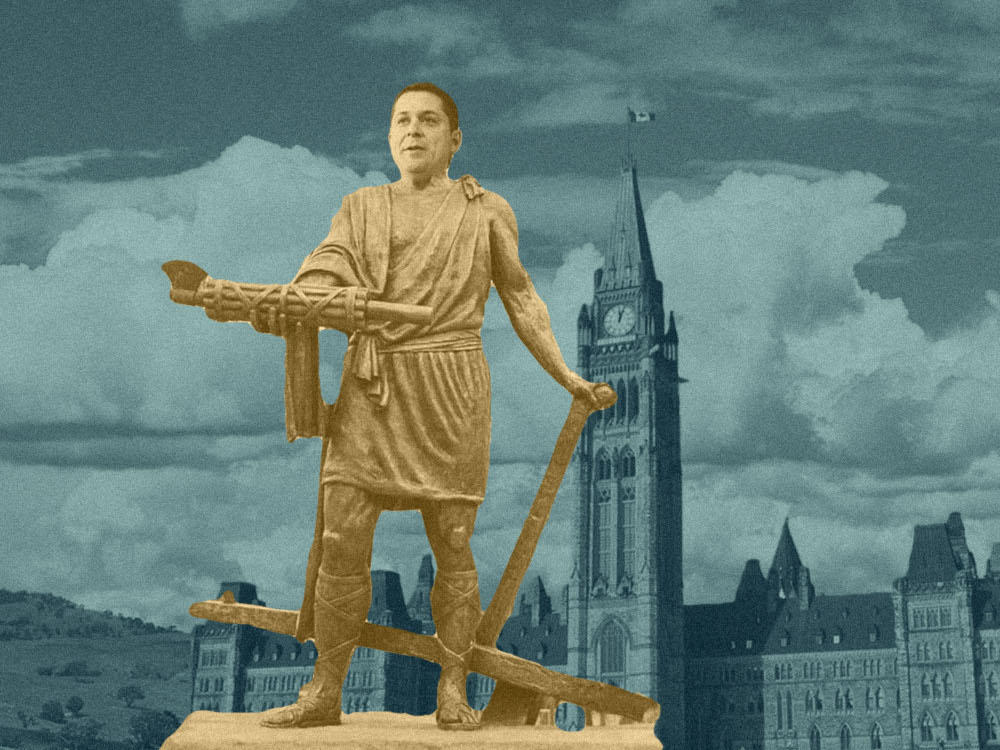
The Tyee Trolls Andrew Scheer


The headline says it all - "SCHEER AMBITION: The Private Sector Months. And Then - to Government."  It's apparently the first in a series on the life and times of Chuckles, our would-be prime minister.
Andrew Scheer has a problem. No one likes to be labelled a career politician — particularly not a Conservative. The conservative ideal is Cincinnatus, that noble Roman who left his fields to save the Republic before returning once again to his plow. But the Conservative leader is neither Cincinnatus nor silver-tongued Cicero. Nor, as his zig-zag to power shows, is he Voltaire, the defender of free speech whose mantle Scheer has often sought to don.
...It stands to reason that Cincinnatus might have had a more difficult time taking power had he been revealed to be a resume-padding stable boy, but ultimately no one is likely to have supported Scheer due to a sterling career peddling supplementary hail coverage anyway. His qualifications, for good or ill, are political.

Is This How Neoliberalism Ends - With a Crash?


It's been nearly 15 years since John Ralston Saul proclaimed the death of neoliberalism in "The Collapse of Globalism, and the Reinvention of the World." Back then he envisioned a new economic model, a new ideology, that would spread through the world and sweep aside the deeply flawed and failing globalism model. Only that didn't happen.

Globalism is still with us. We don't know what else to do. Canada is not a leader in this sort of thing and no one is showing us a new path.

Does this mean that JRS' criticisms of globalism are wrong? Hardly. It's just that no one has found a way out of our deepening rut. So, what's next?

One way or the other, the wheels are coming off the wagon and we don't have a Plan B.

Paul Mason, writing in New Statesman, America argues that the future may no longer be able or willing to bail out modern capitalism.
In his own dumb way, Matt Hancock just summed up the survival strategy for global capitalism. Blinking into the camera lights, Britain’s hapless Health Secretary assured viewers that he could promise to build 40 new hospitals with just £100m because “the rest of the money will come in the future”. 
He was instantly ridiculed but he was right. Eleven years after the financial crash, the only dynamism still left in the system is being driven by the twin engines of rising debt and money creation by central banks. Each of these represents a claim on the future: the problem is, it’s a future that may not exist.
With Germany sliding towards recession, and some $17trn worth of debt now yielding negative interest rates, policymakers are coming face to face with an existential question: what happens when even borrowing and printing money on an unprecedented scale no longer drives sufficient growth? And for the banking industry it poses an even sharper question: what happens when the time value of money evaporates?
First, since the financial crisis of 2008, the world’s companies, households and states have borrowed an extra $57trn, taking the global debt pile to an estimated 325 per cent of GDP.
Second, in order to keep the world economy from depression, the central banks have been forced to print money to the tune of $20trn. When, according to their established doctrines, the US Federal Reserve and the European Central Bank simultaneously tried to unwind quantitative easing over the past 18 months, global growth began to slow.
Exhibit Three is the impact of quantitative easing on interest rates. As an influential paper by Larry Summers and the Bank of England’s Lukasz Rachel shows, real interest rates in the world’s most advanced economies are now negative and likely to fall further. In layman’s terms, for more and more savers, there is no income to be generated from putting money into the bank, or lending it to a government by buying bonds.
Fourth and finally, in August this year, the so-called yield curve on government debt “inverted”. Normally it should cost more for a government to borrow money over ten years than over two, but the cost of borrowing short term has surged, while the cost of borrowing long-term continues to fall.
His conclusion? The party's over.
If I and the other post-capitalist theorists are right, there is no future income or measurable economic growth from which to pay down the debts, or manage down the central bank balance sheets. The ultimate structural reform needed is a managed transition beyond capitalism itself.

It is slowly dawning on the clearest thinkers in the official system that the entire era of financial globalisation has been based on borrowing from and speculating against a future income stream that may not exist. While in the short term, aggressive and radical social-democratic programmes will need to be adopted across the developed world, the strategic task is to design an economy that replaces one based on markets, scarcity, debt, speculation and (of course) carbon.

Ralph Nader. 19 Reasons Americans Should Be Taking To the Streets.

This is Ralph Nader's Top 19 List, "Reasons for Americans to Rise in Revolt."

There has never been more access to food—domestic and imported—yet hunger is an ongoing problem everywhere. In the U.S. alone, 16.5 million children go to bed hungry and 20% of community college students are experiencing “food insecurity.” 
Never have there been more communications technologies, yet it is harder to get through to people personally than fifty years ago. 
Never have people been able to use their right to free speech so unencumbered, yet a torrent of lies are now spread so freely and are often unchallenged. 
Never have there been higher corporate profits, yet staggering amounts of poverty and near poverty remain along with stagnant wages. 
Never have there been more medicines to alleviate pain, yet far too many of these pain killers have caused massive fatalities and addictions. 
Never has there been more liquid corporate capital piled up, yet corporate investment is proportionately lower than before. Instead, CEO’s have burned over 7 trillion dollars in unproductive stock buybacks in the past decade. 
Never have there been more exercise outlets, exercise machines and apps, yet obesity is still rampant. 
Never have there been more tax breaks for big businesses, yet big businesses use so little of the windfalls for productive investments, good jobs and shoring up pensions. 
Never has there been more free access to information, yet so little retained knowledge. 
Never have there been more impressive muckraking film documentaries and books that expose corporate and government crimes, yet this media attention produces less impact and reform. 
Never have there been more ongoing impeachable offenses and statutory violations by a president, yet the opposing Party in Congress have been reluctant to move on the many articles of impeachment. Remember how fast the unified House of Republicans moved to impeach Bill Clinton in 1998 for perjury and obstruction of justice? 
Never have there been more trainers, sports physicians, protective equipment and guards for professional athletes, yet there are far more injuries and days lost by players than was the case sixty years ago. Now there are helmets, gloves, pads, cushioned walls, better shoes etc. Why? 
Never has there been more to read, yet there are so few readers reading. Historically, we have gone from illiteracy to literacy to aliteracy! 
Never before has technology made it so easy for heads of government to meet, yet fewer international treaties are made. (Eg. Cyber, water, environment, consumer, labor etc.) 
Never has there been such an outrageous corporate crime wave, yet law enforcement budgets have decreased! The more big CEO’s are paid, the worse is their management. (Eg. The big banks twelve years ago, General Electric for years.) 
Never before have there been so many wrongful injuries, yet the court budgets are becoming tighter and the law of torts is being restricted. Without the defense of and use of our civil justice system, wrongful injury cases cannot go to court with a trial by jury. 
Never before has there been more corporate fraud, yet agencies tasked with bringing this fraud to justice have smaller budgets and more limitations. The budget of the Federal Trade Commission (FTC) is a third of one day’s worth of health care billing fraud, which is estimated this year to be $350 billion, according to Harvard’s national expert on the subject, Professor Malcolm Sparrow. The Consumer Financial Protection Bureau (CFPB) has been straitjacketed by the evil corporate crime abettor Mick Mulvaney, the acting White House Chief of Staff for corrupt Donald. 
Never has the drug industry accumulated more profits and government subsidies, yet so many patients cannot begin to afford lifesaving medicines. 
Never have the under-taxed super-rich been so rich, yet on average give a smaller proportion of their money to “good works.” Actually, middle and lower income people give more proportionally than do the ultra-wealthy.
Nader, by the way, is backing Elizabeth Warren and her call for a deep structural overhaul of how America operates and how it is governed. Meanwhile, in his Monday morning column, Chris Hedges agrees that it's time to rebel.

In Trumpland, Everything and Every One is Expendable.


One thing Donald Trump will never suffer from is an excess of empathy or responsibility or integrity.  He exists to pursue but one thing - whatever suits his interests and whims. That intense focus is why he has accomplished next to nothing in nearly three years in office.

Trump is, if anything, promiscuous. He will get into bed with anyone and never an apology. Kim Jong Un, sure. Mohamad bin Sultan, every day. The Taliban, why not?

Here's the latest. This time it's Recep Erdogan.
The White House has given the green light to a Turkish offensive into northern Syria, moving US forces out of the area in an abrupt foreign policy change that will in effect abandon the Kurds, Washington’s longtime military partner. 
Kurdish forces have spearheaded the campaign against Islamic State in the region, but the policy swerve, after a phone conversation between Donald Trump and Recep Tayyip ErdoÄŸan on Sunday, means Turkey would take custody of captured Isis fighters, the White House said. 
It has also raised fears of fresh fighting between Turkey and Kurdish forces in Syria’s complex war now the US no longer acts as a buffer between the two sides. 
Trump defended his decision, saying the Kurds were “paid massive amounts of money and equipment” to fight and that he was leaving the fight against Isis to others for the time being.
With Trump in the White House the US has no allies. An ally is someone you can rely upon. No one can rely on Donald Trump. All you can do is try to hear that bus coming before he shoves you straight under it.

This Should Make Trump's Week.


A federal judge has ordered that Donald Trump must release eight years of tax returns to the Manhattan District Attorney's office.

"This court cannot endorse such a categorical and limitless assertion of presidential immunity from judicial process as being countenanced by the nation’s constitutional plan, especially in the light of the fundamental concerns over excessive arrogation of power that animated the Constitution’s delicate structure and its calibrated balance of authority among the three branches of the national government, as well as between the federal and state authorities. Hence, the expansive notion of constitutional immunity invoked here to shield the president from judicial process would constitute an overreach of executive power."
Trump, being Trump, is going to appeal. Next stop is the Federal Court of Appeal. After that it's the well-stacked United States Supreme Court.

What's the Plan When the Bubble Bursts?


Corruption, it is said, runs deep. Big money corruption, deeper still.

Most didn't notice the report of the International Monetary Fund that found that Canada subsidizes the wealthiest industry in the world, fossil energy, to the tune of $60 billion per year, a figure that's steadily growing.

The Trudeau government admits that it subsidizes the wealthiest of the wealthy at a paltry $2.5 billion per year. That's not true. Ask the Auditor General.
A new 2019 report by Canada’s Auditor General reveals government’s review of such subsidies is “incomplete and not rigorous,” is “not based on all relevant and reliable information” and “did not consider economic, social and environmental sustainability over the long term.”
The AG, like the IMF, knows that the government is cooking the books. They both know that subsidies must include the value of every unearned benefit afforded the industry. Once you add in everything the government keeps off the books the subsidy swells from $2.5 billion to $60 billion.  That's $1,650 for every man, woman and child in Canada, a tidy $8,250 for a family of five.

Much of Canada's largesse doesn't arrive at the Calgary Petroleum Club via armoured car. Much of it comes in the form of ridiculously low royalties, tax concessions and deferrals, access to natural resources for well under market value and sometimes free. It's peanuts. 200 million here, a billion or two there, but eventually it adds up. Before you know it, you're doling out $60 billion a year.

Let's look at one source of the Great Canadian Giveaway, the Athabasca tailing ponds. A leaked Alberta government report suggests it could cost upwards of a quarter Trillion dollars to clean up that mess. Look at it this way. The bitumen associated with that liability is long gone, most of it out of the country. The revenue, the profit has been had and long disbursed. The asset is gone Gee, I wonder if those foreign oil companies held back the money they need to clean up those tailing ponds? What's your guess?

Nicholas Stern, Mark Carney and others have been warning that we're sitting on a massive 'carbon bubble.' The Day of Reckoning is not far off when we'll have to choose between humanity or fossil fuels. The smart money isn't betting on bitumen.

Norway's public pension fund has severed its last ties with the Athabasca Tar Sands.
Norway’s municipal employees pension fund, the country’s largest, has sold its last remaining stakes in companies with operations in Canada’s oilsands, saying holding them does not align with efforts to keep global heating below internationally agreed-upon targets. 
The fund, Kommunal Landspensjonskasse (KLP), last year dumped stocks that drew more than 30 per cent of their revenue from oilsands operations, but on Monday said they can no longer tolerate even those that have five per cent exposure.
Three years ago, Norway's energy giant, Statoil, bailed out of Athabasca.
There’s oil and then there’s oil, says Norway’s Statoil, which is pitched in a race to develop the cleanest crude as countries wean themselves off fossil fuels. 
While the world will need oil and gas for decades to come, Statoil’s Chief Executive Eldar Saetre expects that many oil deposits will never be tapped as increasingly discerning consumers will demand only the lowest-polluting crude. 
“A lot of fossil fuels will have to stay in the ground, coal obviously … but you will also see oil and gas being left in the ground, that is natural,” Saetre told Reuters in an interview in London. 
“At Statoil we are not pursuing certain types of resources, we are not exploring for heavy oil or investing in oilsands. It is really about accessing the most carbon-efficient barrels.”
This post, however, isn't about predicting when the Sword of Damocles suspended over Athabasca will drop. It's about what happens next.  Do we send envoys to Texas and Washington and Calgary demanding hundreds of billions of dollars? What do we do if they say no, seize their now valueless bitumen assets? Or do we just treat those tailing ponds as the world's biggest Love Canal, visible to the naked eye from space? Maybe we'll do what we've been doing all along - kicking that environmental mega-disaster down the road in a game of Parliamentary musical chairs.

Saturday, October 05, 2019

Every Man, Woman and Child Indentured to the Fossil Energy Giants


$1,650 per year per person. Let's say it's a family of five. That would make it $1,650 X 5 = $8,250 all in. That would be your family's share of the $60 billion in subsidies annually doled out to Canada's energy industry in 2015, the Year of our Justin. Which goes to show that it's not just Big Oil that's out to rob our kids of their future, government can play that game every bit as well.

Justin will tell you they're only kicking in something in the order of $2.5 billion a year in carbon energy subsidies. He's lying. Says who? How about the International Monetary Fund, that's who. The entire report, in pdf, can be found here.

How to explain the discrepancy? It's a matter of just what you put on the books and what you hide. The IMF defines subsidies as "fuel consumption times the gap between existing and efficient prices (i.e., prices warranted by supply costs, environmental costs, and revenue considerations)."

The Alberta government was stung by the release of an internal study showing that the province faces a remediation bill upwards of $260-billion for the Athabasca tar pit tailing ponds, orphaned wells, etc. Somebody is going to pay for that eventually. That somebody is you or, more accurately, your kids and your grandkids. We don't put those costs on the books yet because that would be terrible politically and we can still kick that can down the road. We keep all sorts of costs off the book such as the value of natural capital, unpriced resources (that belong to the public) that are doled out year after year, royalty and tax deferrals and more.

An essay by U Vic. environmental lawyers, Erin Gray and Calvin Sandborn, reviews the latest IMF numbers. The authors begin by questioning the merit of massive subsidies of the world's most prosperous industry.
Such subsidies not only hurt Canadian taxpayers and the economy — they also exacerbate the climate emergency. 
Indeed, the G20 countries have already agreed that subsidizing fossil fuels is irrational in a warming world — and have called for action to eliminate inefficient fossil fuel subsidies that distort markets. 
The problem is that subsidies encourage the production and wasteful consumption of fossil fuels all while impeding the shift to cleaner renewables.

For these reasons, during the last election campaign Justin Trudeau sensibly committed to “phase out inefficient fossil fuel subsidies.”

The problem is that government has not yet delivered on this promise.

A new 2019 report by Canada’s Auditor General reveals government’s review of such subsidies is “incomplete and not rigorous,” is “not based on all relevant and reliable information” and “did not consider economic, social and environmental sustainability over the long term.”
In other words, the Auditor General dismisses the government's claims on subsidies as just more horse shit.

It's a fine article that lays bare the lengths that this government, like the Harper regime before it, goes to in order to mask what's really going on. They're cooking the books and, in the process, stealing your grandkids' future.

The IMF estimates that elimination of global fossil fuel subsidies would reduce CO2 emissions by 28 per cent and reduce premature air pollution deaths by 46 per cent. 
Equally important, the IMF concluded that elimination of subsidies would actually result in a net economic gain. Eliminating fossil fuel subsidies will be a win for the environment andfor the economy. 
In sum, Canada needs to implement robust carbon taxes to pay for the massive climate change costs that society now confronts.
Just as important, Canada must finally follow through on its specific promise to phase out inefficient fossil fuel subsidies.

After all, claiming to fight climate change while subsidizing fossil fuels is as crazy as brushing your teeth while eating Oreos. It may make you feel virtuous, but it isn’t going to work.
These are vultures, feasting on the carcass of the future leaving nothing but stripped bones and fur.

There Was a Time When We Understood Democracy and What It Meant.


Our connection to democracy is waning. Young people, especially, are leery of it.

The alarm bells rang with a 2016 report out of Harvard by Yasha Mounk and Roberto Foa that found democracy is losing ground around the world.

People everywhere are down on democracy. Especially young people. In fact, so rampant is democratic indifference and disengagement among millennials that a shocking share of them are open to trying something new—like, say, government by military coup.
They find that, across the board, citizens of stable liberal democracies have grown jaded about their government, say Mounk and Foa—and worse. 
[T]hey have also become more cynical about the value of democracy as a political system, less hopeful that anything they do might influence public policy,” they write in a previous article on their research (pdf) published in Jul. 2016, “and more willing to express support for authoritarian alternatives.” 
Okay with autocracy: Many fewer millennials in both Europe and the US object outright to military coups than their elders. 
Rights, schmights: Only around a third of US millennials see civil rights as ”absolutely essential” in a democracy, compared with 41% among older Americans. In the European Union, it’s 39% and 45%, respectively. 
Election optional: More than a quarter of US millennials dismiss the importance of free elections to democracy. (Though rates are overall lower in Europe, millennials also agree at higher rates than older generations.)
In 2017, Forbes asked "Are Millenials Giving Up on Democracy?"
Why are young people so disillusioned with liberal democracy? Across Europe, high youth unemployment rates (ranging from 15% to 48%) and dismal economic prospects have convinced many that the system simply isn’t working, and that new blood is needed to upend the establishment. Fringe parties have taken hold most strongly among youth in countries who feel betrayed by the EU. American Millennials, meanwhile, are fed up with a government they see as gridlocked, corrupt, and unable to solve problems
Millennials’ skepticism of democracy is in part shaped by their location in history. As political scientists Yascha Mounk and Roberto Stefan Foa point out in The Washington Post, Millennials’ openness to illiberal alternatives may reflect the fact they “lack the direct experience of living under, or fighting against, authoritarian regimes like fascism or communism.” 
It’s also rooted in a different perception of the future. The young are much more concerned than the old if leaders don’t ensure their economic security and prosperity for the long term. Democratic pluralism and neoliberal markets have worked very well to tip power to the old and reward the past—and not so well to help the aspiring young. Global Millennials are much more positive than older generations about Xi Jinping and the new China: They are more impressed by Xi’s ability to set clear national priorities and invest hugely in the future, and less bothered by his habit of crushing dissent.
The following year, Vox reported on a 'large-sample' survey that found democracy was losing its allure for the young.
The young are less likely to say that democracy is “always preferable” to any other type of government, and less likely to agree that “democracy serves the people.” The young are more likely to say that “non-democracies can be preferable” in some circumstances and to believe that “democracy serves the elite.”
...the young are less supportive than older Americans of democracy as a concept. They are not less satisfied with American democracy right now, nor are they less likely to think it is responsive to their needs, but they are less likely to believe that democracy is superior to other forms of government and more likely to believe that it serves the elite. 
Why is satisfaction with the American political system so low? And why is support for democracy lower among the young? We have a lot of hypotheses, but we can’t be certain based on these results. 
Is it economic inequality and slow median income growth over decades? Is it political polarization? Is it immigration? Something else, or some combination of these? More people should direct their attention to answering these questions. Because if there is one thing history tells us, it is that when people are so dissatisfied with their political system that they look to extreme outsiders for rescue, it can end badly.
Another 2018 study reported in The Washington Post found that the allure of strongman rule, authoritarianism, was matched by a decline of support for democracy, even elections.

Just last month an article in ForeignPolicy.com warned that "Democracy is Fighting for Its Life." The gist of the article is that democracy, its support already weakened by a disaffected populace, has fallen prey to its fervent enemies, people with names such as Trump, Orban, Bolsonaro, Erdogan, le Pen, Farage and others.
American democracy faces not one, but three distinct and connected crises. There is an ongoing assault on democratic norms and values, which has led to the coarsening of the U.S. social fabric and the erosion of unspoken, but vitally important, norms that provide the guardrails of self-government. There is a sense of displacement, dislocation, and despair among large numbers of Americans who feel that the democratic system has grown increasingly unresponsive to their needs and that government is less willing to advocate for their interests. Finally, there is an onslaught by authoritarian powers in Beijing and Moscow, which are using new forms of technology to reach into democratic societies, exacerbate internal tensions, and carve out illiberal spheres of influences.
Several studies show an ever greater disaffection to capitalism building among young people in the West.

This is not to suggest that the Pentagon will lock down the halls of Congress anytime soon. We're still on the plus side of the ledger only our margins of safety are in decline and, like any other tipping point, no one knows where the edge is.

Look at this ordeal of an election we're caught in today. What a dreary excuse for an election. You know whether you can trust their promises - a resounding "No" there. Harper broke that trust. Trudeau did the same. This election isn't about policy but whom you dislike/distrust most. We've been sent to the polls in the midst of a recently proclaimed national emergency that the candidates seeking our votes avoid like a plague. Pretty thin gruel.

My friend, Peter Lowry, recently wrote that Canadians shouldn't concern themselves with policy but should, instead, simply vote for the Liberal or Conservative candidate in their riding they like best. Don't trouble your pretty little mind with concerns and issues. Go for your Liberal or Tory preference and leave the hard thinking to them. Sorry, Peter, that's not democracy. It's autocracy.

It has been a long time since we last took the pulse of Canadian democracy. Fewer eligible voters are turning out and, of those that do, more are marking their 'X' with one hand while holding their nose with the other.

We are beset by subpar leaders, a school marm and a summer help counter clerk, who want to rule but are loathe to govern. You don't need democracy to rule. When just a few points more than one-third of ballots cast suffices to reward a party with a Parliamentary majority, that is not what Lincoln called "government of the people, by the people, for the people." It's the polar opposite.

We used to understand what democracy meant. We expounded on it at length in two reports on freedom of the press, the 1969 Davey commission report on concentration of ownership of Canada's mass media and the 1980 Kent enquiry commission report. Both reports zeroed in on the lousy role the media plays in establishing an informed electorate without which democracy withers.

Davey argued for the creation of an independent body to break up, through forced divestiture, the evolving media cartel.

“this country should no longer tolerate a situation where the public interest in so vital a field as information [is] dependent on the greed or goodwill of an extremely privileged group of businessmen”
When, a decade later, major newspapers began closing, first in Winnipeg, then in Ottawa, the Kent commission launched its enquiry. It reported that corporate accumulation and profitability had impaired the media's social responsibility to the public. Again the call came for the breakup of media monopolies and editorial independence of head office politics.  Like the Davey commission, the Kent report was ignored.

The media that once fancied itself the 'watchdog of government' and defender of the public interest have, instead, become the lapdog of government, beneficiary of government largesse and manipulator of public opinion. There is quite an incestuous relationship today that abuses the public interest to benefit their respective immediate interests.

We no longer have a shared baseline of facts from which we can argue the merits of opposing visions. This core consensus, the very foundation of social cohesion, has crumbled. Consent is no longer something to be earned but something to be manufactured.

I can argue one thing, based on what I glean from studies and research and reports.  But fact and evidence-based knowledge too often fails today to counter manufactured belief, faith-based understanding. We have completely different realities. Mine is rejected as a hoax perpetrated by thousands of deceitful scientists with their fancy, low five-figure incomes. Is it any wonder we can't find consensus. Knowledge-based arguments cannot dent faith-based belief.  The more it is confronted and challenged the more tenacious that faith/belief becomes.

Every now and then I point out that this blog, from its inception a dozen plus years ago, has been "dedicated to the restoration of progressive democracy." Trudeau had a chance to advance progressive democracy, government for the people, all the people, when, four years ago, he solemnly vowed to implement electoral reform. Then, having won his false majority, he promptly reneged.

We go into this election, facing the grim prospect of another hard-right government, because we were betrayed. Trudeau is no defender of our democracy. How many more young people can we fail before they turn against democracy?

Governments are quick to tell their people to leave everything behind and go to fight, if need be die, in the 'defence of democracy.' They gather in their solemn groups at our cenotaphs every November 11th to venerate those who did die in the name of democracy. Yet they expose their hypocrisy when they won't lift a finger to preserve and restore democracy when a snap of their fingers would do it.

They don't protect us from the manipulations of the corporate media cartel and their manufactured consent. They don't do what is needed that every voice can be heard, every vote can have meaning.

When they show such calculated indifference to democracy in a time of grave peril what can we expect from our young people, those under no illusions about the rotten deal our vaunted democracy has crafted for them?

Friday, October 04, 2019

How Much Lasting Damage have Britain's Tories Caused?


How much? Enough that the Independent is running a claim, by some "better-than-thou," that Boris will get nothing further from the Queen. If need be, she'll remove him.

Wha..wha..wha..WHAT!!

Has it come to that? Is this Britain throwing off the shackles of neoliberalism, rejecting the impassioned pleas of their populists. Parliament standing up, on both sides of the aisle, in defence of their United Kingdom and the British people.

But what does Fintan have to say about it? The esteemed Irish Times columnist, Fintan O'Toole writes that "Boris has destroyed what is left of UK's credibility.


When Boris Johnson described his long-awaited proposals for changes to the Brexit withdrawal treaty as a compromise, he was not wrong. 
Two questions arise, however. What is being compromised? And who is Johnson compromising with? 
The answer to the second is obvious: the proposals are a compromise, not with the EU, but with the DUP. And what is being compromised is the credibility of the UK as a partner in any international negotiations. 
Though the EU and the Irish government are too polite to say so directly, Johnson’s plan destroys any remaining sense that the current regime in London is capable of sticking even to its own self-declared principles.
...The referendum was always driven by the internal politics of the Conservative Party. 
Its purpose, from the point of view of the man who called it, David Cameron, was to silence the increasingly turbulent anti-EU faction in his own party and see off the threat of Nigel Farage. And it has never been able to move on from being an internal negotiation to being an external one. The only thing that has really changed is that “internal” Tory politics came, after the 2017 election, to include the DUP. 
And so here we are again. Political compromise is about two sides with different agendas meeting each other half way. It is easy to see why Johnson might be sincere in thinking he has achieved this – but only if the two sides are Johnson himself with his need to look like he is coming up with some vaguely credible alternative to the backstop and the DUP with its “blood red line” of Northern Ireland leaving the EU on exactly the same terms as the rest of the UK.

Thursday, October 03, 2019

Charter Rights Are Not a "Balancing Act," Mr. Trudeau.


When it comes to gaffes, our 'not ready for prime time' prime minister has had his share. That's why Andrew Scheer is breathing down the Liberal leader's neck.

Most of it is not the stuff that an election in a time of climate crisis should hang on. SNC-Lavalin, bad judgment. Blackface, bad judgment. The bizarre costumes in India, bad judgment. You've got to expect that sort of thing from a guy with his wafer-thin background.

There are other things, however, for which Justin Trudeau should be held accountable. His refusal to deliver on his promise of electoral reform is one. His excuse was unconvincing. Thanks to his dereliction we remain faced with the prospect of another Stephen Harper - or his boy clone - savaging the country and our democracy with a sleazy false majority. That is reason enough not to vote Liberal.

Then there's the Liberals' half-assed assisted dying legislation. We know what the law of Canada is and Justin's legislation is not that. The Supreme Court of Canada in a unanimous, 9-0, per curiam decision spelled out every Canadian's Charter rights to assisted death. The Carter decision is crystal clear. A decent government would have had no difficulty drafting the appropriate legislation. That didn't happen.

The Trudeau government thought it had the right to abridge our right to choose a humane death. Mr. Trudeau flouted the law to narrow the circumstances under which a person experiencing incurable, intolerable suffering could invoke that Charter right. It was arrogant, outrageous, unlawful and politically motivated.

Now we're told that Justin is 'thinking' about amending his egregious law - if he's re-elected, of course.
"When it comes to an issue that is so important, so delicate, so difficult for so many families, the government needs to make sure we're getting the balance right, the balance between protecting the most vulnerable, and making sure people's rights and choices are respected," Trudeau said this morning in Quebec. "We will move forward in a responsible way with legislation that responds to that."
No, Justin. You don't 'balance' away the Charter rights of every Canadian. You don't own our rights. That's between us and the greatest thing your father, a Trudeau with spine, did for this country and our people. It's not yours to whittle down to something you find politically palatable. To say you'll take a second look is also a despicable election ploy, about as despicable as they come.

Fortunately, despite the best efforts of the Liberal department of justice, Canada's superior courts are not enforcing Trudeau's politically-corrupted law. Yet this government still puts those whose rights have been defiled, Canadians with incurable, unbearable suffering, through many thousands of dollars in costs and many months of delay to reclaim their Charter rights through our superior courts.

That is nothing short of cruel and abusive.

A Moment of Comic Relief for Electoral Hump Day


This National Observer cartoon certainly captures the essence of Andy "Chuckles" Scheer for an article that asks an important question, "Will Andrew Scheer Ruin Canada?"

It's the usual stuff. He's a wimpy clone of Harper, in bed with Canada's fossil fuelers, joined at the hip with Ezra Levant's Rebel Media, a rabid social conservative of no real substance or consequence and - he may be our next prime minister. Still it's worth a read.

When the Tories chose Scheer everyone thought Justin was pre-ordained to enjoy a second majority government. Might as well appoint a placeholder to endure the electoral indignity. Who better than the nondescript Scheer? Only thanks to a few blunders - SNC-Lavalin, the 'blackface' business and such - and Trudeau's failure to deliver his promised electoral reform, Scheer rose from irrelevant to a contender. Way to go Justin. He's pretty and he knows how to snatch defeat from the jaws of victory. Geneticists may claim JT gets half his genes from Margaret and half from Pierre but I'm not buying it.

Still, Scheer does have more than a passing resemblance to this guy:


Wednesday, October 02, 2019

The Real Skinny On Joe and Hunter Biden


Donald Trump and Rudy Giuliani can't stand witch hunts except when it's their own doing.

At the moment they've been caught pressuring the Ukrainians to dish up dirt on Hunter Biden, the former vice president's son. Trump claims that the then vice-president traveled to Ukraine to help cover his son's involvement with a corrupt gas company and its sketchy oligarch. In other words it is Joe Biden, not Donald Trump, who is corrupt.

Enter James Risen, a former investigative reporter from the Washington bureau of The New York Times who broke the story four years ago.  Risen says Trump's spin machine has turned the story on its head.

IN DECEMBER 2015, I was an investigative reporter in the Washington bureau of the Times. That month, I published a story reporting that Vice President Joe Biden had just traveled to Ukraine, in part to send a message to the Ukrainian government that it needed to crack down on corruption. 
But I also wrote that his anti-corruption message might be undermined by the association of his son Hunter with one of Ukraine’s largest natural gas companies, Burisma Holdings, and with its owner, Mykola Zlochevsky. Zlochevsky had been Ukraine’s ecology minister under former Ukrainian President Viktor Yanukovych, a pro-Russian leader who had been forced into exile in Russia.
...When Joe Biden arrived in Ukraine in December 2015 to press for more aggressive anti-corruption efforts by the government, Hunter Biden’s role with Burisma made his father’s demands, however well-intentioned, appear politically awkward and hypocritical.
Hunter, the Biden Family Bad Boy.
IN FACT, HUNTER BIDEN has been the black sheep of the Biden family for years. He was the younger son who could never live up to the example set by his older brother, Beau, an Iraq war veteran and the attorney general of Delaware who died of brain cancer in 2015, cutting short a promising political career. 
In 2014, Hunter Biden was discharged from the Navy Reserve after testing positive for cocaine use. He had also been involved in a hedge fund with his uncle, James Biden, Joe Biden’s brother, that went bad in the face of lawsuits involving the Bidens and a business partner. 
Hunter Biden was the family millstone around Joe Biden’s neck, the kind of chronic problem relative that plagues many political families. George H.W. Bush had his son Neil; Jimmy Carter had his brother Billy. 
Still, when Joe Biden went to Ukraine, he was not trying to protect his son — quite the reverse.
The then-vice president issued his demands for greater anti-corruption measures by the Ukrainian government despite the possibility that those demands would actually increase – not lessen — the chances that Hunter Biden and Burisma would face legal trouble in Ukraine.
...But somebody obviously read my piece, as well as others like it, because questions about the Bidens in Ukraine suddenly came roaring back this year. Giuliani, Trump, and their lackeys began spreading the false accusation that Biden had traveled to Ukraine to blackmail the government and force officials to fire the country’s chief prosecutor, Viktor Shokin, to derail an investigation into Burisma. 
In May, when this issue began to surface, The Intercept’s Robert Mackey wrote an excellent piece debunking the lies in the new pro-Trump version of the Biden story. In the process, he provided greater detail than I had included in my 2015 story. He wrote that Shokin had been forced from office at Biden’s urging because he had failed to thoroughly investigate corruption and stifled efforts to expose embezzlement and misconduct by public officials. Biden did threaten to withhold $1 billion in U.S. loan guarantees unless Shokin was ousted. But that was because Shokin had blocked serious anti-corruption investigations, not because he was investigating Burisma.

In other words, it's the degenerate Roy Cohn, Trump's mentor and moral compass, surfacing again. It's where Trump goes to when he needs to find his inner ugly. And the Gullibillies, they eat it up.

Meanwhile, In Russian News


As we enter the second half in what may be the dreariest federal election campaign in many, many decades, a bit of Russian news to perk up your day.

A  Russian man has sued Apple claiming his iPhone turned him gay.
The plaintiff, identified as D. Razumilov, alleges that he became “mired in same-sex relationships” this summer after receiving 69 GayCoins on a cryptocurrency payment app he downloaded onto his iPhone in 2017. The unknown sender was said to have included an English-language message that Razumilov interpreted as “don’t judge without trying.”

“I can say after the passage of two months that I’m mired in intimacy with a member of my own sex and can’t get out,” his complaint continues. “I have a steady boyfriend and I don’t know how to explain it to my parents. After receiving the aforementioned message, my life has changed for the worse and will never be normal again.”

Razumilov accused Apple of “manipulatively pushing me toward homosexuality,” which caused him “moral suffering and harm to mental health,” in his 1 million ruble ($15,300) complaint.
Russia's parliament has invited Greta Thunberg to address young Russians in the state Duma.

Our favourite KGB alumni, Vlad Putin, is expected to have the final say on a Russian scientist's proposal that could lead to genetically-modified babies.

And, while Canada continues to neglect our Arctic Sovereignty, word that Russia has doubled deliveries to Arctic military bases.

A Sensible Carbon Tax


Further proof that the Trudeau government's minuscule carbon tax barely rises above the level of greenwashing.

An article in the MIT Technology review indicates that carbon taxes can work - if they're high enough, at least $100 USD per ton.
A new economic analysis flips some of the traditional thinking about a carbon tax, concluding that the price should fall rather than rise in the decades ahead. It should also start far higher than many previous studies and policy proposals suggested. 
Notably, a plan put forth by former US secretaries of state James Baker and George Shultz in 2017 proposed a carbon fee that would start at $40 a ton and increase every year at 5% above inflation, in line with conventional views rooted in some of the earliest and most influential climate-economy models
But the new model, published September 1 in the Proceedings of the National Academy of Sciences, concludes it would be much more effective to start with a price well above $100. That tax would tick up a bit further in the first decade or so, before slowly sliding downward for the next few centuries.
In basic terms, the so-called EZ-Climate model attempts to merge the tools of financial economics into climate economics, which ends up placing a higher estimated cost on uncertainty—and higher value on averting risks. 
So the model finds a few things likely happen over time. 
The higher the price is at the start, the more rapidly nations and businesses will develop and deploy cleaner ways of doing things, says Gernot Wagner, an author of the paper and associate professor at New York University’s Department of Environmental Studies. 
That also means the price on carbon can start to decline sooner, as more and more of the economy shifts to systems and sources that no longer pump out emissions. But in addition, the world will simply learn more about the exact impacts of climate change, and what it takes to address them. 
“Uncertainty resolves itself over time,” Wagner said in an email, so we no longer have to pay a higher price for it.

Death Knell For the F-35?


It was always a matter of time before the sine qua non of the F-35, its vaunted stealth invisibility, was countered. Since man realized that rocks were much more effective when tied onto sticks, ever weapons breakthrough has been countered. Some times that happens when every adversary unlocks the magic of a new technology and deploys it. It also happens when the new technology is countered, effectively defeated.

A good example is the AIM 9 Sidewinder air-to-air missile. The Sidewinder is a heat-seeking weapon. A sensor in its nose detects the heat of a target aircraft and steers the missile to it. The US developed and deployed it. The Soviets stole one from an airbase in Germany and copied it. The US improved theirs. The Soviets improved theirs. Meanwhile other nations fielded their own heat-seeking missiles. Along came counter-measures, primarily flares that generate massive heat plumes to decoy an incoming missile away from the target. Today, everybody's got them - heat-seekers and counter-measures -  and they're all pretty good.

Now it's the F-35's turn. Once again, a lot of America's magic technology was stolen. Some of it (a lot, actually) was hacked right out of the computers of F-35 contractors. Then there was that unfortunate capture by the Iranians of a Lockheed RQ-170 stealth drone. That yielded no end of intelligence to Russian and Chinese engineers from shaping and materials such as radar absorbing coatings to the electronic wizardry inside. This enables both copying and the development of counter-measures to defeat the F-35's stealth cloaking.

The Americans and Lockheed have kept a straight face in claiming that the F-35 remains invincible. Of course the only way to prove that will be when it is unleashed on a "peer adversary" - i.e. Russia and China which is when we can expect to see what stealth-killing technologies they've developed. Of course a stealth, surprise attack by US forces into Russian or Chinese airspace could easily escalate into a nuclear exchange so that's not really likely to happen.

However Canada is about to buy a new fighter to replace the aging CF-18s bought by Trudeau (not Justin, Pierre).  At first Justin Trudeau ruled out the F-35 but, hey, it's Justin. Let's put it this way, the F-35 is back in the running for the contract.

Which means we need to ask whether this hyper-costly, 20-year old airplane and its technological wizardry are still viable and worth the money.  Is the F-35 still stealthy?  A German radar company, Hensoldt, may be able to answer that. The company claims it has a passive radar system that easily detects the F-35.
Passive radar equipment computes an aerial picture by reading how civilian communications signals bounce off airborne objects. The technique works with any type of signal present in airspace, including radio or television broadcasts as well as emissions from mobile phone stations. The technology can be effective against stealthy aircraft designs, which are meant to break and absorb signals from traditional radar emitters so that nothing reflects back to ground-station sensors, effectively leaving defensive-radar operators in the dark. 
Because there are no emitters, passive radar is covert, meaning pilots entering a monitored area are unaware they are being tracked.
There are limitations to the technology. For one, it depends on the existence of radio signals, which may not be a given in remote areas of the globe. In addition, the technology is not yet accurate enough to guide missiles, though it could be used to send infrared-homing weapons close to a target.
Hensoldt showed up to a Berlin air show where the flight line was graced by two Lockheed F-35s. While other manufacturers put on impressive aerial demonstrations, the Lockheed fighters did not join in.  Hensoldt engineers then left the airfield but, instead, set up their gear at a nearby horse farm and waited patiently for the F-35s to depart after the crowds were long gone.  Apparently they got the data they were after.
Whatever Hensoldt's claims, the German military has embraced passive radar as an emerging technology key for future capabilities, including air defense. Earlier this year, the country's air force was in the process of creating a formal acquisition track for passive sensing, Defense News reported.
...Also noteworthy, in the year and a half that followed the air show, emphasis on stealth features for the Franco-German-Spanish Future Combat Air System program, meant to be Europe's next-generation warplane, shifted.

Officials from the industry teams involved in the program increasingly converged around the idea that stealth as we know it had lost its shine — this following rumors circling the German defense scene about how Hensoldt had apparently managed to light up the American aircraft on the radar screen.
Canada's military brass are dead keen on the F-35 but their reliability hasn't been unblemished in recent decades. Maybe, when the RCAF stages a fly-off to test the Super Hornet F-18, Lockheed's F-35 and SAAB's Gripen, Team Hensoldt should be invited to Cold Lake - as a government consultant.

Update:

The Europeans may be on to the limits and vulnerabilities of the F-35s supposed invisibility but, apparently, so is the Pentagon. As the F-35 is still a way from entering full production, reports are emerging that the US brass are in a hurry to move on to its replacement, hoping to have it operational within a decade, two at the outside.

Harper Defends Prorogation. He Would, Wouldn't He.


Stephen Harper believes Boris Johnson received a raw deal from a unanimous, 11-Justice panel of Britain's Supreme Court who ruled his prorogation of Parliament unlawful, void and of no effect.

It could be said that the British court's powerful judgment cast Harper's prorogation measures in an unflattering light. At least that's how Sideshow Steve sees it, bristling with indignation and revealing his deeply embedded authoritarian instincts.
Mr. Harper said prorogation was an important tool for prime ministers and cited his own experience using it. 
In 2008, Mr. Harper suspended Parliament for roughly six weeks to avoid a vote of no-confidence in his minority government and to prevent the opposition parties forming a caretaker government. In 2009, he prorogued Parliament for a shorter period, which stopped a House of Commons committee from investigating allegations Canadian soldiers in Afghanistan had allowed detainees to be tortured.

Mr. Harper said the 2008 prorogation in particular had saved the country from “long-term damage to the Canadian federation.” Prorogation was “unquestionably a prerogative of the prime minister” and judges should not get involved, he said. 
Mr. Harper was also asked about the future of the United Kingdom after Brexit and whether Scotland would separate, or if Northern Ireland would unify with Ireland in order to remain in the EU. 
He dismissed the reunificiation of Ireland, suggesting a majority of people in Northern Ireland still favour staying in the U.K.
On Scotland, he said the British government should not follow Canada’s example of having “multiple referendums” on independence. Scotland voted 55 per cent to remain in the U.K. in a referendum in 2014, but the Scottish Nationalist government has indicated that it wants to hold another vote. 
Mr. Harper said the British government should be uncompromising toward separatists. 
“People voted. They made a decision and you’re going to live with it. You are not going to have another referendum until you get your way,” he said.
There you have it. It is not unusual that, with the passage of time, memories of politicians past can mellow. The former fiend can be remembered as not a complete shit. But, Harper is the exception. He's still a complete shit and that's not going to change.

The End of the Line for Bernie?


Has Bernie Sanders last best shot at the American presidency come to an end?

Sanders developed chest pains yesterday. He was taken to hospital for an angioplasty. Two stents were inserted in a coronary artery.

That's a real setback at any age but Sanders is 78, in the midst of a grueling campaign for the Democratic nomination, and, even if he succeeded would have to tackle the equally grueling duties and responsibilities of the presidency.

Most of us have seen how two terms in the Oval Office aged much younger, fitter presidents - George W. Bush and Barack Obama. Before that Bill Clinton went through the same grinder. 

Born September 8th, 1941, Sanders would be closing in on 80 if he was inaugurated on January 20th, 2021. 


Tuesday, October 01, 2019

Isn't It Time for Brutal Honesty?

Isn't it time we called a spade a spade? That thought ran through my mind while perusing the morning online papers. An article in today's Guardian caught my eye, an op-ed about "environmental vandalism."

Those two words are such a powerful catch-all for what we're doing to Earth. It is vandalism. Anyone who claims to be progressive, of any political stripe, should recoil at the name.

Progressives are about protecting the environment, leaving the Earth better than they found it. That's a fundamental tenet of progressivism, one that's now honoured far more in the breach.

The father of modern conservatism, the 18th century Irish-Anglo theorist, Edmund Burke, was explicit on this point. Consider this morsel: “Never, no, never did Nature say one thing and Wisdom another.” Take a minute to let that soak in. That is brutal honesty as true in the 21st century as it ever was in the 18th.

Burke wrote of humanity, succumbing to greed,  becoming "the flies of summer."
But one of the first and most leading principles on which the commonwealth and the laws are consecrated, is lest the temporary possessors and life-renters in it, unmindful of what they have received from their ancestors, or of what is due to their posterity, should act as if they were the entire masters; that they should not think it among their rights to cut off the entail, or commit waste on the inheritance, by destroying at their pleasure the whole original fabric of their society; hazarding to leave to those who come after them a ruin instead of an habitation—and teaching these successors as little to respect their contrivances, as they had themselves respected the institutions of their forefathers. By this unprincipled facility of changing the state as often, and as much, and in as many ways, as there are floating fancies or fashions, the whole chain and continuity of the commonwealth would be broken. No one generation could link with the other. Men would become little better than the flies of a summer.
"Hazarding to leave to those who come after them a ruin instead of a habitation." Doesn't that neatly sum up what we're doing today?

Fast forward a century and a half to Theodore Roosevelt who, espousing the progressive cause, expressed a similar sentiment. Consider this from Roosevelt's seventh annual address to Congress in 1907:
As a nation we not only enjoy a wonderful measure of present prosperity but if this prosperity is used aright it is an earnest of future success such as no other nation will have. The reward of foresight for this nation is great and easily foretold. But there must be the look ahead, there must be a realization of the fact that to waste, to destroy, our natural resources, to skin and exhaust the land instead of using it so as to increase its usefulness, will result in undermining in the days of our children the very prosperity which we ought by right to hand down to them amplified and developed.  
And again in his address to a gathering of farmers in Osawatomie, Kansas in 1910:
Conservation means development as much as it does protection. I recognize the right and duty of this generation to develop and use the natural resources of our land; but I do not recognize the right to waste them, or to rob, by wasteful use, the generations that come after us. I ask nothing of the nation except that it so behave as each farmer here behaves with reference to his own children. That farmer is a poor creature who skins the land and leaves it worthless to his children. The farmer is a good farmer who, having enabled the land to support himself and to provide for the education of his children, leaves it to them a little better than he found it himself. I believe the same thing of a nation.
Burke, Roosevelt and the great Progressive thinkers would judge us pretty harshly for yielding to greed and leaving those who come after us 'a ruin instead of a habitation,' and 'for skinning and exhausting the land.' Yet to argue Burke's and Roosevelt's case today would be loudly denounced as radical, even heretical.

The Guardian article asks whether our environmental predations violate the rights of those yet to be born? If you're progressive, you don't need the wisdom of Burke or Roosevelt to answer that. You know the answer.
The youth lawsuits and school strikes dramatise a crucial aspect of the threat to democracy posed by climate emergency: the question of intergenerational responsibilities and ethical duties across decades and centuries
To put it another way: what is the relationship of democracy to time? This question may seem abstract but is actually foundational. We are all born into a world we did not make, subject to customs and conditions established by prior generations, and then we leave a legacy for others to inherit. The project of self-government invariably requires navigating the tension between short- and long-term thinking, our immediate circumstances and what is to come, the present and the future. Nothing illustrates this more profoundly than the problem of climate crisis, which calls into question the very future of a habitable planet. 
When individuals like me take multiple flights a year and buy food imported from halfway around the world, we can rest assured that we won’t meet the people who will, down the road, be most gravely affected by our carbon-intensive lifestyle. But don’t we have democratic obligations to them regardless? If we expect justice from our predecessors, don’t we owe this debt to future generations? Right now the world’s relatively affluent are on the way to being bad ancestors, the kind who think only of themselves in the here and now.
...Take climate breakdown. On one level, we all have a long-term interest in greenhouse gases being reduced, particularly those who have children or grandchildren they would like to see thrive, or just survive. If the world were a more equitable place, perhaps we could find a relatively painless resolution, because at least the sacrifice demanded of everyone would be more or less the same. As things stand, though, people in wealthy countries appear unprepared to make anything resembling the sort of sacrifice required for climate justice – especially not if citizens of other relatively affluent countries or communities are going to keep the coal fires burning. (And burn they do: coal remains one of the main fuels powering the global economy, with an estimated 1,600 new plants in the works worldwide.)
...A proposal for curbing emissions from the developed world so that the billion individuals who live without electricity can enjoy its benefits would probably pass in a landslide in a world referendum, but it would likely fail if the vote were limited to people in the wealthiest countries.
The case against Scheer, Kenney, Moe, Horgan and Ford. Oh yeah, Trudeau is part of this too.
Still, an overwhelming majority of people in those affluent countries believe the climate crisis is an urgent threat that must be addressed. Going against the grain, one contingent of citizens, largely disconnected from the repercussions of their actions, sees environmentalism as the real threat and takes solace in denialism. If it is too hard to face the fact that one’s way of life will lead to planetary catastrophe, disavowal is a way to alleviate the cognitive dissonance: the experts are untrustworthy, the scientific research an elaborate hoax, the whole thing a conspiracy cooked up by liberals. Denial, though sometimes the result of ignorance, can also be an act of self-protection, a last-ditch defence of social privileges.
We can't even claim naivete as an excuse.
...two pioneering climate scientists issued the following statement in a 1957 coauthored paper, bolstering Marsh’s case for urgent action with carefully marshalled evidence: “Human beings are now carrying out a large-scale geophysical experiment of a kind that could not have happened in the past nor be reproduced in the future. Within a few centuries we are returning to the atmosphere and oceans the concentrated organic carbon stored in sedimentary rocks over hundreds of millions of years.”
And it is precisely that 'concentrated organic carbon', amassed over hundreds of millions of years and safely sequestered in the Tar Pits of Athabasca that our petro-state wants thrown back into the atmosphere knowing, full well, that it will take countless lives and inflict dislocation and suffering on a scale heretofore unknown to humanity. We know. We've known this for decades and yet those who ask for your vote want to massively ramp up this devastation.
The fossil fuel and finance industries, alongside the public officials they’ve bought off, will fight to the death to maintain the status quo, but our economic and political arrangements don’t have to function the way they do. 
With climate calamity upon us, liberal democracies are in a bind.

...The fact is, we’re up against ecological limits, not monetary shortages; we are constrained by a carbon budget not a federal one, and we need to remake our economy to reflect this reality. Ample wealth exists to be reclaimed for collective benefit, and bringing finance under democratic control will mean that money will finally serve people, instead of the other way around. Nationalisation and other forms of community ownership of energy suppliers and infrastructure will be crucial but must also involve genuine public oversight and control. This is the radically democratic, equitable and sustainable vision at the heart of the best and boldest proposals for a Green New Deal.
We must decide where our country is going. We must decide nothing less than whether we will allow our youngest generations some measure of a viable future.
Thousands of years ago, the Athenian statesman Pericles defined democracy as providing for the many, not the few. Inspired by the young climate strikers and their allies, the challenge ahead involves expanding “the many” to somehow acknowledge and account for future generations, adding a new temporal dimension to our concept of social inclusion. 
Towards this end, our democratic movements must be guided by a deceptively simple question: what kind of ancestors do we want to be? With every action or inaction, we help decide how the future will unfold. What principles and commitments do we want to adopt for a democracy that doesn’t yet exist? How will we cast our votes for a society we won’t live to see?
This year you must think like a progressive. Heed the wisdom of the past for, without it, there may be no future. It's time to abandon regressive leadership that promises so much yet delivers next to nothing. Let's stop the environmental vandals beginning with our own House of Commons.