Showing posts with label EU. Show all posts

Tuesday, February 19, 2019

The Rapid Decline of Governance - Part Deux


Is 2019 the year the Transatlantic Relationship irreparably fractured? Have Europe and the United States finally taken their leave of each other? Has the United States forfeited its right to proclaim itself leader of the free world? Have mutual rancour and distrust displaced what remained of the bonds between the EU and the US?

In a word, "yes."

According to Brookings fellow, Thomas Wright, the "Transatlantic Charade" ended at the Munich Security Conference.
Europe and the Trump administration have stopped pretending to respect each other. For the past two years, we have been treated to a transatlantic charade. Everyone knows there’s a problem, but publicly the leaders proclaim that nothing has fundamentally changed. But at the 2019 Munich Security Conference, which took place over the weekend, the charade ended. The American position is collapsing under the weight of its own contradictions. The Europeans are defaulting to nostalgia for a multilateral order. Meanwhile, the true challenge of a rising authoritarian bloc goes largely ignored.
The mood of defiance was summed up by Wolfgang Ischinger, the chairman of the Munich Security Conference, in his opening and closing remarks. Ischinger, who is 72, opened the forum’s proceedings sporting a hoodie emblazoned with the EU flag—a gift from his grandson, and a not-too-subtle rebuke to an American administration that has reversed a 70-year policy of support for Europe. Three days later, in a suit and tie, he offered his closing observation: “As this conference concludes, critics might argue that some speakers were less interested in putting the pieces back together than in creating more disarray in our international system.”
The "some speakers" Ischinger referenced were Trump Veep, Mike Pence, and secretary of state Pompeo.
In 2017, Pence spoke at length about the importance of the NATO alliance and its historic accomplishments. In 2019, there was none of that. The only praise of NATO was for its response to Trump’s leadership on defense spending. Otherwise, Pence offered a litany of criticism leveled against NATO and the EU—for not doing enough on Iran, Nord Stream 2, or Venezuela. (Ironically, the EU would have had a common position on this last item were it not for the effective veto of the pro-Trump Italian government.) 
Pence could have come and spoken about the common challenge facing the alliance from China—which is what many Europeans and Americans expected him to do.  ...He did not choose that path, possibly fearing that it would be shot down by a president who has repeatedly rejected the idea of working with the EU on China. 
The administration’s America First approach to Europe is now riven with contradictions. Take Iran as an example. Senior administration officials have repeatedly said over the past year that while the United States was pulling out of the JCPOA, the Iran nuclear deal, they were not calling on the EU to do the same. That, they said, was a matter for Europeans, as sovereign nations, to decide. Apparently sovereignty is not what it used to be. With no explanation for the U-turn, Pence demanded that the EU now withdraw from the JCPOA. His message was clear: Under Trump, the alliance means getting behind whatever Washington decides, even if that changes weekly. 


...The European position is understandable, but fraught with risk. Help, if it comes, will not arrive until 2021. Rumors are rife in Washington of a new Trump move against the NATO alliance, which is preparing for a major meeting in Washington in April.

...But despite all the problems of policy and personnel, the alliance cannot afford to wait two years. The Trump administration may believe that it does not need Europe, and the Europeans may believe that America is temporarily lost, but meanwhile, China and Russia gain ground. In Munich, Yang Jiechi, a senior Chinese official, gave a long and meandering speech about win-win solutions and the benefits of multilateralism, which was completely at odds with China’s increasingly assertive and disruptive behavior. Russian Foreign Minister Sergey Lavrov and Iranian Foreign Minister Mohammad Javad Zarif reveled in the disarray between the allies and sought to drive a wedge between them, weaponizing the Trump administration’s rhetoric about sovereignty. 
Wolfgang Ischinger was right. There is a big problem. Western leaders are retreating into their foxholes, taking potshots at one another, rather than figuring out how to deal with new challenges. We’ve been lucky so far that there has not been a major crisis on Trump’s watch, but the luck is unlikely to hold forever.
Then there's the formerly United Kingdom where both the Conservative and Labour parties are adrift, in disarray and chaos ensues with a hard Brexit now less than forty days off. Guardian diplomatic editor, Patrick Wintour, writes that, even at the United Nations, British influence is in palpable decline.
Brexit is already leading to a “palpable decline” in British influence at the UN, and that influence would be in freefall but for the UK’s commitment to spend 0.7 % of gross national income on overseas aid, a study has found. 
The report by the UK branch of the United Nations Association suggests Britain will lose political capital on the 15-member UN security council and the larger general assembly in New York because its campaigns will no longer be automatically aligned with those of the EU.
One by one, the grand old stalwarts are descending into chaos, the United States, the European Union and the no-longer-Great Britain. No one, it seems, has any remedy for this affliction. In most cases the decline in governance is mirrored by an equally worrisome fracturing of social cohesion.

It is not unfair to say that Donald Trump has played an outsized role in this disunity. Much of it emanates from his damaged psyche and his malignant narcissism. That is the most likely outcome when the most powerful man on the planet is mentally unwell.  Then again, destabilizing the West is exactly what Trump's Kremlin idol, Vlad Putin, craves most.

Friday, June 08, 2018


There is no proof that Donald Trump is working for Vlad Putin but Obama's national security advisor, Susan Rice, writes that Putin couldn't have wished for a better stooge.

Mr. Putin’s objectives are plain: to restore Russia to global greatness at the expense of the United States and to divide Europe by weakening NATO and the European Union. In Mr. Putin’s zero-sum calculus, when the United States and Europe founder, Russia benefits. The Russian leader knows that America’s global power rests not only on our military and economic might but also on our unrivaled network of alliances from Europe to Asia. For some seven decades, our alliances have ensured that America’s strength and influence are magnified. Accordingly, Mr. Putin seeks to drive wedges between the United States and its closest partners, to strain and ultimately rupture its alliances.

If Mr. Putin were calling the shots, he would ensure that America’s reliability is doubted, its commitments broken, its values debased and its image tarnished. He would advise the new president to take a series of steps to advance those aims:

First, withdraw from the Trans-Pacific Partnership, the trade agreement the United States negotiated to bolster its economic and strategic position in the Pacific, at the expense of China (and Russia). Then, pull out of the Paris climate agreement, becoming the only country in the world absent from this landmark accord.

Second, criticize NATO and cast doubt on America’s willingness to defend its allies on the grounds that they haven’t paid their bills (when that’s not how NATO works). Simultaneously, corrode the European Union by: lauding Brexit; sending Stephen Bannon to stoke European anti-establishment movements; and undermining Europe’s most powerful country, Germany, most recently through installing a right-wing flamethrower as ambassador.

Third, for the coup de grâce: start a trade war with our closest allies. Impose steel and aluminum tariffs on Canada, Mexico and the European Union with the threat of auto tariffs to follow so that, according to reputable economists, both the United States and its allies’ economies will suffer. Justify the penalties on the preposterous grounds that allies threaten United States national security. Do so after withdrawing from the Iran nuclear deal, following months of stringing our European partners along with the hope that we might agree to augment aspects of the pact. Then threaten sanctions on European companies for abiding by the deal, which has worked as intended.

...Finally, for completeness, Mr. Putin might encourage the president to ensure that countries large and small revile America’s leadership, suggesting he: disparage African nations and Haiti with a vulgarity; call Latin American migrants rapists and criminals; halt most refugee admissions; ban Muslims from several countries from entering the United States; restrict legal immigration; and separate children from their parents at the border.

With the sum of these actions, President Trump has deeply angered our closest allies and offended almost every member of the international community, except Israel, Saudi Arabia, the United Arab Emirates — and Russia. Meanwhile, Russia is ascendant in the Middle East. The European Union is reeling — with Italy, Slovenia, Austria and Hungary now led by populist nationalists who embrace Mr. Putin and wish to terminate sanctions against Russia for its invasion of Ukraine. NATO’s unity is similarly strained, provoking concern about its collective will to counter any new Russian aggression.

...America stands alone, weakened and distrusted. Without United States leadership, the G-7 can accomplish little. And, when next we need our allies to rally to fight terrorists, place sanctions against North Korea, combat a pandemic or check China and Russia, will they join with us after we have so disrespected them?


Friday, May 25, 2018

Like a Punch In the Gut


Five words that sum up a lawsuit underway against the European Union. Five words that perhaps should be a rallying cry for people around the world.

We Can't See a Future

Lawyers acting for a group including a French lavender farmer and members of the indigenous Sami community in Sweden have launched legal action against the EU’s institutions for failing to adequately protect them against climate change. 
A case is being pursued in the Luxembourg-based general court, Europe’s second highest, against the European parliament and the council of the European Union for allowing overly high greenhouse gas emissions to continue until 2030. 
The families, including young children, claim their lives have been blighted by the policy decisions in Brussels, and that the EU’s inadequate emissions targets will cause more suffering. 
The legal complaint asserts that the EU’s existing climate target to reduce domestic greenhouse gas emissions by at least 40% by 2030, compared with 1990 levels, does not protect their fundamental rights of life, health, occupation and property.
The litigants, from Portugal, Germany, France, Italy, Romania, Kenya, Fiji, and the Swedish Sami Youth Association Sáminuorra, say the EU should define a higher reduction target.

We Can't See a Future 

Be honest. Can you? Can you see a future for your grandchildren that protects their "fundamental rights of life, health, occupation and property"? Can you see that in the policies your government is pursuing today? Of course you can't because your government isn't making a secure future for our grandchildren its priority. If it was it would be saying, "Okay, there's the objective. What must we do to reach it?" 

Only your government isn't doing that, not even close. They're muttering about carbon pricing, a policy that is not connected to meaningful outcomes. How does a carbon tax, this far into the 21st century, secure future generations rights of life, health, occupation and property? It doesn't. It's window dressing and nothing more. What connects paltry carbon taxes to a livable future for the next generation? Nothing. There is no connection. It's merely a gestural response especially coming from a government hell bent on flooding world markets with toxin-laced, high-carbon bitumen.

Can courts force governments to change course?
In 2015, a court in The Hague ordered the Dutch government to cut its emissions by at least 25% within five years, ruling that its plans to cut emissions by 14-17% compared with 1990 levels by 2020 were unlawful, given the scale of the threat posed by climate change. The government has appealed the decision, which will be heard in The Hague on Monday.
Science has spoken, loudly and clearly. We must decarbonize our economy and our society as rapidly as possible. As in "now." We don't have another 20 or 30 years to screw around. It's not going to be easy and it's not going to be cheap but we have to do it, now.

People hit by drought, people hit by floods, people hit by severe storm events of increasing frequency, duration and intensity, people hit by sea level rise - these are real people, victims of our inaction. This is just the start. So why are we continuing to subsidize Canada's fossil energy giants to the tune of nearly $46 billion a year?

With the political parties we have today - Liberal, Conservative, New Democrat - we can't see a future. I wish so many of us didn't prefer it that way.


Friday, April 28, 2017

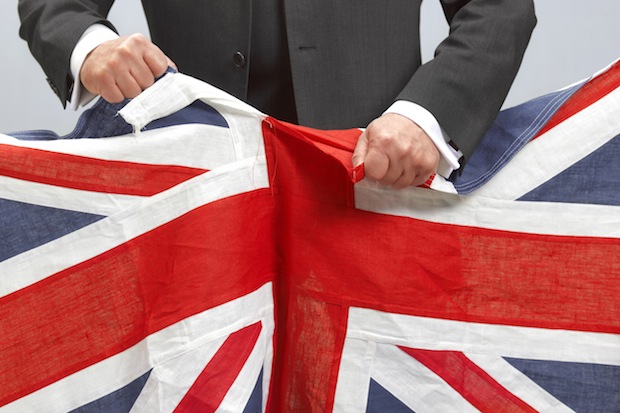
Farewell, United Kingdom


At times she seems to think herself a latter day Margaret Thatcher but Theresa May's legacy might be as the prime minister who destroyed the United Kingdom.

She's been pushing the European Union for a new deal to grease Britain's Brexit from the EU. That's earning May a lot of pushback, most recently from Angela Merkel who added her voice to the chorus saying there'll be no deal, no negotiations for a deal, before Britain is out.

Scottish leaders say if the UK is out of the EU, Scotland wants out of the UK and they're demanding a second referendum. May says no but her arguments are lame and likely to fuel the drive for Scottish independence.

Now the EU is sending another body blow to 10 Downing Street with an expected announcement that Europe mght allow a unified Ireland to join the EU after Brexit. Nice. Peel off Northern Ireland from the United Kingdom. With the Scots in the mood to say adios that would leave England and Wales, if May could persuade the Welsh to stay put. The Britain, formerly known as Great Britain, a once United Kingdom no more.

Sounds like the gloves are off.

Friday, July 17, 2015

It's Hard to Believe We Were That Stupid

Just as Europe undermined the EU so too did we undermine, potentially fatally, the North Atlantic Treaty Organization.  Both organizations foolishly indulged in a promiscuous bout of expansion that has left them unwieldy, incoherent and perhaps even dangerous.

This is EU Europe:


This is NATO:


Both began and operated quite well with a small, well integrated membership, capable of reliably cooperating to achieve clearly understood objectives.  And then they both got just a little whorish in the bacchanal that marked the collapse of the Soviet Union.

Oh my, look, there's one missing - the Duchy of Grand Fenwick.


How they got left out I'll never know.  I guess Bush and Cheney forgot about them in their race to march NATO to Russia's doorstep.

When it comes to NATO it might be a good idea to cull the membership herd, especially if we see the E.U. beginning to come part at the seams.  There are a lot of scary people and movements waiting in the wings to exploit that chaos and we might not find their table manners exactly pleasing.

Don't forget that Article 5 business, the "mutual aid" clause that says an attack on one NATO member is an attack on all.  There's no Article 5(b) that covers the situation where one NATO member attacks another.  Worse yet, there are some NATO aspirants that might like nothing better than to provoke a regional adversary (can you say Russia?) and then drag in the NATO muscle. Think Georgia. Think Ukraine.

NATO was built to face threats from without, namely the Soviet bloc.  It cobbled together nations of the Western European tradition on an implied assumption of shared values and principles. What a happy bunch of chaps - well, except for those uppity French.  DeGaulle, you know.

NATO picked up some dodgy characters in its rampage of expansion to the East. Take Hungary, which joined in 1999.  Sixty years earlier it joined another alliance, the Axis powers.  And today you wouldn't consider Hungary a particularly enthusiastic adherent to democracy.  Sort of like the little kid who's standing still in the corner of the pool.  You just know he's peeing.

It's like having more kids than you can possibly feed. When you get the urge to add a few more, don't.  And try to get the kids you do have educated and out the door as soon as you can.

Quick, put a call through to Grand Fenwick. I need to speak to the Duke.          

Thursday, July 16, 2015

The European Union Backstory. Greece Is the Least of Its Problems.


We may be on the verge of witnessing a ground shaking, dangerous and scary spectacle - the dismemberment of the European Union.  The recent events in Greece may have set some wheels in motion but Harvard professor of international relations, Stephen Walt, says the collapse of European unification traces much further back to five triggering events. He writes that no Western nation will emerge unscathed if it all falls apart.

As an economic unit, the EU has a combined GNP larger than that of the United States, considerable wealth, advanced industries, and significant military potential. The United States is formally allied with most of its members and has long benefited from cooperation with its fellow democracies there. Europe’s future course is therefore of considerable interest to the United States.

...Unfortunately, it is hard to be optimistic about the EU’s prospects today, especially its stated goal of an “ever closer union.” Despite its past achievements, the EU now suffers from growing tensions and several self-inflicted wounds. The EU is likely to experience repeated crises and internal divisions, and one cannot rule out a gradual and irreversible decline in its cohesion and influence. Because a prosperous and tranquil Europe is in America’s interest, this is not good news for the United States.

Today, the EU faces five fundamental challenges. None of them will be easy to overcome.

Problem No. 1: Overexpansion


The EU today is a victim of its past success. What began as a limited arrangement among six countries to coordinate coal and steel production has become an elaborate supranational organization of 28 members governed by a bewildering array of institutions and subsidiary agencies and hamstrung by the need to reach consensus before taking important decisions. At the same time, its members are still independent nation-states with their own governments and their own complicated internal political arrangements. America’s complex federal system is a model of simplicity by comparison.

Moreover, as the EU has expanded, its membership has become increasingly heterogeneous. Germany’s GDP is more than 300 times larger than Malta’s, and Luxembourg’s per capita income is nearly seven times higher than Latvia’s and five times higher than Greece’s. The geographic size, population, and economic resources of the member states are vastly different, and their respective cultures and national histories have become less similar as the EU has grown. Not surprisingly, expansion has made the EU more cumbersome, more divided, and less popular. In 2014, more than 70 percent of EU citizens surveyed believed their voices do not count in EU decision-making, and nearly two-thirds declared that the EU does not understand the needs of its citizens.


Gee, it sounds like the European Union fell victim to the same expansionist insanity that befell NATO.  Go figure.

Problem No. 2: The collapse of the Soviet empire

Although the disappearance of the Soviet Union was a welcome development, it removed one of the main motivations for European unity. The EU is often seen as a purely economic and political project, but security concerns were a key part of its rationale from the start. That rationale faded as NATO grew stronger, and it disappeared when the Warsaw Pact collapsed. The absence of an external danger encouraged European leaders to focus more on selfish national concerns and to see the EU as a way to limit and constrain German dominance. (That last goal, needless to say, has not worked out quite as well as they hoped.) Since the early 1990s, EU members have repeatedly pledged to develop a “common foreign and security policy,” but they have never succeeded in doing so. Today, the incoherent European response to events in Ukraine highlights the lack of consensus on basic security issues.

Problem No. 3: The euro crisis


The third problem facing the EU today, of course, is the euro crisis.

It is now clear that the decision to create the euro was an enormous blunder, as skeptics warned at the time. It was done for political rather than economic reasons: to renew momentum for unity, to bind a reunified Germany more tightly inside European institutions, and to put Europe on a more equal footing with the United States.

But as the euro’s critics emphasized early on, the EU lacked the political and institutional mechanisms needed to make a currency union work. Instead, the euro’s proponents simply assumed the common-currency members would never let themselves get into serious financial trouble, and if this happened anyway (as, of course, it did), they further assumed that it would be easy to create the institutions that the eurozone lacked.

...Even worse, the crisis has sown deeper divisions within the continent, with debtors and creditors exhibiting a level of resentment and hostility not seen for many years. Instead of demonstrating a powerful commitment to European unity, EU member states now try to get what they want by threatening to blow up the entire enterprise. Greece used the threat of Grexit to try to win concessions from its creditors, and France used much the same threat to force Germany to soften its demands (however slightly).

Next up: British Prime Minster David Cameron will use the threat of a referendum on the United Kingdom’s membership in the EU to extract some special deals from the other members. When different states keep threatening to exit in order to blackmail their supposed partners, it hardly conveys the “one for all, all for one” spirit that is supposed to inspire and justify the broader European project. Needless to say, this situation is not what the euro’s creators had in mind when they took that fateful step.

Problem No. 4: A deteriorating regional environment


The EU now faces serious turmoil on its periphery, with direct consequences for Europe itself. State failures in Libya, Syria, Yemen, and sub-Saharan Africa have produced a flood of refugees seeking to get in, while the emergence of al Qaeda, the Islamic State, and other extremist movements has had worrisome repercussions among some of Europe’s Muslim populations. The danger of homegrown or lone-wolf terrorism is often exaggerated, but it is not zero. And some Europeans now want to roll back the open internal borders that were a key achievement of the 1986 Single European Act. Meanwhile, the conflict in Ukraine raises new concerns about the security of the EU’s eastern frontier. The EU has been unable to agree on new measures to address any of these challenges, however, further underscoring its dysfunctional decision-making process.

Problem No. 5: The persistence of nationalism

The EU’s final challenge is the stubborn hold that nationalism exerts on the populations of the individual member states. The elites who launched the original European project hoped it would transcend existing national loyalties, but nationalism remains alive and well throughout the continent. Britain may vote to leave the EU next year (though I believe this is unlikely), Scottish nationalism may lead it to exit the United Kingdom, and nationalist sentiments continue to simmer in Catalonia and elsewhere.

Economic stagnation, high youth unemployment, and concerns about immigration have also fueled a resurgence of Euroskeptic nationalist parties that reject the core principles on which the EU is built. Add to this mix Europe’s unfavorable demography — its overall population is declining and the median age is rising rapidly — and you have a recipe for slow economic growth and growing dissatisfaction with mainstream parties and existing political institutions. If these trends eventually allow groups like the National Front in France to gain real power, support for an “ever closer union” will erode even further.


Professor Walt foresees just three possible outcomes to Europe's woes.  It could find a path to resolve these five threats but he doesn't think they've got the leadership to do it.

There are no European leaders today with the vision and stature of an Adenauer, de Gaulle, or Thatcher, and it would take years for serious reforms to work their way through the EU’s elaborate consensus-based governing machinery.

Instead of an “ever closer union,” therefore, the EU is more likely to simply muddle through. It will keep applying Band-Aids to contain the euro crisis and will hope that trade deals with the United States and China will provide an economic boost. In this scenario — which I regard as the most likely — the EU will stay in business, but robust growth will remain elusive, support for the union will decline, and Europe’s global influence will continue to wane.

But there is a third possibility: The EU experiment could start to unravel. A Greek exit from the eurozone would set a dangerous precedent, nationalist resentments could deepen, leaders with more authoritarian inclinations could come to power (as has already occurred in Hungary), and Greece could dissolve into widespread social unrest (or worse). Some European states might even look to Moscow for help (though they are unlikely to get much). If disintegration begins, the only question will be: How far and how fast will it go?


...To sum up: Since the end of World War II, stability and prosperity in Europe have been of enormous benefit to the United States. The European Union has been a key ingredient in a world order that has been highly favorable for America. If the EU’s best days are behind it, Americans will have to prepare for a world that is less stable, secure, and prosperous than the one to which they have become accustomed. We should hope this is not the case, but it is the most likely outcome given where Europe is today.

Guess Who's Coming to Dinner? No One, Angela, No One.


Is it the Euro or is it Angela Merkel - or both?  Whatever the case, Merkel's brutal subjugation of Greece has given the neighbours outside the Eurozone good cause to think twice about joining the common currency, the Euro.

Once, it was an exclusive club that nearly all of Europe aspired to join. Now, in the wake of Greece's latest financial crisis and the hard-line response from many of the Continent's powers, becoming a partner in the European common currency seems less and less appealing to many of the countries lined up for their chance.

From Poland to the Czech Republic to Hungary and points farther south and east, joining the euro is increasingly seen as rife with risks and costs - including a substantial surrender of sovereignty - that outweigh the benefits. And while many of the countries that have not yet adopted the single currency had doubts before the Greek crisis flared, the heavy penalties incurred by Athens to stay in the eurozone have made the trade-offs even clearer and the political leanings against membership more pronounced.

The qualms about partnership in the currency raise further questions about the ability of the European Union to maintain momentum toward its long-held and oft-stated goal of ever-closer union. More than any other policy, the single currency was intended to bind the members economically and politically while reducing the chances of conflict, and the decline in enthusiasm for the union has tracked a more general reassessment of European integration.

The doubts are now playing out primarily in the countries that most recently joined the European Union, primarily in Central and Eastern Europe. Lithuania became the 19th and newest adopter of the euro in January.

...Zoltan Pogatsa, a political economist at the University of West Hungary, said the greatest benefits to joining the eurozone came from undertaking the financial reforms required to become a member. Once that stability is achieved, he said, it may be wiser to keep the local currency and peg it to the euro, as Denmark and Sweden have done.

"This way, you preserve your option to devalue, and you do not fall under the technocratic dictatorship of austerity," he said.


Monday, July 06, 2015

Krugman - Europe Also Won in Yesterday's Greek Bailout Referendum

From my years practicing insolvency law, I was left stunned at the illogic in the demands that the creditors sought to impose on Greece.  The approach made no sense.  They demanded Greece accept a debt load it could never hope to pay off. They essentially wanted the Greek government to mortgage the very future of Greek youth, even those yet unborn.

It doesn't make any difference whether it's an individual, a corporation or a country - when it falls insolvent the best deal for creditors is always a workable deal and that means debt forgiveness, taking a haircut.  If Joe owes you a million dollars but he can only repay it at a hundred dollars a month, you have no more hope of recouping your money than Joe has of paying it.  Sometimes there is no deal.  Companies go under, their assets sold for pennies on the dollar of value. Countries can go in all sorts of predictable and unpredictable ways.

Nobel laureate economist Paul Krugman writes that yesterday's No vote in Greece was a win not only for the Greek people but also for Europe itself.


...Europe’s self-styled technocrats are like medieval doctors who insisted on bleeding their patients — and when their treatment made the patients sicker, demanded even more bleeding. A “yes” vote in Greece would have condemned the country to years more of suffering under policies that haven’t worked and in fact, given the arithmetic, can’t work: austerity probably shrinks the economy faster than it reduces debt, so that all the suffering serves no purpose. The landslide victory of the “no” side offers at least a chance for an escape from this trap.

...In advance of the referendum, the European Central Bank cut off their access to additional funds, helping to precipitate panic and force the government to impose a bank holiday and capital controls. The central bank now faces an awkward choice: if it resumes normal financing it will as much as admit that the previous freeze was political, but if it doesn’t it will effectively force Greece into introducing a new currency.

...In the failed negotiations that led up to Sunday’s referendum, the central sticking point was Greece’s demand for permanent debt relief, to remove the cloud hanging over its economy. The troika — the institutions representing creditor interests — refused, even though we now know that one member of the troika, the International Monetary Fund, had concluded independently that Greece’s debt cannot be paid. But will they reconsider now that the attempt to drive the governing leftist coalition from office has failed?


...Unless Greece receives really major debt relief, and possibly even then, leaving the euro offers the only plausible escape route from its endless economic nightmare.

And let’s be clear: if Greece ends up leaving the euro, it won’t mean that the Greeks are bad Europeans. Greece’s debt problem reflected irresponsible lending as well as irresponsible borrowing, and in any case the Greeks have paid for their government’s sins many times over. If they can’t make a go of Europe’s common currency, it’s because that common currency offers no respite for countries in trouble. The important thing now is to do whatever it takes to end the bleeding.


Monday, May 11, 2015

John Bull In a China Shop


What good is a majority if it lands you in a minefield?  Conservative prime minister David Cameron finds himself in that predicament after last week's elections handed him a very slim majority.

He's looking to slash about 12-billion quid from his country's welfare budget. His "red meat" backbench are spoiling for a tussle with the European Union.  And the other big winner, Scotland's SNP, will pose a constant threat of stripping the "United" from United Kingdom.

From the Washington Post:

After unexpected political charisma and cunning propelled him to another term as Britain’s prime minister, David Cameron will now need every ounce of those skills to avoid going down in history with an altogether different title: founding father of Little England.

A result that maintained the status quo at 10 Downing Street masked the dramatic transformations roiling Britain, ones that threaten to leave this country more isolated than at any time in its modern history.

Thursday’s election may become just the first in a trilogy of rapid-fire votes that set this island adrift from Europe, divide it in half along ancient lines of national identity and ultimately leave behind a rump state of ever-diminishing value to its American allies.

“Yesterday was V-E Day, when the United Kingdom was celebrating its finest hour. Seventy years later, it could be contemplating the beginning of its end in its current form,” said David Torrance, a British political analyst and author. “The next five years will be a twin debate about two unions — the European Union and the United Kingdom.”

The questions of whether Britain stays whole and whether it remains in Europe are deeply entangled, with the outcome of one expected to heavily influence the other.

Cameron has landed in a situation where it is going to be ridiculously easy to overplay his hand with disastrous results if he does.  If Britain divorces from Europe the Scots may tell Cameron he's going it alone.

Sunday, May 10, 2015

But What Did They Expect?

David Cameron is wasting no time hammering rightwing nails in Britain's coffin. He has served notice he'll be making the most of his slim majority win last week and the first thing to go will be Britain's Human Rights Act.

Just as Harper has Poillevre to do his slime work, Cameron has his own poindexter to axe the Human Rights Act, this guy, Michael Gove:

Backpheifengesicht anyone?

Cameron is also preparing his ransom note to the European Union.  His win has unleashed a backbench clamoring for a new deal with the EU whereby Britain could opt out of EU legislation as it saw fit.

It remains to be seen how far Cameron can go before he again ignites the fuze of Scottish independence.


Sunday, March 29, 2015

Why Syrzia Matters. It's About a Good Deal More than Austerity. It's About Salvaging Democracy.


Le Monde reminds all of us why Syrzia matters not just in Greece, but across Europe and even on our side of the North Atlantic.

The Greeks don’t need to have the meaning of the word “democracy” explained to them. Even so, they have been given countless lectures since voting in a leftwing government determined to end the austerity policies that have made their lives a misery for six years. The schoolmasterly reprimands have come from people who know what they are talking about: they are people who imposed treaties their electorates had voted against and reneged on campaign promises as soon as they came to power. They are now in a trial of strength with Syriza, which has been trying, against terrible odds, to stick to its promises and beliefs. That trial was all the tougher since those beliefs may spread thoughts of resistance to those hitherto resigned to powerlessness. This confrontation has been about more than just the fate of Greece: the future of European democracy is at stake.

...Though Syriza is isolated in the EU, hounded by its creditors and faced with capital flight, it is in fact trying to rehabilitate concepts that have become alien to democratic life, such as “sovereignty”, “dignity”, “pride” and “hope”. But how could it do so in a state of permanent financial crisis when it is forced to back down in each successive negotiation? And do so all the more painfully as the means designed to throttle the will of a restive populace were shown publicly, while the tormentors chuckled as they recounted the most recent confrontations.

...As its finance minister Yanis Varoufakis has made clear, Greece is “determined not to be treated like a debt colony that should suffer”. What is at stake goes beyond the right of a people to choose their destiny, even when a judge of democratic niceties as fine as German finance minister Wolfgang Schäuble reckons that they have “elected a government which is acting somewhat irresponsibly”. Because the question also concerns the possibility of a state extricating itself from destructive policies, rather than having to further toughen those policies each time they fail.

....
Greece’s economic collapse, which has now lasted six years, is comparable to the damage that four years of military destruction and foreign occupation inflicted on France in the first world war.  Which explains why Tsiprias's government gets enormous pupular support — even from the right — every time it refuses to prolong such a destructive policy, and why it is unwilling to survive “like a junkie waiting for his next fix”. But Syriza has few friends outside Greece. As in Agatha Christie’s Murder on the Orient Express, to investigate the potential killers of Greece’s hopes would mean interviewing every EU government, and the chief suspect would be Germany: the failed disciplinary strictures are German, and it intends to squeeze those — especially in Mediterranean countries — who refuse to endure them indefinitely. In Spain, Portugal and Ireland, the governments’ motive for the crime is more sordid. Their citizens would benefit if the iron fist of austerity stopped pounding them. But their governments are afraid, especially when they feel threatened by a domestic challenge from the left, that Greece will demonstrate that it is possible to refuse to follow “a well-marked path, a known path, a path that the markets and the institutions and all the European authorities know,” the path that French finance minister Michel Sapin claims must be “explored right to the end”. The prospect of Greece breaking free would show that all these governments were gravely mistaken to make their people suffer needlessly.

Everyone knows that getting Greece’s debt repaid would be like “extracting blood from a stone” (Paul Krugman, The New York Times, 29 January). So why isn’t it equally clear that Syriza’s economic strategy to finance urgent social expenditure through a determined fight against tax fraud could draw on a young, determined, popular, political force, originating in social movements and free of the compromises and corruption of the past? Even if not marked out, the path is discernible. The uncertain future brings to mind what the philosopher Simone Weil wrote about workers’ strikes in France in June 1936: “No one knows how things will turn out. There is reason to fear a range of disasters. ... But no fear can erase the joy of seeing those who have always had to bow their heads, by definition, standing up for themselves. ... Whatever may happen next, we will always have had this. For the first time, and forever, there will be other memories floating around these heavy machines than silence, coercion and submissiveness”. The Greeks’ struggle is universal. Our good wishes no longer suffice. The solidarity it deserves calls for action. Time is still, as always, running out.


Thursday, February 19, 2015

Will the E.U. Again Pull the Rug Out From Under Harper's Feet?

The European Union's FQD, fuel quality directive, was once seen as a bitumen killer.  It's intended to encourage the use of lower-carbon oil and to kill off the European market for tar sand oil.

It had been reported that the Canadian government persuaded the Euros to drop the regulation, opening Europe to Athabasca exports.  Now it seems the FQD isn't dead after all.

The EU’s most senior energy official confirmed that the fuel quality directive (FQD) to encourage greener road fuels will not be scrapped at the end of the decade, as had been thought.
Asked by the Guardian whether that meant the FQD would continue after 2020, the EU’s vice president for energy union, Maroš Šefčovič, said: “My first reaction is yes. We just have to adjust it to all the lessons learned from biofuels, and all the [other] lessons learned from the previous time.”

The FQD has been a platform for measures intended to price tar sands out of the European market – and for targets to provide 10% of Europe’s transport fuel from low carbon sources,mostly biofuels, by 2020.

Monday, September 01, 2014

Could America Break Its Own Bank on a Russian Anvil?


The sanctions being plastered on Russia by the US and her allies are already having a rebound effect, especially in Europe.  Russia is not only the major supplier of the natural gas the Europeans will need to get through this winter, it's also a key market for their exports.  In these matters the EU and US are in different boats.  Another key difference is that American sanctions are more heavily weighted on depriving Russia of access to credit - loans.

Here's the rub.  International finance is generally conducted in US dollars, the global reserve currency.  Throughout the post-WWII era that's been a huge advantage to the United States.  US monetary policy can be adjusted to suit America's international interests - think "quantitative easing".

If Russia finds its Western credit facilities cut off the question becomes if there's anyone else willing to meet Russia's loan needs.  China, perhaps?  This is the same China, Peoples Republic whereof, that has, from time to time, groused about the burden of having the US dollar as the world's reserve currency.

Asia Times' columnist, Pepe Escobar, thinks the US may be pushing its luck:

"Moscow, allied with the BRICS, is actively working to bypass the US dollar - which is the anchor of a parallel US war economy based on printing worthless pieces of green paper.  Progress is slow, but tangible' not only the BRICS but BRICS aspirants, the G-77, the Non-Aligned Movement (NAM), the whole Global South is absolutely fed up with the Empire of Chaos' non-stop bullying and want another paradigm in international relations.  The US counts on NATO - which it manipulates at will - and mad dog Israel; and perhaps the GCC, the Sunni petro-monarchies partners in the Gaza carnage, which can be bought/silenced with a slap on the wrist.

With just over $400-billion in Euro-Russian trade at stake, the Euros, already enduring economic and political crisis, have more to lose than the US from an overplayed hand.  As for Ukraine, its gas reserves are running on empty and winter is coming.  If Moscow and Beijing choose to work in concert we could be looking at a new world order not to America's liking.

Tuesday, February 28, 2012

Europe Remains "A Question of War and Peace"

Former German chancellor Helmut Kohl warns today's crop of European leaders not to forget the lessons of Europe's bloody past.

"The current discussion in Europe and the crisis in Greece mustn't lead us to lose sight of or even question or retreat from the goal of a united Europe," Kohl wrote in a guest commentary published in Germany's best-selling daily, Bild, on Tuesday. 

Kohl repeated his mantra that the euro was about nothing less than preventing war. That view, he argued, still applied despite the decades of peace Europe has enjoyed.
 
"The evil spirits of the past have by no means been banished, they can always return. That means: Europe remains a question of war and peace and the desire for peace remains the driving force behind European integration," wrote Kohl.

He made a swipe at the new generation of European leaders who, unlike him, were born after World War II.

"For those who didn't live through this themselves and who especially now in the crisis are asking what benefits Europe's unity brings, the answer despite the unprecedented European period of peace lasting more than 65 years and despite the problems and difficulties we must still overcome is: peace."

Kohl served as German Chancellor for 16 years, the longest term since Otto von Bismark.   He presided through the end of the Cold War and the reunification of East and West Germany.  Kohl lost a brother in WWII.  He was drafted in the final weeks of the war.

Saturday, October 16, 2010

EU Pressing for Arctic Deepwater Drilling Ban

European Union vice-president Diana Wallis says there'll be protesters marching the streets if the fragile Arctic environment isn't safeguarded.   Wallis claims there's been plenty of talk but no action and doesn't want the region's fate left entirely to the club of Arctic nations:


At a workshop under the aegis of NATO held at Cambridge University,  Wallis said she was bored by continuing talk rather than immediate action over wider participation in the Arctic Council.

"It's got to be widened out. If we don't do things then people will take to the streets to make sure something is done over climate change," she argued.

The Arctic Council is largely made up of nations with coastal regions surrounding the north pole, such as Russia, Norway and Greenland. The council is charged with protecting the environment.

It's hard to imagine what Wallis is worrying about. Surely you don't think Ottawa would sacrifice the Arctic environment for oil and gas riches, do you? Why just look at the wonderful job they've done in Athabasca.

In fact, Canada, the U.S. and Russia are just waiting to pounce on the resources of the Arctic. Let's face it kids, our Canada is now a classic petro-state and all this business about environmental safeguards is a bet you probably shouldn't take.