Wednesday, August 08, 2012

What Keeps the F-35 Airborne?

If you follow the international news on the F-35 it appears Lockheed has made it through the rough patch and now has the controversial warplane flying straight and level.

Although the F-35 is over budget (grossly), overdue and underperforming and remains beset by serious technical problems, the Pentagon and America's allies are still lining up to buy it.

Stealth, it seems, is all the rage.   It overcomes all the F-35's flaws in limited range, meagre payload, and sub-par speed, climb rate and maneuverability.   Yet even American defence planners admit the stealth advantage is a "perishable" technology that may be obsolete within just five years.   So, why pay such an enormous penalty premium out of tight defence budgets for a warplane that may be obsolete before it reaches your hangars?

What has made Britain, Norway, South Korea, Japan and Israel commit to the F-35 while even its short-term viability is clouded?   Why are the Canadian Forces so obsessed with getting the F-35?  By all indications, this is a political issue, one that trumps defence questions every time.

The Brits say that shelling out for the F-35 will strengthen military ties with the United States.   The same reasoning has been attributed to Canadian defence planners.   Everybody, it seems, wants to be America's military BFF and the F-35 is the price of admission.

Lockheed's F-35 programme has produced a sub-prime warplane that is simply too big to fail.  Lockheed Martin is America's largest defence contractor in a land where biggest is always best.  Lockheed took a body blow when the Obama White House axed the F-22 stealth fighter (the '35 is a light bomber, not a fighter) in mid-stream.   It is said to need big sales of the F-35 to stay healthy.  So the U.S. is calling in the markers, twisting arms when required, and turning the F-35 into one of those "you're either with us or against us" deals.

We live in a world today where the Emperor never has any clothes and nobody ever says a goddamned word about it.

Tuesday, August 07, 2012

Drought - America Isn't Alone

Russian wheatfield ravaged by locusts and drought

Another giant grain exporter, Russia, is also being hammered by drought leaving Brits fearful of major food price increases.

Farmers in Russia are being crippled by severe drought, which has caused a potentially devastating drop in the country's grain production.
Fears are mounting that the country, which exports the cheapest wheat, will impose an export ban, pushing up the price of food globally.
Russia is forecast to produce 75million tons of grain this year – a 30 per cent drop in the country’s usual yield.

Jack Watts, senior analyst at HGCA the Home-Grown Cereals Authority, said: ‘If there is a longer term period of higher prices then this may well end up with higher food prices.’ 

Speaking to Radio 4’s Farming Today programme today, he said: ‘Two years ago Russia had a blanket export ban in place very quickly.
‘In 2012 the market is very fearful of this happening, there is no confirmation or real denial an export ban is going to happen, but the market is nervous based on a repeat of what we saw in 2010.’
The former Soviet Union is one of the world's biggest producers of wheat, barley  and rye.

Will Drought Overtake Athabasca?

I'm not sure that Harper/Enbridge will get the Northern Gateway pipeline/tanker port up and running before climate change closes in on them.

The drought of 2012 is going to send a shockwave through world food prices well into next year and quite possibly beyond that.   The Third World already lives in a state of permanent food insecurity.   Many of these countries are also being hammered by the impacts of climate change, mainly droughts or floods or both.

The two emerging economic superpowers - India and China - are also facing serious water and food shortage threats.   Food insecurity could lead to chaos between the relatively poor and vulnerable masses and the very small affluent minority driving both nation's economic miracles.

If leading climate change scientists like James Hansen are right, we are already locked into global warming.   Until such time as we find a way to strip CO2 out of the atmosphere much faster than we emit the stuff, our world seems destined to get hotter and dryer.

Food insecurity destabilizes entire nations.   It was a principle cause of the Arab Spring that began in Tunisia when a food vendor set himself on fire in protest.

Globalized free trade, however, is utterly dependent on trade among stable governments across stable regions and continents.  Global warming presents a threat to the very international stability without which globalized free trade falters.

A severe and widespread food crisis next year could place a powerful spotlight on climate change and carbon emissions, particularly the higher-carbon fossil fuels such as Athabasca bitumen.   The large economies cannot afford to have entire regions of the world disrupted by political and social, potentially even military, upheaval.  It's just plain bad for business.

If climate scientists like Hansen are right and climate change has landed on our doorstep far sooner than they had expected, the future of fossil fuels, especially the dirtiest varieties, is very much up in the air.  

I suspect Steve Harper's urgency to get Athabasca developed as quickly as possible and its products transported to the world markets without delay reflects his awareness of the uncertain viability of bitumen and the possibility of a market collapse.

Was It Good for You Too?

An Aviation Week editor spent some time recently at Edwards Air Force Base filming an unmanned aerial vehicle (UAV) in flight.  His recording was disrupted by a severe sonic boom from an F-35 speeding through the Edwards high-speed corridor.   Notice the F-35 boom at the 7 second mark.  Then compare it to the boom of the F-16 chase plane at the 18 second mark.  Ouch!

There Are Ways to Fix It - Eventually


The struggle of the 21st century will be to reduce atmospheric carbon concentration to safe levels.   There's a fair chance it can be done, given time, commitment and vast resources.

One way to reduce carbon is to extract it from the air and mineralize it, that is turn it into a stable compound that can be safely buried.  We don't need a stunning technological breakthrough to get carbon out of the air.   Trees already do it very nicely.   A lot of trees.   But the trick is to then stabilize it by transforming the wood carbon into mineral carbon.   There's a word for it, biochar.

Trees are felled and the wood is essentially baked in kilns to transform it into dense charcoal.   The neat part is that heating the wood releases methane and other combustible gases that are cleanly burned to fuel the process.   The resulting biochar is then trucked away to be ploughed into farmland.   Why farmland?  Because biochar enriches the soil, makes it far more fertile and productive.   Marginal soil, in many cases, can be transformed into good quality, arable soil.

So, what's the hold up?   There is a time lag factor of two to four decades that the tree takes to grow to its maximum carbon intake point at which it can be felled and a new tree planted.

Then there's the economic factor.   Trees are typically given a resource value for wood or wood products.   Biochar, on a planet-saving scale, would have to be on a highly discounted value.   Somebody would have to make good the difference.   Which is where meaningful carbon pricing might come into play.   Tie carbon emissions to the effective cost of the equivalent in biochar, inclusive of all production, processing and administrative costs from planting to ploughing, and you could deter carbon emissions, stimulate the market for alternative energy and begin realistic and safe carbon sequestration.

Would this sort of thing sound the death knell for fossil fuels?  Some maybe, not all.   There will always be a need for some fossil fuels.   What it would bring to a grinding halt would be the production of and market for the most carbon-intensive fuels and, yes, I mean Tar Sands bitumen.   Yet surely that's a small price to pay for an opportunity, within just a few generations, to bring our climate back into balance.

A reforestation effort of this magnitude is truly mind-boggling.  It would be on the same scale as climate change itself - global.  It could even be more expensive than any endeavour mankind has ever undertaken.   Yet isn't that to be expected in a world running out of options - and time?

Monday, August 06, 2012

Water, Water, Where Exactly?

This image is an absolute eye-opener.   We think of Earth as the Blue Planet, literally covered in water - fresh, saltwater or frozen.   So, just how much water do we really have to go around?   This much:


This picture shows the size of a sphere that would contain all of Earth’s water in comparison to the size of the Earth. The blue sphere sitting on the United States, reaching from about Salt Lake City, Utah to Topeka, Kansas, has a diameter of about 860 miles (about 1,385 kilometers) , with a volume of about 332,500,000 cubic miles (1,386,000,000 cubic kilometers). The sphere includes all the water in the oceans, seas, ice caps, lakes and rivers as well as groundwater, atmospheric water, and even the water in you, your dog, and your tomato plant.

Ted Turner Talks Global Philanthropy - "Save Everything"


Billionaire Ted Turner is outspoken about the state of our Earth, and he puts his money where his mouth is on a scale that shames many affluent countries.   His message is plain, we can no longer ignore the future.   Living in the present is a formula for catastrophe:


We need to be planning for our children's future. We don't want to leave them in an impoverished world. People say, "We've got enough natural gas for 100 years." 100 years? That's nothing! What do we have for a thousand years? We won't have any fossil fuel at the current rate; we're not going to have any steel. We're running out of everything. We're like a rich kid who inherited his father's fortune and is running through it, buying yachts on the Mediterranean.

On Turner's creation of the U.N. Foundation:

I was ripped apart by the knowledge that the U.S. owed the U.N. a billion. I thought, 'Why don't I give them some money?' Nobody had ever given them a billion. I didn't know that until later. But the U.N. could not receive money from individuals or corporations. Did you know that? Nobody'd ever tried to give the U.N. money. So I thought "God doesn't want me to give away that billion!" (laughs) And I'd really worked hard for it! I was gonna buy CBS or something. I was going to do like all the other moguls do, just keep buying things. And what do you do when you buy them? You make more money and buy something else. I was doing that, I was buying a lot of things.
 I went to bed thinking I wasn't going to (make the donation). And I didn't feel good. Then I woke up in the middle of the night and thought, "Why don't I create a foundation that works alongside the U.N.?" If the Foundation did only Nothing But Nets it would be worthwhile. But it does so much more.
For example, the Girl Up program is extremely important. Half of the women in the world don't have equal rights with men, and there's no excuse for that any more. Women have been pushed around enough.

On our failure to address the pressing threats to civilization:

I also gave close to $600 million to the nuclear threat initiative and most of the environmental causes. I've got a new bumper sticker coming out. The old one said, "Save the Humans," you know, like "Save the Whale" or "Save the Wolf." This one says, "Save Everything."

Between our nuclear weapons and our overpopulation, we're headed for, if not extinction, then very close to it. We know better. We don't have any excuses.

On fighting the good fight even when the odds are awful:

If I'd been running CNN, it would have stayed more with international news coverage than it has today. It would have stuck with more serious news. Be damned with ratings! Biggest isn't always best. Best is what's best. That's a judgment, but judgment is what we have brains for. The thing that makes us human beings is our ability to judge. Otherwise we might as well be monkeys. When I was with Captain (Jacques) Cousteau many years ago on the Amazon, on the Calypso, it was just after Reagan called the Soviet Union "the Evil Empire." That discouraged me, because I had been working so hard to help bring the Cold War to an end, and I said, "Captain, at times like this, I get discouraged" and he said, "Ted, let me tell you something. Even if we knew for sure we were going to lose, which we don't -- what else would men of good conscience do, but do their best to the very end, keep fighting to the very end?" I said, "Sounds good to me, Captain!"A
nd every time I get discouraged, I remember that and I stand with the Captain. And that's why we're going to win. We're going to win because we can't afford to lose. And if we lose, we'll go down fighting. We can't lower the flag. We won't surrender.

A New Civilization for a New Epoch

Goodbye Holocene, hello Anthropocene.   The Holocene epoch of the past 12,000 years is said to be giving way to a new epoch, one in which man will be the key shaper, hence the name "Anthropo - cene."   The most significant feature of the new epoch will be a far harsher climate driven by anthropogenic or man-made global warming and we've only had a first taste of that lash.

The Earth will adapt to the new epoch.   Not every species of life, of course, but the planet itself will get by just fine.  It has endured extinction events several times before.

What's far less clear is the prognosis for man's greatest achievement, our civilization.   Just as we were making progress on spreading democracy, lifting the poorest out of poverty, improving access to safe freshwater and sanitation and other altruistic goals defining civilization at its best, our efforts are being overtaken by the ravages of global warming.

In the context of climate change there are also "have" and "have not" nations generally organized according to each country's equatorial proximity.   The nearer the country to the equator the more likely it is to be a have not nation.

The dwindling ranks of climate change skeptics scream ever louder to deny it but the consensus is holding and strengthening that global warming is real, is worsening and is mostly man-made due to post-Industrial Revolution CO2 emissions.   In essence, what has landed on our doorstops is primarily man-made and made by the men of the greatest "have" nations.   It is the fallout of the very processes that made them supermen.

But, while generations of supermen worked tirelessly to transform their nations, their societies into the best of the best, most of the most, they managed to export the scourge of their efforts into the atmosphere in the form of carbon dioxide emissions.   No need for ocean-going tugs and barge convoys when a simple smoke stack would suffice.

Today, perhaps more than ever, it's very much an "us versus them" world that strains the ties that hold together our civilization.   The "have" versus "have not" dichotomy is growing ever starker.  Here's an example.   The recent extreme drought that has swept the American breadbasket states will send a sharp spike in global food prices for at least a year or two.   Americans are being warned to expect a 3-4% overall increase in food costs.   For some Americans, the very poorest, that will be a hit but probably not life-threatening.   For most Americans the blow will be as bearable as a spike in gasoline prices.   But what about the peoples of the have not nations?

The have nots are already reeling from the droughts and floods brought to them by global warming.  They're already on the ropes.   Yet they too will have to meet the same food price increases as the peoples of the have countries.   If anything, they're more dependent on staple grains and legumes than the more advantaged and affluent sectors of civilization.  The UN Office of Humanitarian Affairs warns the poorest and most vulnerable will take the greatest hit from rising food prices.  For them it's a recurrent struggle with cumulative effects.

 As global grain prices begin to climb, the Sahel countries of West Africa, those in the Horn, and in central and southern Africa - many of which depend mainly on imported cereals to feed their people - are most exposed to the impact of more expensive food, said the UN Food and Agriculture Organization (FAO). Around the world plenty of people are already living with high food prices, and more will be joining them.

The international prices of cereals
began to rise to record levels in mid-June this year, when the implications of one of the worst droughts ever to hit the US, the world's largest producer of maize and soybeans, became breaking news and commodity markets reacted.

Soaring food prices in 2007/08 forced the poor to sell their assets, cut down their spending on quality food, education and health, leaving them more vulnerable to future shocks, said FAO.


And there, you see, lies the hook.   For several years these countries have experienced permanent food insecurity.   That's their starting line when something like the megadrought of 2012 comes along.   They've already had to flog their assets and slash their spending on decent food, education, health and just about anything else they could trim.   These people are literally standing at the abyss.  The "haves" have utterly transformed the meaning and consequences of  the "have not" status the vulnerable did almost nothing to deserve much less create.

One of the arguments favoured by the fascist Right in the U.S. and elsewhere is that global warming is a hoax designed to permit the transfer of vast, unearned wealth from the "haves" to the "have nots" of the world.  It is a "socialist plot," the establishment of the dreaded World Government.

We must not let the idea take hold that their suffering is, in significant part, the outcome of our prosperity.   Think I'm kidding?  Find a Western government - left, right or centrist - that has been willing to link the global warming consequences visited on the Third World with our own two centuries of industrialism.  It's a truth that must not be spoken.   The whispered mention of it by a head of state would open the floodgates to torrents of demands for compensation.

Perhaps that is what will define civilization for the anthropocene,  a general and probably violent retreat from our aspirations for inclusion, cohesion and mutual advancement into a world of narrow alliances and a brutal "every man for himself" decline.

  'Welcome to the Anthropocene' Earth Animation from Globaïa on Vimeo.

Sunday, August 05, 2012

A Glimpse of Enbridge Muscle

Enbridge Muscle in Michigan


This is what happens when you don't play ball with Enbridge.   You wind up with a couple of armed guards on your property - just in case.


Livingstone county farmer, Keith Huff, has an Enbridge problem.   He's in a right-of-way court dispute with the pipeline company.   Unbeknownst to Huff, Enbridge went to court to get a restraining order against Huff and sent a pair of gun-toting security goons on to his property, just in case.


[Huff] "maintains the company is trespassing because he has not reached a compensation settlement with Enbridge for access to his property.   He said he wants an appraisal done before workers step foot onto his property.


"Enbridge spokesman Joe Martucci says the guards were placed near Huff''s property as a precautionary measure to ensure Huff didn't interfere with the project's early work.


"He said the company doesn't believe Huff poses a physical threat."


Did you get that?   Enbridge doesn't believe Keith Huff poses any physical threat so they get a restraining order against the guy and park two armed guards on  his property.


America's Latest Drought Victim - the Mighty Mississippi


America's drought has forced traffic closures on the Mississippi River in Wisconsin and Arkansas and in Mississippi it's not even knee deep in places.

"It looks like a coastline out there," said Reynold Minsky, president of the 5th Louisiana Levee District board. "There are more beaches on the river than there are in Florida." 

The story is repeated along the length of the river.

 The Mississippi river is drying up and some shipping companies are worried that the drought of 1988 may be repeated, a time when the river dried up so much that barge traffic came to a standstill. In 1988 the shipping industry lost $1 billion, a number that would be far higher in 2012 and could be reached in as little as three days.

Almost all of the rivers 2,500 miles are experiencing some type of low water level. Just outside of Memphis the river is 13 feet below normal depth while the National Weather Service says Vicksburg, Mississippi is 20 feet below normal levels. Overall the Mississippi is 13 feet below normal averages for this time of year.

The drying up river is forcing barge, tugboat and towboat operators to navigate narrower and more shallow spots in the river, slowing their speeds as they pass dangerously close to one another. 

In some parts of the Mississippi the river is so narrow that one-way traffic is being utilized.

Because of the shallow water levels shippers have been forced to load less cargo which has left them with lower profit margins over fears that they would run into the rivers floor with heavier freight.

Industry analysts predict that closing down the Mississippi will cause losses up to $300 million per day and then grow exponentially over subsequent shutdown days. An idle tugboat alone costs nearly $10,000 to operate daily.

The Army Corps of Engineers is employing dredges to keep channels open to navigation.
 

Mitt Romney Has a Problem. Her Name is Rachel Maddow.

There aren't many American journalists today who can hold a candle to Rachel Maddow.   She's aggressive, fearless and relentless - perfect qualities for exposing a charlatan like Mitt Romney.

 
Visit NBCNews.com for breaking news, world news, and news about the economy

An Eye Into Christian Bigotry


Anyone looking for the ugly face of Christianity need look no further than Murfreesboro, Tennessee.   The Grace Baptist Church decided to respond to the construction of a mosque by erecting 13 crosses along the route Muslims will take to pray.  It's part of a wave of Islamophobia that has swept through the redneck town.


Grace Baptist moved into its current home of about 6,000 square feet two years ago and is currently served by Interim Pastor Dan Watts.

The mosque next door has been the subject of intense scrutiny and debate in the past two years, including vandalism to its sign, a bomb threat, arson to construction equipment on site and a lawsuit to block its construction. Plaintiffs unsuccessfully argued in court that Islam is not a religion but won one battle in which the judge agreed that insufficient notice was provided by the county government concerning a meeting over the mosque’s site plans, which is under appeal. Construction on the first phase of the building is nearing completion.

Even in today's America, where bigotry and racism have become acceptable in mainstream society, the Murfs are decidedly outspoken.

Until the new Islamic Center was approved in 2010, “I didn’t know that there were any Muslims in this community,” said Pete Doughtie, owner of the Rutherford Reader, a local free newspaper.

His thoughts on Muslims are summed up in the headline of a recent column: “They have nothing positive to add to America.”

“All it takes for those Islamic warriors is to get enough foothold in one area such as our government in order for them to feel they are on a roll,” he wrote. “Our schools are vulnerable and are sitting ducks right now.”

Currently one Muslim student at Central Magnet School in Murfreesboro is allowed to pray in an empty room during lunch, said James Evans, spokesman for Rutherford County Schools.

Doughtie said Muslim students should assimilate to Christian culture. Rather than allowing Muslim students to pray, he’d rather see all students take part in a Christian prayer each day at school.

“We have been a strong Christian country, and if we don’t get back to it, the whole face of this nation is going to change,” Doughtie said.

What's next?   Lynchings, cross burnings, fire bombings?


Time For Sober, Second Thought on Canada's Future


Several decades ago we cut out the middleman and settled down to an existence where "because I can" leads directly to "so I shall."   What has fallen into desuetude was what once existed between the two, contemplation.

It was the sticky, moral middle ground that had to go.   Within it lurked messy problems like posterity, meaning and purpose.

Take the Tar Sands for example.   Their development has followed the very linear path of because I can/so I shall.   Discussion of whether we should leave the stuff in the ground to await new technologies or to meet the needs of future generations are snuffed out like a discarded cigarette.  Posterity?   Hardly.   Alberta and Ottawa are treating the resource as though it belongs to them, today and future generations of Albertans and Canadians be buggered.  

Norway, which now sits atop one of the world's largest sovereign wealth funds, spent a good deal of highly productive time before passing from "can" to "shall."   That led them to understand and accept that the country's non-renewable petroleum reserves belonged to the country, both now and into the distant future.   Hence their oil wealth would not be taken into the treasury and doled out to the citizenry but instead would be kept separate, invested and preserved for future generations.

Norwegians, it seems, didn't get the message that, without those oil dollars, their country would be a backward,  impoverished place with a second-rate economy.   Canadians, by contrast, are continually fed that very story because it bolsters the "can/shall" dynamic.    On the world stage, we can't cut it without those bitumen royalties - or so the story goes - so shut up and keep digging.

Canada, we rank 35th in population, 88th by population density (of countries with more than 9-million people),  a very respectable second place in overall territory, and, by an enormous margin, number one in total coastline.   And yet, with all these advantages and our country's vast resources and highly educated population, we'd be second rate without bitumen?   Really?   Shouldn't we perhaps have a little contemplative discussion about that?  I know, maybe we should ask the Norwegians what they think of our bitumen boom and bust mentality.

Weaver Backs Hansen Research on Global Warming

For more than a quater century, NASA Space Laboratory director James Hansen has led the effort to warn the world about the fact of global warming.

Now, Hansen has created another stir across the world with the announcement of a research study based on data from the past six decades that he claims shows global warming is a scientific fact, no longer just a theory.   The peer reviewed study will be released this week but many have already read it online.

So, what to make of the Hansen study?   I don't know, do you?   Unless you're a climate scientist, you probably don't know either.   Fortunately there's a prominent Canadian climate scientist, Dr. Andrew Weaver from the University of Victoria, who has read the report and come to a pretty clear conclusion.

The science in Hansen's study is excellent "and reframes the question," said Andrew Weaver, a climate scientist at the University of Victoria.

"Rather than say, 'Is this because of climate change?' That's the wrong question. What you can say is, 'How likely is this to have occurred with the absence of global warming?' It's so extraordinarily unlikely that it has to be due to global warming," Weaver said.

I'll take Weaver's word for it.   Science is never a closed book but some things get so close to certain that we have to accept them as fact.   For the past decade or two we've gotten pretty close on global warming with climate models.   Hansen's research backs those models up with hard data, closing the door on denialists and their powerful benefactors.

Saturday, August 04, 2012

We Outlawed the Potlach for B.C. First Nations

But not for our unelected, unelectable and outgoing premier, Crispy Clark.   Her credit card statements for 2011/12 fiscal year just came in to the tune of $475K.

Madame premier wracked up a tab of $3,267.66 at Ferris Oyster Bar in Victoria and $2,279 at Bishops in Vancouver.   Her Rogers and Telus cell phone bills added a further $100,000.

To put this in some perspective, premier Crispy more than doubled the annual tab run up by her predecessor, Gordo "I only had a couple of beers, officer" Campbell.

Vancouver Under Climate Change Gun

Vancouverites and the region's masses of visitors might have to kiss Granville Island and other attractions goodbye.   Sea level rise is estimated to reach 80 cms. in Nanaimo on Vancouver Island and upwards of 120 cms. in the Lower Mainland's Fraser River estuary by 2100.

Sea level rise sounds far more benign than it is.   For those rising seas exact a number of impacts from salination of freshwater reserves to erosion and flooding, particularly through stronger storm surge events.

Andrew Yan, a planner and researcher with Bing Thom Architects, estimates the city will have to spend upwards of $510 million to build and upgrade the dikes and seawalls - plus billions more to buy the land to put them on - over the next century.
"What's under threat in Vancouver is a lot of our identity; our beaches, our seawall ... this is what makes Vancouver such a livable place," Yan said. "We just need to look at Granville Island and its exposure to sea level rise and what may be required to defend it."


Richmond’s Steveston, which has experienced huge residential growth along its waterfront in recent years, will face significant pressures in the future, Yan said, while south Surrey’s Crescent Beach is already being threatened by a more insidious force: increasing groundwater from rising ocean tides.

“It affects every municipality that touches the water,” Yan said.

“Sea level rise isn’t going to separate itself from the boundaries of Vancouver, Burnaby, Richmond or Surrey. We’d better be serious about this. It’s important to plan now as opposed to 50 or 70 years from now.”

...Deborah Harford, executive director of Simon Fraser University’s Adaptation to Climate Change Team, noted all of Metro Vancouver is ranked as at high risk for negative effects of climate change because it has so many people, so much infrastructure and so many assets at sea level. And with the region built on river deltas, she said, there’s also risk of the sea encroaching toward the area’s rivers, leading to “salt wedging” or salination of the region’s agricultural lands and the water supply.

These reports appear confined to basic sea level rise, of itself a Herculean challenge.   The problem for the Lower Mainland, however, is more complex yet.   A warming atmosphere is triggering early Spring melt of the local mountain snowpack which triggers flooding in the Fraser estuary river system where already low-lying communities are put at risk.  Rising seas will only back up that meltwater, adding to the flooding.  

And then there's the subsidence factor.   A lot of the communities of the Lower Mainland are already below sea level, the ocean held back by dykes.   Constructing homes and buildings is a complicated process of pre-loading where mountains of soil or sand are heaped in place to cause the spongy soil to compact enough that it will bear the weight of construction.   After a suitable interval the preload is trucked away and construction ensues.   However that never really ends the subsidence which slowly continues, increasing the amount the property is below sea level.   Rising sea levels mean burning the candle at both ends.   Adding snowpack meltwater flooding to that only worsens the situation.

And then, there's the Big One, the inevitable earthquake that's expected to rock coastal British Columbia some time between this afternoon and a century from now.

Two separate geological studies released this week suggest the earthquake hazard in the transboundary region of the Pacific Coast of North America — including southern British Columbia — is significantly greater than previously believed, with both teams of U.S. scientists urging heightened readiness throughout the region for a future offshore “megathrust” event that could compare with the one that triggered Japan’s earthquake-tsunami-nuclear catastrophe last year.

In one study, a 13-year, comprehensive analysis of the Cascadia earthquake-prone zone between Vancouver Island and Northern California, a team of researchers led by Oregon State University earth scientist Chris Goldfinger concluded that the “clock is ticking” ahead of a potentially devastating earthquake in the region within the next 50 years.

The second study, which appears in the latest issue of the journal Geology, interprets new fault-zone temperature data along the Pacific Coast to conclude that the probable impact area of the next megathrust quake in the region could extend as much as 55 kilometres farther east than previous studies have suggested — raising the spectre that coastal cities such as Vancouver, Victoria, Seattle and Portland would experience significantly greater-than-expected seismic impacts when the next “Big One” strikes.

“If one is closer to the rupture area of an earthquake, then the ground shaking will be more intense, all other things being equal,” study co-author Glenn Spinelli, a research scientist with the New Mexico Institute of Mining and Technology, told Postmedia News. “Therefore, if the rupture area of a Cascadia subduction zone earthquake is closer to land, then the shaking on land will be greater.”

And what happens when already boggy, below-sea-level lands are hit by a major earthquake?   This is what happens when the land beneath your feet - and your house - turns to porridge.


California Prepares to Meet Climate Change Head On

Reports released this week by the California Energy  Commission and the California Natural Resources Agency reveal adaptation measures the state will need to take to address climate change impacts and they're innovative.


State researchers foresee temperature increases of 2.7F over 2000 averages by 2050.   Note that's 2.7F higher than the state was averaging just 12-years ago.   The reports explore how California will be impacted - everything from agriculture and irrigation, habitat destruction and species extinction, urban living and energy risks and vulnerabilities.

Among the proposals are the creation of "migration corridors" to permit animal and plant species to escape uninhabitable regions and relocate to new locations capable of supporting them.   Some creatures, however, simply can't migrate.   Alpine species, for example, cannot survive when taken out of their colder environment so they will have to be trapped and transported for suitable relocation.

California will prepare for sea level rise by retreat from especially vulnerable parts of the coast.   This is something much easier done well in advance than only when immediately necessary.  It's a process that begins by prohibiting new development in areas that are to be subject to inundation.

The state is expected to create a network of "chilling stations" for urban populations to escape the impacts of heatwaves.   Identified as particularly high risk are poor neighbourhoods that have density, transportation and lack of tree cover stresses.   They point out the particular problems faced by inland cities.   Sacramento, for example, has historically had four 100F+ days per year.   That is predicted to increase to 25-days of extreme heating per year - heat that kills the young, the old and the infirm.

California, unlike your own province, is putting these challenges out in the open, loud and clear.   They're talking about what is coming and options for dealing with those dangers.

They're interesting reports, almost forty of them, and reviewing some of them is helpful if only to get you asking why your province isn't doing the same for its citizens.

James Hansen - I Was Wrong

Global warming guru and head of the NASA Goddard Space Laboratory, Dr. James Hansen, now says he got it wrong when in 1998 he testified to Congress about the future that climate change would bring to our planet.

"I was too optimistic.

My projections about increasing global temperature have been proved true. But I failed to fully explore how quickly that average rise would drive an increase in extreme weather.

In a new analysis of the past six decades of global temperatures, which will be published Monday, my colleagues and I have revealed a stunning increase in the frequency of extremely hot summers, with deeply troubling ramifications for not only our future but also for our present.

This is not a climate model or a prediction but actual observations of weather events and temperatures that have happened. Our analysis shows that it is no longer enough to say that global warming will increase the likelihood of extreme weather and to repeat the caveat that no individual weather event can be directly linked to climate change. To the contrary, our analysis shows that, for the extreme hot weather of the recent past, there is virtually no explanation other than climate change.

These weather events are not simply an example of what climate change could bring. They are caused by climate change. The odds that natural variability created these extremes are minuscule, vanishingly small. To count on those odds would be like quitting your job and playing the lottery every morning to pay the bills.

Twenty-four years ago, I introduced the concept of “climate dice” to help distinguish the long-term trend of climate change from the natural variability of day-to-day weather. Some summers are hot, some cool. Some winters brutal, some mild. That’s natural variability.

But as the climate warms, natural variability is altered, too. In a normal climate without global warming, two sides of the die would represent cooler-than-normal weather, two sides would be normal weather, and two sides would be warmer-than-normal weather. Rolling the die again and again, or season after season, you would get an equal variation of weather over time.

But loading the die with a warming climate changes the odds. You end up with only one side cooler than normal, one side average, and four sides warmer than normal. Even with climate change, you will occasionally see cooler-than-normal summers or a typically cold winter. Don’t let that fool you.

...The future is now. And it is hot."

Wednesday, August 01, 2012

Twenty Per Cent of Squat Is... What?

Mitt Romney is outraged that anyone would dare criticize the fairness of his across-the-board 20% tax cut proposal.    The criticism is that this would benefit very, very rich people a very, very great deal and poor or middle class Americans far less.   In fact the proposal was found to cause a net income penalty for most Americans.

The report by the centrist Tax Policy Center found that Romney's tax cuts would boost after-tax income by an average of 4.1 percent for those earning more than $1 million a year, while reducing by an average of 1.2 percent the after-tax income of individuals earning less than $200,000.

Oh Mitt, oh dear.   Meanwhile Robert Reich delivers a powerful look at what is really at stake in America's 2012 elections.

How Does Mitt Dig His Way Out of His Tax Hole?

Senate majority leader Harry Reid says he's heard that Mitt Romney didn't pay taxes for 10-years.  That, according to Reid, could well account for Romney's refusal to release his tax records.

The Twit is under pressure to show that he actually paid up.   It's easily enough done.   All Romney has to do is release his tax returns just like so many other pols, including Mitt's father, George, readily did.

What's Romney afraid of, that the public might find out he's rich?   Pretty much everyone already knows that.  If he's got clean tax returns releasing them would remove the spotlight and generate a rebound in Romney's poll numbers.   The longer he waits, the louder the chorus clamoring for his returns, the worse it looks for Mitt.

Then again, if these rumours are accurate, if Mitt is a chronic tax dodger, Mitt and the GOP have a monster of a problem on their hands.   Right now the pressure is coming from the White House and Congressional Democrats.   Before long the GOP might have to jump in as well.   This story has legs and unless the Romney camp can conjure up something to make it all go away - and soon - their guy may have to release his returns or fall on his sword.

Meanwhile, Robert Reich has this look at how Romney's money mill works and how it works against the American people.


South Asia's Water Woes

The twin cities of Islamabad, Pakistan's capital, and Rawlapindi are facing the prospect of running out of water.   Both cities rely on  the Khanpur Dam as their main source of water.   An extended heat wave and drought has left the Khanpur reservoir with just a 15-day supply remaining.   The Islamabad-Rawalpindi metropolitan area has a population of 4.5-million.  Protests are already breaking out in the capital.

Neighbouring India has a building water crisis of its own.   A weak and sporadic monsoon has left reservoirs dangerously low and, like Pakistan, threatens winter crops and drinking water.

"The situation is precarious because the monsoon has delivered normal rainfall to only one-third of the country. The total deficit so far this season is 22%, but rainfall has been 40% below average in key crop-growing areas in the north and northwest. India's 84 important reservoirs are filled only to 19% capacity, which is 41% lower than last year."

Let's Skip the 5th Generation F-35 and Put Our Money on the 6th Generation Option

The F-35 was a good idea that simply kept going downhill.   Lockheed was going to build the F-22 stealth fighter and the F-35 stealth light attack bomber.   But it was a sucker's bet on the longevity of stealth technology.  And we now know that Israeli and American defense planners have realized this stealth is a "perishable" technology with an effective life of just five to ten years into the future.  What will they call it after that?   The No-Longer Stealth Fighter?

Without stealth the F-35 is a dog.   Even the much superior F-22 has been proven vulnerable to the Eurofighter Typhoon in close-in air combat, the dogfight.

Maybe we should tell the Americans we'll take a pass on the F-35 and wait for the 6th generation aircraft they have under development.  Like the Americans, let's go drone.

In the States the Air Force and the Navy and several manufacturers are coming out with designs for unmanned combat aircraft.   The designs are remarkably similar and resemble the RQ-170 drone the Americans gifted to Iran just before Christmas.   Here's a picture of the Northrop-Grumman X-47B under development for the U.S. Navy.


With a wingspan of 62 feet, the X-47 is considerably bigger than the 45-foot wingspan of an F-18.  Boeing has a similar project, the X-45.   And, of course, Lockheed is also in on this.

Once we give up the delusion that the F-35 is a viable air combat fighter - and it's not - then it is realistic to compare the F-35 to drones as light strike bombers.   Like  the Americans, I'd bet on the drones.

Yes There Are Some Things That Should be Left In the Ground

Asbestos is one, that's a no-brainer.   We should not be exporting a product we prohibit from use at home.  There's no moral ambiguity there.

Bitumen is another.  With climate skeptic Professor Richard Muller's research so forcefully (and for him, surprisingly) confirming the reality of anthropogenic global warming, the consensus is overpowering and must be accepted.   The case is made for leaving the most environmentally degrading, carbon emissions intense, and dangerous fossil fuel in the ground.   Not forever.   Just for now.

For many years the governments of Alberta and Ottawa along with the Oil Patch have been assuring us that carbon capture and sequestration, CCS, is both technically and economically viable and just around the corner.   The idea is that the tar sands producers would capture the emissions from extraction and processing, and bury them safely and permanently underground.  We're still waiting.

An operational and effective CCS system would change the Tar Sands dynamic significantly.   With carbon capture and thorough upgrading or refining, Alberta bitumen could be transformed into something similar in emissions to conventional crude oil.   That wouldn't resolve the local and regional environmental hazards, such as tailing ponds, groundwater contamination and the constant threat to the world's third largest watershed, the McKenzie, but it would take a good bit of wind out of the sails of Athabasca's critics.   So where is it?   Why are we still waiting?

We're putting the cart before the horse on the Northern Gateway and Kinder Morgan pipeline/supertanker initiatives.  It's letting Alberta and Big Oil off the hook for their long-promised, never delivered environmental remediation.   If they won't make it happen now, why would anyone trust them to deliver afterward?

Let's face it.   The pipeline routes have been chosen because they're the most direct, the cheapest, not because they're the safest, the most easily monitored, the most accessible in the event of a pipeline failure.   They're the cheap and dirty option.   That's the one that Alberta and Ottawa and Enbridge, and the oil producers and the Chinese want rammed down British Columbia's throat.

And we know that there are no safe supertanker routes along British Columbia's rugged and treacherous coast.   We and the Americans recognized that a long time ago when we agreed that Alaska supertankers heading for the Lower 48 would stay well out to sea a safe distance from British Columbia waters.   Why would we think even larger tankers, Chinese owned and operated, would be safer than the American boats?

And then there's the thorny question all The Players want to duck, liability.   They know that Exxon got tagged for somewhere between four to six billion for the Exxon Valdez catastrophe.   And that was a ship much smaller than the tankers the players want to ply British Columbia's waters.   And the Valdez was laden with ordinary conventional crude.   Compared to a bitumen-laden supertanker tragedy, the Valdez was spilled milk.   The Players know it and they're not lining up to indemnify British Columbia for what is almost certain to befall us.   Those risks are way too high for them so they're ducking them through a variety of devices including shell companies and limited liability agreements.

What British Columbians are finally waking up to is the reality that these pipelines are about cutting corners, shaving costs, and ducking liability, all in the name of ever greater bitumen profits.  They're coming to realize that the greatest cost saving of all comes from not having to do the right thing and from offloading the liability on British Columbia.   That's treachery.

So go back to the drawing boards.   Get that CCS system up and running.   Take responsibility for transforming bitumen into the safest form of crude oil possible.   Then find the safest routes possible for your pipelines.   The safest, not the cheapest.   Point those pipelines to port facilities and coastal waters that are as safe as possible for tanker traffic.   The safest, not the cheapest.   And, if going the safest route is just too expensive for your already too expensive fossil fuel, that's tough.   Leave it in the ground.

The Consensus is Sound. We Have Much to Do.

The conversion of UC Berkley climate skeptic, Professor Richard Muller, to global warming believer has rocked the denialist community.  Muller's project took three years to prove the IPCC wrong and, instead, proved that the UN panel actually understated both the degree of warming and the role man made emissions played in causing it.   Muller actually concluded that virtually the entire 2.5F warming since pre-industrial days was man made.

Muller's conversion has even impacted Britian's most denialist newspaper, The Telegraph.  There, science writer and comment editor, Tom Chivers, writes there's really no justification for denying the powerful consensus of the science community.

As a non-climate scientist, I have to accept certain things on authority, as I do with all expert knowledge. This is an argument from authority, but we all do it, and it's vital: if I had cancer, I'd accept the authority of the oncologist and the body of knowledge of the oncology community, rather than try to guide my own treatment with information I'd found on the internet. As Ben Goldacre said long ago in a different context, you have only two options: "you can either learn to interpret data yourself and come to your own informed conclusions; or you decide who to trust".

I've decided who to trust, and it's mainstream scientific opinion: the Royal Society, the Royal Institution, Nasa, the US National Academy of Sciences, the US Geological Survey, the IPCC, the national science bodies of 30 or so other countries. And that gives me a possible route out of the confirmation-bias trap: I have, in advance, outsourced my judgment to expert bodies. If several of them changed their position, I would change mine. It's far from perfect, but short of becoming a climate scientist myself, it's the only option I have; otherwise my reasonable belief that the climate is changing due to human behaviour becomes an article of faith. As it is, although it is mediated through authority, it's still, I hope, based on empirical data, on the scientific method.

What I want to ask those sceptics who, like me, are not professional climate scientists is: what's your way out? You are as trapped by confirmation bias as I am. You will not be able to disinterestedly search through the torrents of information, false and true, on the internet and elsewhere: the more you look, the more you will confirm your own beliefs, because that's what we do. Since the design of the human mind makes you an unreliable judge, what evidence would it take to change your mind? Who, in short, do you trust?

Muller, as Chivers points out, still can't link his epiphany over the reality and extent of man-made global warming to specific climate change impacts sweeping the world but that's not his field.  Those findings are being researched and tested by others - biologists, botanists, hydrologists, epidemiologists, glaciologists, geologists, the list goes on and on and on.

I too accept the view of scientific authority, especially when the consensus is this widespread and powerful.   And, if you don't, you need to point to some other scientific authority that is somehow as significant or greater than that of the mainstream scientific opinion.    And you can't.   That doesn't exist.   Muller is the last straw.   This argument is over.  It is time to accept the consensus and benefit from it.   There is much, so much to do.

Tuesday, July 31, 2012

Enbridge Shut Out Again

Ottawa, Alberta and the rest of Canada want to ram Enbridge down British Columbia's throat as operator of the environmental calamity they call the Northern Gateway pipeline but the Americans aren't so indifferent.

Following Enbridge's latest pipeline failure, in Wisconsin, the U.S. transportation secretary has ruled Enbridge won't be allowed to restart the pipeline until it can prove it's safe.   In other words, what Enbridge says about the safety of that pipeline means diddly squat.

"Accidents like the one in Wisconsin are absolutely unacceptable," U.S. Transportation Secretary Ray LaHood said in a statement Tuesday.

"I will soon meet with Enbridge's leadership team and they will need to demonstrate why they should be allowed to continue to operate this Wisconsin pipeline without either a significant overhaul or a complete replacement."

This is, of course, the same outfit that the Alberta government, the federal government, and just about all the provincial governments other than British Columbia's argue should be allowed, without objection, to run a potentially catastrophic bitumen pipeline across remote and seisimically active British Columbia wilderness and out to Asia via supertanker traffic through insanely treacherous coastal waters.

Really.  Are you f--king serious?  This is precisely where the rubber meets the road.  This is where this nonsense ends.  Alberta is one thing but the way we see the rest of Canada and our bond to confederation will be directly impacted by the response of the other provinces.  If you allow us to be trampelled underfoot by the petro-pols in Alberta and Parliament Hill, our response will be utterly predictable.  Your choice.

They Bought Manhattan. They Bought Louisiana. They Bought Alasaka. Just a Thought.


What would the Americans give Canada for Alberta?  Let's say everything east of the Rockies to the Saskatchewan border and everything from the north end of the Athabasca tar fields down to the U.S. border.  Yep, Edmonton and Calgary are included in the package.   And if the Americans didn't offer enough, invite bids from the Chinese.   The Americans would pay anything to keep that from happening.

Look at it this way.   Albertans are far and away the closest bunch we have to Americans anywhere in Canada.   Overall they're rude and crude and oh so fond of conspicuous consumption.   They've got a bounty of bible thumpers and bigots (collectively known as the Reform Party).   Albertans seem tailor-made for FOX News and Rush Limbaugh.   Of course there are plenty of exceptions and they might want to relocate to stay in Canada but they could sell out to incoming Americans.

And America has had a greedy eye on the tar sands.   Why Dick Cheney eerily called them "ours."   All we'd be doing is formalizing the deal on a cash basis.   The U.S. could even put up one of those walls like they have along their Mexican border to keep Canadians out (and Albertans in).   We could even split the cost of something like that.

It would solve a lot of problems.   There'd be no pipelines to fuel Chinese communism, that's for sure.  The British Columbia interior and coast would be spared Alberta's depredations.   The Americans would finally have what they've longed for - real energy security, freedom from those damned Arabs.   And, quite frankly, I'd trust the American EPA to keep an eye on those tailing ponds and carbon emissions over the Alberta government's see no evil/speak no evil/hear no evil environmentalism any day.  It'd cure the Dutch Disease and allow our manufacturing base to recover under a realistically valued Loonie.

And Steve Harper might take that as his cue to di di mau back to Calgary to run for governor of the 51st State of the Union.

This is like win-win all around.  No?

Monday, July 30, 2012

Ex EnviroMin David Anderson - Northern Gateway Bad but Enbridge Even Worse

Former Liberal Environment Minister David Anderson has slammed both the Northern Gateway pipeline proposal and the would-be pipeline operator, Enbridge.    Anderson says the pipeline is not in Canada's best interests and the proposed operator, Enbridge,  is the least trustworthy company to get the job done.

Is It Too Late to Bring Back Herman Cain?

The Republicans are obviously stuck with the notion that it takes a business whiz to make a good president of the United States.   That's how they wound up with Mitt the Twit Romney as their presidential nominee.

But Mitt, or as Jeremy Clarkson calls him,"the American Borat," is proving to be anything but presidential.    In fact, he's an idiot in magic underwear.

Romney decided to showcase his presidential acumen by visiting Britain, Israel and Poland, three countries decidedly pro-American, and he screwed up at every turn.   He got the British prime minister pissed off with him, the Lord Mayor of London too.   Worse, by far, he got the main presenter of Top Gear,  Jeremy Clarkson, up in arms.

Then, fresh from that profound fiasco, it was off to Israel, where Romney again stepped squarely in it.  At a speech to select Jewish campaign donors, Romney declared Israel's relative success compared to the Palestinian's poverty and squalor was the historically inevitable result of a superior culture and providence.   Romney said that was why per capital GDP in Israel was a healthy $21,000 per annum contrasted with just $10,000 for the average Palestinian.   (the actual figures are $31,000 versus $1,500)   To Romney the fact that the Palestinian territories are occupied and repressed by Israel wasn't part of the equation.   Not surprisingly, Romney was criticized as a racist.

And then off to Poland where Romney met with Lech Walesa, who led the Solidarity movement that topped Polish Communism.   The Solidarity boys and girls, however, wanted no part of the Mormon Moron.

“Regretfully, we were informed by our friends from the American headquarters of (trade union federation) AFL-CIO, which represents more than 12 million employees … that Mitt Romney supported attacks on trade unions and employees’ rights,” Solidarity said in a statement.

Mitt Romney is a walking public relations disaster for the United States.   Like Sarah Palin, he hasn't bothered to study up for the job he's seeking.   And he can't help saying really stupid things, the sort that can leave scars.

But wait.   Remember that Godfather's Pizza guy, Herman Cain?   Is it too late to bring him back?

Megadrought the New Normal

It's here - to stay.   Let's call it "megadrought."  And what the States is getting now could be considered, "the wet end of a drier hydroclimate period."   From the oh-so corporatist Globe & Mail.

Anyone who weathered the stubborn dry spell that enveloped western North America from 2000 to 2004 knows it was harsh, but now a group of researchers has concluded it was the most severe drought in 800 years – bone-dry conditions that the scientists believe could become the “new norm” in this vital agricultural region.

“Projections indicate that drought events of this length and severity will be commonplace through the end of the 21st century,” the group of 10 scientists from several American universities and the University of British Columbia wrote in a study published Sunday in the journal Nature Geoscience.

If so, a “megadrought” that severely cuts crop production could be on the horizon, the scientists warn. Many farmers now in the throes of an extreme drought in the U.S. Midwest that is devastating corn and soybean crops and threatening to send food prices soaring might concur, although it’s not yet clear whether this dry spell is part of the broader trend, noted Beverly Law, a professor of global change biology at Oregon State University and a co-author of the study.

But climate change and megadrought are just part of the agricultural story.   There is also the one mighty Ogallala aquifer that underlies eight states of America's bread basket.   It has been the key to irrigation of crops, particularly water-intensive corn, for decades.   But it's drying up, pumped out.  With drought sweeping the region and the vital Ogallala nearly drained out, bountiful agriculture of the Great Plains is coming to an end.   This too is the new normal.

First Nations Fiercely Reject Northern Gateway

"We're here to stay. We'll do anything that we need to, to protect our land and sea."
                                               - Hieltsuk Chief Councilor Marilyn Slett


B.C.'s unelected, unelectable and outgoing premier, Christie Clark, may have bitumen dollar signs in her eyes but the province's First Nations, especially coastal bands, see the Northern Gateway much differently.   To them the bitumen pipeline/supertanker project cannot be allowed to happen.


"The Heiltsuk will never support this pipeline." Standing on the Bella Bella breakwater overlooking Lama Passage, Chief Councillor Marilyn Slett is calm but emphatic. No amount of reassurance or compensation, Slett says, will change her community's stance on the proposed Northern Gateway project.

People in this community of 1,500 say they have relied on the surrounding ocean passages since time before memory. Like many places in B.C., the coastal ecosystem provides Bella Bella with food, transportation, and jobs in fishing and tourism -- a way of life residents fear would be wiped out in an instant by a tanker spill.

The New York Times - America's Tar Sands Complicity

An  editorial in The New York Times, "Canada's Oil, the World's Carbon" stresses that the climate change impacts of Athabasca bitumen  trafficking must not be ignored.

"...the climate question must be addressed, if only to give a full accounting of the range of consequences of developing the tar sands, an effort in which the United States will be complicit if it allows the pipeline. That includes the effect of destroying 740,000 acres of boreal forest (a vital sink for greenhouse gases); the carbon dioxide and other greenhouse gases emitted in extracting the oil from the tar sands (a highly energy-intensive process); and the gases emitted by burning the oil.

The point was reinforced this month when 10 leading climate scientists sent a letter to Hillary Rodham Clinton asking the State Department to consider how helping to open Canada’s tar sands would affect the planet’s climate. “The vast volumes of carbon in the tar sands ensure that they will play an important role in whether or not climate change gets out of hand,” the letter said.
“Understanding the role this large-scale new pipeline will play in that process is clearly crucial.”

We hope, of course, that the State Department is rigorous in addressing all relevant questions: whether America needs this oil now or in the future; how many jobs the pipeline will actually provide. The department will also be asking about the danger of oil spills. But its report will be incomplete if it does not also consider what the oil flowing through the Keystone XL would spill into the skies — both now and in the future.

Eventually, Canadians will have to accept the link between bitumen trafficking and the climate change impacts that will drive genocide and mass killings elsewhere in the world.   Yes, it's Canada's oil, but that also becomes the world's carbon.   We, all of us, have to wear responsibility for exporting the filthiest fossil fuel on the planet.

Climate Change Will Drive Genocide

By 2030, more than half the world's population will live in areas under "severe water stress."

Unmet demand for food, water and energy, are now seen as reliable indicators of looming genocide or mass killing.

 “We must remain open to the possibility that the past is not necessarily a predictor of where and when mass atrocities will occur, or the means by which they will,” said Chris Kojm, chairman of the National Intelligence Council, a government agency, which will release its first estimate on the threat of genocide and mass killings later this year.

...In areas where there are disproportionate numbers of young men, Mr. Kojm said, the risk of genocide also rises. And, in much the same way that democracies are less likely to go to war than autocracies are, so too, participants said, are autocratically governed countries more likely to engage in genocide or other mass atrocities.

Climate change acts as a “multiplier of other resource crises,” according to Timothy Snyder, a professor of history at Yale University, causing uncertainty about resources, leading to “the ecological panic that I’m afraid will lead to mass killings in the decades to come,” Mr. Snyder told the symposium.

“We’ve entered into this moment of ecological panic,” he said. “Global warming will itself almost certainly directly cause mass killing, but it will likely indirectly cause it” as major states like China and the United States seek to feed their citizens, possibly touching off shortages elsewhere, in places that would then be at risk. China has already begun to act and, in a potential harbinger of future problems, has been investing in farmland in Ukraine and in parts of Africa for a few years.

 With the specter of mounting violence in some countries, the threat of future mass killings was a prime concern.

“The United States and our partners must act before the wood is stacked or the match is struck,”[Secretary of State Hillary] Clinton said, “because when the fire is at full blaze, our options for responding are considerably costlier and more difficult.”

The remarks were made at a conference of foreign policy experts in Washington/

Prosperity = Cultural Superiority, says Romney

As DailyKos puts it, Mitt Romney couldn't order a hamburger without insulting the ketchup and the mustard.

The Prince of Gaffe was at it again in Israel where he told an Israeli audience that the difference between their per capita GDP, $21,000, and that of Palestinians, a mere $10,000, reflected a "dramatically stark difference in economic vitality."

Romney went on to claim that economic history shows that "culture makes all the difference."

The Palestinians were a little miffed that Mitt the Twit didn't figure out that an entire population under occupation might not achieve its full potential quite as easily as its occupiers.   Or the fact that Israel, with its 8-million population, gets a boost from $2.4-billion in US aid annually.

DK wondered whether in light of his fanciful notions of cultural superiority, the American Borat will return home to explain to Republican red state citizens that it's the cultural superiority of the Democratic blue states that leave them so much better off.

Honestly, this guy can't help himself.   He is an utter buffoon and proves it just about everywhere he goes.  Romney stands for nothing, including his own record.   The guy just says whatever he thinks the crowd he's currently addressing wants to hear and when he can't figure that out, he tells them their trees are "just the right height."

Sunday, July 29, 2012

Ya Think?


Dick "go fuck yourself" Cheney says John McCain's decision in the 2008 campaign to pick Sarah Palin was his vice-presidential running mate was "a mistake."

“I like Governor Palin. I’ve met her. I know her. She – attractive candidate,” Cheney told ABC’s Jonathan Karl. “But based on her background, she’d only been governor for, what, two years. I don’t think she passed that test … of being ready to take over. And I think that was a mistake.”

The former vice president, in his first interview since a successful heart transplant, suggested that Palin’s selection wasn’t well-handled.

“The test to get on that small list has to be, ‘Is this person capable of being president of the United States?’” he said.

Really, Dick, ya think?   Guess what?   John McCain agrees.

Hey Canada, Do You Really Want to Talk?


Having a conversation with a bitumen booster is like talking to a climate change denier.  It's impossible to have a broad-reaching discussion, covering all the bases.   That's because the Tar Sanders have some bases they want to bypass.   They want to narrow the conversation to play into their greatest strengths and ignore everything else.   And are they ever great at playing loose with facts.

Right now they've taken advantage of the B.C. premier's blunders and transformed the Northern Gateway debate into an issue of shakedowns and the constitution.   That lets them avoid discussing what really matters to pipeline opponents, the merits and perils of piping bitumen, or rather dilbit, at all.

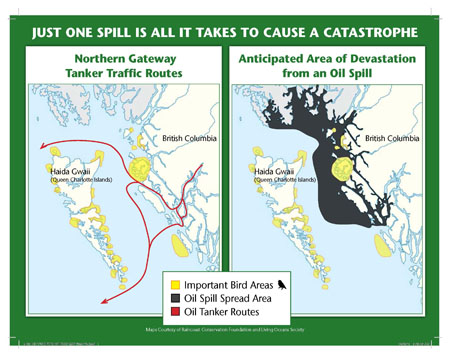
The safety and environmental issues are swept aside with a nod.   Sure, fair enough, end of discussion.    They agree that the environment must be safeguarded but they don't want to talk about the reality of that problem.   They don't want to get into how Harper has effectively stripped the B.C. coast of Fisheries and Coast Guard monitors and defenders.   They don't want to explore this supposed oil spill response fleet of vessels that has been assembled; how it can operate only in good weather and calm seas (a relative rarity in the north) and how long it takes to deploy; or how the technology deployed is intended to be used on conventional oil spills and won't work on a bitumen spill.   They don't want to explain how anyone is going to deal with a heavily-laden tanker that loses power or steerage in a Hecate Strait storm where waves can reach 30-meters in height.  They don't want to talk about the closest, ocean-going tugs capable of handling a laden, supertanker failure being based in Anacortes, Washington, three to four days sailing, in good conditions, to northern B.C. They don't want to get into the pipeline operator, Enbridge's sullied and extensive safety record.   They don't want to discuss the seismic and topographical challenges the pipeline would be subject to crossing the B.C. wilderness or the problems associated with cleanup of pipeline spills in that vast emptiness.   They don't want to refute what the Coast Guard types out here are saying, that a supertanker disaster in the Hecate Strait or Dixon Entrance isn't a matter of "if" but a matter of "when and how often."   They don't want to talk about what a bitumen spill would do to the seabed 600-feet down, what it would do to the local ecology or how there's no technology in existence or coming down the pike to do anything about it.   And they sure as hell don't want to talk about the liability cut-outs planned for the Chinese supertanker operators, for Enbridge, for Big Oil and for Alberta and Ottawa that will leave British Columbia on the hook.   Why if this is such a damned good thing for Canada, such a safe venture, have all the key players put in place means to escape liability when it all goes wrong?  If the tanker operators are afraid of it, and Enbridge is afraid of it, and the oil producers are afraid of it and Alberta and Ottawa are afraid of it, shouldn't British Columbians be allowed to ask why?

They claim to agree on environmental protection and then ignore the litany of environmental perils that underlie the bitumen pipelines.   They must be working straight from the old R.J. Reynolds playbook.

They want to pretend that British Columbia's opposition is all about shaking down Alberta.   The rest of the provinces may be content to line up behind Alberta and Ottawa and demand that B.C. lie down and play dead.   We need to talk - about all the issues listed above and more - but unless we can have a discussion on these and some straight answers, there's really nothing to talk about.

Saturday, July 28, 2012

The World Sees Romney Just a Bit Differently Today

It was supposed to be what one Guardian pundit called an "easy date."  He meant Mitt Romney's visit to Britain, about the friendliest foreign milieu an American presidential aspirant can hope to find.  But Mitt blew it.  He offended the prime minister, the mayor of London, MI6 and a good chuck of the British public.

Now "Mittens" has some new nicknames from his British visit.   He's "Mitt the Twit" or my favourite, from Top Gear's Jeremy Clarkson, "The American Borat."

Romney managed to best some of George W. Bush’s best “hey, did I do that?” moments during his visit when he first dissed the country’s Olympic preparations in an interview. He continued, doubting the country could pull together a proper Olympic brouhaha, and said the people might not “come together” to celebrate the games.

Then he revealed a supposedly secret meeting with Britain’s intelligence agency MI6 to press, further being a general doofus. Amid all the scrutiny, it came to light that Romney cast Britain in an unflattering light in his book No Apology: The Case for American Greatness – a bit of a riff on Mittens’ continued and erroneous assertion that the current POTUS likes to spend his free time apologizing for America in all corners of the globe, a fib that appeals to a certain segment of voters.
In the book, Romney sneers of England:
“England [sic] is just a small island. Its roads and houses are small. With few exceptions, it doesn’t make things that people in the rest of the world want to buy. And if it hadn’t been separated from the continent by water, it almost certainly would have been lost to Hitler’s ambitions. Yet only two lifetimes ago, Britain ruled the largest and wealthiest empire in the history of humankind. Britain controlled a quarter of the earth’s land and a quarter of the earth’s population.”
Clarkson's final tweet sort of said it all -  "Mitt Romney. Go fuck yourself. We are better than you."

If America is Israel's Best Friend, Why Does Israel Respond with Treachery?

The CIA deems Israel America's greatest counterintelligence threat in the Middle East.   This is America as in Israel's hands down greatest benefactor and defender.

The CIA considers Israel its No. 1 counterintelligence threat in the agency's Near East Division, the group that oversees spying across the Middle East, according to current and former officials. Counterintelligence is the art of protecting national secrets from spies. This means the CIA believes that U.S. national secrets are safer from other Middle Eastern governments than from Israel.
     
Israel employs highly sophisticated, professional spy services that rival American agencies in technical capability and recruiting human sources. Unlike Iran or Syria, for example, Israel as a steadfast U.S. ally enjoys access to the highest levels of the U.S. government in military and intelligence circles.

...Israel is not America's closest ally, at least when it comes to whom Washington trusts with the most sensitive national security information. That distinction belongs to a group of nations known informally as the "Five Eyes." Under that umbrella, the United States, Britain, Australia, Canada and New Zealand agree to share intelligence and not to spy on one another. Often, U.S. intelligence officers work directly alongside counterparts from these countries to handle highly classified information not shared with anyone else.
     
Israel is part of by a second-tier relationship known by another informal name, "Friends on Friends." It comes from the phrase "Friends don't spy on friends," and the arrangement dates back decades. But Israel's foreign intelligence service, the Mossad, and its FBI equivalent, the Shin Bet, both considered among the best in the world, have been suspected of recruiting U.S. officials and trying to steal American secrets.

...During the Bush administration, the CIA ranked some of the world's intelligence agencies in order of their willingness to help in the U.S.-led fight against terrorism. One former U.S. intelligence official who saw the completed list said Israel, which hadn't been directly targeted in attacks by al-Qaida, fell below Libya, which recently had agreed to abandon its nuclear weapons program.

...Some CIA officials still bristle over the disappearance of a Syrian scientist who during the Bush administration was the CIA's only spy inside Syria's military program to develop chemical and biological weapons. The scientist was providing the agency with extraordinary information about pathogens used in the program, former U.S. officials said about the previously unknown intelligence operation.

At the time, there was pressure to share information about weapons of mass destruction, and the CIA provided its intelligence to Israel. A former official with direct knowledge of the case said details about Syria's program were published in the media. Although the CIA never formally concluded that Israel was responsible, CIA officials complained to Israel about their belief that Israelis were leaking the information to pressure Syria to abandon the program. The Syrians pieced together who had access to the sensitive information and eventually identified the scientist as a traitor.

Before he disappeared and was presumed killed, the scientist told his CIA handler that Syrian Military Intelligence was focusing on him.