Saturday, April 18, 2020

What do Pandemics and Climate Breakdown Have in Common? They're a Lot Easier to Handle If You're Rich.


We know that, eventually, climate breakdown will exact a heavy toll on every country. However, like pandemics, the burden will be easier to bear for rich countries than for poor nations.

The rich have options that the poor do not.

A clear example of what that means, in terms of life and death, is the pandemic in Malawi, one of the poorest countries in Africa.

When the government ordered a pandemic lockdown it sent many of citizens into the streets in protest. On BBC this morning one of these protesters explained their predicament quite simply - what you manage to earn each day determines how much food you will have on the table for your family that evening.

It's the 21st century equivalent of hunter-gatherer economics. There is no social safety net. Sheltering in place can mean dying in place.
A Malawi high court has temporarily barred the government from implementing a 21-day lockdown to curb coronavirus following a petition by a human rights group.

Small-scale traders, often young people, had been staging protests in the three major cities against the planned lockdown, initially due to begin on Saturday, carrying placards declaring that it would be better to contract the virus than die of hunger because they are unable to work. 
Most of those protesting called on the government to provide them with cash and food handouts if a lockdown went ahead.
We see Covid-19 in the context of our own experience - locally, provincially, nationally. That is our reality. Others would give almost anything to endure our struggle.

We are going to see this rich-poor dichotomy play out again and again as humanity is battered by more pandemics and the looming impacts of climate breakdown.  Survival will be dictated in no small part by resilience, the ability to bounce back before the next punch lands.  Countries that are more resilient will fare better but they may become much less compassionate toward the have-nots.

It's a hell of a "reset" button.

Thursday, April 16, 2020

NYT - "The End of the World Economy As We Know It"


According to the Grey Lady, we're in for "a rethink of of how much any country wants to be reliant on any other country."

For years I thought it was obvious that the global economy could not possibly survive climate breakdown. The global chain with its vast supply lines depended on a high degree of stability in its participating nations. Droughts here, famine there, critical water and resource shortages along the chain would leave the nation links exposed to destabilizing forces that, as history shows, lead to chaos or worse.  Now, it seems, a viral pandemic may have accentuated the vulnerabilities of globalism.

The world economy is an infinitely complicated web of interconnections. We each have a series of direct economic relationships we can see: the stores we buy from, the employer that pays our salary, the bank that makes us a home loan. But once you get two or three levels out, it’s really impossible to know with any confidence how those connections work. 
And that, in turn, shows what is unnerving about the economic calamity accompanying the spread of the novel coronavirus.

In the years ahead, we will learn what happens when that web is torn apart, when millions of those links are destroyed all at once. And it opens the possibility of a global economy completely different from the one that has prevailed in recent decades. 
“As much as I hope we are able to get ordinary economic activity back up, that’s just the beginning of our problem,” said Adam Tooze, a historian at Columbia University and author of “Crashed,” a study of the extensive global ripple effects of the 2008 financial crisis. “This is a period of radical uncertainty, an order of magnitude greater than anything we’re used to.”
Crises have a way of bringing to the fore issues that are easy to ignore in good times.
One obvious candidate is globalization, in which companies can move production wherever it’s most efficient, people can hop on a plane and go nearly anywhere, and money can flow to wherever it will be put to its highest use. The idea of a world economy with the United States at its center was already falling apart, between the rise of China and America’s own turn toward nationalism.

There are signs that the Covid-19 crisis is exaggerating, and possibly cementing, those changes. 
“There will be a rethink of how much any country wants to be reliant on any other country,” said Elizabeth Economy, a senior fellow at the Council on Foreign Relations. “I don’t think fundamentally this is the end of globalization. But this does accelerate the type of thinking that has been going on in the Trump administration, that there are critical technologies, critical resources, reserve manufacturing capacity that we want here in the U.S. in case of crisis.”

How are "We" Holding Up?


It takes a bit of doing for the average Joe to keep abreast of developments in a multi-discipline area such as climate change. The fields are many, all linked by research that tests and defines the central thesis of this climate breakdown. It's so much more than a number of people in lab coats running around taking temperatures.

We're lucky that the scientific community is so well aware of the need to disseminate their research, pass along their knowledge, to the wider public in language that even the scientifically-illiterate (yeah, me) can understand, albeit sometimes with a bit of effort required. They know they're in a constant struggle with denialists and the segment of the population that simply doesn't want to know.

The climate breakdown is going to bring change to our lives. Some of it will be jarring. Some will require giving up ways that have, for generations, been familiar.  With every passing month we are sailing further and further into uncharted waters.

We've not been served well by our political caste. In many ways they have politicized what is a matter of science and transformed it into an issue where political considerations often prevail to the point where they obstruct progress.

Government doesn't transition easily from normal to emergency mode. Democratic government, we're told is the art of the possible. Governments make compromises while seeking to "do their best." Churchill taught us that there are times when the art of the possible must give way to a more directed approach when he said, "Sometimes it is not enough that we do our best. Sometimes we must do what is required."

Most governments are empowered to act in an emergency to "do what is required."  Canada has the "Emergencies Act" for this purpose. Yet governments, especially minority governments without a strong popular mandate, may be reluctant to use emergency powers, preferring to stay within the bounds of consensus.

Now we have another urgent but, by comparison, relatively modest crisis on our hands, a coronavirus.  Again what should primarily be a medical issue is dominated by political considerations such as the stock markets, the economy and, in the States, the looming November elections. How does what is in the best interests of the American people compete when vying against what is in the best interests of Donald J. Trump and his election fortunes?

There is another Achilles Heel common to both the viral pandemic and climate breakdown - fear. People are afraid, insecure. That makes them easy pickings for those who prey on their fears. Today that means the neo-nationalist Right.
In many ways, the pandemic fits most neatly into nationalist narratives: there are few more powerful or reactionary forces in politics than fear, and this is surely the pandemic’s most viral emotion. The outbreak of xenophobia accompanying the fear of infection has been well documented since coronavirus emerged. The disease was first portrayed as a distinctly “Chinese virus”, originating in Wuhan, and people perceived as Asian were subjected to racist attacks around the world. Yet there seems less acknowledgment that this divisive, hostile symptom of the outbreak will likely outlive the disease. In China, for example, where cases of infection have sharply declined, black people are being subjected to random testing and evicted from their homes over anxieties about “imported coronavirus”. Everywhere you look, as Susan Sontag observed in Aids and Its Metaphors, there is the same need “to make a dreaded disease foreign”.

The link between “germophobia” and xenophobia is a recurring theme in politics. The left has not been immune from this trope. In 1958, for example, when tuberculosis was the disease-du-jour, the Trades Union Council warned the Ministry of Labour against Indian and Pakistani immigration, drawing on classic xenophobic anxieties. Key among their concerns were “the poor health of these immigrants and the belief that many of them are carriers of contagious and infectious diseases”. 
But a wealth of research suggests that not only is the fear of infection more pronounced on the right, but also – more worryingly – that political attitudes become more conservative and reactionary as fears of infection rise. Indeed, one of the primary causes of “germophobia” is living in cultures that stress hygienic practices (for good reason, that accounts for much of the world right now).
... 
The grim frequency with which dirt and disease are associated with “dangerous” outsiders speaks to the emotional force of this narrative. From portraying minorities as “vermin” to casting concerns about immigration as concerns about public health, the political expedience of this conflation has been affirmed again and again. According to a recently published working paper, the Republican party’s weaponisation of the Ebola crisis in 2014 – stoking paranoia and blaming immigration – played an important role in their resounding victory in that year’s midterm elections.

None of this bodes well for our situation, where the fear of infection is already being mobilised to reactionary ends in countries such as Hungary, India, Israel and Algeria. “We are fighting a two-front war,” Hungarian prime minister Viktor Orbán declared last month, shortly before imposing coronavirus laws that amount to a de facto dictatorship. “One front is called migration and the other one belongs to the coronavirus. There is a logical connection between the two as both spread with movement.”
Canada, it seems lucked out, by having a Conservative opposition in disarray with a placeholder leader who inspires almost no one, within his party and without. The most powerful Tory, Jason Kenney, is sidelined, presiding over an economy in flames.

I sense from those I speak with a certain feeling of having been "sucker punched" by the Covid-19 contagion. People seem to feel they were caught unawares, ill-prepared, and now society is reeling, the economy shuttered, communities locked down. It is, in a way, a bit like being under house arrest. We don't know how this is going to play out. We don't know if anyone close to us will die. It might be us. Who can tell? The Sword of Damocles...


Wednesday, April 15, 2020

The Great Unraveling. Could the Climate Crisis Be the Ultimate Victim of Covid-19?


We've always known it would take a Herculean effort and an enormous amount of luck to forge the global consensus needed to tackle climate breakdown.  In a dangerously overcrowded world with dwindling resources, the "haves" aren't falling over each other to make room for the "have nots." We're not even willing to give up our obsessive but ultimately futile pursuit of perpetual exponential growth (GDP), an attitude that pretty much puts sharing out of the question.

James Temple writes in the MIT Technology Review that there's an emerging witches brew of pandemic, nationalism and a much greater threat, climate breakdown.

Temple sees the last UN climate summit as the writing on the wall when the axis of nationalism joined forces to thwart any meaningful action on climate change. It was a harbinger of a new "every man for himself" world in which the weakest and most vulnerable will just have to fend for themselves.

There’s plenty of blame to go around. But by most accounts, Australia, Brazil, and the US—each now run by nationalist leaders who rose to power in part on promises to defy global demands for greater climate action—took special pains to thwart progress.

Brazil immediately backed out of hosting the convention after the election of Jair Bolsonaro, and its delegates spent their time in Madrid arguing for the need to open up the Amazon for farming and mining. The US, on track to exit the accords altogether under President Donald Trump, stonewalled efforts to establish a process for providing funding and support to poor nations hit by climate disasters. 
In the end, nearly every major decision at COP25 was punted to the next conference, originally scheduled for this November in Glasgow.
... 
The Paris accords [2015] had lifted hopes that after decades of dithering, the world might finally pull together to confront climate change. Nearly every nation signed on, each agreeing to take specific steps to rein in emissions. But what if, in retrospect, Paris was not the start of an era of cooperation, but its high point?

As the covid-19 outbreak rages across the world, it’s easy to forget about the climate crisis. The priorities right now are, and should be, slowing the pandemic, saving lives, and then restarting economies left in shambles. But by that point few countries are likely to be able or especially eager to sacrifice near-term growth to help slow global warming.
... 
So the threat of rapidly accelerating climate change will remain. And we’ll be living in a much poorer world, with fewer job opportunities, less money to invest in cleaner systems, and deeper fears about our health, our financial futures, and other lurking dangers.
Temple contends that coal-power is making a big comeback in China that, like many other nations, is undermining the trust essential to establish a global collaboration to thwart climate change.
China’s investments in renewables fell 8% last year to the lowest level since 2013, according to BloombergNEF, even as the world total slightly increased. Moreover, it’s kicked off a new building boom in coal plants: nearly 150 gigawatts’ worth are under construction or likely to be revived, roughly the capacity of the EU’s entire fleet, according to a report late last year by Global Energy Monitor
China may pump money into some clean energy sectors through economic stimulus efforts in the coming months, but there are few reasons to suspect it will back off its reliance on cheap coal or accelerate its timetable for cutting climate pollution in the foreseeable future.
“I think the rise of nationalism, in the US and elsewhere, has created a degree of economic uncertainty that has strengthened the hardliners and forced them to rethink the degree to which they can rely on green energy to power their future,” Jonah Nahm [John Hopkins] says.
Could climate breakdown fuel a new nationalist order?
As the historian Nils Gilman argued in February in a persuasive essay, “The Coming Avocado Politics,” there are good reasons to worry that rising anxieties over environmental emergencies will justify a more hard-line set of solutions on the right, an “ecologically justified neo-fascism” that includes militarizing borders, hoarding resources, and bolstering national protections against climate change.
It could lead us into far darker places as well, potentially justifying “neo-imperialist” responses “where we actively seek to repress the development and ambitions of the rest of the world,” Gilman says. Specifically, the US or other nations could turn to extreme methods, from eliminating development financing to deploying military force, to prevent the carbon bombs that would go off if billions of poor people start consuming goods, services, and energy at the same levels as Americans.

As the virus spreads and the economic downturn deepens, people will, rightfully, focus primarily on the immediate dangers: their health and that of friends and family; the likelihood of losing work; and the plunge in their retirement savings and home values. Enhancing global cooperation and combating distant climate dangers just aren’t going to take priority for some time.

Tuesday, April 14, 2020

Obama: America Can't Afford to Lose This One.

Barack Obama's endorsement of Joe Biden wrapped up in a call to action.

The Long Haul. We're Only Getting Started.


The impetus, even among relatively progressive governors, to find ways to re-open the economy, carries the blended scent of necessity and desperation. Life must go on even at the cost of life itself.

The sense I have of what they're contemplating is a system of abrupt starts and stops. Get people back to work but, if the virus comes storming back, it's everybody sheltering in place again. On-off-on-off-on again.

A new research paper warns we'll be needing measures such as social-distancing well into 2022.
The paper, published in the journal Science, concludes that a one-time lockdown will not be sufficient to bring the pandemic under control and that secondary peaks could be larger than the current one without continued restrictions. 
One scenario predicted a resurgence could occur as far in the future as 2025 in the absence of a vaccine or effective treatment. 
Marc Lipsitch, a professor of epidemiology at Harvard and co-author of the study, said: “Infections spread when there are two things: infected people and susceptible people. Unless there is some enormously larger amount of herd immunity than we’re aware of … the majority of the population is still susceptible.
“Predicting the end of the pandemic in the summer [of 2020] is not consistent with what we know about the spread of infections.”
What emerges from this paper and others like it is that our future hinges on the timely development of an effective vaccine and the challenge of vaccinating the population globally.

Has anyone heard what the anti-vaxxers have to say about this?

Monday, April 13, 2020

A Virus That Stalks Humanity


There's a lot of talk these days about lifting the Covid-19 quarantine. The governors of New York and five other east coast states have formed a working group on lifting some restrictions. The governors of California, Oregon and Washington have their own task force looking at the same things.

Spain, that was so hard hit, is trying to ease the population back to work.

Does all this sound a bit too much, too soon? The World Health Organization thinks this early-onset optimism could backfire.  Until we get the global population properly vaccinated, the WHO says Covid-19 will continue to stalk us.
An official with the World Health Organization cautioned that the coronavirus is likely not seasonal but will rather continue sporadically until researchers are able to make a vaccine.

The WHO's special envoy, Dr. David Nabarro, made the remarks during a Sunday appearance on NBC’s Meet the Press. 
“We’re not so sure that it will come in waves in the way that influenza does,” Nabarro explained. “We think it's going to be a virus that stalks the human race for quite a long to come until we can all have a vaccine that will protect us. And that there will be small outbreaks that will emerge sporadically, and they will break through our defenses. 
“So, the key for this particular virus is that every community, as a kind of defensive shield, can pick up cases as soon as they appear, isolate them, and stop outbreaks from developing,” he continued. “It's going to be necessary for every single country to have that capacity.”
Meanwhile, The Guardian's Simon Jenkins writes that, at a policy level, we're all flying blind.
The trickle is starting. Spain, Austria, Italy, China, possibly Germany and the US will this week begin, however hesitantly, the great return to work. As others hold back and some may even toughen lockdowns, the result will be the most extraordinary mass experiment in history. 
The outcome should go some way to settle the central argument of coronavirus policy, of lockdown and suppression v mitigation and herd immunity. It will also condition a later political blame game, who was right and who was wrong. 
In this experiment, only one thing should matter: the evidence. It is the lack of it that has clearly determined the wide diversity in policy responses in different countries. We see a potentially fatal disease, Covid-19, of unusual infectiousness. Yet we have no idea how infectious, because lack of testing means we cannot tell if vast numbers of people have it to some degree, or just a few. The science disagrees. We have no idea if fatality is the outcome for 5% of victims, or 1%, or 0.3% – and therefore how drastic should be the response.
Statistics are in chaos. Death “rates” lag behind deaths. Deaths are confused with “hospital deaths”. Headlines highlight “most cases per nation” or “most deaths per nation”, not deaths per million. Yet we are at the mercy of these statistics. They are the raw material of the modellers, and their models are the sacred entrails into which policymakers peer each day, to see what level of lockdown to impose on their people.
Herd immunity? The only way societies are protected by herd immunity is when a substantial percentage of the population has immunity either through previous exposure to the disease or vaccination. That's it, A or B. The B option, a universal vaccine, is months, perhaps a year or more away. Then there's option A, previous exposure. No one knows if a bout of Covid-19 confers immunity on the survivors. There are anecdotal reports of individuals contracting the virus twice. But, even if Covid-19 does confer immunity on those it fails to kill, the percentage of those who have contracted the virus, in the US it's one in several hundred, falls far short of the substantial percentage needed to create effective herd immunity.
Economics has taken a terrible battering this last month, because it is thought to put “money before lives”. But all options cost lives, which is why political judgment has moved to centre stage. Businesses are ruined, dreams shattered, people die. As in the conundrum of the swerving driver, do you avoid one death now, but is it at the cost of five down the road? 
The cliche is true. Only time will tell, but that time starts now. The task is to scrutinise the evidence and let it tell the truth, not just the truth we want it to tell.

Sunday, April 12, 2020

Did Canada Drop the Ball on Covid-19?


The obvious answer is "yes," the federal government's response to the Covid-19 pandemic was a litany of quarter- or half-measures, missed opportunities that  allowed the virus to win the early rounds. Time and again "the economy" defeated the public interest.

A critical care physician from Edmonton, Dr. Raiyan Chowdhury, told CBC that Canada dropped the ball.
Chowdhury said the government took too long to realize how significant the issue was and took too long to call out the severity of the problem. 
"I always feel like we're behind the curve," he said in an interview. 
Chowdhury concedes that hindsight is 20-20 and it's easier to see mistakes in retrospect, but he points to a list of other countries — South Korea, Singapore, Taiwan and New Zealand — that have fared relatively well to show that other governments, with the same evidence in hand, were quicker to react and did so more decisively.
"Like everything when it comes to this pandemic, it's the people and leaders who moved early that made the difference," Chowdhury said. 
In January, Canada's chief public health officer, Dr. Theresa Tam, said there would be cases of COVID-19, but "it's going to be rare." 
All through January and well into February, Health Minister Patty Hajdu and other federal ministers reassured Canadians that the risk of getting the coronavirus in Canada was low, even after the first few cases popped up in the country. 
Considering how fast the virus was spreading throughout China and into Europe, that surprised many in the medical and scientific community who were watching. 
"How fast can an epidemic spread? The answer used to be as fast as the fastest horse can run or the fastest boat can sail," Dr. Marcus Powlowski, a physician and Liberal MP who sits on the parliamentary health committee, said in an interview. "Now diseases spread as fast as the fastest plane can travel. That hasn't been emphasized enough."
The government balked at closing our borders.
"The long-term implications of shutting down borders is they're not very effective at controlling disease. In fact, they're not very effective at all," Hajdu said on Feb.17.

Multiple studies have shown that borders don't stop viruses, but stricter controls can slow them down by days or even weeks. Since the goal was delaying the virus and buying time, Chowdhury said not restricting entry into Canada early on was one of the government's biggest missed opportunities. 
A month after Hajdu's statement, Ottawa closed the border to all foreign nationals and to non-essential travel from the U.S. Chowdhury said that was weeks too late.
A toothless effort to isolate/quarantine arrivals.
"People coming from high-risk regions need to be quarantined," said Dr. Ashish Jha, a professor of global health at Harvard University and the director of the Harvard Global Health Institute. 
But it took until March 25 —14 days after the WHO declared COVID-19 a pandemic — for the government to do that, invoking the Quarantine Act, making it mandatory under the threat of fines up to $750,000 and even jail time.
Tam's bad calls.
"Is it possible that an asymptomatic person could transmit the virus? Even if it is possible, we believe it is a rare event," Tam said at the parliamentary health committee at the end of January. 
The first report of asymptomatic transmission — out of Germany — was at the end of January. Yet it wasn't until the end of March, that Tam acknowledged the growing body of evidence. 
Even so, it didn't immediately change Tam's view on things like whether the general public should wear masks to slow the spread of the virus. Even at the end of March, she was insisting that it was not beneficial for an asymptomatic person to wear a mask. 
Jha, of Harvard, said that was a misstep. 
"We have known for at least a good month to six weeks that asymptomatic transmission is real and it happens," he said. "Even when you're just breathing or talking, you can be spreading the virus through droplets and that is what makes the case for masks much more compelling." 
In early April, Tam said non-medical masks can help lower the risk of spreading the disease to others even if you don't feel ill.
Missed opportunities, some that come with a terminal price.
Despite assurances in January that there was a healthy federal stockpile of equipment that could be used as a backup to any shortfalls by the provinces, Canada is now scrambling to produce millions of items as it competes in the global race for much-needed supplies. 
Provinces are still struggling to test people for the virus in larger numbers and to obtain faster results. They are a long way off from being able to test asymptomatic people, and then isolate those who test positive, something Jha said will be key to easing restrictions and getting back to normal. 
Of course, Canada is not alone in having missed opportunities. 
"The world essentially diverged into two main strategies," said Jha, explaining that one strategy — the more successful one — was to do early and aggressive testing and isolation. 
"Almost none of the Western democracies did that. They have really just all kind of bungled their way through this."
It's become standard fare for politicians, taken by surprise by events, to absolve themselves by saying that "no one saw this coming," the adult version of "the dog ate my homework." Harper did it when Canada got rolled by the Great Recession of 2007-2008. Harper did it again when Calgary suffered successive "once in a century" floods just 8 years apart.

Justin Trudeau failed Canada and it's small comfort to realize we probably would have been worse off if Scheer's Tories were in power. And Trudeau actually looks pretty good compared to America's unhinged president. That, however, misses the point.

We need to recalibrate our priorities. We can't allow "the economy" to defeat the public interest. We must accept that it's not enough to declare an emergency and then revert to business as usual. You cannot declare a climate emergency one day and, less than 24 hours later, greenlight a massive new bitumen pipeline.   When an emergency looms, that is your priority. Everything else is secondary.

To quote Churchill, "Sometimes it is not enough that we do our best. Sometimes we must do what is required." Right now we need leaders who understand that.

Saturday, April 11, 2020

There's Nothing I Can Say.

This woman, a young nurse, went to New York, the American Covid-19 epicenter. I have nothing worthy to say.

A Glimmer of Hope


At various centres around the world research is underway to find a vaccine capable of combatting the Covid-19 pandemic.

A paper released by the University of Pittsburgh school of medicine claims a promising vaccine could neutralize the virus.
The paper appeared today in EBioMedicine, which is published by The Lancet, and is the first study to be published after critique from fellow scientists at outside institutions that describes a candidate vaccine for COVID-19. The researchers were able to act quickly because they had already laid the groundwork during earlier coronavirus epidemics. 
"We had previous experience on SARS-CoV in 2003 and MERS-CoV in 2014. These two viruses, which are closely related to SARS-CoV-2, teach us that a particular protein, called a spike protein, is important for inducing immunity against the virus. We knew exactly where to fight this new virus," said co-senior author Andrea Gambotto, M.D., associate professor of surgery at the Pitt School of Medicine. "That's why it's important to fund vaccine research. You never know where the next pandemic will come from." 
"Our ability to rapidly develop this vaccine was a result of scientists with expertise in diverse areas of research working together with a common goal," said co-senior author Louis Falo, M.D., Ph.D., professor and chair of dermatology at Pitt's School of Medicine and UPMC. 
Compared to the experimental mRNA vaccine candidate that just entered clinical trials, the vaccine described in this paper -- which the authors are calling PittCoVacc, short for Pittsburgh Coronavirus Vaccine -- follows a more established approach, using lab-made pieces of viral protein to build immunity. It's the same way the current flu shots work. 
The researchers also used a novel approach to deliver the drug, called a microneedle array, to increase potency. This array is a fingertip-sized patch of 400 tiny needles that delivers the spike protein pieces into the skin, where the immune reaction is strongest. The patch goes on like a Band-Aid and then the needles -- which are made entirely of sugar and the protein pieces -- simply dissolve into the skin.
Keep your fingers crossed.

Thursday, April 09, 2020

For Everyone Who Thinks Our Leaders are Being So Heroic. You're Wrong.

We've got ordinary people that decades of neoliberals have consigned to the precariat, the "Gig Economy," who now put their lives on the line for us every day and not from a podium distance away either. They're our heroes. Your job - your only job - Mr. prime minister, is to make damned sure we're not back in this mess or something far worse five years from now in such a vulnerable state.

We don't have the time to keep screwing around. These people are going to work, getting sick, some even dying - for us. Shouldn't we start respecting the chance they're giving us, their courage?


Magical Thinking and Dark Conspiracies in the Age of Pandemic


You don't have to look very far these days before you'll spot someone who is, to put it crudely, "batshit crazy." These are lunatics who see "dark forces" hatching sinister plots to enslave us and have their way with our daughters.

Magical thinking, like religious fundamentalism, can mark a dominant nation in the throes of decline. Once a society, or a substantial segment of a population, takes its leave of reality, that usually means hard times ahead.

Consider this 2017 article from The Atlantic,  from the book"How America Went Haywire" by Kurt Andersen.

We have passed through the looking glass and down the rabbit hole. America has mutated into Fantasyland.

How widespread is this promiscuous devotion to the untrue? How many Americans now inhabit alternate realities? Any given survey of beliefs is only a sketch of what people in general really think. But reams of survey research from the past 20 years reveal a rough, useful census of American credulity and delusion. By my reckoning, the solidly reality-based are a minority, maybe a third of us but almost certainly fewer than half. Only a third of us, for instance, don’t believe that the tale of creation in Genesis is the word of God. Only a third strongly disbelieve in telepathy and ghosts. Two-thirds of Americans believe that “angels and demons are active in the world.” More than half say they’re absolutely certain heaven exists, and just as many are sure of the existence of a personal God—not a vague force or universal spirit or higher power, but some guy. A third of us believe not only that global warming is no big deal but that it’s a hoax perpetrated by scientists, the government, and journalists. A third believe that our earliest ancestors were humans just like us; that the government has, in league with the pharmaceutical industry, hidden evidence of natural cancer cures; that extraterrestrials have visited or are visiting Earth. Almost a quarter believe that vaccines cause autism, and that Donald Trump won the popular vote in 2016. A quarter believe that our previous president maybe or definitely was (or is?) the anti-Christ. According to a survey by Public Policy Polling, 15 percent believe that the “media or the government adds secret mind-controlling technology to television broadcast signals,” and another 15 percent think that’s possible. A quarter of Americans believe in witches. Remarkably, the same fraction, or maybe less, believes that the Bible consists mainly of legends and fables—the same proportion that believes U.S. officials were complicit in the 9/11 attacks.
Why are we like this? 
The short answer is because we’re Americans—because being American means we can believe anything we want; that our beliefs are equal or superior to anyone else’s, experts be damned. Once people commit to that approach, the world turns inside out, and no cause-and-effect connection is fixed. The credible becomes incredible and the incredible credible.
The word mainstream has recently become a pejorative, shorthand for bias, lies, oppression by the elites. Yet the institutions and forces that once kept us from indulging the flagrantly untrue or absurd—media, academia, government, corporate America, professional associations, respectable opinion in the aggregate—have enabled and encouraged every species of fantasy over the past few decades. 
...The great unbalancing and descent into full Fantasyland was the product of two momentous changes. The first was a profound shift in thinking that swelled up in the ’60s; since then, Americans have had a new rule written into their mental operating systems: Do your own thing, find your own reality, it’s all relative. 
The second change was the onset of the new era of information. Digital technology empowers real-seeming fictions of the ideological and religious and scientific kinds. Among the web’s 1 billion sites, believers in anything and everything can find thousands of fellow fantasists, with collages of facts and “facts” to support them. Before the internet, crackpots were mostly isolated, and surely had a harder time remaining convinced of their alternate realities. Now their devoutly believed opinions are all over the airwaves and the web, just like actual news. Now all of the fantasies look real.
...For most of the 20th century, national news media had felt obliged to pursue and present some rough approximation of the truth rather than to promote a truth, let alone fictions. With the elimination of the Fairness Doctrine, a new American laissez-faire had been officially declared. If lots more incorrect and preposterous assertions circulated in our mass media, that was a price of freedom. If splenetic commentators could now, as never before, keep believers perpetually riled up and feeling the excitement of being in a mob, so be it. 
Limbaugh’s virtuosic three hours of daily talk started bringing a sociopolitical alternate reality to a huge national audience. Instead of relying on an occasional magazine or newsletter to confirm your gnarly view of the world, now you had talk radio drilling it into your head for hours every day. As Limbaugh’s show took off, in 1992 the producer Roger Ailes created a syndicated TV show around him. Four years later, when NBC hired someone else to launch a cable news channel, Ailes, who had been working at NBC, quit and created one with Rupert Murdoch. 
Fox News brought the Limbaughvian talk-radio version of the world to national TV, offering viewers an unending and immersive propaganda experience of a kind that had never existed before. 
...Before the web, cockamamy ideas and outright falsehoods could not spread nearly as fast or as widely, so it was much easier for reason and reasonableness to prevail. Before the web, institutionalizing any one alternate reality required the long, hard work of hundreds of full-time militants. In the digital age, however, every tribe and fiefdom and principality and region of Fantasyland—every screwball with a computer and an internet connection—suddenly had an unprecedented way to instruct and rile up and mobilize believers, and to recruit more. False beliefs were rendered both more real-seeming and more contagious, creating a kind of fantasy cascade in which millions of bedoozled Americans surfed and swam. 
...Before the web, it really wasn’t easy to stumble across false or crazy information convincingly passing itself off as true. Today, however, as the Syracuse University professor Michael Barkun saw back in 2003 in A Culture of Conspiracy, “such subject-specific areas as crank science, conspiracist politics, and occultism are not isolated from one another,” but rather they are interconnected. Someone seeking information on UFOs, for example, can quickly find material on antigravity, free energy, Atlantis studies, alternative cancer cures, and conspiracy. 
The consequence of such mingling is that an individual who enters the communications system pursuing one interest soon becomes aware of stigmatized material on a broad range of subjects. As a result, those who come across one form of stigmatized knowledge will learn of others, in connections that imply that stigmatized knowledge is a unified domain, an alternative worldview, rather than a collection of unrelated ideas.
...People on the left are by no means all scrupulously reasonable. Many give themselves over to the appealingly dubious and the untrue. But fantastical politics have become highly asymmetrical. Starting in the 1990s, America’s unhinged right became much larger and more influential than its unhinged left. There is no real left-wing equivalent of Sean Hannity, let alone Alex Jones. Moreover, the far right now has unprecedented political power; it controls much of the U.S. government. 
Why did the grown-ups and designated drivers on the political left manage to remain basically in charge of their followers, while the reality-based right lost out to fantasy-prone true believers? 
One reason, I think, is religion. The GOP is now quite explicitly Christian. The party is the American coalition of white Christians, papering over doctrinal and class differences—and now led, weirdly, by one of the least religious presidents ever. If more and more of a political party’s members hold more and more extreme and extravagantly supernatural beliefs, doesn’t it make sense that the party will be more and more open to make-believe in its politics?
...Karl Rove was stone-cold cynical, the Wizard of Oz’s evil twin coming out from behind the curtain for a candid chat shortly before he won a second term for George W. Bush, about how “judicious study of discernible reality [is] … not the way the world really works anymore.” These leaders were rational people who understood that a large fraction of citizens don’t bother with rationality when they vote, that a lot of voters resent the judicious study of discernible reality. Keeping those people angry and frightened won them elections. 
But over the past few decades, a lot of the rabble they roused came to believe all the untruths. “The problem is that Republicans have purposefully torn down the validating institutions,” the political journalist Josh Barro, a Republican until 2016, wrote last year. “They have convinced voters that the media cannot be trusted; they have gotten them used to ignoring inconvenient facts about policy; and they have abolished standards of discourse.” The party’s ideological center of gravity swerved way to the right of Rove and all the Bushes, finally knocking them and their clubmates aside. What had been the party’s fantastical fringe became its middle. Reasonable Republicanism was replaced by absolutism: no new taxes, virtually no regulation, abolish the EPA and the IRS and the Federal Reserve.
...I’m reminded of one of H. L. Mencken’s dispatches from the Scopes “monkey trial” in 1925. “Civilized” Tennesseans, he wrote, “had known for years what was going on in the hills. They knew what the country preachers were preaching—what degraded nonsense was being rammed and hammered into yokel skulls. But they were afraid to go out against the imposture while it was in the making.” What the contemporary right has done is worse, because it was deliberate and national, and it has had more-profound consequences.
...I really can imagine, for the first time in my life, that America has permanently tipped into irreversible decline, heading deeper into Fantasyland. I wonder whether it’s only America’s destiny, exceptional as ever, to unravel in this way. Or maybe we’re just early adopters, the canaries in the global mine, and Canada and Denmark and Japan and China and all the rest will eventually follow us down our tunnel. Why should modern civilization’s great principles—democracy, freedom, tolerance—guarantee great outcomes?
...If we’re splitting into two different cultures, we in reality-based America—whether the blue part or the smaller red part—must try to keep our zone as large and robust and attractive as possible for ourselves and for future generations. We need to firmly commit to Moynihan’s aphorism about opinions versus facts. We must call out the dangerously untrue and unreal. A grassroots movement against one kind of cultural squishiness has taken off and lately reshaped our national politics—the opposition to political correctness. I envision a comparable struggle that insists on distinguishing between the factually true and the blatantly false. 
It will require a struggle to make America reality-based again. Fight the good fight in your private life. You needn’t get into an argument with the stranger at Chipotle who claims that George Soros and Uber are plotting to make his muscle car illegal—but do not give acquaintances and friends and family members free passes. If you have children or grandchildren, teach them to distinguish between true and untrue as fiercely as you do between right and wrong and between wise and foolish.

Wednesday, April 08, 2020

No, It's Not an Evil Plot by the Deep State to Destroy Democracy


It's a hoax. It's a plot to plunge us into feudalism. It's an act of bio-terror. Conspiracy theorists are having a field day spinning their nonsense thanks to the Covid-19 pandemic.

BBC Future has a look at what makes otherwise intelligent people believe, and circulate, myths about the coronavirus.
At worst, the ideas themselves are harmful... But even seemingly innocuous ideas could lure you and others into a false sense of security, discouraging you from adhering to government guidelines, and eroding trust in health officials and organisations. 
There’s evidence these ideas are sticking. One poll by YouGov and the Economist in March 2020 found 13% of Americans believed the Covid-19 crisis was a hoax, for example, while a whopping 49% believed the epidemic might be man-made. And while you might hope that greater brainpower or education would help us to tell fact from fiction, it is easy to find examples of many educated people falling for this false information.
Part of the problem arises from the nature of the messages themselves. 
We are bombarded with information all day, every day, and we therefore often rely on our intuition to decide whether something is accurate. As BBC Future has described in the past, purveyors of fake news can make their message feel “truthy” through a few simple tricks, which discourages us from applying our critical thinking skills – such as checking the veracity of its source. As the authors of one paper put it: “When thoughts flow smoothly, people nod along.” 
Eryn Newman at Australian National University, for instance, has shown that the simple presence of an image alongside a statement increases our trust in its accuracy – even if it is only tangentially related to the claim. A generic image of a virus accompanying some claim about a new treatment, say, may offer no proof of the statement itself, but it helps us visualise the general scenario. We take that “processing fluency” as a sign that the claim is true.

For similar reasons, misinformation will include descriptive language or vivid personal stories. It will also feature just enough familiar facts or figures – such as mentioning the name of a recognised medical body – to make the lie within feel convincing, allowing it to tether itself to our previous knowledge.

Even the simple repetition of a statement – whether the same text, or over multiple messages – can increase the “truthiness” by increasing feelings of familiarity, which we mistake for factual accuracy. So, the more often we see something in our news feed, the more likely we are to think that it’s true – even if we were originally sceptical.
These tricks have long been known by propagandists and peddlers of misinformation, but today’s social media may exaggerate our gullible tendencies. Recent evidence shows that many people reflexively share content without even thinking about its accuracy.
Classic psychological research shows that some people are naturally better at overriding their reflexive responses than others. This finding may help us understand why some people are more susceptible to fake news than others. 
Researchers like [University of Regina, psychology researcher, Gordon]Pennycook use a tool called the “cognitive reflection test” or CRT to measure this tendency. CRT questions are not so much a test of raw intelligence, as a test of someone’s tendency to employ their intelligence by thinking things through in a deliberative, analytical fashion, rather than going with your initial intuitions. The people who don’t do this are often called “cognitive misers” by psychologists, since they may be in possession of substantial mental reserves, but they don’t “spend” them. 
Cognitive miserliness renders us susceptible to many cognitive biases, and it also seems to change the way we consume information (and misinformation).
...Matthew Stanley, at Duke University in Durham, North Carolina, has reported a similar pattern in people’s susceptibility to the coronavirus hoax theories. Remember that around 13% of US citizens believed this theory, which could potentially discourage hygiene and social distancing. “Thirteen percent seems like plenty to make this [virus] go around very quickly,” Stanley says. 
Testing participants soon after the original YouGov/Economist poll was conducted, he found that people who scored worse on the CRT were significantly more susceptible to these flawed arguments. 
These cognitive misers were also less likely to report having changed their behaviour to stop the disease from spreading – such as handwashing and social distancing.
...There is no panacea. Like our attempts to contain the virus itself, we are going to need a multi-pronged approach to fight the dissemination of dangerous and potentially life-threatening misinformation. 
And as the crisis deepens, it will be everyone’s responsibility to stem that spread.

Wexit? WhatsIt?


Well that didn't last long, did it? Seems the 'Bertans have lost their wild-eyed enthusiasm for liberating their province from the oppressive Canadian state. Now those damned eastern bloodsuckers don't seem so bad at all.
COVID-19 is serving as a powerful reminder of how much we depend on each other and how much we’ll need to keep doing that as we emerge from its shadow. For most of us, this growing sense of social and national solidarity is a good thing. 
But for Alberta’s separatist movement, it’s a major setback. That’s because, just as there are no atheists in foxholes, there won’t be many people who believe they’re better off on their own after this pandemic finally passes. As Albertans stare at the possibility of an economic downturn that’s reminiscent of the Great Depression, some of them are realizing that they could use a little help from their friends – even the ones they don’t particularly like. 
This is a nightmare for those who have been dreaming about an independent Alberta, one that’s equal parts political revenge fantasy and Ayn Rand fan-fiction. Only once unshackled from the burdens of supporting the rest of the country and the ungrateful people in it who were holding them down, it suggests, will their province truly flourish.
The separatist dream of an independent Alberta also conveniently overlooks the fact that separating from Canada wouldn’t mean separating from geography. British Columbia would still stand between them and the Pacific Ocean, and the vast majority of its residents would want no part of a right-wing Libertarian petrostate, to say nothing of the many untreatied Indigenous communities who have made their feelings about Alberta’s favourite industry clear.
Hmm, I wonder what Ezra's doing right about now?

Look On the Bright Side. Think of How Much We're Learning!


Every cloud has a silver lining. Well, perhaps not every cloud.

Covid-19, however, may have a silver lining. How could a contagion that leaves in its wake so much death and destruction have a good side? Permit me to explain.

Think of Covid-19 not as an ordeal we'll struggle to survive through over the next 12 to 18-months. Think of it as a dress rehearsal, a means of finding out our strengths and weaknesses, a lesson in what we've done right and where we failed. Think of it as a global "stress test."

We're going to learn a lot about ourselves and some of it won't be flattering. We're going to learn a lot about this community of nations, what works and where it fractures. We're going to learn a great deal about neoliberalism and the toll it has taken on us at every level.

Data. We're going to have data coming out our backsides. Everyone is going to grab "their" data and then run off and try to make sense of it. Oh, won't that be dandy.  Grifters like Trump - and that type is legion - will be cutting and pasting like an evangelist preparing a Sunday sermon. They'll try to persuade us that up is down and night is actually day and enemies lie in wait here, and here, and over there too.

If we're lucky, we will have the wisdom to make productive use of that data. It will help us imagine the next great challenges that the science types tell us are looming, locked and loaded. It should help us understand the reality of true emergencies, something that hasn't been part of our First World consciousness since Great War, Part Deux. As the kids might say, "shit gets real."

Preparedness. There's a subject we'll need to touch upon. What does a baseline of preparedness look like? What I wouldn't give to see the pandemic playbook Obama handed over to Trump before it was pulped by the Mango Mussolini. That's the sort of thing we'll need to create for ourselves.

We're learning these events can resemble "come as you are" parties. What you've got is what you bring and, if you're short of something, chances are everyone else will be too. This time around it's medical masks, ventilators and medical infrastructure straining under the load. Next time it could be something else such as food insecurity, for example.

Beware leaders who want nothing more than a return to "normal." There isn't any normal any more. That's what got us into the mess we're trying to survive right now. Normal is why we had so little resilience to meet this pandemic. Neoliberalism saw no profit in resilience. It imposed an era of "everyday low taxes" and razor-edge "just in time" economics that lavished enormous wealth on the few at the ultimate expense of the many.

We need to learn that it's not enough to declare a climate breakdown emergency one day and approve the construction of a massive bitumen pipeline the very next. If an emergency exists (and does it ever) then you act accordingly. The emergency, which threatens your nation and your people, becomes your immediate priority.

I hope we learn the invaluable lessons of the Covid-19 pandemic. I hope our leaders learn those lessons. We can't let them take us back to the edge of the abyss. Not again.

A Petro-Pearl Harbor?


They didn't see it coming. On the morning of Sunday, December 7, 1941, a fleet of Japanese aircraft carriers launched a devastating surprise attack on the US Navy's forward base in the central Pacific, Pearl Harbor. They caught American sailors napping.

Now there's another fleet steering for American shores, perhaps hoping to catch the Americans distracted by the Covid pandemic.
The world’s top oil exporter, Saudi Arabia, is making good on its promise to flood the world with oil even as demand collapses, with a surge in tankers carrying Saudi crude to the United States, tanker-tracking data compiled by Bloomberg showed on Wednesday.

Last month, when Saudi Arabia pledged to flood the markets with oil, the Kingdom’s crude oil exports to the U.S. hit a one-year-high of 516,000 barrels per day (bpd), according to the data compiled by Bloomberg. 
So far this month, at least seven supertankers carrying a total of 14 million barrels of oil are currently traveling to the U.S. Gulf Coast. This compares to just 2 million barrels of Saudi oil en route to America in the same period in March. Almost all tankers are chartered by the Saudi state-run shipping firm Bahri, according to the data compiled by Bloomberg. 
Just after the collapse of the OPEC+ production cut deal in early March, Saudi Arabia’s Bahri was understood to have hired multiple very large crude carriers to carry all the extra oil that the Kingdom planned on exporting in April—a rare move indeed for the shipping company that sports its own fleet of 41 tankers.
And, unlike the Japanese at Pearl Harbor, the Saudis might have a second wave in mind.
The Kingdom is ready to further boost its exports, despite growing diplomatic pressure for a global deal, the analyst noted. 
“At least 18 ballast VLCCs are currently positioned very close to Saudi Arabia's oil terminals of Ras Tanura and Yanbu, which could load around 36 million barrels in total,’’ according to IHS Markit Commodities at Sea.

Tuesday, April 07, 2020

It Stands to Reason. Air Pollution Linked to Covid-19 Death Rates.


Okay, this doesn't come from social media. It's not another wacko conspiracy theory. It's out of Harvard's TH Chan School of Public Health where researchers have found a link between the levels of air pollution we ordinarily live with and Covid-19 death rates.
In an analysis of 3,080 counties in the United States, researchers at the Harvard University T.H. Chan School of Public Health found that higher levels of the tiny, dangerous particles in air known as PM 2.5 were associated with higher death rates from the disease. 
For weeks, public health officials have surmised a link between dirty air and death or serious illness from Covid-19, which is caused by the coronavirus. The Harvard analysis is the first nationwide study to show a statistical link, revealing a “large overlap” between Covid-19 deaths and other diseases associated with long-term exposure to fine particulate matter. 
“The results of this paper suggest that long-term exposure to air pollution increases vulnerability to experiencing the most severe Covid-19 outcomes,” the authors wrote.

The paper found that if Manhattan had lowered its average particulate matter level by just a single unit, or one microgram per cubic meter, over the past 20 years, the borough would most likely have seen 248 fewer Covid-19 deaths by this point in the outbreak.
The British prime minister, Boris Johnson, has for many years lived in a city known for its bad air and PM 2.5 pollution, London. He's now occupying an intensive care bed in a London hospital as doctors try to save his life from Covid-19 infection.

Here in Canada you may get a hefty dose of PM 2.5 particles during your daily commute to work. Medical researchers have long recognized a link between these pollutants and heart disease.

I have posted extensively on PM 2.5 and how it kills. Here are a few highlights:

More than 90 per cent of the world's population live with toxic air. PM 2.5 contamination has even been found in the placenta of a newborn.  These particles embed carbon, sulfur, nitrogen and heavy metals in critical organs - lungs and hearts.
A recent comprehensive review concluded that air pollution may be damaging every organ and virtually every cell in the human body, as tiny particles are inhaled, move into the blood stream and are transported around the body. Much of the evidence of harm, from diabetes to reduced intelligence to increased miscarriages, is epidemiological, as harmful experiments on people are unethical. But one study in 2018 found air pollution particles in the placentas of women who had given birth.
Chinese researchers found that PM 2.5 pollution reached such levels that it impacted photosynthesis.
Chinese scientists report that China's smog-clogged atmosphere has taken on aspects of "nuclear winter" and could wreak havoc on the country's already stressed food supply.

He Dongxian, an associate professor at China Agricultural University's College of Water Resources and Civil Engineering, said new research suggested that if the smog persists, Chinese agriculture will suffer conditions "somewhat similar to a nuclear winter".
The World Health Organization says PM 2.5 should not exceed 25 parts per cubic metre of air. In 2015, Shenyang set a record of 1400 ppcm.
China Central Television's web site listed some of the pluses most Chinese might not appreciate, including: 
1. It unifies the Chinese people.
2. It makes China more equal.
3. It raises citizen awareness of the cost of China’s economic development.
4. It makes people funnier.
5. It makes people more knowledgeable (of things like meteorology and the English word haze) 
And China's military chimed in pointing out that, even as the smog was slowly killing them off, it was also helping defend the Chinese people from foreign threats.

“Smog may affect people’s health and daily lives … but on the battlefield, it can serve as a defensive advantage in military operations,” said an article on the website of Global Times, a nationalist newspaper affiliated to the Communist Party’s mouthpiece the People’s Daily. 
Missile guidance that relies on human sight, infrared rays and lasers could be affected by smog in varing degrees, the article said. It explained that tiny particles in the air contributing to air pollution could hinder missile guidance systems.
In 2013, air pollution in Beijing erased the difference between day and night.


In 2016, while PM 2.5 levels reached 999 ppcm, Delhi staged a 10k race. Masks were optional.


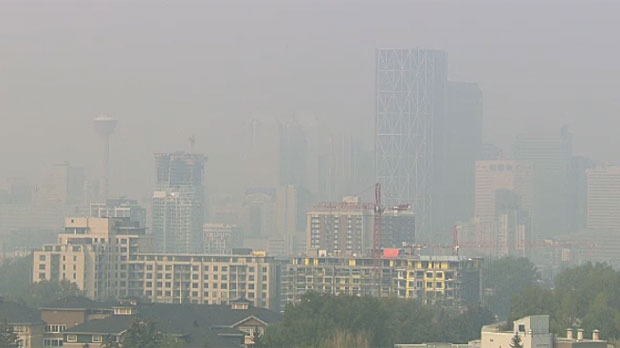
Here in western North America, climate change is bringing longer and more destructive wildfire seasons. At times smoke from fires hundreds of miles inland can reach the coast and cross to Vancouver Island. This stuff is laden with PM 25 and, while coastal residents can fend off the worst of it with modern air purifiers, it plays pure hell on the people of Alberta, especially Calgarians. 

Calgary air quality worse than Shanghai due to wildfire smoke ...


The thing to remember is that these particles embed in your heart and in your lungs. They leave people compromised, vulnerable to respiratory and cardiac disease - and Covid-19. 

Before We Consign the Weakest to Penury, Remember, When They Go We Are All One Step Nearer the Bottom Rung.


It was April, 2019, when Nobel laureate economist, Joe Stiglitz, penned an op-ed in The New York Times calling for a rebirth of "progressive capitalism."

As I read the article I was reminded of Theodore Roosevelt's Square Deal speech delivered in Kansas in 1910. I put together a post in which I blended quotes from Roosevelt's speech with Stigliz' op-ed. I had completely forgotten about it but it's more powerful, more meaningful, more urgent today than it was last year.

Who would have thought, a year ago, that the world would be stood on its head today, brought low by a contagion invisible to the human eye?

Stiglitz wrote:
A progressive capitalism based on an understanding of what gives rise to growth and societal well-being gives us a way out of this quagmire and a way up for our living standards.

There is a broader social compact that allows a society to work and prosper together, and that, too, has been fraying. America created the first truly middle-class society; now, a middle-class life is increasingly out of reach for its citizens. 
America arrived at this sorry state of affairs because we forgot that the true source of the wealth of a nation is the creativity and innovation of its people. One can get rich either by adding to the nation’s economic pie or by grabbing a larger share of the pie by exploiting others — abusing, for instance, market power or informational advantages. We confused the hard work of wealth creation with wealth-grabbing (or, as economists call it, rent-seeking), and too many of our talented young people followed the siren call of getting rich quickly.
...Just as forces of globalization and technological change were contributing to growing inequality, we adopted policies that worsened societal inequities. Even as economic theories like information economics (dealing with the ever-present situation where information is imperfect), behavioral economics and game theory arose to explain why markets on their own are often not efficient, fair, stable or seemingly rational, we relied more on markets and scaled back social protections. 
The result is an economy with more exploitation — whether it’s abusive practices in the financial sector or the technology sector using our own data to take advantage of us at the cost of our privacy. The weakening of antitrust enforcement, and the failure of regulation to keep up with changes in our economy and the innovations in creating and leveraging market power, meant that markets became more concentrated and less competitive. 
Politics has played a big role in the increase in corporate rent-seeking and the accompanying inequality. Markets don’t exist in a vacuum; they have to be structured by rules and regulations, and those rules and regulations must be enforced. Deregulation of the financial sector allowed bankers to engage in both excessively risky activities and more exploitive ones. Many economists understood that trade with developing countries would drive down American wages, especially for those with limited skills, and destroy jobs. We could and should have provided more assistance to affected workers (just as we should provide assistance to workers who lose their jobs as a result of technological change), but corporate interests opposed it. A weaker labor market conveniently meant lower labor costs at home to complement the cheap labor businesses employed abroad.
We are now in a vicious cycle: Greater economic inequality is leading, in our money-driven political system, to more political inequality, with weaker rules and deregulation causing still more economic inequality.
A call to arms.
The neoliberal fantasy that unfettered markets will deliver prosperity to everyone should be put to rest. It is as fatally flawed as the notion after the fall of the Iron Curtain that we were seeing “the end of history” and that we would all soon be liberal democracies with capitalist economies. 
Most important, our exploitive capitalism has shaped who we are as individuals and as a society. The rampant dishonesty we’ve seen from Wells Fargo and Volkswagen or from members of the Sackler family as they promoted drugs they knew were addictive — this is what is to be expected in a society that lauds the pursuit of profits as leading, to quote Adam Smith, “as if by an invisible hand,” to the well-being of society, with no regard to whether those profits derive from exploitation or wealth creation.

Monday, April 06, 2020

Are We Heading For a Debt Revolt?


The Great Recession of 2008-2009 seemed a disaster for everyone but it wasn't. The lucky ones who knew how to game the catastrophe as it loomed reaped fortunes. And, in the aftermath of that fiasco, we read reports of how the richest of the rich were no longer putting their wealth to work in the economy but were accumulating their money and hiding it in tax havens that seemed to exist in every country, on every block.

All that wealth should come in handy as they move to snap up bargains in the post-pandemic wake. Wealth begets wealth in ways even governments have a hard time tracking.

But for every big winner there are legions of losers. Only this morning I heard a clip of Pierre Poilievre trying to use the pandemic to take shots at Justin Trudeau without somehow being seen exploiting the pandemic to take cheap shots at Justin Trudeau. For a second he almost seemed sincere when he said that we are going to see a great many Canadians emerge from this tragedy in deep poverty.  Not that he suggested we should reinstate wealth taxes or anything.

The fact is Pete is right. A great many of our fellow citizens were already living in precarious circumstances - two jobs, rundown apartments, living paycheque to paycheque - when this pandemic hit knocking them from the curb into the gutter. I like to think of them as Morneau's Brigade, warriors of the Gig Economy, living in the Job Churn lane. I wonder what they look forward to in the contagion aftermath? Do they see light at the end of their tunnel? Or do they just see more tunnel?

Panama Papers-type wealth was the rage before the virus. It even prompted some desultory reaction from our reluctant political caste, nothing, of course, that would really threaten these vast fortunes.  Now I think we're going to see that money charging in on horseback to establish a vulture economy with the many too impoverished to put up much resistance. Wealth before, debt after.

Author Nicholas Powers argues that the American government has but one way forward - debt relief.

The giant stimulus exposed the cruelty of the United States allowing generations of people to be crushed by debt and poverty. The student loan debt of $1.6 trillion, the medical debt of $88 billion wrecked lives; it could have been paid off. When the coronavirus pandemic subsides, we cannot go back to business as usual.

The sudden stop of the economy exposed our fragility; a few missed checks and we sink into debt. Over 3 million Americans filed for unemployment in March, and in April it could be tens of millions. We may see 37 million jobs vanish, specifically low-wage work like waitressing and manual labor.

Every day that goes by, the U.S. debt crisis deepens. The COVID-19 quarantine paralyzed industries and it could last up to a year, maybe more. Workers who lose work can’t pay bills and can’t buy goods from businesses who fire their workers, who can’t pay their bills. The downward debt spiral accelerates. A working-class collapse threatens to bring down the wealthy, and that is why Republicans and Democrats race to stop their fall. They could have done this all along. They chose not to.
...More dazzling yet, in an act of hocus pocus that would make David Copperfield proud, the U.S. Department of the Treasury gave $454 billion to the Federal Reserve, which through the alchemy of fractional reserve banking can leverage that up to $4 trillion and throw it at the economy like poker cards from a magician’s hat — conjuring vast treasure out of a “fraction” of money. And it is Republicans putting on the show. 
The historical irony is painful. Since the rise of the New Right, which was first given national exposure in Sen. Barry Goldwater’s 1964 campaign and consolidated in President Reagan’s two terms, small government was a Republican dogma. Reagan famously said, “Government is not the solution to our problem; government is the problem.” The same came from Grover Norquist, the Republican head of Americans for Tax Reform, who said of the U.S. government, “I just want to shrink it down to the size where we can drown it in the bathtub.” Troubling homicidal fantasy aside, the idea was in opposition to big government liberalism. Tellingly, the parts that were too “big” were those that helped the poor, workers, minorities, and saved the environment. Republicans always found war and tax cuts affordable. The hypocrisy did not go unnoticed. After Reagan’s vice president, George Bush, was voted out in 1992 after just one term, I remember Tupac’s 1993 song, “Keep Ya Head Up,” was a big hit. My friends and I would nod our heads and rap along with the line, “They got money for wars but can’t feed the poor.”
...Today, in the grip of the coronavirus pandemic that could kill 1.2 million of us, mostly our elderly and sick, the only practical response is a swift expansion of the welfare state, including Medicare for All and subsidized medical school. Not just one-time $1,200 payments. Not just extended unemployment benefits. Not just loans and bailouts to businesses. We face a future of more pandemics and an intensifying climate crisis. A dramatic expansion of social welfare programs is not negotiable; it is a necessity for survival.
We urgently need a Jubilee Year, a massive debt forgiveness like the one described by anthropologist David Graeber in his Debt: The First 5,000 Years.

As I wrote a couple of weeks ago, America may need to follow the example of Solon.

America and, for that matter, many countries in the developed world may need new policies vaguely akin to Solon's Seisachtheia.

Athenian society had become debt-bound. The economy was collapsing under its own weight. There were too many debtors who could not pay, many of them stripped of their lands and imprisoned or, together with their families put into slavery. There were too many creditors, merchants, who could not recover what was owed them and also lost the customers who had built their businesses that now languished in prisons or slavery. The city state was falling into decline.
Solon's reform of these injustices was later known and celebrated among Athenians as the Seisachtheia (shaking off of burdens). As with all his reforms, there is considerable scholarly debate about its real significance. Many scholars are content to accept the account given by the ancient sources, interpreting it as a cancellation of debts, while others interpret it as the abolition of a type of feudal relationship, and some prefer to explore new possibilities for interpretation. The reforms included: 
annulment of all contracts symbolised by the horoi. 
prohibition on a debtor's person being used as security for a loan, i.e., debt slavery.
release of all Athenians who had been enslaved. 
The removal of the horoi clearly provided immediate economic relief for the most oppressed group in Attica, and it also brought an immediate end to the enslavement of Athenians by their countrymen. Some Athenians had already been sold into slavery abroad and some had fled abroad to escape enslavement – Solon proudly records in verse the return of this diaspora.

I don't suggest that 21st century America could have a "shaking off of burdens" but, like ancient Athens it has a plague of debt that requires some remedy. The annual federal deficit when Trump came to power was $585 billion, 3.2% of GDP. By 2019, Trump had it up to $984 billion or 4.7% of GDP. This year it will easily break a trillion dollars. Now Trump is promising another $.85 trillion (atop the existing trillion dollar deficit) in stimulus spending. [Congress has already bumped that to $2.2 trillion and another round of bailouts is expected before long] The American commercial sector has been fueled by debt and easy money. The era of "everyday low taxes" has exacerbated this dangerous imbalance. We've been warned for years that consumer indebtedness had reached perilous levels. We have created a weakness that increases our vulnerability to even a viral epidemic.

Those who survived the Black Death prospered. Those who survived WWI and the Spanish Flu pandemic were greated with the Roaring 20s. That's not in the cards this time.


Neoliberalism, an Ideology That Just Keeps Punishing.


Could the Covid-19 virus finally weaken neoliberalism's grip on our governments? Cornell law prof, Joseph Margulies, thinks it just might.

We have faced crises before, and this too shall pass. For all the pain it has caused and will cause, it is just a virus, not an existential threat to the nation. Yet in critical respects, this crisis is unlike any we have experienced for more than a century. It commands a response and imposes burdens that are very different from those seen by anyone alive today. Before it is over, the virus will touch every aspect of national life. And though we are early in the curve, we can already distill what may be the most important lesson of the crisis into a single sentence: COVID-19 exposes the cruel folly of neoliberal governance
As I have written here before, neoliberalism is the idea that social problems are better solved by the private sector than by government. But more than an economic or political model, neoliberalism is an ideology, a way to make sense of the world.  
We haven’t had this many people look plaintively to the federal government for a lifeline since the New Deal, and everyone is very relieved neoliberals never managed to drown government in the bathtub. 
The first and most obvious lesson of COVID-19, therefore, is that despite what neoliberals insist, people immediately and instinctively look to the national government for rescue when their economic or physical health is imperiled. Even more importantly, because the response is universal, we should resist the neoliberal determination to stigmatize it. Now more than ever, we see that government is not the enemy. 
Yet, if the virus has made government cool again, it has not imposed its burdens uniformly, and that too is a product of neoliberal governance. Decades of neoliberal policy have shredded social welfare programs, dramatically weakened support for workers, and produced record levels of inequality. The top 1% of households in the United States own 40% of all wealth in the country, more than the bottom 90% combined, a higher level of inequality than at any time since at least 1962. And things are getting worse. Thanks in part to the Trump tax cut of 2017, the 400 richest Americans in 2018 paid a lower total tax rate, including state, federal, and local taxes, than any other income group in the country, a distinction never equaled in U.S. history.
COVID-19 exacerbates this morally obscene inequality. As many have observed, those who are best positioned to weather the COVID-19 storm are the wealthy and the well-paid workers with steady jobs, good benefits, and safe, stable housing. Those who do not have to work or who can work remotely can most easily accommodate the demands recommended by public health officials and ordered by state governments to minimize transmission—viz., shelter in place, and practice social distancing whenever you leave your home. 
The poor simply do not have this luxury, especially those whose work is precarious, who are in low-wage hourly or piecemeal employment with few or no benefits. Contract employees. Delivery drivers. Cleaning and janitorial staff. Home health care providers. Many members of the gig economy.
...for many of these workers, financial security is a contradiction in terms. According to a 2015 study by the Pew Research Center, one in five adults in the United States, or just under 50 million people, lives in a household that is in or near poverty, an increase of more than 100% since 1970. According to the Federal Reserve, roughly one of every eight Americans could not cover an unanticipated expense of $400. Nearly three in ten could cover the cost but would have to borrow or sell something to do so. Other surveys capture different pieces of the same picture. Just under three in ten Americans report that they have no emergency savings whatsoever, and nearly six in ten say they live paycheck to paycheck. Worse, the poor are most apt to have the preexisting medical conditions like diabetes and hypertension that make them especially vulnerable should they become infected.
The second lesson of the virus, therefore, is to make plain to the wealthy what the poor have known for decades. Neoliberal policy has brought millions of Americans to the knife edge of financial and physical ruin, and COVID-19 will push them over.
Precisely when so many among us are suffering and we most need to be communitarians, neoliberalism conditions us to be individualists.

I am not the first to notice the link between COVID-19 and neoliberalism, and I hope I will not be the last. COVID-19 will not destroy this country, but it has exposed better than even the 2008 financial crisis the cruelty of neoliberal policy. If the virus finally weakens the stranglehold that neoliberalism has on policymaking in this country, perhaps the great suffering it inflicts and sorrow it brings will not be all in vain.