Monday, September 09, 2019

Democracy on Death Watch


Is Justin Trudeau a defender of democracy? No. What about Andrew Scheer? Hell no.

Both of those hustlers think it's just dandy that Canada should be ruled* on the strength of less than two votes out of five so long as one of them is the winner.  They're not interested in governing with the consent of the people. The last thing either wants is to be at the mercy of an informed electorate. And so one side makes empty promises to lure in the rubes while the other appeals to the darker instincts of its followers. They may only get less than two out of five votes but a goodly percentage of their catch are what Jacques Parizeau described as lobsters for the pot  - you catch them, in his case that meant getting them to vote for Quebec separatism, and then you get them into the boiling cauldron before they know what's happened. You tell'em whatever they want to hear and then you boil them up.

*Being governed and being ruled are not the same. We're supposed to be governed with the informed consent of the electorate. When three out of five don't support you, that's not consent. When you get a minority of support on the strength of empty promises or fear mongering that sure as hell is not informed consent either. It's not democracy. It's a pretence and it's the Canadian way. We are a ruled people.

Perhaps the demise of democracy is inevitable. A new paper by a prominent social scientist concludes that democracy is finished.
A brief three decades after some had heralded the “end of history” it’s possible that it’s democracy that’s nearing the end. And it’s not just populist rabble-rousers who are saying this. So is one of the establishment’s pioneer social scientists, who’s daring to actually predict the end of democracy as we know it. 
[Shawn] Rosenberg, who earned degrees at Yale, Oxford and Harvard, may be the social scientist for our time if events play out as he suggests they will. His theory is that over the next few decades, the number of large Western-style democracies around the globe will continue to shrink, and those that remain will become shells of themselves. Taking democracy’s place, Rosenberg says, will be right-wing populist governments that offer voters simple answers to complicated questions. 
And therein lies the core of his argument: Democracy is hard work and requires a lot from those who participate in it. It requires people to respect those with different views from theirs and people who don’t look like them. It asks citizens to be able to sift through large amounts of information and process the good from the bad, the true from the false. It requires thoughtfulness, discipline and logic.
Rosenberg argues that democracy is devouring itself.
We’re to blame, said Rosenberg. As in “we the people.” 
Democracy is hard work. And as society’s “elites”—experts and public figures who help those around them navigate the heavy responsibilities that come with self-rule—have increasingly been sidelined, citizens have proved ill equipped cognitively and emotionally to run a well-functioning democracy. As a consequence, the center has collapsed and millions of frustrated and angst-filled voters have turned in desperation to right-wing populists
His prediction? “In well-established democracies like the United States, democratic governance will continue its inexorable decline and will eventually fail.”
We don't bring thoughtfulness, discipline and logic into the polling station. Not any more.
Unfortunately, evolution did not favor the exercise of these qualities in the context of a modern mass democracy. Citing reams of psychological research, findings that by now have become more or less familiar, Rosenberg makes his case that human beings don’t think straight. Biases of various kinds skew our brains at the most fundamental level. For example, racism is easily triggered unconsciously in whites by a picture of a black man wearing a hoodie. We discount evidence when it doesn’t square up with our goals while we embrace information that confirms our biases. Sometimes hearing we’re wrong makes us double down. And so on and so forth. 
Our brains, says Rosenberg, are proving fatal to modern democracy. Humans just aren’t built for it.
...“In sum, the majority of Americans are generally unable to understand or value democratic culture, institutions, practices or citizenship in the manner required,” Rosenberg has concluded. “To the degree to which they are required to do so, they will interpret what is demanded of them in distorting and inadequate ways. As a result they will interact and communicate in ways that undermine the functioning of democratic institutions and the meaning of democratic practices and values.” 

Sunday, September 08, 2019

Cassandra Calling - "No Way Out"

A sobering look at renewable energy from LSE anthropologist, Jason Hickel. If you don't know who he is you really should check him out.

Hickel has written an essay in Foreign Policy exploring the limits of alternative 'clean energy.'  His conclusion is blunt:

"No energy is innocent. The only truly clean energy is less energy."

Hickel shatters the myth that we can ever really decarbonize the global economy.
In 2017, the World Bank released a little-noticed report that offered the first comprehensive look at this question. It models the increase in material extraction that would be required to build enough solar and wind utilities to produce an annual output of about 7 terawatts of electricity by 2050. That’s enough to power roughly half of the global economy. By doubling the World Bank figures, we can estimate what it will take to get all the way to zero emissions—and the results are staggering: 34 million metric tons of copper, 40 million tons of lead, 50 million tons of zinc, 162 million tons of aluminum, and no less than 4.8 billion tons of iron. 
In some cases, the transition to renewables will require a massive increase over existing levels of extraction. For neodymium—an essential element in wind turbines—extraction will need to rise by nearly 35 percent over current levels. Higher-end estimates reported by the World Bank suggest it could double. 
The same is true of silver, which is critical to solar panels. Silver extraction will go up 38 percent and perhaps as much as 105 percent. Demand for indium, also essential to solar technology, will more than triple and could end up skyrocketing by 920 percent. 
And then there are all the batteries we’re going to need for power storage. To keep energy flowing when the sun isn’t shining and the wind isn’t blowing will require enormous batteries at the grid level. This means 40 million tons of lithium—an eye-watering 2,700 percent increase over current levels of extraction.
...The problem here is not that we’re going to run out of key minerals—although that may indeed become a concern. The real issue is that this will exacerbate an already existing crisis of overextraction. Mining has become one of the biggest single drivers of deforestation, ecosystem collapse, and biodiversity loss around the world. Ecologists estimate that even at present rates of global material use, we are overshooting sustainable levels by 82 percent.
Can we find the resources essential to decarbonize the global economy? Is that just another way of restating other existential threats, overpopulation and our rapacious over consumption of the planet's finite resources?

As these hurdles keep appearing they only corroborate the idea that Earth can simply not support our current population numbers. The most recent estimates I have seen suggest that the truly sustainable limit is now somewhere between two and three billion. That's a shocking figure given that we're already closing in on  eight billion and heading, by some estimates, to ten billion or more.

It flies in the face of every principle of neoliberalism but we're at the stage where we must learn to live within the sustainable capacity of our ecosystem, our one and only biosphere, Spaceship Earth. Either we find our way back inside or we'll perish outside.

Saturday, September 07, 2019

Why "50 by 30" Matters This Year


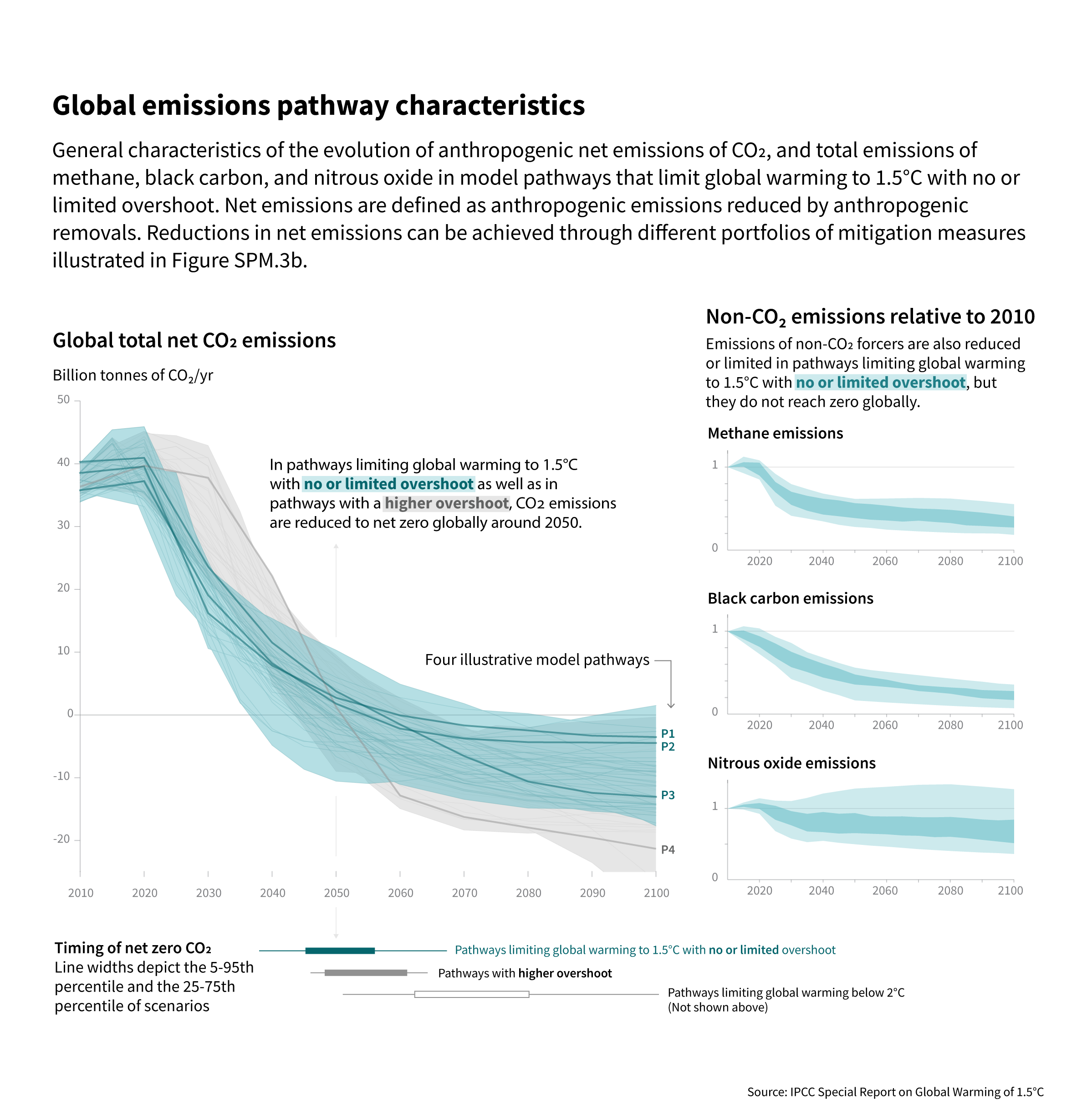
Last year the IPCC warned of an urgent need to cut greenhouse gas emissions by 45 per cent by 2030. Since then fossil fuel consumption and GHG emissions have increased enough that we're now at 50 per cent by 2030.

What does 50 by 30 mean? Why should you care? What will befall us if our governments fail to meet that prescription?

The important thing to remember is that 50 by 30 is the threshold we must meet if we're to have a chance of decarbonizing by 2050.  50 by 30 is actually the easy part that puts us on the path to a zero carbon economy by 2050 without which we don't have much chance of averting catastrophic climate change.

The report explained that countries would have to cut their anthropogenic carbon dioxide emissions, such as from power plants and vehicles, to net zero by around 2050. To reach that goal, it said, CO2 emissions would have to start dropping "well before 2030" and be on a path to fall by about 45 percent by around 2030 (12 years away at that time). 
Mid-century is actually the more significant target date in the report, but acting now is crucial to being able to meet that goal, said Duke University climate researcher Drew Shindell, a lead author on the mitigation chapter of the IPCC report. 
"We need to get the world on a path to net zero CO2 emissions by mid-century," Shindell said. "That's a huge transformation, so that if we don't make a good start on it during the 2020s, we won't be able to get there at a reasonable cost."
Colorado State university's Scott Denning says '50 by 30' isn't as alarming as it sounds.
"All this work gets summarized as 'in order to avoid really bad outcomes, we have to be on a realistic glide path toward a carbon-free global economy by 2030.' And that gets translated to something like 'emissions have to fall by half in a decade,' and that gets oversimplified to '12 years left.' 
"There's certainly a grain of truth in the phrase, but it's so oversimplified that it leads to comically bad misconceptions about how to get there, conjuring up ridiculous cartoon imagery suggesting we just go on with life normally for the next 11 years and then the world ends," Denning said.
...Missing the target doesn't imply the onset of cataclysmic climate change in 2030, Denning said.

"Things just keep getting worse and worse until we stop making them worse, and then they never get better," he said. "But no matter what, the world has to move on from fossil fuels just as we moved on from tallow candles and outhouses and land lines."
There are so many caveats to all of this. Where to begin?

Consider the source. Dire as this warning is, it does come from the Inter-Governmental Panel on Climate Change, the IPCC. If this organization has demonstrated anything since its inception it is getting projections wrong. The IPCC has been persistently optimistic, unduly optimistic. We get overtaken by events the IPCC warned might happen by the end of the century if we don't mend our ways. They're the diametric opposite of alarmist.

Consider the scope. The IPCC is concerned with one thing, anthropogenic or man-made climate change. Man-made greenhouse gas emissions, mankind's 'carbon budget.' That was useful at one time but that time may have passed. We have crossed enough tipping points that nature is now getting in on the game, generating its own greenhouse gases, especially CO2, methane and warming-driven water vapour.

When the IPCC crunches its numbers it doesn't factor in these non-anthropogenic emissions that are beginning to come on quite strong, especially from wild fires and the release of once safely sequestered greenhouse gases from thawing tundra, permafrost and melting seabed clathrates. If we were to deduct these natural emissions from the carbon budget it would put a huge dent in how much more man-made emissions the atmosphere can bear.

Time is not on our side. It is going to become more difficult, not less, to meet the IPCC targets.  Weaning ourselves off fossil fuels is just part of the challenge. We also need to arrest overpopulation and curb our insane consumption patterns.  More people = more consumption = more emissions. There are more of us, we're living longer, the global 'consumer class' is burgeoning, especially in China and India. These things are all trending in the wrong direction making the path to a carbon-free global civilization more difficult, if not impossible, to achieve with each passing year.

Nobody much cares. Much has changed since Stephen Harper reluctantly and, I'm sure, disingenuously committed Canada to a 30 per cent cut in GHG emissions by 2030. Yet we've never been on track to achieve even Harper's inadequate target. Trudeau is working to expand bitumen extraction, production and transmission in a quest to flood world markets with this climate wrecking, high-carbon sludge.

He may have declared a state of climate emergency in Canada but he doesn't act as though we're in any peril. He won't even acknowledge the IPCC call for '50 by 30.' That's not even on his horizon much less his government's 'to do' list.

UCLA climate scientist, Daniel Swain, warns that we must not read too much into '50 by 30' even if we were willing to try to achieve it.
In some ways, the "12 years" narrative may set up a deadline that's too lenient, because some key part of the climate system may already be at or past tipping points, Swain said. 
It creates the false illusion that there is some sort of guardrail moving forward, that if we just get in under the deadline we'll be OK, he said. But "twelve years from now, it could be too late for some of these things, like the ice sheets." 
Research in the past few years reinforces the idea that some climate tipping points have already been breached.
Glen Peters, director of the Cicero climate research center in Oslo, warns we're already way behind the power curve.
"In terms of deadlines, we have already missed the deadline," he said. "We should have started mitigating decades ago, then we would have the problem solved."
So what does this mean when we go to the polls this October? If your party won't acknowledge the '50 by 30' obligation what they're telling you is that they're writing off the future of our country.  A vote for them is a vote against Canada and against our young people. Those who won't change course and take meaningful action now are writing off the future and why would you support that?

It's a question of life or death and this October you get to choose.

Regina's Finest? The Dead South.

Definitely worth a listen.

Two Sides of The Same Coyne


Andrew Coyne looks at the Trudeau Conservatives and the Scheer Liberals, or is it the other way around? Does it matter?
The two main parties, after all, could not be more different. The one, it is well known, is little more than a personality cult centred on the leader, while the other is a personality cult, minus the personality. The first is notably bereft of any governing philosophy or principles but will say and do whatever it takes to win, while the second will say and do whatever it takes to lose. 
Of course, both parties have from time to time had their share of scandals, a Wright-Duffy here, an SNC-Lavalin there, but with a critical difference. For whereas the Liberals abuse power because they can — because being so often in government and so accustomed to its pleasures, no one expects them to do any differently — the Conservatives do so because they must: because being so rarely in government, they are at every disadvantage, between an uncooperative bureaucracy and a hostile media, and need recourse to every expedient just to even the scales. Or because the Liberals did it first. Or just because. 
On the issues, too, voters face a profound, nay, a historic choice. It is a choice between a party that has run deficits for the last four years, and a party that would run deficits for the next five; between a party that negotiated free trade deals with the United States, Europe and Asia, and a party that negotiated free trade deals with Asia, Europe and the United States; between a party that held health-care transfers to the provinces to increase by no more than the rate of growth in GDP, and a party that has increased health-care transfers by no less than the growth in GDP. 
It is a choice between a party that makes no secret of its opposition to electoral reform and a party that very successfully made a secret of it; between a party that repeatedly smuggled legislation past Parliament via gargantuan omnibus bills, invoked “time allocation” motions to cut off debate and held its members captive to the most rigid system of party discipline in the democratic world, and a party that said it would not do any of these things. 
It is a choice between a party that, in its time in office, failed to build a single pipeline to tidewater, and a party that has failed, in its time in office, to build a single pipeline to tidewater; between a party that has no realistic plan to meet the targets for greenhouse gas emissions to which they both have committed, and a party that has a plan that is even less realistic.
...Of course, elections are not just about the parties; they are as much or more about the party leaders. Here, too, voters will have to choose between two very different white middle-aged Catholic heterosexual males (themselves entirely unlike any of the white middle-aged Catholic heterosexual males — Dion, Martin, Chretien, Mulroney, Clark, Turner, Trudeau the elder — who preceded them).

It’s not just a choice between a Liberal party leader elected by people who weren’t Liberals and a Conservate party leader elected by people who weren’t Conservatives — it’s between a leader who has no experience of the struggles of ordinary people and a leader who has spent two-thirds of his adult life on the public payroll. 
It’s between a leader who would not reopen divisive social issues and a leader who demands they be reopened just long enough to declare them closed; between a leader who insists that same-sex marriage and abortion and marijuana remain legal and another who accepts that they will. 
Perhaps the sharpest point of distinction between the two can be seen in that traditional test of Canadian leadership, foreign policy. The two leaders would fail to exert any influence on the United States or China in completely different ways. On defence spending, though neither would come close to meeting our NATO commitments, one would feel more badly about it. 
Still, the two leaders are alike in one respect, I’ll grant you. Neither wants anything to do with Doug Ford.
Now this will obviously spark outrage among Trudeau's true believers but that's mainly their fondness for a steady diet of horse shit. To an outsider, Coyne's words ring true. Between the two of them there's not much to like, they're both in the bag to the same special interests and neither of them really gives a goodgawdamn about the future of Canada.  Yes, the Tories have a clear lead in bigotry but, beyond that... meh.


Excess


Rowan Williams, former Archbishop of Canterbury, looks at the fires ravaging the Amazon rainforest and sees one thing, mankind's lust for excess.

Whether it's vanishing fish stocks, exhausted farmland, emptied aquifers, or a fetish for trafficking bitumen, it's a civilizational-scale addiction, one that we will not survive. It is as plain as that and the outcome is just as clear.

This is a rainforest that provides one-fifth of the world’s oxygen; it is hard not to feel powerless and despairing in the face of the disaster overtaking the region. 
But however strong – and bitter – the feeling about this as an environmental catastrophe, we must never lose sight of the fact that it is also a human tragedy. 
We need to listen with intensified attention to the voices of those who call the rainforest home, voices all too often sidelined or deliberately silenced, their stories a mere footnote in global news headlines. We have no excuse for not listening now.
Humanity seems to be dividing into two camps: victims, inevitably the poor and vulnerable; and those who perpetrate their suffering for a quick and fleeting windfall. Best not to get too judgmental about the scoundrels torching the rainforests. Canada is "punching above its weight" when it comes to flooding the world with some of the worst, highest-carbon fossil fuels including thermal coal and bitumen. If you think that's not killing people, rendering their ancestral homelands unlivable and forcing them to seek survival in migration, you'll be wearing that before the coming decade is out.
For generations, the indigenous peoples of the Amazon basin have been the stewards of the forests. Some have literally paid for this with their lives, long before this summer’s fires. These communities have for years been subject to attacks, illegal invasions and deforestation. Their rights have been overridden in the face of the greed of various powerful economic interests, and theirs is a story that speaks of the stark economic inequality blighting and corrupting so much of our world, including countries like Brazil.

...This is not just Brazil’s problem – or indeed that of other Amazon countries like Bolivia and Colombia, which have also been impacted by fire and environmental devastation. All of us are implicated. The global patterns of economic growth, including the unprecedented levels of demand for meat in the developed world, account for much of the pressure on land use in the region. And widespread deforestation in other parts of the world means we are more reliant than ever on the region for our global ecological balance. 
The wildfires raging in the Amazon are a visible metaphor for the effect of our unrestrained passion for limitless economic growth. It is this passion that has led to so much deforestation in recent years. It is this that is responsible for the vast majority of the current fires in the region. Brazil’s National Institute for Space Research has published data showing a 278% increase in deforestation this July compared with the same month last year.

It looks increasingly likely that we are at, or very near, a tipping point in our global ecological crisis, a crisis generated by the desire to maximise indefinitely what we can extract from our environment, as if it were no more than a store cupboard to be raided. The Canadian poet Robert Bringhurst writes that “the wild”, the untamed, complex world around us, “is not a portfolio of resources for us or our species to buy and sell or manage or squander as we please. The wild is earth living its life to the full.” 
The compulsive acquisitiveness that causes the radical damage we see dehumanises us as well as ruining our environment. The fires are burning in the soul as well.
I understand it's hard to grasp that the very people we'll be supporting at the ballot box this October are those driving us, all of humanity, over the edge of this planetary tipping point. To them the only course is the pursuit of perpetual exponential growth and our degraded world is "no more than a store cupboard to be raided."

Andrew Scheer is Andrew Scheer, as unapologetic as they come. Justin Trudeau says he's different than Scheer but, when it comes to the bottom line for humanity and the planet, it's a distinction without much difference.


Friday, September 06, 2019

What We're Really Up Against


I've heard a lot of people who, at the mention of the climate crisis, believe that, when the time is right - just a little longer, any year now - we'll all just throw a few solar panels on the roof and - problem solved.

Sorry, that's not going to happen.  It's wishful thinking of the sort that can lead to truly dangerous delusions.

An article at BBC Future takes a sobering look at the hurdles that stand in our way to a clean energy world. They're daunting. Not insurmountable but damn near. I won't load you up with crushing realities. If you want them, follow the link.

The author suggests that our best intentions won't work unless we're ready to overhaul capitalism as we understand it, this melange of 18th century economics, 19th century industrialism and 20th century geopolitics.  If we're to have a reasonable chance of salvaging our societies we have to ditch globalism, the hell spawn of our fossil fuel contagion and re-localize our economies.
The current blind faith in technology will not save us. For the planet to stand any chance, the global economy must be redesigned. The problem is more fundamental than capitalism or the emphasis on growth: it is money itself, and how money is related to technology. 
Climate change and the other horrors of the Anthropocene don’t just tell us to stop using fossil fuels – they tell us that globalisation itself is unsustainable.

Even the Globe Can't Stomach BoJo


The Globe editorial board can't find adjectives bad enough to describe the blonde-mop FUBAR now occupying No. 10.

They did, however, manage to sum up Boris Johnson's disastrous week of blunders and reverses.
British politics today is what results from the collision of an unstoppable force, an immovable object and a clown car. 
The unstoppable force is the dominant faction of Britain’s Conservative Party, which insists on not just an exit from the European Union, but the most catastrophic exit possible. It’s a plan for national self-defenestration. The immovable object is reality – the reality that a no-deal Brexit will play havoc with the economy and hurt real people; the reality that a majority of Parliament and the people will not back it; the reality that the Brexit-at-any-cost crowd can’t press the detonator without majority approval. 
And the clown car is Mr. Johnson. 
The Tories have transformed themselves into a protest party, even while continuing to govern a Group of Seven nation with a permanent seat on the United Nations Security Council. They’ve become increasingly monomaniacal in their Brexit obsession, and increasingly childlike. It’s an evolution that has reached its nadir in the premiership of Mr. Johnson.
...In 2016, the British people were asked what they thought of the idea of skydiving. In a referendum, they narrowly answered that, in theory, they’d be willing to give it a try. 
For three years, the British government has claimed that it is close to reaching a deal with the EU and acquiring the wherewithal for making a safe-ish jump possible. 
But the position of Mr. Johnson’s new government is that since Britain voted for the idea of skydiving, then skydiving there must be. On Oct. 31, Britain has no option but to jump out of a plane, parachute or no parachute.

That’s democracy, right?

Thursday, September 05, 2019

"He Shat On the Carpet"


The American vice-president, Mike Pence, is a profoundly stupid man. You could say he's the ideal playmate for America's reality-challenged president, DJ Trump.

Pence paid his respects to his ancestral homeland, Ireland, during a recent trip to Iceland, Poland and the Irish Republic. He took his wife and his mom along and they even stayed at Trump's Irish golf resort during their visit.

It probably shouldn't have come as a surprise that Pence abused the hospitality of his Irish hosts by pitching Boris Johnson's Brexit plan and lecturing the Irish government about their responsibility to negotiate with BoJo "in good faith."

It was all too much for Irish Times' columnist, Miriam Lord:
It came as a shock. 
Like pulling out all the stops for a much-anticipated visitor to your home and thinking it has been a great success until somebody discovers he shat on the new carpet in the spare room, the one you bought specially for him. 
US vice-president Mike Pence met President Michael D Higgins and Taoiseach Leo Varadkar on Tuesday during an official visit. His Irish hosts, up to their oxters for the last three years in Brexit worry, hoped to impress upon him Ireland’s fears about the consequences of a no-deal Brexit for the country.
...No room left for doubt. As Pence read from the autocue and Irish eyes definitely stopped smiling, it was clear he was channeling His Master’s Voice. Trump is a fan of Brexit and of Boris. 
...he veered off his rather gushing statement following his meeting with the Taoiseach into some crunching Brexit remarks about our duty to do right by Boris Johnson and the UK. 
As the air in the steamy ballroom turned decidedly frosty, Pence urged Ireland and the European Union “to negotiate in good faith” with the new British prime minister. 
The local crowd raised eyebrows and wondered what he thinks the aforementioned EU has been doing for the last three years, if not negotiating in good faith with the UK.
Varadkar’s expression didn’t change. He stood on the platform beside the vice-president and hardly flinched, smiling politely. 
Even when Pence made it worse by not only mentioning “good faith” and “Boris Johnson” in the same context but by also requesting his hosts to have “respect for the UK’s sovereignty”, Varadkar maintained a stoic courtesy. 
He had to. It’s in the job description for normal prime ministers.
...You can never be too careful. In the end, Pence brought his wife, his mother and his sister to the Old Country, where it seems a lot of the natives have turned alarmingly heathen in the generations since his ancestors left our shores. 
His morning began with a trip to the Phoenix Park and a courtesy call on the President. 
To look at Mike Pence, with all smiles and handshakes, you’d hardly think he isn’t very keen on the gays at all. 
Brave Mike sat down to lunch with the Taoiseach and his partner Matthew and managed not to choke on his Dublin Bay prawns. The VP’s wife Karen, who recently took up a part-time teaching position in a school which bans LGBT pupils and staff, kept her fillets of venison down despite the company. 
The next prime minister the couple will meet on their trip will be the serial philanderer Boris Johnson. He’s pretty experienced on the extramarital and premarital sex front, which they abhor. 
...“I carry Ireland with me wherever I go,” said Pence, speaking of an old Ireland, one his ancestors left generations ago. 
Still, his visit was a great example of diversity in action. President Trump, who recently visited, is very hands-on with women and likes to grab them in all sorts of places. And his second in command is the opposite. He won’t stay on his own with a woman who isn’t his wife. 
God bless America.


Fighting Back. Monbiot on Civil Disobedience in the War Against Climate Change.


It's pretty clear now that fighting climate change means fighting power, fighting authority. Across the political spectrum it is increasingly difficult to find people in positions of power willing to abandon the status quo and, in the affluent West, that means the neoliberal model of perpetual exponential growth coupled with continued reliance on cheap, climate wrecking fossil fuels. Those in power and authority will not be moved without a fight and, in this case, it'll be a fight for survival.

There have been plenty of protests and demonstrations, blocking roads, that sort of thing. It's not enough.

In Britain there are plans for a new form of civil disobedience - swarming the giant Heathrow airport with drones, shutting the place down. George Monbiot argues that it's an essential next step.
We owe our right to vote, our freedom from servitude and subjection, our prosperity and security to people reviled in their time as lawbreakers and reprobates. Breaking the law on behalf of others is a long and honourable tradition. Next week, a few dozen unaffiliated activists intend to start something they call Heathrow Pause. They will each fly a toy drone within the restricted zone around Heathrow airport. The drones will fly nowhere near the flight paths, and never above head height, ensuring they present no risk. But any drone activity forces the airport to suspend all flights. The activists know they face arrest and possibly long prison sentences.

Their plan is to launch their drones consecutively, stopping flights for as long as possible: perhaps for several days. In doing so they seek to denormalise one of the most destructive activities on Earth. Once unthinkable, then a bizarre novelty, then an extraordinary luxury, then a hope, then an expectation, flying – and flying frequently – is now treated as a right. Worldwide, the number of flights is expected to double in 20 years.

Those who defend the sector point out that it currently produces “only” 2.4% of the world’s emissions. But this is because just 20% of the world’s people have ever flown. In terms of individual impact, taking a flight, because of the quantity of fuel it uses, inflicts more harm on the living planet and its people than anything else you are likely to do
Even in rich nations, flying is overwhelmingly concentrated among the wealthiest citizens. In the UK, 15% of the population accounts for 70% of flights. Those most likely to fly frequently, according to House of Commons research, have a second home abroad and a household income of more than £115,000. We are told that flying is about freedom. It is: the freedom of the rich to destroy the lives of the poor
As flying expands, it will become one of the principal causes of global heating. The impact is already greater than the 2.4% of emissions suggests, as planes create cirrus clouds that roughly double the overall heating effect. There are technological alternatives for most of our damaging activities – but not flying.
...The socially just solution is the frequent-flyer levy proposed by the Free Ride coalition. There would be no aviation tax for the first flight in any year that a person takes but escalating taxes on subsequent flights. Set at the right level, the levy would avert the need for airport expansion, and steadily scale down the industry. But don’t expect the government to listen. The new transport secretary, Grant Shapps, was previously chair of the British Infrastructure Group, which lobbied “to ensure that every opportunity for growth is seized”, backing airport expansion and a reduction in air passenger duty. 
Nothing will change until the impacts of flying become salient. One of the Heathrow Pause campaigners, Valerie Brown, told me: “I’m petrified, of course ... It’s not easy to face the idea of prison, but it’s even more frightening to me to think about what my grandchildren and all the children of the world will face in 20 or 30 years’ time.” Another, James Brown (no relation), explained that he decided to act when he found his adult daughter had broken down with grief about ecological destruction. “I’m prepared to face the consequences,” he said. “I don’t know what prison will be like for me. But against the alternatives it’s a small price to pay.” 
They risk their liberty in the hope of freeing us from the momentous consequences of climate breakdown. History will judge them kindly.

Here's Your Bundle of Joy for Today


As our world descends into chaos and, yes, in case you've not noticed that is happening, it can be hard to keep up with events. Here are some stories you might have missed.

From the Barents Observer, June, July and August were the hottest ever recorded in the Arctic according to data from Russian and US weather services. This summer has been marked by high temperatures, massive ice loss and wildfires across the high Arctic. Great, just great.

A post mortem on the G7 summit finds the gathering was a 'joke.' While Trump took a powder, the G6 coughed up $20 million to aid firefighting in the Amazon rain forest. That's half the cost of staging the G7 summit. Half.

The Canadian HRReporter cites a new study by the ILO, International Labour Organization, that finds continued warming "will dramatically change the world of work by 2030." Get that? 2030.  Don't worry it won't hit us very hard. Those little brown people from the poorest and most vulnerable countries, this is our gift to them. I've got an idea! Let's flood the world with high-carbon, low value sludge. We'll call it 'oil.' No, wait, we'll call it 'ethical oil."

CNN reports that young Americans are getting pissed off at Washington's inaction on climate change.

The Atlantic reports that the populism wave that swept so much of the West is now on the wane.  Long on grievance, populist leaders are inevitably short on solutions.  Even newcomer, Bolsonaro, is said to now be deeply unpopular with Brazilians.

The editors of the business mag, Fortune, write that the global biodiversity collapse is "a business issue."  The business sector, it claims, not only has come to understand it is the source of much of the problem but also stands to be a major victim.

A chilling but remarkably comprehensive look at the world's looming freshwater crisis can be found at FNArena, a financial news web site. Wow, the business world finally may be losing its fondness for climate change denial suggesting it has come to realize the risks and opportunities of the approaching crisis. Could our governments be next?

The Seattle Times reports that a new marine heat wave, similar to "the blob" of 2015 only worse, has formed off the Pacific coasts of the US and Canada. Salmon runs, already stressed, may again be imperiled.

Turning to the world of warfare and nuclear proliferation, Turkey's strongman, Recep Erdogan, says it's just not fair that Israel should have a nuclear arsenal but not Turkey.  Those peace loving Saudis are also interested in acquiring a stock of nukes.

At Foreign Policy in Focus, editor John Feffer's piece, Burning Down the House, looks at how far right governments in Brazil, the US and the UK are "laying bare their nihilistic roots and destructive potential."
Doesn’t idiocy ever take a vacation? 
As August wound down, the populist troika of Donald Trump, Boris Johnson, and Jair Bolsonaro proved once again that the United States, the United Kingdom, and Brazil would be better off with no leaders rather than the dubious characters that currently pretend to govern these countries. 
In all three cases, these leaders escalated their nationally destructive policies this summer in ways that have alienated even their erstwhile supporters. Once again, they have demonstrated that they have no interest in making America, Great Britain, or Brazil great again. They are only interested in doing as much damage as they can before they are ultimately dragged out of office.
Finally a cry for help in the Millenium Alliance for Habitat and the Biosphere (MAHB) from those on the front lines of existential climate change. While some of us still dispute the reality of climate change and others, such as our own government pay lip service even as they look the other way, people are being displaced, even dying from our energy policies.
Climate change could not have happened at a worse time in human history it would seem. We simply don’t have the bandwidth to handle it. This is when it becomes clear that things are spiraling out of control.  
Every year, we are told, is the hottest year, till the next year comes around. Then a new record is broken. It is getting worse. That we know. We hear it; we can even feel it now. 
We need to understand what this existential crisis means to people, already living on the margins of survival. It is a matter of record that every extreme weather event — flood or drought — forces people to migrate, searching for work. 
It pushes them out of their homes — sometimes this is temporary and sometimes relocation becomes permanent. But now, climate change has become that last straw breaking the camel’s back.
...Just think. When a white supremacist opened fire and massacred people in El Paso, Texas, USA, he said he was doing this to protect the world from climate change. His cold logic, written on his now taken down blog, is that Americans will never give up their lifestyle, which he accepts is destroying the planet. His answer: remove enough people so that the US lifestyle can be sustainable. Kill them. Stop them from entering the US. 
In the past I would have dismissed this rant as madness. But now we are getting to a point where the two crisis points will intersect, indeed implode. As yet, we have little actual data on the causes of migration. We talk glibly about climate refugees because it is hard to understand the nature and gravity of this problem. 
Keep that in mind the next time some Conservative or Liberal tells you we need the bitumen pits of Athabasca.

The Three Stooges of Westminster


If the Tories keep going like this Queen Elizabeth is going to need a fresh bottle of hand sanitizer. David Cameron, Theresa May and now, Boris Johnson, the Three Stooges of Westminster.

Cameron laid the groundwork for the current Brexit fiasco that has rocked Parliament and left the British people deeply divided. Before that was the 2014 referendum on Scottish independence that could have unglued the United Kingdom had it not been narrowly defeated. The following year, after leading his party to a strong majority win, he launched the referendum popularly known as Brexit, again assuming the result would be to remain. It wasn't. Cameron stepped down and left the steaming puddle to his successor, Theresa May.

May, perhaps subliminally seeking to prove that she could screw things up just as thoroughly as David Cameron wasted little time before unveiling her own blunders.  The first was to trigger Article 50 of the Treaty on European Union, setting the wheels in motion to get the UK out of the EU and only then trying to negotiate (dictate) terms of exit with the EU.

Fearing the Euros saw her as weak and hapless, May threw the Tories' majority to the winds, calling a snap election, confident that her government would be returned with another solid majority. She hoped that a strong victory would send a message to Brussels that she had the country behind her.  Like David Cameron she took a gamble and it blew up in her face.  The Tories were handed a minority and had to strike a deal with the Ulster gang to cling to power.

It didn't help May that, within her own cabinet, insurrection was brewing. Boris "Both Ways" Johnson, Michael Gove and others were gunning to bring her down and become the next prime minister. May struggled tenaciously to hold onto power but to no avail.  Failing three times to get Parliament to approve her Brexit deal with the EU there was nowhere else to go but out. 

Boris was rewarded by the Tory party faithful and became the third Conservative prime minister in just four turbulent years.  By now Parliament had become a shambles. Party lines gave way to 'leave' or 'remain' camps. Johnson pledged a Halloween Brexit, a hard Brexit if need be, come hell or high water.

This has not been a good week for Boris Johnson or the Brexiteers. MPs, many angered by Johnson's ploy to prorogue Parliament, have used their majority to take control from their prime minister. They have passed a measure prohibiting a hard (no deal) Brexit that is being expedited through the House of Lords. They also soundly defeated Johnson's motion for a snap election. To add insult to injury, today's Boris' brother, Jo, announced he's resigning his seat in the commons due to unbearable conflict between family loyalty and the interests of the country.

Where does Britain go from here? Who knows? There are many opinions, guesses mainly, on what lies ahead in the countdown to Halloween.  The Euros seem bemused. Newspapers on the continent are mercilessly taking the piss out of the unkempt first minister.
A “zombie prime minister” cornered by his “own intransigence” whose failed “kamikaze strategy” had left his country facing a future that had “never looked less certain” – Europe’s media were not kind to Boris Johnson after his fourth successive Commons defeat
Le Monde said the prime minister had now “lost control of his Brexit strategy, the calendar and even of his own camp, which is deep in internal crisis”. The prime minister had warned in August the road would be bumpy, the French paper said, “but did he really expect to be buffeted to this extent, and so soon?” 
The first of Wednesday night’s parliamentary votes “as good as finished off Johnson’s long-promised ‘do-or-die’ Halloween Brexit,” Le Monde said. His second defeat of the evening, in which MPs refused the prime minister an early election before a no-deal Brexit was no longer possible, was “even more bitter”. 
Add to that the mounting fury in the Conservative party over his purge of Tory rebels, and Downing St “must surely be having doubts”, the paper concluded. Johnson may still have some options – including calling a vote of no confidence in himself – “but who outside the Westminster bubble still understands the Battle of Brexit?”
Some are calling the uprising in the House of Commons a revolution, a taking back of power from the executive into the hands of the elected.  I'll believe it when I see the guillotine standing tall outside the black lacquered door of No. 10.

Tuesday, September 03, 2019

My Dear Jason Kenney. Please, Go For It. Don't Hesitate. Do It Now.


The Alberta Tories are itching to launch an orgy of cost-cutting. Their oil is worth shit. Before long the bottom might just fall out of the bitumen markets. It's a question of when.

Alberta, the province that loves nothing better than to lecture the rest of the country, has never been able to manage its money whether boom or bust. As they say in that bumper sticker, give'em an oil boom and they'll just "piss it all away."
From physician pay to nurses’ duties and the role of hospitals, Alberta’s entire health system needs a complete overhaul, according to the MacKinnon panel. 
In a frank conclusion, the panel wrote Alberta has “no choice but to bring spending on health in line with (other) provinces in order to balance the budget.” 
“There are no quick fixes to curb increasing costs in health care. The system needs a major transformation,” it wrote. 
The panel, headed by former Saskatchewan finance minister Janice MacKinnon, was tasked with examining the state of Alberta’s finances and proposing solutionsto what Finance Minister Travis Toews deems a “spending problem.”
Cutting salaries for doctors and nurses is a terrific idea. Forcing the public to rely on 'for profit' health care is brilliant and, might I add, long overdue.


Besides, British Columbia has a few openings for new doctors and nurses. We'll take up your slack. I've already got one of your medical ex-pats and, all things being equal, our coastal paradise is a lot more appealing when looking for a place to practice medicine.

New Brunswick New Dems Defect En Masse to GPC


Is this the 'Jagmeet Singh effect' in action?

Fourteen disgruntled former New Brunswick NDP candidates are defecting and throwing their support behind the provincial and federal Greens — a move unlikely to spark confidence in the federal New Democrats on the cusp of an election call. 
The 14 former provincial candidates announced their exodus in a media release sent to CBC News today. They also are expected to hold a press conference in Moncton this afternoon to submit their membership applications to New Brunswick Green Party Leader David Coon. 
In their declaration of support, the members note that federal Green Party Leader Elizabeth May has visited New Brunswick, while NDP Leader Jagmeet Singh hasn't set foot in the province since winning the leadership back in 2017.
The former New Democrats say they support the Green Party of Canada "and encourage all New Democrats, New Brunswickers and, indeed, all Canadians in voting for the Green Party of Canada this election." 
The shift means Singh's NDP can't turn to any of those provincial candidates to run in federal ridings in the upcoming election campaign. The federal party doesn't have any candidates nominated in New Brunswick at the moment, according to the party's website.

NDP operator, Cam Holstrom, was predictably nonplussed. These Dippers were just losers anyway. Who needs 'em? Better off widdout 'em. 

Designer Meds - Courtesy of AI


There are signs that artificial intelligence may be the key to unlocking new, effective and affordable drugs for what ails us. From MIT Technology Review.

The news: A team from AI pharma startup Insilico Medicine, working with researchers at the University of Toronto, took 21 days to create 30,000 designs for molecules that target a protein linked with fibrosis (tissue scarring). They synthesized six of these molecules in the lab and then tested two in cells; the most promising one was tested in mice. The researchers concluded it was potent against the protein and showed “drug-like” qualities. All in all, the process took just 46 days. The research was published in Nature Biotechnology this week. 
The method: The system examines previous research and patents for molecules known to work against the drug target, prioritizing new structures that could be synthesized in the lab. It’s similar to what a human chemist might do to seek new therapies—just much faster. 
Context: Getting a new drug to market is hugely costly and time consuming: it can take 10 years and cost as much as $2.6 billion, with the vast majority of candidates failing at the testing stage, according to the Tufts Center for the Study of Drug Development. No wonder, then, that there’s so much work under way on using AI to expedite the process. DeepMind is among the companies exploring pharmaceutical research as a potential avenue for its algorithms. 
A word of caution: Although the research looks promising, it’s still very much a proof of concept. We’re a long way from AI-designed drugs being created, let alone sold to patients. We explored the issue in this article from our TR10 issue earlier this year.

War on Journalism


Axios reports that Trump allies are putting together a fund to launch investigations into reporters and editors of the New York Times, Washington Post and other media outlets.
Trump’s war on the media is expanding. This group will target reporters and editors, while other GOP 2020 entities go after the social media platforms, alleging bias, officials tell us. 
The group claims it will slip damaging information about reporters and editors to "friendly media outlets," such as Breitbart, and traditional media, if possible. 
People involved in raising the funds include GOP consultant Arthur Schwartz and the "loose network" that the N.Y. Times reported last week is targeting journalists. The operations are to be run by undisclosed others. 
The prospectus for the new project says it's "targeting the people producing the news." 
The irony: The New York Times exposed an extremely improvisational effort that had outed a Times editor for past anti-Semitic tweets. This new group is now using the exposure to try to formalize and fund the operation. 
Organizers joke that their slogan should be: "Brought to you by The New York Times." 
Under "Primary Targets," the pitch lists: 
"CNN, MSNBC, all broadcast networks, NY Times, Washington Post, BuzzFeed, Huffington Post, and all others that routinely incorporate bias and misinformation in to their coverage. We will also track the reporters and editors of these organizations."

From America, A New Idea for Breathing Life Back Into Unions


Some of us were lucky to live through the early postwar era marked by the advance of a truly broad-based middle class, a time of genuine prosperity. The middle class spanned the range from factory workers to skilled trades, office workers to artisans and the professions, blue collar to white collar.

That middle class was great for democracy as so many had a vested interest in government and a strong economy and saw that more wealth accumulated in the ranks of workers. Organized labour played a dynamic role in this period of advances.

Then Reagan, Thatcher and Mulroney ushered in the neoliberal contagion and reversed most of those popular gains. More of what previously had been the middle class dropped into the precariat. Wealth was sucked out of the blue and white collar crowd and into the pockets of the richest of the rich. Union membership plummeted. Corporatism triumphed. Democracy faltered. Here we are today.

Now there's an effort to restore organized labour and reclaim democracy.

In the mid-1950s, a third of Americans belonged to a labor union. Now, only 10.5 percent do, including a minuscule 6.4 percent of private sector workers; public sector unions took a hard blow in 2018 when the Supreme Court cut off a major source of revenue. The decline of union membership explains as much as a third of the increase in inequality in the US, has reduced voter turnout among low-income workers, and has weakened labor’s ability to check corporate influence in DC and state capitals.

...So a growing number of labor law experts and even presidential candidates (including Sen. Bernie Sanders, former Rep. Beto O’Rourke, and South Bend, Indiana, Mayor Pete Buttigieg) have settled on a new approach to revive the US labor movement. Major labor leaders like SEIU President Mary Kay Henry are embracing this strategy too, and shifting their organizations in turn. 
Henry has dubbed this “unions for all” — an entire industry’s workers, that is, not just in one company. This approach involves moving beyond the traditional form of union organizing that you know from movies like Norma Rae, where unions organize workplace-by-workplace and fight tough battles for recognition, to an approach closer to that used in Europe or Australia. 
This approach is called “sectoral bargaining,” and it could change the way work is done in the United States.
... Because unionization happens in individual companies and workplaces, the system is known as “enterprise-level” bargaining. And if you’re covered by an enterprise-level union contract, the system works pretty well. Unionized workers in the US enjoy significantly higher wages and better benefits than nonunion workers, and have greater recourse if they’re being mistreated by their employer.

Unions get higher pay for their members by demanding money that would otherwise go to shareholders and executives, and so the latter have every reason to fight union drives. 
But according to Princeton economist Henry Farber and Harvard sociologist Bruce Western, an even bigger reason for the decline of unions than corporate resistance to organizing drives is that unionized companies in the US have added fewer jobs over time than their nonunion counterparts. 
The slower growth has a few causes: Unions were most successful in now-stagnating or shrinking industries like manufacturing and transportation; investors are less willing to put money into firms where unions capture some of their profits; and unions increase labor costs for employers, who respond by hiring fewer workers. Western and Farber found that unionized firms’ slower growth accounted for most of the decline in union membership between the 1970s and ’90s. 
But workers in most European countries, and some other rich countries outside the US, have figured out an ingenious way around this. Unions there bargain not at the company level but at the sector level — negotiating for all workers in an entire industry rather than just one company or workplace.
It's a thought-provoking article and I urge you to read it in its entirety. Neoliberalism is our scourge but today's governments show neither the ability nor the inclination to pry its claws from our throats. Our best hope begins by no longer imagining government works for us, those who elect those people to office.

What Is Our 'Political Tipping Point'?


The chaos of Hurricane Dorian has climate writer, Kate Oronoff, asking how much destruction will it take for our leaders to treat climate change seriously.

Donald Trump has been rightly criticized for golfing as Dorian devastated the Bahamas and drifted toward the US. But it’s as good a metaphor as any for the way elites across political lines have approached the crisis they have helped create and continue to fuel. One of the cruelest realities of global warming is that the people whohave done the least to contribute to it tend to be among the first and worst hit. Nations like the United States have amassed tremendous wealth both by burning fossil fuels and exploiting land and labor from the places most threatened by rising temperatures through slavery, colonialism and their living legacies. Similar inequalities play out within nations, including in the US, where most people’s own carbon footprints are dwarfed by those of the billionaires and fossil fuel executives best equipped to insulate themselves from heavy weather. 
Internationally, climate-vulnerable countries have for decades made the case that more ambition is needed, focusing policymakers’ concerns on to issues of equity. The Bahamas is part of a group within the UN known as the Alliance of Small Island States (Aosis), comprising countries already being hammered by climate impacts who have got comparatively few financial resources to deal with them. The Aosis chair and Maldives energy minister, Thoriq Ibrahim, argued at COP 24 last year that it would “be suicide not to use every lever of power we have to demand what is fair and just: the support we need to manage a crisis that has been thrust upon us”. 
That support has not been forthcoming. In its special report released last year, the Intergovernmental Panel on Climate Change found that keeping warming below 1.5 degrees Celsius – a level already dangerous for low-lying states – would require an annual investment in decarbonization of $3tn through 2050. And that’s just to mitigate warming. Trillions more will be required to adapt to the climate impacts already locked in, ensuring that when hurricanes like Dorian do hit they do less damage. Repairing the loss and damage of storms and other disasters is expected to cost $300bn a year by 2030, jumping to $1.2tn a year by 2060. As the world’s largest historical emitter of greenhouse gases and its biggest economy, the United States has both the ability and an outsized responsibility to decarbonize rapidly and make it possible for countries do the same – a climate debt
Back in 2009, industrialized nations pledged to mobilize $100bn toward mitigation and adaptation efforts by 2020, a response to persistent demands from climate justice organizers. As of last September, only $3.5bn had actually been allocated to the fund and just $10.3bn pledged to the multilateral body that’s supposed to be the main vehicle for dispersing that money, the Green Climate Fund (GCF). Before he left office, Obama promised $3bn toward the GCF. Just $1bn of that ever materialized before Trump withdrew that vow. That’s a fraction of the estimated $15bn a year the federal government spends subsidizing fossil fuel development. At the end of August, the US Import-Export Bank approved $5bn in financing for a natural gas project in Mozambique. We have more than enough money to fight the climate crisis, at home and abroad. It’s just going to all the wrong places.
Word to the wise. When your government spends more subsidizing fossil fuels than it spends on climate change mitigation and adaptation, your government is not working for you but against you and your future.

Jeff Bezos’s escape plans notwithstanding, we’re all stuck on this warming planet together. Whether human civilization stays intact amid all this worsening weather depends on recognizing our shared humanity – and designing policy accordingly. Platitudes for the planet won’t cut it.

Riding the Atlantic Tiger

Here Philip Klotzbach, a hurricane expert and meteorologist at Colorado State University, demonstrates how dangerous Dorian really is.
Since 1950, only 3 Atlantic hurricanes have had max winds stronger than Hurricane Dorian's current max winds of 180 mph: Allen (1980): Max winds of 190 mph Gilbert (1988): Max winds of 185 mph Wilma (2005): Max winds of 185 mph 
"Only one hurricane has made continental US landfall with winds this strong: The Labor Day Hurricane of 1935 (185 mph max winds)." 
"Only two hurricanes have made continental US landfall with a lower pressure than Hurricane Dorian's current pressure of 913 hPa. Labor Day Hurricane of 1935 (892 hPa) and Camille of 1969 (900 hPa)." 
"Dorian now has the strongest winds (180 mph) for a hurricane this far north (26.5°N) in the Atlantic east of Florida on record." 
"The strongest hurricane landfalls in the Atlantic basin not in the continental US since 1985 are 180 mph landfalls by Hurricane Irma in 2017 on Barbuda, St. Martin and the British Virgin Islands. Unfortunately, it looks like Hurricane Dorian may join that infamous list shortly."

Spectators To Our Own Collapse


No one would accuse Chris Hedges of frivolously resorting to optimism but, to those who have followed him, his descent into deep pessimism in recent years has been profound, even disturbing.

His latest op-ed, "The Last Act of the Human Comedy," he argues that the symptoms of our civilizational collapse have closed in around us.
There is nothing new to our story. The flagrant lies and imbecilities of the inept and corrupt leader. The inability to halt the costly, endless wars and curb the gargantuan expenditures on the military. The looting of a beleaguered populace by the rich. The destruction of the ecosystem. The decay and abandonment of a once-efficient infrastructure. The implosion of the institutions, from education to diplomacy, that sustain a functioning state. The world has seen it before. It is the familiar disease of the end of a civilization.
...Most of the climate activists and operatives of democracy see themselves, like the wider consumer culture, as being in the business of selling hope. Without hope, they argue, people would succumb to despair. People would not resist the looming catastrophe. Of course, the opposite is true. Hope, or rather false hope, exacerbates despair and lethargy. It infantilizes the population.

...Compared with the earth, none of us are around for very long. We are, to the cosmos, ephemerons. Our little lives blink on for a moment and then go dark. Nothing truly important can be achieved in a single lifetime. We must work toward something greater than ourselves. We must live fully, as Dworkin did, by summoning the courage to confront the starkness of the human condition and demanding justice, not because it will be achieved, since in its perfect form it will never be achieved, but because it defines us as distinct and sentient individuals. Justice cannot be fought for in the abstract. It must be grounded in a concrete confrontation with power—which is almost always embedded in white, male patriarchy—on behalf of the oppressed. This means sustained acts of defiance and civil disobedience that shut down city roads, airports and pipelines. Corporate capitalism and imperialism, which created the ecological debacle, will be destroyed or these forces will kill us in an unprecedented global genocide.

A call to rise up, to resist for the sake of resistance.
As the Grand Inquisitor pointed out in “The Brothers Karamazov,” those who possess the emotional and intellectual fortitude to face what lies before them will always be in the minority. There is a numbing comfort that comes with surrendering moral autonomy for abject servility and obedience, and this comfort is especially attractive in a crisis. 
“No doubt there will be free societies in the future as there have been in the past,” writes the philosopher John Gray in “Straw Dogs: Thoughts on Humans and Other Animals.” “But they will be rare, and variations on anarchy and tyranny will be the norm. The needs that are met by tyrants are as real as those to which freedom answers; sometimes they are more urgent. Tyrants promise security—and release from the tedium of everyday existence. To be sure, this is only a confused fantasy. The drab truth of tyranny is a life spent in waiting. But the perennial romance of tyranny comes from its promising its subjects a life more interesting than any they can contrive for themselves. Whatever they become, tyrannies begin as festivals of the depressed. Dictators may come to power on the back of chaos, but their unspoken promise is that they will relieve the boredom of their subjects.” 
And yet, no more than 3% to 5% of the population need be engaged to challenge despotic power. This means, first, naming and accepting reality. It will not be easy. It means grieving for what is to come, for there is certain to be mass death. It means acting, even if defeat is certain, to thwart those who would extinguish us. Extinction Rebellion plans to occupy and shut down major city centers around the globe in October. This is a good place to start. By defying the forces of death, we affirm life.

Trudeau's Squandered Opportunities


As Justin Trudeau nears the end of his government's first majority mandate it is lamentable how his government still follows in Stephen Harper's footprints.

That's the conclusion of an op-ed in today's Globe and Mail by Jocelyn Coulon, a researcher at the Montreal Centre for International Relations and a former senior policy adviser to the Minister of Foreign Affairs.

Canada’s situation in the world has deteriorated. For the first time in its recent history, Canada now finds itself in an exceptional position: its relations are rocky, not to mention poor, with four of the world’s great powers: the United States, Russia, China and India. It was not supposed to be like this. 
During the previous election campaign, Prime Minister Justin Trudeau had promised to restore Canada’s reputation on the international stage. According to the Liberals, during their decade in power, the Conservatives had refocused the international role of Canada, from that of an honest broker to that of a warrior nation, a country with a belligerent tone. Opinion polls had consistently shown that Canadians were uncomfortable with this new role for the country. 
Mr. Trudeau understood the gap between Conservative government policy and public expectations. He sought to restore the balance, providing voters with an ambitious election platform that skilfully combined tradition and innovation. Mr. Trudeau’s platform offered voters the prospect of Canada re-engaging with the United Nations, taking part once again in UN peacekeeping missions, and even looking to engage with adversaries such as Russia and Iran. 
Still, it is worth asking whether Mr. Trudeau walks the talk – whether his actions as Prime Minister correspond to his compelling words. What has become of the ambitious goal of restoring Canada’s role on the world stage? If the Trudeau government’s concrete actions are compared with its public statements, it is clear that the promise of bringing Canada back has not been fulfilled. On peacekeeping, on Russia, on the Middle East, on foreign aid, the Liberal foreign policy agenda does not represent a break with Conservative policies, but a continuation
After 2015, I'll be largely sitting out this election campaign. Justin has shown us that he'll tell us whatever he thinks we want to hear and then, if elected, will do whatever he damn well likes. Scheer is, at the very least, not one bit more credible than Trudeau. 

Again I fall back on the wisdom of Theodore Roosevelt who, in 1910, said this of deceptive politicians:
"A broken promise is bad enough in private life. It is worse in the field of politics. No man is worth his salt in public life who makes on the stump a pledge which he does not keep after election; and, if he makes such a pledge and does not keep it, hunt him out of public life."
Fortunately for Trudeau and for Scheer, Canada's voting public now have an acquired taste for political horse shit.  This ensures they'll be ladling out steaming bowls of the same horse shit we got during the Harper years and from Justin Trudeau in 2015 and their acolytes will, like Dickens' Oliver Twist, hold out their gruel bowl and ask, "Please, Sir, I want some more." Dull-witted twits.

Me? On voting day I'll visit the polling station, unsullied by the Liberal and Conservative chicanery, and simply vote Green.

Monday, September 02, 2019

Texas, the Lone Gunman State


Some Texans claim that their state was founded on guns - the Alamo, cowboys, the legendary Texas Rangers.

And they're not going to let a few gun massacres get in their way, neeether.

After the El Paso massacre, Saturday's 7-dead, 20-wounded slaughter in Midland and Odessa looked a bit like minor-league mayhem. Hardly worth frettin' over and, goodgawdamn, no reason to interfere with Sunday's introduction of several new, relaxed gun laws.

The nearly dozen new laws, championed by Republican Gov. Greg Abbott, vastly expands where individuals can bring their guns—including school parking lots, foster homes, churches, and rental properties. One of the laws, inspired by the aftermath of Hurricane Harvey, allows Texans to open and conceal carry during natural disasters. Another prevents homeowners associations from regulating gun ownership. And it’s not just guns. Texans will now be legally able to carry pointed keychains, clubs, and brass knuckles.

It's not clear why they overlooked hand grenades but maybe they're saving that for Christmas.

A Cautionary Tale - Live In Harmony With Your Environment or You're Out.


Of course we're Masters of the Universe or so we like to imagine. It's just that once what was a fanciful conceit is now a dangerous, potentially lethal indulgence.

Today we're trying to support roughly twice as many humans as the world can sustain. The unfortunate evidence of what we've done is everywhere.

The Indonesian capital of Jakarta is one example. It may be the first capital city to fall to climate change.
Indonesia just found itself a new capital. The country’s president, Joko Widodo, announced last Monday that the new seat of government will be on the island of Borneo, hundreds of miles to the northeast of the current capital, Jakarta. The crowded city’s aquifers have been drained and the ground is caving in, making it one of the fastest sinking cities in the world. The Java Sea threatens to swallow 95 percent of the city over the next 30 years.
And we're just getting started in the global 'retreat from the sea.'
An overheating planet and unchecked development along the coasts have let the sea expand into new territory, leaving many people who live along the shores unsettled (in both senses of the word). According to the United Nations, up to 1 billion people could be displaced by storms, droughts, and floods in 30 years. In the United States, the cost for protecting people and property from rising seas and intense downpours is expected to climb into the hundreds of billions of dollars in the coming decades—and that’s a conservative estimate. 
There’s “an ongoing mass migration” away from our coasts, said Elizabeth Rush, author of the Pulitzer-prize nominated book Rising: Dispatches from the New American Shore. “These changes will happen whether we like it or not,” Rush said. “How profoundly and how detrimentally they reshape our coastal communities is up to us.”
It's hard to muster much sympathy for the rich slobs who monopolized our shorelines for generations. However they're often a thin line of hyper-affluence. A block or two inshore you're apt to find middle class homeowners. A few blocks further in it may be working class neighbourhoods.

Where sea level rise is compounded by surface subsidence, flooding can inflict great damage on a highly vulnerable segment of the population who don't have the options available to the rich.

The Americans are now formulating policies aggregated under the title, "managed retreat." That can include everything from elevating existing homes on stilts, higher and stronger sea walls, costly new water and sewer systems, on and on and on.

There's a snag. Waterfront homeowners, the rich folks, expect local and state governments to take them off the hook with buyouts and, so far, they've done quite well. Socialism for the rich, I suppose. Only what happens when governments confront the outstretched hands of the less affluent, less powerful, less visible middle and working class property owners who, in their turn, are inundated? How will they find the revenues in this, the era of "Everyday Low Taxes" and deficit-budgeting governments?