Wednesday, April 08, 2020

No, It's Not an Evil Plot by the Deep State to Destroy Democracy


It's a hoax. It's a plot to plunge us into feudalism. It's an act of bio-terror. Conspiracy theorists are having a field day spinning their nonsense thanks to the Covid-19 pandemic.

BBC Future has a look at what makes otherwise intelligent people believe, and circulate, myths about the coronavirus.
At worst, the ideas themselves are harmful... But even seemingly innocuous ideas could lure you and others into a false sense of security, discouraging you from adhering to government guidelines, and eroding trust in health officials and organisations. 
There’s evidence these ideas are sticking. One poll by YouGov and the Economist in March 2020 found 13% of Americans believed the Covid-19 crisis was a hoax, for example, while a whopping 49% believed the epidemic might be man-made. And while you might hope that greater brainpower or education would help us to tell fact from fiction, it is easy to find examples of many educated people falling for this false information.
Part of the problem arises from the nature of the messages themselves. 
We are bombarded with information all day, every day, and we therefore often rely on our intuition to decide whether something is accurate. As BBC Future has described in the past, purveyors of fake news can make their message feel “truthy” through a few simple tricks, which discourages us from applying our critical thinking skills – such as checking the veracity of its source. As the authors of one paper put it: “When thoughts flow smoothly, people nod along.” 
Eryn Newman at Australian National University, for instance, has shown that the simple presence of an image alongside a statement increases our trust in its accuracy – even if it is only tangentially related to the claim. A generic image of a virus accompanying some claim about a new treatment, say, may offer no proof of the statement itself, but it helps us visualise the general scenario. We take that “processing fluency” as a sign that the claim is true.

For similar reasons, misinformation will include descriptive language or vivid personal stories. It will also feature just enough familiar facts or figures – such as mentioning the name of a recognised medical body – to make the lie within feel convincing, allowing it to tether itself to our previous knowledge.

Even the simple repetition of a statement – whether the same text, or over multiple messages – can increase the “truthiness” by increasing feelings of familiarity, which we mistake for factual accuracy. So, the more often we see something in our news feed, the more likely we are to think that it’s true – even if we were originally sceptical.
These tricks have long been known by propagandists and peddlers of misinformation, but today’s social media may exaggerate our gullible tendencies. Recent evidence shows that many people reflexively share content without even thinking about its accuracy.
Classic psychological research shows that some people are naturally better at overriding their reflexive responses than others. This finding may help us understand why some people are more susceptible to fake news than others. 
Researchers like [University of Regina, psychology researcher, Gordon]Pennycook use a tool called the “cognitive reflection test” or CRT to measure this tendency. CRT questions are not so much a test of raw intelligence, as a test of someone’s tendency to employ their intelligence by thinking things through in a deliberative, analytical fashion, rather than going with your initial intuitions. The people who don’t do this are often called “cognitive misers” by psychologists, since they may be in possession of substantial mental reserves, but they don’t “spend” them. 
Cognitive miserliness renders us susceptible to many cognitive biases, and it also seems to change the way we consume information (and misinformation).
...Matthew Stanley, at Duke University in Durham, North Carolina, has reported a similar pattern in people’s susceptibility to the coronavirus hoax theories. Remember that around 13% of US citizens believed this theory, which could potentially discourage hygiene and social distancing. “Thirteen percent seems like plenty to make this [virus] go around very quickly,” Stanley says. 
Testing participants soon after the original YouGov/Economist poll was conducted, he found that people who scored worse on the CRT were significantly more susceptible to these flawed arguments. 
These cognitive misers were also less likely to report having changed their behaviour to stop the disease from spreading – such as handwashing and social distancing.
...There is no panacea. Like our attempts to contain the virus itself, we are going to need a multi-pronged approach to fight the dissemination of dangerous and potentially life-threatening misinformation. 
And as the crisis deepens, it will be everyone’s responsibility to stem that spread.

Wexit? WhatsIt?


Well that didn't last long, did it? Seems the 'Bertans have lost their wild-eyed enthusiasm for liberating their province from the oppressive Canadian state. Now those damned eastern bloodsuckers don't seem so bad at all.
COVID-19 is serving as a powerful reminder of how much we depend on each other and how much we’ll need to keep doing that as we emerge from its shadow. For most of us, this growing sense of social and national solidarity is a good thing. 
But for Alberta’s separatist movement, it’s a major setback. That’s because, just as there are no atheists in foxholes, there won’t be many people who believe they’re better off on their own after this pandemic finally passes. As Albertans stare at the possibility of an economic downturn that’s reminiscent of the Great Depression, some of them are realizing that they could use a little help from their friends – even the ones they don’t particularly like. 
This is a nightmare for those who have been dreaming about an independent Alberta, one that’s equal parts political revenge fantasy and Ayn Rand fan-fiction. Only once unshackled from the burdens of supporting the rest of the country and the ungrateful people in it who were holding them down, it suggests, will their province truly flourish.
The separatist dream of an independent Alberta also conveniently overlooks the fact that separating from Canada wouldn’t mean separating from geography. British Columbia would still stand between them and the Pacific Ocean, and the vast majority of its residents would want no part of a right-wing Libertarian petrostate, to say nothing of the many untreatied Indigenous communities who have made their feelings about Alberta’s favourite industry clear.
Hmm, I wonder what Ezra's doing right about now?

Look On the Bright Side. Think of How Much We're Learning!


Every cloud has a silver lining. Well, perhaps not every cloud.

Covid-19, however, may have a silver lining. How could a contagion that leaves in its wake so much death and destruction have a good side? Permit me to explain.

Think of Covid-19 not as an ordeal we'll struggle to survive through over the next 12 to 18-months. Think of it as a dress rehearsal, a means of finding out our strengths and weaknesses, a lesson in what we've done right and where we failed. Think of it as a global "stress test."

We're going to learn a lot about ourselves and some of it won't be flattering. We're going to learn a lot about this community of nations, what works and where it fractures. We're going to learn a great deal about neoliberalism and the toll it has taken on us at every level.

Data. We're going to have data coming out our backsides. Everyone is going to grab "their" data and then run off and try to make sense of it. Oh, won't that be dandy.  Grifters like Trump - and that type is legion - will be cutting and pasting like an evangelist preparing a Sunday sermon. They'll try to persuade us that up is down and night is actually day and enemies lie in wait here, and here, and over there too.

If we're lucky, we will have the wisdom to make productive use of that data. It will help us imagine the next great challenges that the science types tell us are looming, locked and loaded. It should help us understand the reality of true emergencies, something that hasn't been part of our First World consciousness since Great War, Part Deux. As the kids might say, "shit gets real."

Preparedness. There's a subject we'll need to touch upon. What does a baseline of preparedness look like? What I wouldn't give to see the pandemic playbook Obama handed over to Trump before it was pulped by the Mango Mussolini. That's the sort of thing we'll need to create for ourselves.

We're learning these events can resemble "come as you are" parties. What you've got is what you bring and, if you're short of something, chances are everyone else will be too. This time around it's medical masks, ventilators and medical infrastructure straining under the load. Next time it could be something else such as food insecurity, for example.

Beware leaders who want nothing more than a return to "normal." There isn't any normal any more. That's what got us into the mess we're trying to survive right now. Normal is why we had so little resilience to meet this pandemic. Neoliberalism saw no profit in resilience. It imposed an era of "everyday low taxes" and razor-edge "just in time" economics that lavished enormous wealth on the few at the ultimate expense of the many.

We need to learn that it's not enough to declare a climate breakdown emergency one day and approve the construction of a massive bitumen pipeline the very next. If an emergency exists (and does it ever) then you act accordingly. The emergency, which threatens your nation and your people, becomes your immediate priority.

I hope we learn the invaluable lessons of the Covid-19 pandemic. I hope our leaders learn those lessons. We can't let them take us back to the edge of the abyss. Not again.

A Petro-Pearl Harbor?


They didn't see it coming. On the morning of Sunday, December 7, 1941, a fleet of Japanese aircraft carriers launched a devastating surprise attack on the US Navy's forward base in the central Pacific, Pearl Harbor. They caught American sailors napping.

Now there's another fleet steering for American shores, perhaps hoping to catch the Americans distracted by the Covid pandemic.
The world’s top oil exporter, Saudi Arabia, is making good on its promise to flood the world with oil even as demand collapses, with a surge in tankers carrying Saudi crude to the United States, tanker-tracking data compiled by Bloomberg showed on Wednesday.

Last month, when Saudi Arabia pledged to flood the markets with oil, the Kingdom’s crude oil exports to the U.S. hit a one-year-high of 516,000 barrels per day (bpd), according to the data compiled by Bloomberg. 
So far this month, at least seven supertankers carrying a total of 14 million barrels of oil are currently traveling to the U.S. Gulf Coast. This compares to just 2 million barrels of Saudi oil en route to America in the same period in March. Almost all tankers are chartered by the Saudi state-run shipping firm Bahri, according to the data compiled by Bloomberg. 
Just after the collapse of the OPEC+ production cut deal in early March, Saudi Arabia’s Bahri was understood to have hired multiple very large crude carriers to carry all the extra oil that the Kingdom planned on exporting in April—a rare move indeed for the shipping company that sports its own fleet of 41 tankers.
And, unlike the Japanese at Pearl Harbor, the Saudis might have a second wave in mind.
The Kingdom is ready to further boost its exports, despite growing diplomatic pressure for a global deal, the analyst noted. 
“At least 18 ballast VLCCs are currently positioned very close to Saudi Arabia's oil terminals of Ras Tanura and Yanbu, which could load around 36 million barrels in total,’’ according to IHS Markit Commodities at Sea.

Tuesday, April 07, 2020

It Stands to Reason. Air Pollution Linked to Covid-19 Death Rates.


Okay, this doesn't come from social media. It's not another wacko conspiracy theory. It's out of Harvard's TH Chan School of Public Health where researchers have found a link between the levels of air pollution we ordinarily live with and Covid-19 death rates.
In an analysis of 3,080 counties in the United States, researchers at the Harvard University T.H. Chan School of Public Health found that higher levels of the tiny, dangerous particles in air known as PM 2.5 were associated with higher death rates from the disease. 
For weeks, public health officials have surmised a link between dirty air and death or serious illness from Covid-19, which is caused by the coronavirus. The Harvard analysis is the first nationwide study to show a statistical link, revealing a “large overlap” between Covid-19 deaths and other diseases associated with long-term exposure to fine particulate matter. 
“The results of this paper suggest that long-term exposure to air pollution increases vulnerability to experiencing the most severe Covid-19 outcomes,” the authors wrote.

The paper found that if Manhattan had lowered its average particulate matter level by just a single unit, or one microgram per cubic meter, over the past 20 years, the borough would most likely have seen 248 fewer Covid-19 deaths by this point in the outbreak.
The British prime minister, Boris Johnson, has for many years lived in a city known for its bad air and PM 2.5 pollution, London. He's now occupying an intensive care bed in a London hospital as doctors try to save his life from Covid-19 infection.

Here in Canada you may get a hefty dose of PM 2.5 particles during your daily commute to work. Medical researchers have long recognized a link between these pollutants and heart disease.

I have posted extensively on PM 2.5 and how it kills. Here are a few highlights:

More than 90 per cent of the world's population live with toxic air. PM 2.5 contamination has even been found in the placenta of a newborn.  These particles embed carbon, sulfur, nitrogen and heavy metals in critical organs - lungs and hearts.
A recent comprehensive review concluded that air pollution may be damaging every organ and virtually every cell in the human body, as tiny particles are inhaled, move into the blood stream and are transported around the body. Much of the evidence of harm, from diabetes to reduced intelligence to increased miscarriages, is epidemiological, as harmful experiments on people are unethical. But one study in 2018 found air pollution particles in the placentas of women who had given birth.
Chinese researchers found that PM 2.5 pollution reached such levels that it impacted photosynthesis.
Chinese scientists report that China's smog-clogged atmosphere has taken on aspects of "nuclear winter" and could wreak havoc on the country's already stressed food supply.

He Dongxian, an associate professor at China Agricultural University's College of Water Resources and Civil Engineering, said new research suggested that if the smog persists, Chinese agriculture will suffer conditions "somewhat similar to a nuclear winter".
The World Health Organization says PM 2.5 should not exceed 25 parts per cubic metre of air. In 2015, Shenyang set a record of 1400 ppcm.
China Central Television's web site listed some of the pluses most Chinese might not appreciate, including: 
1. It unifies the Chinese people.
2. It makes China more equal.
3. It raises citizen awareness of the cost of China’s economic development.
4. It makes people funnier.
5. It makes people more knowledgeable (of things like meteorology and the English word haze) 
And China's military chimed in pointing out that, even as the smog was slowly killing them off, it was also helping defend the Chinese people from foreign threats.

“Smog may affect people’s health and daily lives … but on the battlefield, it can serve as a defensive advantage in military operations,” said an article on the website of Global Times, a nationalist newspaper affiliated to the Communist Party’s mouthpiece the People’s Daily. 
Missile guidance that relies on human sight, infrared rays and lasers could be affected by smog in varing degrees, the article said. It explained that tiny particles in the air contributing to air pollution could hinder missile guidance systems.
In 2013, air pollution in Beijing erased the difference between day and night.


In 2016, while PM 2.5 levels reached 999 ppcm, Delhi staged a 10k race. Masks were optional.


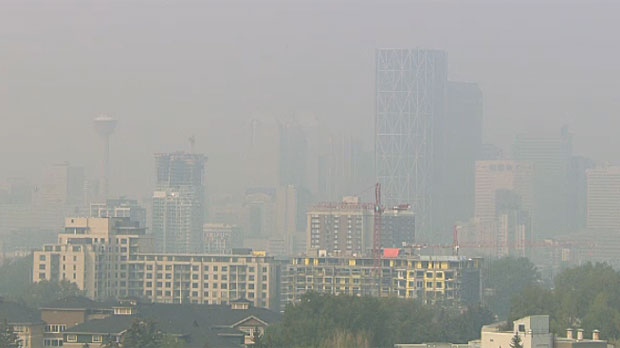
Here in western North America, climate change is bringing longer and more destructive wildfire seasons. At times smoke from fires hundreds of miles inland can reach the coast and cross to Vancouver Island. This stuff is laden with PM 25 and, while coastal residents can fend off the worst of it with modern air purifiers, it plays pure hell on the people of Alberta, especially Calgarians. 

Calgary air quality worse than Shanghai due to wildfire smoke ...


The thing to remember is that these particles embed in your heart and in your lungs. They leave people compromised, vulnerable to respiratory and cardiac disease - and Covid-19. 

Before We Consign the Weakest to Penury, Remember, When They Go We Are All One Step Nearer the Bottom Rung.


It was April, 2019, when Nobel laureate economist, Joe Stiglitz, penned an op-ed in The New York Times calling for a rebirth of "progressive capitalism."

As I read the article I was reminded of Theodore Roosevelt's Square Deal speech delivered in Kansas in 1910. I put together a post in which I blended quotes from Roosevelt's speech with Stigliz' op-ed. I had completely forgotten about it but it's more powerful, more meaningful, more urgent today than it was last year.

Who would have thought, a year ago, that the world would be stood on its head today, brought low by a contagion invisible to the human eye?

Stiglitz wrote:
A progressive capitalism based on an understanding of what gives rise to growth and societal well-being gives us a way out of this quagmire and a way up for our living standards.

There is a broader social compact that allows a society to work and prosper together, and that, too, has been fraying. America created the first truly middle-class society; now, a middle-class life is increasingly out of reach for its citizens. 
America arrived at this sorry state of affairs because we forgot that the true source of the wealth of a nation is the creativity and innovation of its people. One can get rich either by adding to the nation’s economic pie or by grabbing a larger share of the pie by exploiting others — abusing, for instance, market power or informational advantages. We confused the hard work of wealth creation with wealth-grabbing (or, as economists call it, rent-seeking), and too many of our talented young people followed the siren call of getting rich quickly.
...Just as forces of globalization and technological change were contributing to growing inequality, we adopted policies that worsened societal inequities. Even as economic theories like information economics (dealing with the ever-present situation where information is imperfect), behavioral economics and game theory arose to explain why markets on their own are often not efficient, fair, stable or seemingly rational, we relied more on markets and scaled back social protections. 
The result is an economy with more exploitation — whether it’s abusive practices in the financial sector or the technology sector using our own data to take advantage of us at the cost of our privacy. The weakening of antitrust enforcement, and the failure of regulation to keep up with changes in our economy and the innovations in creating and leveraging market power, meant that markets became more concentrated and less competitive. 
Politics has played a big role in the increase in corporate rent-seeking and the accompanying inequality. Markets don’t exist in a vacuum; they have to be structured by rules and regulations, and those rules and regulations must be enforced. Deregulation of the financial sector allowed bankers to engage in both excessively risky activities and more exploitive ones. Many economists understood that trade with developing countries would drive down American wages, especially for those with limited skills, and destroy jobs. We could and should have provided more assistance to affected workers (just as we should provide assistance to workers who lose their jobs as a result of technological change), but corporate interests opposed it. A weaker labor market conveniently meant lower labor costs at home to complement the cheap labor businesses employed abroad.
We are now in a vicious cycle: Greater economic inequality is leading, in our money-driven political system, to more political inequality, with weaker rules and deregulation causing still more economic inequality.
A call to arms.
The neoliberal fantasy that unfettered markets will deliver prosperity to everyone should be put to rest. It is as fatally flawed as the notion after the fall of the Iron Curtain that we were seeing “the end of history” and that we would all soon be liberal democracies with capitalist economies. 
Most important, our exploitive capitalism has shaped who we are as individuals and as a society. The rampant dishonesty we’ve seen from Wells Fargo and Volkswagen or from members of the Sackler family as they promoted drugs they knew were addictive — this is what is to be expected in a society that lauds the pursuit of profits as leading, to quote Adam Smith, “as if by an invisible hand,” to the well-being of society, with no regard to whether those profits derive from exploitation or wealth creation.

Monday, April 06, 2020

Are We Heading For a Debt Revolt?


The Great Recession of 2008-2009 seemed a disaster for everyone but it wasn't. The lucky ones who knew how to game the catastrophe as it loomed reaped fortunes. And, in the aftermath of that fiasco, we read reports of how the richest of the rich were no longer putting their wealth to work in the economy but were accumulating their money and hiding it in tax havens that seemed to exist in every country, on every block.

All that wealth should come in handy as they move to snap up bargains in the post-pandemic wake. Wealth begets wealth in ways even governments have a hard time tracking.

But for every big winner there are legions of losers. Only this morning I heard a clip of Pierre Poilievre trying to use the pandemic to take shots at Justin Trudeau without somehow being seen exploiting the pandemic to take cheap shots at Justin Trudeau. For a second he almost seemed sincere when he said that we are going to see a great many Canadians emerge from this tragedy in deep poverty.  Not that he suggested we should reinstate wealth taxes or anything.

The fact is Pete is right. A great many of our fellow citizens were already living in precarious circumstances - two jobs, rundown apartments, living paycheque to paycheque - when this pandemic hit knocking them from the curb into the gutter. I like to think of them as Morneau's Brigade, warriors of the Gig Economy, living in the Job Churn lane. I wonder what they look forward to in the contagion aftermath? Do they see light at the end of their tunnel? Or do they just see more tunnel?

Panama Papers-type wealth was the rage before the virus. It even prompted some desultory reaction from our reluctant political caste, nothing, of course, that would really threaten these vast fortunes.  Now I think we're going to see that money charging in on horseback to establish a vulture economy with the many too impoverished to put up much resistance. Wealth before, debt after.

Author Nicholas Powers argues that the American government has but one way forward - debt relief.

The giant stimulus exposed the cruelty of the United States allowing generations of people to be crushed by debt and poverty. The student loan debt of $1.6 trillion, the medical debt of $88 billion wrecked lives; it could have been paid off. When the coronavirus pandemic subsides, we cannot go back to business as usual.

The sudden stop of the economy exposed our fragility; a few missed checks and we sink into debt. Over 3 million Americans filed for unemployment in March, and in April it could be tens of millions. We may see 37 million jobs vanish, specifically low-wage work like waitressing and manual labor.

Every day that goes by, the U.S. debt crisis deepens. The COVID-19 quarantine paralyzed industries and it could last up to a year, maybe more. Workers who lose work can’t pay bills and can’t buy goods from businesses who fire their workers, who can’t pay their bills. The downward debt spiral accelerates. A working-class collapse threatens to bring down the wealthy, and that is why Republicans and Democrats race to stop their fall. They could have done this all along. They chose not to.
...More dazzling yet, in an act of hocus pocus that would make David Copperfield proud, the U.S. Department of the Treasury gave $454 billion to the Federal Reserve, which through the alchemy of fractional reserve banking can leverage that up to $4 trillion and throw it at the economy like poker cards from a magician’s hat — conjuring vast treasure out of a “fraction” of money. And it is Republicans putting on the show. 
The historical irony is painful. Since the rise of the New Right, which was first given national exposure in Sen. Barry Goldwater’s 1964 campaign and consolidated in President Reagan’s two terms, small government was a Republican dogma. Reagan famously said, “Government is not the solution to our problem; government is the problem.” The same came from Grover Norquist, the Republican head of Americans for Tax Reform, who said of the U.S. government, “I just want to shrink it down to the size where we can drown it in the bathtub.” Troubling homicidal fantasy aside, the idea was in opposition to big government liberalism. Tellingly, the parts that were too “big” were those that helped the poor, workers, minorities, and saved the environment. Republicans always found war and tax cuts affordable. The hypocrisy did not go unnoticed. After Reagan’s vice president, George Bush, was voted out in 1992 after just one term, I remember Tupac’s 1993 song, “Keep Ya Head Up,” was a big hit. My friends and I would nod our heads and rap along with the line, “They got money for wars but can’t feed the poor.”
...Today, in the grip of the coronavirus pandemic that could kill 1.2 million of us, mostly our elderly and sick, the only practical response is a swift expansion of the welfare state, including Medicare for All and subsidized medical school. Not just one-time $1,200 payments. Not just extended unemployment benefits. Not just loans and bailouts to businesses. We face a future of more pandemics and an intensifying climate crisis. A dramatic expansion of social welfare programs is not negotiable; it is a necessity for survival.
We urgently need a Jubilee Year, a massive debt forgiveness like the one described by anthropologist David Graeber in his Debt: The First 5,000 Years.

As I wrote a couple of weeks ago, America may need to follow the example of Solon.

America and, for that matter, many countries in the developed world may need new policies vaguely akin to Solon's Seisachtheia.

Athenian society had become debt-bound. The economy was collapsing under its own weight. There were too many debtors who could not pay, many of them stripped of their lands and imprisoned or, together with their families put into slavery. There were too many creditors, merchants, who could not recover what was owed them and also lost the customers who had built their businesses that now languished in prisons or slavery. The city state was falling into decline.
Solon's reform of these injustices was later known and celebrated among Athenians as the Seisachtheia (shaking off of burdens). As with all his reforms, there is considerable scholarly debate about its real significance. Many scholars are content to accept the account given by the ancient sources, interpreting it as a cancellation of debts, while others interpret it as the abolition of a type of feudal relationship, and some prefer to explore new possibilities for interpretation. The reforms included: 
annulment of all contracts symbolised by the horoi. 
prohibition on a debtor's person being used as security for a loan, i.e., debt slavery.
release of all Athenians who had been enslaved. 
The removal of the horoi clearly provided immediate economic relief for the most oppressed group in Attica, and it also brought an immediate end to the enslavement of Athenians by their countrymen. Some Athenians had already been sold into slavery abroad and some had fled abroad to escape enslavement – Solon proudly records in verse the return of this diaspora.

I don't suggest that 21st century America could have a "shaking off of burdens" but, like ancient Athens it has a plague of debt that requires some remedy. The annual federal deficit when Trump came to power was $585 billion, 3.2% of GDP. By 2019, Trump had it up to $984 billion or 4.7% of GDP. This year it will easily break a trillion dollars. Now Trump is promising another $.85 trillion (atop the existing trillion dollar deficit) in stimulus spending. [Congress has already bumped that to $2.2 trillion and another round of bailouts is expected before long] The American commercial sector has been fueled by debt and easy money. The era of "everyday low taxes" has exacerbated this dangerous imbalance. We've been warned for years that consumer indebtedness had reached perilous levels. We have created a weakness that increases our vulnerability to even a viral epidemic.

Those who survived the Black Death prospered. Those who survived WWI and the Spanish Flu pandemic were greated with the Roaring 20s. That's not in the cards this time.


Neoliberalism, an Ideology That Just Keeps Punishing.


Could the Covid-19 virus finally weaken neoliberalism's grip on our governments? Cornell law prof, Joseph Margulies, thinks it just might.

We have faced crises before, and this too shall pass. For all the pain it has caused and will cause, it is just a virus, not an existential threat to the nation. Yet in critical respects, this crisis is unlike any we have experienced for more than a century. It commands a response and imposes burdens that are very different from those seen by anyone alive today. Before it is over, the virus will touch every aspect of national life. And though we are early in the curve, we can already distill what may be the most important lesson of the crisis into a single sentence: COVID-19 exposes the cruel folly of neoliberal governance. 
As I have written here before, neoliberalism is the idea that social problems are better solved by the private sector than by government. But more than an economic or political model, neoliberalism is an ideology, a way to make sense of the world.  
We haven’t had this many people look plaintively to the federal government for a lifeline since the New Deal, and everyone is very relieved neoliberals never managed to drown government in the bathtub. 
The first and most obvious lesson of COVID-19, therefore, is that despite what neoliberals insist, people immediately and instinctively look to the national government for rescue when their economic or physical health is imperiled. Even more importantly, because the response is universal, we should resist the neoliberal determination to stigmatize it. Now more than ever, we see that government is not the enemy. 
Yet, if the virus has made government cool again, it has not imposed its burdens uniformly, and that too is a product of neoliberal governance. Decades of neoliberal policy have shredded social welfare programs, dramatically weakened support for workers, and produced record levels of inequality. The top 1% of households in the United States own 40% of all wealth in the country, more than the bottom 90% combined, a higher level of inequality than at any time since at least 1962. And things are getting worse. Thanks in part to the Trump tax cut of 2017, the 400 richest Americans in 2018 paid a lower total tax rate, including state, federal, and local taxes, than any other income group in the country, a distinction never equaled in U.S. history.
COVID-19 exacerbates this morally obscene inequality. As many have observed, those who are best positioned to weather the COVID-19 storm are the wealthy and the well-paid workers with steady jobs, good benefits, and safe, stable housing. Those who do not have to work or who can work remotely can most easily accommodate the demands recommended by public health officials and ordered by state governments to minimize transmission—viz., shelter in place, and practice social distancing whenever you leave your home. 
The poor simply do not have this luxury, especially those whose work is precarious, who are in low-wage hourly or piecemeal employment with few or no benefits. Contract employees. Delivery drivers. Cleaning and janitorial staff. Home health care providers. Many members of the gig economy.
...for many of these workers, financial security is a contradiction in terms. According to a 2015 study by the Pew Research Center, one in five adults in the United States, or just under 50 million people, lives in a household that is in or near poverty, an increase of more than 100% since 1970. According to the Federal Reserve, roughly one of every eight Americans could not cover an unanticipated expense of $400. Nearly three in ten could cover the cost but would have to borrow or sell something to do so. Other surveys capture different pieces of the same picture. Just under three in ten Americans report that they have no emergency savings whatsoever, and nearly six in ten say they live paycheck to paycheck. Worse, the poor are most apt to have the preexisting medical conditions like diabetes and hypertension that make them especially vulnerable should they become infected.
The second lesson of the virus, therefore, is to make plain to the wealthy what the poor have known for decades. Neoliberal policy has brought millions of Americans to the knife edge of financial and physical ruin, and COVID-19 will push them over.
Precisely when so many among us are suffering and we most need to be communitarians, neoliberalism conditions us to be individualists.

I am not the first to notice the link between COVID-19 and neoliberalism, and I hope I will not be the last. COVID-19 will not destroy this country, but it has exposed better than even the 2008 financial crisis the cruelty of neoliberal policy. If the virus finally weakens the stranglehold that neoliberalism has on policymaking in this country, perhaps the great suffering it inflicts and sorrow it brings will not be all in vain.

How Do We Know These Kids are Ready for School?


CBC's morning news summary included a report on Ontario kids returning to classes, virtual school, from their homes. That made me wonder how many of these young people are ready to resume classes.

I grew up in a nice, middle class home. We never really wanted for anything. Dad worked. Mom worked. Their jobs were secure. It was a time of relative ease and comfort even if the TV set was black & white and the only remote control was the kids.

What sort of baggage, what measure of uncertainty, are these young people today carrying?

Mom and dad might well be laid off. They might be wage-slaves in Canada's new "job churn" employment market, the gig economy victims.  Plans that the family may have had before the chaos may have been scrapped. They might have heard their folks grumbling about how they'll keep food on the table. Things that adults now worry about must be terrifying for their kids.

I don't know much about the educational system. I wasn't very fond of it, not nearly as fond as I was of truancy. Fortunately we have in our midst a number of teachers and retired teachers who blog regularly. Maybe they've got some helpful thoughts on how the school system can handle kids in distress.

--- Update:

For those caring for children or grandkids, Atlantic writer and psychotherapist, Lori Gottleib, has some useful advice on how to help those young people through this. You know how during the safety briefing on a flight they tell the parents that, in case of emergency, they have to put their own oxygen mask on before helping their child? She says it's sort of that same thing.

Parents are so focused on making things run smoothly for their kids that they’re running themselves ragged. Parents don’t eat regular meals, sleep enough, reach out to other adults for support, enlist their kids to help with the household duties, or take time for enjoyable activities like reading a book or taking a walk. 
But nobody can function like this for long, and eventually parents’ own anxiety will become worse as a result. And if there’s one thing in a household that’s as contagious as a virus, it’s anxiety. Guess who’s in charge then? Not the person a kid wants in the pilot’s seat. In order to be present for their kids, parents first need to be present for themselves.

Trump Was Bad News in Good Times. Now This...


You can't deny that this guy has a certain skillset. Even pickpockets are highly skilled. So too are grifters. The skillset that Donald Trump has garnered has taken him to some notable successes although never quite as notable as he would have everyone else believe.

The guy is perhaps the greatest narcissist of our time. That's been hard enough to take in the pre-pandemic years but it has become a huge and deadly threat today.
Since the early days of the Trump administration, an impassioned group of mental health professionals have warned the public about the president’s cramped and disordered mind, a darkened attic of fluttering bats. 
...Narcissistic personalities like Trump harbor skyscraping delusions about their own capabilities. They exaggerate their accomplishments, focus obsessively on projecting power, and wish desperately to win. 
What that means, during this pandemic: Trump says we’ve got plenty of tests available, when we don’t. He declares that Google is building a comprehensive drive-thru testing website, when it isn’t. He sends a Navy hospital ship to New York and it proves little more than an excuse for a campaign commercial, arriving and sitting almost empty in the Hudson. A New York hospital executive calls it a joke.
...Narcissistic leaders never have, as Trump likes to say, the best people. They have galleries of sycophants. With the exceptions of Drs. Anthony Fauci and Deborah Birx, Trump has surrounded himself with a Z-team of dangerously inexperienced toadies and flunkies — the bargain-bin rejects from Filene’s Basement — at a time when we require the brightest and most imaginative minds in the country.

Faced with a historic public health crisis, Trump could have assembled a first-rate company of disaster preparedness experts. Instead he gave the job to his son-in-law, a man-child of breathtaking vapidity. Faced with a historic economic crisis, Trump could have assembled a team of Nobel-prize winning economists or previous treasury secretaries. Instead he talks to Larry Kudlow, a former CNBC host.
...Narcissistic personalities love nothing more than engineering conflict and sowing division. It destabilizes everyone, keeps them in control. 
What that means, during this pandemic: Trump is pitting state against state for precious resources, rather than coordinating a national response. (“It’s like being on eBay,” complained Gov. Andrew Cuomo of New York last week.) His White House is a petty palace of competing power centers. He picks fights with Democratic officials and members of the press, when all the public craves is comfort.
...Narcissistic personalities are vindictive. On a clear day, you can see their grudges forever. 
What that means, during this pandemic: Trump is playing favorites with governors who praise him and punishing those who fail to give him the respect he believes he deserves. “If they don’t treat you right, don’t call,” he told Vice President Mike Pence.

...Narcissistic personalities are weak.

What that means, during this pandemic: Trump is genuinely afraid to lead. He can’t bring himself to make robust use of the Defense Production Act, because the buck would stop with him. (To this day, he insists states should be acquiring their own ventilators.) When asked about delays in testing, he said, “I don’t take responsibility at all.” During Friday’s news conference, he added the tests “we inherited were “broken, were obsolete,” when this form of coronavirus didn’t even exist under his predecessor.

This sounds an awful lot like one of the three sentences that Homer Simpson swears will get you through life: “It was like that when I got here.”
...But every aspect of Trump’s crisis management has been annexed by his psychopathology. As Americans die, he boasts about his television ratings. As Americans die, he crows that he’s No. 1 on Facebook, which isn’t close to true.

But it is true that all eyes are on him. He’s got a captive audience, an attention-addict’s dream come to life. It’s just that he, like all narcissistic personalities, has no clue how disgracefully — how shamefully, how deplorably — he’ll be enshrined in memory.

Maybe This Is Part of God's Plan


If, by God, you mean Loki.

I was just listening to NPR's recap on pandemic news from around the globe.  Japan, check. Italy, check. USA, check. Then they turned to Chernobyl in the Ukraine. There, emergency crews are fighting a forest fire that has caused radiation levels to spike 16 times above normal.

“There is bad news – radiation is above normal in the fire’s centre,” Yegor Firsov, head of Ukraine’s state ecological inspection service, said on Facebook on Sunday.

Kiev has mobilised two planes, a helicopter and around 100 firefighters to fight the blaze, which broke out on Saturday and spread over 20 hectares in a forested area near the Chernobyl power plant.

Saturday, April 04, 2020

Preparedness Is a Choice. To Remain Unprepared Is Also a Choice.


Many Americans must die over the next year thanks for their president's refusal to fight the Covid-19 virus for the critical two months, mid-January to mid-March, that allowed the virus to become established in America and spread, especially across the South.

Trump's "Don't Worry. Be Happy" attitude set the tone for many Red State governors, guys who thought it okay to allow teens to mass for Spring Break on Florida's beaches or revelers to gather for Mardi Gras in New Orleans. Slate.com reports that the partiers who filled the streets of New Orleans didn't realize they were in danger.

The first COVID-19 case in Louisiana was reported on March 9. By March 26 there were 2,305, resulting in 83 deaths. New Orleans now has one of the highest per capita infection rates and COVID-19 death rates in the country. New cases are growing exponentially. As the city faces shortages of ventilators and personal protective equipment in hospitals, Mayor LaToya Cantrell went on CNN last Thursday to rally support for the city. Oddly, Wolf Blitzer spent most of the segment asking her about Mardi Gras—if anyone had advised her to cancel it or if, in hindsight, she wished she had. Cantrell pointed out that federal authorities consulting with the city ahead of its public events hadn’t raised any red flags.
If we're lucky we'll get through the Covid-19 pandemic before another calamity hits and the science types have warned us that there are several catastrophes that await, locked and loaded. They've warned us that the day will come when we're confronted not just by one of these disasters but two, perhaps three, at the same time. What then?

What we need to understand is that we can no longer wait for the disaster to happen and then respond to it. We have to prepare for catastrophes well in advance. Preparedness is a choice but we have to recognize to remain unprepared, vulnerable is also a choice.

Jeremy Konyndyk was part of the pandemic team set up during the Obama administration. He was instrumental in writing the pandemic playbook. Trump dismantled that team. Trump ignored the emergency playbook.


Canada needs to learn from this murderous object lesson in the States. Yes, the Trudeau government was better prepared than the Trump White House. We weren't dismissive of the peril although our reaction often seemed to mirror Trump's. While we were quicker to recognize it we were still unprepared. Medical supplies, emergency equipment, essential gear that ought to have been warehoused in strategic places around the country, wasn't. We didn't have the intensive care/pandemic infrastructure ready to go. That would have cost money and I suppose we needed that money for other things such as billions in annual subsidies and benefits to the fossil energy industry.

No more. This is our lesson. This is our wake-up call. Never again can we allow ourselves to be caught as unprepared as we are now. I think we're going to get off easy this time, even if it doesn't feel like it. We can't risk that again.

What We're Up Against - In One Picture


This Evil Bastard has Inflicted More Loss and Death on The United States than Radical Islamists Could Ever Dream Of


It's said a fish rots from the head first. So does America.

Donald J. Trump has consigned hundreds of thousands of Americans to ugly and unnecessary deaths. Many more will suffer the loss of a mother or father, son or daughter, spouse or dear friend. Massive loss will ensue and nobody knows where it ends.

It's time for a recap of just how Trump crippled America as he gambled so many lives on his gut instincts and abject ignorance. It seems like such a long time ago but it all begins in January.

Now it's Trump's base coming into the crosshairs, the Gullibillies with their cultivated stupidity, that will find the lies they have so readily swallowed are now covered with a lethal virus.
Many of those states followed the lead set by Trump and Fox News, remaining relaxed about the threat and moving astonishingly slowly to put physical distancing controls in place. Florida, under its Republican governor, Ron DeSantis, has echoed Trump’s approach and only imposed a statewide stay-at-home order on Friday despite having the sixth-largest tally of confirmed cases in the country. 
Georgia and Mississippi followed suit. Some Republican states including Oklahoma and South Carolina still have no statewide mandatory stay-at-home orders. 
Pueyo points out that Republican voters are additionally vulnerable as they have a higher age profile than Democratic voters. Coronavirus makes no distinctions as to party, but it does prey on the elderly. 
So it is one of the great paradoxes of Trump’s pandemic that he may have put many of his own loyal supporters in mortal peril. As Konyndyk put it: “Trump has endangered his own supporters by sending out a message in contradiction to the science, and they believed him.”
In today's New York Times, Margaret Renki also writes that the American South is screwed.

On March 22, when Nashville’s mayor John Cooper closed nonessential businesses here, it was a terrible blow to companies and shops still reeling from the tornado that tore through Middle Tennessee on Super Tuesday. 
 Nashville’s courts and schools were already closed, but the crowds on Lower Broadway, the heart of Nashville’s tourist district, showed no sign of dissipating. “Downtown Nashville is undefeated,” tweeted a visitor posting a video of music fans crowded onto a dance floor. Even after the Nashville Board of Health voted unanimously to shut the honky-tonks down, several bar owners said they would not comply unless ordered to do so by the governor of Tennessee. 
Such orders have been slow in coming here, and in nearly every other state in the American South. Tennessee governor Bill Lee was slow to end the legislative session and send members of the Tennessee General Assembly home to their districts, slow to close public schools, slow to suspend church services, slow to shutter restaurants and gyms. 
... Last week I arrived to pick up a to-go order I’d paid for on the phone and that the owner had promised to put directly into the trunk of my car. But where I expected to find a deserted parking lot, it was business as usual on a sunny spring Saturday. Nashville has received hundreds of reports of similar violations.
...Most Southern states, like Tennessee, did not expand Medicaid, and in those states a perfect storm has gathered force. What does it mean to live though a pandemic in a place with a high number of uninsured citizens, where many counties don’t have a single hospital, and where the governor delayed requiring folks to stay home? Across the South, we are about to find out.

Finally, on April 2, Mr. Lee acknowledged epidemiological reality and issued a stay-at-home order. The rest of the red-state governors will also capitulate to reality before this is all over. But the time for decisive action has long since passed, and their delays, like the president’s, will end up costing thousands of lives. 
Viruses are not partisan. Science itself is not partisan. Nevertheless, Covid-19 has become a partisan issue here in the South because our governors have followed the lead of both the president, who spent crucial early weeks denying the severity of the crisis, and Fox News, which downplayed concerns about the pandemic as Democratic hysteria. That’s why every governor who has issued a deeply belated shelter-in-place order is a Republican. 
In that March 16 conference call with mayors and county leaders around Tennessee, Mr. Lee offered some advice: “I want to encourage you to pray. I want you to pray for your citizens that are affected by economic downturns, by the sickness sweeping through the state. I want you to know that you’re being prayed for as leaders in your community that you will have wisdom and discernment.” 
I, too, pray for my fellow Tennesseans. I pray for the success of researchers racing for a vaccine. I pray for the safety of every medical team working to save lives. But I also pray for our leaders to lead, to put the safety of their citizens far, far above partisan pandering. And when the entire medical community — people who are putting their very lives on the line for us — are begging for help, the answer isn’t prayer alone. It’s also action.

Friday, April 03, 2020

The Barefoot Contessa's Guide to Coping with Quarantine


Ina Garten's tip for how to cope when you're a pandemic shut-in.

Why Doug Ford is Gaming the Covid-19 Pandemic and Fox News Accidentally Blows Trump's Cover.


The proof is right there on a screen capture posted to Warren Kinsella's blog.  "Province says 4,400 deaths have been prevented so far." That's what you call polishing a turd.

If you've been diagnosed with Covid-19 and haven't died then that must mean the Ford government prevented your death. So, a few hundred have died. How does that stack up against the 4,400 deaths we've prevented? 

The mortality rate for Covid-19 varies from country to country. Italy is running about 12 per cent. Britain is at 9%. Germany at 1%. Let's say Ontario's Covid mortality rate is somewhere around 5 per cent of diagnosed cases. "4,400 deaths" would translate into 88,000 Ontarians with the virus. The figure in the map above shows 3,288 which is a far cry from 88,000.

Ford is manipulating the stats to claim victory where none exists. Self-isolation is responsible, not Doug Ford. The public did that. Society deserves the credit, not the provincial government. To claim credit for preventing 4,400 deaths is despicable.

Meanwhile, Fox News unwittingly set off a landmine under Donald Trump's ass during an interview with infectious disease specialist, Dr. Rishi Desai -

Wednesday, April 01, 2020

When Power Speaks Truth to the Public, We All Win.


The Globe has high praise for British Columbia's handling of the Covid-19 pandemic.

Last Friday, British Columbia Provincial Health Officer Bonnie Henry and Health Minister Adrian Dix gave a master class in treating the public like adults. It was a model for any government dealing with a crisis.

First, Dr. Henry walked viewers through the statistical models the province is using, and the reasons why the evidence leads her to believe the province may be on the point of getting the upper hand on COVID-19. Her explanations were clear and careful. There was no obfuscation or bluster.

After Dr. Henry had presented and analyzed the data on the spread of the virus and the public health measures taken, Mr. Dix itemized the province’s key resources – from ventilators to hospital beds – and measured their availability against three scenarios: a modest outbreak (South Korea), medium (China’s Hubei province) and bad (northern Italy). 
It inspired confidence. Transparency does that. 
A free and transparent flow of data will help win public support and trust. A lot is being asked of Canadians and without public buy-in, Canada will not succeed in bending the curve.
B.C. is an example of doing it right. Others need improvement. In Ontario, journalists are still digging up data that the provincial government should be releasing, and discovering information gaps that may prove costly.
Dr. Henry does indeed lay her cards on the table. You don't hear public officials mentioning that Covid-19 will probably return, with a vengeance, in the fall, after lulling us into a false sense of security by receding in the hottest months of summer. You don't hear it from Donald Trump. You don't even hear it from our prime minister. Some of them, especially Trump, even portray it as a "one and done" epidemic.

A quick search of pandemics at the Centers for Disease Control or its counterparts in the UK and Canada, reveals that pandemics come in two, sometimes three waves, over a span of 12 to 18-months. The second wave is typically the most deadly. Getting the public to accept that and prepare for it is a Herculean chore and it will take time. What will our contagion look like this fall? How will our economy cope? What are the chances there will be effective anti-virals in sufficient quantities by the end of summer to blunt the impact of a second wave? How long before there's a vaccine?

While You're Waiting for that Cheque from Ottawa


While you're waiting for that relief cheque from Ottawa, here's a word to keep in mind, "Phoenix."

Phoenix is the system the Harper government introduced in 2011 to streamline paycheque services for Canada's public service.  It was a screw-up then and it's still a screw-up.

The Liberal government that succeeded Harper inherited this mess and has been struggling with it ever since. Canada's minister of digital government, Joyce Murray,  said that "Canada's hard-working employees should be paid accurately and on time." Last month it was announced that SAP Canada would soon be testing various fixes to debug Phoenix. According to ITCanada, the testing is expected to take a year.

While you're praying you don't catch Covid-19 it wouldn't hurt to throw in a little prayer that your relief cheque isn't processed through Phoenix.

BTW, by the time the next round of testing is done, it'll mark the 10th anniversary of the Phoenix system. Ten years to perhaps fix a screwed-up payroll system. Remember what people once managed to do in ten years? (you can pick this up at the 2:00 mark)

We Don't Have to Lose the Oceans But Saving Them Won't Be Easy


For decades, humans have been inflicting one blow after another on our oceans. Global heating, ocean acidification, the discharge of chemicals, especially fertilizers, the dumping of massive plastics waste, rapacious overfishing and the use of trawls that rake and destroy seabed habitats where the oceanic food chain begins, seabed drilling accidents. It's been a prescription for the death of our oceans on which all life, marine and terrestrial, depends.

Apparently we can reverse all that.
The glory of the world’s oceans could be restored within a generation, according to a major new scientific review. ...The scientists say there is now the knowledge to create an ocean renaissance for wildlife by 2050 and with it bolster the services that the world’s people rely on, from food to coastal protection to climate stability. The measures needed, including protecting large swathes of ocean, sustainable fishing and pollution controls, would cost billions of dollars a year, the scientists say, but would bring benefits 10 times as high.
The law of the sea creates three classes of oceans - ours, yours, and anybody's/nobody's, the vast swathes that we pillage and contaminate.
...progress is far from straightforward. Pollution from farms and plastics still pours into the oceans, the waters are reaching record high temperatures, and destructive fishing is still taking place in many places, with at least one-third of fish stocks overexploited. 
“The Mediterranean is still pretty much a basket case,” said Roberts. “And there is horrendous overfishing throughout large parts of south-east Asia and India, where fisheries are just catching anything they trawl on the seabed to render into fish meal and oil.” 
The global heating of the oceans has driven the few hundred surviving northern right whales along the coast of the western Atlantic. Here, amid busy shipping lanes and lobster fisheries, they are killed by collisions or drowned in a tangle of ropes, according to Roberts, though new regulations are starting to help. 
The Gulf of Mexico suffers massive dead zones owing to huge amounts of manure and fertiliser running off midwest farms, and elsewhere albatrosses continue to be snared by long-line fishers, despite simple solutions being available.
The challenge will be to forge a powerful international consensus to do what is required for a protracted period, 30 years, and that puts the public interest, humanity's interest, over the narrow special interests of industrial fishing fleets, seabed miners and such. That's a tall order.

Tuesday, March 31, 2020

America's Cocktail. Equal Parts of Denial and Death.


Paul Krugman writes that his fellow countrymen don't realize that America is on the "worst trajectory" of any developed nation wrestling with the coronavirus and that includes Italy.
I’m not sure that people understand, even now, what that kind of exponential growth implies. But if cases kept growing at their current rate for a month, they would increase by a factor of a thousand, and almost half of Americans would be infected. 
We hope that won’t happen. Many although not all states have gone into lockdown, and both epidemiological models and some early evidence suggest that this will “flatten the curve,” that is, substantially slow the virus’s spread. But as we wait to see just how bad our national nightmare will get, it’s worth stepping back for a few minutes to ask why America has handled this crisis so badly.
...Among advanced countries, the United States has long stood out as the land of denial and death. It’s just that we’re now seeing these national character flaws play out at a vastly accelerated rate. 
About denial: Epidemiologists trying to get a handle on the coronavirus threat appear to have been caught off guard by the immediate politicization of their work, the claims that they were perpetrating a hoax designed to hurt Trump, or promote socialism, or something. But they should have expected that reaction, since climate scientists have faced the same accusations for years. 
And while climate-change denial is a worldwide phenomenon, its epicenter is clearly here in America: Republicans are the world’s only major climate-denialist party.
...decades of science denial on multiple fronts set the stage for the virus denial that paralyzed U.S. policy during the crucial early weeks of the current pandemic.

About death: I still sometimes encounter people convinced that America has the world’s highest life expectancy. After all, aren’t we the world’s greatest nation? In fact, we have the lowest life expectancy among advanced countries, and the gap has been steadily widening for decades. 
This widening gap, in turn, surely reflects both America’s unique lack of universal health insurance and its equally unique surge in “deaths of despair” — deaths from drugs, alcohol and suicide — among working-class whites who have seen economic opportunities disappear. 
Is there a link between the hundreds of thousands of excess deaths we suffer every year compared with other rich countries and the tens of thousands of additional excess deaths we’re about to suffer from the coronavirus? The answer is surely yes.
...while America is a great nation with a glorious history and much to be proud of — I consider myself very much a patriot — the rise of the hard right has, as I said, also turned it into a land of denial and death. This transformation has been taking place gradually over the past few decades; it’s just that now we’re watching the consequences on fast forward.